

Self-improvement means becoming a better version of yourself mentally, emotionally, and behaviorally. NLP (Neuro-Linguistic Programming) helps by reshaping how you think, speak, and act so you can overcome fears, change unhelpful habits, and build lasting confidence.
We all want to grow, whether that means breaking bad habits, thinking more positively, or improving how we handle stress. That’s what self-improvement is about: making consistent, conscious choices that move you closer to your best self.
Key Takeaway:
- NLP (Neuro-Linguistic Programming) empowers self-improvement by linking thoughts, language, and behaviors to reframe negatives, build habits, and boost emotional balance techniques like anchoring, reframing, swish pattern, and visualization make it accessible for beginners. [1]
- Mechanisms: Anchoring conditions positive emotions via memory-gesture pairing; reframing shifts event meanings for resilience; swish pattern rewires habits by visualizing desired behaviors over unwanted ones; visualization creates multi-sensory success “movies” to prime the brain. [1]
- Tips: Practice anchoring 3–5 times daily with gestures; reframe thoughts by listing 3 empowering alternatives; use swish 5–7 reps per session with exaggerated positive images; visualize 5–10 minutes daily, including sensory/emotional details start small for consistency. [2]
- Caveats: Results build over weeks with repetition; combine with journaling for tracking; safe for all but consult pros for deep emotional work ideal for stress, confidence, or habit change without overwhelm. [2]
Bottom Line: These NLP techniques offer quick, practical rewiring for mindset shifts and lasting self-improvement consistent practice turns negatives into growth, enhancing confidence and habits with minimal effort.
But many people struggle to change because they focus only on behavior, not the thinking behind it. That’s where NLP (Neuro-Linguistic Programming) comes in. It helps you understand how your brain, language, and emotions interact so you can reprogram limiting thoughts into empowering ones.
The best part? You don’t need advanced training to start. Below are simple, beginner-friendly NLP techniques that can shift your mindset, improve communication, and help you create lasting personal change.
What Is Self-Improvement?
Self-improvement is the ongoing process of enhancing your mindset, habits, and emotional intelligence. It’s not about perfection, it’s about progress. You focus on understanding yourself better, managing emotions, and taking small steps that lead to long-term growth.
In a world that changes rapidly, self-improvement keeps you adaptable, confident, and self-aware. It helps you take responsibility for your thoughts and actions instead of being controlled by them. Studies show that people committed to personal growth report higher life satisfaction and lower stress levels, proving that small daily efforts create long-term results.
How NLP Supports Self-Improvement
NLP (Neuro-Linguistic Programming) is a personal development approach that connects your thoughts (Neuro), language (Linguistic), and behavior patterns (Programming).
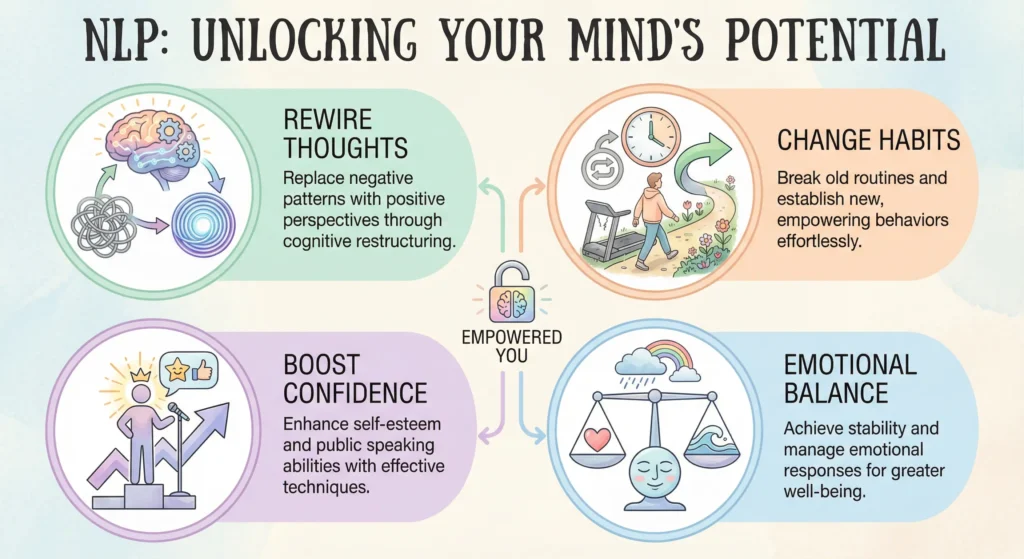
In simple words, it’s about understanding how your mind works and learning to reprogram your thought patterns for success. NLP offers tools that help you:
- Change negative self-talk into empowering thoughts
- Replace bad habits with positive behaviors
- Improve communication and confidence
- Achieve emotional balance and clarity
Beginner-Friendly NLP Techniques for Self-Improvement
Anchoring Positive States
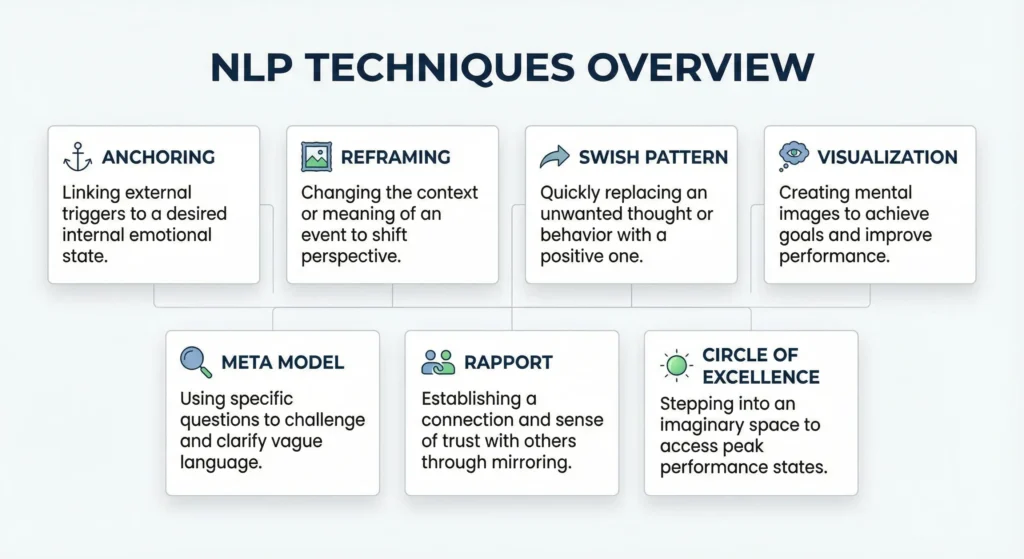
Anchoring is an NLP technique that helps you associate a specific gesture or word with a strong positive emotion like calmness, confidence, or motivation.
How to do it:
- Recall a powerful, positive memory (like a time you felt proud or happy).
- As you relive the feeling, press your thumb and middle finger together or use a physical gesture.
- Repeat the process until your brain links that gesture with the emotion.
Why it helps:
Whenever you feel anxious or low, repeating the same gesture “anchors” your brain to that positive emotion. It’s like pressing a mental reset button to regain confidence instantly.
Reframing Negative Thoughts
Reframing means changing how you interpret a situation so you can view it from a more empowering perspective.
Example:
Instead of saying, “I failed that project,” you could say, “That experience taught me what doesn’t work.”
Why it helps:
Reframing helps you break free from negative self-talk and develop emotional resilience. Instead of getting stuck in guilt or frustration, you focus on growth and solutions. This shift in perspective builds mental flexibility, one of the strongest indicators of long-term self-improvement.
The Swish Pattern

The Swish Pattern helps you replace unwanted habits or thoughts with more desirable ones.
How to do it:
- Picture the behavior or habit you want to change (e.g., procrastinating).
- Then, imagine a clear, empowering image of your ideal self, focused and productive.
- Mentally “swish” the negative image away and replace it with the positive one in your mind.
- Repeat until your brain automatically prefers the empowering version.
Why it helps:
This technique rewires your subconscious response. Over time, your brain begins to associate satisfaction with the new, positive behavior instead of the old one. It’s one of the most practical ways to reprogram habits.
Building Rapport
Rapport means building a natural connection with others by matching their tone, pace, body language, and energy.
How to do it:
When talking to someone, subtly mirror their gestures or match their speaking rhythm. It creates a subconscious sense of understanding and comfort.
Why it helps:
Rapport strengthens communication and empathy, two vital components of personal growth. When people feel heard and understood, their relationships improve, and so does their self-confidence.
Visualization for Success
Visualization is using your imagination to create a vivid mental image of achieving your goals.
How to do it:
Imagine yourself already living the goal you want to achieve, see, feel, and hear every detail. Picture the satisfaction, confidence, and pride of success.
Why it helps:
The brain reacts to imagined experiences almost like real ones. By visualizing success repeatedly, you condition your mind to believe it’s possible. This boosts motivation, consistency, and emotional focus, key ingredients for self-improvement.
The Meta Model
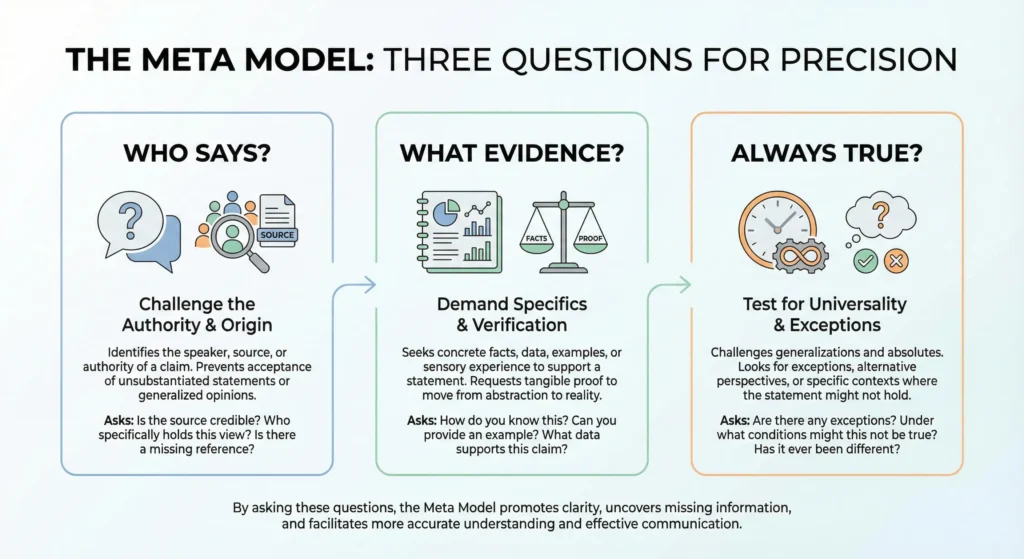
The Meta Model helps you question limiting beliefs and vague statements that hold you back. It’s about getting clarity through precise questioning.
Example:
If you think, “I’m not good enough,” you can ask:
- “Who says that?”
- “What evidence supports it?”
- “Has there been a time when I was good enough?”
Why it helps:
These questions challenge negative assumptions and force your mind to think logically. The Meta Model replaces emotional bias with clarity, helping you make better decisions and break self-imposed limitations.
The Circle of Excellence
This technique uses mental visualization to “step into” a mental image of achieving your goals.
How to do it:
- Imagine a circle on the ground.
- Fill it with emotions like confidence, calmness, or energy.
- Step into the circle whenever you want to feel those emotions.
Why it helps:
It builds emotional control and awareness. Instead of being ruled by emotions, you learn how to create them consciously, an essential skill in personal growth.
Why These NLP Techniques Work for Self-Improvement
Each NLP tool is designed to help you take control of your internal world.
They work because they:
- Help you identify and interrupt negative thought loops
- Encourage self-awareness and emotional intelligence
- Support goal-oriented thinking and motivation
- Improve communication and relationships
- Create a mindset that naturally attracts growth and confidence
How to Start Using NLP for Personal Growth
- Pick one technique (like reframing) and practice it daily.
- Track your mindset using a journal.
- Combine NLP with mindfulness or coaching for deeper transformation.
- Stay consistent; your subconscious mind rewires through repetition.
For deeper learning, you can explore NLP courses in Toronto or attend workshops by certified NLP trainers.
FAQs
Q: What is NLP in self-improvement?
NLP (Neuro-Linguistic Programming) is a method that helps you understand how thoughts, language, and habits influence your life. It teaches practical ways to change unhelpful behaviors and improve emotional balance.
Q: Are NLP techniques easy for beginners?
Yes. Simple methods like anchoring, reframing, and visualization are easy to learn and can create noticeable changes within days when practiced consistently.
Q: How do NLP techniques improve confidence?
NLP builds confidence by helping you reframe negative beliefs, visualize success, and create emotional anchors that trigger self-assurance in stressful situations.
Q: Can NLP help with motivation?
Absolutely. NLP reprograms the way you think about goals and challenges, allowing you to stay focused, positive, and action-driven even when things get tough.
Q: Is NLP backed by science?
While NLP’s research base is mixed, many therapists and life coaches report measurable improvements in mindset, motivation, and emotional well-being when clients use NLP consistently.