
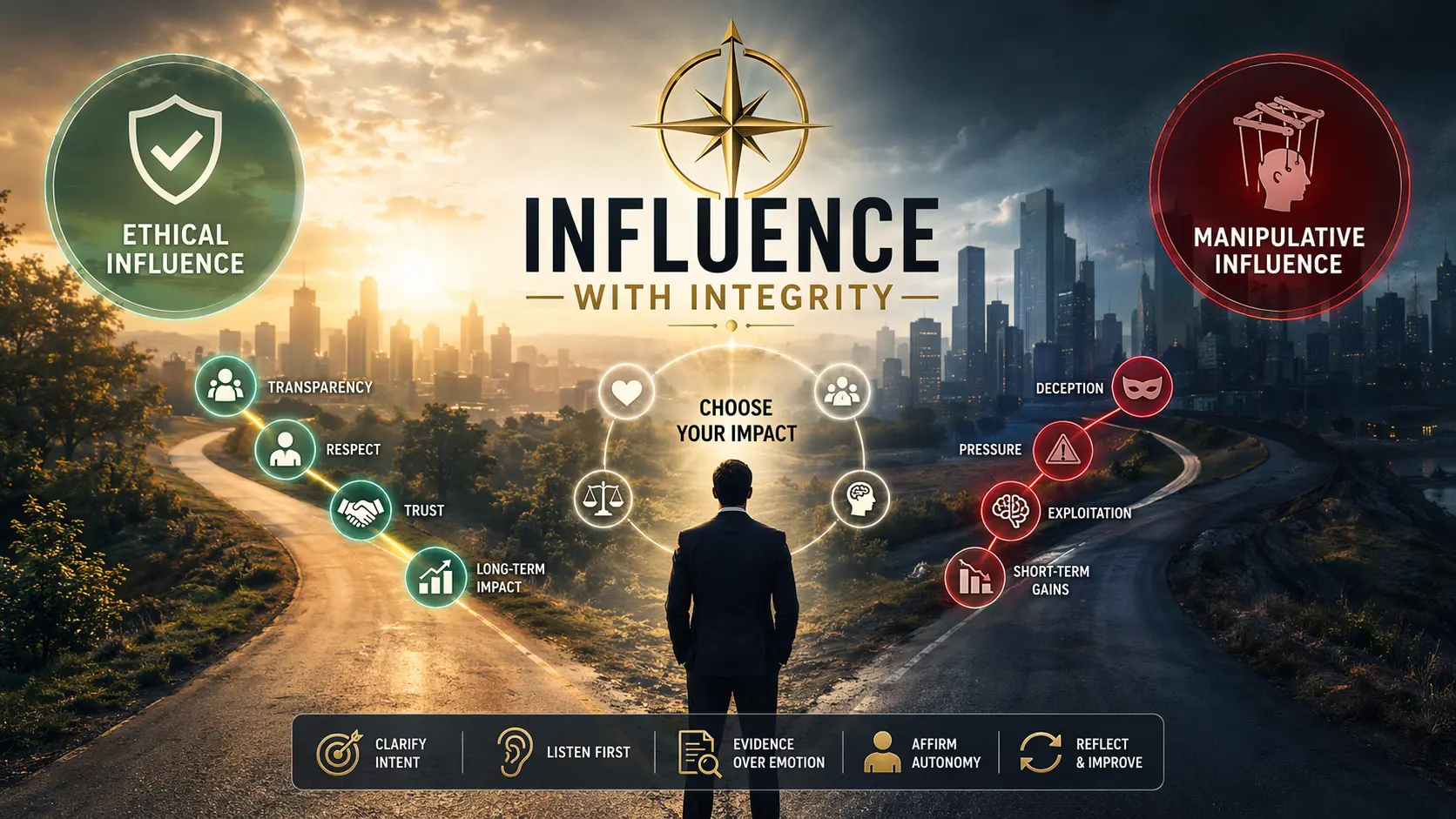
Ethical influence is the practice of shaping decisions through transparent, truthful, and autonomy-respecting communication that benefits both parties. The line between persuasion and manipulation comes down to intent and transparency: are you sharing real information to help someone make a better choice, or are you engineering their response to serve your own agenda?
In 2026, this distinction carries more weight than ever. Leaders who influence ethically build the kind of trust that creates lasting teams, loyal clients, and reputations that compound over time. Those who blur the line, even subtly, tend to generate short-term wins that collapse into long-term losses. The question is not whether you are influencing the people around you. The question is whether you are doing it with integrity.
Every message you send, every proposal you make, every recommendation you deliver is an act of influence. That is not a warning. It is a fact about how leadership works. The real question is not whether you are influencing the people around you. It is whether you are doing it ethically.
Key Takeaway:
- Ethical influence is built on transparency, trust, and respect for the other person’s autonomy, while manipulation uses hidden motives, pressure, or deception to drive outcomes.
- In 2026, the difference matters more than ever as AI-driven communication, digital persuasion, and NLP techniques become increasingly common in sales, coaching, and leadership.
- Ethical influence helps people make empowered decisions by presenting options clearly, understanding needs, and aligning communication with genuine value.
- Manipulation often creates short-term compliance but damages long-term trust, relationships, reputation, and client retention.
- The best communicators use influence responsibly—focusing on consent, clarity, and mutual benefit rather than control or emotional exploitation.
Bottom Line: Ethical influence guides people toward informed decisions that serve their best interests, while manipulation prioritizes control over trust. In modern leadership, coaching, and sales, long-term credibility always comes from influence rooted in integrity.
In 2026, that question has gotten harder to answer. AI systems can predict emotional responses, micro-target messaging, and personalize persuasion at a scale no single human could manage. Leaders who once relied on gut instinct and personal rapport are operating inside systems that blur the line between authentic connection and algorithmic manipulation.
This article will give you a clear framework for understanding where ethical influence ends and manipulation begins, how to apply that framework in real leadership situations, and why mastering this distinction is one of the most valuable things you can do for your credibility, your team, and your long-term business results.
Persuasion vs. Manipulation: What Actually Separates Them?
Most leaders know the difference in extreme cases. A threat is manipulation. A well-reasoned argument is persuasion. But the real ethical territory lives in the gray zone between them, and that is where most leadership decisions get made.
The distinction comes down to three tests.

The Intent Test
Ethical persuasion is driven by a genuine desire to help the other person make a better decision. Manipulation is driven by a desire to engineer a specific outcome, regardless of whether it serves the other person. If you are asking yourself, “How do I get them to say yes?” rather than “how do I help them see what is genuinely in their interest?” you may have already crossed the line.
The Transparency Test
Ethical influence can survive full disclosure. If you were to explain exactly what you were doing and why, the other person would still feel respected. Manipulation, by contrast, depends on concealment. The moment full transparency would change the outcome, you are no longer in the territory of persuasion.
The Autonomy Test
Ethical influence preserves the other person’s ability to say no and genuinely respects that outcome when it happens. Manipulation removes or undermines that choice through pressure, false urgency, or emotional exploitation.
Ethical Persuasion vs. Manipulation: A Side-by-Side Comparison
| Factor | Ethical Persuasion | Manipulation |
| Intent | Mutual benefit | Self-serving |
| Transparency | Open and honest | Hidden or misleading |
| Autonomy | Preserved and respected | Bypassed or exploited |
| Methods | Logic, evidence, rapport | Fear, urgency and bias exploitation |
| Long-term outcome | Trust and loyalty | Erosion of credibility |
| NLP Alignment | Ethical pacing and leading | Covert influence without consent |
Is Psychological Influence in Business Always Ethical?
Understanding how the human mind works and using that understanding to communicate more effectively is not inherently manipulative. It is one of the core skills of great leadership. The question is how you apply that knowledge.
When influence techniques serve the other person, helping them access information they would want, feel heard in a way that opens genuine dialogue, or make a decision they will stand behind later, they are ethical. When they exploit cognitive biases without the other person’s awareness, or are designed to extract a specific behavior regardless of whether it benefits that person, they cross into manipulation.
Communication scholars Baker and Martinson developed the TARES Test as a practical checklist for this gray zone. It asks five questions about any persuasive communication. If you answer no to any of them, you have work to do before that message goes out.
The TARES Test for Ethical Persuasion
| Principle | Question to Ask |
| Truthful | Is this factually accurate? Does it lead others to believe what I believe? |
| Authentic | Does this reflect my genuine values and intent? |
| Respectful | Does this honour the other person’s dignity and intelligence? |
| Equitable | Is this fair to everyone involved, not just to me? |
| Socially Responsible | Would I be comfortable if this were visible to the world? |
Five Warning Signs You Have Crossed the Line
These are not theoretical edge cases. They show up in boardrooms, sales calls, performance reviews, and leadership conversations every week.

- You feel the need to hide your influence strategy. Ethical persuasion does not require concealment.
- The decision would change with full information. If transparency were to shift the outcome, that is not persuasion.
- You are relying on urgency, fear, or scarcity that is not real. Manufactured pressure is a manipulation tactic dressed in business language.
- You are optimizing for agreement, not for outcome quality. Conversion without concern for the result is manipulation.
- You would be uncomfortable explaining your approach out loud to someone you respect. If it does not survive the daylight test, it is probably not ethical.
How Ethical Leaders Influence Without Crossing the Line
One of the most consistent findings in leadership research is that the leaders who build the most durable influence are not the most persuasive in the short term. They are the most trusted over time. According to a survey published by FranklinCovey, 91% of senior business leaders agree that earning and maintaining trust directly improves business outcomes. Great Place to Work data from the same report shows that high-trust organizations generate 8.5 times more revenue per employee than low-trust competitors.
Trust is not a soft leadership value. It is a measurable performance multiplier.
Transparent Framing Over Selective Omission
Ethical leaders share information that is relevant to the other person’s decision, even when that information weakens their own case. This builds credibility faster than any persuasion technique.
Inspiring Shared Values Over Manufacturing Urgency
They align people around goals that genuinely matter, rather than engineering pressure to produce compliance. Commitment built on shared values outlasts commitment built on fear.
Holding Space for a Genuine No
They treat refusal as valid information rather than an obstacle to overcome. This is one of the hardest practices for results-oriented leaders, and one of the most powerful signals of ethical integrity.
Darren G. came to James feeling blocked in his career, his relationships, and his sense of what was possible. Through their work together, he discovered that the biggest obstacle to his influence was not a lack of tactics. It was the limiting beliefs shaping how he showed up. Once those shifted, the way he engaged with others changed completely, and so did the results. His relationships improved. Opportunities opened. That is ethical influence in action: a transformation that starts internally and changes everything around it.
How Neuro-Linguistic Programming Teaches Ethical Influence: The Pacing and Leading Model
Neuro-Linguistic Programming, NLP, is one of the most misunderstood tools in the leadership and coaching space. In popular culture, it is sometimes associated with manipulation or covert persuasion. In serious practice, it is the opposite: a framework for understanding how people process information, what creates genuine connection, and how to communicate in ways that respect the other person’s model of the world.
One of the central NLP techniques for ethical influence is pacing and leading. Pacing means meeting someone where they are, matching their energy, acknowledging their perspective, and demonstrating that you genuinely understand their current state before asking them to move anywhere new. Leading then means gently guiding the conversation toward a new possibility once that trust is established.
This is not manipulation. It is the opposite of jumping straight to your conclusion and pressuring someone to agree. It is the practice of earning the right to lead by first genuinely listening.
Heather Chetwynd had trained in NLP elsewhere before joining James’s NLP Practitioner program. What she found there were no more tactics. It was clear how everything fits together: how the techniques connect to a coherent ethical framework rather than operating as isolated tricks. That is the difference between NLP as a covert influence tool and NLP as a genuine leadership practice.
Try This: In your next high-stakes conversation, pace before you lead. For the first several minutes, focus entirely on understanding the other person’s perspective. Reflect back on what you are hearing before you introduce your own position. Notice how the quality of the conversation changes.
For more on how these principles apply in leadership communication, how NLP enhances communication skills for leaders at Unleash Your Power is a strong next read. For high-stakes negotiation scenarios, the piece on NLP techniques for negotiation offers practical application.
How AI and Technology Are Reshaping Persuasion Ethics in 2026
The ethics of influence have always been complex. AI has made them urgent.
AI systems can now predict emotional states, personalize messaging down to the individual level, and optimize content for maximum behavioral impact, all without the other person’s awareness. What used to require years of relational skill to do at a human level, algorithms now do at scale in seconds.
One 2025 case study found that companies that voluntarily limited emotional targeting and maintained full transparency in their AI-driven marketing actually saw customer satisfaction scores rise by 28% while conversion rates remained stable. Ethical AI practices were not a sacrifice. They were a competitive differentiator.
For executives, the risk is not only external. AI tools are already shaping how internal communications are written, how performance feedback is framed, and how organizational decisions are positioned. Leaders without a clear personal ethical standard for influence will increasingly find themselves outsourcing that judgment to systems that do not have one.
“AI does not remove responsibility. It scales it. The greatest risk is not manipulation. It is automated manipulation at scale, operating without anyone in the room questioning whether it is right.”
Who Should Master Ethical Influence?
Ethical influence is not a communication soft skill. It is a leadership infrastructure.
If you lead a team, negotiate with clients or partners, manage stakeholder expectations, or communicate organizational direction, mastering the ethics of influence is foundational, not optional. Research published in the 2025 Impulse study found that leaders who genuinely support their teams have 3.4 times more engaged workers. According to DDI’s 2025 Global Leadership Report, only 29% of employees currently trust their immediate manager, a 17% drop since 2022. The trust gap is real, measurable, and closing it is a strategic business priority.
Business leaders building high-trust cultures, executives navigating complex organizational change, founders building investor and client relationships, and high-stakes communicators of any kind will all benefit from developing this as a deliberate capability rather than relying on instinct.
For leaders ready to build this as a structured skill set, NLP for relationship building and communication and why NLP improves leadership skills are strong next steps.
Who Should Avoid These Approaches (And Why)?
If you are looking for ways to close faster, overcome objections more aggressively, or apply pressure without it being noticed, this is not the framework for you.
Covert persuasion, high-pressure closing techniques, and what some corners of the internet market as “dark NLP” generate compliance in the short term. They also generate resentment, disengagement, and reputational damage in the medium term. People are significantly better than they are credited for at detecting when they have been influenced against their own interests. And in 2026, with AI-flagged manipulation, trust surveys, and greater workplace transparency, the consequences arrive faster than they used to.
These approaches produce transactions. Ethical influence produces relationships. The difference compounds over time, and not in the manipulator’s favor.
Data and Findings: What the Research Says About Trust and Influence

The business case for ethical influence is no longer theoretical. Research cited by FranklinCovey shows that 91% of senior business leaders agree their ability to earn and maintain trust directly improves the bottom line, with half of those executives strongly agreeing that trust has a direct impact on financial results.
Great Place to Work data from the same research base shows that the top 100 high-trust workplaces generate 8.5 times higher revenue per employee than low-trust competitors. That is not a marginal difference. It is a structural one.
On the team side, the DDI 2025 Global Leadership Report found that only 29% of employees trust their immediate manager, a decline of 17 percentage points since 2022. The Inpulse 2025 study adds that employees whose managers genuinely trust them are 53% more likely to be engaged at work.
The trust gap is the influence gap. When leaders lack the communication skills to build genuine rapport, articulate shared values clearly, and demonstrate consistent integrity in how they persuade, they lose engagement, retention, and performance. Developing ethical influence is not a value exercise. It is a business intervention.
For those looking to apply this in client-facing contexts, mastering sales with NLP explores how these principles translate directly into sustainable sales outcomes.
The CLEAR-R Ethical Influence Framework
This is the framework James has refined through more than 20 years of working with leaders across industries. It applies to any influence situation, from team conversations and client negotiations to organizational communications and high-stakes decisions.

Clarify Your Intent
Before you communicate, ask yourself honestly: Who does this decision genuinely serve? If the honest answer is only you, stop and reframe. Influence that begins with self-serving intent will tend to become manipulation regardless of the technique used.
Listen First
Understand the other person’s perspective, concerns, and goals before introducing your own. Influence that skips this step is pressure with better packaging. Listening is not just a courtesy. It is the foundation of any influence worth building.
Engage with Evidence, Not Emotion
Use facts, real outcomes, and honest data to make your case. Emotional appeals are not inherently unethical, but they cross the line when they are used to bypass rational thinking rather than complement it.
Affirm Autonomy
Make it clear, both explicitly and through how you show up in the conversation, that the other person has a genuine right to decide. Influence that depends on removing that right is not persuasion.
Reciprocity and Reflection
After the conversation, ask yourself: was this mutually beneficial? Would I be comfortable describing exactly what I did and why to someone I respect? If the answer to either is no, recalibrate before the next conversation.
This framework does not eliminate the complexity of influence. But it gives you a repeatable standard that you can apply consistently, across contexts and cultures, in a way that builds the kind of reputation that lasts.
FAQs
What is the difference between ethical persuasion and manipulation?
Ethical persuasion and manipulation differ primarily in intent, transparency, and respect for autonomy. Ethical persuasion aims to help someone make an informed decision that benefits them, using honest and open communication. Manipulation, on the other hand, seeks to control outcomes for personal gain, often through hidden tactics, emotional pressure, or incomplete information. A simple test: if full transparency would change the outcome, the approach is likely manipulation, not persuasion.
How can you tell if your influence is ethical?
You can evaluate ethical influence using three key tests:
Intent Test: Are you helping or just trying to get a “yes”?
Transparency Test: Would you feel comfortable explaining your approach openly?
Autonomy Test: Does the other person feel free to say no?
If your communication passes all three, it is likely ethical. If not, it may be crossing into manipulation.
Why is ethical influence important in leadership?
Ethical influence is critical in leadership because it builds trust, credibility, and long-term performance. High-trust organizations consistently outperform low-trust ones, with stronger employee engagement, retention, and revenue per employee. Leaders who influence ethically create sustainable relationships, while manipulative tactics often lead to short-term gains but long-term reputational damage.
How does AI impact ethical persuasion in 2026?
AI significantly amplifies both ethical and unethical influence by enabling hyper-personalized messaging, emotional prediction, and behavioral targeting at scale. While this increases effectiveness, it also raises ethical risks. Without clear standards, AI can automate manipulation. Ethical leaders must ensure transparency, avoid exploitative targeting, and maintain human accountability when using AI-driven communication tools.
What are common signs of manipulative communication?
Five common signs of manipulation include:
Hiding your true intent or strategy
Withholding important information
Creating false urgency or pressure
Prioritizing agreement over outcome quality
Causing discomfort when explaining your approach
If your communication relies on any of these, it likely undermines trust and crosses ethical boundaries.
6. What is the CLEAR-R framework for ethical influence?
The CLEAR-R framework is a practical model for ethical persuasion:
Clarify Intent – Ensure mutual benefit
Listen First – Understand before influencing
Engage with Evidence – Use facts, not pressure
Affirm Autonomy – Respect the right to choose
Reflect – Evaluate fairness and transparency afterward
This framework helps leaders apply ethical influence consistently across conversations and decisions.
Can psychological techniques like NLP be used ethically?
Yes, psychological techniques such as NLP (Neuro-Linguistic Programming) can be ethical when used with transparency, respect, and positive intent. For example, techniques like pacing and leading are ethical when they help build genuine understanding and guide constructive outcomes. They become manipulative only when used covertly to override someone’s judgment or autonomy.
What is the long-term impact of manipulation in business?
Manipulation may produce short-term results, but it leads to trust erosion, disengagement, and reputational damage over time. Employees, clients, and stakeholders are increasingly able to detect inauthentic influence, especially in a transparent, AI-driven world. Sustainable success comes from ethical influence that builds lasting relationships, not from tactics that prioritize immediate compliance.
Final Thoughts
Influence is one of the most powerful tools available to you as a leader. It is also one of the easiest to misuse, often without realizing it. The executives and leaders who build lasting reputations are not the ones who found the best psychological shortcuts. They are the ones who consistently showed up with honest intent, communicated with integrity, and respected the intelligence and autonomy of the people around them.
In 2026, the bar for ethical influence is higher, not lower. AI has raised the ceiling on what manipulation can do, which means the responsibility of the humans in the room has increased proportionally.
You already have the capacity to influence with integrity. Developing it deliberately, with the right tools and frameworks, is what separates a career of transactions from a career of genuine transformation.
READY TO BUILD THIS AS A LEADERSHIP CAPABILITY?
James’s NLP Training and Certification programs give you the full framework for ethical influence. You will develop the skills to build rapport that lasts, communicate in ways that drive real commitment, and lead with the kind of presence that people trust.
Visit unleashyourpower.com to explore NLP Training and Certification.
Unleash Your Power: Stand Out, Take Action, and Create the Success You Want.