
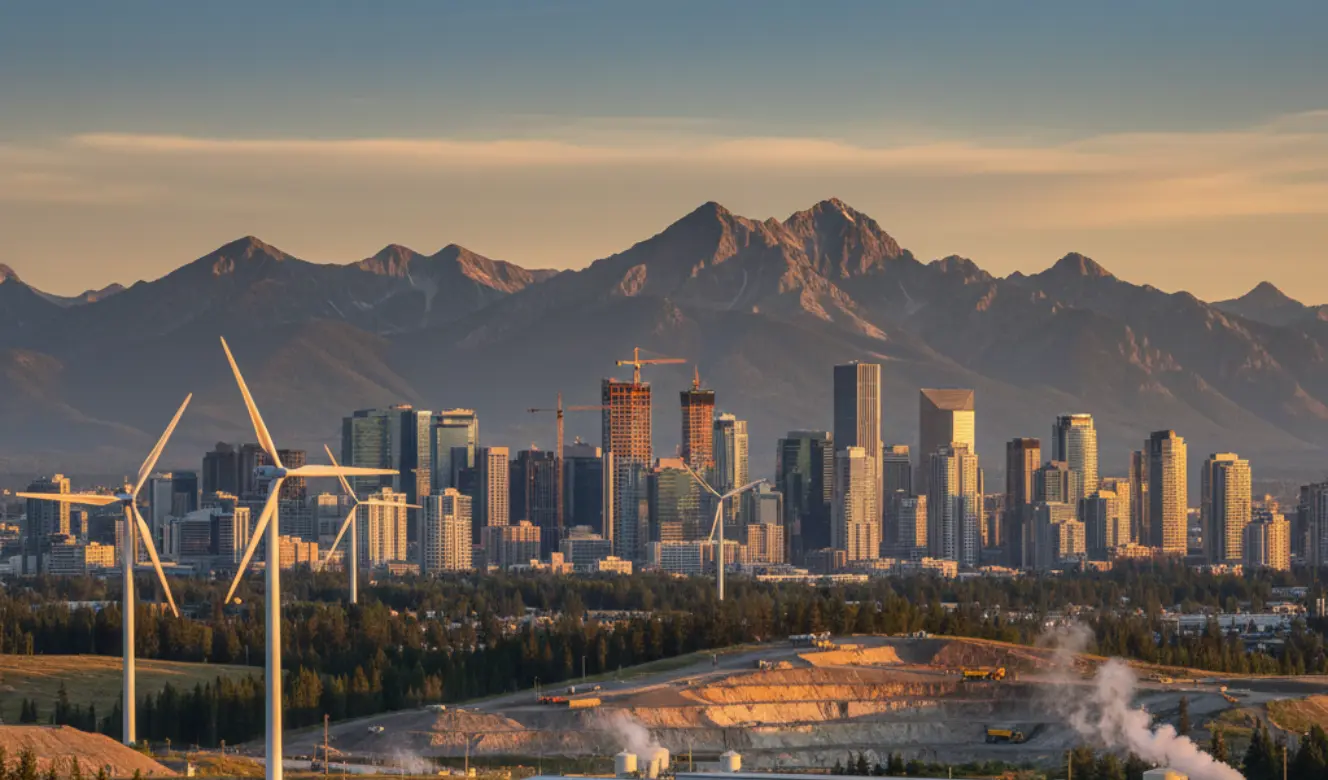
Western Canada is entering a period of economic transformation unlike anything we’ve seen in recent history. While the region has built its reputation on natural resources and energy production, a fundamental shift is underway. Emerging industries in Alberta, British Columbia, Saskatchewan, and Manitoba are diversifying at an accelerated pace, creating unprecedented opportunities for entrepreneurs and business leaders who can see what’s coming.
Key Takeaway:
- Western Canada (BC, Alberta, Saskatchewan, Manitoba) is poised for strong growth in emerging industries through 2027, driven by natural resources transition, clean energy, tech innovation, and critical minerals—creating high-potential opportunities for entrepreneurs, investors, and skilled workers. [1]
- Top sectors: Clean energy & renewables (hydrogen, small modular reactors, wind/solar), critical minerals & battery supply chain (lithium, cobalt, nickel, rare earths), agri-tech & food innovation (precision agriculture, plant-based proteins), tech & AI (quantum computing, cybersecurity, fintech), and low-carbon resource extraction (CCUS, hydrogen from natural gas). [1]
- Key drivers: Federal/provincial incentives (tax credits, grants, clean-tech funds), abundant natural resources, skilled workforce, proximity to Asian/U.S. markets, and net-zero commitments—Alberta leads in hydrogen/CCUS, BC in critical minerals & clean tech, Saskatchewan in potash & uranium, Manitoba in hydro & agri-tech. [2]
- Caveats: Regulatory hurdles, infrastructure needs (transmission, pipelines), skilled labour shortages, and global commodity volatility remain risks—success depends on early positioning, partnerships, and leveraging government programs. [2]
Bottom Line: Western Canada’s emerging industries in clean energy, critical minerals, agri-tech, and advanced tech offer significant growth potential through 2027—position early, leverage incentives, and address risks to capture high-value opportunities in the energy transition and innovation economy.
- Source: Unleash Your Power – Emerging Industries in Western Canada 2027
- Source: Article Details / FAQs
The professionals who develop strategic clarity now through leadership training and transformational tools like NLP will be positioned to capture disproportionate value as these industries scale.
The data tells a compelling story. Alberta is projected to lead the nation with 2.3% GDP growth in 2026, while Saskatchewan follows closely at 2.1%. These aren’t just numbers on a spreadsheet. They represent billions in investment, tens of thousands of new jobs, and entire ecosystems being built from the ground up. The question isn’t whether change is happening. The question is whether you’ll lead through it or watch from the sidelines.
This comprehensive analysis reveals the 10 industries poised for explosive growth across Western Canada in 2027 and beyond. More importantly, it shows you where to focus your energy, what skills to develop, and how to position yourself at the forefront of this economic evolution.
Why Western Canada’s Economic Landscape Is Shifting
The traditional narrative about Western Canada’s economy is outdated. Yes, oil and gas remain important. But commodity-producing provinces are now outperforming the national average for reasons that go far beyond petroleum. According to economic forecasts from RBC, Alberta and Saskatchewan will maintain their positions as growth leaders in 2026, supported by energy infrastructure, agricultural output, and an emerging focus on critical minerals and clean technology.
The shift is being driven by three converging forces. First, improved market access through projects like the Trans Mountain Expansion has reduced dependence on U.S. markets. Alberta now ships over 50% of its energy exports to non-U.S. trading partners, particularly Europe. Second, massive federal and provincial infrastructure spending is creating the backbone for new industries. Third, Western Canada’s skilled workforce, clean energy grid, and commitment to environmental standards make it an attractive destination for international investment.
The TD Economics provincial analysis confirms what forward-thinking leaders already sense: we’re witnessing a fundamental restructuring of the regional economy. The professionals who understand this aren’t just tracking trends. They’re developing the entrepreneurial mindset to capitalize on them. That means moving beyond reactive planning to strategic positioning.
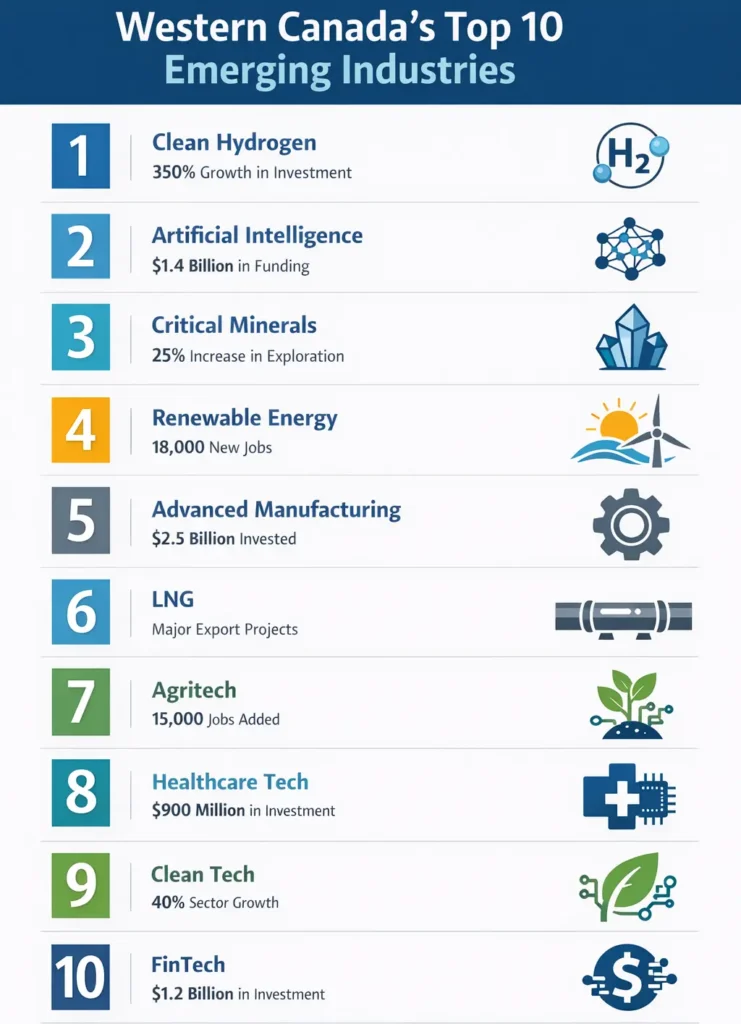
1. Clean Hydrogen Production & Infrastructure
Clean hydrogen represents one of the most transformational opportunities in Western Canada’s economic future. This isn’t speculative. Air Products’ Edmonton hydrogen complex is already under construction, representing a multi-billion-dollar investment that will create 2,500 construction jobs and establish Edmonton as the center of Western Canada’s hydrogen economy. The facility uses advanced Auto-Thermal Reforming technology to capture over 90% of carbon emissions, achieving net-zero status while producing hydrogen at scale.
Alberta’s natural gas reserves and available CO2 storage sites position the province as a global leader in blue hydrogen production. Meanwhile, British Columbia’s renewable energy capacity makes it ideal for green hydrogen development. The federal government has committed over $17.7 billion through the Clean Hydrogen Investment Tax Credit, offering 15-40% credits for hydrogen production projects through 2035.
The opportunity extends beyond production. Transportation, storage, and distribution networks need to be built. Industrial applications in manufacturing, agriculture, and heavy transportation are scaling. For entrepreneurs and business leaders, hydrogen represents a complete value chain still in formation, which means early movers can establish dominant positions.
2. Artificial Intelligence & Machine Learning
Artificial intelligence is no longer emerging it’s accelerating. Microsoft’s landmark $19 billion investment in Canadian AI infrastructure between 2023 and 2027 signals where global capital is flowing. The company is building new digital infrastructure with capacity coming online in the second half of 2026, specifically targeting Vancouver, Calgary, and Edmonton as innovation hubs.
According to AI market projections, the Canadian AI sector will reach $11.25 billion in 2025, with Western Canada capturing a significant market share. The University of British Columbia and the University of Alberta rank among Canada’s top institutions for AI research, creating talent pipelines that feed into growing tech ecosystems. Vancouver’s proximity to Seattle and Asia-Pacific markets, combined with Calgary’s energy sector expertise, creates unique opportunities for AI applications in resource optimization, predictive maintenance, and automation.
The 39th Canadian Conference on Artificial Intelligence will take place at Simon Fraser University in Vancouver in May 2026, bringing together researchers, developers, and entrepreneurs. This isn’t abstract technology. AI is being integrated into agriculture, healthcare, manufacturing, and financial services across Western Canada right now.
3. Critical Minerals Mining (Lithium, Copper, Graphite)
Western Canada sits on massive reserves of the materials that will power the next century. Canada’s Critical Minerals Strategy identifies 34 critical minerals, with six priorities: lithium, graphite, nickel, cobalt, copper, and rare earth elements. The demand for these materials is projected to grow by at least 71% by 2030, driven by electric vehicle batteries, renewable energy infrastructure, and advanced electronics.
British Columbia hosts significant copper and graphite deposits. Alberta’s lithium brines in oil and gas fields represent untapped potential as extraction technology advances. Saskatchewan’s potash and uranium industries provide existing mining expertise that’s transferring to critical minerals development. The federal government has allocated over $3.08 billion in grants and contributions for critical minerals projects, with additional support through the Critical Minerals Infrastructure Fund.
Export Development Canada financing is enabling strategic projects like Torngat Metals’ Strange Lake rare earth deposit in Northern Quebec, with $110 million in bridge financing. Similar deals are being structured for Western Canadian projects. The opportunity isn’t just in extraction processing, refining, and manufacturing components domestically, which creates exponentially more value and jobs.
4. Renewable Energy (Wind & Solar)
Wind and solar capacity are expanding rapidly across Western Canada’s vast geography. Alberta and Saskatchewan receive some of the highest solar irradiance in Canada, making large-scale solar farms economically viable. The prairie provinces’ strong, consistent winds create ideal conditions for wind energy development. British Columbia’s existing hydroelectric infrastructure provides grid stability that supports renewable integration.
Canada aims to generate 67% of electricity from renewable sources, with 80% from non-greenhouse gas emitting sources. Western provinces are critical to achieving these targets. The federal government’s $60 billion Clean Economy Plan includes investment tax credits specifically designed to accelerate renewable energy projects. Major utilities and independent power producers are committing billions to new capacity.
The LNG Canada Phase 1 completion in Kitimat will substantially increase liquefied natural gas export capacity, but it’s being paired with massive wind farm development to power operations sustainably. This integration of traditional and renewable energy creates a blueprint for the region’s energy transition pragmatic, economically viable, and environmentally responsible.
5. Advanced Manufacturing & Industrial Technology
Western Canada’s manufacturing sector is being transformed by automation, robotics, and advanced materials. According to industrial demand survey data, Calgary and Vancouver are expected to outperform the overall Canadian industrial market in 2026. This growth is driven by active user requirements and strategic positioning within North American supply chains.
The $3.2 billion graphite processing plant announced for Ontario demonstrates the scale of investment flowing into advanced manufacturing. Similar facilities are being evaluated for Western locations, particularly where critical minerals, energy, and skilled labor converge. Alberta’s energy sector expertise is transferring to precision manufacturing for renewable energy components, hydrogen infrastructure, and electric vehicle parts.
Construction activity remains exceptionally strong, with Alberta housing starts reaching 50,000 units annually, the fastest pace on record. This residential and commercial building boom is driving demand for advanced building materials, automation technology, and construction management software. The professionals who understand both traditional manufacturing and emerging technologies will bridge these worlds.
6. LNG (Liquefied Natural Gas) Export
British Columbia’s LNG Canada facility represents the largest private investment in Canadian history. Phase 1 completion in 2026 will transform BC’s natural gas industry and create a permanent export corridor to Asian markets. The facility’s capacity to process and export liquefied natural gas positions Western Canada as a reliable energy supplier to allies seeking alternatives to geopolitically unstable sources.
The ripple effects extend far beyond the facility itself. Pipeline infrastructure, marine terminals, transportation networks, and supporting services are all scaling. The project has created thousands of construction jobs and will employ hundreds in permanent operations. More importantly, it proves that large-scale energy projects can proceed in Canada when properly managed with Indigenous partnerships and environmental considerations.
Natural gas remains a transition fuel as the world moves toward cleaner energy. Western Canada’s ability to supply it responsibly, with lower emissions than many global competitors, creates a competitive advantage that will persist for decades.
7. Agritech & Precision Agriculture
Saskatchewan and Alberta produce a significant portion of the world’s wheat, canola, and lentils. But agriculture in Western Canada is being revolutionized by technology. Precision agriculture uses GPS, sensors, drones, and AI to optimize planting, irrigation, fertilization, and harvesting. Saskatchewan’s record crop yields in recent years demonstrate what’s possible when farming meets data science.
Climate variability and the need for sustainable farming practices are accelerating the adoption of agritech solutions. Companies developing soil sensors, automated equipment, and crop analytics are finding strong demand across the prairies. The integration of biotechnology to develop drought-resistant, higher-yield crops creates opportunities for research institutions and commercial agriculture companies alike.
Western Canada’s farming operations tend to be larger and more capital-intensive than those in other regions, making them ideal early adopters of expensive new technologies. Once proven at scale in Saskatchewan or Alberta, these solutions can be exported globally.
8. Healthcare Technology & Telemedicine
Healthcare delivery across Western Canada’s vast geography has always been challenging. Telemedicine and digital health technologies are solving longstanding access problems while creating entirely new business opportunities. Virtual care consultations surged during the pandemic and never returned to previous levels. Patients and providers discovered that the efficiency gains are real.
An aging population and healthcare worker shortages are driving increased investment in technology solutions. AI-powered diagnostic tools, remote patient monitoring, and digital therapeutics are being integrated into public and private healthcare systems. Alberta and BC are investing heavily in electronic health records and interoperable systems that enable better care coordination.
The intersection of healthcare and AI is particularly promising. Machine learning algorithms can analyze medical imaging faster and often more accurately than human radiologists. Predictive models identify patients at risk of complications before symptoms appear. These aren’t future technologies, they’re being deployed in Western Canadian hospitals and clinics right now.
9. Clean Technology Innovation
Clean tech encompasses everything from carbon capture and storage to water treatment, waste reduction, and energy efficiency solutions. Western Canada’s combination of environmental challenges and technical expertise creates a natural testing ground for clean technology innovation. Alberta’s decades of experience in oil and gas make it uniquely qualified to lead in carbon capture and sequestration.
The federal government’s Clean Technology Investment Tax Credit provides up to 30% refundable credits for clean technology investments. This is spurring the development of technologies that reduce emissions across industries from agriculture to manufacturing to transportation. Companies like Teck Resources have invested $600 million in water treatment and clean technology initiatives, demonstrating that major industrial players see clean tech as strategically essential, not just good PR.
Entrepreneurs who can solve specific environmental problems while generating positive returns will find abundant capital and market demand. The days of choosing between profitability and sustainability are ending. The best opportunities exist where they converge.
10. Financial Technology (FinTech)
Western Canada’s fintech sector is growing rapidly, driven by traditional financial institutions adopting new technologies and startups disrupting legacy systems. Calgary’s concentration of financial services companies and Vancouver’s tech talent create complementary ecosystems. Payment processing, blockchain applications, digital banking, and embedded finance are all areas of active development.
The emergence of digital currencies and decentralized finance (while volatile) has demonstrated consumer appetite for financial innovation. Traditional banks are responding by building digital-first products and acquiring fintech companies. This creates opportunities for both established players and new entrants with innovative solutions.
The intersection of fintech with other emerging industries is particularly interesting. Financing mechanisms for clean energy projects, carbon credit trading platforms, and agricultural commodity marketplaces all require sophisticated financial technology. The entrepreneurs who understand both finance and the industries being financed will create the most value.
FAQs
What makes Western Canada attractive for emerging industries?
Western Canada offers a compelling combination of advantages that few regions globally can match. The resource wealth is obviously critical minerals, natural gas, agricultural land, and renewable energy potential. But equally important are the less tangible assets: a skilled, educated workforce; world-class research institutions; political stability; strict rule of law; and environmental standards that give companies social license to operate.
The region’s clean energy grid gives manufacturers and data centers a competitive advantage. Alberta, BC, and Manitoba all generate the majority of electricity from hydroelectric, wind, or other renewable sources. This matters enormously as companies face pressure from investors and customers to reduce carbon footprints. Location in Western Canada provides an immediate sustainability advantage.
Perhaps most importantly, there’s room to build. Unlike more congested regions, Western Canada has land, infrastructure capacity, and communities eager for economic development. When global companies evaluate where to locate their next facility, these practical considerations often determine final decisions.
Which Western Canadian province has the strongest economic growth forecast?
Alberta leads with a projected 2.3% GDP growth in 2026, making it the strongest performer in Western Canada and among the national leaders. This growth is being driven by record oil production, the Trans Mountain Expansion providing improved market access, and strong housing construction activity. The province’s unemployment rate is expected to ease to 6.9% in 2026 as the construction and services sectors add jobs.
Saskatchewan follows closely at 2.1% growth, supported by robust construction activity, strong agricultural output, and major mining projects coming online. The McIlvenna Bay Foran Copper Mine is 64% complete and targeting commercial production in mid-2026. The Jansen potash mine is expected to begin production in mid-2027. These projects create immediate construction employment and long-term operational jobs.
British Columbia faces more headwinds, with growth forecast at 1.2% due to lumber and aluminum tariffs and demographic shifts. However, the LNG Canada facility completion provides a significant offset. Manitoba’s growth is projected at 1.3%, impacted by tariff exposure on manufacturing exports. The fundamental takeaway: commodity-producing provinces are outperforming, but every Western province offers specific opportunities depending on your industry and expertise.
How can entrepreneurs position themselves for growth in these industries?
Positioning for growth in emerging industries requires both strategic thinking and personal transformation. First, develop deep knowledge in one or two of these sectors. Surface-level understanding won’t differentiate you. Become the person who understands both the technology and the business model, the regulatory environment and the competitive dynamics. This takes focused learning, but the investment pays exponential returns.
Second, build strategic networks before you need them. Attend industry conferences, join relevant associations, and connect with researchers, policymakers, and other entrepreneurs in your target sectors. The most valuable opportunities often come through relationships, not job boards or RFPs. One entrepreneur I worked with struggled with self-doubt during a major career transition into tech. Through targeted NLP techniques, he eliminated anxiety, developed assertive communication skills, and transformed his entire career trajectory, skills that are essential as Western Canada’s economy evolves.
Third, develop the leadership capabilities these industries demand. Leadership development strategies that emphasize adaptability, clear communication, and strategic vision will serve you regardless of which specific industry you enter. The technical skills can be learned. The leadership mindset that allows you to navigate uncertainty, inspire teams, and make decisions with incomplete information is what separates those who succeed from those who don’t.
What skills will be most valuable as these industries grow?
The skills landscape is shifting as rapidly as the industries themselves. According to job market trends, AI-related roles dominate the fastest-growing positions in Canada for 2026. Specifically, large language model expertise, natural language processing, machine learning, and computer vision are in the highest demand. But these technical skills alone aren’t sufficient.
The most valuable professionals will combine technical capability with strategic thinking. Data science matters less if you can’t translate insights into business decisions. Software development creates limited value without understanding the problems customers actually need solved. The ability to bridge technical and business domains will command premium compensation across all emerging industries.
Equally important are the human skills that AI can’t replicate: complex problem-solving, creative thinking, emotional intelligence, and persuasive communication. These capabilities enable you to lead teams, negotiate partnerships, and adapt as industries evolve. NLP techniques for business growth can accelerate the development of these skills by helping you understand how perception shapes behavior, how to build genuine rapport, and how to communicate with clarity and impact.
Conclusion
Western Canada stands at an inflection point. The industries analyzed here represent trillions in economic value over the next decade. Clean hydrogen, artificial intelligence, critical minerals, renewable energy, advanced manufacturing, LNG export, agritech, healthcare technology, clean tech innovation, and fintech are not isolated trends; they’re interconnected threads in a new economic fabric being woven across Alberta, BC, Saskatchewan, and Manitoba.
The data is clear. The investments are flowing. The infrastructure is being built. What remains uncertain is who will lead through this transformation and who will be left responding to changes they didn’t anticipate. The professionals who position themselves now to develop both the technical knowledge and the leadership capabilities these industries demand will capture disproportionate opportunities.
This isn’t about predicting the future. It’s about creating it. Every major economic shift produces a new generation of leaders who understand what is coming and act decisively, while others hesitate. You have the information. You understand the landscape. The question is whether you’ll transform your leadership approach to match the magnitude of the opportunity.
Western Canada’s emerging industries need leaders with strategic clarity, adaptive mindsets, and the courage to act. The region’s economic transformation creates space for entrepreneurs who see themselves not as participants in someone else’s economy, but as architects of what comes next. Your transformation starts with a single decision: to stop observing and start leading.
Unleash Your Power: Stand Out, Take Action, and Create the Success You Want.