

Toronto’s 2026 event calendar looks stacked. FIFA World Cup games. PDAC Convention is drawing thousands of mining professionals. The Small Business Show at Metro Toronto Convention Centre. Business Transitions Forum. Dozens of major conferences bring executives from around the world. In this new era of corporate speaking, if you’re planning corporate events or preparing to speak at one, you need to know something: the rules just changed.
Key Takeaway:
- Corporate speaking in Toronto is evolving rapidly. By 2026, companies will prioritize speakers who deliver authentic, interactive, and transformation-focused experiences rather than traditional keynote lectures. [1]
- Key 2026 trends include: high demand for mental health & resilience topics, leadership in hybrid/remote teams, AI & future-of-work sessions, diversity & inclusion with real action plans, and sustainability/climate leadership. Audiences want practical takeaways they can implement immediately. [1]
- To succeed, speakers should focus on interactive formats (workshops, fireside chats, audience polls), use storytelling with Canadian relevance, offer post-talk implementation support, and demonstrate measurable ROI for the organization. [2]
- Toronto’s corporate events market is highly competitive but rewarding — speakers who align with 2026 trends and deliver genuine value can command premium fees and build long-term corporate relationships. [2]
Bottom Line: The future of corporate speaking in Toronto in 2026 belongs to authentic, interactive, and results-driven speakers who address timely topics like resilience, hybrid leadership, AI, and inclusion. Focus on delivering real value and practical tools rather than just inspiration to stand out and thrive in this evolving market.
Traditional 60-minute keynotes where someone lectures from a stage while attendees scroll their phones? That format is dying. The speakers commanding attention in 2026 aren’t the ones with the most polished slides or the biggest name recognition. They’re the ones who understand what actually moves people today and it’s not what worked in 2019. If you’re booking keynote speakers who understand how to command today’s corporate stages or developing your own executive presence, the landscape has fundamentally shifted.
The gap between what audiences tolerate and what they actually value has never been wider. They’ll sit through another generic motivational talk because the schedule says so. But they won’t remember it. They won’t apply it. And they definitely won’t change anything about how they lead because of it. The speakers who break through that noise are doing something different, something that connects leadership development that translates to real-world results with the realities of how people actually learn and change in 2026.
Let’s talk about what’s actually working.
Why Traditional Corporate Speaking Formats Are Evolving
Your audience’s attention span didn’t suddenly shrink because they’re lazy. It evolved because they’re drowning in content. They’ve been conditioned by TED talks that deliver big ideas in 18 minutes, podcasts they can pause and resume, and short-form videos that get to the point fast. When someone takes the stage for a full hour and spends the first 15 minutes on their bio and generic warm-up stories, the room mentally checks out.
The data backs this up. Event planners are cutting keynote lengths dramatically. The new standard emerging from major corporate events? Twenty minutes or less. Some event planners are redesigning corporate gatherings entirely, replacing single long keynotes with multiple shorter sessions, interactive stations, and breakout discussions where attendees actually engage rather than just receive information passively.
Toronto’s major 2026 events reflect this shift. Look at what’s happening at the conventions filling the Metro Toronto Convention Centre. There’s a move toward interactive formats, panel discussions with real-time audience participation, and shorter, punchier presentations that respect people’s time and attention. The keynote speaker who can land a powerful message in 15 minutes and leave people wanting more will get rebooked. The one who stretches thin content across 60 minutes won’t.
This isn’t about dumbing things down. It’s about respecting that your audience is smart, busy, and capable of grasping complex ideas quickly when they’re presented clearly. The challenge for speakers? You can’t hide behind filler anymore. Every minute has to count.
Five Trends Defining Corporate Speaking in Toronto for 2026
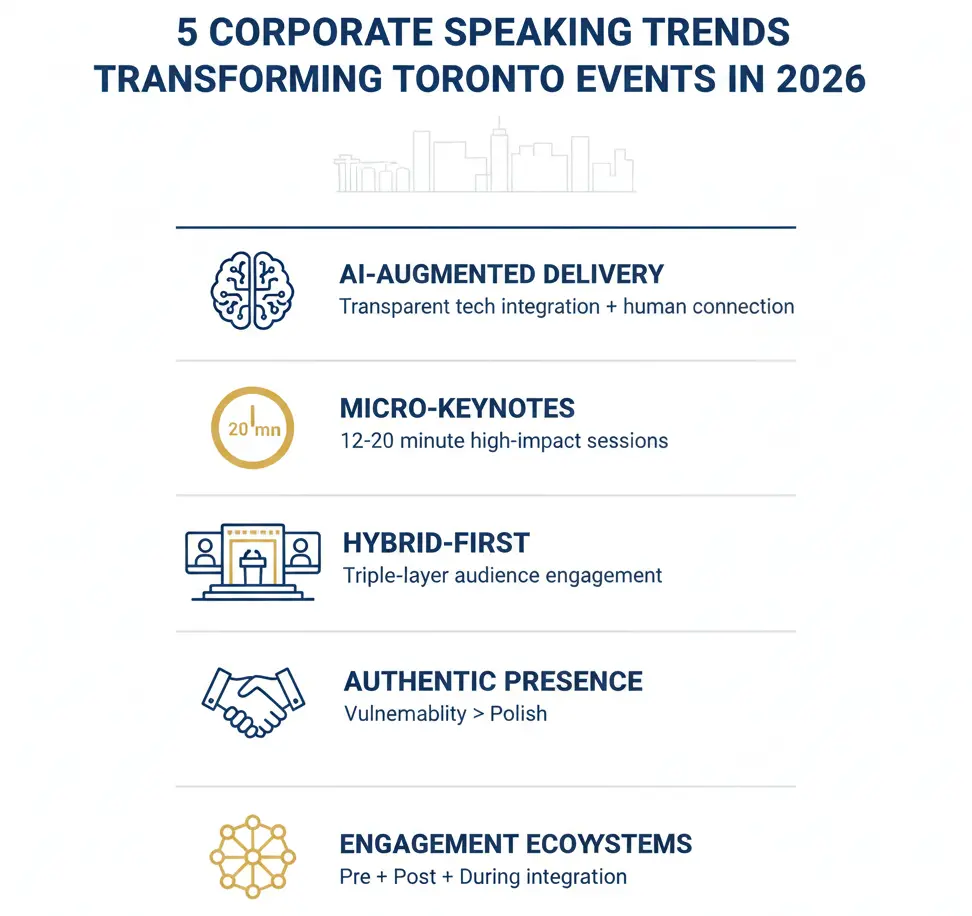
AI-Augmented Delivery (Without Losing the Human Touch)
Here’s what’s happening behind the scenes at the highest level. Top speakers are using AI to analyze audience data, identify themes from pre-event questionnaires, draft outline structures, and even rehearse with feedback on pacing and filler words. But the best ones aren’t hiding it. They’re being transparent about it.
Public speaking trainers observe that 2026 isn’t about whether speakers use AI, it’s about how openly and skillfully they integrate it. Audiences respect honesty. When a speaker says, “I analyzed 200 pre-event surveys with AI to understand what keeps you up at night, and here’s what I found,” that builds credibility. When they pretend every insight came from divine inspiration, people sense the inauthenticity.
But here’s the critical piece: AI can help you prepare, but it can’t establish rapport. It can’t read the energy of a room and adjust in real time. It can’t use techniques like anchoring, where you consciously link a powerful emotional state to a specific gesture or tone to help people remember and access what you’re teaching them. That’s still human territory. The speakers who win in 2026 use technology for efficiency but rely on genuine connection for impact.
Micro-Keynotes and Serialized Storytelling
Forget the single long keynote. Progressive organizations are splitting that hour into three 12-minute segments spread across a day or multi-day program. Each segment builds on the last, creating a narrative arc that keeps people engaged over time rather than overwhelming them all at once.
Think about how Netflix changed television. They didn’t just put movies online; they changed how stories unfold across episodes, creating cliffhangers and callbacks that keep you invested. Corporate speaking is borrowing that playbook. Instead of “Here’s everything I know about leadership in 60 minutes,” it’s “Let me show you three frameworks across three sessions that transform how you think about decisions, conversations, and culture.”
This format works particularly well for Toronto’s multi-day conventions. Attendees come back for day two already primed by what they heard in the opening segment. The speaker becomes a thread connecting the entire event rather than a standalone performance.
Hybrid-First and Multi-Format Mastery
Walk into any major Toronto venue preparing for 2026 events, and you’ll see three distinct setups: the physical stage, the virtual broadcast station, and increasingly, the immersive or holographic feed for remote participants who want something beyond flat Zoom screens.
The speakers who thrive aren’t just comfortable on camera; they can speak to a live audience while maintaining eye contact with virtual attendees through strategic camera placement, adjust their energy for people in different time zones tuning in remotely, and make both groups feel included. It’s like conducting an orchestra where half the musicians are in the room and half are streaming in from around the world.
This triple-layer stage requires new skills. You need to know when to address the camera directly, when to work the physical room, and how to create moments that translate across all formats. The technical bar just got higher, but so did the reach. A keynote at a Toronto convention can now impact people in Vancouver, Halifax, and London simultaneously.
Authentic Vulnerability Over Polished Perfection
I once feared speaking up in rooms where I felt invisible. That fear kept me small for years. Then I discovered that the very techniques I’d been studying, NLP anchoring, reframing, and rapport-building, could transform that fear into confident presence. Here’s what I learned: audiences don’t connect with perfection. They connect with truth.
In 2026, we’re living in what researchers call a “low-trust world.” People have been burned by too much AI-polished content that sounds impressive but feels hollow. They’re hungry for speakers who’ll acknowledge real challenges, share actual failures, and demonstrate expertise through depth rather than performance. Workplace communication research reveals that trust rebuilding requires authentic leadership communication, not more polished talking points.
One executive I worked with came to me, paralyzed by anxiety every time he needed to present at work. Through NLP anchoring techniques and building authentic confidence, he eliminated that fear completely, and now he’s the one colleagues turn to for high-stakes presentations. What changed wasn’t his slides or his delivery polish. It was his willingness to show up as himself, anchored in genuine expertise rather than performing someone else’s version of confidence.
The shift from “let me impress you” to “let me help you” transforms everything. That’s not about lowering standards, it’s about meeting higher ones. When you drop the mask and bring real value grounded in proven methodology, people lean in.
Pre and Post-Event Engagement Ecosystems
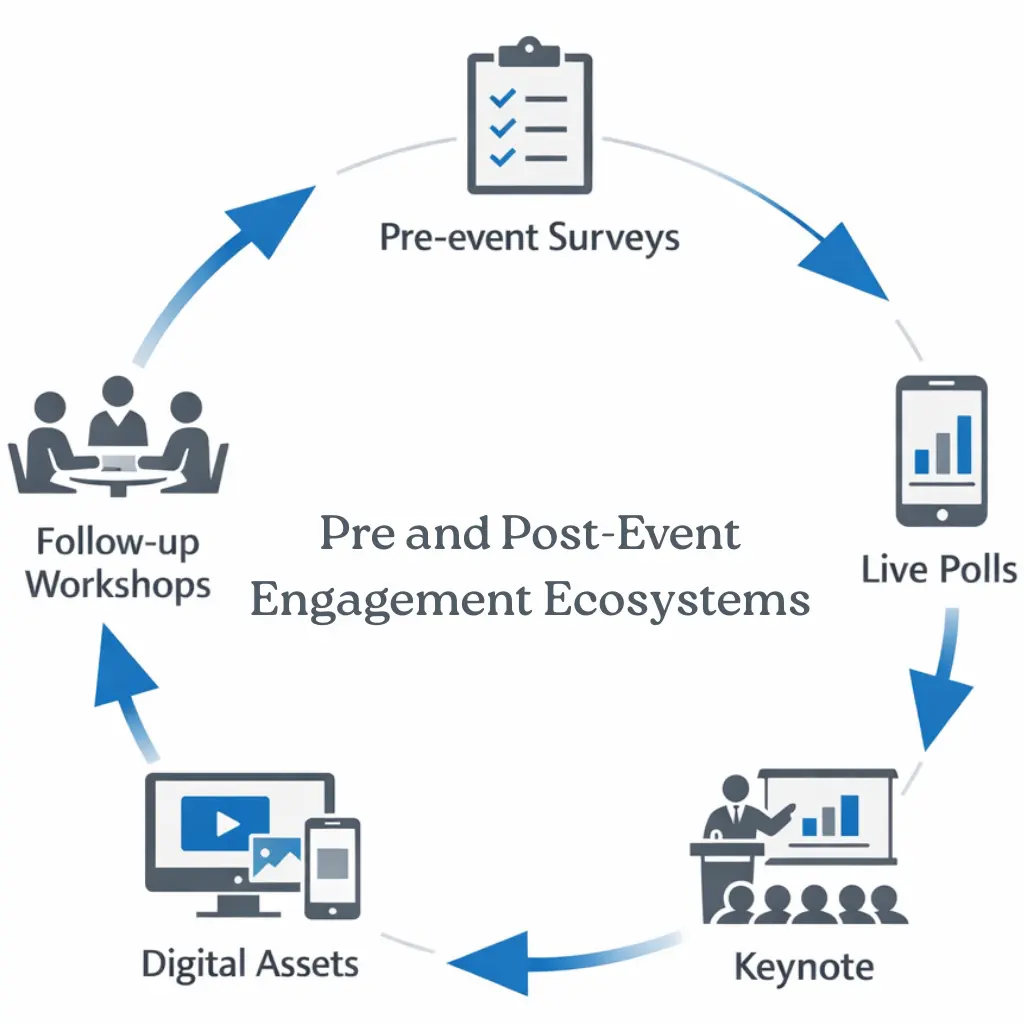
The keynote used to be the entire deliverable. Speaker shows up, does their thing, leaves. Done. Not anymore. Industry research on keynote speaking evolution shows that impact now extends far beyond the stage through pre-event questionnaires, real-time polls during sessions, post-event Q&A forums, moderated breakout discussions, and digital assets that turn one talk into ten applications.
Toronto-based communications research shows that executives who build multi-channel visibility, including video, podcasts, webinars, and speaking engagements, generate significantly more engagement than those relying on text alone. The keynote becomes the anchor point in a larger conversation.
Smart speakers now provide workshop guides, video clips for internal team sharing, implementation frameworks teams can use in Monday morning meetings, and follow-up sessions where participants report results. The question shifts from “Did people enjoy the keynote?” to “Did it change how they work three months later?”
What Makes a Great Corporate Speaker in 2026?
Strip away the hype, and here’s what matters. Great speakers in 2026 bring content depth, not surface inspiration. They provide frameworks you can actually use, not just feel-good stories you forget by Tuesday. They customize for your industry and culture rather than delivering the same generic talk they gave last week in a different city.
When I’m evaluating speakers or working with executives to develop their presence, I look for people who can answer three questions clearly: What specific problem does this solve for your audience? What will they be able to do on Monday that they couldn’t do on Friday? How does this connect to proven methodology rather than personal opinion?
The speakers who command premium fees and get rebooked don’t just entertain, they transfer capability. They integrate established approaches like NLP with current business realities. They understand that Toronto’s business environment has specific dynamics, economic pressures, and cultural nuances that a speaker from elsewhere might miss. Speaker training that builds genuine confidence focuses on these fundamentals rather than teaching performance tricks.
Customization isn’t optional anymore. Audiences can immediately tell when someone is recycling content. They want you to reference their industry, acknowledge their specific challenges, and demonstrate that you’ve done your homework. That preparation shows respect and respect builds trust faster than charisma ever will.
How Do You Choose the Right Speaker for a Corporate Event?
Start by ignoring the sizzle reel. Every speaker’s marketing video looks impressive. Instead, ask these questions: Can they customize their content for our specific audience and goals? Do they understand our industry and market? Will they collaborate before the event to align messaging, or just show up and perform their standard talk?
Request examples of how they’ve adapted content for different audiences. Ask about their preparation process. Find out if they provide any pre-event consultation or post-event resources. Event organizers prioritize speakers who can bridge disciplines like connecting economic trends with leadership decisions or technology with human impact, rather than staying in narrow lanes.
Look for evidence of depth. Anyone can deliver an inspiring story. Can they also provide NLP techniques for establishing instant rapport with diverse audiences? Can they explain not just what works, but why it works and how to apply it in different contexts? That distinction separates speakers who educate from those who merely entertain.
For Toronto-specific events, ask if they understand the Canadian business landscape, local economic factors, and cultural nuances. A speaker who assumes Toronto operates like New York or London will miss the mark. The best ones do their research and speak to your reality, not some generic corporate world.
What Topics Are Most Relevant for Toronto Corporate Events in 2026?
Based on what’s filling the convention calendars and what executives are asking about, five themes dominate. First, leading through uncertainty when geopolitical complexity and economic volatility are the new normal. People want frameworks for making decisions when the traditional playbooks don’t apply anymore.
Second, AI literacy for non-technical leaders. Not coding tutorials, practical guidance on where AI creates value, where it creates risk, and how to lead teams through this transition without the hype or fear. Third, building trust in environments where trust has eroded. How communication mastery drives leadership effectiveness becomes critical when you’re asking people to navigate change together.
Fourth, hybrid team performance. With distributed teams now permanent, leaders need concrete strategies for maintaining culture, accountability, and connection across physical and digital spaces. And fifth, economic resilience how to make strategic decisions that position your organization for long-term success rather than just surviving the next quarter.
Notice what’s missing? Generic motivation. Vague inspiration. The topics that fill rooms in 2026 are the ones that give people specific frameworks leaders can apply immediately to solve real problems they’re facing right now.
How Long Should a Corporate Keynote Be in 2026?
The honest answer? As short as possible while still delivering real value. Fifteen to twenty minutes is emerging as the new standard for maximum impact and retention. Anything longer needs to justify itself with depth, interactivity, or hands-on application that makes the extra time worthwhile.
Think about it from the audience’s perspective. They traveled to Toronto, paid conference fees, and took time away from urgent work. They’re not asking for entertainment, they’re asking for something they can use. If you can deliver that transformation in 18 minutes, don’t stretch it to 45 because that’s the traditional keynote length.
When longer formats work: deep technical training, workshops with live practice, or sessions where participants are actively applying concepts rather than passively listening, but even then, break it into segments. Teach for 15 minutes, let them practice, debrief, then teach the next piece. That respects both attention spans and adult learning principles.
Toronto’s packed 2026 event calendar shows organizers moving toward this model. Multiple shorter sessions, more interaction, less lecture. The speakers who resist this trend will find themselves replaced by those who embrace it.
Why Is Authentic Presence More Important Than Polish?
Because audiences have gotten really good at spotting performance. They’ve sat through too many keynotes that sounded impressive but offered nothing they could actually use. They’ve watched AI generate perfect-sounding content that lacks any real insight. The result? They value authenticity over perfection now.
From a neuroscience perspective, trust builds through congruence. When your words, tone, body language, and energy all align, people unconsciously recognize that alignment and relax into trusting you. When there’s even a slight incongruence, like someone speaking passionately about vulnerability while maintaining rigid, defended body language, people sense it immediately.
This doesn’t mean being unprepared or sloppy. It means being real within a framework of excellence. Know your content deeply. Practice your delivery. But then show up as yourself, not as some version of what you think a keynote speaker should be. When you acknowledge what you don’t know, share failures alongside successes, and speak from genuine experience rather than borrowed stories, you create a connection that polished performance never achieves.
I’ve seen this transformation dozens of times. Leaders who came in trying to perform as “confident executives” and left speaking as themselves, grounded, knowledgeable, and human. That shift doesn’t make them less credible. It makes them impossible to ignore.
Frequently Asked Questions
1. What are the top corporate speaking trends in Toronto for 2026?
The 2026 landscape is dominated by micro-keynotes (12–20 minutes), AI-augmented data personalization, and “hybrid-first” delivery. Events at venues like the Metro Toronto Convention Centre now prioritize interactive sessions and authentic, vulnerability-led leadership over polished, generic monologues.
2. What is the ideal length for a corporate keynote in 2026?
The new standard is 15 to 20 minutes. To maintain engagement, longer sessions are being replaced by serialized storytelling, where content is broken into short, high-impact chapters interspersed with audience interaction or breakout discussions.
3. How are speakers using AI for events in 2026?
Top speakers use AI to analyze audience data and pre-event surveys to customize their content in real-time. While AI assists with structure and research, the human speaker provides the “emotional anchor” and authentic connection that AI-generated content lacks.
4. Why is authenticity preferred over a polished performance?
In a low-trust, AI-saturated market, audiences value real-world expertise and vulnerability over rehearsed perfection. Authentic presence, where body language and message are congruent, is now the primary driver of trust and leadership influence during high-stakes presentations.
5. How can speakers ensure long-term impact after a Toronto event?
Impact is sustained through engagement ecosystems, including pre-event polls and post-event digital frameworks. By providing actionable tools and follow-up resources, speakers ensure their message leads to measurable behavioral change rather than just temporary inspiration.
Conclusion
The corporate speaking world is changing faster than most people realize, but the fundamentals haven’t. People still respond to authenticity, still value practical frameworks over empty inspiration, still remember speakers who respected their intelligence and their time.
Toronto’s 2026 events represent a unique opportunity. With world-class conferences, international delegates, and organizations hungry for leadership that actually works, the stage is literally and figuratively set. The question isn’t whether corporate speaking is evolving; it clearly is. The question is whether you’re evolving with it.
The speakers who’ll command attention in 2026 aren’t necessarily the most famous or the most polished. They’re the ones who’ve done the work to integrate proven methodologies with current realities, who can deliver massive value in minimal time, who show up authentically while maintaining excellence, and who understand that the keynote is just the beginning of a larger transformation.
Whether you’re preparing to speak at one of Toronto’s major 2026 events or looking for a speaker who brings authentic expertise and proven frameworks, the landscape has shifted. The speakers who command attention don’t just talk about change; they embody the transformation they teach. Your transformation starts today. Take the first step.