
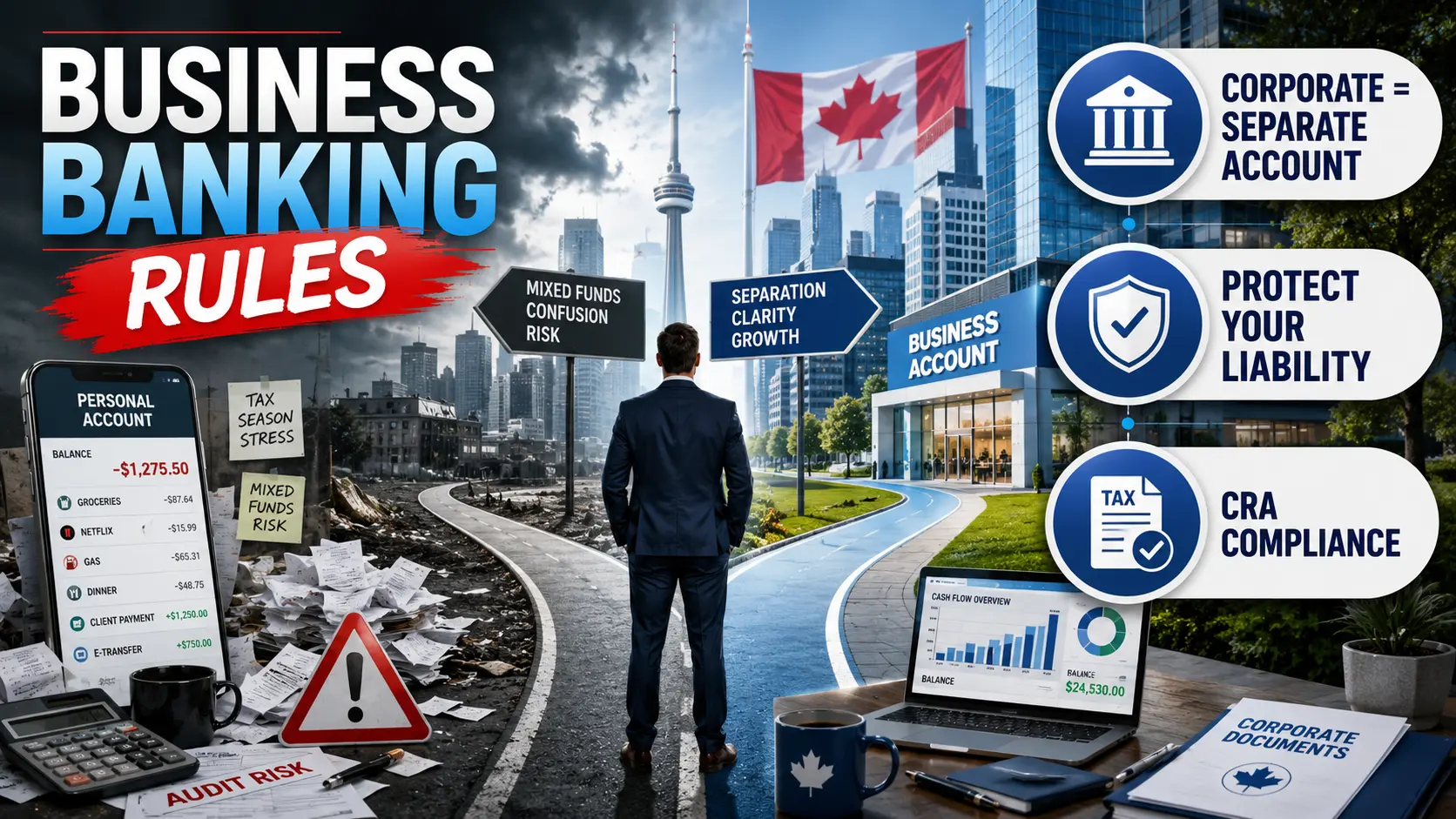
Sole proprietors operating under their own legal name can technically run a Canadian business using a personal account. Corporations cannot. A Canadian corporation is a separate legal entity, and its money does not belong to you personally. Mixing those funds creates CRA recordkeeping problems and weakens the limited liability protection you paid for.
Commingling funds means mixing personal and business money in the same account or financial records. Even where the law allows it, commingling costs you tax clarity, audit defence, professional credibility, and the lending relationships every growing business eventually needs.
Key Takeaway:
- A Canadian business bank account helps separate personal and business finances, making it easier to manage cash flow, track expenses, simplify bookkeeping, build business credit, and stay organized for tax reporting and future growth. [1]
- When comparing business banks, evaluate monthly fees, transaction limits, digital banking features, payment processing, lending options, customer support, integrations with accounting software, and whether the institution can support your business as it scales. [1]
- The best banking solution depends on your business model. Freelancers, startups, incorporated businesses, and growing companies all have different banking needs, so choose an account that matches your transaction volume, financing requirements, and long-term goals rather than simply selecting the lowest monthly fee. [2]
- Review your banking relationship regularly as your business grows. Upgrading accounts, adding merchant services, accessing credit, or switching financial institutions when your needs change can improve efficiency and reduce unnecessary costs over time. [2]
Bottom Line: Choosing the right Canadian business bank is about more than opening an account, it’s about finding a financial partner that supports cash flow management, business growth, financing, and day-to-day operations. The right banking solution can save money, improve efficiency, and help your business succeed over the long term.
The real question isn’t just can you. It’s whether operating that way is quietly limiting the business you’re actually trying to build.
Can you run a Canadian business without a business bank account?
Yes, if you’re a sole proprietor operating under your own legal name, you can legally use a personal bank account. However, if you operate under a registered business name or run an incorporated business, a separate business bank account is generally required. Even when not legally mandatory, dedicated business banking improves tax reporting, audit readiness, cash flow management, and business credibility.
Picture the typical tax-season scene. A freelancer pulling receipts out of glove boxes, scrolling through six months of personal e-Transfers, trying to flag the ones that were technically business income. A newly incorporated owner staring at a personal chequing account that somehow paid for both groceries and a software subscription, with no clear way to explain the difference to an accountant. Both of them are quietly hoping their bookkeeper has a sense of humour.
It’s a common question, and not a silly one. Plenty of founders delay setting up business banking because they’re testing the waters or want to keep things simple. The trouble is, hesitation around banking is usually a signal of something deeper. After twenty years of coaching Toronto entrepreneurs, James has watched this exact decision quietly cap businesses that had every other ingredient for growth. People wait to set up “real” banking until they feel like a “real” business, and they keep waiting.
Here’s what this article will give you: the legal answer split by structure, what the CRA actually expects, the corporate veil risk most founders miss, where fintech fits in, and a simple framework to decide your next move.
What Is a Business Bank Account?
A business bank account is a financial account designed specifically for business transactions. It separates business income and expenses from personal finances and helps maintain accurate records for tax, accounting, and lending purposes.
Business bank accounts typically support:
- Business name deposits
- Corporate ownership structures
- Payroll processing
- Merchant payment services
- Business credit products
- Accounting software integrations
For incorporated businesses, separate banking helps maintain the legal distinction between the corporation and its owners.
The Legal Answer Depends on Your Business Structure
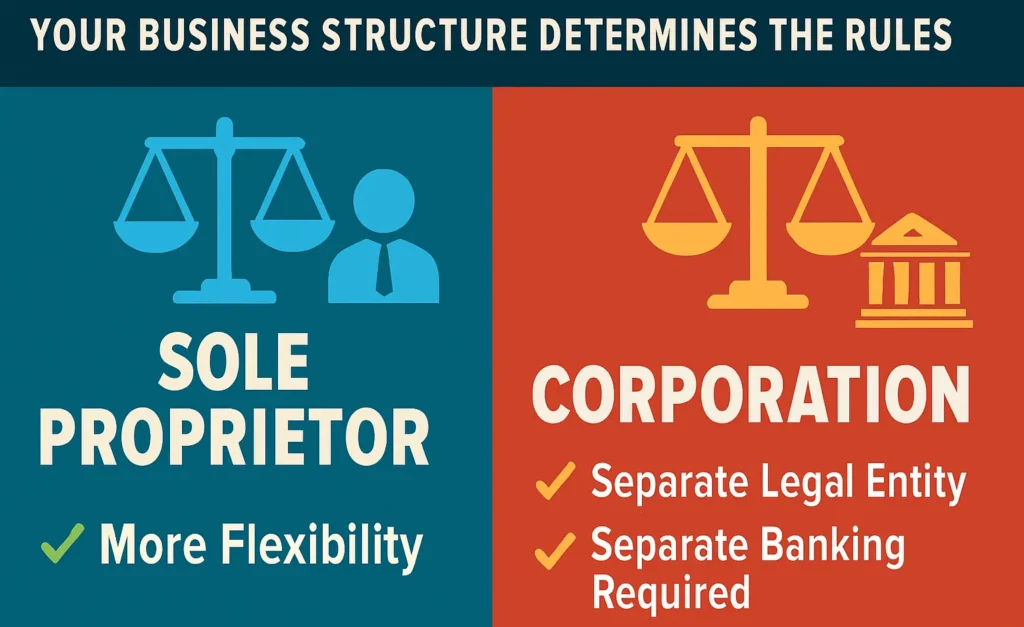
The single most important variable is how your business is structured. Sole proprietorships and corporations sit on opposite sides of a legal line, and that line determines whether banking separation is optional or mandatory.
A sole proprietorship is not legally separate from you. According to the Canada Revenue Agency, a sole proprietor and the business share one legal identity, and you report all income and losses on your personal T1 return using Form T2125. A corporation is a separate legal person, with its own tax filings, its own assets, and its own obligations. That distinction shows up immediately at the bank counter.
If you operate under your own legal name as a sole proprietor, a personal bank account is technically legal. If you operate under a registered trade name, you almost always need a dedicated business account so you can actually deposit cheques made out to that name. If you are incorporated, a business account is required at a practical level by every major Canadian bank, and the separation is expected by both the CRA and the courts.
Sole Proprietors: When the Law Says “It’s Up to You”
If you bill clients in your own legal name, nothing in Canadian law forces you to open a business bank account. You can deposit payments into your personal chequing account and report the income on your tax return at year’s end. This is the route many freelancers, consultants, and side-business owners take when they first start.
The moment you register a business name that’s different from your own, the situation changes. The CRA notes that when your business has a name other than yours, you need a separate bank account to process cheques payable to that business. Some banks go further. RBC requires even sole proprietors operating under their own name to have a business account, regardless of what the law says. Policies vary, but the trend is toward separation.
Even where it’s legal to use a personal account, the CRA still expects organized records, accurate deduction tracking, and accurate reporting. A personal account that mixes Netflix, groceries, and client invoices makes that job harder. The most common consequences show up later: missed deductions, bookkeeping chaos, weak audit defence, and cash flow visibility that’s basically guesswork. Legal does not mean clean.
How Business Banking Works in Canada
The banking requirements for Canadian businesses depend primarily on the business structure.
| Business Type | Personal Account Allowed | Business Account Recommended | Business Account Required |
|---|---|---|---|
| Sole Proprietor (Own Name) | Yes | Yes | No |
| Sole Proprietor (Trade Name) | Usually No | Yes | Practically Required |
| Corporation | No | Yes | Yes |
Most Canadian banks require incorporation documents, identification, and ownership information before opening corporate accounts.
What the CRA Actually Expects
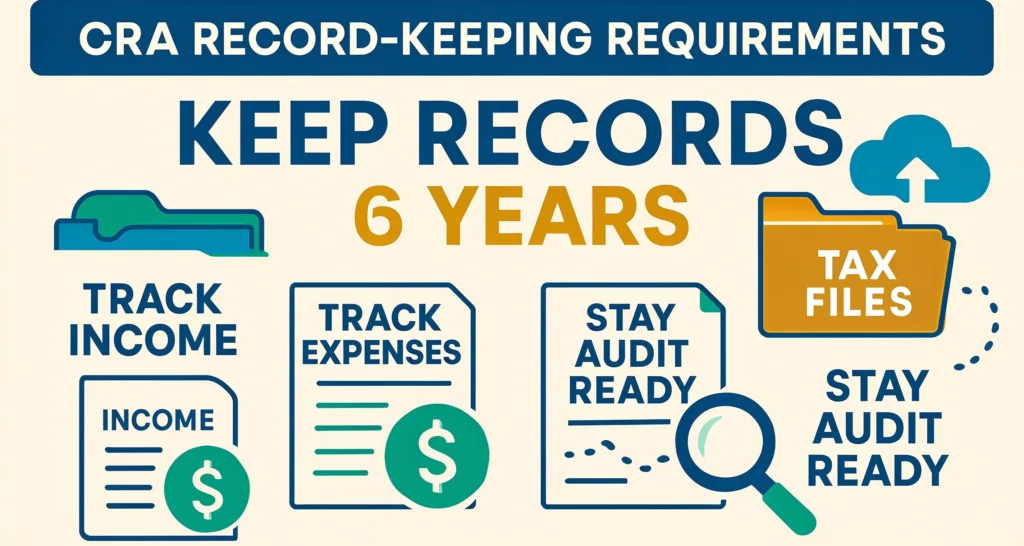
Canadian record retention rules apply to every business, sole proprietorship or corporation. The CRA requires you to keep records for six years from the end of the tax year they relate to. Electronic records must remain accessible and readable by CRA software, even after you upgrade systems or switch software. Books and records must be kept in English or French. Backup copies should be stored separately from your main location, preferably somewhere in Canada.
None of this changes based on whether you opened a business account or not. What changes is how painful compliance becomes.
With a dedicated business account, your monthly statements are already a clean audit trail. Income comes in, expenses go out, and the line between business and personal is automatic. With a personal account doing double duty, every audit becomes an exercise in untangling. Tax preparation takes longer. Deductions get missed because no one wants to forensically review eighteen months of personal spending. CRA reviewers have more reason to dig deeper, because nothing about the picture is obviously self-evident.
Try this: if your accountant has ever asked you to highlight business transactions in a personal statement, that’s the tax you’re paying for mixed banking, before any actual tax bill arrives.
Corporations: Why the Choice Is Already Made for You
A corporation is a separate legal entity. That’s the entire point of incorporating. The money inside the corporation is the corporation’s money, not yours, and treating it any other way undermines the structure you paid lawyers, accountants, or registry services to create.
Canadian banks will not accept personal banking for corporate transactions. Every major institution requires articles of incorporation, a certificate of existence, and director information before they’ll open the account. The Canadian Bar Association traces this separation back to the 1896 Salomon v Salomon & Co Ltd decision, which established that a corporation has its own legal personality distinct from its shareholders. That principle has been upheld in Canadian courts ever since.
Banks care about separation for reasons beyond compliance. Underwriting needs clean financial transparency. Lending history depends on a traceable record of corporate cash flow. Merchant services and business credit lines require account ownership that matches the legal entity. As Avalon Accounting points out, if business transactions run through a shareholder’s personal account, it gets harder to prove what actually belongs to the business, which increases the risk of tax audits and compliance issues.
If you’ve already incorporated, the work is done. The banking step is just operational follow-through. For more on choosing the right setup, see our guide to bank accounts for Canadian startups.
The Corporate Veil Risk Most Founders Miss
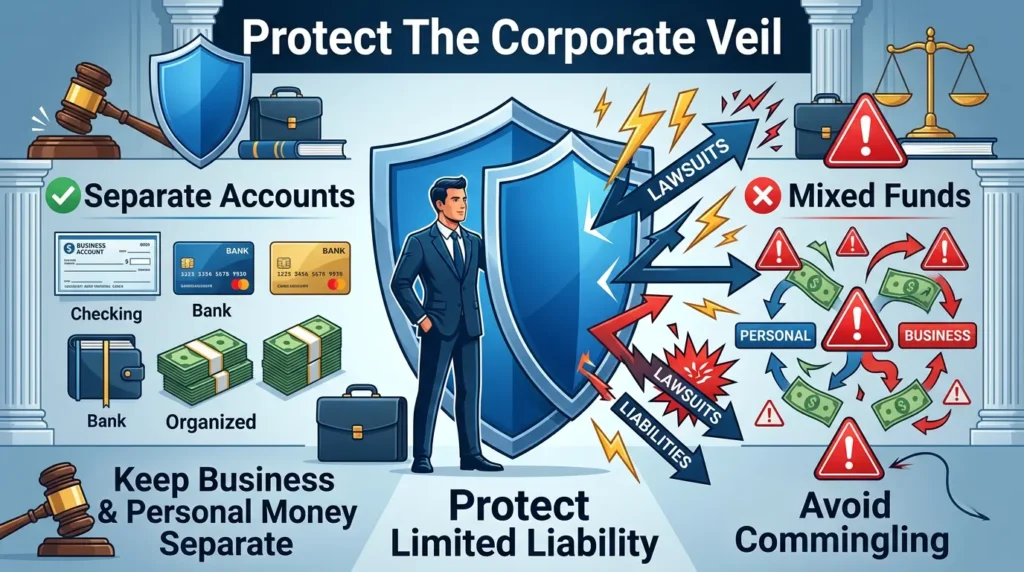
The corporate veil is the legal separation between you and your corporation. It’s the reason creditors typically can’t come after your personal house if your corporation defaults, and the reason lawsuits against the business usually stop at the business.
Canadian courts treat the veil as strong but not absolute. When they decide whether to “pierce” it and hold an owner personally liable, they look at specific factors: whether the corporation is being used as a shield for improper conduct, whether corporate formalities were followed, and whether there’s “intermingling” or commingling of funds between the corporation and its principal shareholder. In Cancun Adventure Tours v Underwater Designer Co., the corporate veil was pierced in part because corporate funds were being used to pay personal expenses of the shareholder.
Owner-operated corporations face elevated scrutiny because the directing mind and the shareholder are usually the same person. As Cactus Law puts it plainly, small businesses should avoid commingling personal and company assets and establish separate bank accounts that are strictly used for their respective purposes. That advice is not theoretical. It’s what protects the structure you paid to create.
This is also where the deeper pattern shows up. Owners delay clean separation because the business still feels temporary, like a thing they’re trying on rather than a thing they’re building. The banking decision is partly about money, but it’s also about whether you’ve decided the business is real yet.
Common Mistakes Business Owners Make
Many Canadian business owners unintentionally create compliance and bookkeeping issues by making avoidable banking mistakes.
The most common mistakes include:
- Using a personal account after incorporation.
- Paying personal expenses from a corporate account.
- Mixing GST/HST funds with operating cash.
- Accepting business payments under a registered trade name without dedicated banking.
- Waiting until tax season to organize transactions.
- Using multiple personal accounts for business activity.
- Applying for business financing without an established business banking history.
These mistakes can increase audit risk, complicate bookkeeping, and weaken lender confidence.
Payment Processor Problems Most Founders Don’t Expect
Stripe, PayPal, Square, and Shopify Payments all run their own compliance reviews on top of whatever your bank does. When the name on your business account does not match the legal entity registered with the processor, things get awkward fast.
Processors can request business verification, freeze funds during reviews, reject payouts to mismatched account names, or trigger know-your-customer escalations that take days to clear. None of that is illegal on their part. It’s standard FinTRAC-aligned compliance. But for a business that depends on weekly payouts to make payroll or pay suppliers, even a brief freeze is real operational pain. Banking setup is not just a tax topic. It’s a cash flow topic.
Personal vs Business vs Fintech: An Honest Comparison
There’s no single best option here. The right setup depends on your structure, your transaction volume, and how fast you’re growing. The verdict, before the table: if you’re incorporated or operating under a trade name, you need a business account of some kind. The choice between a traditional bank and fintech is mostly about cost, features, and how international your operation is.
| Feature | Personal Account | Traditional Business Account | Fintech Business Platform |
| Legal for sole props (own name) | Yes | Yes | Yes |
| Legal for corporations | No | Yes | Yes (technology layer + partner bank) |
| Typical monthly fee | $0 to $17 | $6 to $50+ | $0 to $25 |
| CRA defensibility | Weak | Strong | Strong |
| Client/lender credibility | Low | High | Moderate to high |
| Lending access | None | Strong | Limited |
| Multi-currency / FX | Poor | Moderate | Often best in class |
| Cash deposit support | Yes | Yes | Limited or none |
| Best for | Hobby-stage solo work | Established or scaling businesses | Online, freelance, or international businesses |
For a deeper breakdown of specific products, our roundup of the best free business bank accounts in Canada walks through what each tier actually delivers.
Fintech Alternatives: Real Banks or Not?
Companies like Wise, Airwallex, Venn, and Vault are usually not banks in the traditional sense. They’re financial technology firms registered as money services businesses under FinTRAC, and they partner with CDIC-member banks to hold customer funds. That means your money is safeguarded under standard Canadian deposit protection rules, even though the platform itself is not a chartered bank.
Where fintech genuinely shines: online and digital businesses, freelancers with international clients, founders who hate per-transaction fees, anyone moving meaningful USD or EUR volume, and operators who want clean accounting integrations. The user experience is often years ahead of what the Big Six offer.
Where fintech falls short: cash-heavy businesses, anyone who needs branch access, complex financing relationships, large business loans, and operations that need the kind of long-standing institutional history banks underwrite against. Many growing companies use both a traditional bank for lending and a fintech for daily operations and FX, which is a perfectly reasonable setup.
Data and Findings
Recent Canadian business data helps explain why separate banking becomes increasingly important as businesses grow.
- Canada has approximately 1.29 million small businesses, representing 98.1% of all employer businesses.
- The CRA requires businesses to keep records for at least six years.
- Lenders often require several months of business banking history before extending business credit.
- Many government financing programs require dedicated business banking.
- Payment processors routinely verify banking details against registered business information before releasing funds.
| Factor | Personal Account | Business Account |
|---|---|---|
| Audit Readiness | Low | High |
| Bookkeeping Efficiency | Low | High |
| Loan Eligibility | Limited | Strong |
| Corporate Compliance | Poor | Strong |
| Payment Processor Compatibility | Moderate Risk | High Compatibility |
The pattern is consistent: as businesses mature, banking separation moves from optional to expected.
The 4-Step Banking Decision Framework
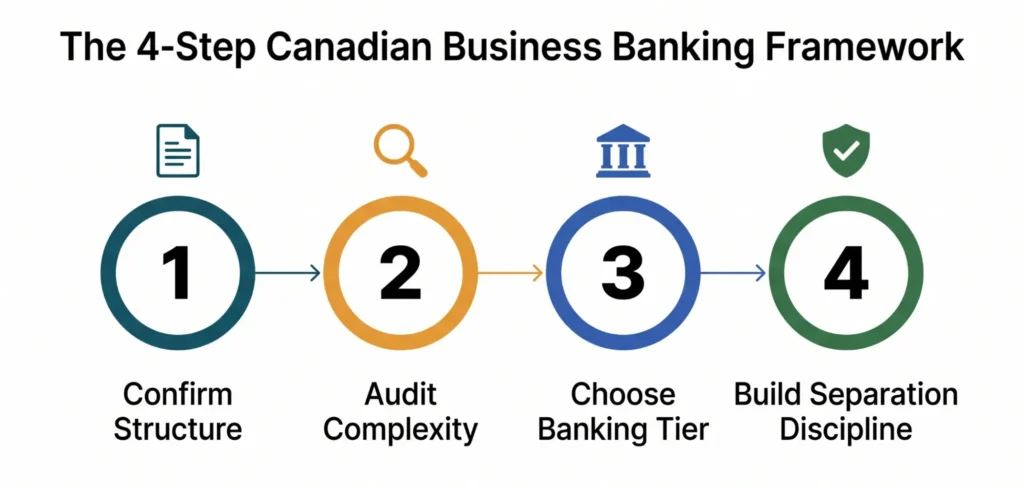
Confirm your structure.
Sole proprietorship under your legal name, sole proprietorship under a registered trade name, or corporation. The structure tells you whether the question is “should I” or “how fast can I.”
Audit your transaction complexity.
Count your monthly inflows and outflows. Add up your client invoices, software subscriptions, contractor payments, and recurring expenses. The more moving parts, the more painful a personal account becomes.
Choose your banking tier.
Personal account for the lightest of hobby-stage work, a no-fee business account from a major bank for low-volume operations, a fintech platform for online and international businesses, or a full-service business bank account for scaling companies with employees and financing needs.
Build the separation discipline.
This is where most owners actually fail. Setting up the account is easy. Using it cleanly, every single transaction, is the practice. Treat the business like a real entity and your behaviour will follow. Operating with that kind of clarity is one of the patterns that consistently separates owners who scale from owners who stay stuck, and it’s a core piece of how James’s work with entrepreneurs through NLP reframes business decisions across the board.
Best Practices for Business Banking in Canada
Whether you’re a freelancer, consultant, or corporation, these practices make compliance easier and improve financial visibility.
- Keep personal and business transactions completely separate.
- Reconcile accounts every month.
- Use accounting software connected to your bank.
- Store digital copies of receipts and statements.
- Track GST/HST obligations separately.
- Document shareholder withdrawals properly.
- Review banking fees annually.
- Establish business credit before financing is needed.
Real-World Example
Consider two freelance graphic designers earning the same annual revenue.
Designer A deposits client payments into a personal account and mixes business purchases with personal spending. At tax time, hundreds of transactions must be manually reviewed.
Designer B uses a dedicated business account connected to accounting software. Revenue and expenses are automatically categorized throughout the year.
Both businesses generate similar income, but Designer B spends less time on bookkeeping, maintains cleaner records, and is better positioned for audits, financing, and growth.
Who Can Realistically Operate Without a Business Account?
If you’re a sole proprietor operating under your own legal name, with low monthly transaction volume, no employees, no contractors on payroll, simple bookkeeping, and a side-hustle or earliest-stage operation, the legal answer is yes. You can keep things in your personal account for now.
The honest framing: this is a temporary solution, not long-term infrastructure. It works while the business is small. It stops working the moment the business starts behaving like a business.
Who Absolutely Shouldn’t?
Anyone running a Canadian corporation. Anyone operating under a registered trade name. Anyone scaling, hiring contractors, running payroll, processing more than a handful of transactions a month, planning to seek financing, or running an e-commerce store with payment processors involved. Anyone whose annual revenue is approaching the $30,000 GST/HST registration threshold. If you’re in any of these categories, a business account isn’t optional infrastructure. It’s the floor.
For founders building from scratch in Ontario, our walkthrough of how to start a small business in Ontario covers the registration and setup decisions that should happen alongside banking.
Frequently Asked Questions
Can a Canadian corporation use the owner’s personal bank account?
No. A Canadian corporation is a separate legal entity, and its money belongs to the corporation, not to any shareholder. Banks will not open corporate accounts using personal banking, and the CRA expects corporate records to reflect that separation. Using a personal account for corporate transactions creates tax reporting problems, complicates audits, and is one of the named factors Canadian courts examine when deciding whether to pierce the corporate veil and hold an owner personally liable.
What happens if the CRA audits a business with mixed accounts?
The audit becomes significantly harder, longer, and more expensive. CRA reviewers have to sort through every transaction to determine which ones are business-related, which can lead to disallowed deductions, additional scrutiny, and a longer review window. Mixed accounts don’t automatically trigger an audit, but if one happens, the lack of separation typically means worse outcomes. Clean, separate banking does the opposite. It makes audit defence straightforward.
Do sole proprietors need a business bank account in Canada?
Legally, you can only operate under a registered business name that’s different from your own legal name. If you bill clients as yourself, you can use a personal account. That said, almost every sole proprietor benefits from separate banking once revenue starts to grow. It simplifies tax filing, strengthens audit defence, builds a record of business cash flow that supports future financing, and signals professionalism to clients and suppliers.
Can I use PayPal or Stripe instead of a business bank account?
No. Payment processors are not replacements for business banking. Most platforms require a valid bank account to receive payouts, and incorporated businesses should use accounts owned by the corporation.
Can the CRA require a separate business bank account?
The CRA does not explicitly require separate banking for sole proprietors operating under their own legal name. However, it requires accurate recordkeeping, which is significantly easier with dedicated business banking.
When should a sole proprietor open a business account?
Most sole proprietors benefit from opening a business account once revenue becomes consistent. Separate banking simplifies bookkeeping, tax preparation, and future financing applications.
Does a business bank account improve loan approval chances?
Yes. Lenders often review business banking history to evaluate revenue consistency, cash flow management, and overall business stability before approving financing.
Conclusion
Can you run a Canadian business without a business bank account?
For some sole proprietors operating under their own legal name, the answer is technically yes. For corporations, the answer is effectively no.
The more important question is whether separate banking improves compliance, bookkeeping, financing opportunities, payment processing, and long-term scalability. In nearly every case, it does.
A dedicated business account creates cleaner records, strengthens audit readiness, protects corporate liability structures, and helps establish credibility with clients, lenders, and payment processors.
As a business grows, separate banking shifts from optional convenience to essential business infrastructure.