
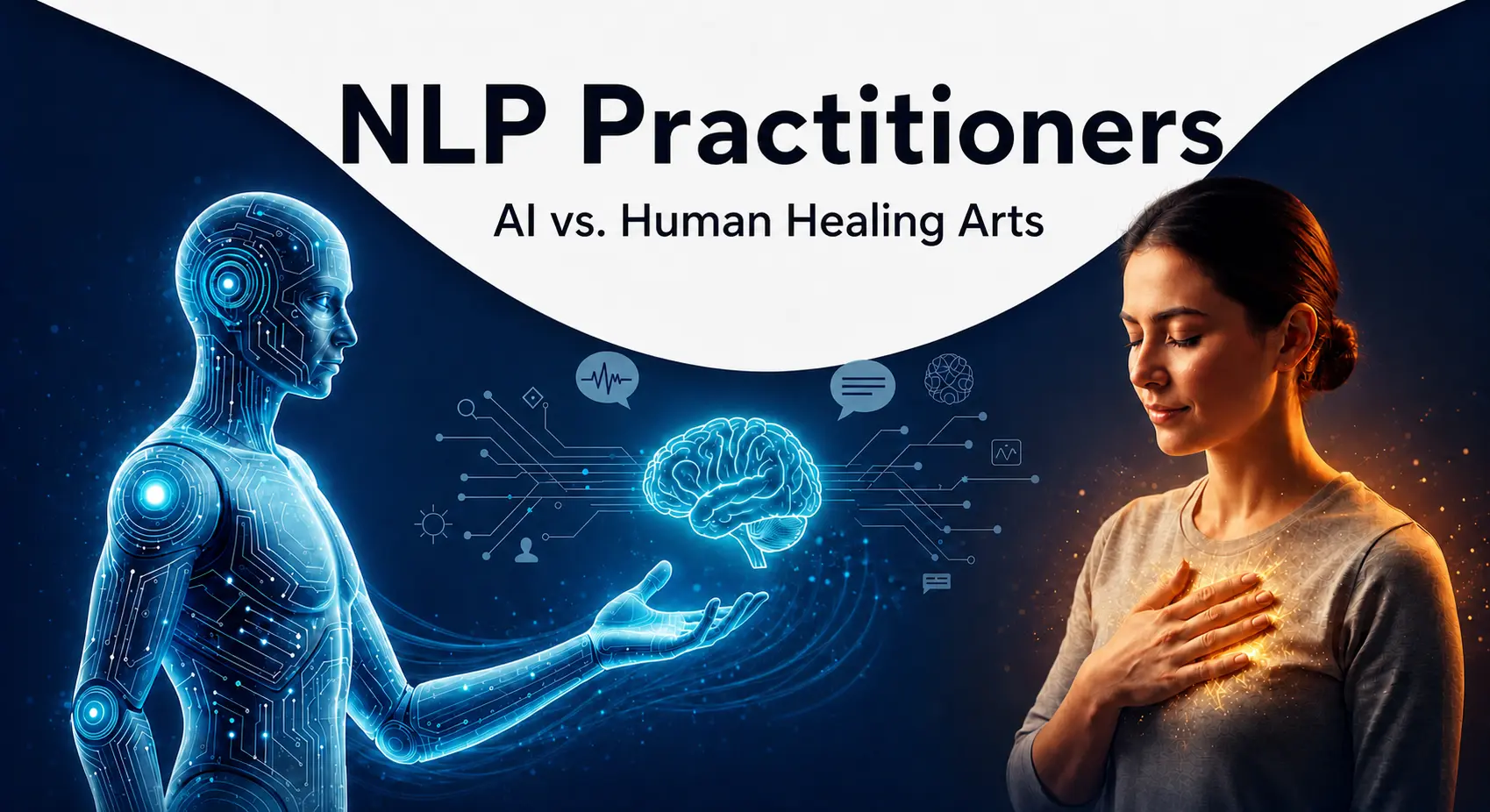
AI is not on track to replace NLP practitioners. It’s changing what practitioners spend their time on. Research through 2026 shows AI tools handle education, worksheets, and reminders well, but they still fall short on rapport, real-time adaptation, and ethical judgment, the exact skills NLP training is built around.
Psychologists surveyed by the APA in 2026 overwhelmingly agree that chatbots can’t treat people with the nuance a trained practitioner brings, and coaching remains one of the professions researchers rate as harder to automate. The practitioners most likely to thrive are the ones who use AI for the repetitive parts of their work and reserve their own time for the parts only a person can do.
Key Takeaway:
- AI is more likely to change NLP practice than replace NLP practitioners. Tools can efficiently handle administrative and educational tasks such as scheduling, worksheets, reminders, note summaries, and content drafting, allowing practitioners to spend more time on client-facing work. [1]
- Human practitioners retain important advantages in areas that require real-time observation, contextual judgment, adaptation, ethical decision-making, and sustained rapport. These skills depend on understanding a client’s verbal and nonverbal responses as they unfold rather than relying only on written input. [1]
- Research showing that AI can appear more empathetic in individual text exchanges does not establish that chatbots produce better long-term outcomes than human practitioners. Single-message impressions are different from the trust, accountability, and relationship that develop across ongoing sessions. [2]
- The C.A.R.E. approach Calibrate, Adapt, Rapport, and Empower highlights the human capabilities that remain central to NLP practice. The strongest strategy for practitioners is to use AI for repetitive tasks while protecting their time for observation, connection, judgment, and meaningful client work. [3]
Bottom Line: AI is reshaping NLP practice by automating repetitive tasks, not eliminating the human relationship at its center. NLP practitioners who use AI strategically for administration, content, and preparation can spend more time doing what remains distinctly human: building rapport, adapting in real time, exercising judgment, and supporting lasting change.
- Source: Unleash Your Power – AI vs Human Healing Arts: Why AI Is More Likely to Change NLP Practice Than Replace It
- Source: Data and Findings
- Source: The 4-Step C.A.R.E. Framework: How Human NLP Creates Lasting Change
If you’re an NLP practitioner, you’ve probably had this thought more than once this year: is ChatGPT coming for my career? You’re not imagining the shift. AI coaching apps, AI chatbots, and viral posts about “AI therapists” have made this a real and reasonable worry.
But the honest answer isn’t a simple yes or no. AI is automating pieces of coaching work. It is not replacing the relationship at the center of it. The practitioners who understand which parts of their work AI can take off their plate, and which parts still require a human being in the room, are the ones who’ll come out ahead.
- AI supports coaching tasks. It doesn’t replace the human relationship at the center of NLP work.
- Research consistently shows the practitioner-client relationship, not just technique, drives outcomes.
- NLP practitioners bring observation, real-time adaptability, and contextual judgment that AI still can’t fully match.
- Administrative and educational tasks are increasingly well suited to AI assistance.
- Practitioners who combine human expertise with AI tools are best positioned for what’s next.
Why Are NLP Practitioners Worried About AI?

The concern makes sense. AI coaching apps have multiplied, ChatGPT has become a default place many people go to talk through a problem, and mental health chatbots like Woebot and Wysa now have real research behind them.
If you’ve felt that low-grade anxiety watching this unfold, you’re not alone. The real question isn’t whether AI will affect NLP practice. It already has. The better question is which parts of the work are shifting, and which parts remain distinctly human.
What AI Does Well (And Why That Matters)
Give AI its due. It’s genuinely useful for a specific slice of coaching work: journaling prompts and reflection questions, accountability reminders between sessions, worksheets and structured exercises, explaining NLP terminology, summarizing session notes, and brainstorming angles on a client’s stated goal.
None of this threatens the core of practitioner work. It removes friction. A practitioner using AI for prep and admin frees up more real session time for the work that actually requires a human.
Will AI Replace NLP Practitioners?
Some tasks are genuinely headed toward automation: scheduling, routine note-taking, generating standard exercises and worksheets, basic educational content, and follow-up email drafts.
Other tasks are unlikely to be fully automated any time soon: reading nuanced emotional shifts in real time, navigating complex or high-stakes situations, adjusting technique mid-conversation based on what’s actually happening, exercising ethical judgment about when coaching isn’t the right fit, and making contextual decisions that depend on a client’s full history, not just their last message.

This is the actual shape of the disruption. It’s task level, not job level.
The Empathy Illusion: What the Research Really Shows
Here’s where a lot of headlines get it wrong. Some studies suggest AI chatbots come across as more empathetic than human professionals. Taken at face value, that sounds like AI is winning. It isn’t the full picture.
Those studies were text-only, evaluated by proxy raters rather than real patients in an ongoing relationship, and they measured perceived warmth in a single exchange, not sustained outcomes over time. A person can sound warm in one written reply and still have no idea how to handle what happens in session three when things get complicated. The specific numbers behind this are in the Data and Findings section below.
For anyone offering coaching or NLP techniques rather than diagnosing and treating conditions, the takeaway still applies. Sounding supportive in a single message is a different skill than helping someone work through something difficult over weeks or months.
Data and Findings
Pulling the research together in one place:
Psychologist sentiment, 2026: The APA’s 2026 Chatbots and Mental Health Survey surveyed more than 1,200 licensed psychologists in the United States. Only about 24 percent believed patients would eventually prefer chatbots to human mental health professionals. Separately, in APA’s coverage of AI use in therapy, 94 percent of responding psychologists said chatbots can’t treat mental health conditions with the level of nuance the situation requires.
Perceived empathy versus real outcomes: A systematic review and meta-analysis published in the British Medical Bulletin pooled 13 studies using ChatGPT-3.5 and 4, all from 2023 to 2024, and found a standardized mean difference of 0.87 favoring AI on perceived empathy, roughly a two-point gain on a ten-point scale. The catch: these were text-only exchanges judged by proxy raters, not real patients in an ongoing relationship, so they measured a single impression rather than results over time.
Where the gap actually shows up: A 2026 research review from Simply Psychology found that human therapists produce significantly better outcomes than chatbots for moderate to severe anxiety and depression, and that this gap widens as symptom severity increases. The same review notes that long-term effectiveness of chatbot support beyond a few weeks is still largely unestablished.
Why the relationship carries weight: Meta-analytic research summarized in Frontiers in Psychiatry estimates that the therapeutic alliance, the working relationship between practitioner and client, accounts for roughly 7.5 percent of the total variance in outcomes across a wide range of treatment approaches, independent of theoretical orientation or specific technique.
Automation risk by profession: A 2026 workforce analysis covered by Extern and a separate breakdown from zPlatform both place empathy-driven, judgment-heavy roles like therapists, counselors, and relational coaching work among the lowest automation risk categories studied, generally in the 10 to 19 percent range, compared to far higher risk for routine, rules-based work.
What AI Still Can’t Do in a Coaching Room

This is the center of the whole conversation, so let’s get specific.
- Human observation: Posture, facial expression, breathing pace, a hesitation before someone answers. A trained practitioner reads all of this in real time. Text-based AI has none of it.
- Real-time adaptation: A skilled NLP practitioner changes direction mid-conversation based on what’s unfolding, not just what was typed a moment ago.
- Ethical judgment: Knowing when a client needs something beyond coaching, and saying so, is a professional responsibility AI isn’t positioned to carry.
- Presence: Sitting with someone through silence or an unexpected emotional turn without rushing to fill the space.
- Sustained accountability: A real, ongoing relationship where someone notices your patterns across months, not just your last message.
As one NLP-focused podcast episode on AI and coaching put it, AI can ask good questions and reflect language convincingly. What it can’t do is build genuine rapport, catch a shift in tone, or use human judgment in the moment. That gap is exactly where NLP training lives.
Why the Human Relationship Still Matters
Decades of research on the therapeutic alliance, the working relationship between a practitioner and client, point to the same conclusion again and again: that relationship is one of the most consistent predictors of whether the work actually sticks, regardless of the specific technique being used. The exact figures behind this are in the Data and Findings section above.
This tracks with what shows up in real client work. Take Mike, who came to James struggling with anxiety, self-doubt, and constant overthinking that was bleeding into his career and relationships. What changed things wasn’t a worksheet or a one-time exercise. It was ongoing work with someone who could notice the specific ways his mind was looping, adjust the approach session to session, and hold him accountable over time. He now describes speaking up at work with a confidence he didn’t have before, and says the mental noise that used to dominate his days has quieted considerably.
That kind of shift doesn’t come from a single empathetic-sounding reply. It comes from a relationship that adapts as the person does.
The 4-Step C.A.R.E. Framework: How Human NLP Creates Lasting Change

James’s approach to training practitioners rests on four elements that are hard to separate from a human presence in the room, part of what he calls Confident Communication in his 5 Pillars of Massive Success.
Calibrate
A practitioner reads verbal and behavioral cues as they happen. AI mostly works from whatever information a user chooses to type in. A human notices the things a client doesn’t say.
Adapt
Interventions shift based on how a person actually responds, not a script. AI leans on learned conversational patterns. A trained practitioner exercises judgment shaped by experience.
Rapport
Trust builds through genuine back-and-forth interaction over time. AI can produce supportive-sounding language. It can’t build the kind of trust that comes from being known by another person.
Empower
Real change means applying what’s learned outside the session. AI can send a reminder. A practitioner offers encouragement, holds someone accountable, and adjusts feedback as circumstances change.
Heather Chetwynd, who came through James’s NLP Practitioner training, had already studied NLP elsewhere but felt confused about how to actually integrate it into her work. Practicing skills like sensory acuity and rapport building in a live training environment, guided by someone who could adjust the teaching in real time, gave her the clarity that reading about techniques alone hadn’t. She walked away with unexpected insight into her own business and a genuine toolbox she could use going forward. That kind of calibrated, in-person learning is difficult to replicate through a screen.
AI Coaching Tools vs. Human NLP Practitioners
| Capability | AI Coaching Tool | Human NLP Practitioner |
| Availability | 24/7 | Scheduled sessions |
| Cost | Lower | Higher investment |
| Educational support | Excellent | Excellent |
| Worksheets and exercises | Excellent | Excellent |
| Rapport | Simulated, conversational | Built through genuine interaction |
| Reading behavioral cues | Limited | Integrated into live sessions |
| Ethical judgment | Limited | Professional judgment and accountability |
| Real-time adaptability | Pattern based | Context sensitive |
| Long-term accountability | Automated reminders | Ongoing personal relationship |
| Complex emotional situations | Limited | Suited to nuanced human interaction |
Is NLP Practitioner Work AI-Resilient?
Automation risk research consistently points the same direction. Automation risk research consistently points the same direction: professions requiring empathy, judgment, and real-time interpersonal interaction remain the most resistant to automation, while relationally driven roles like coaching and counseling land among the safest categories, precisely because trust and empathy are the core of the job, not a feature bolted on top. The specific figures are in the Data and Findings section above.
That doesn’t mean NLP practice is untouchable. Nothing is completely “AI proof.” But it does mean coaching sits in the category of work that depends on judgment, communication, and relationship building rather than repetitive, rules-based tasks, and that category consistently shows up as harder to automate.
How NLP Practitioners Can Use AI Instead of Competing With It

The practitioners who’ll do best aren’t the ones ignoring AI. They’re the ones using it strategically, for preparing session materials, drafting marketing content, generating first drafts of client workbooks, brainstorming program angles, summarizing notes, and handling scheduling and routine admin.
A recent Forbes piece on AI and coaching put it plainly: the coaches who struggle won’t be replaced by AI itself; they’ll be outpaced by other coaches who learned to use it well. Letting AI handle the repetitive work frees you up to spend more of your time doing the part only you can do.
Who Should Use This
This applies most directly to NLP practitioners, coaches, and aspiring practitioners who want a clear-eyed, evidence-based look at how AI is actually reshaping the field, along with anyone deciding between an AI coaching app and working with a trained human practitioner.
Who Should Avoid This
If you’re looking for a technical guide to building AI systems or a machine learning implementation tutorial, this isn’t that resource. This article focuses on the practice of coaching and NLP, not software development.
Frequently Asked Questions
Can ChatGPT replace an NLP practitioner?
Not for the core relationship. ChatGPT can explain concepts and generate exercises, but it can’t observe real-time behavioral cues, adapt mid-session, or build the kind of trust that develops between a client and a trained practitioner over time.
Can AI perform NLP techniques?
AI can describe techniques and prompt someone to try them, but many NLP methods depend on a practitioner calibrating to a client’s specific responses in the moment, something current AI tools aren’t built to do.
Is coaching an AI-resistant career?
Research consistently places relationally driven, judgment-heavy professions among the more automation-resistant categories of work, though no profession is entirely immune to change.
Should NLP practitioners use AI?
Yes, for the parts of the work that don’t require your judgment or presence: admin, content drafting, worksheets, and reminders. That frees up more of your time for the parts that do.
What can AI do better than human coaches?
Availability, cost, and speed. AI is available 24/7 and can generate written material almost instantly.
What still requires a human practitioner?
Reading nuanced emotional and behavioral cues, adapting in real time, exercising ethical judgment, and building the kind of sustained trust that drives lasting change.
Conclusion
AI is changing NLP practice. It’s automating the repetitive parts of the work, expanding access to information, and helping practitioners run their businesses more efficiently. What it isn’t doing is replacing the trust, adaptability, and shared human presence that make transformational work actually work.
The future of NLP isn’t humans versus AI. It’s skilled practitioners using AI to spend less time on admin and more time doing what only people can do: helping other people create lasting change. Unleash Your Power: Stand Out, Take Action, and Create the Success You Want.