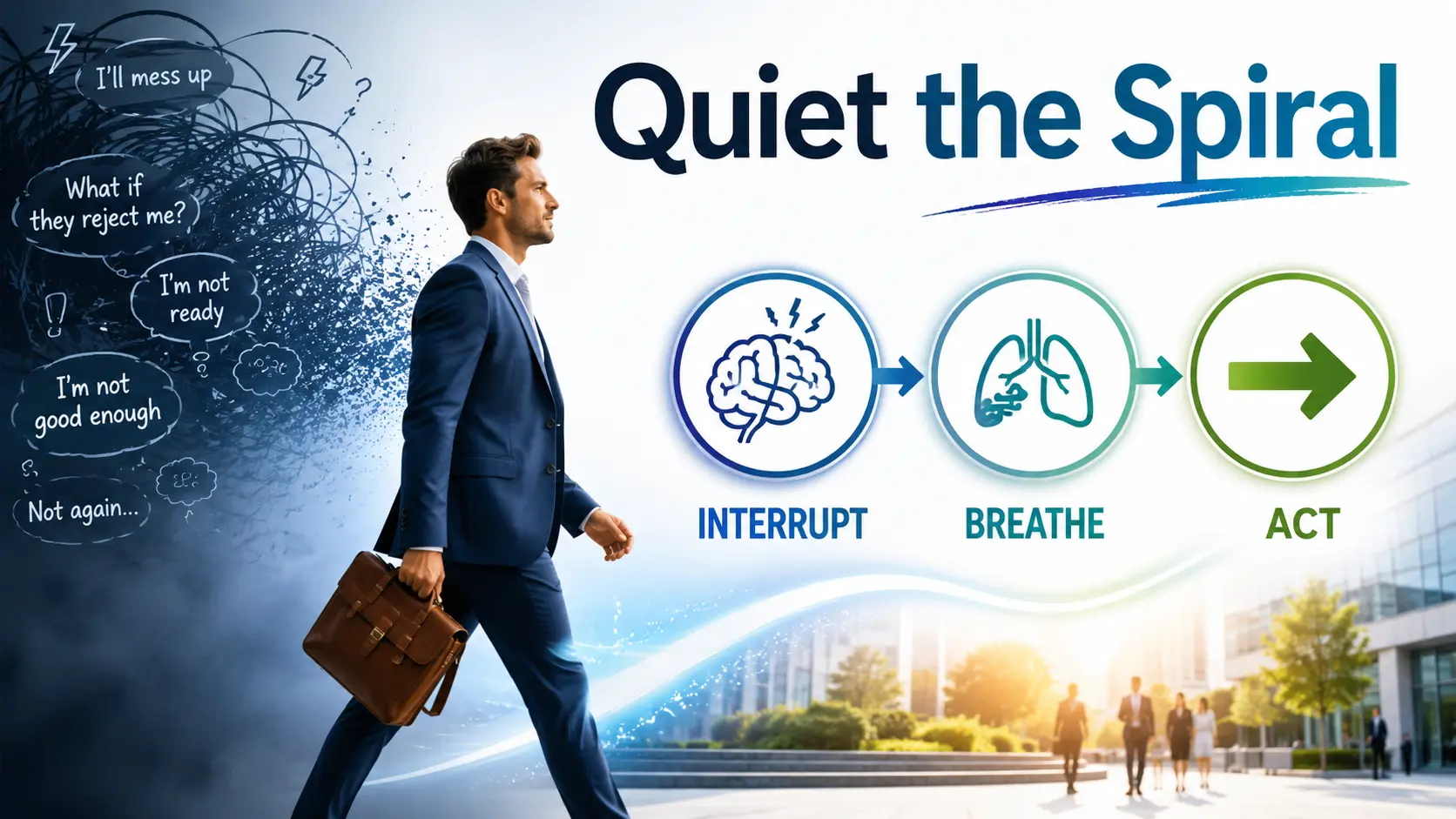
The PAUSE Method is a five-minute mental reset that quiets negative thoughts before high-pressure moments, built for professionals and entrepreneurs who can’t afford to spiral right before a pitch, a negotiation, or a hard conversation. It blends three evidence-informed tools into one short sequence: an NLP pattern interrupt to break the loop, a physiological sigh to calm your nervous system, and affect labeling to take the charge out of the thought.
The five steps are Pattern Interrupt, Air, Unmask, Shift, and Engage, roughly one minute each. Used consistently, it helps you move from reactive to clear-headed in the time it takes to walk to a meeting. One honest caveat: this is a state-management tool for everyday stress and self-doubt, not a treatment for clinical anxiety, panic, trauma, or depression. If negative thinking is persistent or overwhelming, work with a licensed professional.
Key Takeaway:
- A simple 5-minute NLP technique can help interrupt negative thought patterns, improve focus, and shift your mindset toward more resourceful thinking. By changing how you interpret situations, you can respond more confidently instead of reacting automatically. [1]
- Common NLP techniques include reframing limiting beliefs, visualization, positive anchoring, and intentional self-talk. These practices aim to strengthen empowering mental habits that support better communication, confidence, decision-making, and personal performance. [1]
- The greatest benefits come from consistent daily practice rather than one-time use. Spending just a few minutes each day applying NLP techniques can reinforce healthier thinking patterns and help you respond more effectively to everyday challenges over time. [2]
- NLP is designed as a personal development and coaching tool, not a replacement for mental health treatment. If you’re experiencing significant emotional distress or a mental health condition, seek support from a qualified healthcare professional in addition to any coaching or self-improvement practices. [2]
Bottom Line: A 5-minute NLP exercise can be an effective daily habit for building confidence, reducing negative thinking, and improving mental clarity. While lasting transformation requires ongoing practice, small, consistent mindset shifts can create meaningful improvements in both personal and professional life.
What Is the 5-Minute NLP Trick to Quiet Negative Thoughts?
The 5-Minute NLP Trick to Quiet Negative Thoughts is the PAUSE Method, a five-step mental reset that helps interrupt automatic negative thinking before high-pressure situations such as presentations, sales calls, negotiations, or difficult conversations. It combines an NLP pattern interrupt, physiological sigh breathing, affect labeling, cognitive reframing, and immediate action to help you regain focus quickly.
The PAUSE Method is designed as a performance and resilience tool for everyday stress, not as a substitute for professional mental health treatment.
Before the Pitch, the Spiral
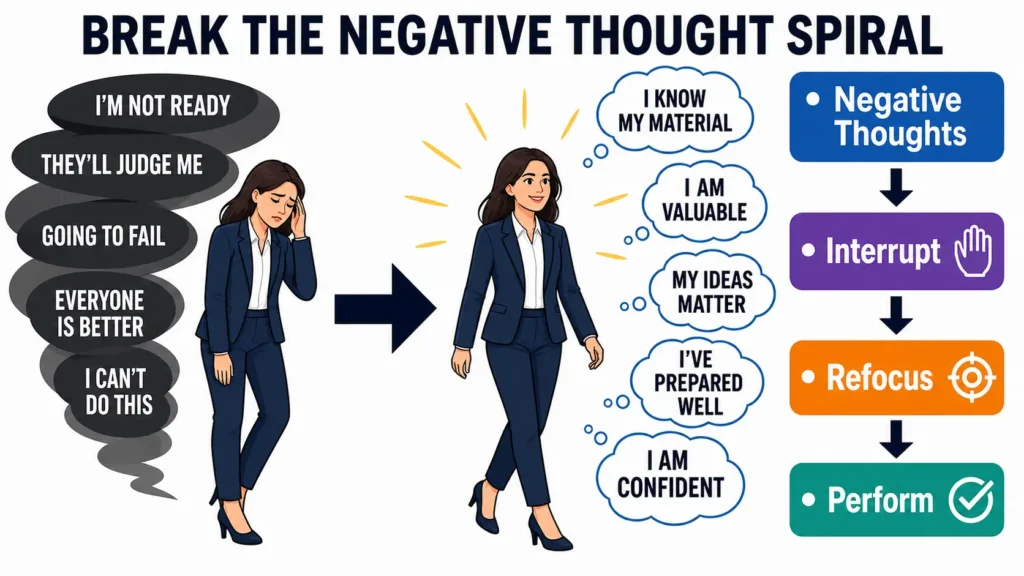
You know the moment. You’re about to walk into a client pitch and a voice says you’re going to blow it. You just got blunt feedback on a proposal, and now you’re replaying it on a loop. A big sale fell through, and your brain is turning one lost deal into proof you’re not cut out for this.
Here’s what most high performers miss. Negative thoughts aren’t the real problem. Everyone has them. The problem is staying stuck inside them while the clock runs down on something that matters. In more than 20 years of training people in NLP and coaching leaders, I’ve watched brilliant professionals lose a room not because they lacked skill, but because they walked in still tangled in their own head.
You don’t need a way never to think negatively. You need a reliable system to interrupt the spiral fast and get your focus back. That’s the PAUSE Method.
Why Negative Thoughts Feel So Sticky
Your brain holds onto the negative on purpose. It’s called the negativity bias, and it’s wiring, not weakness. For most of human history, the person who assumed the rustle in the grass was a predator outlived the optimist. Threat detection kept us alive, so the brain still gives bad news heavier weight and faster processing than good news.
That bias shows up as automatic thinking. A trigger lands, a familiar thought fires, and before you’ve decided anything, you’re three laps into a mental loop. Research from the University of Miami found that the longer your brain holds onto a negative stimulus, the unhappier you tend to report feeling. The stickiness itself, not just the thought, is what wears you down.
Myth check: the “80% of thoughts are negative” claim
You’ve probably seen the stat that we have 60,000 thoughts a day and 80% are negative. It’s everywhere, and it sounds authoritative. It also isn’t supported by any solid study. No large, peer-reviewed research has pinned down a fixed daily percentage that fits everyone.
What actually matters isn’t a number. It’s three things: how long a thought lingers, how much you ruminate on it, and where your attention goes. You can’t always stop the first thought from arriving. You can change what happens next. If you want to go deeper on breaking these cycles, our guide on ways to stop overthinking covers the long game.
What Is an NLP Pattern Interrupt?
A pattern interrupt is a deliberate disruption of an automatic loop. When a negative thought starts running on autopilot, you do something unexpected- a movement, a shift in posture, a change of scene- and that small jolt creates a mental pause so you can choose a different response instead of riding the same track.
A quick note on honesty, because credibility matters. The research base for NLP as a whole is mixed, and you should be wary of anyone promising magic. But the principle underneath a pattern interrupt is well aligned with broader psychology: habitual responses can be disrupted, and disrupting them opens a window for a more deliberate choice. That window is the whole game.
Picture a founder who just got a flat “no” from an investor. Left alone, the mind builds a case: the idea is weak, the runway is shrinking, maybe this was always a mistake. A pattern interrupt stops the prosecution before it reaches its closing argument.
The Fastest Way to Calm Your Nervous System
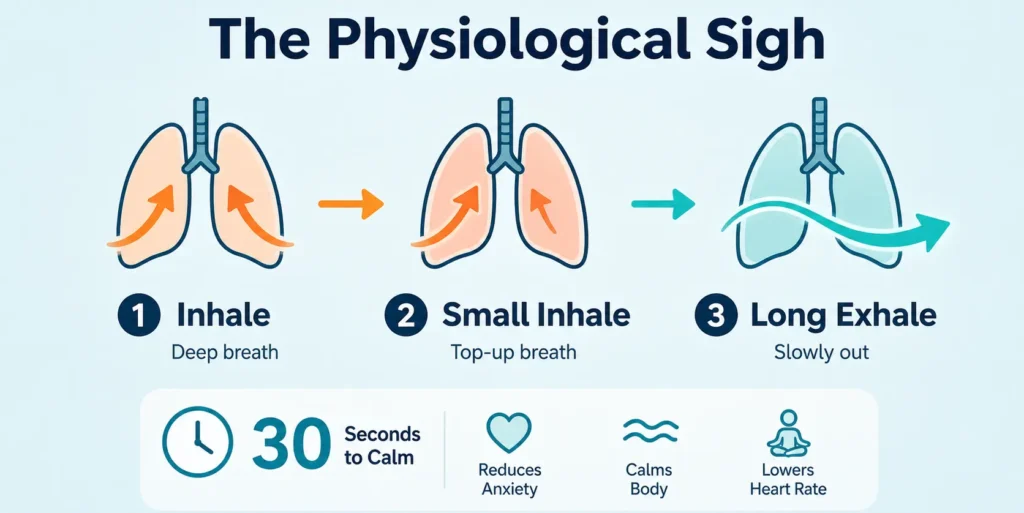
Before you can think clearly, your body has to feel safe. When you’re stressed, breathing turns shallow and fast, which keeps the alarm ringing. The quickest way to switch it off is a breathing pattern called the physiological sigh: two inhales through the nose stacked back to back, then one long, slow exhale through the mouth.
This isn’t folk advice. A 2023 Stanford trial led by researchers including Andrew Huberman compared breathing practices and found that five minutes a day of cyclic sighing improved mood more than mindfulness meditation and lowered resting breathing rate, a marker of a calmer baseline. Even one to three sighs can take the edge off within about 30 seconds. The double inhale reopens collapsed air sacs in the lungs, and the extended exhale tips your nervous system toward its calming, parasympathetic side.
For a professional, that speed is the point. You can run two or three sighs in the elevator before a presentation, in your car before a negotiation, or in the seconds before you answer a difficult email. Nobody notices, and our broader NLP tools for stress management build on the same principle.
Why Naming a Thought Reduces Its Power
There’s a difference between “I’m failing” and “I’m noticing fear.” The first is a verdict about who you are. The second is an observation about what you feel. That shift has a name in the research: affect labeling, often shortened to “name it to tame it.”
UCLA neuroscientist Matthew Lieberman and colleagues found that putting a feeling into words lowers activity in the amygdala, the brain’s threat center, while engaging the prefrontal cortex, the part that reasons and plans. Lieberman compared it to tapping the brakes on your emotional reactions. A later meta-analysis covering two decades of work confirmed the effect holds up across studies, though it’s worth being honest that the effect is real but modest. Naming a feeling turns the volume down. It doesn’t switch it off.
The practical move is precision. “Bad” does almost nothing. “I’m anxious about looking unprepared” does a lot. The more exact the label, the more distance you create between the feeling and your next move.
The 5-Minute PAUSE Method
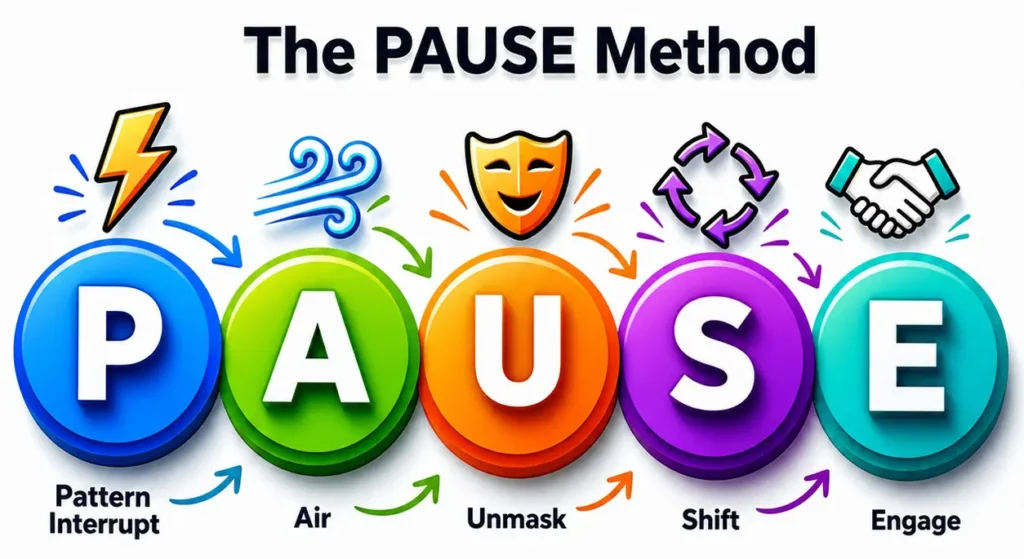
Here’s where the three tools come together into one sequence you can run anywhere. Each step takes about a minute. Five minutes, start to finish.
Pattern Interrupt (1 minute)
Break autopilot with your body. Stand up. Walk to another room. Stretch tall and roll your shoulders. Count backward from 30. Step outside for fresh air. The specific action matters less than the fact that it’s unexpected enough to snap the loop.
This is exactly the shift that changed things for Mike L., a client who came to me drowning in self-doubt, second-guessing, and constant mental noise. Once he learned to interrupt the pattern instead of feeding it, the noise quieted, and he started speaking to people with real confidence at work and in his personal life. The interrupt is small. The downstream effect is not.
Air (1 minute)
Now regulate your physiology before you touch the thought. Run two or three physiological sighs: a full inhale through the nose, a second short sip of air to top off your lungs, then a long, unforced exhale through the mouth. Let the exhale be longer than the inhale. You’re telling your body the threat has passed, which gives your thinking brain room to come back online.
Unmask the Thought (1 minute)
Ask one question: what exactly am I telling myself? Get it out of the fog and into plain words. “I’m going to fail.” “I’m not prepared.” “I’m not good enough.” Then label the feeling underneath it with precision: fear, uncertainty, perfectionism, the sting of being judged. Naming it is what loosens its grip. Often the thought is sitting on top of an older belief, and our guide on how to identify your limiting beliefs helps you spot the pattern.
Shift the Story (1 minute)
This is not positive thinking, and that distinction matters. You’re not slapping a happy slogan over a real concern. You’re challenging the thought and replacing it with something truer and more useful.
Old story: “I’ll embarrass myself in there.” New story: “I’ve handled difficult conversations before, and I can handle this one.”
The new version isn’t a fantasy. It’s evidence-based, and it points you toward action instead of paralysis.
Engage (1 minute)
This is the most important step, and the one people skip. Immediately do one concrete action. Open the laptop. Dial the client. Send the proposal. Walk into the room and start. Action is what stops the loop from restarting, because a busy, engaged brain has no room to re-ruminate. Momentum, not motivation, is what carries you through.
The PAUSE Method at a glance
| Step | What You Do | Why It Helps | Time |
|---|---|---|---|
| Pattern Interrupt | Move, stretch, or change your environment. | Breaks automatic negative thought loops. | ~1 min |
| Air | Take 2–3 physiological sighs. | Calms your nervous system and reduces stress. | ~1 min |
| Unmask | Identify and name the thought and emotion. | Creates emotional distance and reduces its intensity. | ~1 min |
| Shift | Replace the thought with a more realistic perspective. | Encourages clearer, more balanced thinking. | ~1 min |
| Engage | Take one immediate action. | Prevents rumination and builds momentum. | ~1 min |
Best used before meetings, presentations, sales calls, and negotiations, or after rejection, criticism, mistakes, and stressful emails.
How the PAUSE Method Works
The PAUSE Method follows a body-first, mind-second approach. It begins by interrupting automatic thought patterns and calming your nervous system through movement and physiological sigh breathing. Once your body is more regulated, it becomes easier to identify and label negative thoughts, reframe them with a more balanced perspective, and take purposeful action instead of reacting automatically.
Why This Beats Trying to “Think Positive”
Telling yourself to just think positive when you’re genuinely stressed tends to backfire. Your brain knows when you don’t believe the affirmation, and the gap between what you’re saying and what you’re feeling can make things worse. That’s toxic positivity, and it’s not what the PAUSE Method asks of you.
What you’re building instead is psychological flexibility: the ability to feel the thing, name it, and still choose your next move. Reframing works, but the order matters. You calm the body first, create distance from the thought second, and reframe third. Trying to reframe while your nervous system is still in alarm mode is like steering a hydroplaning car.
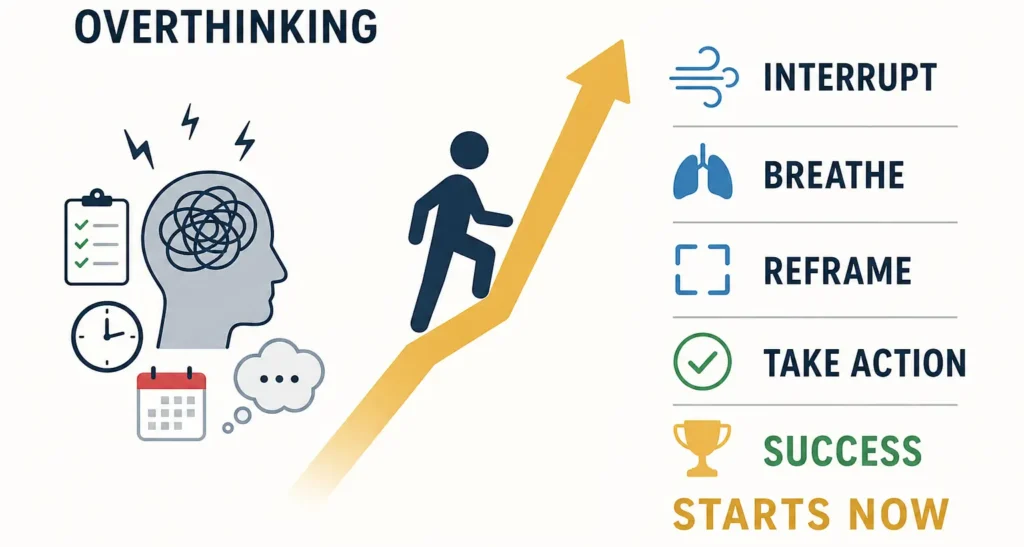
How the PAUSE Method compares to common quick fixes
| Strategy | Speed | Primary Goal | Limitation |
| PAUSE Method | Under 5 min | Interrupt thought loops and regulate stress | Requires deliberate practice |
| Positive affirmations | Instant | Change self-talk | Can feel hollow when emotions run high |
| Thought suppression | Variable | Push thoughts away | Often triggers a rebound and they return louder |
| Brief mindfulness | 5 to 20 min | Improve attention and regulation | Harder to deploy in the seconds before a high-stakes moment |
Common Mistakes When Using the PAUSE Method
To get the best results, avoid these common mistakes:
- Skipping the breathing step, which makes it harder to calm your nervous system before reframing.
- Forcing positive thinking instead of replacing negative thoughts with realistic, evidence-based perspectives.
- Using vague emotional labels like “I feel bad” instead of identifying the specific emotion, such as fear, frustration, or self-doubt.
- Delaying action after reframing, allowing rumination to restart.
- Expecting immediate long-term change, rather than building the habit through consistent practice.
Who Should Use It and Who Shouldn’t
The PAUSE Method is built for professionals, entrepreneurs, leaders, students, and creators who hit everyday negative thought loops and need to regain focus fast. If your spirals tend to show up around performance, feedback, and high-stakes decisions, this is for you.
It is not a replacement for therapy or psychiatric care. If you’re dealing with persistent anxiety, trauma, panic attacks, depression, or any thoughts of self-harm, please reach out to a licensed mental health professional. A five-minute reset is a useful tool in a much bigger toolkit, and the strongest, most self-aware people are the ones who know when to bring in real support.
Data & Findings
Research and client experience point to the same conclusion: regulating your physiology before challenging negative thoughts improves emotional control and performance under pressure.
Unleash Your Power Client Performance Report (2026): Professionals who consistently used a structured pre-performance reset reported steadier focus, greater confidence, and faster recovery from setbacks during the first month of daily practice.
Stanford breathing study (2023): Participants who practiced five minutes of cyclic sighing daily for one month reported greater improvements in mood than those practicing mindfulness meditation, while also lowering their resting breathing rate.
UCLA affect-labeling research: Studies show that accurately naming an emotion reduces activity in the brain’s threat-response system and increases engagement of areas involved in reasoning and self-control. The effect is consistent across multiple studies, though modest rather than dramatic.
Frequently Asked Questions
Does this really work in five minutes?
The reset itself takes about five minutes, and many people feel calmer after the breathing step alone. The deeper benefit, catching loops earlier and recovering faster, builds with repetition over a few weeks.
Is the PAUSE Method backed by science?
Two of its three core tools are well supported. The physiological sigh comes from a 2023 Stanford trial, and affect labeling rests on more than 20 years of UCLA research. The pattern interrupt draws on NLP, where the broader evidence is mixed, though the underlying idea of disrupting automatic responses is sound.
Is this an NLP technique?
It’s NLP-informed. The pattern interrupt and reframing steps come from NLP, and they’re combined here with breathing and labeling research for a more complete, evidence-aware method.
Can I use it before public speaking?
Yes. It’s designed for exactly these moments. Run a pattern interrupt and a few physiological sighs in the minutes before you go on, then engage by starting strong.
Can it stop a panic attack?
It may take the edge off acute stress, but it isn’t a treatment for panic disorder. If you experience panic attacks, please work with a licensed professional for proper care.
Can I use the PAUSE Method every day?
Yes. Daily practice helps make each step feel more natural, so you’re more likely to use the technique automatically during stressful situations like presentations, meetings, or difficult conversations. Even a few minutes of regular practice can improve your ability to interrupt negative thought patterns before they escalate.
What’s the difference between this and meditation?
Meditation is usually a longer practice for general attention and calm. The PAUSE Method is a short, targeted reset you deploy right before or after a specific high-pressure event.
Why doesn’t positive thinking always work?
When your nervous system is in alarm mode, your brain rejects affirmations it doesn’t believe. Calming the body and naming the feeling first is what makes a genuine reframe stick.
Conclusion
The PAUSE Method is a five-step mental reset that combines Pattern Interrupt, Air, Unmask, Shift, and Engage to help interrupt negative thought loops before presentations, meetings, negotiations, sales calls, and other high-pressure situations.
By regulating your body first and then reframing your thoughts, it helps you regain focus and respond more effectively to everyday stress. While it can be a valuable performance and resilience tool, it is not a substitute for professional mental health care if you are experiencing persistent anxiety, depression, trauma, or other clinical conditions.
If you want to build lasting mental resilience beyond the five-minute reset, explore our deeper work on overcoming negative thought patterns with NLP and our daily NLP confidence exercises to make the calm your default.
Unleash Your Power: Stand Out, Take Action, and Create the Success You Want.