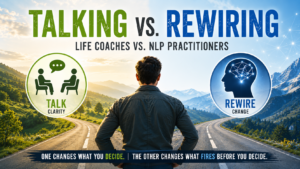
You know the belief is there because you can hear it. “I’m not good enough for that role.” “I’ll just fail again.” “People like me don’t get to have that.” It runs quietly in the background, and it shapes what you try, what you avoid, and what you settle for.
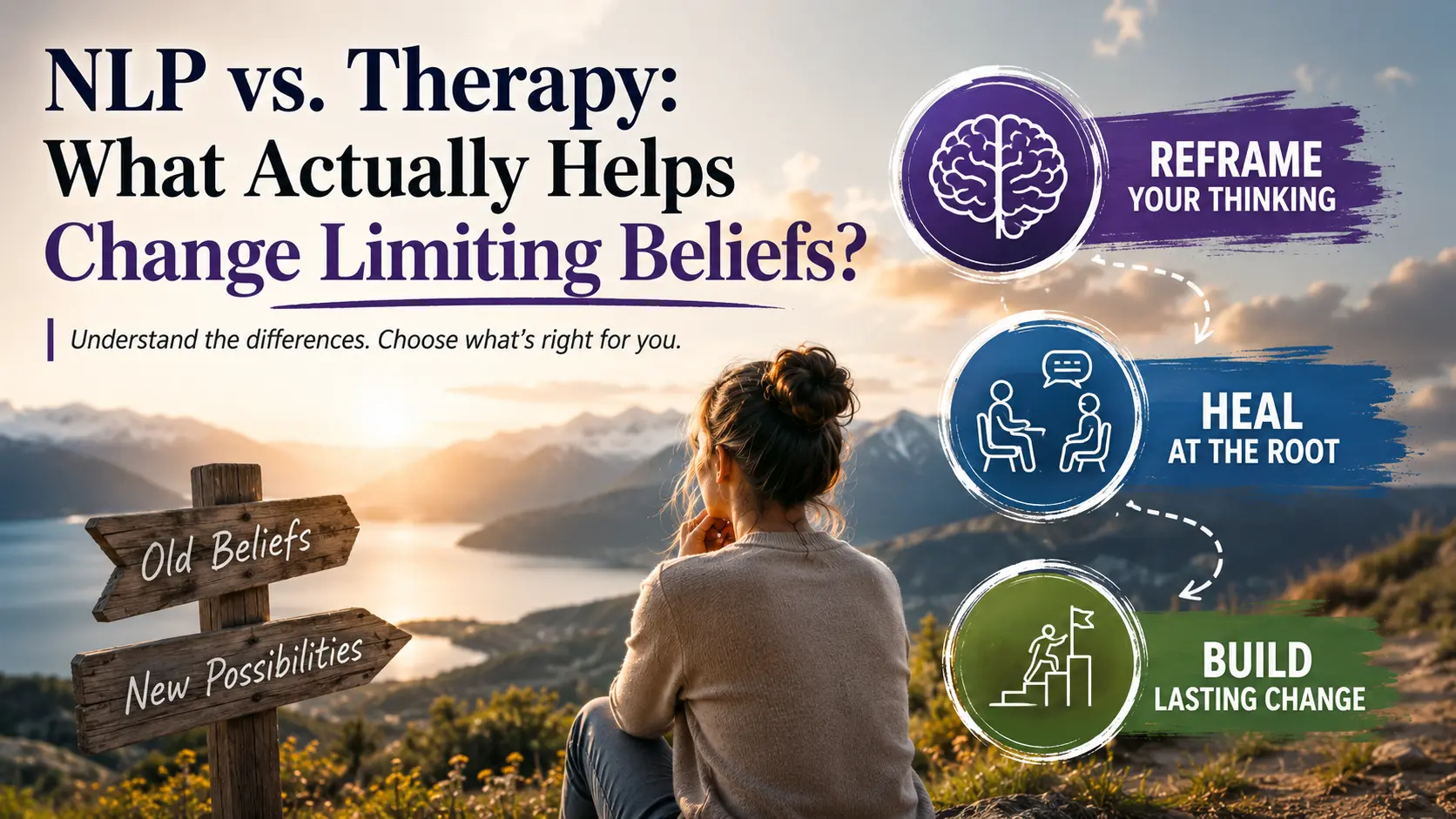
Most people go looking for the fastest way to switch that voice off. Two of the most common paths are Neuro-Linguistic Programming (NLP) and traditional therapy, and they approach the same problem from very different angles. One leans toward rapid cognitive reframing. The other leans toward a deeper understanding backed by decades of research.
Here’s the honest preview: therapy has the stronger evidence base, NLP focuses on fast, practical reframing, and for a lot of people, the smartest move is some combination of the two, depending on what’s actually going on. Let’s break down how each one works so you can choose with clarity instead of guesswork.
Key Takeaway:
- NLP and traditional therapy both help people overcome limiting beliefs, but they use different approaches. NLP is solution-focused and aims to change unhelpful thought patterns and behaviors through techniques such as reframing, visualization, and anchoring, while therapy often explores the emotional roots of beliefs to promote deeper psychological healing. [1]
- NLP may be well suited for improving confidence, communication, performance, habits, and mindset, whereas therapy is generally the better choice for addressing mental health conditions, trauma, anxiety disorders, depression, or complex emotional challenges that require clinical support. [1]
- The most effective approach depends on your goals. Some individuals benefit from using NLP alongside therapy using therapy to process emotional experiences while applying NLP techniques to reinforce empowering beliefs and practical behavioral change. [2]
- Before choosing either approach, consider the nature of your challenge, the qualifications of the practitioner, and the outcomes you want to achieve. NLP coaching is not a substitute for licensed mental health treatment when clinical care is needed. [2]
Bottom Line: NLP and therapy each have unique strengths for changing limiting beliefs. NLP focuses on practical, future-oriented mindset shifts, while therapy emphasizes emotional understanding and healing. Choosing the right approach or combining both can help you create lasting personal growth based on your individual needs.
- Source: Unleash Your Power – NLP vs Therapy: Which Is Better for Changing Limiting Beliefs?
- Source: FAQs Section
Is NLP or Therapy Better for Limiting Beliefs?
Neither one is universally “better.” They solve different problems. NLP is a coaching-style approach built for speed and practical change. It tends to suit people who want to build confidence, sharpen communication, prepare for leadership, or clear a specific performance block, and who are otherwise functioning well.
Traditional therapy is delivered by licensed professionals and carries a far stronger research base. It’s the right choice when limiting beliefs are tangled up with trauma, depression, anxiety disorders, or anything that’s affecting your ability to function day to day.
Many people get the best results by combining them, using therapy to work through deeper emotional patterns and NLP-style coaching to reinforce new habits, communication skills, and goals. The deciding factor isn’t speed. It’s the depth and nature of what you’re working on.
What Are Limiting Beliefs?

A limiting belief is a conclusion you’ve drawn about yourself, other people, or how the world works that quietly caps what you’ll attempt. It feels like a fact. It’s really a story.
These stories don’t appear out of nowhere. They form through childhood experiences, repeated events, and the way the people around us responded to us early on. Over time, conditioning and self-talk reinforce them, and confirmation bias does the rest, because once you believe something, your brain keeps noticing the evidence that fits and skipping the evidence that doesn’t.
A few that show up again and again:
- “I’m not good enough.”
- “I’ll always fail at this.”
- “Success changes people, so I shouldn’t want it.”
- “I don’t deserve to be happy.”
None of these is true in any fixed sense. They’re learned, which is exactly why they can be unlearned.
How Do You Identify Your Own Limiting Beliefs?
You can’t change a belief you can’t see. The first move is always awareness, and your behavior usually points the way before your conscious mind catches up.
Common Signs
Limiting beliefs tend to leave fingerprints. Watch for:
- Procrastination on things that matter to you
- Perfectionism that stops you from finishing or shipping
- Imposter syndrome, the sense that you’ll be “found out”
- Fear of success, not just fear of failure
- Fear of rejection that keeps you small in rooms where you belong
If you recognize a few of these, you’re in good company. There are some of the most common mental blocks that keep capable people overthinking instead of acting.
Reflection Questions
Sit with these honestly, and write down whatever surfaces:
- What do I assume about myself in situations where I hold back?
- What do I consistently avoid, and what am I telling myself about it?
- What story repeats every time things get hard?
A Simple Journaling Exercise
For one week, jot down the moment you hesitate or back off on something, and the sentence running through your head at that exact second. Don’t analyze it yet. Just collect it. By the end of the week, you’ll see the same two or three beliefs show up over and over. Those are your targets.
How Traditional Therapy Works on Limiting Beliefs
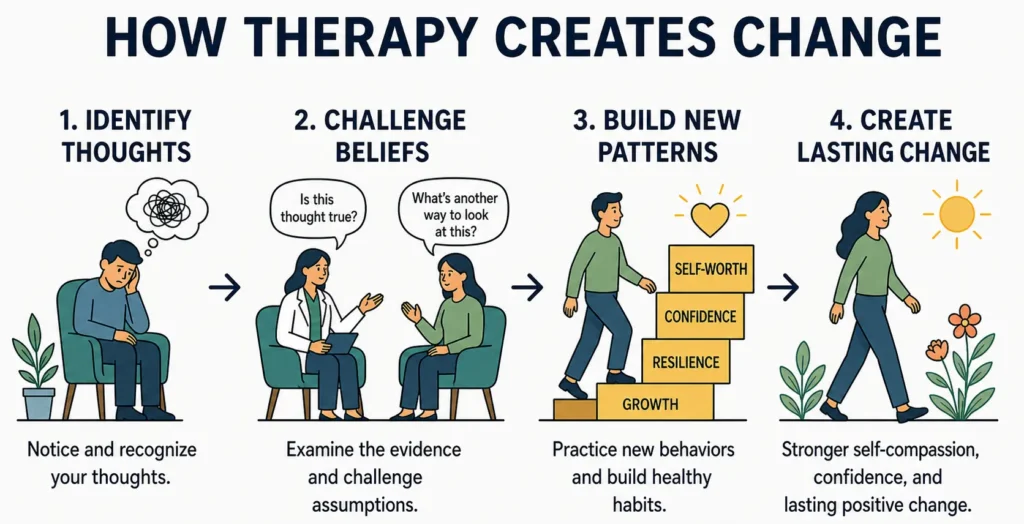
Traditional therapy treats limiting beliefs as part of a larger emotional and psychological picture, and it has serious research behind it.
Cognitive Behavioral Therapy (CBT) is the most studied example. Its core premise, going back to the work of Aaron Beck, is that emotional distress is maintained by maladaptive beliefs and underlying schemas about ourselves and our future. CBT uses cognitive restructuring to surface those beliefs, test them against reality, and replace them, often paired with behavioral experiments where you act against the belief and gather new evidence. Emotional processing is part of the work, too, not just logic.
CBT isn’t the only option. Acceptance and Commitment Therapy (ACT) helps you change your relationship to a thought rather than fighting it. Schema Therapy works directly with deep, long-standing patterns. Psychodynamic therapy explores where those patterns came from in the first place. A good therapist matches the method to the person, so it’s a mistake to treat CBT as the whole of therapy.
The strength here is rigor, regulation, and the ability to treat clinical issues safely. That matters enormously when a belief is sitting on top of something heavier.
How NLP Approaches Limiting Beliefs
NLP comes at the same problem from the language-and-pattern side. Rather than spending long stretches mapping the origin of a belief, it works on how you represent and respond to that belief right now.
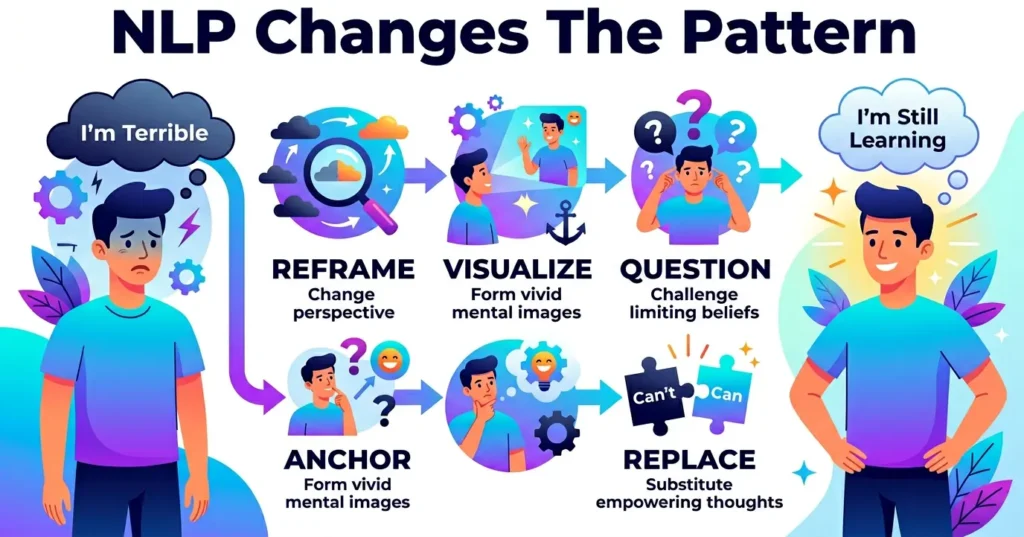
The practical tools include:
- Reframing, which changes the meaning you assign to a situation.
- Language patterns that shift absolute, defeating statements into open ones.
- Visualization, mentally rehearsing the outcome you want until it feels familiar.
- Anchoring, linking a calm or confident state to a physical cue you can trigger on demand.
- Belief examination, questioning whether the belief is actually 100 percent true and what evidence contradicts it.
A quick example of the reframe in action. “I’m terrible at public speaking” carries a verdict. “I’m still developing my confidence speaking” carries a direction. Same situation, very different instructions to your brain.
Across two decades of training and coaching as a Board Designated NLP Trainer, James has watched that kind of shift help people reframe the recurring negative thoughts that were quietly running the show. It’s fast and it’s practical. It’s also worth being clear-eyed about its limits, which the data below makes plain.
NLP vs. Traditional Therapy: The Real Difference
| Factor | NLP | Traditional Therapy |
| Primary goal | Change thought and language patterns | Understand and change thoughts, emotions, and behaviors |
| Typical pace | Often shorter coaching interventions | Varies widely by approach and need |
| Evidence base | Mixed and limited | Stronger, well-researched |
| Best for | Confidence, communication, coaching, performance | Trauma, anxiety, depression, clinical concerns |
| Professional regulation | Varies by practitioner | Licensed, regulated professionals |
The short version: NLP is built for targeted, practical change in people who are doing okay and want to do better. Therapy is built for depth, complexity, and clinical care delivered by a regulated professional.
Data & Findings
Here is what the published evidence actually shows when you put the two approaches side by side. The research base for therapy is large and measurable. The research base for NLP is real but far smaller, and being honest about that gap helps you use each tool in the right place.
| Finding | The numbers | Source |
| CBT is effective for depression, but not clearly superior to other established psychotherapies | Meta-analysis of 409 trials and 52,702 patients (2023) | Psychology Today summary of Cuijpers et al., World Psychiatry |
| CBT improves subclinical depression and helps prevent it from escalating to major depression | 23 randomized trials, 5,877 participants; risk ratio of 0.62 for preventing the transition | Systematic review and meta-analysis, NCBI |
| CBT’s real-world effect sizes are often modest, and review quality varies a lot | Panoramic meta-review covering 494 systematic reviews | Psychological Medicine, Cambridge |
| NLP’s formal evidence base is mixed and limited, and it works best as a complement to care | Commonly used alongside therapy rather than as a standalone clinical treatment | Harbor Mental Health: What Is NLP Therapy |
What this means in practice
Therapy and CBT in particular have the depth of research to be the responsible choice for clinical concerns, even though their effects are realistic rather than miraculous. NLP doesn’t have that volume of controlled evidence, so it’s most defensible as a practical coaching toolkit for confidence, communication, and performance goals, used alongside professional care when care is needed.
A note from the coaching side
This is a qualitative observation, not a clinical trial. Across James’s coaching practice, the most consistent pattern isn’t a percentage; it’s a sequence: clients who name one specific belief and take action against it tend to shift faster than clients trying to overhaul everything at once. That lines up with the research point below: that practice and behavior change do the heavy lifting.
So What Actually Helps Change Limiting Beliefs?
If you’re hoping for one method that erases a belief permanently, the truth is that neither a single NLP technique nor therapy on its own guarantees it. Belief change is a process, not a switch.
Across both approaches, the same ingredients keep showing up:
- Awareness of the belief and when it fires
- Questioning the assumption instead of obeying it
- New experiences that contradict the old story
- Repeated practice so the new pattern outlasts the old one
- Behavior change that proves the new belief with action, not just words
Whichever path you take, lasting change comes from doing the reps. That’s the part no method skips.
When Should You Choose NLP?
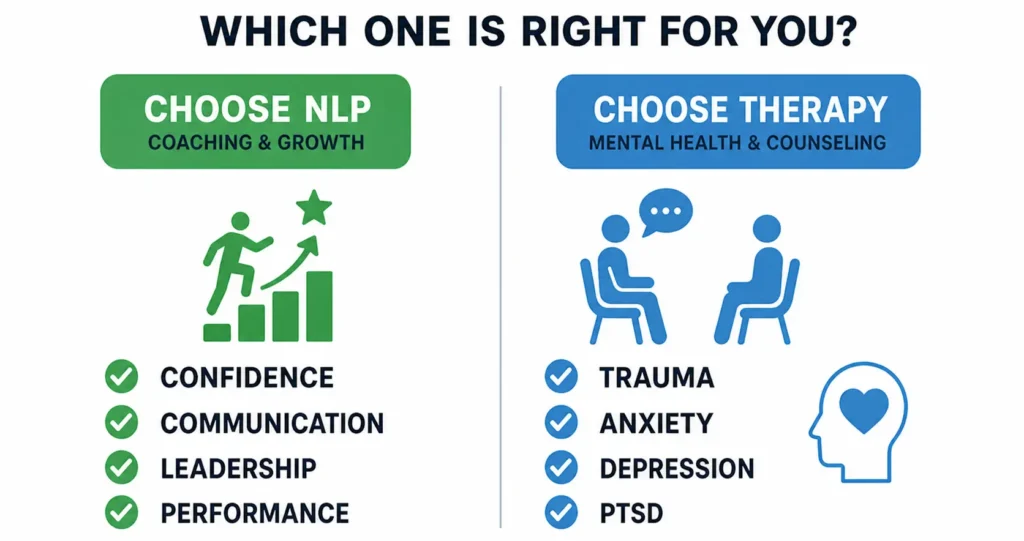
NLP coaching tends to be a strong fit when you’re functioning well and want to:
- Build everyday confidence
- Improve how you communicate and connect
- Prepare for a leadership step or a high-stakes moment
- Clear a specific performance block
- Make real progress toward personal or professional goals
If that sounds like you, this is exactly the territory where a practical, evidence-aware NLP approach earns its keep.
When Is Therapy the Better Choice?
Choose therapy, and choose a licensed professional, if you’re dealing with:
- Trauma or PTSD
- Depression
- Anxiety disorders
- Suicidal thoughts
- Any significant disruption to your daily functioning
These situations deserve qualified mental health care. No coaching method is a substitute for that, and a good coach will tell you so and point you in the right direction.
Can NLP and Therapy Work Together?
For a lot of people, yes, and they play complementary roles.
Therapy can explore and treat the deeper emotional patterns underneath a belief, safely and professionally. NLP-based coaching can then help reinforce the new pattern in daily life, sharpening communication, rebuilding confidence, and keeping you accountable to your goals. One does the deeper repair. The other helps you build forward on top of it. The key is sequence and honesty: NLP supports the work, it doesn’t replace the care.
A Practical Four-Step Process for Working on a Belief
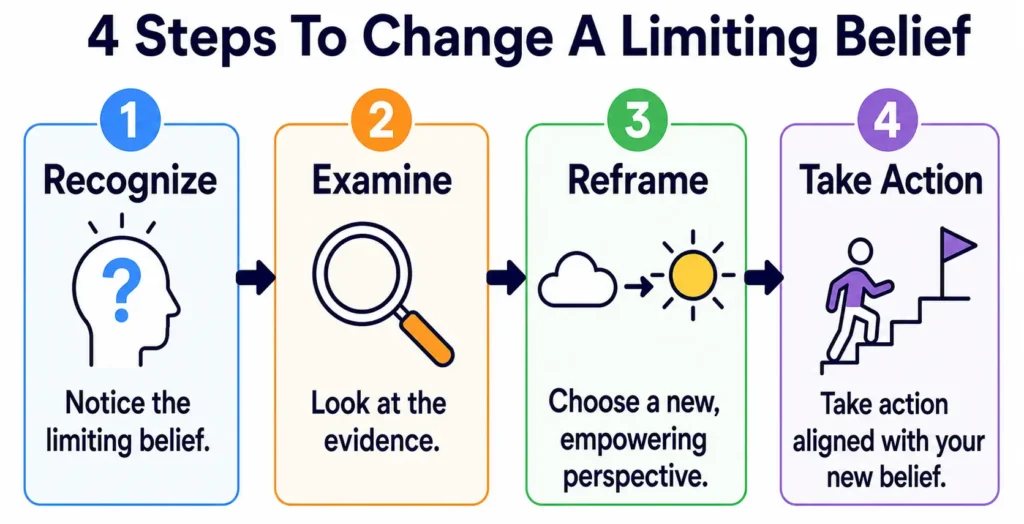
This is a coaching exercise you can try, not a validated clinical protocol. It draws on simple NLP-style reframing, and it pairs naturally with whatever professional support you may be working with.
- Recognize the belief. Name the exact sentence running in your head. Vague pressure can’t be worked on. A specific belief can.
- Examine the evidence. Ask whether it’s 100 percent true, then list the moments that contradict it. Most limiting beliefs fall apart under one honest counterexample.
- Replace it with a more accurate perspective. Not blind positivity. A truer, more useful version. “I always fail” becomes “I’ve struggled here before, and I’m still learning how to do it well.”
- Reinforce the new pattern through action. Take one small step that the new belief would take. Action is what turns a nice idea into a belief your nervous system trusts.
A Real Client Example
The following is one individual’s experience, shared as an example rather than as proof of what NLP will do for everyone.
A client we’ll call Darren came to James feeling stuck and stalled. He had a job that paid well, yet promotions, raises, and the idea of building something of his own all felt permanently out of reach. The challenge looked external. The real driver was a belief that there was simply something holding him back that he couldn’t have what he wanted.
Working together, that belief surfaced and was examined directly, the kind of “goal block” that almost everyone carries in some form. As Darren tested it and replaced it, his thinking shifted, his behavior followed, and the changes showed up not just at work but in his relationships too. The lesson worth taking from it isn’t “NLP fixes careers.” It’s that naming a belief and acting against it can free up movement that felt impossible while the belief ran unchecked.
Frequently Asked Questions
Can NLP remove limiting beliefs?
NLP can help you reframe and weaken limiting beliefs, and many people report real improvement. It’s better described as a tool for changing beliefs through practice than a one-time removal, and it works best for non-clinical goals.
Is NLP better than CBT?
Not in terms of evidence. CBT has a far larger research base and is the more appropriate choice for clinical conditions. NLP can be a useful, faster coaching tool for confidence, communication, and performance goals.
How long does it take to change a limiting belief?
It varies by the person and the belief. Surface-level beliefs can shift quickly with coaching, while deeper patterns usually take consistent practice over weeks or months, and sometimes professional support.
Can coaching replace therapy?
No. Coaching, including NLP, is not a substitute for therapy or clinical care. If you’re dealing with trauma, depression, anxiety disorders, or any significant impairment, work with a licensed professional.
What causes limiting beliefs?
They typically form through childhood experiences, repeated events, conditioning, and self-talk, then get reinforced by confirmation bias as your brain notices evidence that fits the belief.
Are limiting beliefs always formed in childhood?
Often, but not always. Many take root early, while others develop later through significant experiences, setbacks, or repeated feedback in adulthood.
Can therapy and NLP be combined?
Yes. A common pattern is using therapy to treat deeper emotional patterns and NLP-style coaching to reinforce new habits, communication, and goals.
Which approach is right for me?
If you’re functioning well and want practical growth in confidence, communication, or performance, NLP coaching is a strong fit. If beliefs are tied to clinical concerns, start with a licensed therapist. When in doubt, combining both is reasonable.
The Bottom Line
There’s no single method that “cures” limiting beliefs, and anyone promising that is overselling it. Different approaches suit different people, different goals, and different levels of complexity. Lasting change usually comes from the same place every time: honest self-awareness, evidence-based strategies where they’re needed, and consistent practice that turns a new belief into a lived one.
If your goals are growth, confidence, communication, and performance, and you want a practical, evidence-aware coaching approach, that’s exactly what NLP training and coaching are built for. They complement appropriate mental health care, and they never replace it. If you want to know more about the path behind this work, here’s James’s own story of moving from stuck to clear.
You have more say over those old stories than they’ve let you believe. Unleash Your Power: Stand Out, Take Action, and Create the Success You Want.