
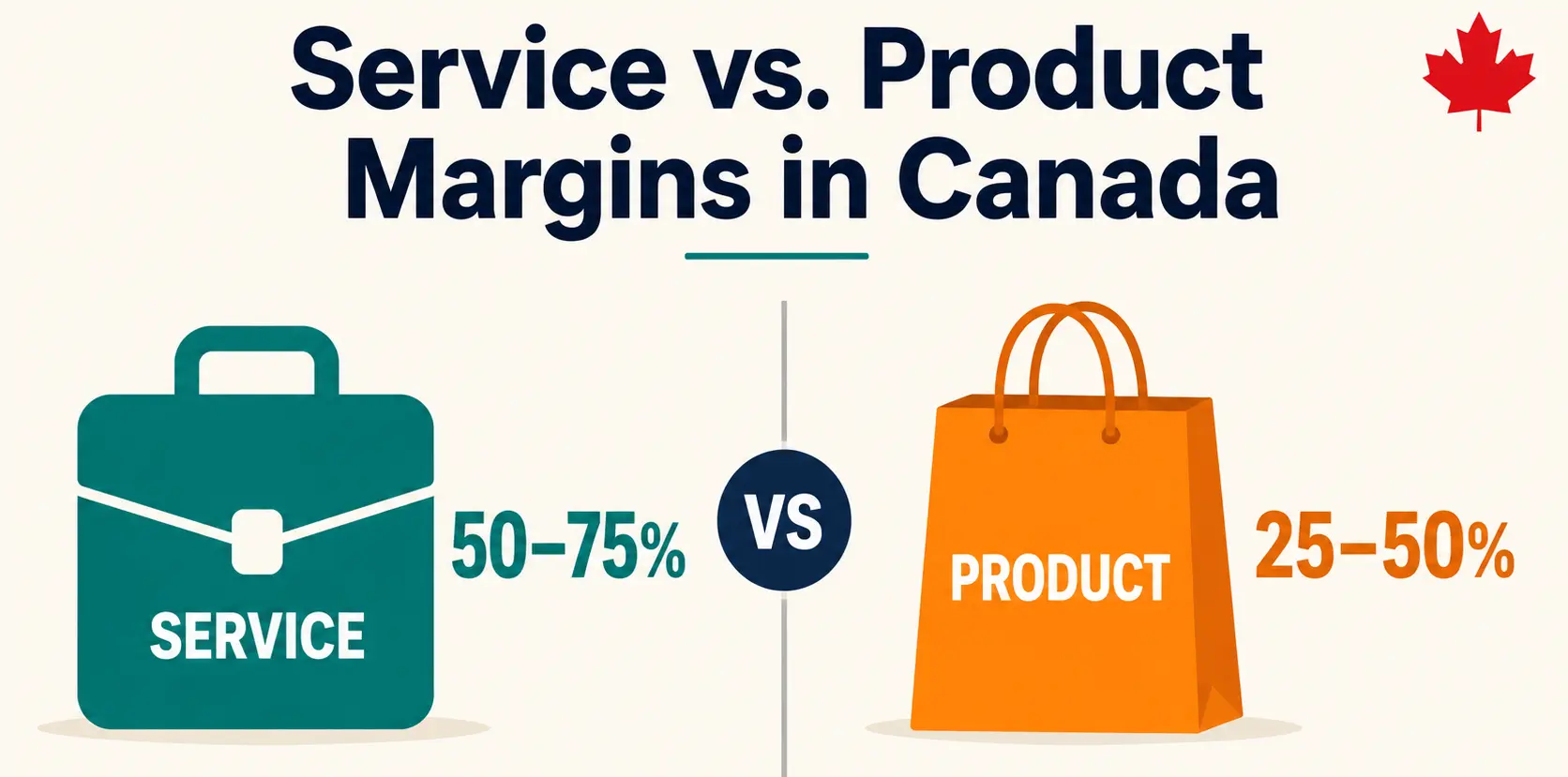
Service vs product: In Canada, service businesses usually generate higher gross margins than product businesses because they avoid inventory, warehousing, shipping, and manufacturing costs. Many Canadian service firms operate with gross margins between 50% and 75%, while product-based businesses often land between 25% and 50%, depending on inventory model and scale.
However, high margins do not automatically create stronger businesses. Service businesses are frequently limited by founder capacity, labour intensity, and burnout risk. Product businesses can build transferable assets, scalable systems, and higher enterprise value over time.
The strongest model for many Canadian entrepreneurs is often a hybrid or productized service business that combines recurring systems with high-margin expertise. The right choice depends on your goals, available capital, risk tolerance, and desired lifestyle.
Key Takeaway:
- Service businesses generally achieve higher profit margins than product-based businesses because they have lower overhead, little or no inventory, and can scale expertise through premium pricing, retainers, and recurring revenue. Product businesses typically require higher sales volume to offset manufacturing, shipping, and inventory costs. [1]
- For Canadian entrepreneurs, the most profitable service models often include consulting, coaching, agencies, and professional services, while product businesses can generate greater long-term scale through strong branding, operational efficiency, and repeat customer purchases. [1]
- Choosing between a service or product business depends on your goals. Services usually provide faster cash flow, lower startup costs, and higher margins, whereas products demand greater upfront investment but offer opportunities for automation, wider market reach, and scalable revenue over time. [2]
- Many successful Canadian entrepreneurs combine both models by using high-margin services to generate predictable cash flow while developing complementary products that diversify income and increase long-term business value. [2]
Bottom Line: Service businesses typically deliver higher profit margins and faster profitability, while product businesses offer greater scalability and brand-building potential. Selecting the right model or combining both, depends on your financial goals, expertise, available capital, and long-term growth strategy.
You are weighing two paths and wondering which one actually pays better. It is one of the most consequential decisions a Canadian entrepreneur makes, and most of the advice online either oversimplifies it (“services always win”) or buries you in US-centric data that ignores how things actually work here.
The truth is more useful and more interesting. Margins matter, but they are only one part of the story. After 20+ years coaching business owners through this exact decision, I have watched people pick the “higher margin” model and still build a business that drains them, while others pick the “lower margin” model and create real wealth. The difference is rarely the math. It is the fit between the model and the person running it.
Here is what the data actually says, what the numbers leave out, and the framework I use with clients to make the call.
What Is the Difference Between a Service Business and a Product Business?
A service business earns revenue by delivering expertise, labour, or professional outcomes to clients. Examples include consulting, coaching, accounting, and marketing agencies.
A product business earns revenue by selling physical or digital products. Examples include eCommerce stores, SaaS companies, consumer brands, and manufacturers.
The primary difference is that service businesses sell time and expertise, while product businesses sell assets that can often be replicated and scaled more efficiently.
Service vs. Product Margins in Canada
A service business usually generates higher gross margins because it avoids inventory, manufacturing, warehousing, and shipping costs. Most Canadian service businesses operate with gross margins between 50% and 75%.
A product business typically generates lower gross margins, often between 25% and 50%, but offers stronger scalability, higher enterprise value, and more transferable assets.
For many Canadian entrepreneurs, a productized service model delivers the best combination of profitability, scalability, and operational flexibility.
Services typically win on early cash flow and pre-launch simplicity. Products often win on scalability and the asset value you can eventually sell. Margin alone is the wrong lens for choosing between them, which is why founders who optimize purely for percentages frequently end up frustrated within two years.
| Factor | Service Business | Product Business |
| Typical Gross Margin | 50–75% | 25–50% |
| Typical Net Margin | 10–20% | 5–15% |
| Startup Capital Required | Low | Moderate to High |
| Inventory Costs | Minimal | Significant |
| Scalability | Moderate | High |
| Time-to-Revenue | Fast | Slower |
| Founder Dependence | High | Lower Over Time |
| Enterprise Value Potential | Moderate | High |
| GST/HST Complexity | Simpler | More Complex |
Why Service Businesses Usually Have Higher Gross Margins

Service businesses generate higher gross margins because they sell knowledge, time, and expertise rather than physical goods. There is no raw material to buy, no factory to run, no shipping container to fill, and no warehouse to lease. Your cost of delivery is mostly labour and a few software subscriptions, which is why Canadian benchmark data from BDC shows law firms, banks, and technology services routinely reporting gross profit margins in the high-90% range while clothing retailers operate between 3% and 13%.
For most Canadian service firms, a healthy gross margin sits between 50% and 75%, and specialized professional services regularly cross 70%. Anything under 40% usually signals a pricing problem, a scope creep problem, or an inefficient delivery model that the owner has not addressed yet.
A few sectors consistently land at the top of this range in Canada:
- Consulting and advisory work
- Coaching and training
- Accounting and bookkeeping
- Marketing and creative agencies
- IT services and managed technology
This is also why services have become the default first move for so many Canadian entrepreneurs during periods of economic uncertainty. You can launch with a laptop, a few software tools, and your expertise. Cash flow starts the day you close your first client. No inventory means no capital sitting on a shelf, and no warehouse lease means no fixed costs hanging over your head if a quarter goes sideways.
Why Product Businesses Can Create More Long-Term Wealth
Service businesses often maximize income. Product businesses often maximize equity. That distinction matters more than founders realize, because the question “which earns more” and the question “which creates more wealth” do not always have the same answer.
Product businesses scale differently. Once you have built the systems, the supply chain, and the brand, the next unit you sell does not cost you proportionally more time. Your inventory, your customer list, your manufacturing relationships, and your brand recognition all become transferable assets that someone else can buy. A service firm where the founder is the product has limited resale value. A product brand with clean operations and recurring revenue can sell for a meaningful multiple.
This is especially clear in software. Salesforce maintains gross margins around 75%, and Dropbox has reported margins above 80% because once the software is built, serving an additional customer barely costs anything. SaaS companies broadly target gross margins of 75% or higher, with strong performers approaching 90%, and that scalability is exactly what makes them so valuable when sold.
Physical product businesses do not reach SaaS-level margins, but they still build equity in ways services struggle to match. Owned brands in Canadian retail and eCommerce typically operate with 40% to 60% gross margins, and that inventory, brand, and customer base become an asset you can grow, refinance, or eventually sell.
The core thesis is simple. If you want immediate income, services win more often than not. If you want to build something with transferable value, products tend to win on a long enough timeline.
How Business Margins Actually Work
Many entrepreneurs focus only on gross margin, but profitability is determined by multiple layers of costs.
| Metric | Formula | Why It Matters |
|---|---|---|
| Revenue | Total Sales | Top-line income |
| Gross Profit | Revenue – Direct Costs | Shows production efficiency |
| Gross Margin | Gross Profit ÷ Revenue | Indicates pricing strength |
| Operating Profit | Gross Profit – Expenses | Measures business performance |
| Net Profit | Revenue – All Expenses | Actual money kept |
The Hidden Costs Most Margin Calculators Ignore

Gross margin is a great metric. It is also a misleading one when it stands alone, because the costs that quietly erode profitability rarely show up in the COGS column.
Service Business Hidden Costs
When you run a service business, the founder bottleneck is the cost that no spreadsheet captures. You are the rainmaker, the deliverer, the project manager, and often the customer support team. Revenue is directly tied to your hours, and your hours are finite. Most service founders hit a ceiling somewhere between $150K and $400K in personal revenue before something has to change.
Other costs show up over time:
- Scope creep: when projects expand past their original quote.
- Hiring limitations: specialized talent is expensive and slow to ramp up.
- Utilization ceilings: that cap how much billable work any person can produce.
- Burnout: which costs you clients, energy, and decision quality.
- Client acquisition fatigue: when every quarter starts at zero again.
Product Business Hidden Costs
Product businesses carry a different set of margin killers, and most of them sit outside the cost of the product itself. Inventory carrying costs, dead stock, returns, shipping, and platform fees can quietly take 15 to 25 percentage points off your gross margin before you notice. Canadian retail businesses commonly settle into net profit margins of 5% to 10% precisely because of these layered costs.
The big ones to model carefully:
- Inventory carrying costs, including warehousing, insurance, and shrinkage.
- Dead stock when buying decisions go wrong.
- Returns and reverse logistics, which Canadian customers expect to be free
- Shipping costs are especially high across Canada’s wide geography
- Cross-border complexity for anything sourced from or sold to the US
- Platform fees on Shopify, Amazon, payment processors, and ad networks
A service business with a 65% gross margin can absolutely become unprofitable if the founder burns out. A product business with a 35% gross margin can absolutely thrive if the systems are tight. High margin percentages do not save you from operational fragility.
Service vs Product Business Comparison
| Category | Service Business | Product Business |
|---|---|---|
| Startup Cost | Low | Medium to High |
| Inventory | None | Required |
| Cash Flow Speed | Fast | Slower |
| Scalability | Moderate | High |
| Founder Dependence | High | Lower |
| Exit Value | Moderate | High |
| Operational Complexity | Lower | Higher |
| Customer Acquisition | Relationship Driven | Marketing Driven |
| Gross Margins | Higher | Lower |
| Enterprise Value | Lower | Higher |
How GST/HST and Canadian Tax Rules Affect Margins

GST/HST is one of the most overlooked factors in this comparison, and it consistently favours service businesses on net margin once you understand how it works.
Both models face the same $30,000 small supplier threshold. Once your taxable revenue crosses that line over four consecutive quarters, you have to register and start collecting GST or HST on your sales. Where the models diverge is on the input side. Product businesses can claim significant Input Tax Credits on inventory purchases, shipping, packaging, and manufacturing supplies, which helps offset the tax you collect. Service businesses have fewer ITCs to claim because their primary expense is usually labour, which is not subject to GST/HST.
That sounds like a product advantage, and on the surface, it is. But the CRA Quick Method of Accounting often flips the calculation for service firms. The Quick Method lets eligible businesses with annual taxable revenues under $400,000 remit GST/HST at a reduced rate rather than tracking every input credit. Service businesses with low GST/HST-bearing expenses frequently come out ahead by a meaningful amount when they elect the Quick Method, effectively adding 1% to 3% to their net margin without changing pricing or operations.
The Quick Method is not available to every type of business. Accountants, financial consultants, lawyers, bookkeepers, and a handful of other professional service categories are excluded. Most other Canadian service businesses can use it, and a quick conversation with your accountant is usually all it takes to confirm eligibility.
Beyond GST/HST, product businesses also navigate provincial sales tax in BC, Manitoba, and Saskatchewan, Quebec Sales Tax for QC sales, and place-of-supply rules that determine which tax applies when you ship across provincial lines. Service businesses generally have a far simpler compliance picture. Tax simplicity is rarely listed as a margin advantage, but compounded over years, it represents real money and real time saved.
Common Mistakes Entrepreneurs Make When Comparing Margins
Many founders choose a business model based on gross margin alone and overlook the operational realities that determine long-term success.
- Ignoring Founder Time: A 70% margin service business may still create less profit than a 40% margin product business if the owner must personally deliver every sale.
- Underestimating Inventory Costs: Many product founders calculate manufacturing costs but ignore storage, returns, shipping, insurance, and dead stock.
- Chasing Margin Instead of Lifestyle Fit: The highest-margin business is not always the best business if it creates stress, burnout, or operational demands that conflict with personal goals.
- Failing to Build Systems Early: Businesses that depend entirely on the founder typically struggle to scale and often have lower resale value.
Margin vs. Business Survival: The Tradeoff Most Founders Miss
Here is where the conventional wisdom breaks down. Services have higher margins, but Statistics Canada survival data referenced in ISED research shows that goods-producing businesses tend to survive longer than service-producing businesses over 20+ year periods. The gap is not small. Goods-producing firms historically reach long-term survival at a rate closer to 28%, while service-producing firms land closer to 23%.
Think about what that means. The “lower margin” model is statistically more durable, and the “higher margin” model is statistically more fragile.
The reason is structural. Goods-producing businesses build moats through capital investment, supply chain relationships, brand equity, and systems that exist independent of the founder. Service businesses often live or die with the founder’s energy, network, and capacity. When the founder gets sick, gets tired, gets distracted, or simply wants to step back, a pure service business can unwind quickly.
This is not a reason to avoid services. It is a reason to design a service business with the same operational durability you would build into a product company. Most service founders never do this, which is why so many high-margin practices quietly disappear after seven or eight years.
The Productized Service Model: Where Many Businesses Maximize Margins

Productized services are quietly the highest-margin model most Canadian founders never consider. They combine the cost structure of a service with the systems, repeatability, and pricing power of a product. The result is gross margins that frequently land between 60% and 80%, with substantially better scalability than custom service work.
A productized service has three things every custom service lacks:
- Fixed scope so you know exactly what is included
- Fixed pricing so every prospect gets the same number
- Standardized delivery so the same outcome happens every time
That sounds simple, but the operational shift is profound. Hybrid models that move agencies and consultants toward productization have been shown to lift profit margins by 15% to 25% within two quarters when implemented well, because standardized work is faster, cheaper, and easier to delegate.
Canadian examples that work well in this model:
- Coaching frameworks with a defined curriculum and outcomes
- Agency retainers with productized deliverables (audits, content systems, ad management packages)
- Implementation programs with fixed timelines
- Training systems delivered to corporate clients on a repeatable schedule
- Digital advisory packages with structured outputs
Heather Chetwynd came to my NLP Practitioner training already trained but unclear on how to integrate everything into a working business. By the end, she had not only the techniques but the clarity to structure her offers into something repeatable and scalable. That clarity, that move from “I do custom work for everyone” to “I have a system I deliver,” is the productization mindset shift in practice. The margins follow the structure, not the other way around.
If you want to build this kind of model into your business, the work usually starts with strategic clarity around your growth direction and the operational systems that support it. This is also one of the most common reasons clients reach out for business coaching in Toronto, because productizing a service properly requires an honest assessment of what you actually deliver and where the leverage lives.
Best Practices for Maximizing Business Margins
- Focus on Pricing Before Cost Cutting: Small pricing improvements often create larger profit gains than reducing expenses.
- Build Standard Operating Procedures: Documented systems improve efficiency and reduce founder dependence.
- Monitor Gross and Net Margins Separately: Both metrics matter. Gross margin measures pricing power, while net margin measures business health.
- Improve Customer Retention: Retaining existing customers typically costs less than acquiring new ones.
- Automate Repetitive Processes: Automation reduces labour costs and increases scalability.
Data and Findings
The most reliable margin benchmarks for Canadian entrepreneurs come from official federal sources and major financial institutions rather than US-centric averages. The findings below draw from BDC benchmarking guidance, the Statistics Canada Rural Business Profile financial ratios table released December 2025, the 2025 Key Small Business Statistics from Innovation, Science and Economic Development Canada, and the BDC gross margin reference, supplemented by sector-specific data from IBISWorld Canada and the CRA Quick Method guidance.
Key Findings:
- The healthy net profit margin range for Canadian small businesses falls between 5% and 7% across all sectors, with anything above 7% considered strong performance, per BDC benchmarking data.
- Service-sector firms in law, banking, and technology routinely report gross profit margins in the high-90% range, while clothing retailers operate between 3% and 13% gross margin, according to BDC’s industry analysis.
- Small and medium-sized enterprises represent 99% of Canadian employer businesses, with 6.4% of high-growth firms concentrated in professional, scientific, and technical services, based on the 2025 Key Small Business Statistics from ISED.
- Canadian retail businesses commonly report net profit margins between 5% and 10%, reflecting the layered impact of inventory, shipping, and platform costs.
- Productized service models deliver gross margins in the 60% to 80% range, and hybrid productization strategies have been shown to lift overall profit margins by 15% to 25% within two quarters of implementation.
- The CRA Quick Method of Accounting allows eligible service businesses under $400,000 in annual taxable revenue to remit GST/HST at reduced rates, often adding 1% to 3% to net margin.
Canadian Net Margin Benchmarks by Business Type:
| Business Type | Typical Net Margin |
| Consulting | 15–30% |
| Agencies | 10–20% |
| SaaS | 20%+ |
| Trades | 8–18% |
| eCommerce | 5–15% |
| Retail | 3–10% |
These ranges represent healthy operating targets for established Canadian businesses. New ventures typically run lower during their first two years while building delivery systems and a customer base. Mature operations with strong systems and pricing discipline often exceed the upper bounds. For a deeper benchmark by stage and sector, our breakdown on how much profit a small business should actually make goes further into the numbers.
Real-World Example: Service Business vs Product Business
Consider two Canadian entrepreneurs starting businesses with $25,000 in available capital.
Entrepreneur A: Business Consultant
- Startup investment: $5,000.
- First client acquired within 30 days.
- Gross margin: 75%.
- Revenue tied directly to personal time.
Entrepreneur B: Niche eCommerce Brand
- Startup investment: $25,000.
- Six months before consistent sales.
- Gross margin: 45%.
- Revenue scales independently of owner hours.
After three years, Entrepreneur A often earns more annual income.
After ten years, Entrepreneur B may have built a more valuable transferable asset that can be sold.
This example highlights why margin alone should never determine business model selection.
When a Service Business Is the Better Choice

A service business is the stronger choice when you need cash flow quickly, you have specialized expertise that commands a premium, and you want operational flexibility without locking up capital. It is also the right call when you are early in entrepreneurship and learning what the market actually wants, because services let you test, adjust, and reprice without committing to inventory.
You should lean toward a service model if:
- You have limited startup capital
- You need a positive cash flow within the first 90 days
- Your expertise is the offer itself
- You want flexibility in how, when, and where you work
- Operational complexity is something you actively want to avoid
- You are aiming for a boutique, lifestyle, or solo practice
This is also the path most aspiring coaches, consultants, and creative professionals start with because the on-ramp is short. The trap to avoid is staying in pure custom service mode forever. Most successful Canadian service founders eventually productize parts of their offer, build leverage through hiring or systems, or layer in a digital product. The starting point is fine. The static endpoint is not.
When a Product Business Makes More Sense
Product businesses make more sense when you are building for the long game, you have capital to invest upfront, and you genuinely enjoy operations, logistics, and systems. They also make sense when your eventual goal is to sell the business, because product brands with clean operations are far easier to value and transfer than service practices built around a single founder.
You should lean toward a product model if:
- You want to build a transferable asset
- You have capital to invest in inventory or development
- You think in systems and enjoy operational design
- You are aiming for scalability beyond personal effort
- You see a clear path to brand equity in your market
- Long-term exit value matters more than year-one income
Product businesses also benefit from clearer competitive positioning. A great brand stands out in a way that a great consultant rarely can. If you are still in the exploration phase, our overview of the most profitable businesses to start in Canada covers margin ranges and demand patterns across categories, and the step-by-step on starting a small business in Ontario walks through the practical setup.
Which Business Model Fits You?
| Your Goal | Recommended Model |
|---|---|
| Fast Cash Flow | Service Business |
| Low Startup Cost | Service Business |
| Flexible Lifestyle | Service Business |
| Build Sellable Asset | Product Business |
| Long-Term Enterprise Value | Product Business |
| Best Hybrid Option | Productized Service |
| Lowest Operational Complexity | Service Business |
| Highest Scalability | Build a Sellable Asset |
The Margin Fit Framework

Before you commit, run through these five steps. This is the same sequence I walk clients through when they bring this decision to a coaching session, and it almost always produces a clearer answer than running more margin spreadsheets.
Audit Your Cash Position
How long can you survive without business income? If the answer is less than six months, services almost always win because they generate cash faster. Product businesses often need 6 to 18 months to reach consistent profitability. Pick the model your runway can actually support.
Clarify Your Time-Value Equation
What do you want from this business? Freedom, income, or asset creation? These are three different answers, and the right model depends on which one you choose.
Darren came to me feeling stuck, blocked from promotions, unable to start the business he wanted, frustrated even though his current job paid well. What surfaced in coaching was not a margin problem. It was a clarity problem. The blocks he carried about money, worth, and what kind of business actually fit him were holding the whole decision hostage. Once those came out, the model decision practically made itself. Most founders skip this step. Do not.
Map Your Scalability Ambition
Are you building a lifestyle business that supports you, or an enterprise you eventually exit? If you genuinely want a boutique practice you can run for 20 years, the scalability advantages of products matter less. If you want something that grows beyond your hours, products and productized services dominate.
Stress-Test the Margin Math
Take your projected gross margin and subtract the hidden costs we covered earlier. For services, subtract burnout risk, founder dependence, and utilization ceilings. For products, subtract inventory risk, returns, shipping, and platform fees. Then look at net margin honestly. The model that still works at the lower honest number is the model to pick.
Pick Your Lead Model (Then Layer)
You do not have to pick forever. Most successful Canadian businesses I have worked with start with one model, prove the unit economics, and layer in the other once they have the systems to support it. Services that productize into digital products. Products that wrap into premium consulting offers. Hybrids that combine the best of both. Pick your lead model with conviction, but expect to evolve.
Frequently Asked Questions
Are service business margins really higher than product margins in Canada?
In most cases, yes, at the gross margin level. Canadian service businesses typically operate between 50% and 75% gross margin, while product businesses generally land between 25% and 50%. The gap narrows significantly at the net margin level once you account for founder time, hiring costs, and operational overhead. Service margins look better on paper, but product businesses often catch up on net profitability as they scale.
What is the average profit margin for a Canadian small business?
BDC benchmarking data places the healthy net profit margin range for Canadian small businesses between 5% and 7%, with anything above 7% considered strong performance. This range varies dramatically by industry. Consulting firms regularly clear 15% to 30% net, while retail businesses typically operate between 3% and 10%. Industry and maturity matter more than any single benchmark number.
Is a product business or a service business easier to start in Canada?
Service businesses are easier to start because they require less capital, less inventory, and less operational infrastructure. You can launch most service businesses with a laptop, a few software tools, and your expertise. Product businesses require upfront investment in inventory or development, supplier relationships, fulfillment systems, and often physical space. The trade-off is that service businesses tend to require more founder energy to grow, while product businesses can scale more independently once systems are in place.
How does GST/HST affect my margins as a Canadian business owner?
GST/HST does not affect your gross margin directly because the tax is collected from customers and remitted to the CRA. It can affect your net margin through the Input Tax Credits you can claim on business expenses. Product businesses typically claim more ITCs because their inventory and shipping costs include GST/HST. Service businesses with low GST/HST-bearing expenses often benefit more from the CRA Quick Method of Accounting, which can add 1% to 3% to net margin for eligible firms under $400,000 in annual taxable revenue.
What is a productized service and why does it have such high margins?
A productized service is a repeatable service offering packaged with fixed scope, fixed pricing, and standardized delivery. Instead of custom-quoting every client, you sell the same defined package over and over. This structure produces gross margins of 60% to 80% because it eliminates scope creep, accelerates delivery time, makes hiring and delegation easier, and lets you build operational systems around a known deliverable. It combines the high gross margins of a service with the scalability and repeatability of a product.
Should I switch from a service business to a product business to grow faster?
Not always. Switching models without addressing the operational systems behind your current business often makes things worse. A better first move for most Canadian service founders is to productize part of their existing offer, which captures the scalability benefits without abandoning the cash flow and client relationships you have already built. Once you have proven repeatable systems, layering in a true product offering becomes much easier. Most successful Canadian businesses I have worked with evolve into hybrids over time rather than making clean switches.
Conclusion
There is no universal winner in the service-versus-product question. There is only the model that fits you, your capital, your strengths, and the life you actually want to build. Margins are real, but they are one input among many, and the founder who picks the higher-margin model without thinking through scalability, durability, and personal fit usually ends up wishing they had chosen differently.
The most successful Canadian entrepreneurs I have worked with over the past 20 years have one thing in common. They picked a model that matched who they are, then they built the operational discipline to make that model work. Sometimes that meant productizing a service. Sometimes that meant layering in consulting around a product brand. It always meant getting honest about what they actually wanted before running the numbers.
If you are at this decision point and the math alone is not giving you a clear answer, you may be facing a clarity problem rather than a margin problem. That is exactly the work we do inside business coaching in Toronto, helping founders cut through the noise and choose the model that builds the business and the life they actually want.
Unleash Your Power: Stand Out, Take Action, and Create the Success You Want.