
Picture this. You’re a senior leader at a Toronto tech company. The board meeting is 48 hours away. Your AI roadmap is half-formed, your developers are pushing back on the timeline, and investors want certainty you don’t have.
You’re technically sharp. You’ve shipped products, scaled teams, and navigated hard quarters. But right now, sitting in that chair, you feel like you’re one wrong move from losing the room.
This isn’t a hypothetical. It’s the daily reality for hundreds of tech leaders across Toronto’s fastest-growing sector.
Toronto is projected to support over 414,000 tech jobs in 2025, representing nearly 11% of the city’s total workforce. The opportunity here is enormous. So is the pressure to lead through it.
Key Takeaway:
- Toronto’s rapidly expanding technology sector has increased demand for executive coaching as founders, executives, and emerging leaders navigate scaling challenges, team growth, and organizational complexity. [1]
- Executive coaching helps technology leaders strengthen communication, decision-making, emotional intelligence, and leadership effectiveness while managing the pressures of fast-growing businesses. [2]
- As startups transition into larger organizations, leaders often require coaching to improve delegation, build high-performing teams, manage culture, and shift from technical expertise to strategic leadership. [3]
- Many Toronto tech companies view executive coaching as a competitive advantage because strong leadership directly influences employee engagement, innovation, retention, and long-term business performance. [4]
- The most effective coaching engagements focus on measurable leadership outcomes, helping executives adapt to changing market conditions while maintaining clarity, resilience, and sustainable growth.
Bottom Line: Toronto’s technology boom has created a growing need for executive coaching. Leaders who invest in coaching often develop stronger leadership capabilities, build more effective teams, and position their organizations for sustainable growth in an increasingly competitive market.
- Source: Toronto Global – Toronto’s Technology Ecosystem
- Source: International Coaching Federation – Executive Coaching Research
- Source: Harvard Business Review – Leadership Development and Scaling Organizations
- Source: Forbes Coaches Council – Executive Coaching and Organizational Performance
Here’s what most people won’t say out loud: the biggest risk in Toronto’s tech sector isn’t artificial intelligence. Its leaders are trying to navigate AI-driven transformation alone, using the same thinking patterns that got them promoted three years ago.
The leaders pulling ahead aren’t just smarter. They’re developing how they think, decide, and lead under pressure. And increasingly, they’re doing it with an executive coach.
This article explains why executive coaching has become the sharpest competitive edge in Toronto’s tech sector and what the data actually says about its impact on real business results.
Toronto’s Tech Sector Is Under Unprecedented Leadership Pressure
AI Has Moved From the Engineering Team to the Boardroom
Not long ago, AI was someone else’s problem. It lived in roadmaps and sprint reviews. Leaders could nod along and delegate the details.
That era is over.
Research tracking Toronto’s executive landscape in 2025 confirms that AI strategy has moved directly to the C-suite. CEOs are no longer passive sponsors of digital transformation. They’re expected to own it: the strategy, the risk management, the communication to boards, teams, and investors simultaneously. Toronto’s AI ecosystem, anchored by institutions like the Vector Institute and scaling companies like Cohere, is producing world-class innovation. But it’s the leaders behind that innovation who determine whether their organizations actually execute on it.
Technical Excellence No Longer Equals Leadership Effectiveness
Here’s the data point that changes how you think about this.
An analysis of more than 20 million global employee survey responses found that effective change management has replaced belonging and feeling valued as the number one driver of employee engagement in 2025. For the first time in nearly a decade, employees are prioritizing confidence in their leaders above almost everything else.
Your team doesn’t just want a technically capable leader. They want a leader who communicates clearly through uncertainty, holds vision without losing calm, and makes decisions without freezing when the data is incomplete.
Those aren’t technical skills. They’re leadership skills. And the gap between having them and lacking them is exactly what executive coaching is designed to close.
What Is Executive Coaching? And Why It Works Differently Than Training
Coaching vs. Leadership Training
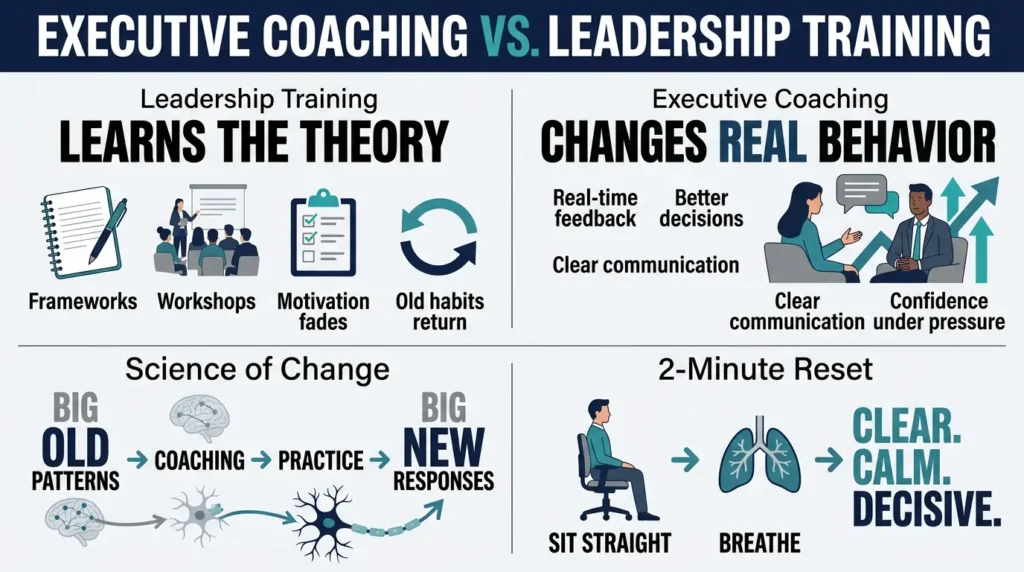
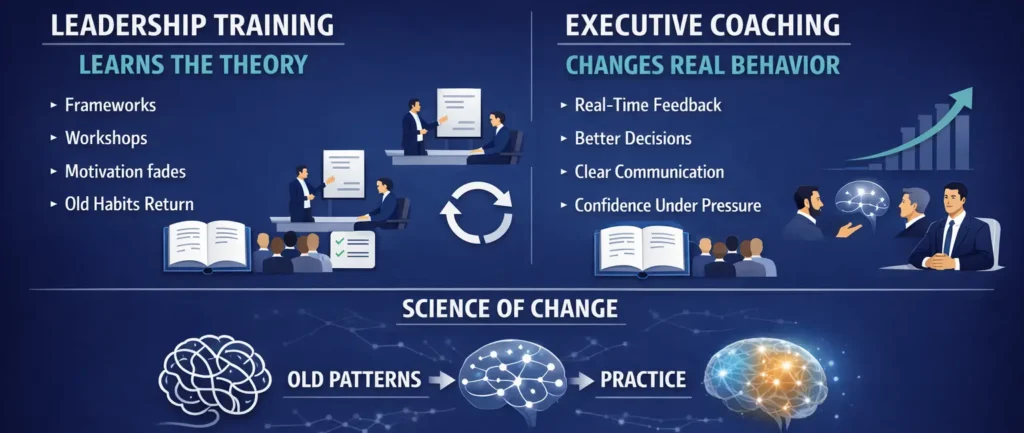
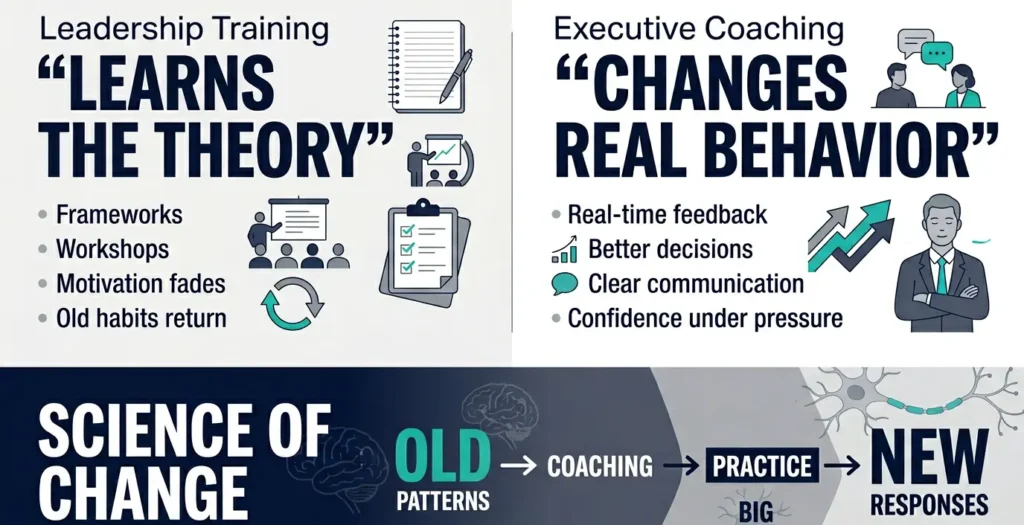
Leadership training gives you frameworks. You leave with a notebook, some ideas, and genuine intentions to apply what you learned. Three weeks later, the old patterns are back.
Coaching is different. It works in real time, applied to your actual challenges, with someone focused entirely on how you think and operate when pressure hits.
Leaders don’t fail because they lack knowledge. Most tech leaders have read the books, done the courses, and absorbed the theory. They fail because, under pressure, old patterns take over. Decisions slow down. Communication gets muddier. The limiting belief that never quite went away starts driving again.
Leadership training in Canada builds the roadmap. Coaching helps you actually drive it consistently when it matters most.
The Science Behind Lasting Behavior Change
The reason executive coaching produces results that training rarely sustains comes down to how the brain actually changes.
Neuroplasticity tells us that the brain can rewire, but only when specific conditions are met. Cognitive restructuring, the process of identifying and genuinely shifting thought patterns, doesn’t happen through reading about it. It happens through guided practice applied to real pressure, with skilled feedback in the moment.
This is where NLP training for business goes beyond conventional coaching. Neuro-Linguistic Programming works at the pattern level. It doesn’t install new concepts to think about. It rewires how you respond when the stakes are real: when the investor is skeptical, when the team meeting goes sideways, when you’re exhausted and the decision can’t wait.
In more than 20 years of working with professionals and executives, I’ve seen one consistent truth: breakthroughs don’t come from learning something new. They come from clearing what’s been in the way.
What an Executive Coach Actually Helps You Do
Here’s what changes when you work with the right coach:
Decision-making sharpens. Not because you have more information, but because your relationship with uncertainty shifts. You stop waiting for perfect data and start trusting your read of the room.
Communication gets cleaner. You stop over-explaining. You get to the point. People listen differently because you’re clearer about what you actually want to convey.
Blind spots surface. Every leader has patterns they can’t see in themselves. A skilled coach holds up the mirror without judgment and helps you act on what you see.
Limiting beliefs dissolve. The story that you’re not strategic enough, not commanding enough, not ready for the next level, those stories have a shelf life. Coaching ends them.
Try This:
2-Minute Reset Before a High-Stakes Moment
Before your next board pitch, investor call, or difficult team conversation, try this. Sit up straight, press both feet firmly into the floor, and take three slow, controlled breaths. With each breath, anchor one word internally: clear, calm, decisive. This is a basic NLP anchoring technique. Over time, repetition trains your nervous system to associate those physical cues with the mental state you want. Leaders I’ve worked with use this before every significant moment. It works because your brain learns through association, not willpower.
Data and Findings
The growth of executive coaching isn’t a trend. It’s a structural shift backed by consistent, measurable data across markets.
According to Mordor Intelligence’s 2025 benchmarking research, organizations that embed systematic coaching record 25% stronger business outcomes than peers who don’t. The global executive coaching and leadership development market was estimated at USD 103.56 billion in 2025 and is projected to reach USD 174.53 billion by 2031, growing at a 9.11% CAGR.
Closer to home, Canada’s online executive coaching platforms market is valued at USD 2.3 billion, with Toronto identified as the dominant city driving that demand. This growth is fueled directly by the concentration of corporate headquarters, a high-pressure tech and finance workforce, and a culture of professional development that’s accelerating alongside AI adoption.
North America holds 40.88% of the global executive coaching market share, driven by mature corporate governance, tech-sector investment, and a data-driven approach to leadership ROI. Toronto sits at the center of that demand.
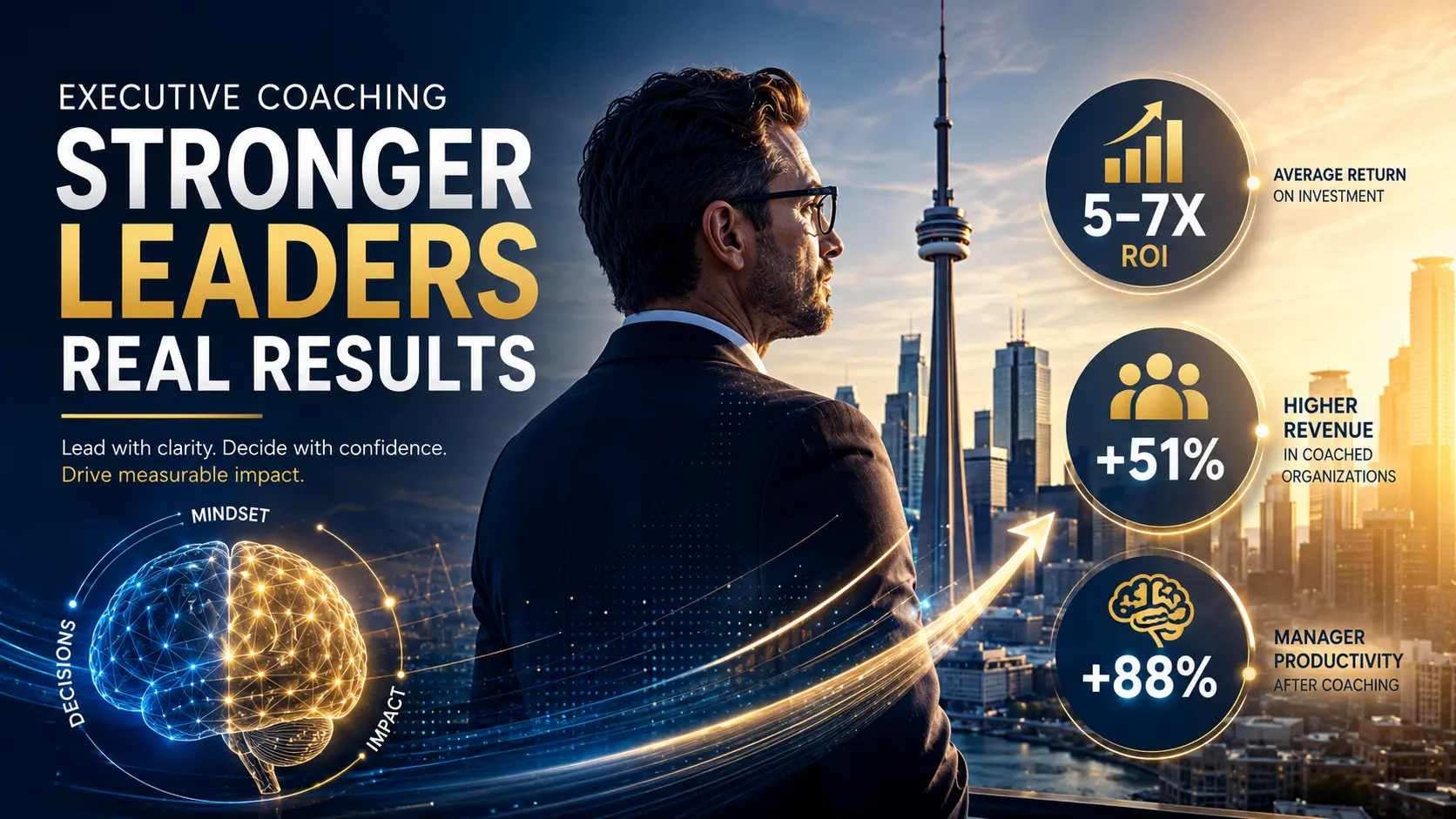
From an ROI standpoint, studies consistently show an average return of 5 to 7 times the initial coaching investment. One Fortune 500 study recorded returns of up to 788% when factoring in productivity gains and employee retention. Research from entrepreneurshq.com confirms that companies with structured coaching programs report 51% higher revenue and 62% higher employee engagement than those without.
The data on individual outcomes are equally clear. Managers who completed structured coaching engagements were 88% more productive than peers who didn’t. 58% of coached leaders reported improved decision-making as a measurable outcome, and 65% hit their specific business goals during their coaching engagement.
These aren’t soft outcomes. They’re the exact metrics that drive hiring decisions, funding conversations, and board confidence.
The ROI Tables: What Coaching Actually Changes
Executive Coaching ROI by Outcome Category
| Outcome Area | Impact Reported | Source |
| Average investment return | 5 to 7x the cost | ICF / MetrixGlobal |
| Peak ROI in Fortune 500 study | 788% | IACC, 2025 |
| Organizations recouping full investment | 86% | ICF Global Study |
| Executives reporting measurable business impact | 77% | Human Capital Institute |
| Business outcomes vs. peers without coaching | +25% | Mordor Intelligence, 2025 |
| Employee engagement in coached organizations | +62% | Coaching Industry Data |
| Revenue in coached vs. uncoached organizations | +51% | Grand View Research |
| Manager productivity after coaching | +88% | IACC Research |
Toronto Tech Sector Coaching Demand Context
| Data Point | Figure | Source |
| Toronto projected tech jobs (2025) | 414,000+ | CompTIA, 2025 |
| Fortune 500 companies use executive coaching | 48% | CompTIA, 2025 |
| Canada online exec coaching market size | USD 2.3 billion | Ken Research |
| North America’s share of the global coaching market | 40.88% | Mordor Intelligence |
| Global exec coaching market (2025) | USD 103.56 billion | Mordor Intelligence |
| Corporate coaching spend growth rate | 8.4% annually | Grand View Research |
| Coached leaders in hitting specific business goals | 70% | ICF |
| Coached leaders hitting specific business goals | 65% | ICF, 2024 |
Why Toronto Tech Leaders Are Turning to Coaching Now
The AI Leadership Gap Is Real
No MBA program prepared leaders for what’s happening right now. The speed at which AI has moved from a technical consideration to a boardroom responsibility has outpaced every traditional leadership development model in existence.
The World Economic Forum has been direct about what separates leaders who succeed through AI disruption from those who don’t. It’s not vision alone. It’s transparency, honest communication, and the ability to create grassroots momentum within teams. Leaders who issue strategy memos and expect alignment are losing their people. Leaders who bring teams into the uncertainty, who communicate clearly about what’s known and what isn’t, are the ones whose organizations adapt.
That kind of communication isn’t automatic. For technically trained leaders, it’s often the hardest skill they’ve ever had to develop.
If you’re managing AI strategy for your company and doing it without a thinking partner, you’re carrying a load that was never meant to be carried alone.
The Cost of Not Adapting
Up to 70% of organizational change efforts fail due to insufficient leadership capability during the transition. Not a technology failure. Not budget constraints. Leadership.
Toronto’s tech sector is producing genuine world-class output. But coaching for tech startups in Ontario consistently shows that innovation without strong human leadership behind it stalls, misaligns, and eventually burns people out. The leadership gap is invisible until it costs you something real: a key hire who leaves, a product launch that loses momentum, a team that quietly stops trusting your direction.
Try This:
Use This Question in Your Next Team Meeting
When someone raises vague resistance to a decision or timeline, try this NLP meta-model question instead of explaining or defending: “What specifically would need to be true for you to feel confident moving forward?” This does two things. It shifts the conversation from complaint to criteria, and it forces the other person to get concrete about what they actually need. Most of the time, the resistance dissolves once you’ve clarified it.
How Do You Know If You’re Ready for Executive Coaching?
Signs You’ve Hit Your Leadership Ceiling
Most leaders don’t recognize their ceiling until they’ve been pressing against it for a while. Here’s what it actually looks like.
Conversations with your team feel draining instead of energizing. You leave meetings feeling like you managed a situation rather than led through one.
Decision-making is slowing down, not because the data is missing, but because something inside you keeps second-guessing. You know what you think, but you hesitate before committing.
You feel the pull of the next level but can’t quite see the path to it. You’re performing, but you sense you’re operating at the edge of your current capacity.
Quick Self-Diagnosis: You May Be at Your Leadership Edge If
- You’ve been avoiding at least one difficult conversation for weeks
- You’re leading almost entirely from logic and your instincts feel muffled
- Your team is aligned on paper but you sense they’re not fully bought in
- You feel mentally overloaded even when your schedule is technically manageable
- Feedback from your peers or direct reports surprises you more often than it used to
Three or more of those? That’s not a productivity problem. That’s a leadership development opportunity.
Mike’s story reflects this directly.
Mike came to work with me carrying self-doubt, anxiety, and a head full of noise that made it nearly impossible actually to hear the people around him. After clearing those patterns through NLP coaching, something fundamental shifted. The anxiety lifted. The noise cleared. He started speaking with genuine confidence, not forced confidence, and for the first time in years, he could really listen. That’s what this level of work produces: not a better version of the same leader, but a fundamentally clearer one.
What to Look for in an Executive Coach
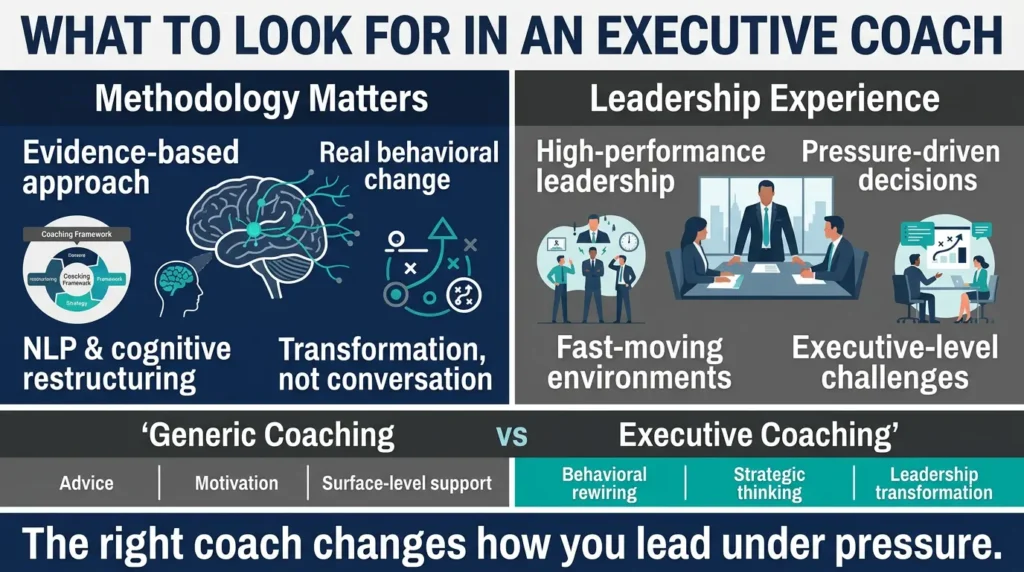
Not all coaching is equal. Here’s what actually matters when you’re evaluating.
Methodology
Generic coaching can be useful. But if your coach doesn’t have a structured, evidence-based approach to behavioral change, you’re getting conversation, not transformation. Look for frameworks rooted in proven modalities like NLP, cognitive restructuring, or behavioral science.
Experience with leaders
A coach who works primarily with career transitions operates in a different context than one embedded in high-performance leadership. The challenges, the pace, and the stakes are different.
Documented results
Ask for specifics, not just testimonials, but actual evidence of what changed: confidence, communication, decision quality, team performance.
As a Board Designated Trainer with more than 20 years of experience working with professionals, entrepreneurs, and executives, I’ve built this practice around one thing: transformation that actually holds up under pressure. Not accountability check-ins. Not feel-good sessions. Pattern-level change that shows up in how you lead, how your team responds, and how your organization performs as a result.
Frequently Asked Questions
How much does executive coaching cost in Toronto?
Executive coaching in Toronto typically ranges from $300 to $700 per hour, depending on the coach’s credentials, methodology, and program structure. Most structured engagements are packaged across six to twelve months and bundle sessions, assessments, and real-time support. When the documented average ROI sits between 5 and 7 times the initial investment, the cost becomes a straightforward business case rather than a personal expense.
How long does executive coaching take to show results?
Many leaders notice meaningful shifts in clarity and communication within the first few sessions. Deeper behavioral change, the kind that holds under real pressure, typically develops over three to six months of consistent work. The timeline depends on the depth of the challenge, the quality of the methodology, and the extent to which the leader engages with the process.
Is executive coaching only for senior executives?
No. While the term originated in C-suite development, the same principles apply to any leader managing people, driving change, or operating under significant pressure. Mid-level tech leaders, product managers, and team leads often see some of the highest coaching impact because they’re navigating upward influence and downward leadership simultaneously, which is genuinely one of the most demanding positions in any organization.
What’s the difference between business coaching and executive coaching?
Business coaching focuses on strategy, systems, and growth outcomes for the organization. Executive coaching focuses specifically on the leader’s mindset, communication patterns, decision-making quality, and interpersonal effectiveness. In practice, the two often overlap because how you think and lead directly determines what your business is capable of achieving.
How do I choose the right executive coach in Toronto?
Start with methodology. Ask how they produce change, not just what outcomes they talk about. Look for coaches with direct experience in your context, whether that’s tech leadership, high-growth environments, or entrepreneurship. Verify credentials and ask for specific results their clients have achieved. And pay attention to the quality of the first conversation. You’re going to be doing serious work with this person. The relationship and the honesty in it matter as much as the credentials.
The Bottom Line
Toronto’s tech sector isn’t slowing down. The pressure isn’t easing. The AI disruption shaping this city’s most dynamic industry is compressing leadership timelines and raising the stakes for every decision you make.
The leaders who will define the next five years in this market are investing in how they think and lead right now, not when things settle.
Executive coaching isn’t a luxury. It’s one of the highest-return investments in professional development that exists, and the data backs that up across thousands of organizations and hundreds of thousands of leaders. The question has never been whether coaching works. The question is whether you’re ready to lead at the level this sector demands.
If you are, explore business coaching in Toronto with James or reach out directly to start a conversation about what’s possible for you.
Unleash Your Power: Stand Out, Take Action, and Create the Success You Want.