
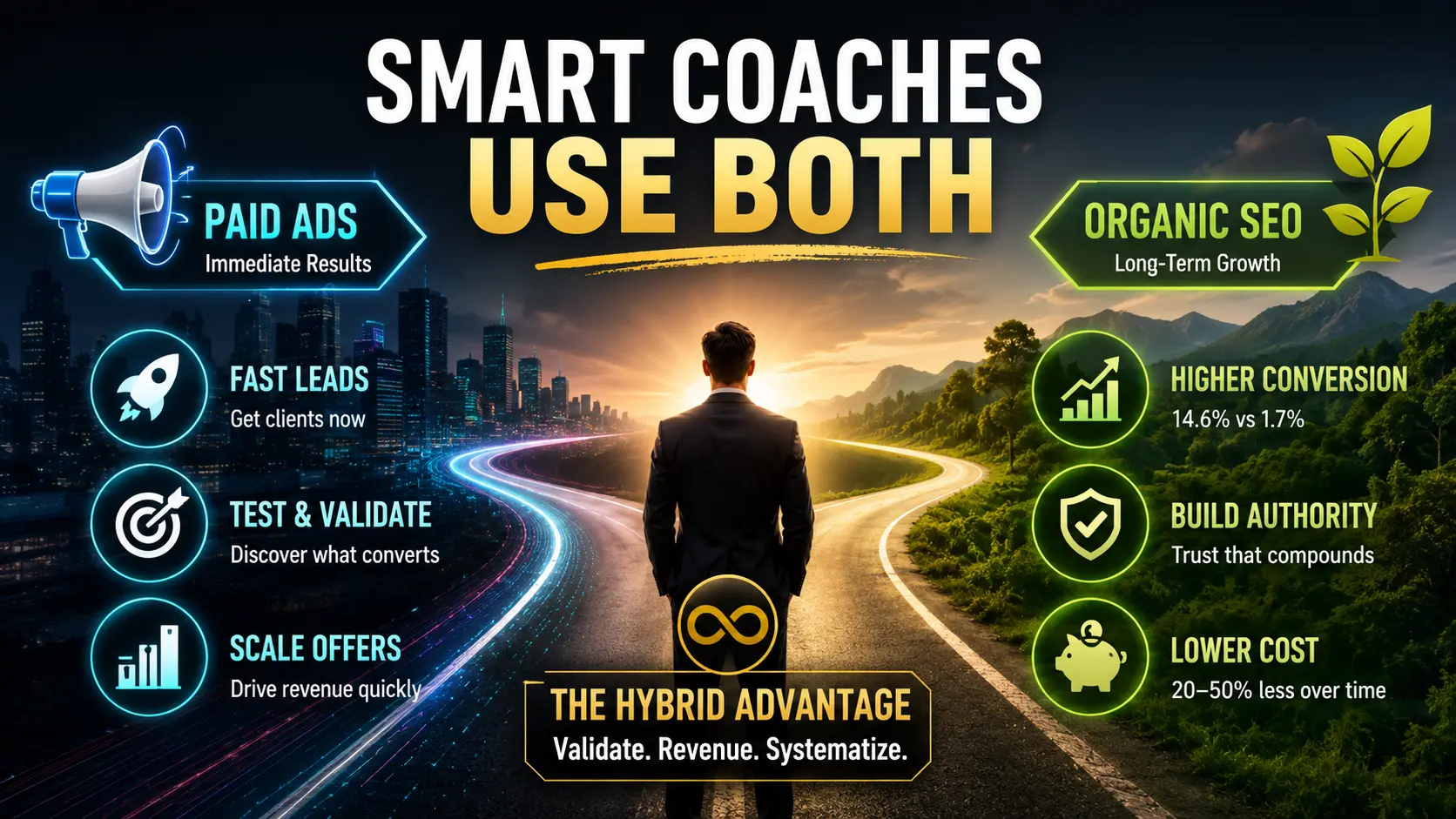
When comparing SEO vs paid ads, hybrid client acquisition for coaches combines paid ads and organic SEO into a single system. Paid ads generate immediate leads and validate what actually converts, while SEO builds long-term authority and inbound traffic that compounds over time.
The most effective strategy is not a choice between the two; it is a sequenced approach where ads test certainty and SEO scales it. Coaches who implement this system consistently reduce their client acquisition costs while building an audience they own, not rent.
Key Takeaway:
- SEO and paid ads serve different purposes for coaching businesses. SEO builds long-term visibility, authority, and organic lead generation, while paid ads deliver immediate traffic and faster market validation. [1]
- Paid advertising can generate leads quickly, making it valuable for new offers, workshops, launches, and testing messaging. However, traffic stops as soon as ad spending stops, making it an ongoing expense. [2]
- SEO requires patience but creates compounding results over time. High-quality content, optimized service pages, and strong search rankings can continue generating coaching leads long after the initial investment is made. [3]
- For most coaches, the strongest strategy is not choosing one channel over the other. Paid ads can validate offers and identify winning messages, while SEO scales those proven messages into sustainable organic growth. [4]
- Coaches with limited budgets often benefit from prioritizing SEO and content marketing, while coaches seeking rapid lead generation may use paid ads strategically until organic traffic gains momentum. [5]
Bottom Line: Paid ads provide speed, while SEO provides sustainability. Coaches who combine paid advertising for short-term lead generation with SEO for long-term authority and organic traffic typically create the most predictable and profitable growth over time.
- Source: SEO vs Paid Ads – Key Differences, Pros, and Cons (2026)
- Source: SEO vs Paid Ads for Small Businesses
- Source: The Compounding Math of SEO for Coaches
- Source: Reddit – SEO vs Paid Ads Decision Framework
- Source: Reddit – Should Small Businesses Invest in SEO or Paid Ads First?
Research shows that organic search leads convert at 14.6% compared to 1.7% for paid advertising, making SEO the highest-converting long-term channel available to coaches today.
Why Most Coaches Get Client Acquisition Wrong
You have probably been here before. You set aside a budget for ads, launch a campaign, get a handful of leads that go nowhere, and then wonder whether paid advertising even works for coaching. Or the opposite: you spend months writing content, posting consistently, and waiting for clients who never quite arrive. Neither approach is wrong. The mistake is treating them as separate strategies rather than two parts of one system.
Darren G. came to James feeling stuck despite having a solid income and genuine ambition. The problem was not the effort; he was working hard. The block was in how he was approaching growth: doing things that felt productive but were not building toward anything compounding. Once he identified and removed those patterns, his results shifted fast. The same dynamic plays out for coaches in their marketing every day.
The Either/Or Trap That Drains Budgets
Most coaches pick a lane and stay in it. They either run ads because they want clients now, or they commit to organic content because they want to avoid spending money. Both choices make sense in isolation. But in practice, each channel has a structural weakness that the other channel solves.
Ads without SEO: you get traffic that stops the moment your budget runs out. SEO without ads: you wait 6 to 18 months for results in a competitive niche, burning time that has real value. The coaches who scale sustainably use both in the right order, at the right time.
What Your Competitors Are Not Doing
Here is something worth knowing: SEO remains largely untapped in the coaching industry. While most coaches default to social media and paid advertising, a well-executed organic strategy can become a genuine competitive advantage. Every piece of content that ranks is a permanent asset. Every ranking page works for you around the clock without requiring daily attention. That is the kind of leverage most coaches never build because they are too focused on short-term lead generation. If you are starting a life coaching business, this distinction matters immediately.
SEO vs Paid Ads at a Glance
Before going deeper, here is a clear side-by-side comparison:
| Channel | Speed to Results | Cost Over Time | Conversion Rate | Best Use Case |
| Organic SEO | 3 to 18 months | Decreases as content compounds | 14.6% (organic leads) | Authority, inbound, long-term growth |
| Paid Ads | Immediate | Continuous, often rising | 1.7% (outbound/paid) | Testing, launches, rapid visibility |
| Hybrid (VRS) | Faster than SEO alone | Declining over time | Highest combined | Scaling a coaching business sustainably |
The numbers tell the story. Organic search leads convert at nearly nine times the rate of paid advertising. But paid channels get you in front of people immediately. The question is not which one wins; it is how you sequence them.
What Organic SEO Does for Coaching Businesses

Organic SEO for coaches means showing up in Google search results when potential clients type queries like “life coach for entrepreneurs,” “how to build confidence at work,” or “NLP coaching near me.” You do not pay for each click. You invest once in creating high-quality content, and that content continues to generate traffic and leads long after publication.
The Conversion Rate Advantage You Cannot Ignore
The gap between organic and paid conversion rates is not marginal; it is structural. Research consistently shows that search engine leads convert at 14.6%, while leads from paid advertising and outbound methods convert at 1.7%. The reason is intent. Someone who finds your content through a Google search is actively looking for what you offer. They have already qualified themselves before they ever land on your page.
Over time, a strong organic presence also reduces your client acquisition cost significantly. Industry benchmarks from HubSpot suggest that businesses prioritizing SEO can achieve 20 to 50% lower long-term acquisition costs compared to paid-only strategies. That is not a marginal improvement; it is the difference between a coaching business that scales and one that stays on the content treadmill forever.
Find Your First Three High-Intent Keywords
Open Google and type a question your ideal client would ask, something like “how to stop self-sabotage as an entrepreneur” or “NLP techniques for confidence.” Look at the autocomplete suggestions and the “People Also Ask” section. Those are real queries from real people. Pick three that match your niche and expertise. Those become your first three pieces of content. Start there before worrying about domain authority or backlinks.
What Paid Ads Do Well and Where They Fall Short
Paid advertising is not the enemy of a healthy coaching business. It fills a real gap, and pretending otherwise leads coaches to underinvest in it at the wrong moments.
Where Ads Genuinely Deliver
Speed is the primary value of paid advertising. If you are launching a program with a two-week enrollment window, ads are the right tool. If you are entering a new niche and want to test whether your offer resonates before committing months of content production, ads give you that answer quickly. Paid channels can also be 50% more likely to convert in the short term for time-sensitive offers precisely because they reach people mid-decision rather than mid-research.
Ads also work well for retargeting. Someone who visited your site, read your blog, or watched your video is a warm lead. A targeted ad that brings them back has a completely different economics than a cold-traffic campaign.
The Hidden Cost of “Free” Content
Here is something that often gets skipped in conversations about organic marketing: it is never actually free. If you spend 15 hours a week on content and value your time at even a modest hourly rate, that is a real cost. Calculating your true organic client acquisition cost, including tools, editing, strategy, and time, often reveals that your “free” content is more expensive than you thought. That does not mean stop. It means being intentional, measuring it, and pairing it with a system that compounds your investment rather than repeating it endlessly.
When Ads Become a Money Pit
Paid advertising without a clear testing methodology burns through budgets fast. If you are running ads to a generic landing page, targeting a broad audience, and hoping for results, that is not a strategy; that is a gamble. The coaches who waste money on ads are not doing it because ads do not work. They are doing it because they skipped the step of figuring out what actually converts before scaling spend.
The VRS Method: The Elite Hybrid Acquisition System for Coaches
The biggest mistake coaches make is trying to guess what content will work. Paid ads eliminate guesswork. SEO then scales certainty
The VRS Method Validate, Revenue, Systematize is a hybrid client acquisition system that uses paid ads to test what converts, then transforms those proven insights into long-term organic traffic through SEO. It is the framework that separates coaches who are always chasing clients from coaches who build an acquisition engine that runs without them.
Heather Chetwynd came to James’s NLP Practitioner training already familiar with the techniques but unclear on how to integrate them into a coherent system. What shifted for her was not learning more tactics. It was seeing how the pieces fit together. That is exactly what the VRS Method does for your marketing.

Validate (Use Ads to Test What Converts)
Before investing months in content, run targeted ads to your top two or three content ideas or offers. Spend a modest amount enough to get statistically meaningful data and measure which messages, angles, and offers generate genuine interest. This phase is research, not revenue. You are buying information about your audience, not just buying leads.
A 2025 integrated strategy analysis cited a company that used PPC to test ad headlines, then turned the top performers into SEO articles. Within three months, those articles ranked in the top five for their target queries and doubled organic leads. That is the feedback loop in action.
Revenue (Run Both Channels in Parallel)
Once you know what converts, run paid traffic to your best-performing offers while simultaneously building organic content around those same proven themes. This phase generates revenue through ads while your SEO content is maturing in the background. You are not choosing between short-term and long-term; you are funding one with the other.
Many high-performing coaching businesses aim for a structure where roughly 60% of revenue remains as profit, with around 15% allocated to marketing. When client acquisition relies entirely on paid ads, that 15% is constantly consumed and reset. A hybrid strategy gradually shifts more of that budget toward owned channels, protecting your margins as you scale. This is how scaling a coaching business in Toronto or anywhere becomes financially sustainable rather than just theoretically possible.
Systematize (Let SEO Carry the Long-Term Load)
As your organic content matures and begins ranking, reduce ad spend on content that now drives free traffic. Redirect that budget toward retargeting warm audiences and testing new offers. Your SEO content becomes a permanent asset. Your ads become a precision tool rather than a primary acquisition channel.
This is the phase where growth compounds. A well-optimized article on a high-intent keyword continues generating qualified leads for years. Every new piece of content adds to the system rather than replacing yesterday’s effort.
The Keyword Feedback Loop
Take your three highest-performing ad variations, the headlines and the copy that got the most clicks or conversions. Strip out the core language. Those phrases are what your audience actually responds to. Build your next three SEO articles around those exact concepts. You have now turned paid data into a content strategy with a proven conversion baseline
How to Know Which Channel to Prioritize Right Now
Not every coach is in the same position. The right balance between paid and organic depends on where you are in your business and what you are trying to accomplish in the next 90 days. Understanding how to market a life coaching business effectively starts with being honest about your current stage.
Prioritize paid ads if:
- You have a program launching within 60 days.
- You have not validated your offer or messaging yet.
- You need revenue before SEO can generate meaningful traffic.
- You are testing a new niche or audience segment.
Prioritize organic SEO if:
- You have a validated offer and a consistent conversion process.
- You are building for 12 to 24 months of compounding growth.
- You want to reduce dependency on ad spend over time.
- You are committed to consistent content production.
Run both if:
- You have at least a minimal ad budget and time to create content.
- You are in growth mode and want both short-term leads and long-term assets.
- You want to measure ROI from business coaching and marketing in a way that accounts for both channels.
How Long Does SEO Take for a Coaching Business?

SEO timelines depend on your niche competitiveness and how consistently you publish. For most coaching businesses, 3 to 6 months is realistic for less competitive queries, with 12 to 18 months in more saturated spaces. This is exactly why the hybrid approach matters and keeps clients coming in during the months before your organic content gains traction.
Should Coaches Run Google Ads or Meta Ads?
Google Ads targets people who are actively searching, making them better suited for high-intent queries like “business coach Toronto” or “NLP training online.” Meta Ads target people based on demographics and interests, making them better for awareness and retargeting warm audiences. Most coaches benefit from starting with Google Ads for bottom-funnel traffic and layering Meta retargeting once they have site traffic worth remarketing to.
Data and Findings
Based on Unleash Your Power’s 2026 client performance observations and current industry benchmarks:
- Coaches who build consistent organic content report lead quality significantly higher than cold-traffic paid campaigns, with shorter sales cycles and higher close rates as a result.
- Organic search leads convert at 14.6% vs 1.7% for paid and outbound methods, a gap that grows as organic authority increases over time.
- Long-term client acquisition costs drop 20 to 50% for businesses that establish a strong organic presence compared to paid-only strategies.
- Combined PPC and SEO strategies account for 76% of B2B traffic, confirming that neither channel is sufficient on its own.
- Google Ads cost-per-lead rose to $70.11 in 2025, making organic acquisition increasingly attractive as ad costs continue climbing year over year.
- Goal setting for business growth in a coaching practice is directly tied to marketing clarity. Coaches with a documented acquisition framework consistently outperform those operating reactively.
Who Should Use the Hybrid VRS Strategy
This approach works best for coaches who:
- Have a clear niche and a validated coaching offer.
- Can commit to publishing at least two substantial content pieces per month.
- Have a modest ad budget to run in Phase 1 and Phase 2 (even a small amount is enough to gather directional data).
- I want to build a client acquisition system rather than constantly hustle for individual clients.
- Are you thinking 12 months ahead, not just this week?

Who Should Wait Before Going Hybrid
Hold off on the full VRS system if:
- You have not yet defined your niche or ideal client clearly and ads will amplify confusion, not clarity.
- You are brand new to coaching and still developing your methodology.
- You cannot produce consistent content over a 6 to 12-month period.
- Your website is not yet set up to convert traffic into leads.
In those cases, get your foundation in place first. Then build the acquisition system on top of something solid.
Frequently Asked Questions
Is organic SEO or paid ads better for coaches?
Neither is better in isolation. The most effective approach is a sequenced hybrid strategy that uses ads to validate what converts, then scales those insights through organic content. Each channel solves the weakness of the other.
How much should a coach spend on paid advertising?
The goal in Phase 1 is to spend enough to gather meaningful data, not generate immediate profit. Many coaches start with a few hundred dollars per month, test two or three ad variations, and let the results inform their content strategy.
How long does it take for a coaching blog to rank on Google?
For less competitive queries, 3 to 6 months is realistic with consistent publishing. More competitive niches take 12 to 18 months. Running paid ads during that window keeps leads coming in while your organic content matures.
What type of content ranks best for coaching businesses?
Content that directly answers specific questions your ideal clients are searching for ranks best and converts the highest. The more specific the query, the less competition and the stronger the intent of the person searching.
Can coaches do SEO without a big budget?
Yes. SEO primarily requires time and consistency, not a large financial investment. Keyword research, content creation, and on-page optimization can all be done with free or low-cost tools.
Conclusion
The coaches who win at client acquisition are not the ones spending the most on ads or producing the most content. They are the ones who understand that paid ads and organic SEO work as a system, not a choice. You use ads to find certainty. You use SEO to scale it. And over time, your acquisition costs fall while your authority rises.
If you are ready to build a client acquisition strategy that compounds rather than resets, book a discovery call with James to find the right approach for your coaching business. Or explore how NLP training can give you the mindset and communication tools to convert more of the leads your marketing brings in.
Unleash Your Power: Stand Out, Take Action, and Create the Success You Want.