
Corporate fraud in Canada is rising rapidly, with estimated losses exceeding CAD $111 billion in 2025. One of the simplest and most underused ways to protect your business is public registry verification.
A critical fact: a registered business is not automatically a legitimate one.
Using databases like Corporations Canada and provincial registries, you can confirm a company’s legal status, directors, and, since January 2024, its beneficial owners (Individuals with Significant Control), which are now publicly searchable for federally incorporated companies. Fraudulent entities often reveal themselves through inconsistencies: inactive status, mismatched ownership, or suspicious addresses that contradict what the other party has told you.
Key Takeaway:
- A Canada business registry check helps verify whether a business is legally registered, active, incorporated, or operating under a valid business name in a specific province or federally. [1]
- Business registry searches are commonly used to confirm legitimacy, check incorporation status, identify directors, review registration dates, and avoid fraud or duplicate business names. [2]
- In Canada, business registrations may exist at both the federal and provincial levels, meaning entrepreneurs often need to search multiple registries depending on where the business operates. [3]
- Registry checks are especially important before signing contracts, sending payments, hiring vendors, entering partnerships, or purchasing an existing business. [4]
- While registry listings confirm legal registration, they do not guarantee financial stability or trustworthiness, so businesses should still perform due diligence beyond a basic registry search.
Bottom Line: A Canada business registry check is a simple but essential due diligence step that helps verify whether a company legally exists, operates properly, and matches the information presented publicly before entering business relationships.
- Source: Corporations Canada – Federal Corporation Search
- Source: Canada Business Registries Search
- Source: Ontario Business Registry
- Source: How to Check If a Business Name Is Taken in Canada
This guide walks you through the specific databases to use, the red flags to watch for, and a 5-step CLEAR verification framework you can apply before signing any agreement or sending a single dollar.
When You Should Run a Registry Check (Before It’s Too Late)
Most Canadian entrepreneurs only think about verification after something goes wrong. A payment doesn’t clear. A vendor disappears. A partner’s business address turns out to be a mail drop. By that point, the damage is usually done.
The practical rule is simple. Run a registry check before:
- Signing vendor or supplier agreements.
- Entering into a partnership or investment arrangement.
- Sending a deposit or large payment to a new entity.
- Responding to unsolicited business offers that involve money or contracts.
- Any situation where ownership details seem unclear or inconsistent with what you’ve been told.
If money, contracts or ownership are involved, a registry check is not optional.
It takes less than ten minutes. The cost of skipping it can be catastrophic. According to the Insurance Bureau of Canada, fewer than 5% of business scams are ever reported to law enforcement, which means most losses are simply absorbed as a cost of doing business. That doesn’t have to be your story.
What Public Registries Actually Tell You (And What They Don’t)
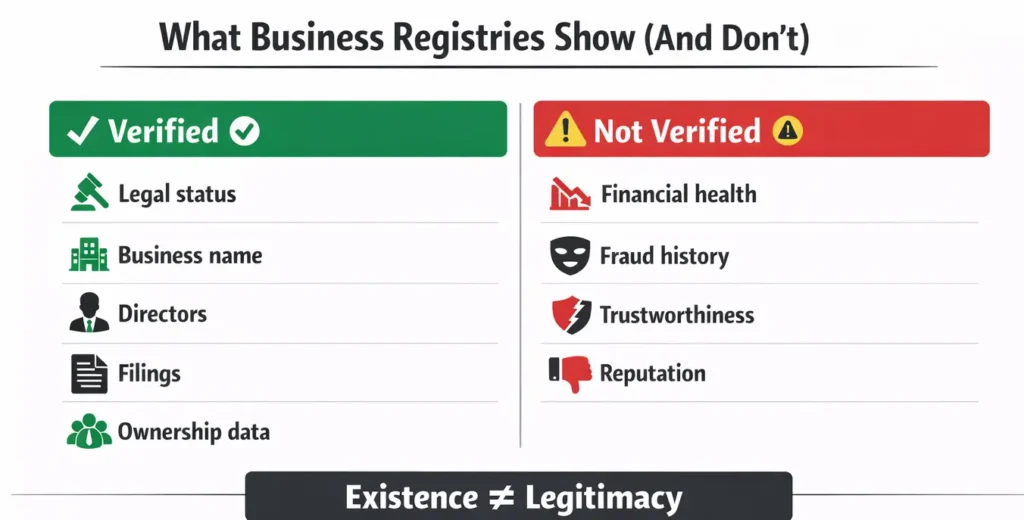
What You Can Verify
Canada’s business registries give you access to verified, government-sourced information that no sales pitch or LinkedIn profile can replicate. A proper registry search will confirm:
- Whether a business legally exists and is currently active.
- Its official registered name and any prior name changes.
- The current directors and officers on record.
- Filing history, including whether annual returns have been submitted.
- Beneficial ownership data for federal corporations (since January 2024).
What They Cannot Prove
Registries are powerful, but they have limits. A corporation search won’t tell you whether a company is financially solvent, whether its principals have a history of fraud in another jurisdiction, or whether the business is being run honestly. Think of it this way: a registry confirms existence, not legitimacy. It’s the starting point for due diligence, not the finish line.
This matters because sophisticated fraudsters rely on the assumption that most people won’t look further than a professional website and a confident phone call. Running a registry check is the objective step that breaks that pattern.
How to Search a Canadian Corporation Step-by-Step
Federal Search via Corporations Canada
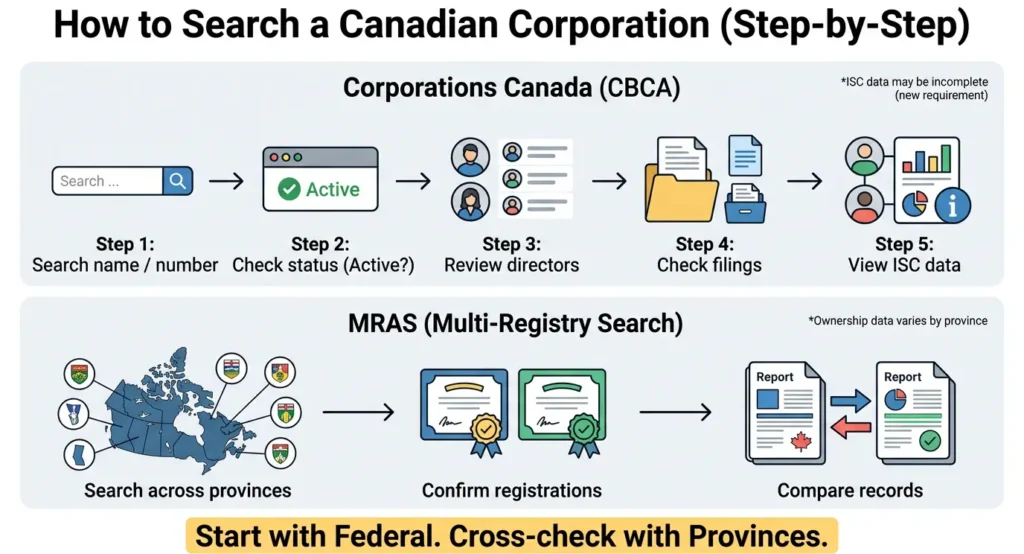
For any business incorporated under the Canada Business Corporations Act (CBCA), Corporations Canada is your first stop. The database is free and publicly accessible at ised-isde.canada.ca. Here’s how to use it:
- Go to the Corporations Canada online search tool.
- Enter the business’s legal name, corporation number, or CRA Business Number.
- Review the corporate status, look for ‘Active’ vs. ‘Dissolved’ or ‘Inactive’.
- Check the directors listed on record and compare against what the company has told you.
- If the corporation filed its beneficial ownership information, the Individuals with Significant Control (ISC) data will appear here as well.
One important nuance: ISC filings became mandatory in January 2024, and the database is still being populated as corporations file their annual returns. If ISC data isn’t showing yet for a corporation, that doesn’t automatically signal fraud. But it’s worth noting and following up on.
The Multi-Registry Search via MRAS
Canada’s Multi-Jurisdictional Registry Access Service (MRAS) connects business registries across British Columbia, Alberta, Saskatchewan, Manitoba, Quebec, and federal corporations in one search. It’s particularly useful when a company claims to operate across multiple provinces, since it lets you verify registration in each jurisdiction without running separate searches.
One limitation worth knowing: MRAS reflects what each jurisdiction has on file, and not all provincial registries expose the same depth of ownership data. Quebec’s Enterprise Registrar is the most detailed, with publicly searchable transparency information by individual name. Other provincial registries often restrict ownership data to government and law enforcement access. For full beneficial ownership visibility on a Canadian company, the federal CBCA registry is currently your most reliable public source.
Federal vs. Provincial Registries: What Most People Miss
Whether a company is federally or provincially incorporated changes what you can find and where you need to look. Fraudulent entities sometimes exploit the gap between these two systems by presenting themselves as federally registered when they’re not, or vice versa.
| Feature | Federal (CBCA) | Provincial (e.g., Ontario) |
| Search Portal | Corporations Canada | Provincial registry systems |
| Coverage | Nationwide | Province-specific |
| Beneficial Ownership | Publicly searchable (2024+) | Often limited or private |
| Best Use Case | National / international deals | Local vendors and services |
Insight: Fraudulent entities often exploit gaps between federal and provincial records to appear more credible than they are.
If a vendor or partner claims to be federally incorporated, verify it directly in the Corporations Canada database. If they claim to be a provincially registered business, go to that specific province’s registry. Don’t accept their word alone. The search takes two minutes and the information is free.
Beneficial Ownership: The Fraud Layer Most People Ignore
Here’s where most due diligence falls short. Knowing that a company exists and has a registered director is useful, but it tells you almost nothing about who actually controls it. That distinction matters enormously in fraud prevention.
What Changed in 2024
Since January 22, 2024, all corporations under the Canada Business Corporations Act are required to file their beneficial ownership information with Corporations Canada. Beneficial owners are formally called Individuals with Significant Control (ISC), defined as anyone who owns or controls 25% or more of a corporation’s shares, or who exerts control over the corporation in practice.
The publicly searchable portion of this data includes:
- The individual’s full legal name
- Their address for service (or residential address if no service address was provided)
This is a significant development for Canadian entrepreneurs. For the first time, you can look up who actually stands behind a federal corporation, not just which directors are listed.
Why It Matters for Fraud Detection
Shell structures and hidden ownership are central to many corporate fraud schemes. A fraudster might incorporate a company, list a nominee director, and operate the entity entirely in the background. The beneficial ownership requirement makes it significantly harder to pull off invisibly.
When you run an ISC search on a company and the ownership data contradicts what you’ve been told, that’s a serious red flag. When a federal corporation files a ‘Statement of Inability to Identify ISCs,’ that’s worth pausing on before proceeding with any agreement.
Registry Red Flags That Signal Corporate Fraud
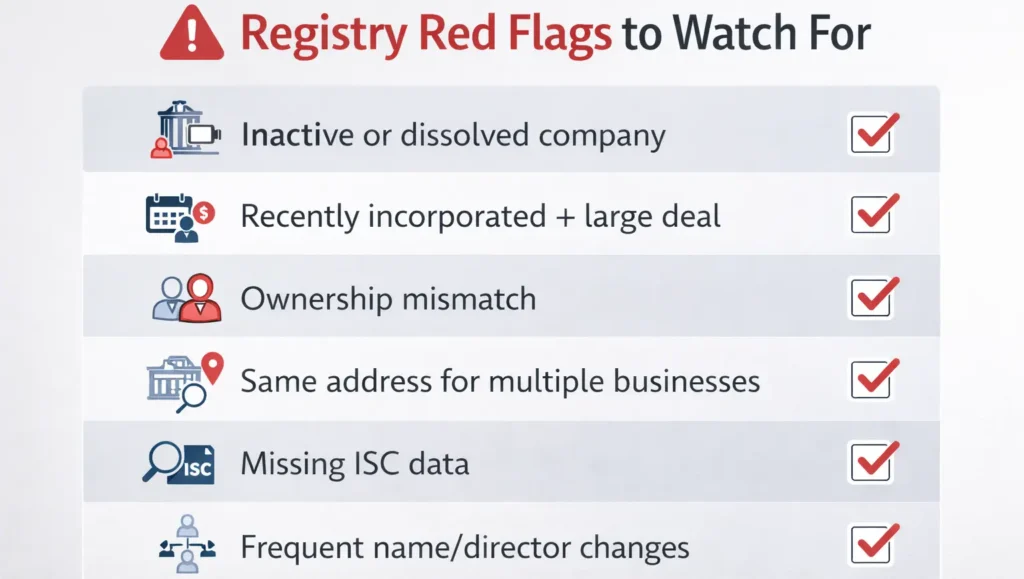
Not every discrepancy in a registry search means fraud. But certain patterns appear repeatedly in cases where businesses have been defrauded. Train yourself to recognise these:
- Inactive or dissolved company status presenting as an active business.
- Newly incorporated entity (less than 6 months old) making high-value proposals.
- Director or owner names that don’t match the people you’re communicating with.
- Multiple unrelated businesses listed at the exact same registered address.
- Ownership data that conflicts with what the company has told you about its structure.
- Missing or unclear ISC information with no explanation provided.
- Frequent director or name changes over a short period.
The Psychology of Sophisticated Fraud (Why Smart People Miss It)
The hard truth about corporate fraud is that it often happens to sharp, experienced entrepreneurs. Fraudsters are skilled at building trust quickly. They appear credible, match your communication style, and create a sense of urgency that discourages you from slowing down.
Three psychological patterns work in their favour. Authority bias makes you assume that someone who sounds knowledgeable and professional is legitimate. Mirroring makes you feel rapport with someone who seems to think the way you do. Urgency pushes you toward fast decisions before the rational part of your brain can intervene.
A registry check works as a pattern interrupt. It forces you to verify objective data before the emotional pull of the deal takes over. That’s not paranoia. That’s decisive leadership.
The 5-Step CLEAR Verification Framework
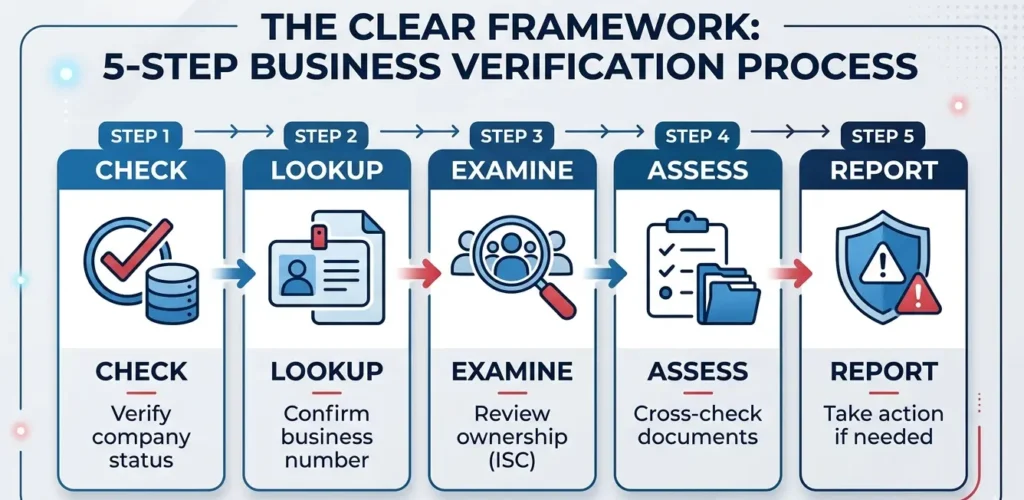
Here’s the system James uses to help entrepreneurs apply registry verification consistently. Run this before any new vendor, partner, or investor relationship moves forward.
Check: Confirm Legal Status
Search the company on Corporations Canada or the relevant provincial registry. Confirm that it is currently active, not dissolved, inactive, or in the process of being struck off the register. This single step eliminates a significant percentage of fraudulent entities.
Lookup: Verify the CRA Business Number
Cross-reference the company’s CRA Business Number (BN) with the government’s lookup tool. A valid BN confirms the entity is registered with the Canada Revenue Agency for tax purposes. If the BN doesn’t match the legal name in the registry, stop and ask questions before proceeding.
Examine: Review Beneficial Ownership Data
For federally incorporated companies, search the ISC data on Corporations Canada. Confirm that the ownership information matches what you’ve been told about the company’s structure. Three specific things to watch for:
- Named individuals who don’t match the people you’re dealing with
- Missing ISC data on a company that should have filed by now
- A ‘Statement of Inability to Identify ISCs’ with no explanation offered
Assess: Cross-Reference Against What You’ve Been Told
Take the registry data and compare it against the contracts, emails, payment instructions, and company structure claims you’ve received. Look for anything that doesn’t line up. A legitimate company will have no problem explaining discrepancies. A fraudulent one will pressure you to overlook them or dismiss your concern.
Report: Know What to Do When Something Doesn’t Match
If the data raises serious concerns, pause the transaction immediately. Do not confront the other party prematurely. Document everything first: emails, contracts, registry screenshots, and payment instructions. Then report to the Canadian Anti-Fraud Centre (CAFC) at 1-888-495-8501 or online at antifraudcentre-centreantifraude.ca. If the discrepancy involves a federal corporation’s registered information, report directly to Corporations Canada.
What to Do If You Find Suspicious or Fraudulent Information
Finding a red flag in a registry search can feel disorienting, especially if you’re already partway through a deal. Here’s how to handle it with a clear head.
Immediate Actions
- Stop any pending payment or agreement from moving forward.
- Do not confront the other party until you’ve documented everything.
- Screenshot the registry data showing the discrepancy.
- Compile all communications, contracts, and payment requests in one place.
Where to Report
Your two primary reporting destinations in Canada are:
- Canadian Anti-Fraud Centre (CAFC): 1-888-495-8501 or antifraudcentre-centreantifraude.ca. Even if financial loss hasn’t occurred yet, reporting a suspected fraud attempt contributes to law enforcement intelligence.
- Corporations Canada: If the issue involves incorrect or fraudulent federal corporate information, contact Corporations Canada directly. They have procedures in place to investigate and protect the integrity of their registry.
You may also want to involve your local police and speak with a legal advisor before taking any further steps, particularly if you’ve already transferred funds or signed documents.
Data & Findings: Corporate Fraud in Canada
The scale of corporate fraud in Canada makes registry verification a practical necessity, not a precaution reserved for large enterprises.
- CAD $111 billion: Total estimated business fraud losses in Canada in 2025, representing 7.2% of equivalent revenues, according to a TransUnion survey of Canadian business leaders
- 42%: Year-over-year increase in those fraud losses compared to 2024, the steepest single-year jump on record
- 200,000+: Fraud incidents reported to Canadian police in 2023, up 12% from the year before, per Statistics Canada
- $638 million: Total losses reported to the Canadian Anti-Fraud Centre in 2024 alone
- 5-10%: The estimated share of business fraud incidents that actually get reported, meaning the figures above represent only a fraction of what’s occurring
- January 2024: The date Canada’s public beneficial ownership registry for CBCA corporations became mandatory, giving entrepreneurs a direct window into who actually controls the companies they deal with
The trend is moving in one direction. Synthetic identity fraud, where fraudsters combine real and fabricated information to create convincing fake entities, jumped to 26% of total fraud losses in 2025, up from 18% the year before. Registry verification is one of the few free tools that can catch these schemes before damage is done.
Who Should Use Registry Verification
Registry verification is relevant for any entrepreneur who does business with other businesses. More specifically, you should be running these checks if you:
- Are onboarding new vendors, suppliers, or service providers.
- Are you entering into a partnership or co-investment arrangement?
- Have received an unsolicited business proposal involving money or contracts.
- Operate in a regulated sector with FINTRAC compliance obligations.
- Are you considering a significant contract with a company you haven’t worked with before?
When You Can Skip It (Rare Cases)
There are limited situations where a full registry check adds little value: long-term, verified partners with a solid track record and multiple completed projects together, or publicly traded companies already subject to securities disclosure requirements and audited financials. In every other situation, the two minutes it takes to run a search is time well spent.
FAQs
How do I verify if a company is legitimate in Canada?
To verify if a company is legitimate in Canada, search its legal status, directors, and ownership in official public registries like Corporations Canada or the relevant provincial database.
Start by confirming the company is active (not dissolved or inactive). Then check:
Director names match who you’re dealing with.
Business number aligns with the legal entity.
Ownership (ISC data) reflects what the company claims.
A legitimate company will have consistent, verifiable information across all records, while fraudulent entities often show mismatches or missing data.
What is the fastest way to check a Canadian business before sending money?
The fastest way to check a Canadian business is to run a 3-step verification: status check, business number lookup, and ownership review. In under 10 minutes:
Search the company on Corporations Canada.
Confirm it is active.
Cross-check the CRA Business Number.
Review ownership (Individuals with Significant Control).
If anything doesn’t match what you were told, pause the transaction immediately. Fast verification is often the difference between avoiding and experiencing fraud.
What are the biggest red flags of corporate fraud in registry searches?
The biggest red flags in a Canadian registry search are inconsistencies between official records and what the company claims.
Watch for:
Inactive or dissolved status presented as active.
Recently incorporated company making high-value offers.
Director or owner names that don’t match the communication.
Multiple unrelated businesses use the same address.
Missing or unclear ownership (ISC) data.
A single discrepancy may not confirm fraud, but multiple red flags significantly increase risk.
What is beneficial ownership and why does it matter for fraud detection?
Beneficial ownership identifies the individuals who actually control or profit from a company, even if they are not listed as directors.
Under the Canada Business Corporations Act, federally incorporated companies must disclose Individuals with Significant Control (ISC), which are now publicly searchable.
This matters because:
Fraudsters often hide behind shell structures.
Nominee directors can mask real control.
Ownership data exposes who is truly behind the business.
If ownership information contradicts what you’ve been told, or is missing, it’s a serious risk signal.
Can a registered company still be fraudulent in Canada?
Yes, a registered company in Canada can still be fraudulent.
Business registration only confirms that a company legally exists; it does not guarantee legitimacy, honesty, or trustworthiness.
Fraudsters can:
Register companies legally.
Use real-looking documentation.
Create a convincing online presence.
That’s why verification must go beyond registration and include:
Status checks
Ownership validation
Cross-referencing all claims
Registration proves existence, not integrity.
What should I do if I suspect a company is fraudulent in Canada?
If you suspect a company is fraudulent, stop all transactions immediately and document everything before taking further action.
Then:
Save emails, contracts, and payment details.
Capture registry screenshots.
Report to the Canadian Anti-Fraud Centre.
Notify Corporations Canada if federal data is involved.
Do not confront the company prematurely, as this can complicate investigations. Acting quickly and methodically helps protect both your business and others.
How long does it take to verify a business using public registries in Canada?
Verifying a Canadian business using public registries typically takes less than 10 minutes.
A basic check includes:
Searching for the company name.
Confirming active status.
Reviewing directors.
Checking ownership (if available).
Despite being quick and free, this step is often skipped, making it one of the most effective ways to prevent avoidable fraud.
Take the Next Step
Protecting your business from corporate fraud isn’t about being suspicious of everyone. It’s about making clear, confident decisions backed by verified information. The entrepreneurs who thrive long-term aren’t just the ones with the best ideas. They’re the ones who build solid systems around how they evaluate who they do business with.
In my 20+ years working with business owners across Canada, I’ve seen how a single unverified partnership can cost far more than money. It costs momentum, confidence, and the time you can’t get back. The tools are free and accessible. The framework is straightforward. The decision to use them is yours.
If you’re unsure about a company you’re dealing with, don’t rely on assumptions. Book a discovery call and we’ll walk through your specific situation, apply the CLEAR verification framework together, and make sure you’re moving forward with clarity and confidence.
Ready to protect your business and lead with confidence?
Book your discovery call at unleashyourpower.com and let’s build the clarity your business deserves.
Unleash Your Power: Stand Out, Take Action, and Create the Success You Want.