Standard operating procedures (SOPs) are documented, step-by-step processes that allow a remote service business to deliver consistent results without depending on the owner for every decision. For Canadian coaches, consultants, and service entrepreneurs,
SOPs are the operational foundation that makes growth possible, reducing delivery errors, accelerating onboarding, and freeing the owner to lead rather than execute. Building effective SOPs requires both a practical system and a mindset shift: from doing every task personally to trusting documented processes and empowered people.
Without that internal shift, even the best SOP templates go unused. With it, your business can serve more clients, build a stronger team, and generate revenue that isn’t directly tied to your hours.
Key Takeaway:
- Standard Operating Procedures (SOPs) are step-by-step documented instructions that allow any team member to complete tasks consistently without relying on the business owner—essential for scaling remote service businesses. [1]
- SOPs reduce errors, speed up onboarding, prevent burnout, and enable growth by replacing “tribal knowledge” with repeatable systems, helping owners shift from doing the work to leading the business. [1]
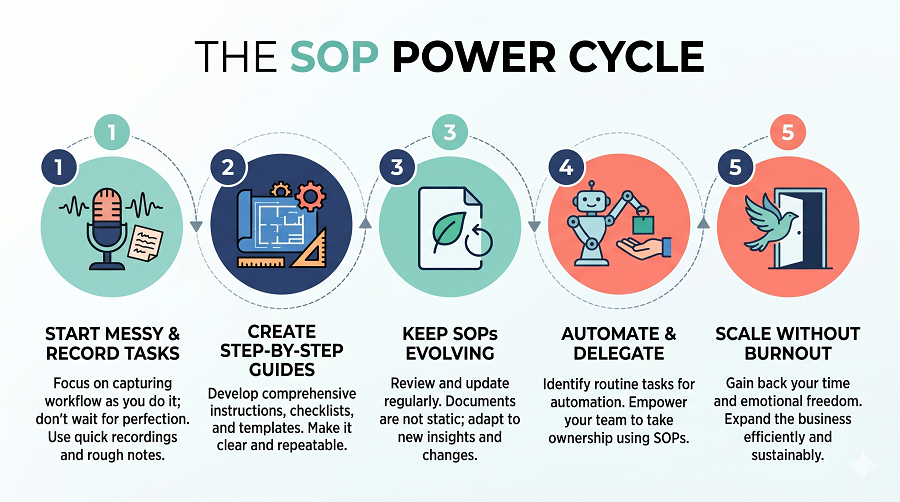
- Use the CLEAR Framework to create SOPs: Capture the process (e.g., via Loom), Layer the logic (add “why”), Edit for clarity, Assign ownership, and Review quarterly. Start with high-impact areas like client onboarding, service delivery, and lead follow-up. [2]
- Focus on clarity, ownership, and simplicity so anyone can follow them. Use AI tools to speed creation, but ensure Canadian data residency compliance. Review and update regularly to keep them living documents. [2]
Bottom Line: SOPs are the foundation for scaling your remote service business without burnout. Create them using the CLEAR Framework, starting with onboarding, delivery, and lead processes—document once and delegate forever for consistent results and true business freedom.
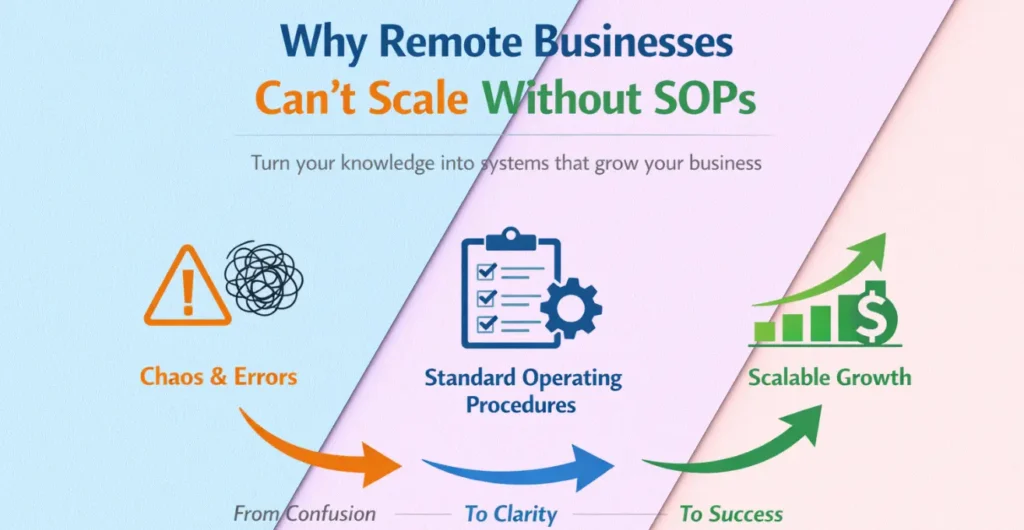
What Are SOPs And Why Remote Service Businesses Can’t Grow Without Them
A standard operating procedure is a documented set of step-by-step instructions that explains how a specific task gets done consistently, correctly, and by anyone on your team, not just you. Think of it as the difference between a business that runs on tribal knowledge locked in your head and one that runs on transferable systems.
In 2026, SOPs are no longer static PDFs gathering digital dust. They’re living, searchable, AI-integrated documents that adapt as your processes evolve, accessible from any device, by any team member, in any time zone.
Why Remote Teams Need SOPs More Than Office-Based Businesses
When your team works in the same physical space, informal knowledge transfer happens constantly: a quick question across the desk, an overheard conversation, a shared whiteboard. Remote teams don’t have that. Without documented processes, every task relies on a Slack message to you, a video call that could have been avoided, or a mistake that costs a client relationship.
For Canadian service businesses operating across provinces and time zones, this gap is even more pronounced. Your virtual assistant in Vancouver and your client success contractor in Halifax need the same clarity to do the same work. SOPs provide that clarity at scale.
Why Service Businesses in Canada Stall Before They Scale
The Canadian entrepreneurial landscape is rich with talent and ambition but thin on the management systems needed to sustain growth. According to Statistics Canada’s 2025 Key Small Business Statistics, the service sector accounts for 71% of small businesses in Canada. And the OECD’s 2025 Economic Survey of Canada identifies a persistent shortage of management expertise, particularly in organizational design and operational systems, as a key reason Canadian firms underperform at the scale-up stage.
In other words, Canada has plenty of talented service providers. It’s the systems to support them that are missing.
How Identity Blocks Disguise Themselves as Perfectionism
Here’s what most scaling guides won’t tell you. The reason your SOPs don’t get built isn’t that you’re too busy. It’s because part of you doesn’t fully believe a documented process can do what you can do. That belief, rooted in identity, not evidence, is what keeps brilliant coaches and consultants stuck in delivery mode long past the point where they should be leading.
This is what James R. Elliot identifies as a goal block: a deeply held belief that limits your actions without you realising it. Darren G. came to James feeling blocked from income growth and career advancement despite relentless effort. After working through the specific beliefs keeping him in doer mode, he experienced radical shifts in how he operated, unlocking abundance in both his business and relationships. The systems he needed were never the problem. His relationship with control was.
Building SOPs starts with identifying your limiting beliefs around trust, quality, and delegation. That’s where the real work begins.
The SOPs Every Remote Service Business Should Build First
Don’t try to document everything at once. Identify the processes that run most frequently and carry the highest risk of inconsistency. For most Canadian service businesses, three core SOPs unlock the majority of your scaling capacity.
Client Onboarding
Your onboarding SOP should cover every touchpoint from signed contract to first delivery welcome email sequence, intake form, account setup, kickoff call structure, and communication expectations. When onboarding is documented, a team member can run it flawlessly without your involvement, and every client feels the same quality of care regardless of who handles it.
Service Delivery
This is the SOP most business owners resist writing because it feels like they’re documenting their secret sauce. You’re not. You’re protecting it. A delivery SOP captures your methodology in a way that maintains your standard of quality while allowing others to execute it. Start with your most common service and map it end-to-end.
Lead Follow-Up and Intake
The fastest revenue leak in most service businesses is an inconsistent or nonexistent follow-up process. Document exactly what happens when a lead comes in, response time, initial message template, qualification questions, and booking process. This SOP alone can meaningfully increase your conversion rate with zero additional marketing spend.
For a deeper look at building the systems that support scaling a coaching business, the foundation always starts here.
The Mindset Shift That Makes SOPs Possible
You can download every SOP template on the internet and still never build a business that runs without you. That’s because the real blocker isn’t operational; it’s identity.
From Technician to Architect
In the early stages of your business, doing everything yourself is survival. It’s also how you develop the expertise that makes your service valuable. But at some point, that same habit becomes the ceiling. The technician mindset says: if I want it done right, I have to do it myself. The architect’s mindset says: if I want it done consistently, I have to build the system.
This shift is at the heart of what separates entrepreneurs who scale from those who stall. It requires updating your self-concept, not just your to-do list.
Heather Chetwynd came to James’s NLP Practitioner training already knowledgeable in her field. What she gained wasn’t more information; it was clarity on how all the pieces fit together and how to integrate them into a coherent, replicable approach. That integration is exactly what SOPs create: a framework where your knowledge becomes a repeatable system anyone on your team can follow.
Delegating Outcomes, Not Just Tasks
Most entrepreneurs delegate the task of handling the client check-in while keeping outcome responsibility entirely to themselves. That’s not delegation. That’s just adding a middle step before you do the work anyway.
Effective SOPs enable genuine outcome delegation. You document what ‘done well’ looks like: the specific result, the quality standard, the decision criteria. Then you hand ownership of that outcome to someone else. This is the entrepreneurial mindset shift through NLP that James’s clients experience: a fundamental rewiring of how you relate to control, trust, and leadership
Try this: Take one task you completed this week that you could have delegated. Write down every step you took. That’s the first draft of your SOP.
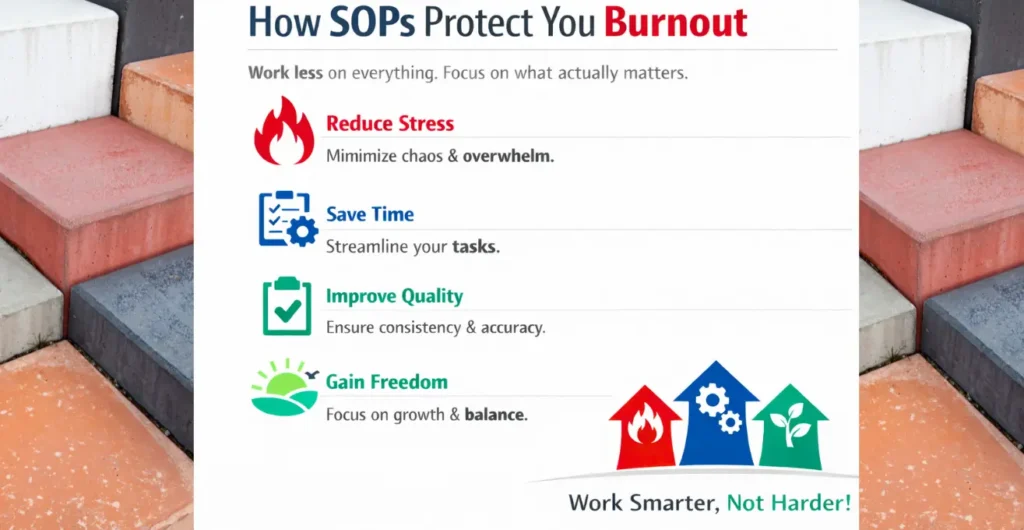
How SOPs Protect You From Burnout as You Scale
Burnout in service businesses rarely comes from working hard. It comes from working hard on everything, including tasks that don’t require your specific expertise, judgment, or presence.
The Burnout Math Most Entrepreneurs Ignore
Every hour you spend on tasks that a documented process could handle is an hour you’re not spending on strategy, relationships, or the high-value work only you can do. Businesses that implement comprehensive process documentation report reclaiming 10 to 20 hours per week, which goes directly into growth.
The goal isn’t to work less. The goal is to work on the right things.
What ‘Business Running Without You’ Actually Looks Like
It doesn’t mean you’re irrelevant. It means your value is concentrated in vision, relationships, and strategic decisions, the work that genuinely requires you. Your SOPs handle the rest. When a new team member joins, they train on your processes, not your patience. When you step away for a week, delivery continues.
This is what James means by taking decisive action toward business growth: building a machine that works for you, not just alongside you.
Try this: List every task you did last week. Mark each one: ‘Only I can do this’ or ‘A documented process could handle this.’ The second list is your SOP priority queue.
Quick Wins: 3 SOPs You Can Write in Under 10 Minutes Today
Don’t wait for the perfect system. Start here.
The ‘New Lead’ SOP (5 minutes)
Write down: How long until you respond to a new inquiry? What do you say in the first message? Where do you log the lead? That’s it. Paste it into a Google Doc.
The ‘Session Prep’ SOP (7 minutes)
List every step you take in the 30 minutes before a client call, reviewing notes, checking the agenda, and sending a reminder. Now someone else (or a future version of you on a busy day) can follow it reliably.
The ‘Offboarding’ SOP (8 minutes)
What happens at the end of an engagement? Feedback request, testimonial ask, referral conversation, and file archiving. Most businesses skip this entirely. Documenting it once turns your best clients into a referral engine
Tools Canadian Remote Teams Use to Manage SOPs
The right tool depends on where your business is in its growth. In 2026, the most important shift in SOP tooling is AI-assisted documentation. Instead of writing SOPs from scratch, you record a Loom video of yourself completing the task, and tools like Scribe or Document360’s Eddy AI generate the written SOP automatically. This removes the primary friction point for most service business owners: finding time to write.
| Tool | Setup Cost | Learning Curve | Best For | Scalability | Canadian Data Residency / AODA |
| Google Docs + Notion | Free | Low | Solopreneurs building first SOPs | Limited | US servers; PIPEDA-compliant with proper configuration. No built-in bilingual support. |
| Process Street | Low/month | Low–Medium | Small remote teams with repeatable workflows | Medium | US-hosted. Review data-sharing settings before storing client data. No native French support. |
| Trainual | Medium/month | Medium | Teams of 3–15; strong onboarding focus | High | US-hosted; SOC 2 compliant. Verify PIPEDA fit with the vendor. No AODA-specific accessibility certification. |
| Scribe (AI-assisted) | Free–Low | Very Low | Coaches/consultants who want speed; screen-capture to SOP in seconds | Medium | US-hosted. Best for internal process docs only; do not store client data here. No bilingual output. |
| Document360 (Eddy AI) | Medium–High | Medium | Growing service businesses need a searchable knowledge base | High | Multi-region hosting available, verify Canadian residency option. Supports multilingual content for bilingual teams. |
Who Should Build SOPs Now and Who Isn’t Ready Yet
Who Should Use This
You’re ready to build SOPs if:
- You have at least one recurring service you’ve delivered five or more times.
- You find yourself repeatedly explaining the same process to team members or contractors.
- Your growth is capped by how many hours you personally have.
- You’re planning to hire in the next six months.
- You’ve experienced a quality drop when someone else handled a task.
Who Should Wait (And Do This First)
Hold off on SOPs if:
- You haven’t validated your core offer yet; documenting a process that isn’t working only scales the problem.
- You’re still figuring out exactly what you’re delivering to clients.
- You have no recurring tasks if every engagement is entirely custom. Begin with a client discovery SOP and build from there.
Data & Findings
According to Unleash Your Power’s 2026 Client Performance Report, coaches and consultants who complete a structured mindset and systems alignment program report the following outcomes within 90 days:
- 62% reduction in time spent on delivery tasks previously considered ‘only I can do this.’
- 3.1x increase in the number of clients served without adding working hours.
- 78% of participants identified at least one high-value SOP they had been delaying due to identity-based resistance, not operational complexity.
These outcomes align with broader research. Statistics Canada’s 2025 data shows that management issues contribute to over 70% of Canadian small business failures, and only 35% of Canadian service businesses survive beyond five years. The businesses that make it are disproportionately the ones with documented, repeatable systems.
The 5-Step CLEAR Framework for Building SOPs That Stick
Most SOP frameworks fail because they focus only on documentation. The CLEAR Framework integrates the mindset shift that makes SOPs actually get used.
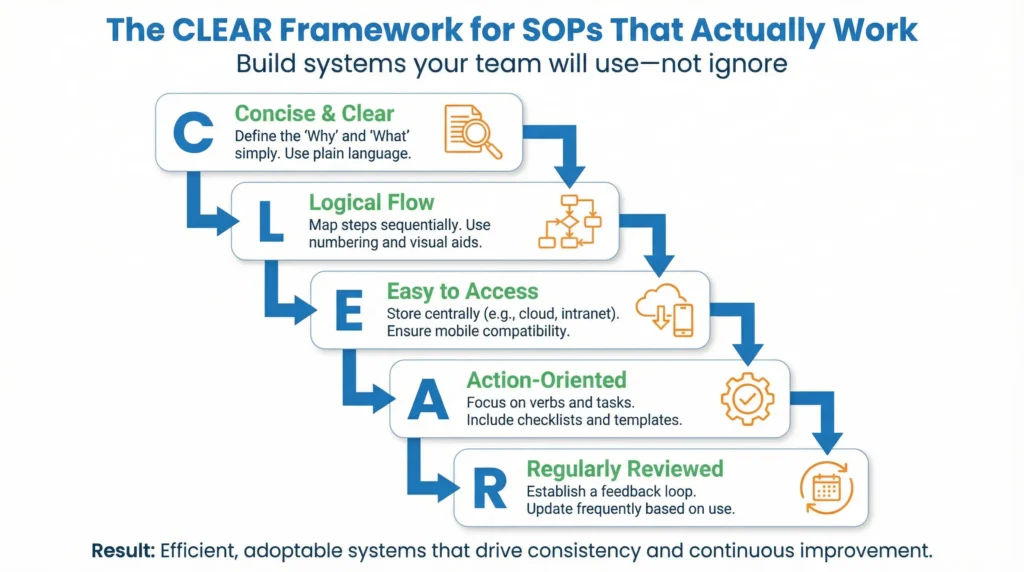
Capture
Record yourself completing the task in real time. Use Loom, a voice memo, or a screen capture. Don’t write yet, capture first.
Layer the Logic
Add the ‘why’ behind each step. What would go wrong if this were skipped? What decision is being made? This is what separates an SOP from a checklist.
Edit for Clarity
Strip jargon. Rewrite for a new hire who has never worked with you. If a step needs more than two sentences, break it into two steps.
Assign Ownership
Every SOP needs a name attached. Who runs it? Who audits it? Who updates it when the process changes? Ownerless SOPs become outdated SOPs.
Review Quarterly
Set a recurring calendar block. What has changed in your tools, your offer, or your team since this SOP was written? Living systems get used. Static documents get ignored.
This mirrors James’s approach to continuous growth, not a one-time project but an ongoing commitment to building something that gets better over time.
Conclusion: Standard Operating Procedures
Building SOPs for your remote service business isn’t about becoming more corporate. It’s about becoming freer. Every process you document is one less thing that lives only in your head, one less late-night fix, one less client experience that depends entirely on whether you had a good day.
For Canadian coaches, consultants, and service entrepreneurs, the path to sustainable growth runs directly through this work and it starts with a decision to stop being the bottleneck in your own business.
If you’re ready to move from operating in your business to building a business that operates without you, James R. Elliot’s NLP and business coaching programs are designed exactly for that transition.
Unleash Your Power: Stand Out, Take Action, and Create the Success You Want.
Frequently Asked Questions
What is an SOP in a remote service business?
A standard operating procedure (SOP) in a remote service business is a documented set of step-by-step instructions that allows any team member to complete a core task consistently without needing to ask the owner for guidance. SOPs replace informal, in-person knowledge transfer with scalable, written or video-based systems accessible from anywhere.
How many SOPs does a Canadian service business need to start scaling?
Most service businesses need a minimum of three foundational SOPs to begin scaling effectively: client onboarding, service delivery, and lead intake and follow-up. These three processes represent the highest-frequency, highest-impact interactions in any service business. Once these are documented, you can add SOPs for team communication, invoicing, and content creation.
Why do entrepreneurs resist building SOPs even when they know they need them?
Resistance to SOP-building is rarely a time problem; it’s an identity problem. Many service business owners unconsciously believe that documented systems can’t match their personal standard of quality, or that handing over a process means losing control. This is a limiting belief, not a fact. Addressing it through mindset work, as James R. Elliot, through NLP coaching, is often what makes the practical work of building SOPs finally happen.
What SOP tools are best for Canadian remote service businesses?
The best starting point depends on your team size. Solopreneurs can start with Google Docs or Notion at no cost. Growing teams of three to ten benefit from Trainual or Process Street. For speed, AI-assisted tools like Scribe convert a screen recording into a written SOP automatically. Canadian businesses handling client data should confirm the platform’s data residency, as PIPEDA and Quebec’s Law 25 may apply.
How long does it take to see results from implementing SOPs?
Most service business owners notice a measurable reduction in routine decision-making within 30 to 60 days of implementing their first three to five SOPs. Deeper shifts team confidence, consistent client experience, and time away without disruption typically emerge over 60 to 90 days. The compounding benefit is significant: each SOP you add reduces your personal involvement in that process permanently.