
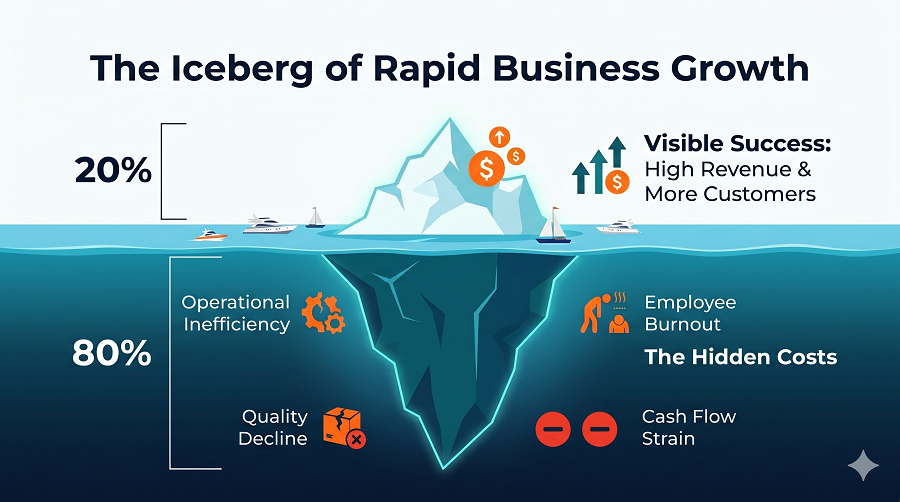
Growth Feels Like Winning, Until It Quietly Breaks Your Business
Rapid business growth in Canada creates five hidden costs most entrepreneurs never see coming: cash flow instability, hiring overload, regulatory compliance strain, culture erosion, and founder burnout.
The Startup Genome Report found that 74% of high-growth companies fail from premature scaling. For Canadian SMEs navigating complex provincial obligations, deliberate and decision-led growth is the difference between scaling up and breaking down.
You landed a major contract. Revenue is climbing. The team is growing. From the outside, your business looks like a success story.
Inside, though, you’re working harder than ever, cash feels tighter than it should, decisions are piling up, and you’re not sure the system holding everything together is strong enough to hold much more.
This is what rapid growth actually looks like for most Canadian entrepreneurs. And the costs that are quietly accumulating are the ones that bring growing businesses down. Understanding them is how you stop that from happening to yours.
Key Takeaway:
- Rapid business growth often hides operational strain beneath surface success. While revenue may rise, internal systems, cash flow, and team alignment can quietly break down, creating instability that limits long-term scalability.
- Hidden costs: premature hiring, rising overhead, inconsistent cash flow, compliance gaps, and decision fatigue. Without structured systems, growth amplifies inefficiencies instead of profitability.
- Why it happens: Founders chase expansion before building infrastructure. Lack of financial forecasting, unclear processes, and weak leadership alignment create what experts call “infrastructure debt.”
- What to do: Shift from speed to strategy. Build scalable systems, strengthen financial controls, hire with intention, and prioritize operational clarity before expanding further.
- When to be cautious: If growth is accompanied by stress, declining margins, team confusion, or constant firefighting, it’s a signal that scaling is outpacing structure and needs immediate correction.
Bottom Line: Rapid growth is not always healthy growth. Without strong systems and financial discipline, scaling can create hidden risks that stall or even reverse business success.
- Source: Unleash Your Power – Hidden Costs of Rapid Business Growth
- Source: Unleash Your Power – Business & Leadership Insights
Why Fast Growth Is One of the Riskiest Phases for Canadian SMEs
Canada’s small and medium-sized enterprises (SMEs) are the backbone of the economy, contributing close to 48% of private sector GDP. But being vital to the economy does not make you immune to its pressures. About half of all new Canadian businesses do not make it past the five-year mark. Many of those failures happen not in the startup phase, but during growth. To understand why small businesses fail to grow in Canada is the first step to avoiding those traps yourself.
Understanding the hidden costs of rapid business growth is essential for entrepreneurs. Awareness allows for better planning and risk management.
Ontario SMEs face a particularly loaded environment during scaling: WSIB classification changes, Employer Health Tax (EHT) thresholds, multi-jurisdictional compliance obligations, and a persistent skilled labour shortage that the CFIB reported in 2025 affects 53% of SMEs actively trying to grow.
Growth does not guarantee survival. It amplifies whatever you already have, including your gaps.
The 5 Hidden Costs of Rapid Business Growth
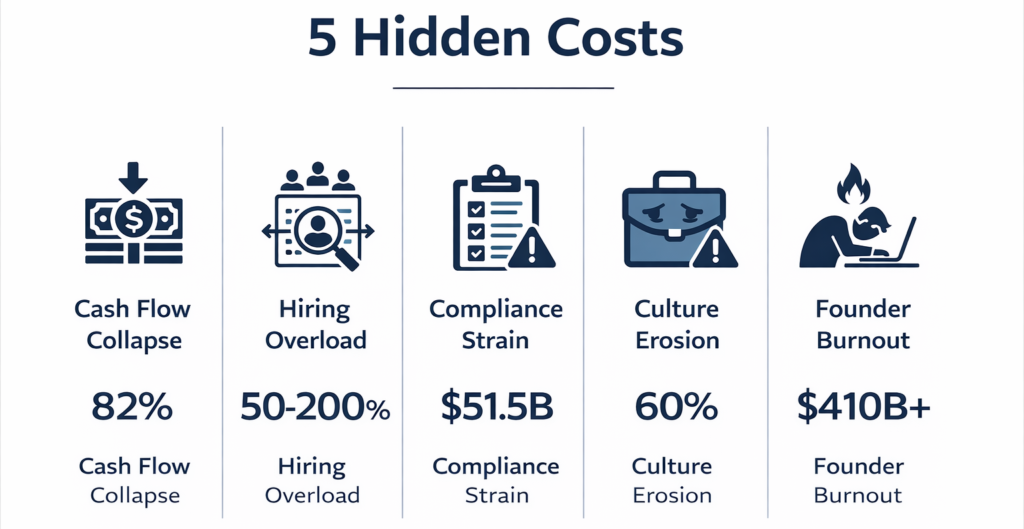
1. Cash Flow Collapse
Revenue going up does not mean money is available. When you’re scaling fast, you’re spending ahead of income, on inventory, payroll, marketing, and new hires.
Client payment cycles lag behind. Research consistently shows that 82% of business failures cite cash flow issues as the primary cause, not lack of demand. The business looked profitable on paper right up until it ran out of operating capital.
2. The True Cost of Rapid Hiring in Canada
Every new hire in Canada costs significantly more than their salary. Mandatory employer contributions including CPP, EI, WSIB, and in Ontario the Employer Health Tax add roughly 10 to 15% on top of gross salary.
This is before onboarding, training, benefits, and the cost most founders underestimate: turnover. When rapid growth leads to reactive hiring, turnover follows. Research shows that replacing an employee costs between 50% and 200% of their annual salary, depending on seniority and role.
The Canadian labour market compounds this. As of 2025, over half of SMEs say skilled labour shortages are directly limiting their ability to grow.
3. Regulatory Compliance Overload
The Canadian regulatory environment does not pause for growth. In 2024, total compliance costs for Canadian businesses reached an estimated $51.5 billion, up 13.5% from 2020 according to the CFIB. Ninety percent of small business owners say excessive regulation adds significant stress to their operations. When you scale fast, regulatory exposure grows faster than your systems can handle it. Building smart reinvestment strategies means treating compliance as a core budget line, not an afterthought.
4. Culture Erosion
Culture is not a ping pong table. It’s the shared understanding of how things get done. When you hire reactively under pressure, values alignment gets skipped. The result: inconsistent standards, duplicated effort, confused accountability, and a team working hard but not pulling together. Culture erosion is invisible until it’s expensive.
5. Founder Burnout and Decision Fatigue
According to a Startup Snapshot report, 72% of founders experience mental health impacts during growth phases, including anxiety, burnout, and decision fatigue. The volume of decisions multiplies during rapid growth. When you’re making dozens of high-stakes calls per day without adequate systems or support, decision quality drops. Bad decisions compound. And the cost shows up in every part of the business.
Premature Scaling vs Strategic Scaling
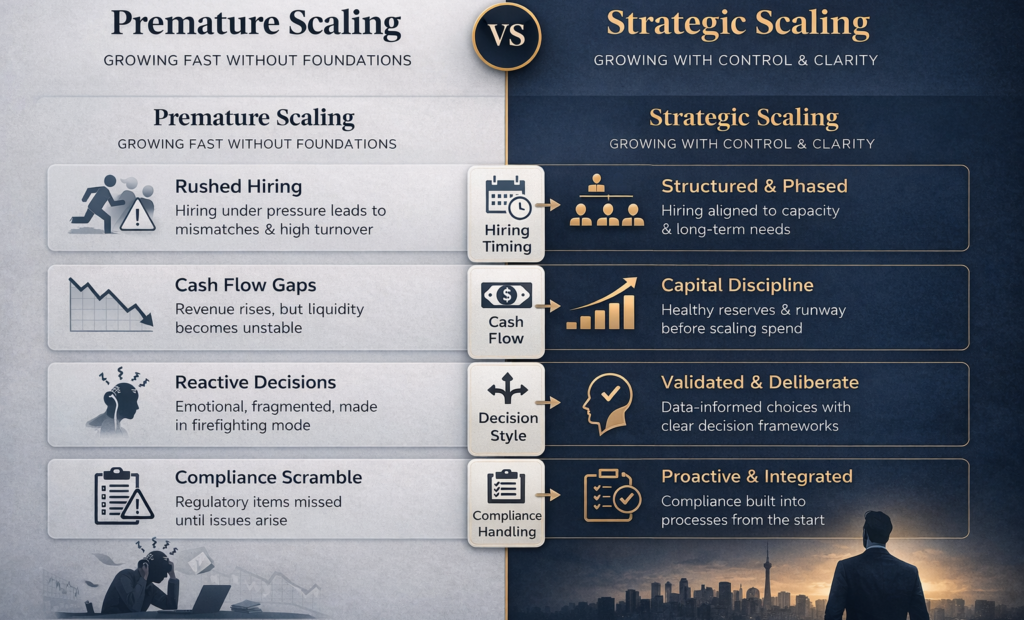
The difference between the two is not the speed of growth. It’s whether your systems, decision quality, and cash position can hold the weight of what you’re adding.
Premature scaling means expanding your business, team, spending, and market reach, faster than your foundations can support.
| Factor | Premature Scaling | Strategic Scaling |
| Hiring timing | Before revenue confirms need | When capacity proves demand |
| Cash flow | Outflows ahead of inflows | Spending tied to cash on hand |
| Decision style | Reactive, pressure-driven | Deliberate, data-informed |
| Compliance handling | Reactive (catch-up mode) | Proactive (built into systems) |
| Outcome | Fragile, high burnout risk | Resilient, sustainable |
The Startup Genome Report, based on research across more than 3,200 high-growth startups, found that 74% of high-growth companies fail because of premature scaling. The failure is rarely about product or demand; it’s about infrastructure expanding out of sync with the business’s actual stage of development.
What Is Premature Scaling?
Premature scaling means expanding your business, team, spending, market reach, product complexity, faster than your foundations can support.
The Startup Genome Report, based on research across more than 3,200 high-growth startups, found that 74% of high-growth companies fail because of premature scaling. The failure is rarely about product or demand. It’s about infrastructure expanding out of sync with the business’s actual stage of development.
Signs you’re scaling prematurely:
- Hiring before revenue is confirmed and predictable
- No documented systems or repeatable processes
- The founder is still the decision-maker in every operational call
- Constant firefighting with no time for strategic thinking
- Cash feels tight despite growing revenue
The Mindset Cost: How Growth Pressure Distorts Decision-Making
There’s a cost that doesn’t appear on any financial statement. When you’re operating under sustained pressure, your thinking narrows. The options you can see shrink. You react instead of respond. And decisions that feel urgent in the moment often look avoidable in hindsight.
One of James’s long-term clients, Darren G., came to him feeling blocked despite running a business that looked successful from the outside. He had a well-paying role, but promotions he’d planned for kept slipping, and every new initiative seemed to stall before it gained real traction. What James identified wasn’t a market problem or a strategy problem. It was a goal block: a set of internal limits Darren had never seen because they lived below conscious awareness.
Once those were surfaced and cleared, the ceiling lifted. His thinking expanded, his decisions became more decisive, and his relationships improved as a side effect. The same pattern plays out in growth-stage businesses all the time. You can read more about how NLP techniques support entrepreneurs through exactly these phases.
The limiting factor during rapid growth is rarely the market. It’s often the founder’s internal decision-making system breaking down under load. That’s the hidden cost most business advisors never name, and it’s the one that sets everything else in motion.
How NLP Builds the Decision-Making Clarity Growth Demands
NLP (Neuro-Linguistic Programming) is not a motivation tool. It’s a framework for how you process information, manage your internal state, and make decisions under pressure. For growth-stage business owners, three NLP tools make a direct and measurable difference.
Reframing Growth Pressure as Strategic Data
When revenue is climbing and demands are multiplying, most founders interpret pressure as a signal to move faster. NLP reframing shifts that interpretation. Pressure becomes data: what is this telling you about your systems, team capacity, and decision processes? That shift moves you from reaction to strategy.
Anchoring a Calm Decision State
During high-stakes periods, your emotional state determines the quality of your thinking. NLP anchoring lets you create and recall a specific mental state on demand, calm, focused, decisive. Leaders who use anchoring make clearer decisions in less time, with less second-guessing. This is a core technique in James’s approach to NLP for stress management in business.
Using the Meta Model to Challenge Assumptions
When teams are overwhelmed, communication becomes sloppy. Assumptions go unchallenged. The NLP Meta Model is a questioning framework that surfaces vague or distorted thinking, the kind that leads to the wrong hires, the wrong contracts, and the wrong priorities. With 20+ years of coaching growth-stage business leaders, James uses this tool consistently to help clients see what their stressed-out mental maps have been filtering out.
The 4-Step Controlled Growth Framework
This is the framework James uses with Canadian entrepreneurs who want to scale without the hidden costs accumulating beneath them.
Step 1 — Validate Before You Accelerate
Confirm that demand is consistent and your unit economics are solid before you expand. Scaling amplifies what’s already there. Make sure it’s working before you make it bigger.
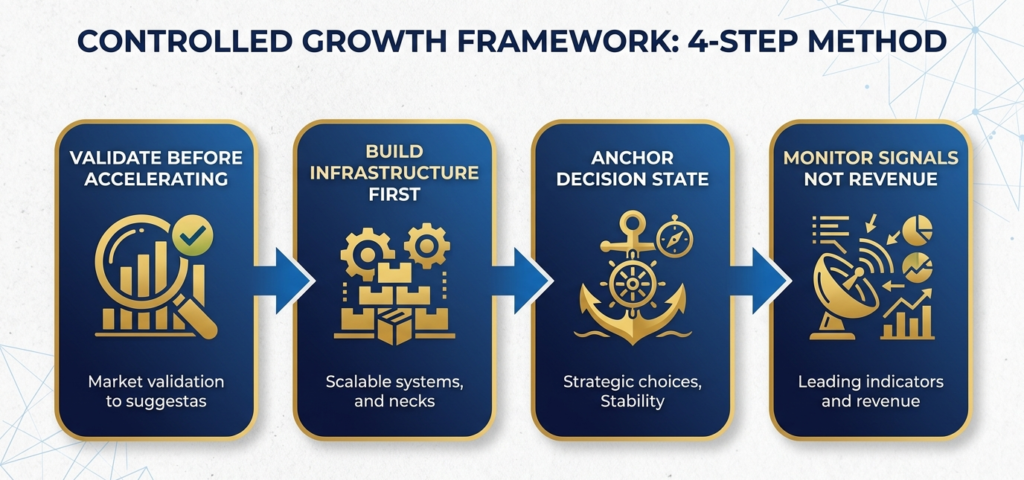
Step 2 — Build Infrastructure Before Headcount
Systems, documented processes, and clear decision paths need to exist before new people arrive. The goal is to hire into a structure, not to hire and hope a structure forms. This is the foundation of effective goal setting for business growth.
Step 3 — Anchor Your Decision State
Before major hiring decisions, contract negotiations, or expansion moves, use deliberate state management. Calm, focused decision-making protects your business from the reactive choices that scaling pressure generates.
Step 4 — Monitor Signals, Not Just Revenue
Revenue is a lagging indicator. The signals that matter during growth are cash runway, team capacity, decision turnaround time, and customer experience quality. Monitor those and you’ll see problems before they compound.
Quick Decision Snapshot: Should You Scale Now?
Scale now if:
- Cash flow is stable and covers 6+ months of operating expenses
- Demand is proven, consistent, and documented
- Core processes are written down and repeatable
- At least one person on the team can lead their function without your constant oversight
Slow down if:
- You’re hiring ahead of confirmed revenue
- Decisions are being made reactively under pressure
- You as the founder are still involved in every operational call
- Compliance obligations are being handled in catch-up mode
Who Should Scale Aggressively
You’re ready to scale if demand is validated, your unit economics are profitable, your core team can operate without you in every decision, and your cash runway covers at least six months of buffer against the unexpected. The businesses that scale well are the ones that have already built their systems and then hire into them.
By addressing these issues proactively, business owners can create a framework for sustainable growth.
Who Should Slow Down
If you’re unsure whether the growth will hold, if cash flow is already stretched, or if you’re making key decisions in a reactive state, adding speed adds risk. The goal is not to stop growing. It’s to grow at the pace your infrastructure can support. That’s where intention separates the businesses that thrive from the ones that quietly collapse under the weight of their own momentum.
Here’s the Data & Findings section with every stat hyperlinked to its verified primary source, ready to paste into WordPress or your doc:
Data & Findings
Based on findings from the Startup Genome Report, CFIB, Statistics Canada, and Unleash Your Power’s coaching client base (2024–2026):
- 74% of high-growth startups fail due to premature scaling (Startup Genome Report, 3,200+ startups)
- 82% of business failures cite cash flow issues as the primary cause (Jessie Hagen, U.S. Bank / SCORE)
- $51.5 billion — total compliance cost for Canadian businesses in 2024, up 13.5% from 2020 (CFIB Red Tape Report, January 2025)
- 90% of Canadian SME owners say excessive regulation adds significant stress to their operations (CFIB Red Tape Report, January 2025)
- 53% of Canadian SMEs cite skilled labour shortages as a direct barrier to growth (CFIB, June 2025)
- 10 to 15% — additional employer cost burden over gross salary in Canada (CPP, EI, WSIB, EHT where applicable)
- 50 to 200% — estimated cost of replacing an employee, depending on role seniority (Randstad Canada / Gallup)
- 72% of founders report mental health impacts including burnout (Startup Snapshot, The Untold Toll, 2023)
- SMEs account for approximately 48% of Canada’s private sector GDP (Statistics Canada via ISED Key Small Business Statistics 2024)
Frequently Asked Questions
What are the hidden costs of growing a business too fast in Canada?
The five most significant hidden costs are cash flow instability (where spending outpaces available cash), rapid hiring expenses that include 10 to 15% mandatory employer burden plus turnover costs of 50 to 200% per lost employee, regulatory compliance overload, culture erosion from reactive hiring, and founder burnout. Each is predictable and manageable with the right planning framework in place.
What is premature scaling and why does it kill businesses?
Premature scaling means expanding headcount, spending, and market reach faster than your infrastructure can support. The Startup Genome Report found that 74% of high-growth companies fail this way. The problem is not ambition. It’s that growth amplifies whatever’s already there, including gaps, weak systems, and unresolved decision-making habits.
How can NLP help business owners make better decisions during rapid growth?
NLP gives business owners specific tools to manage their internal state under pressure, challenge assumptions that narrow their options, and reframe growth challenges from threats into data. Anchoring and reframing are particularly valuable during scaling phases when decision volume is high and the stakes are compounding daily.
What regulatory costs should Canadian entrepreneurs plan for when scaling?
In 2024, total business compliance costs in Canada reached approximately $51.5 billion. For growing SMEs, the specific obligations to plan for include CPP, EI, and WSIB employer contributions (adding 10 to 15% over salary), Employer Health Tax in Ontario for payrolls above $1 million, and multi-provincial employment standards if hiring across provincial lines. Treating compliance as a budget line from day one is one of the most important financial discipline moves a scaling entrepreneur can make.
When is the right time to scale a Canadian SME?
You’re ready when demand is proven and consistent, cash flow covers at least six months of operating expenses, your core processes are documented, and at least one person on your team can lead their function independently. If any of those conditions are not yet met, the better move is to build the foundation first, then accelerate.
Ready to Scale With Intention?
Rapid growth is not a problem to power through. It’s a system to design.
If you’re navigating a growth phase and the decisions are starting to feel like they’re making themselves, that’s the signal. Controlled growth, the kind that holds, starts with decision clarity, not more effort.
James R. Elliot has spent 20+ years helping Canadian entrepreneurs and business leaders build the internal frameworks that support sustainable growth. Whether you’re scaling a team, entering a new market, or facing a decision you can’t quite see clearly, the right support changes the outcome. Learn more about business coaching with James and take the first decisive step.
Unleash Your Power: Stand Out, Take Action, and Create the Success You Want.