
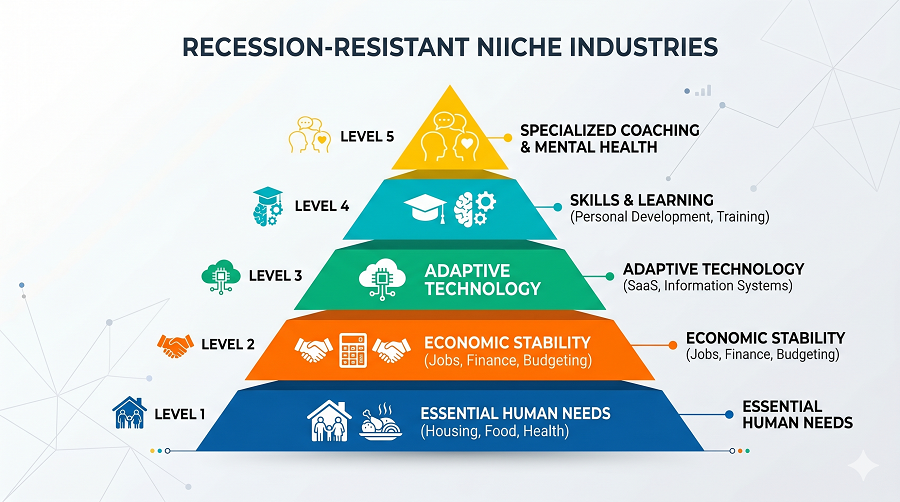
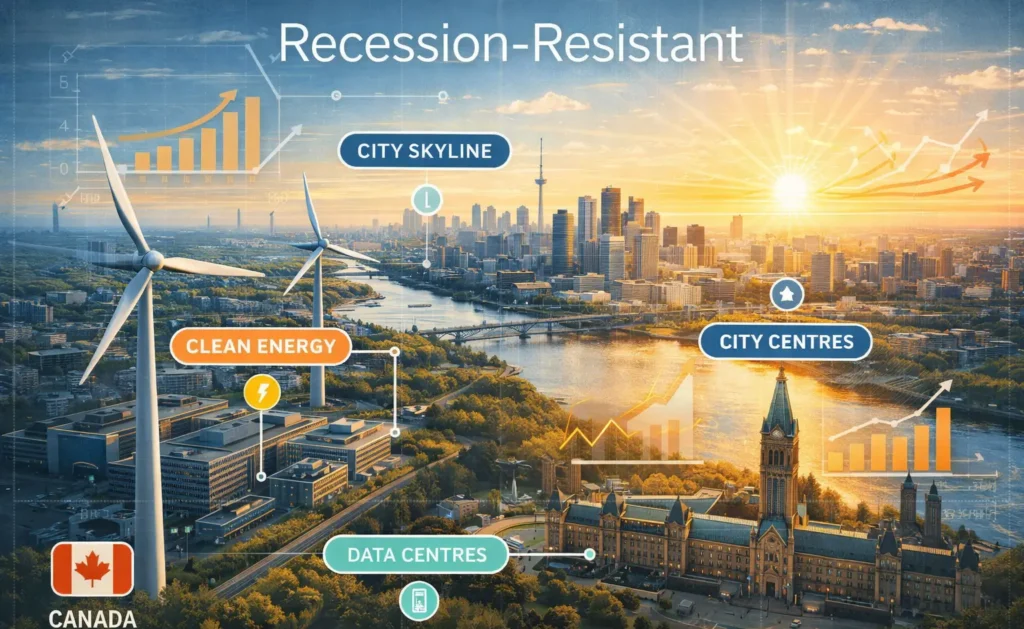
Despite US tariff pressure and sluggish GDP growth, Canada’s economy contains a core of structurally protected, high-demand industries that hold steady or accelerate in downturns. These 11 recession-resistant niche industries are positioned to thrive in Canada in 2026:
- National Defence & Defence Technology
- Cybersecurity
- Healthcare Technology & Telehealth
- Critical Minerals & Mining Services
- AI Infrastructure & Data Services
- Professional Coaching & Leadership Development
- Clean Energy & Electrification
- Agri-Tech & Food Security
- Government Infrastructure Contracting
- Mental Health Services
- Immigration & Settlement Services
These sectors are driven by government spending, irreplaceable domestic demand, and structural shifts that tariffs cannot touch.
Key Takeaway:
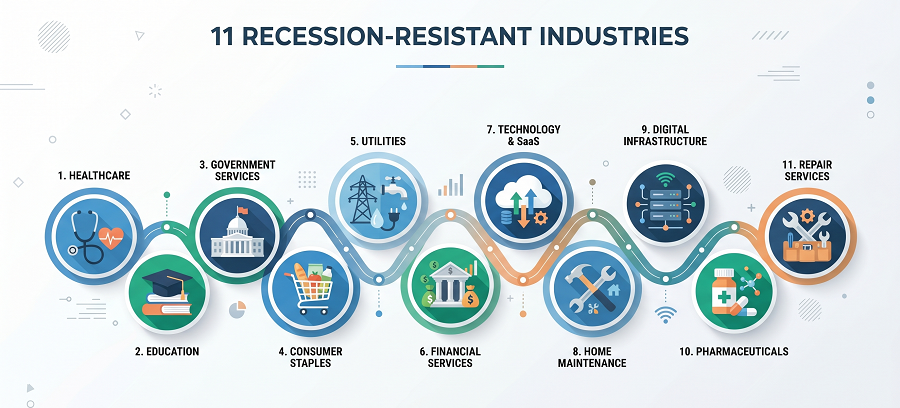
- The 11 most recession-resistant niche industries in Canada include: Healthcare & Senior Care, Home Maintenance & Repairs, Essential Groceries & Meal Prep, Pet Care, Accounting & Bookkeeping, Digital Security & Cybersecurity, Waste Management & Junk Removal, Funeral Services, Mental Health & Wellness Support, Education & Tutoring, and Government Contracting. [1]
- These niches thrive in recessions because they fulfill essential human needs (health, safety, food, shelter, pets) or provide critical B2B services that businesses cannot easily cut, leading to stable or growing demand even when consumer spending drops. [1]
- To succeed: Focus on one niche, solve a specific painful problem, build recurring revenue (subscriptions, retainers, memberships), keep overhead low, and position yourself as the reliable expert. Low-capital entry is possible in most of these through service-based or digital models. [2]
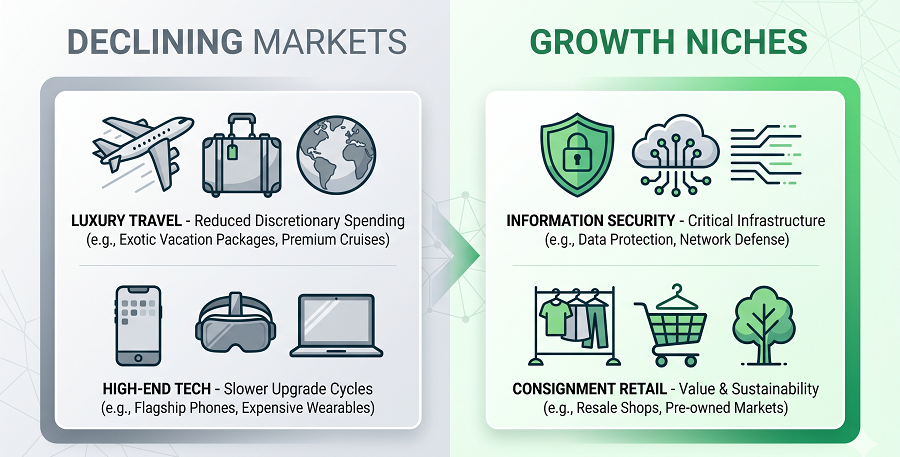
- Avoid highly discretionary sectors like luxury goods, travel, or non-essential retail during uncertain times. The strongest opportunities combine essential demand with scalable delivery and recurring income potential. [2]
Bottom Line: Recession-resistant businesses focus on essential needs that people and companies cannot easily eliminate. Choose one of the 11 stable niches, solve a specific problem, and build recurring revenue to create a durable, low-risk business even in tough economic times.
Canada’s Economic Outlook Heading Into 2026
Canada avoided a technical recession in 2025, but calling it smooth sailing would miss the real picture. US tariffs on steel, aluminum, and autos continue to bite. GDP growth is forecast at around 1.4–1.7%. The unemployment rate is hovering near 6.5–7%, and business confidence, while improved from mid-2025 lows, remains cautious.
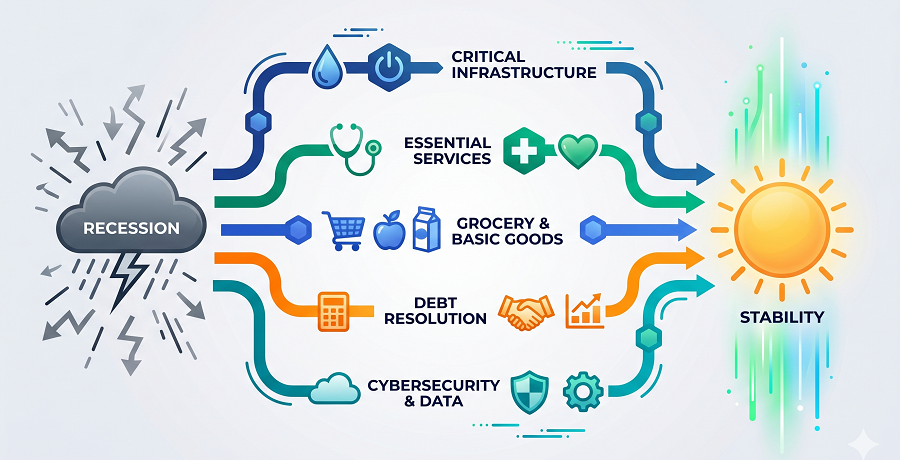
And yet, the story beneath the headline numbers is more interesting. The Bank of Canada’s Q4 2025 Business Outlook Survey found that only 22% of firms were budgeting for a recession, the lowest level reported in all of 2025. Consumer spending, supported by lower interest rates and wage growth, is expected to be the primary engine of growth. And the federal government is deploying what economists are calling the largest fiscal stimulus since 1980, with nation-building infrastructure projects, defence spending, and clean energy investment fuelling demand across the country.
The key insight? This is not a cyclical slowdown. RSM Canada’s 2026 economic analysis describes it as a structural transition. The industries that lose are the ones tied to US export markets and discretionary consumer spending. The industries that win are those anchored in domestic necessity, government mandates, and long-term global shifts. That is exactly the list you need to be paying attention to right now.
What Makes a Canadian Industry Recession-Resistant in 2026?
Not every stable-looking industry is actually protected. True recession resistance in Canada’s 2026 context comes down to two structural filters:
It Serves Domestic Demand, Not Export Markets
Industries tied primarily to Canadian consumers, Canadian government contracts, or Canadian regulatory requirements are insulated from US tariff shock. RBC Economics notes that the economy has effectively become fragmented, with trade-hit regions versus trade-insulated regions. The sectors on this list operate almost entirely in the trade-insulated zone.
It’s Backed by Government Spending or Irreplaceable Need
The federal government’s 2026 fiscal agenda includes billions directed at defence, infrastructure, clean energy, and immigration integration. When government demand replaces export demand, the business cycle becomes a much smaller factor. Add sectors where demand is non-negotiable, such as healthcare, mental health, and food security, and you have a resilience formula that holds through almost any macroeconomic scenario.
11 Recession-Resistant Niche Industries at a Glance
| Industry | Why It’s Recession-Resistant | Opportunity |
| Defence Technology | Government procurement & sovereignty push | Defence suppliers, consulting, engineering |
| Cybersecurity | 25,000+ professional shortage; growing 8.2% annually | SMB consulting, managed security services |
| Healthcare Technology | Aging population + telehealth adoption | Telehealth startups, health data platforms |
| Critical Minerals | Global energy transition; NATO supply chain needs | Mining services, processing, logistics |
| AI Infrastructure | 250,000+ tech jobs needed by 2026 in Canada | AI ops, data engineering, cloud services |
| Coaching & Leadership | Recession accelerates demand for performance skills | NLP training, executive coaching, e-learning |
| Clean Energy | LNG Canada, electrification, federal green agenda | Energy consulting, EV infrastructure, utilities |
| Agri-Tech & Food Security | Buy Canadian policies; domestic food demand is inelastic | Precision farming, supply chain, food tech |
| Govt Infrastructure | Largest fiscal stimulus since 1980; nation-building projects | Project management, civil engineering, trades |
| Mental Health Services | Record demand; government funding expanding | Online therapy, corporate wellness, coaching |
| Immigration & Settlement | Population diversification; IRCC-funded integration | Language training, settlement consulting, HR |
11 Recession-Resistant Niche Industries Thriving in Canada in 2026
National Defence & Defence Technology
Canada released its first-ever Defence Industrial Strategy in February 2026, a comprehensive blueprint prioritizing Canadian firms in procurement, establishing a $4 billion Defence Platform through BDC, and projecting over $180 billion in direct procurement investment by 2035. The government is also building BOREALIS, a purpose-built national innovation hub accelerating frontier technologies, including AI, quantum computing, and cybersecurity for defence applications. For entrepreneurs, engineers, and technology consultants, this is a generational demand signal, and it’s just beginning.
Cybersecurity
Canada currently faces a shortage of more than 25,000 cybersecurity professionals. The industry is growing at 8.2% annually and is projected to reach nearly CAD $7.5 billion by 2029. What makes cybersecurity exceptional as a niche opportunity is the human performance factor: Canada’s National Cyber Threat Assessment 2025–2026 confirms that the majority of breaches originate from human error, not technical vulnerabilities. This means that cybersecurity is not purely a technical field. It is a leadership and communication field. Organizations that pair technical defences with strong leadership training and culture dramatically outperform those that don’t. This is a natural intersection for coaches, consultants, and NLP-trained professionals who understand behaviour change.
Healthcare Technology & Telehealth
Remote healthcare has become a permanent structural feature of Canadian service delivery, not a pandemic trend. Canada’s aging population, combined with persistent physician shortages and strained hospital systems, makes telehealth demand structurally inelastic. Digital health records, virtual care platforms, remote monitoring tools, and AI-assisted diagnostics are all growing rapidly. For professionals with backgrounds in health, technology, or even coaching and behaviour change, this sector offers multiple points of entry.
Critical Minerals & Mining Services
Canada produces 10 of the 12 defence-critical raw materials identified by NATO and holds the world’s largest deposits of high-grade uranium. As the global energy transition accelerates and defence supply chains demand domestic sourcing, Canada’s critical minerals sector is being repositioned as a sovereign priority. BDC’s 2026 economic outlook identifies mineral extraction and processing as one of the clearest growth opportunities, independent of US trade dynamics.
AI Infrastructure & Data Services
The Information and Communications Technology Council projects that Canada will need to fill over 250,000 tech-related positions by 2026. The primary driver is AI infrastructure, data centers, cloud services, machine learning pipelines, and AI integration for regulated industries like healthcare, finance, and logistics. Companies that can build AI tools tailored to Canadian regulatory requirements, including PIPEDA compliance and bilingual service delivery, have a structural competitive edge over generic global platforms.
Professional Coaching & Leadership Development
Here is something most people overlook: recessions accelerate demand for performance skills. When companies downsize, and individuals face career uncertainty, the investment in coaching, communication mastery, and mindset development becomes urgent rather than optional. In 20+ years of working with professionals and entrepreneurs across Canada, the pattern is consistent: economic pressure forces the growth conversation that should have happened years earlier.
This is exactly where Darren G. found himself. Stuck in a well-paying job with no path forward, blocked from promotions and from launching his own business, he came to work on his mindset through NLP coaching. After identifying and breaking through his goal blocks, his thinking, relationships, and career trajectory transformed. That shift wasn’t luck, it was skill. And the coaching industry that produces those shifts is growing regardless of what the economic headline says.
Heather Chetwynd took it further. After completing NLP Practitioner training, she walked away not just with coaching tools but with unexpected clarity about her business direction. The coaching niche is one of the few sectors where the investment pays off for both the provider and the client, making it recession-resistant from both sides of the transaction.
If you’re building a coaching practice or considering transitioning into leadership development, the NLP training programs at Unleash Your Power are specifically designed to build both the credentials and the client-facing skills you need to compete in this growing market.
Clean Energy & Electrification
The completion of LNG Canada Phase 1, the expansion of electrical grid infrastructure to support EV adoption, and the federal government’s electrification agenda are creating multi-year demand for energy consulting, project management, infrastructure development, and clean technology services. This isn’t a niche defined by ideology; it’s driven by contracts, timelines, and government commitments that are already funded and underway.
Agri-Tech & Food Security
Buy Canadian policies, disrupted international supply chains, and growing consumer awareness around food origins are reshaping Canada’s agricultural sector. Precision farming technology, supply chain software, food-tech startups, and agricultural consulting are all benefiting from a structural push to strengthen domestic food production. This is a sector where rural and urban Canada intersect, and where the economic and the environmental mandates align.
Government Infrastructure Contracting
Oxford Economics describes Canada’s 2026 fiscal impulse as the largest since 1980, excluding the pandemic. Nation-building projects, including the Port of Montreal expansion, mini nuclear reactors in Ontario, and the British Columbia LNG terminal, are all creating demand for project managers, civil engineers, trades professionals, and the consultants who support large-scale infrastructure delivery. Government contracts are among the most recession-resistant revenue streams available.
Mental Health Services
Canada’s mental health crisis is structurally driven, not cyclical. Pandemic-era demand never subsided, and economic uncertainty compounds it. Government funding for mental health programs has expanded at both federal and provincial levels, insurance coverage for digital mental health platforms is increasing, and the corporate wellness sector is growing as employers recognize the productivity cost of untreated stress and burnout. For coaches, counsellors, therapists, and wellness entrepreneurs, this is a sustained market with genuine social impact.
Immigration & Settlement Services
Canada’s immigration policy continues to drive population diversification even as overall immigration targets are being recalibrated. The individuals entering Canada need integration programs, language training, credential recognition support, employment placement, and settlement consulting services funded in large part through Immigration, Refugees and Citizenship Canada (IRCC). This creates a resilient service market that operates largely independent of the broader trade environment and is closely linked to government funding cycles rather than consumer discretionary spending.
How Do You Enter a Recession-Resistant Industry in Canada?
Economic opportunity is rarely about perfect timing. It’s about the ability to adapt your thinking when markets shift. The professionals who successfully pivot into recession-resistant sectors in 2026 are not always the most technically qualified; they are the most mentally adaptable. Here’s how to move with intention:
Audit Your Transferable Skills
Start with an honest inventory. Most professionals significantly undervalue what they already know. A project manager in manufacturing has skills that translate directly to government infrastructure contracting. A nurse has skills that map to healthcare technology and telehealth coaching. A communications specialist has skills that the cybersecurity sector desperately needs. Mastering the right mindset for business starts with recognizing your existing assets before you think about gaps.
Reframe Uncertainty as a Market Signal
Here is what most people miss: the industries that feel uncertain to enter right now are uncertain because they are growing fast. The talent supply hasn’t caught up with the demand curve yet. That is not a reason to hesitate; it is the exact window to move. The entrepreneurial mindset cultivated through NLP is precisely the capacity to read market signals as opportunities rather than threats.
Try this: Take one industry from the list above and spend 90 minutes this week researching what specific roles or services within that sector are currently understaffed. Look at Canadian job boards, LinkedIn, and government procurement listings. What you find will likely surprise you.
Who Should Pursue Recession-Resistant Niches in 2026?
| Pursue These Niches If You… | Avoid (or Prepare First) If You… |
| Are ready to pivot and can tolerate 6–12 months of transition | Expect immediate income with zero reskilling |
| Have transferable leadership, tech, or communication skills | Are resistant to continuous learning and adaptation |
| Thrive in uncertainty and can make decisions with incomplete info | Need the certainty of a guaranteed outcome before acting |
| Are coachable and willing to reshape your identity around a new niche | Prefer to wait and see — recession-resistant sectors fill fast |
| See the current economy as a signal, not just a threat | Define yourself only by your current industry title |
If the left column describes you, even partially, the window is open. If the right column sounds more familiar, the work to shift those patterns starts with identifying what’s actually holding you back. That’s not a small thing. It’s the entire game.
Data & Findings
Canada’s 2026 Economic Baseline (Sources: BDC, RBC Economics, BMO Capital Markets, Bank of Canada, RSM Canada, Oxford Economics)
- GDP Growth: Forecast at approximately ~1.0%–1.4% for 2026, reflecting a low-growth environment supported by domestic demand and easing monetary conditions.
- Unemployment Rate: Currently ~6.5%–6.7% nationally, with expectations of stabilization as economic conditions gradually improve.
- Recession Outlook: Canada is not currently in a recession, with growth remaining positive despite economic headwinds and higher interest rates.
- Monetary & Economic Conditions: The Bank of Canada projects modest growth with easing inflation pressures, supporting a gradual stabilization through 2026.
The 5-Step Recession-Proof Mindset Framework
Knowing which industries to enter is the analytical part. The harder, more important work is this: developing the internal capacity to actually move. In my 20+ years working with professionals and entrepreneurs, I’ve seen it consistently: the gap between opportunity and outcome is almost never information. It’s the mindset. Here is the framework I use with clients navigating exactly this kind of transition.
Step 1: Clarity of Vision
The Recession Reality Check: Identify which 80% of your current activities are distractions from the direction you actually need to move in. Most professionals in a shrinking sector know they need to pivot, but clarity about the destination is fuzzy, so the inertia wins. Write down the specific industry, the specific role or service, and the specific first action. Vague intention doesn’t survive economic pressure.
Step 2: Confident Communication
The Recession Reality Check: In uncertain markets, leaders who communicate with precision and calm command trust. Your ability to articulate your value in a new niche, clearly, without over-explaining or underselling, is the skill that opens doors. This isn’t personality. It’s a learnable framework. NLP techniques for confident communication are specifically designed to accelerate this skill, even for those who’ve struggled with it for years.
Step 3: Courageous Action
The Recession Reality Check: Waiting for certainty in a recession means missing the window. The professionals who enter recession-resistant sectors early, before the talent supply catches up with demand, are the ones who build lasting positions. Action taken with 70% information beats inaction waiting for 100%. Make the move now and course-correct as you go.
Step 4: Compelling Presence
The Recession Reality Check: In a competitive, fast-moving sector, how you show up matters as much as what you know. Compelling presence is not charisma; it’s the capacity to be fully engaged, fully confident, and fully clear about the value you bring. That presence is built deliberately, through practice and the right internal anchoring techniques. It’s the difference between being passed over and being sought out.
Step 5: Continuous Growth
The Recession Reality Check: The professionals thriving in 2026’s recession-resistant sectors are not the ones who have figured everything out. They are the ones who are committed to being learnable. In sectors growing at 8–15% annually, the landscape shifts fast. Adaptability, not expertise, is the primary competitive advantage. Embrace the learning curve; it’s the most reliable moat you can build.
Try this: Map your current strengths to one of the 11 industries above using the 5 Pillars as your lens. Where do you have Clarity? Is your Communication a competitive asset? Where does Courageous Action need to show up first?
Frequently Asked Questions
What does recession-resistant mean in the Canadian context for 2026?
A recession-resistant industry in Canada’s 2026 context is one where demand is driven by domestic need, government mandates, or long-term structural shifts, rather than discretionary consumer spending or US export markets. These sectors maintain or grow their demand even when the broader economy slows, because the underlying drivers are not cyclical.
Is now a good time to pivot into one of these industries?
Yes, and timing matters. The talent supply in sectors like cybersecurity, defence technology, and healthcare technology has not caught up with demand. Professionals who move into these sectors now, during the early growth phase, build positions that are far more defensible than those who wait until the sectors are saturated.
How does coaching help professionals enter recession-resistant industries?
Coaching, particularly NLP-based coaching, addresses the two biggest barriers to pivoting: limiting beliefs about capability and fear of failure in unfamiliar territory. Working with a qualified coach accelerates the clarity, communication, confidence, and courageous action needed to make a real transition rather than just researching one indefinitely.
Are these industries only for entrepreneurs or also for employees?
Both. Every industry on this list has demand for employees, contractors, consultants, and business owners. The coaching and leadership development sector, for example, includes employed trainers at corporations, independent coaches, and online education entrepreneurs. Choose the structure that matches your current resources and risk tolerance; the sector opportunity applies across all of them.
What is the single most important mindset shift for navigating economic uncertainty?
The shift from threat orientation to signal orientation. Economic uncertainty is not noise to wait out; it is data about where the real opportunities are forming. The professionals who thrive in uncertainty are those who’ve built the internal capacity to read market signals clearly, communicate their value confidently, and act before the window closes. That capacity is built through practice and the right coaching support; it doesn’t arrive by accident.
Your Next Move
Canada’s economy is in the middle of a structural transition, and that transition is creating exactly the kind of concentrated opportunity that only appears once or twice in a career. The 11 industries on this list aren’t just surviving 2026; they’re building the foundations of Canada’s next decade of growth. The question isn’t whether the opportunity is real. The question is whether you have the clarity, the skills, and the courage to step into it.
If you’re ready to build the mindset and the practical tools that make that step possible, explore James R. Elliot’s NLP training and business coaching programs at Unleash Your Power. Whether you’re pivoting a career, scaling a coaching practice, or leading a team through uncertain times, the work starts here.
Unleash Your Power: Stand Out, Take Action and Create the Success You Want.