
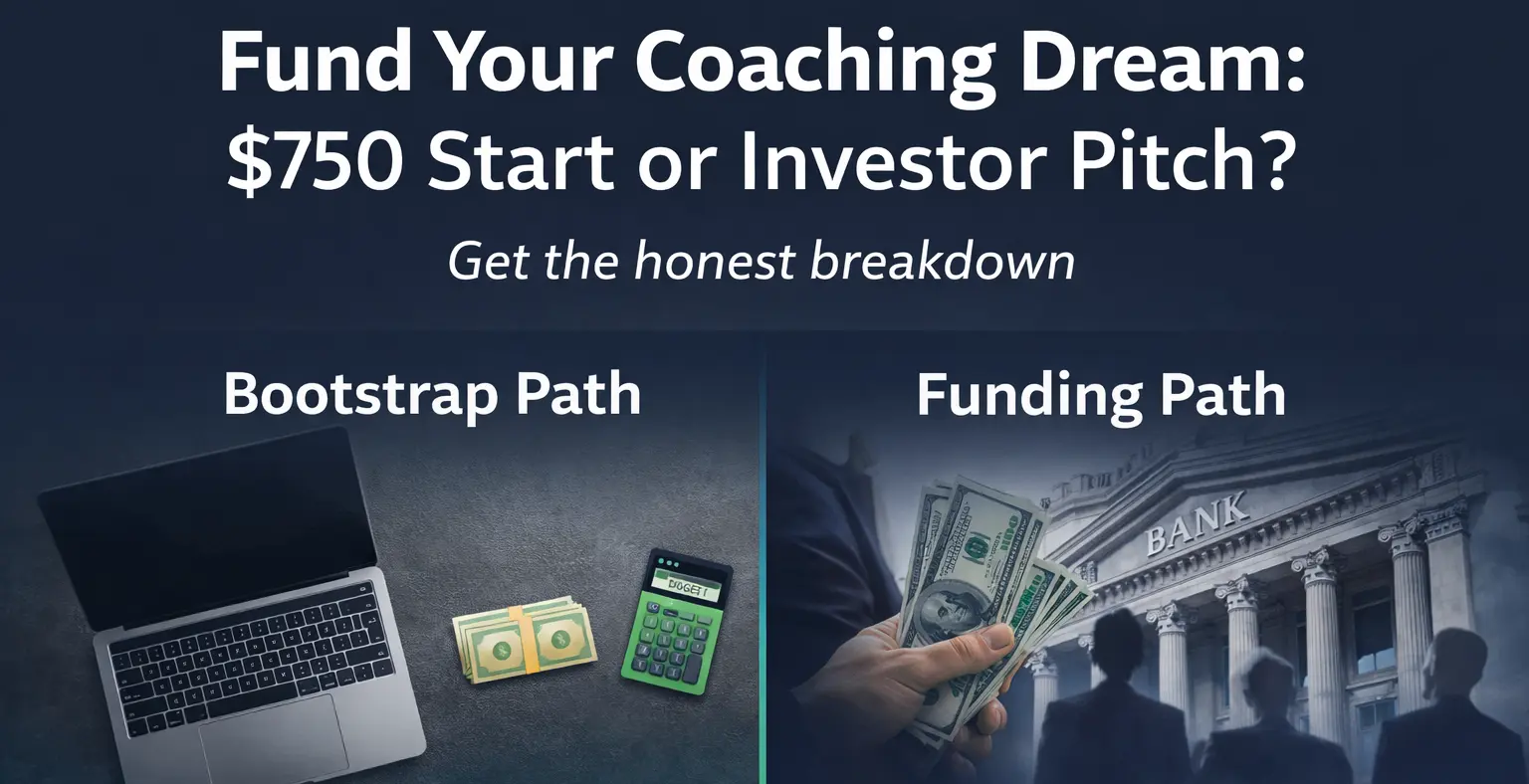
A life coaching business plan is a strategic roadmap that outlines your coaching niche, client acquisition strategy, and financial projections to ensure long-term profitability. Securing funding for a coaching business typically involves a mix of bootstrapping, Small Business Administration (SBA) loans, or specialized wellness grants. To successfully attract investors or lenders, your plan must demonstrate a clear revenue model, balancing startup costs like ICF certification and digital infrastructure against projected income from 1-on-1 sessions and group programs. Most coaching startups require an initial capital investment of $2,000 to $7,500 to reach a break-even point within the first 6 to 12 months.
Here’s the truth: most “business plan gurus” won’t tell you about starting a life coaching business: you probably don’t need investor funding at all.
The coaching industry sits in an unusual paradox. Starting costs run between $750 and $5,000, making it one of the most accessible businesses you can launch. Yet coaches face a high expertise barrier. You need genuine skills, credible training, and the ability to transform lives. Whether you’re completing your life coaching certification or planning your launch strategy, you’re facing a critical decision: write a formal business plan to secure funding, or build lean and bootstrap your way to profitability.
Key Takeaway:
- A solid life coaching business plan is essential for Canadian entrepreneurs who want to start, fund, or scale their coaching business successfully — it serves as both a roadmap and a requirement for most funding applications. [1]
- The plan should clearly define your niche, target audience, services and pricing, marketing strategy, financial projections, legal structure (sole prop vs corporation), and how you will deliver coaching while staying compliant with Canadian tax and privacy laws. [1]
- For funding, focus on realistic revenue forecasts, startup costs, and cash flow projections. Canadian coaches can access grants, loans, and programs through BDC, Futurpreneur, Canada Small Business Financing Program, provincial funding, and crowdfunding platforms. [2]
- Success comes from combining a professional business plan with strong personal branding, a clear offer, and consistent marketing — this dramatically increases your chances of securing funding and building a profitable coaching business. [2]
Bottom Line: A well-written life coaching business plan is your foundation for success in Canada — it not only guides your daily operations but also significantly improves your ability to secure funding and build a sustainable, profitable coaching business.
I’ve worked with hundreds of aspiring coaches over 20+ years. The ones who succeed aren’t always those with the fanciest business plans or the biggest startup budgets. They’re the ones who take decisive action with clarity and purpose.
By the end of this guide, you’ll know exactly which funding path fits your situation, what belongs in a business plan that actually works, and how to execute without wasting months on documents nobody reads. We’ve covered the basics of launching your practice, but now let’s tackle the money question head-on.
Do You Actually Need a Business Plan? (And When You Don’t)
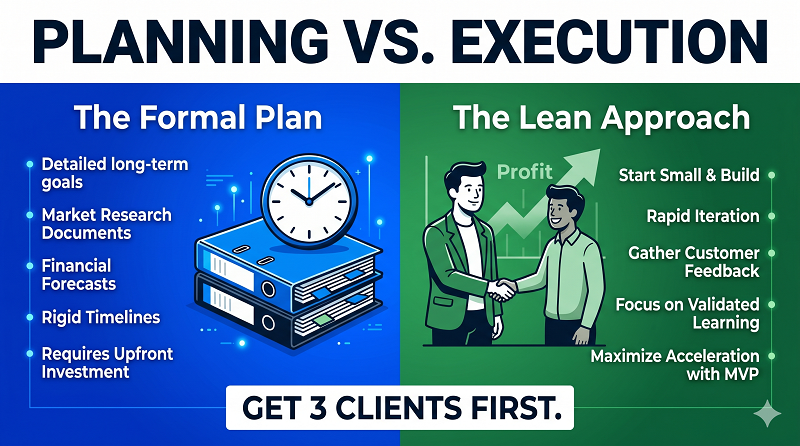
Let me be direct: most solo coaches don’t need formal business plans.
That’s not what certification programs teach you. That’s not what business books preach. But it’s reality. You can launch a profitable coaching practice with a clear niche, package pricing, and consistent client acquisition. Skip the 20-page document. Get your first three paying clients instead.
The exceptions are real, though. You absolutely need a formal business plan if you’re seeking bank loans or investor funding. Banks won’t approve your application without seeing detailed financial projections, market analysis, and proof that you can repay the loan. Investors need to understand your business model before writing checks.
You also need a plan if you’re building a coaching agency rather than a solo practice. Hiring coaches, renting office space, and scaling infrastructure require capital and clear systems. That demands formal planning.
For everyone else, consider the “lean roadmap” alternative. Write down your vision, define your niche clearly, set your pricing structure, and outline your marketing channels. That’s your working document. Update it quarterly based on what you learn from actual clients.
Here’s the reality that stops most coaches from ever needing investor funding: the coaching industry remains relatively small at around 24,000 practitioners in the United States. Investors struggle to understand how a service business scales. They want hockey stick growth trajectories. Coaching delivers steady, sustainable income, not explosive returns. Your profit margins can hit 30-70%, which sounds great until investors realize that comes from your time and expertise, not a product they can manufacture at scale.
“In my experience scaling coaching practices, the biggest mistake is over-funding the ‘aesthetic’ (fancy websites/offices) before the ‘engine’ (lead generation). Your business plan should allocate at least 40% of initial funding to client acquisition strategies, rather than just infrastructure.”
The Bootstrapping Reality Check
Coaching is perfectly built for bootstrapping. Your overhead stays low. Your margins stay high. You need a laptop, reliable video conferencing software, scheduling tools, and a basic website. Total investment: $1,000 to $2,000 maximum.
The most common funding path combines personal savings with strategic use of business credit cards. You’re not borrowing $50,000. You’re investing $2,000 to $5,000 of your own money to get started, then reinvesting your first client payments to upgrade tools and expand marketing.
Timeline expectations matter here. Most coaches hit profitability within 6 to 12 months when they maintain disciplined client acquisition habits. That means consistent networking, content creation, and discovery calls. The money follows the work.
When Funding Makes Sense (Rare, But Real Scenarios)
Funding isn’t wrong. It’s just rarely necessary for solo coaching launches.
Three scenarios justify seeking outside capital. First, if you’re building a certification program or coaching academy, you need funding for curriculum development, accreditation processes, and marketing to attract students. These programs require upfront investment before generating revenue.
Second, launching group coaching programs with significant marketing spend can benefit from capital injection. You’re testing paid advertising, building automated funnels, and creating digital course materials. Smart funding accelerates what works.
Third, targeting corporate clients in Toronto or other major markets sometimes requires professional infrastructure upfront. Corporate buyers expect polished materials, references, and established processes. Building that credibility takes investment.
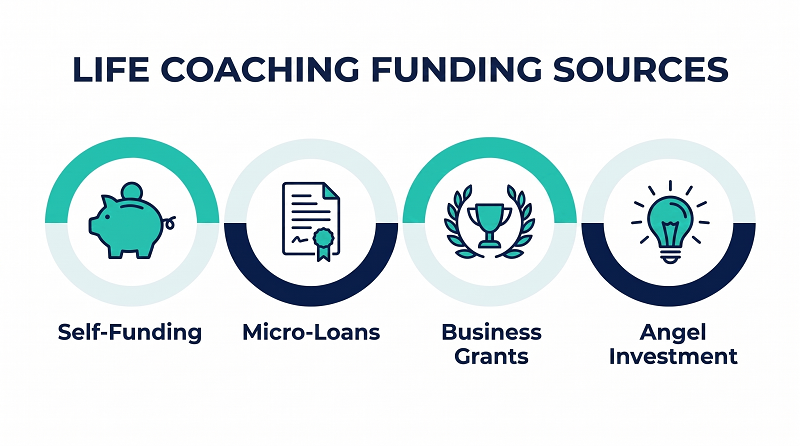
Even in these scenarios, follow the funding hierarchy: personal savings first, then business credit cards for tools and software, small business loans if you’ve proven a concept, and angel investors as an absolute last resort.
Why do investors hesitate to fund coaching businesses? Beyond the small industry size, explaining return on investment gets tricky. You’re not building software that scales infinitely. You’re trading expertise for income. Investors want businesses that can grow without proportional increases in founder time. Coaching doesn’t naturally fit that model.
Types of Funding
| Funding Source | Pros | Cons | Best For |
| Bootstrapping | Full ownership; no debt. | Limited growth speed. | Part-time coaches. |
| SBA / Bank Loans | Larger capital injection. | Strict credit requirements. | Full-scale coaching studios. |
| Micro-Grants | No repayment needed. | Highly competitive. | Niche or non-profit coaching. |
| Angel Investors | Expert mentorship included. | Loss of equity/control. | Scalable Coaching SaaS. |
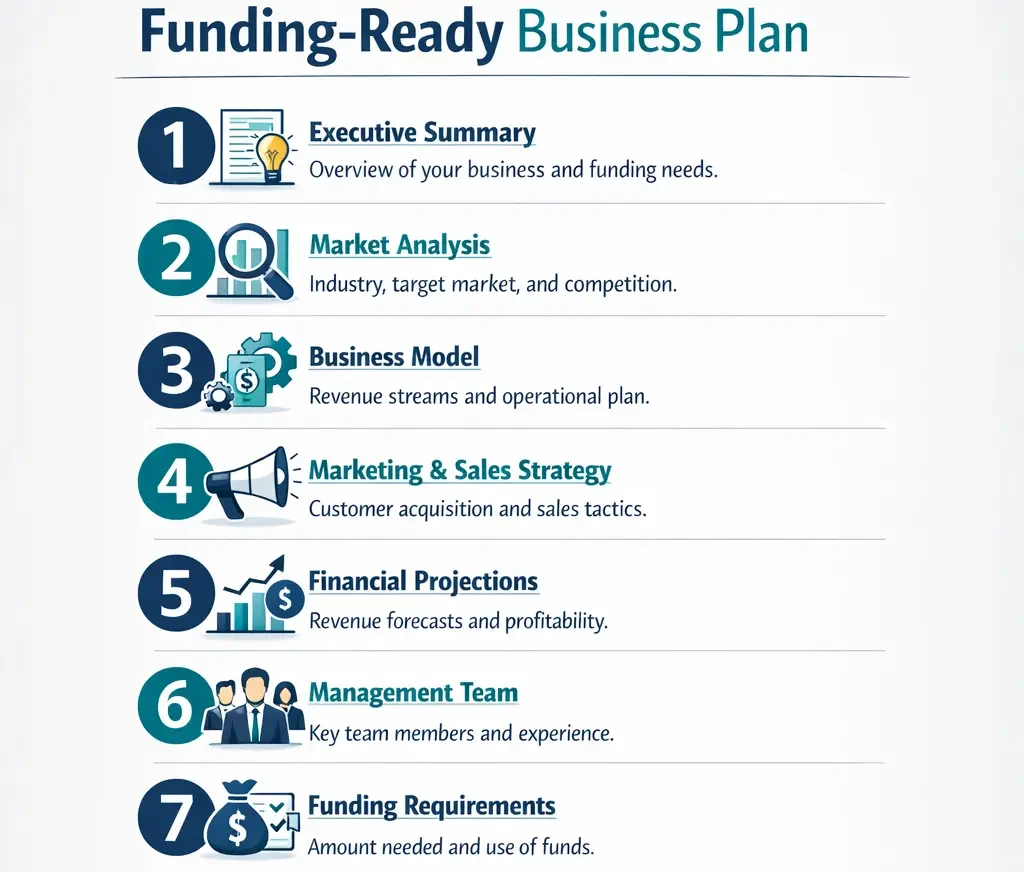
The 7 Essential Sections of a Funding-Ready Business Plan
If you’ve decided you need formal funding, your business plan must cover seven critical sections. Banks and investors scrutinize these areas closely.
1. Executive Summary (Your Elevator Pitch on Paper)
Start with transformation, not services. Your mission statement should capture the change you create for clients. “I help mid-career professionals reclaim their confidence and advance into leadership roles” works better than “I provide one-on-one coaching sessions.”
Your vision statement looks five years ahead. Where do you want your practice? What impact do you want to create? Keep it to one sentence that captures your aspirational destination.
Include your unique positioning clearly. Who exactly do you serve, and what makes your approach different? This isn’t about being better than everyone else. It’s about being the right choice for your specific niche.
If you’re requesting funding, state the specific amount and its use. “Seeking $10,000 to fund ICF certification, professional website development, and initial marketing campaign targeting executive women in financial services” gives lenders clarity.
2. Company Description (Your Coaching Niche & Model)
Your legal structure matters to lenders. LLCs provide liability protection and signal professionalism. Sole proprietorships are easier to establish but expose your personal assets to business risks. Choose based on your risk tolerance and growth plans.
Define your niche with surgical precision. “I help everyone” kills your business before it starts. You can’t market to everyone. You can’t speak to everyone’s pain points. Pick a specific group. “I coach entrepreneurs scaling from $100K to $500K annual revenue who feel overwhelmed by team management” gives you focus.
Outline your service offerings with clear pricing models. Will you offer one-on-one sessions, group programs, or both? Package pricing beats hourly rates for both you and your clients. Clients get better results with commitment. You get predictable revenue.
For coaches integrating NLP methodologies, explain how these tools differentiate your approach and accelerate client transformation. Don’t assume readers understand NLP. Explain briefly how it creates faster, lasting change.
3. Market Analysis (Proving Demand Exists)
Lenders want proof that people will pay for your services. Start with target audience demographics. Age ranges, income levels, geographic location, and professional roles give shape to your market.
Add psychographics for depth. What keeps your ideal clients awake at night? What frustrates them at work? What do they want to achieve but can’t seem to reach on their own?
Industry growth data strengthens your case. The coaching industry saw a 33% increase in practitioners between 2015 and 2019, according to research from the International Coaching Federation. The U.S. market alone generates $13 billion annually. These numbers prove coaching demand continues growing.
Local market analysis matters for in-person coaches. How many potential clients live within your service area? Who else serves this market? What gaps exist that you can fill?
Your competitive advantages should be specific and provable. Maybe you’ve spent 15 years working in the corporate environment you now coach. Maybe your NLP certification accelerates results compared to traditional coaching methods. Maybe you offer hybrid virtual and in-person options that others don’t provide.
4. Services & Pricing Strategy
Industry pricing benchmarks give you a starting point. According to a comprehensive cost analysis, life coaches charge between $75 and $200 per hour, with $120 as the average. New coaches typically start toward the lower end and increase rates as they build testimonials and expertise.
Package pricing works better than hourly rates for a sustainable business. A three-month commitment at $1,500 to $4,500 gives new coaches a predictable income while ensuring clients stay engaged long enough to see results. If your client quits after two sessions, they blame you for lack of progress. If they commit to three months, they invest in their own transformation.
Revenue stream diversification strengthens your business plan. Can you offer workshops to groups? Could you create a digital course that generates passive income? Would corporate speaking engagements fit your expertise? Multiple income sources reduce risk and prove you understand business sustainability.
5. Marketing & Sales Strategy (The Make-or-Break Section)
This section makes or breaks funding applications. Investors and lenders want to see how you’ll actually get clients. Saying “I’ll use social media” isn’t enough. You need specific channels with realistic conversion expectations.
Client acquisition channels that work for coaches include referrals from existing clients, content marketing through blogs and LinkedIn, networking in professional associations, and strategic partnerships with complementary service providers. Pick three channels. Master those before adding more.
Realistic conversion rates matter. New coaches typically convert about 10% of discovery calls into paying clients. That means you need to conduct 10 discovery calls to land one client. Your marketing plan should show how you’ll generate those conversations consistently.
Marketing budget allocation proves you’ve thought through costs. Even bootstrapped coaches need a budget for basic tools. Website hosting, scheduling software, and minimal paid advertising run $200 to $500 monthly. Show these numbers.
Social proof plans demonstrate how you’ll build credibility. Will you offer discounted sessions to early clients in exchange for detailed testimonials? How will you collect and showcase case studies? Lenders want to see that you’ve planned beyond just delivering coaching.
6. Financial Projections (No Past Data? No Problem)
New coaches panic about financial projections without historical data. Use industry benchmarks instead.
Startup costs break down clearly. Certification programs range from $1,500 to $10,000, depending on accreditation level. Website development costs $500 to $3,000 for professional results. Marketing budgets need $200 to $500 monthly initially.
Revenue projections should follow conservative growth patterns. Year one might generate $30,000 to $60,000 as you build your client base. Year two could reach $60,000 to $100,000 as referrals increase and you raise rates. Year three might break $100,000 as you add group programs or corporate contracts.
Break-even analysis shows when revenue exceeds costs. Most coaches hit break-even within 6 to 12 months if they maintain consistent marketing and client acquisition.
Cash flow statements matter more than you think. Coaching income can be uneven. Some clients pay monthly. Others pay upfront for packages. Show when money enters your business versus when you incur expenses.
7. Funding Request & Use of Funds (Be Specific)
Vague funding requests get denied. “I need $20,000 to start my coaching business” won’t cut it.
Instead, break down exactly how you’ll use every dollar. “$10,000 for ICF-accredited certification and 100 hours of supervised practice. $5,000 for a professional website with scheduling integration, client portal, and content management system. $3,000 for initial marketing campaign, including LinkedIn ads, local networking events, and discovery call funnel development. $2,000 for basic business operations, including LLC formation, liability insurance, and accounting software.”
Expected ROI and payback timeline show lenders you understand business fundamentals. “Based on converting 10% of discovery calls at an average package price of $3,000, I project break-even at month 8 with full loan repayment by month 18.”
Consider the alternative phased growth approach. Maybe you don’t need $20,000 upfront. Maybe you start with $2,000 from personal savings, prove the concept with three clients, then seek a $5,000 business line of credit for scaling marketing. Lenders love seeing skin in the game.
The Bootstrapping Blueprint (Start for Under $2,000)
Most coaches should bootstrap. Here’s exactly how.
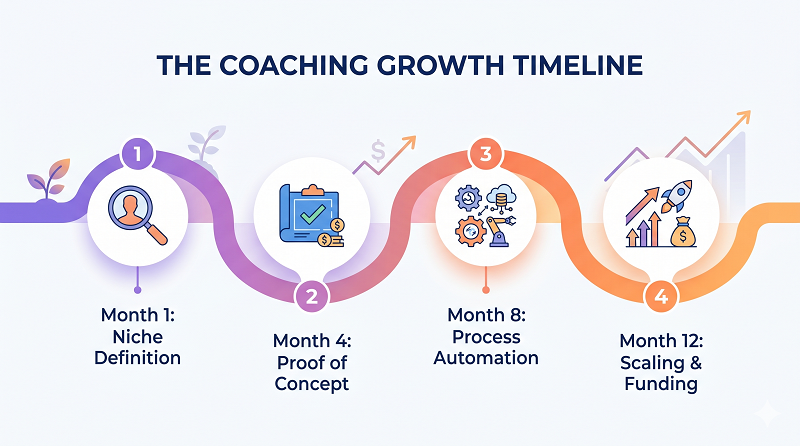
Phase one is pre-revenue setup at $1,000 to $2,000 total investment. Free or affordable certification options exist if you research carefully. Build your website on Wix or Squarespace for $300 to $500 annually, including domain and hosting. Use Calendly’s free plan for scheduling. Establish social media presence on LinkedIn and relevant Facebook groups at zero cost.
Phase two focuses on landing your first clients through time and effort, not money. Offer free 30-minute discovery sessions to qualified prospects. Consider testimonial-for-service trades where early clients receive discounted rates in exchange for detailed case studies. Tap your existing network for referrals. Create valuable content on LinkedIn addressing your niche’s specific challenges.
Phase three involves revenue reinvestment. Your first paying clients fund upgrades. Invest in a better website with client portal functionality. Test small amounts of paid advertising to identify what works. Pursue advanced certifications that command higher rates. Add client management software like practice management platforms designed for coaches.
Once you have your foundation, marketing becomes systematic rather than random.
The math works beautifully. Ten clients at $1,500 per package generate $15,000 in revenue. Subtract 20% for operating costs and you take home $12,000 in your first quarter. That’s profitable from day one if you’ve kept startup costs under $2,000.
What Investors and Banks Actually Want to See
Understanding lender and investor criteria saves wasted effort.
Bank loans typically require 680+ credit scores and two years of business history. That creates a catch-22 for new coaches. You need funding to build the business that proves you deserve funding. SBA loans offer lower requirements but still require proof of concept.
Angel investors rarely fund solo coaching practices. They look for businesses with explosive growth potential. Coaching agencies, certification programs, or platform businesses combining technology with coaching services attract investor interest. Individual practitioners don’t fit their model.
What gets scrutinized most intensely? Market size and your realistic share potential top the list. With 71,000 coaches worldwide competing for clients, investors want to understand why you’ll capture meaningful market share.
Differentiation matters enormously. What separates you from thousands of other coaches? Niche expertise, proprietary methodologies, or unique positioning give you defensible advantages.
Customer acquisition cost versus lifetime value determines business sustainability. If you spend $500 acquiring a client who pays $1,500 once, your unit economics don’t work. If that client refers three others and renews annually, the math changes completely.
Your expertise and track record provide confidence to lenders. Relevant career experience, certifications, and early client results prove you can deliver transformation, not just sell coaching packages.
The uncomfortable reality: most coaches get funding after proving their concept works. Build a small client base first. Show consistent income. Then approach lenders from a position of strength rather than desperate need.
Do I Need a Business Plan If I Bootstrap?
Short answer: yes, but keep it simple.
Your purpose shifts when you’re not seeking funding. The business plan becomes a personal roadmap rather than an investor document. You’re creating clarity for yourself, not convincing someone else to write checks.
Lean plan essentials include a clear niche definition, specific service packages with pricing, a realistic 12-month revenue goal, identified marketing channels with action steps, and basic financial tracking to know when you’re profitable.
Treat this as a living document. Update quarterly as you learn what actually works versus what you thought would work. Client feedback will reshape your services. Marketing results will redirect your efforts. Financial reality will adjust your projections.
The benefits exist even without funding needs. Writing forces clarity on fuzzy thinking. You can’t market to everyone or solve all problems. The plan makes you choose. It creates accountability to yourself. It helps detect when to pivot versus when to persist.
Use template approaches wisely. A one-page business model canvas covers essentials without overwhelming detail. Save the 20-page formal plan for when you’re actually meeting with lenders.
As you complete your training, this roadmap keeps you focused on building a practice that serves your ideal clients profitably.
What Are the Most Common Mistakes in Life Coaching Business Plans?
The biggest mistakes coaches make are vague target audiences, unrealistic financial projections without industry benchmarks, and missing marketing strategies that show how they’ll actually get clients.
Banks and investors spot these red flags instantly. They’ve reviewed thousands of business plans. Yours won’t fool them.
Mistake one is the “helping everyone” trap. When your business plan describes your ideal client as “anyone who wants positive change,” you’ve told lenders you don’t understand business fundamentals. Successful businesses serve specific people with specific problems. Narrow your focus.
Mistake two involves hockey stick growth projections pulled from thin air. Claiming you’ll generate $200,000 in year one with zero clients today and no marketing budget raises immediate skepticism. Base projections on conservative industry benchmarks. Show your math. Prove you understand realistic conversion rates and customer acquisition timelines.
Mistake three is allocating zero budget to marketing while projecting significant revenue. How exactly will clients find you? Word of mouth alone doesn’t scale predictably. You need deliberate marketing channels with associated costs.
Related mistakes include ignoring competition entirely, failing to address your specific advantages, skipping market size analysis, and providing no details on how you’ll actually deliver services. Each gap undermines lender confidence.
How Much Money Do I Really Need to Start a Life Coaching Business?
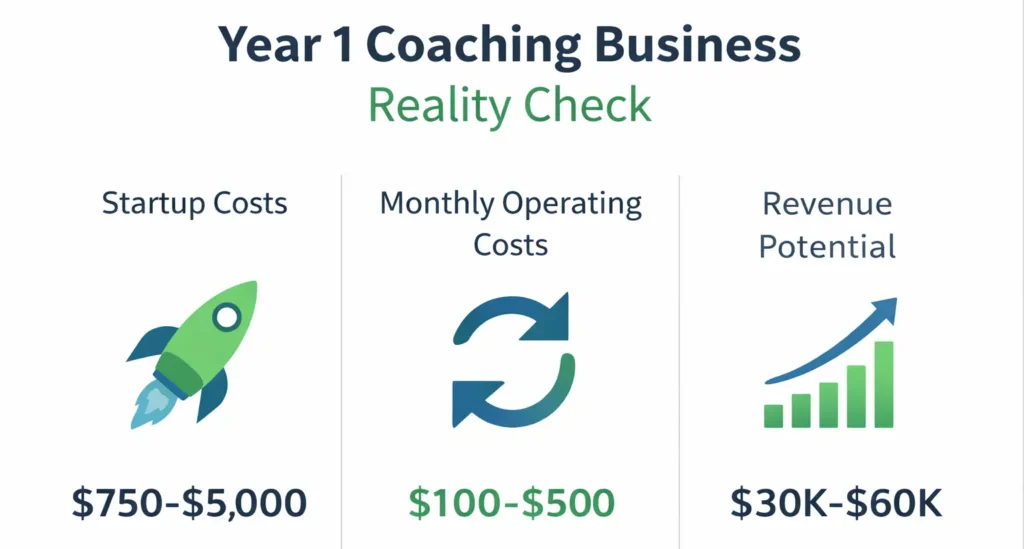
You can start a virtual coaching practice for $750 to $2,000, covering basic certification, a simple website, and scheduling tools. Most coaches invest $5,000 to $15,000 for credibility markers like ICF certification and professional branding.
The minimum viable approach runs $750 to $2,000 total. Choose an affordable online certification program. Build a basic website on Wix or Squarespace. Use free scheduling software. Leverage social media for initial marketing. Meet clients virtually to avoid office rental costs.
The professional launch approach costs $5,000 to $15,000. Pursue ICF-accredited certification for credibility. Hire a professional to design your website with client portal integration. Invest in quality headshots and brand photography. Buy initial marketing through targeted ads and networking events. Budget for liability insurance and business formation costs.
Monthly operating costs run from $100 to $500, depending on your tools. Website hosting, scheduling software, video conferencing subscriptions, and basic marketing add up. Factor these into your break-even calculations.
The biggest investment isn’t money, though. It’s time to build your initial client base. Expect to invest 10 to 20 hours weekly on marketing, networking, and discovery calls for your first six months. That time generates your first revenue, which then funds business growth.
Should I Get an LLC Before Writing My Business Plan?
Form your LLC before approaching banks or investors. It demonstrates seriousness and protects your personal assets. You don’t need it to start coaching clients or write your plan, though.
Business structure impacts your plan’s legal section and your personal risk exposure. LLCs separate your business from your personal finances. If someone sues your coaching business, they can’t automatically access your personal home, savings, or other assets. Sole proprietorships offer no such protection.
LLC formation costs $50 to $500, depending on your state. Some states charge annual fees. Others require biennial reports. Research your specific state requirements.
Tax flexibility provides another LLC advantage. You can choose how the IRS taxes your business. Stay taxed as a sole proprietorship for simplicity, elect S-corporation status to save on self-employment taxes, or choose other structures as your business grows.
Professional credibility matters more than coaches think. Clients notice. Having “LLC” after your business name signals you’re serious, established, and professional. It’s not required, but it helps.
When should you actually form the LLC? Two paths work. Form it before seeking funding or after landing your first paying clients. The first option is necessary if you’re applying for loans. The second option is fine if you’re bootstrapping. Get your first three clients, prove your concept works, then formalize your structure.
Frequently Asked Questions
Do I need a business plan to start a life coaching business?
Most solo life coaches can launch without a formal business plan by using a simple roadmap outlining their niche, pricing, and marketing strategy. However, if you plan to apply for bank loans or investor funding, a structured business plan with financial projections and market analysis becomes essential.
How do you write a life coaching business plan that gets funding?
A funding-ready life coaching business plan includes seven key sections: executive summary, company description, market analysis, services and pricing, marketing strategy, financial projections, and funding request. Lenders want clear evidence of demand, realistic revenue projections, and a strategy for acquiring clients consistently.
How much money do you need to start a life coaching business?
Most life coaching businesses start with $750–$5,000, depending on certification, website development, and marketing tools. A lean virtual practice requires minimal overhead, while coaches investing in professional branding, training, and marketing may spend $5,000–$15,000 during the first year.
Is it better to bootstrap a life coaching business or seek investors?
Bootstrapping is often the best option for life coaches because startup costs are low and profit margins are high. Most coaches begin with personal savings and reinvest early client revenue. Investor funding usually makes sense only when building scalable coaching programs, academies, or larger coaching teams.
What do banks and investors look for in a coaching business plan?
Banks and investors want proof that your coaching business can generate consistent revenue. They review your niche, client acquisition strategy, pricing model, and financial projections. Demonstrating early traction, such as three to five paying clients, greatly increases your chances of securing funding.
Conclusion: Profit First, Plan Second
The “Business Plan Paradox” is simple: Formal plans secure funding, but paying clients secure your business. Whether you are bootstrapping or seeking investors, your primary objective is “Proof of Concept.”
- For Bootstrappers: Create a lean, 1-page plan focusing on niche and pricing. Secure 3–5 clients before investing in premium tools.
- For Funding Seekers: Use a formal 7-section plan, but lead with data from your initial successful client transformations to prove your model works.
The Bottom Line: Don’t let “perfect planning” become a barrier to entry. Funding follows impact. Define your mission, master your coaching tools, and the capital will follow.
Stop planning……..Start performing………….
Your business plan is only as strong as your coaching results. Don’t just build a document, build a career with the proven psychological tools that create measurable change. Join 5,000+ coaches who turned their passion into a high-revenue practice. Get Certified: Explore Training Now →