
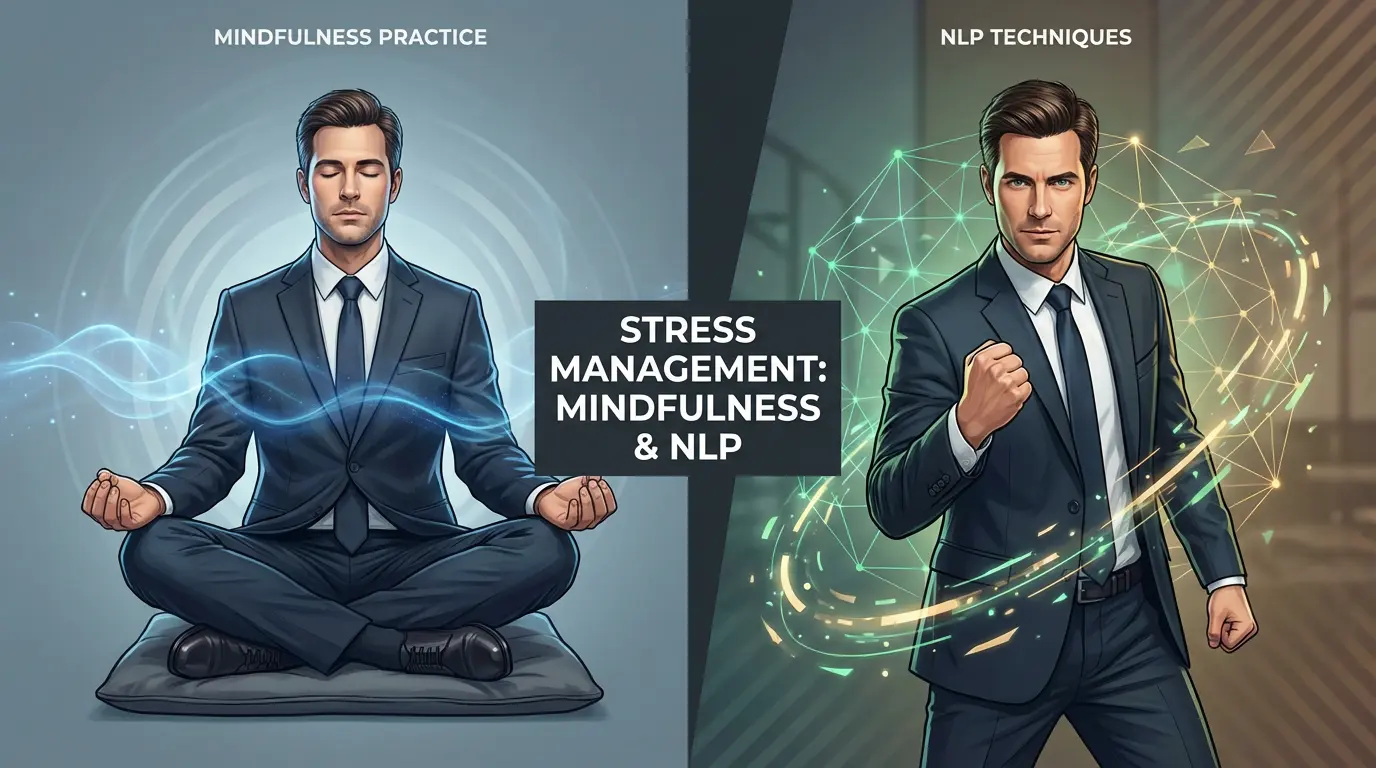
Nearly half of American workers face stress every single day at work. That’s not just uncomfortable; it costs the U.S. economy over $300 billion annually in lost productivity, health issues, and burnout. If you’re reading this, chances are you’re part of that statistic. You’ve probably tried deep breathing exercises, downloaded meditation apps, and maybe even attended a mindfulness workshop. Yet here you are, still feeling that familiar tension creeping up your shoulders during Monday morning meetings.
Key Takeaway:
- Both NLP and Mindfulness are powerful tools for stress management—NLP focuses on rapid mindset shifts through language patterns, reframing, and anchoring positive states, while Mindfulness emphasizes present-moment awareness, non-judgmental observation, and breath-based calming. [1]
- NLP offers quick, targeted techniques (e.g., swish pattern, visual-kinesthetic dissociation) for breaking stress loops and building resilience fast; Mindfulness builds long-term emotional regulation by reducing reactivity and cortisol through consistent practice (e.g., body scans, mindful breathing). [1]
- Use NLP for immediate stress relief or specific triggers (5–10 min techniques); use Mindfulness for deeper, ongoing calm (10–20 min daily); combine both—start with NLP to interrupt acute stress, then transition to Mindfulness for sustained presence and recovery. [2]
- NLP works best for people who respond to visualization and verbal patterns; Mindfulness suits those who prefer quiet observation—both are safe and non-invasive; results often appear in days (NLP) to weeks (Mindfulness); consult a practitioner if dealing with trauma or severe anxiety. [2]
Bottom Line: NLP excels at fast, targeted stress rewiring; Mindfulness builds deep, lasting calm—use them together for maximum effectiveness depending on your needs and personality.
What if the problem isn’t your effort, it’s your approach? For professionals drowning in workplace pressure, NLP for stress management offers a faster alternative to traditional stress reduction methods. While mindfulness programs ask you to spend eight weeks observing your stress, Neuro-Linguistic Programming teaches you to transform it often in a single session.
This isn’t another article telling you to “just meditate more.” We’re going to compare two fundamentally different approaches to stress management and show you which one actually works when you can’t afford to wait months for results. Rather than spending endless hours learning to observe your stress, powerful NLP stress tools help you actively rewire how your brain responds to pressure.
Understanding the Two Approaches
Before we can compare these methods, you need to understand what each one actually does. They’re not just different techniques; they’re built on completely different philosophies about how change happens.
What is Mindfulness-Based Stress Reduction?
Mindfulness-Based Stress Reduction, or MBSR, is an eight-week program developed by Jon Kabat-Zinn back in 1979. The core idea is simple: learn to be fully present in each moment without judging what you find there. You observe your thoughts, feelings, and sensations without trying to change them. Acceptance is the path to peace.
The standard MBSR program includes meditation practices, body scan exercises, mindful breathing, and gentle yoga. You’re training your brain to notice when your mind wanders into stress-inducing territory and gently bring it back to the present. The philosophy says that by observing your stress without engaging with it, you naturally reduce its power over you.
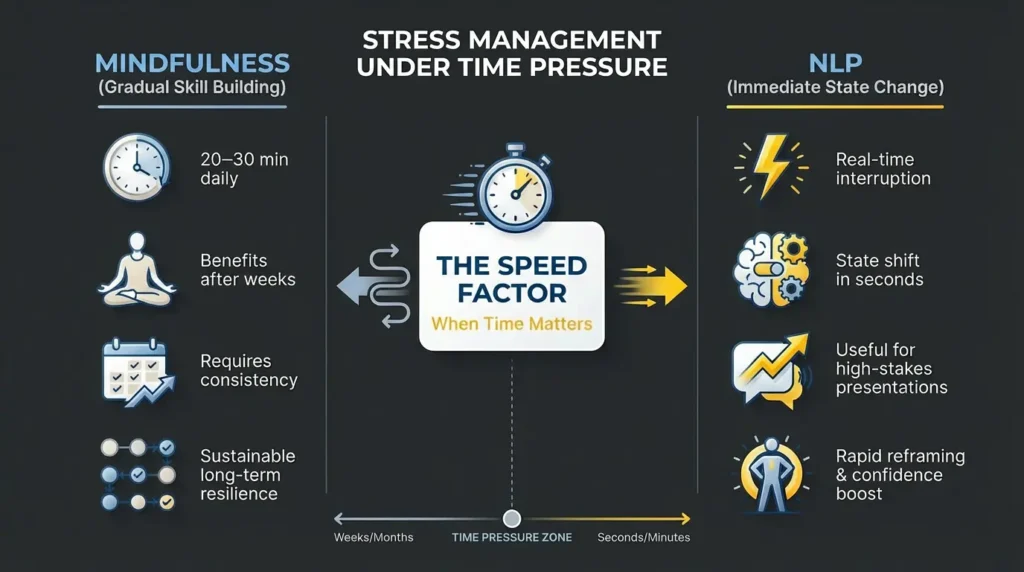
Research shows benefits typically appear after eight weeks of consistent daily practice, we’re talking 20 to 30 minutes every single day. For many people, that’s where the challenge begins.
What is NLP for Stress Management?
Neuro-Linguistic Programming takes a completely different angle. Instead of observing your stress, you actively reprogram the mental patterns creating it. NLP was developed by studying therapists who got remarkably fast results with their clients, we’re talking breakthroughs in single sessions, not years of therapy.
The foundation is this: your brain uses language and mental imagery to create your experience of reality. Change those patterns, and you change your emotional response. When you feel stressed, it’s because specific internal representations trigger that state. Maybe it’s how you visualize upcoming deadlines, the internal voice criticizing your performance, or the physical sensations you’ve associated with pressure.
NLP techniques have transformed how professionals approach personal development by giving them direct access to these internal programs. Techniques like anchoring, reframing, and submodality shifts let you interrupt stress patterns and install more resourceful responses. Many people experience noticeable changes within minutes or hours, not months.
The Speed Factor: When Time Matters
Let’s be honest about the reality most professionals face. You’re juggling deadlines, managing teams, answering to stakeholders, and trying to maintain some semblance of work-life balance. You don’t have eight weeks to wait for stress relief to kick in. You need tools that work now.
Mindfulness requires commitment. That daily 20 to 30-minute practice isn’t optional if you want results. You’re building a skill gradually, like learning to play an instrument. Miss a few days and you lose momentum. The benefits are cumulative, showing up after weeks of consistent effort.
NLP techniques, on the other hand, can interrupt stress patterns in real-time. Imagine you have a high-stakes board presentation in ten minutes and you’re spiraling into anxiety. Trying to meditate won’t help; you need immediate intervention. An NLP anchor you’ve installed can shift your state in seconds. A quick reframe can transform how you interpret the pressure you’re feeling.
This isn’t theoretical. I’ve seen executives use anchoring techniques right before stepping on stage, transforming nervous energy into confident presence. That’s the difference we’re talking about: tools you can deploy exactly when you need them, not practices that only work if you’ve been doing them for months.
How Each Approach Tackles Stress
The philosophical difference between these approaches shows up most clearly in how they actually handle your stress.
Mindfulness: Accepting What Is
Mindfulness teaches you to observe without judgment. When stress arises, you notice it. You feel the tension in your chest, hear the critical thoughts, acknowledge the racing heart. But instead of reacting, you simply observe. You create space between the stimulus and your response.
The goal is to develop awareness of your stress patterns and build tolerance for discomfort. You’re training yourself to watch the stress like clouds passing through the sky, present, but not permanent. You don’t try to push it away or fix it. You accept it, breathe with it, and let it move through you.
The strengths here are real. Over time, mindfulness builds powerful long-term emotional regulation. You become less reactive. You develop meta-awareness, noticing you’re getting stressed before it spirals out of control. You break the habit of rumination, that endless mental replaying of problems that keeps you up at 3 AM.
NLP: Changing What Is
NLP doesn’t ask you to accept your stress; it gives you tools to transform it. The philosophy is active intervention. You identify the specific mental programs creating your stress response, then you change those programs.
Take reframing as an example. That critical voice in your head saying “This deadline is going to crush me” isn’t a neutral truth; it’s a meaning you’ve assigned to the situation. Reframe it to “This deadline is sharpening my focus” and watch your physiology shift. Same situation, different internal representation, completely different emotional state.
NLP creates new neural pathways by changing how you code information internally. You’re not just observing stress patterns; you’re actively integrating NLP into your daily routine to build more resourceful automatic responses. The focus is immediate pattern interruption and targeted behavior change.
Mike, a professional who worked with James, struggled with constant mental noise and anxiety that affected his career for years. He’d tried various stress management approaches with limited success. Through targeted NLP techniques, he eliminated the overthinking and anxiety in weeks, achieving what traditional methods hadn’t accomplished in years. Today, he communicates with confidence and the anxiety has vanished.
Can NLP Techniques Actually Reduce Stress Faster Than Mindfulness?
Here’s where things get interesting. Mindfulness has extensive research backing it up. Thousands of studies validate MBSR for reducing stress, anxiety, and depression. The evidence base is solid.
NLP’s research landscape looks different. It doesn’t have the same volume of controlled studies, partly because it was developed by practitioners focused on results rather than academic validation. But here’s what we do know: NLP was specifically created by modeling therapists who achieved rapid, positive results with clients. The entire methodology is built on “what actually works in practice.”
The mechanism explains the speed difference. Fundamental differences between the two approaches come down to this: mindfulness builds awareness first, then change emerges gradually over time. NLP targets the internal programming directly, creating change at the source.
NLP anchoring techniques have shown effectiveness for managing anxiety by creating instant access to calm states. Reframing changes how you perceive anxiety-inducing events, leading to different emotional responses. These aren’t passive observations; they’re active interventions in your neurology.
For acute stress episodes, the presentation tomorrow, the difficult conversation this afternoon, the decision you need to make right now, NLP gives you actionable tools. For baseline stress reduction and long-term resilience, mindfulness builds a foundation. The question is: what does your situation demand?
Many busy professionals choose NLP because they literally can’t wait eight weeks when burnout is happening now. They need relief today, not two months from now.
Three Practical NLP Techniques for Immediate Stress Relief
Let me give you three techniques you can start using today. These aren’t theory they’re practical tools that work.
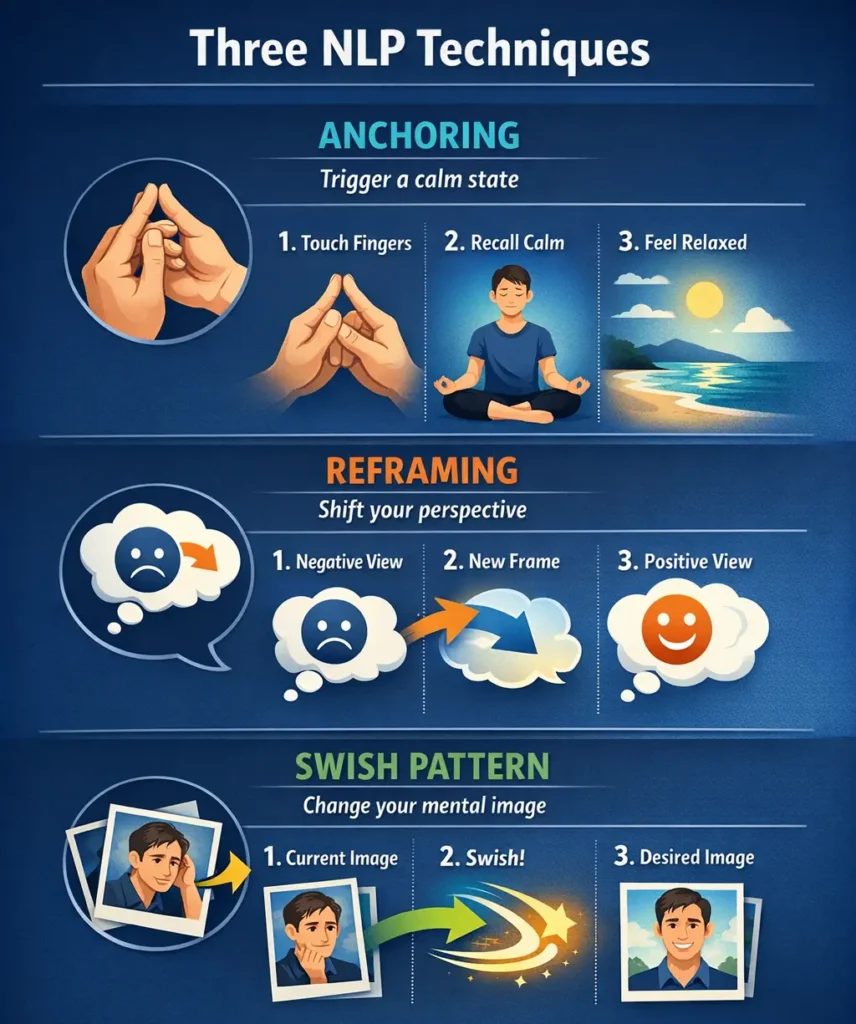
The Anchoring Technique
Your brain already creates anchors all the time. A certain song brings back memories. A smell triggers emotions. You’re going to deliberately create an anchor linked to a calm, confident state that you can activate whenever you need it.
Here’s how: Think of a time when you felt completely calm and in control. Maybe you were walking on a beach, or you’d just accomplished something meaningful. Step into that memory fully. See what you saw, hear what you heard, feel what you felt. When the feeling peaks, create a unique physical gesture: press your thumb and middle finger together, or touch a specific spot on your wrist.
Hold the gesture while the feeling is strong, then release. Repeat this several times, building the association. Now you have an anchor. Next time you’re feeling stressed before a meeting, during a difficult conversation, or facing a deadline, trigger that anchor and feel your state shift.
Use this before presentations, during negotiations, or any time you need instant access to a resourceful state. It takes minutes to learn and lasts a lifetime.
Reframing: Change the Meaning, Change the Stress
Your stress isn’t caused by events; it’s caused by the meaning you assign to those events. The upcoming deadline isn’t inherently stressful. Your interpretation that “I’ll never finish in time” or “This will expose my inadequacy” creates the stress.
Reframing gives you the power to change that meaning. When you catch yourself in a stress-inducing thought, pause. Ask yourself: “What else could this mean?” or “How might this situation actually be serving me?”
“This deadline is crushing me” becomes “This deadline is focusing my priorities.” “This criticism means I’m failing” becomes “This feedback is showing me exactly what to improve.” Same situation, completely different emotional response.
The shift happens instantly. You’re not lying to yourself or forcing positive thinking. You’re recognizing that your initial interpretation isn’t the only valid one. Proven NLP stress reduction approaches, like reframing work, target the source of the meaning-making machinery in your mind.
The Swish Pattern for Breaking Stress Loops
Some stress is automatic. You see your inbox hit 200 emails and immediately feel overwhelmed. Your boss calls an unexpected meeting and anxiety spikes. These are pattern responses your brain has learned to associate specific triggers with stress.
The Swish Pattern interrupts these loops. First, identify the stress-triggering image in your mind. What do you see internally right before the stress hits? Maybe it’s visualizing that overflowing inbox, or imagining your boss’s disappointed face.
Now, create a preferred image yourself, handling the situation calmly and competently. Make it vivid. You’re responding to emails efficiently, or you’re confidently engaging in that meeting.
Here’s the pattern: Start with the stress image large and bright in your mind. In the corner, place the preferred image small and dim. Now, rapidly shrink the stress image while expanding the preferred image swish! The calm image replaces the stress image. Do this ten times quickly.
Your brain starts to automatically make this swap. The old trigger begins to fire up the new response instead. This works because you’re rewiring the automatic pattern at a neurological level. You can explore more NLP techniques for professional growth to build on these foundations.
When Mindfulness Wins: The Long Game
I’m not here to tell you mindfulness doesn’t work. It absolutely does, particularly for specific goals that NLP isn’t optimized for.
If you’re building sustained resilience over months and years, mindfulness excels. The daily practice creates a baseline of calm that becomes your new normal. You’re not just managing acute stress; you’re fundamentally changing your relationship with all stressors.
Evidence-based mindfulness programs have shown remarkable effectiveness for healthcare professionals, reducing burnout, anxiety, and depression over eight-week programs. The research backing MBSR makes it a safe bet for complementing medical treatment of chronic conditions like anxiety disorders, chronic pain, or PTSD.
There’s also something valuable about the community aspect of MBSR programs. You’re learning alongside others, sharing experiences, and building accountability. That social support amplifies the benefits and helps you maintain the practice long-term.
Mindfulness develops meta-awareness, so you notice you’re getting stressed earlier in the cycle, before it escalates to crisis levels. That early detection system is incredibly valuable for preventing burnout before it happens.
The discipline of a daily practice also builds character. There’s power in committing to something and following through consistently. That skill translates to other areas of life and work.
The Best of Both Worlds: Integration Strategies
Here’s what most people don’t realize: NLP and mindfulness aren’t competing approaches. They’re complementary tools that work beautifully together.
Think of it this way: mindfulness creates the awareness of what needs to change, and NLP gives you the tools to actually change it. Mindfulness helps you notice “I’m getting stressed about this presentation.” NLP gives you techniques to transform that stress response immediately.
Use NLP techniques for specific triggers and performance stress. When you need rapid state changes before that presentation, during a difficult conversation, or facing a critical decision, deploy your NLP tools. Anchoring, reframing, and pattern interrupts work on demand.
Use mindfulness for your daily baseline and emotional regulation. A morning mindfulness practice sets your tone for the day. It builds the foundation of presence and awareness that makes you more effective at everything you do.
Research shows that mindfulness and NLP amplify each other’s effects when used together. The mindfulness practice enhances your awareness of internal states, which makes NLP interventions more precise. NLP techniques give you immediate tools to work with what mindfulness reveals.
A powerful daily rhythm looks like this: Start your morning with 10 to 15 minutes of mindfulness practice. Build your baseline. Throughout the day, use NLP techniques as needed for specific challenges. End your day by reflecting on what worked and where you want to improve.
If you’re serious about mastering both approaches, formal training makes a massive difference. Our NLP Practitioner Certification gives you the complete toolkit for transformation, which you can integrate seamlessly with any mindfulness practice you’re already doing.
Which Should Stressed Professionals Choose?
Let’s make this practical. What should you actually do?
Choose mindfulness if:
- You have eight or more weeks and can commit 20 to 30 minutes daily
- You prefer gradual, research-backed approaches with extensive evidence
- You’re managing chronic conditions like anxiety disorders, chronic pain, or PTSD
- You value community and the structure of formal programs
- You’re drawn to the philosophy of acceptance and non-judgment
Choose NLP if:
- You need results in days or weeks, not months
- You face specific, recurring stress triggers at work
- You’re time-constrained but highly motivated to change
- You want active control over your stress responses
- You’re action-oriented and prefer doing over just observing
- You’ve tried mindfulness and found it too slow or passive
Choose both if:
- You’re serious about mastering stress comprehensively
- You want the efficiency of NLP with the foundation of mindfulness
- You’re willing to invest in genuine transformation, not quick fixes
- You understand that different tools work for different situations
The truth is, over 80% of professionals risk burnout in today’s workplace. You can’t afford to wait months hoping meditation will eventually help. You need tools that work now and that’s exactly what NLP delivers.
FAQs: NLP vs Mindfulness
How do NLP and mindfulness relate?
Mindfulness and NLP share the goal of mastering your internal state, but take fundamentally different paths. Mindfulness teaches you to observe your thoughts and feelings without judgment, building awareness over time. NLP gives you tools to actively change those thoughts and feelings by reprogramming the mental patterns that create them.
Think of mindfulness as learning to watch the movie of your mind, while NLP teaches you to rewrite the script. Both are valuable. Both work. They just operate on different timelines with different mechanisms.
The relationship between them is complementary, not competitive. Mindfulness shows you what’s happening in your internal world. NLP gives you precision tools to change what you find there.
Can you use NLP and mindfulness together?
Absolutely and many professionals find this combination most powerful. Use mindfulness practice to build your baseline awareness and notice when stress patterns arise. Then deploy NLP techniques to transform those specific patterns quickly.
Mindfulness creates the space to recognize you’re stressed. NLP gives you the tools to change your response immediately. This integrated approach offers both the long-term resilience of mindfulness and the rapid intervention of NLP.
Start your day with mindfulness to set your foundation. Throughout the day, use techniques for rapid stress transformation when specific challenges arise. You get the best of both worlds: the depth of mindfulness and the speed of NLP.
Which is better for workplace stress: NLP or mindfulness?
For busy professionals facing immediate workplace pressure, NLP typically delivers faster results. You can learn and apply techniques like anchoring or reframing in minutes, not months. When you have a critical meeting in an hour and you’re spiraling into anxiety, NLP gives you tools that work right now.
However, mindfulness builds crucial long-term resilience against burnout. If you have the time and discipline for daily practice, the benefits compound over months and years.
The best answer depends on your timeline and needs. Need to manage stress before tomorrow’s presentation? NLP. Building sustainable stress management over your entire career? Start with NLP for quick wins, then add mindfulness for the foundation. You don’t have to choose just one.
Do NLP techniques actually work for stress management?
While NLP doesn’t have the extensive research base of mindfulness programs like MBSR, it was specifically developed by modeling therapists who achieved rapid, positive results with clients. The entire methodology emerged from studying what actually works in practice.
Techniques like reframing, anchoring, and pattern interrupts work by changing the internal representations and language patterns that trigger stress responses. Many professionals report immediate relief from specific stressors. The transformation Mike experienced, eliminating anxiety and mental noise that had plagued him for years, demonstrates the real-world effectiveness.
Individual results vary, as with any approach. The key is applying the techniques consistently and, ideally, working with a qualified NLP practitioner who can customize the approach to your specific patterns. That’s where professional training makes the biggest difference.
Conclusion
Both NLP and mindfulness work for stress management. They just work differently, on different timelines, through different mechanisms. The question isn’t which one is “better,” it’s which one fits your situation right now.
For stressed professionals who can’t afford to wait eight weeks while workplace pressure mounts, NLP’s speed and specificity make it the practical choice. You get tools you can use immediately, techniques that work in minutes, and the power to actively transform your stress responses instead of just observing them.
Mindfulness builds the foundation. NLP handles the specific challenges. Together, they create a comprehensive approach to stress mastery.
Your stress doesn’t have to wait for you to become a meditation expert. You can take action today. Start with one NLP technique, try anchoring right now. Create that gesture. Link it to a calm, confident memory. Test it before your next stressful situation. Feel the difference.
The transformation that Mike, Darren, and countless other professionals have experienced didn’t come from passively hoping things would improve. It came from taking decisive action with proven tools.
You have the power to transform how you respond to stress. The question is whether you’re ready to unleash that potential and take control of your state, your reactions, and your life.
Ready to master stress management techniques that work in the real world? Discover our NLP Practitioner Certification and transform how you respond to pressure starting now.