
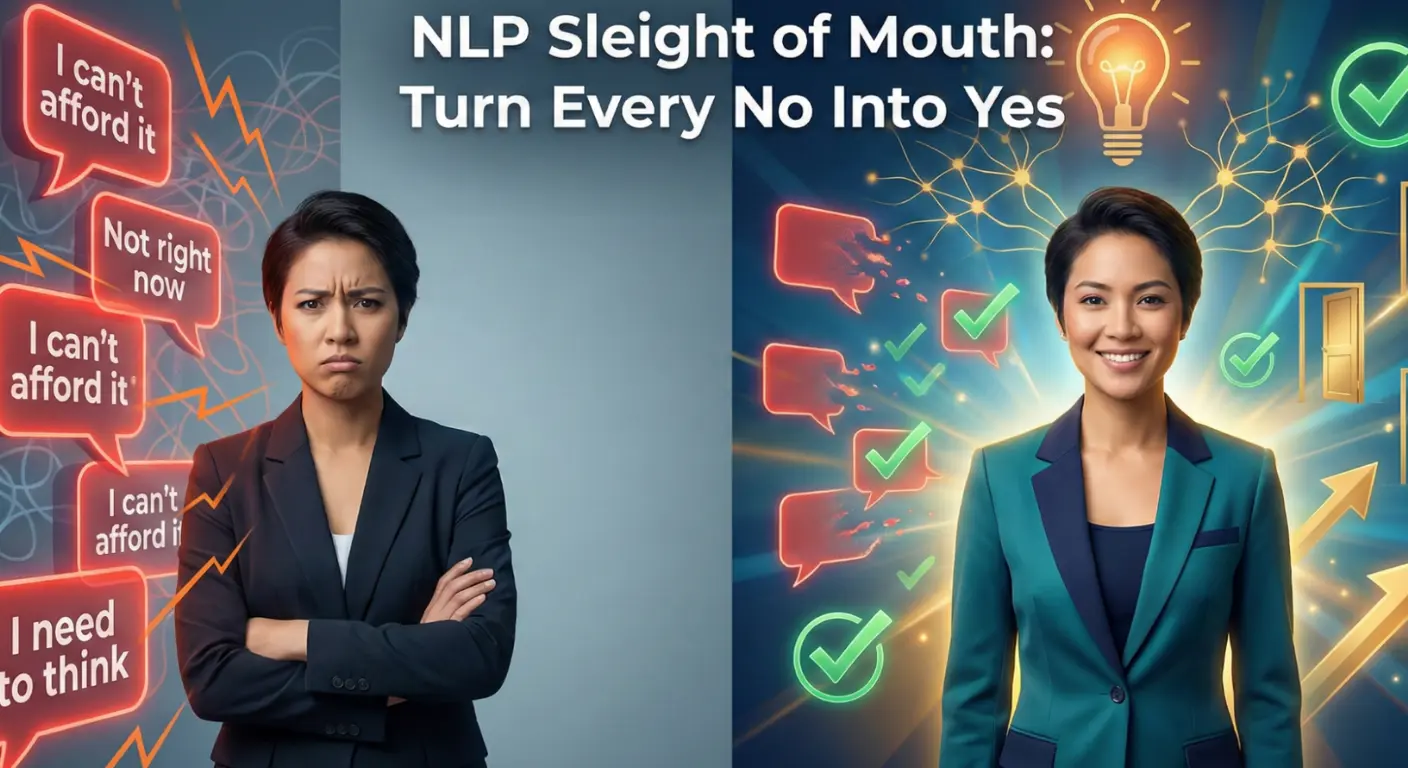
Picture this: You’ve just delivered the perfect pitch. Your potential client clearly needs what you’re offering. The conversation’s going well, the rapport is solid, and then it happens: “I can’t afford it right now” or “I need to think about it.” Your heart sinks. You know these objections aren’t really about money or timing, but you’re stuck recycling the same tired responses that rarely work.
Key Takeaway:
- Sleight of Mouth is a powerful NLP technique that reframes objections by changing the meaning of limiting beliefs, turning resistance into opportunity through 14 specific patterns (e.g., Intent, Redefine, Counter-Example, Hierarchy of Criteria). [1]
- Each pattern shifts perspective: Intent uncovers positive motivation behind the objection; Redefine changes the frame of meaning; Counter-Example provides evidence that contradicts the belief; Hierarchy of Criteria reorders values to make the objection less important. [1]
- Use in sales, coaching, therapy, or self-talk: Identify the limiting belief → choose the right pattern → deliver the reframing conversationally → test for new response; practice the 14 patterns daily to build fluency and natural delivery. [2]
- Avoid overuse or forcing patterns—match the person’s emotional state and values; not manipulation but respectful communication; works best with rapport and genuine curiosity; results often immediate in shifting perspective and reducing resistance. [2]
Bottom Line: Sleight of Mouth reframes objections elegantly using 14 NLP patterns to transform limiting beliefs into empowering perspectives—mastery comes from practice, rapport, and genuine curiosity for rapid, respectful influence in any conversation.
Here’s the truth: most coaches, sales professionals, and business leaders discover the hard way that basic objection handling feels like pushing a boulder uphill because you’re treating symptoms instead of addressing the belief structure underneath. When someone says, “I can’t afford coaching,” they’re not giving you a fact; they’re sharing a limiting belief. And beliefs don’t respond to logic or persuasion. They respond to reframing.
That’s where NLP training introduces one of its most powerful advanced tools: sleight of mouth. This systematic approach gives you 14 distinct verbal patterns that don’t just answer objections; they transform the thinking that creates objections in the first place. Whether you’re an aspiring coach building your practice, a business leader navigating team resistance, or a sales professional tired of hearing “no,” mastering sleight of mouth means you’ll never be caught off-guard by pushback again. And for those pursuing life coaching certification, these patterns become essential tools in your professional toolkit.
What Is NLP Sleight of Mouth? (And Why Most People Get It Wrong)
Most people think sleight of mouth is just fancy reframing. They’re wrong. And that misunderstanding is exactly why they struggle to use it effectively.
The Origin Story: When Richard Bandler Never Lost an Argument
In NLP certification courses during the 1980s, co-founder Richard Bandler had a peculiar teaching method. He’d adopt an obviously absurd position, “I can’t see the curve, therefore the earth is flat” and challenge participants to convince him otherwise using their newly learned NLP skills. No matter how logical their arguments, Bandler always had a response that completely turned their reasoning around. Every single time.
Robert Dilts watched this happen repeatedly and became fascinated. There had to be patterns in what Bandler was doing. So Dilts did what NLP practitioners do best: he modeled the behavior. He identified 14 distinct verbal patterns that Bandler was using intuitively. He organized them into a systematic framework. And he named it “sleight of mouth,” a reference to sleight of hand magic tricks where you see something transform right before your eyes.
The result? A conversational system that works like verbal magic, shifting someone’s perception in seconds.
It’s Not Just Advanced Reframing
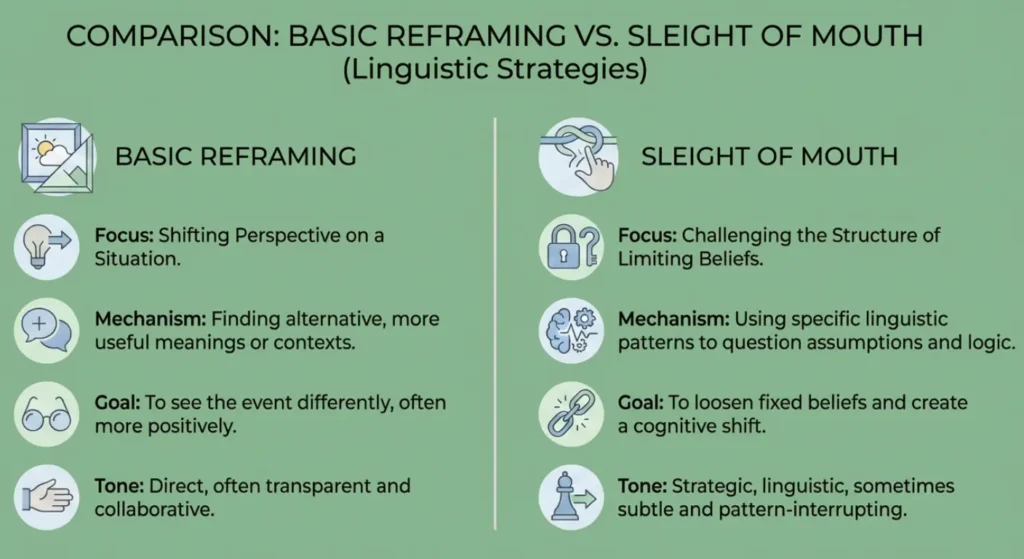
Here’s where most people get confused. They think sleight of mouth is just reframing with extra steps. But there’s a crucial difference.
Basic reframing says, “Look at it this way instead.” You’re offering an alternative perspective and hoping it sticks. Sleight of mouth systematically targets the structure of how beliefs form. It works specifically on two linguistic patterns: Complex Equivalences (A means B) and Cause-Effect statements (A causes B).
When someone says, “I can’t hire a coach because I can’t afford it,” they’re not stating a fact. They’re expressing a cause-and-effect belief: “My current financial situation causes my inability to invest in coaching.” That structure is what sleight of mouth works on. The patterns don’t argue with the belief; they shift the frame around it, loosening its grip.
This precision is what makes sleight of mouth more powerful than generic reframing. You’re not guessing at what might work. You’re applying specific patterns to specific structures. And that systematic approach is exactly what makes these patterns so valuable for overcoming limiting beliefs in yourself and others.
The Foundation: Learning to Hear Belief Structures in Objections
Before you can use any sleight of mouth pattern effectively, you need to develop one critical skill: hearing the complete belief structure in what people say. This is where most people fail.
Why You Can’t Use Patterns Without This Skill
Someone says, “I’m not sure this is right for me.” That’s not a belief structure; that’s a vague statement. If you jump straight to a sleight of mouth pattern here, you’re shooting in the dark. You need the full belief first.
The skill is learning to draw out what they really mean. What makes them unsure? What would “right for me” look like? What happens if they move forward anyway? These questions reveal the actual belief: “Starting something I’m unsure about causes failure” or “Being uncertain means I should wait.”
Now you have something to work with. Now the patterns can do their magic.
The Two Structures That Run Every Objection
Every limiting belief follows one of two structures. Master recognizing these, and you’ll hear objections differently forever.
Complex Equivalence links two things that aren’t actually the same: “You’re late again, which means you don’t care about me.” Being late and not caring are completely different things, but in this person’s mind, they’re equivalent. The equation is A = B.
Cause-Effect states that one thing directly causes another: “I can’t get to the gym because I have too many responsibilities.” Again, these might not actually be related, but the belief creates a causal link. The structure is A causes B.
Here’s a practice exercise that changes everything: Take any objection you commonly hear and complete the sentence structure. “I need to think about it” becomes “Making a decision without more time causes me to make mistakes” or “Saying yes now means I’m being impulsive.” Suddenly, you’re working with the actual belief instead of the surface objection.
When I work with coaching clients on communication skills, we spend an entire session just on this, listening for and extracting these belief structures. One client, Darren, felt blocked from career advancement despite strong performance. Through identifying the belief structures keeping him stuck, complex equivalences like “asking for a raise means I’m greedy,” he broke through to radical career growth. The patterns only worked because we first found the beliefs.
The 14 Sleight of Mouth Patterns (Organized for Easy Application)
Here’s the problem with most sleight of mouth training: they dump all 14 patterns on you at once, and your brain freezes. You can’t remember which pattern does what, let alone use them in a real conversation.
I’m organizing them differently. Four categories based on how they work. Master 2-3 from each category and you’ll handle 95% of objections with confidence.
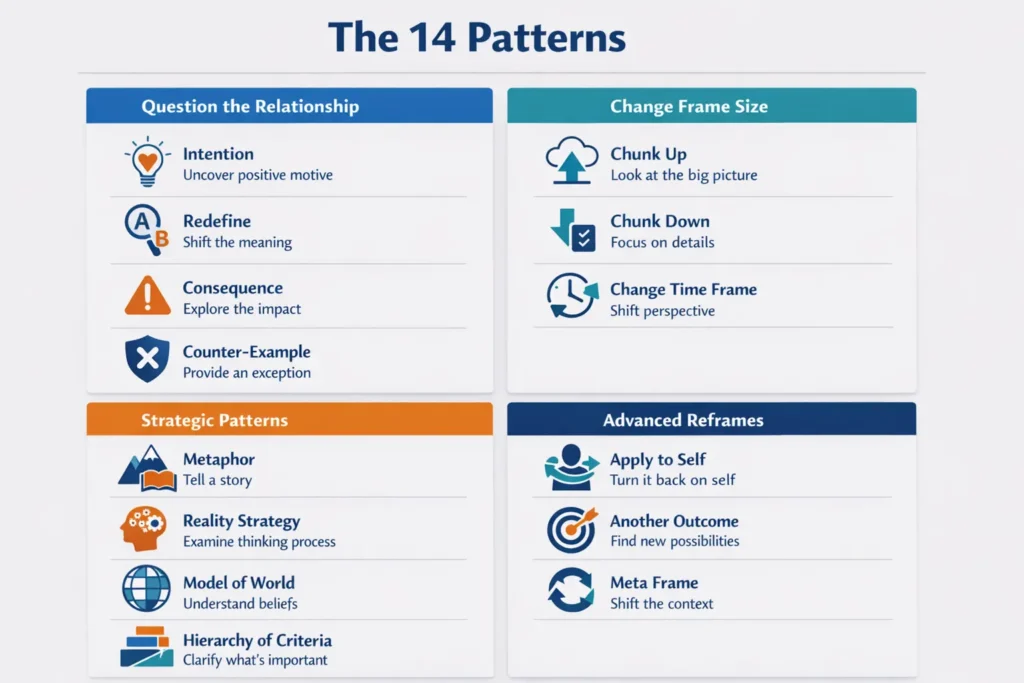
Category 1: Question the Relationship (4 patterns)
These patterns challenge whether A actually causes B or whether A really means B.
Intention: What’s the positive intent behind this belief?
- Objection: “I can’t afford coaching right now.”
- Response: “I appreciate that you’re being financially responsible. What would being ready financially look like for you?”
- Why it works: Validates their concern while shifting focus to the real goal
Redefine: Can we use a different word with better implications?
- Objection: “This is too expensive.”
- Response: “I hear you. Most of my clients initially saw this as an expense too. Then they started seeing it as an investment in their primary income source. How do you view developing your core skills?”
- Why it works: Changes the frame from cost to value
Consequence: What happens if you keep believing this?
- Objection: “I don’t have time for this right now.”
- Response: “I get that. What do you think happens to professionals who keep putting their development on hold year after year?”
- Why it works: Future-paces the cost of inaction
Counter-Example: Can you think of a time when this wasn’t true?
- Objection: “I’ve tried coaching before and it didn’t work.”
- Response: “That’s valuable to know. Have you ever tried something multiple times before finding the approach that worked for you, maybe with fitness, relationships, or learning a skill?”
- Why it works: Shows the belief isn’t universally true
Category 2: Change the Frame Size (3 patterns)
These patterns zoom in or out to shift perspective.
Chunk Up: What’s the bigger picture this is really about?
- Objection: “I need to check with my spouse first.”
- Response: “Absolutely. And when you talk with them, what’s the conversation really about? Is it permission, or is it about aligning on your shared goals for the future?”
- Why it works: Elevates to the real issue
Chunk Down: What specifically are you concerned about?
- Objection: “This won’t work for my situation.”
- Response: “Help me understand which specific part of your situation do you think creates a challenge?”
- Why it works: Gets to the actual concern instead of the generalization
Change Time Frame: How will this look in 5 years?
- Objection: “Now isn’t the right time.”
- Response: “I respect that timing matters. Five years from now, when you look back, what will tell you it was the right time?”
- Why it works: Shifts from present constraints to a future perspective
Category 3: Strategic Patterns (4 patterns)
These use different angles to reveal new possibilities.
Metaphor/Analogy: Create a parallel that illustrates absurdity or a new perspective
- Objection: “I need to be 100% sure before I start.”
- Response: “That makes sense. Did you wait to be 100% sure before you started your current job, your relationship, or any major decision? Or did you get clear enough and then learned by doing?”
- Why it works: Shows the pattern in a neutral context
Reality Strategy: How do you know this belief is true?
- Objection: “People in my industry don’t invest in coaching.”
- Response: “How would you know if some of them do? Would they announce it, or would they quietly use it as a competitive advantage?”
- Why it works: Questions the evidence for the belief
Model of World: Some people believe the opposite; does that make them wrong?
- Objection: “Taking time for development means I’m not focused on results.”
- Response: “Interesting. Some of the highest performers I work with believe that developing their skills is how they get better results. What do you think they’re seeing that creates that belief?”
- Why it works: Introduces an alternative viewpoint without arguing
Hierarchy of Criteria: Isn’t [higher value] more important than [stated concern]?
- Objection: “I can’t take time away from my team right now.”
- Response: “I hear you’re committed to your team. Long-term, which serves them better: you being constantly available, or you developing the leadership skills that multiply your effectiveness?”
- Why it works: Reframes using their own values
Category 4: Advanced Reframes (3 patterns)
These are the patterns that feel like magic when done well.
Apply to Self: Doesn’t your objection apply to you for saying it?
- Objection: “Anyone can claim they’ll get results.”
- Response: “You’re right to be discerning. How do you prove to your own clients that you deliver results?”
- Why it works: Creates empathy through shared experience
Another Outcome: What if the real issue is something else entirely?
- Objection: “I’m worried I won’t follow through.”
- Response: “That’s honest. The real question isn’t whether you’ll follow through on your own; it’s whether having structured accountability changes that pattern. What’s your experience with that?”
- Why it works: Reframes the problem and the solution
Meta Frame: What does having this belief say about how you approach things?
- Objection: “I need more proof that this works.”
- Response: “I respect that you make evidence-based decisions. Out of curiosity, when you’re building something new in your life or business, do you wait for guaranteed proof, or do you test and adjust?”
- Why it works: Reveals the pattern behind the pattern
According to research on understanding how beliefs form through generalization, these patterns work because they interrupt the automatic thinking that keeps limiting beliefs in place.
How to Actually Apply This: The 3-Step System
Knowing the patterns is useless if you can’t deploy them in a real conversation. Here’s the system that makes sleight of mouth practical.
Step 1: Listen for the Belief Structure
Don’t jump to patterns immediately. That’s the amateur move. Instead, ask clarifying questions: “What do you mean by that?” or “What would happen if you moved forward anyway?” or “How do you know that’s true?”
Then paraphrase to confirm: “So you’re saying that [A] causes [B], is that right?” This does two things. First, it ensures you’re working with the actual belief. Second, it makes the person consciously aware of their own belief structure, which already starts loosening it.
Step 2: Choose Your Pattern Based on Context
Not every pattern works in every situation. Here’s your decision framework:
If they seem defensive or worried, you’re pushing → Start with Intention (validates them first)
If they’re stuck in black-and-white thinking → Use Counter-Example (shows exceptions exist)
If timeline is the issue → Change Time Frame (shifts temporal perspective)
If it’s about evidence or proof → Reality Strategy or Model of World
If there’s a values conflict → Hierarchy of Criteria
The key is reading the person and the context. Sleight of mouth isn’t about being clever; it’s about being helpful. As explored in NLP coaching and business coaching applications, the best practitioners make these patterns feel like natural conversation.
Step 3: Stack Patterns for Stubborn Objections
One pattern might loosen a belief. Stacking 2-3 creates breakthroughs.
Here’s what that looks like in a real conversation:
Client: “I can’t justify the investment when I’m not sure it’ll work.”
You (Intention): “I appreciate you being thoughtful about where you invest. When you think about what ‘working’ would look like, what’s the real outcome you’re after?”
Client: “I need to see my business grow, but I’ve spent money on things before that didn’t pan out.”
You (Counter-Example): “That makes total sense. Have you ever invested in something, education, equipment, relationships, where it took time to see the return but ultimately paid off?”
Client: “Well, yeah. My degree took years to pay for itself.”
You (Change Time Frame): “Exactly. So when you look at where you want your business to be in three years, what capabilities would make that growth inevitable instead of hopeful?”
Notice how each pattern builds on the previous one. You’re not arguing you’re expanding their thinking. That’s the ethical boundary. You’re increasing choice, not removing it.
Real-World Scenarios: Sleight of Mouth in Action
Theory is useless without application. Let’s walk through three scenarios showing exactly how these patterns work in context.
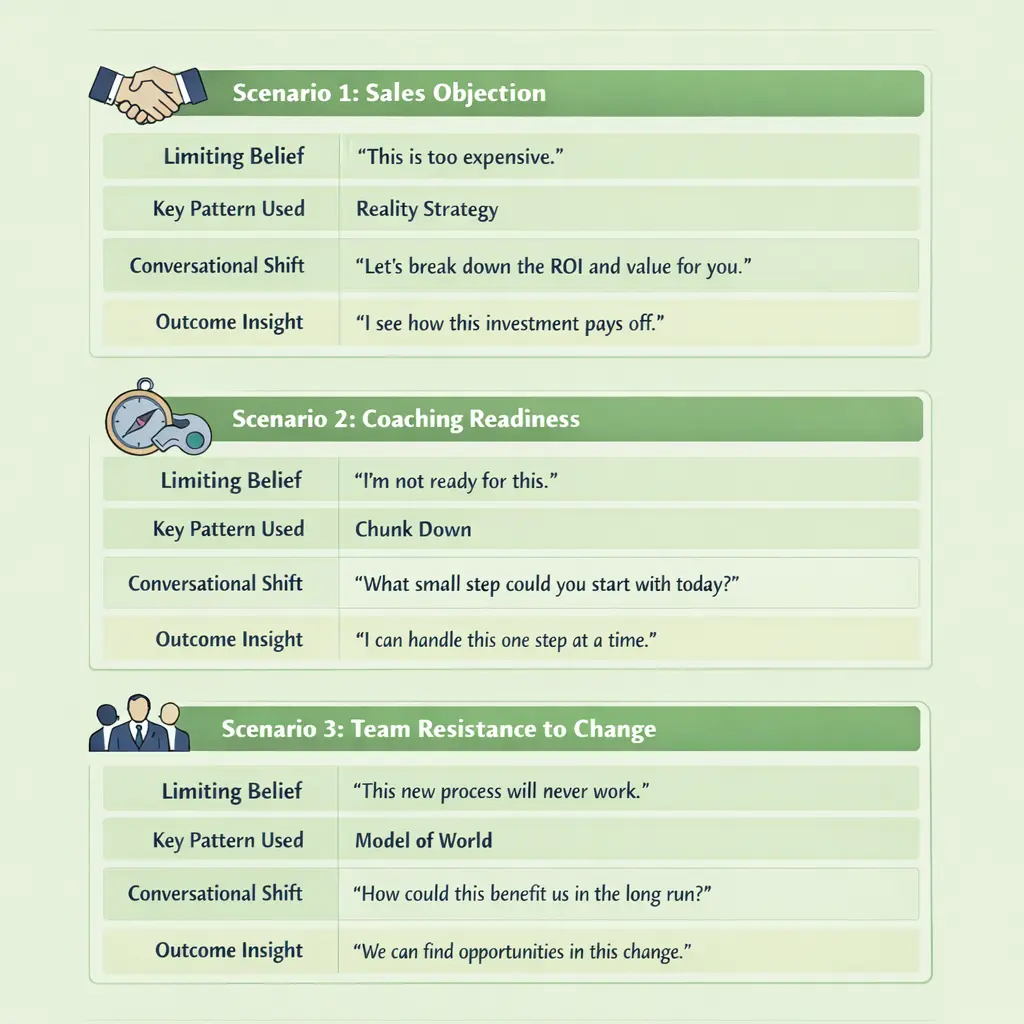
Scenario 1: The Sales Professional Facing “I Need to Think About It”
This objection usually means “I need a reason to say yes.” The belief structure underneath is often: “Making a decision without more deliberation causes mistakes” or “Saying yes now means I’m being impulsive.”
Prospect: “This looks good, but I need to think about it.”
You (Reality Strategy): “Absolutely. Out of curiosity, when you think about it, what specifically will you be evaluating?”
Prospect: “I just want to make sure it’s the right decision.”
You (Intention): “That makes sense, you want to be confident you’re making a smart choice. Can I ask, what information would make you feel that confidence?”
Prospect: “I guess I just need to know it’ll work for my situation.”
You (Meta Frame): “I respect that. And I’m curious about your business. When you close a deal, do your clients always have 100% certainty up front, or do they need enough clarity to move forward and then see results?”
Prospect: “Fair point. They usually need some confidence but not perfect certainty.”
You (Change Time Frame): “Exactly. So three months from now, what would tell you this was the right decision today?”
Notice the natural flow. You’re not hammering them with patterns; you’re having a conversation that progressively shifts their perspective. This is what makes mastering sales with NLP so effective.
Scenario 2: The Coach Hearing “I’m Not Sure I’m Ready”
The belief here is usually: “Starting before perfect conditions exist causes failure” or “Being ready means all obstacles are removed first.”
Client: “I want to work with you, but I’m not sure I’m ready.”
You (Chunk Down): “I appreciate your honesty. What would ‘ready’ look like specifically?”
Client: “I’d need to have my schedule more under control and be less stressed.”
You (Redefine): “That makes sense. What if ‘ready’ isn’t about having everything handled first? What if ready means being committed to the process even when things are messy? Have you ever started something meaningful when conditions weren’t perfect?”
Client: “Well, yeah. I started my business when I had no idea what I was doing.”
You (Counter-Example): “Exactly. And did being ‘not ready’ stop you from succeeding, or did you figure it out along the way?”
Client: “I figured it out. I guess I always do.”
You (Consequence): “You do. So what happens if you wait for the perfect time to work on the stress and schedule issues? Do those typically resolve themselves, or do they get managed when you actually address them?”
The progression is key. You’re walking them to their own conclusion.
Scenario 3: The Leader Facing Team Resistance to Change
When teams resist change, the belief is often: “This won’t work here because past changes failed” or “Change causes disruption that outweighs benefits.”
Team Member: “We tried something like this before and it didn’t work.”
You (Model of World): “That’s valuable context. Other organizations in our industry have implemented this successfully. What do you think they did differently that made it work for them?”
Team Member: “I don’t know. Maybe they had more resources.”
You (Chunk Down): “Maybe. What specifically didn’t work when we tried it before? What was the actual breakdown?”
Team Member: “Leadership didn’t follow through, so we stopped using it.”
You (Metaphor): “Ah, so it’s like buying gym equipment and never using it. The equipment isn’t the problem. The implementation is. What would make this implementation different?”
Team Member: “Probably actual commitment from the top.”
You (Hierarchy of Criteria): “Exactly. And which matters more to our team’s success: maintaining our current approach with its known limitations, or implementing change with genuine commitment to make it work this time?”
These scenarios show sleight of mouth in action, not as manipulation, but as a way to help people think past their automatic resistance.
The Practice Plan: How to Make Patterns Automatic
Knowledge without practice is just interesting information. Here’s how to turn sleight of mouth from theory into a reflexive skill.
Week 1: Pattern Recognition
Spend one week just listening for belief structures in conversations. Don’t respond yet, just notice when someone states “A causes B” or “A means B.” You’ll be shocked how often people communicate in these structures once you start listening for them.
Journal examples you hear. Write down the exact words, then identify whether it’s a complex equivalence or cause-and-effect. This trains your brain to recognize patterns in real time.
Week 2-3: Deliberate Practice
Pick 3 patterns to master first. I recommend: Intention, Consequence, and Counter-Example. These three are the most versatile and least likely to come across as manipulative.
Practice with a partner using common objections in your field. One person gives the objection, the other responds using a specific pattern. Then switch. Do this for 20-30 minutes daily. Record yourself if possible, you’ll notice patterns in your delivery that feel unnatural.
The goal isn’t perfection. It’s building the neural pathways, so patterns start arising automatically in conversation.
Week 4+: Real-World Application
Start using patterns in actual conversations. Don’t announce what you’re doing, just apply the patterns naturally. After each conversation, review what worked and what felt awkward.
Pay attention to responses. Did the person’s face soften? Did their objection shift? Did they start questioning their own beliefs? These calibration cues tell you when patterns are landing.
Gradually add more patterns to your toolkit. By month three, you should have 7-10 patterns you can access fluidly. That’s when sleight of mouth stops being a technique and becomes part of how you communicate.
FAQs
What’s the Difference Between Sleight of Mouth and Regular Reframing?
Regular reframing offers a different perspective. Sleight of mouth systematically targets the structure of limiting beliefs, specifically complex equivalences and cause-and-effect relationships. It’s precision verbal engineering rather than general perspective-shifting. Where reframing says “look at it this way,” sleight of mouth reveals why the original way of looking at it doesn’t hold up under examination.
How Long Does It Take to Master Sleight of Mouth Patterns?
Most people can use 3-5 patterns conversationally within 2-3 weeks of focused practice. Mastery of all 14 patterns typically takes 3-6 months of consistent application. The key is daily practice with real conversations, not just theoretical study. Mike, one of my clients, transformed his professional communication by practicing NLP patterns until they became automatic, eliminating anxiety and building genuine confidence. According to structured training programs, the difference between knowing patterns and using them fluently is deliberate practice with feedback.
Can Sleight of Mouth Be Used Unethically?
Yes. Any persuasion tool can be misused. The ethical boundary is this: Are you expanding someone’s thinking to help them make better decisions, or are you manipulating them into choices that don’t serve their interests?
Always use sleight of mouth to increase choice, not remove it. If someone genuinely can’t afford something or isn’t ready for a commitment, sleight of mouth helps clarify that truth; it doesn’t override it. The moment you’re more focused on getting a yes than serving the person, you’ve crossed the line.
Which Sleight of Mouth Patterns Work Best for Sales Objections?
Start with Intention (uncovers the real concern behind the objection), Consequence (future-paces the cost of inaction), and Redefine (reframes “expensive” as “investment” or “cost” as “value exchange”). These three handle roughly 70% of price, timing, and authority objections when used in combination.
The real power comes from stacking them: use Intention first to validate and understand, then Consequence to create urgency, then Redefine to shift the frame. This sequence feels natural and helps prospects talk themselves into the decision instead of feeling pushed.
Do I Need NLP Certification to Use Sleight of Mouth?
No certification is required to learn and apply these patterns. However, formal NLP certification programs provide the foundational skills, rapport building, calibration, and meta-model questioning that make sleight of mouth significantly more effective in real conversations.
Think of it this way: you can learn to throw a punch from a video, but martial arts training teaches you when to punch, how to read your opponent, and how to move naturally. Certification gives you the full framework, not just isolated techniques.
Conclusion: From Objection-Handling to Belief Change Mastery
You now have what most coaches, sales professionals, and business leaders never develop: a systematic approach to handling any objection. Not by overpowering it with logic, not by manipulating people into compliance, but by expanding the thinking that creates resistance in the first place.
That’s the real transformation sleight of mouth offers. Most people stay stuck using the same 2-3 responses to objections, hoping something will eventually stick. They’re playing a guessing game. Sleight of mouth gives you 14 different angles to shift perspective. More importantly, it teaches you the meta-skill of seeing belief structures in real time and knowing which patterns will open new possibilities.
The patterns work because they mirror how beliefs actually form through cause-and-effect relationships and equivalences that we accept without examination. When you question those structures skillfully, beliefs loosen. When beliefs loosen, objections disappear. And when objections disappear, real conversations about transformation can happen.
Your next step is simple: Start with the practice plan in this article. Don’t try to master all 14 patterns at once. Focus on making 3-5 patterns conversational over the next month. Track your results. Notice the shift in how people respond to you.
And if you want to accelerate your skill development with the full context of how these patterns fit into the larger NLP framework, consider formal training. The difference between learning isolated techniques and developing integrated expertise is the difference between knowing a few magic tricks and becoming a true communicator.
Ready to master the communication patterns that turn objections into opportunities? Explore our NLP training program to unleash your full persuasive power and transform how you handle every conversation that matters.