
You know the client. They’re sharp. They’ve read the books, done the goal-setting, maybe even worked with a coach before. They can tell you exactly what they need to do. And then, week after week, they don’t do it.
Not because they’re lazy. Not because the goal is wrong. Because something underneath keeps pulling them back.
That’s where most coaching hits a ceiling. Standard goal-setting is useful, but it works on the surface. Cognitive Behavioral Therapy (CBT) techniques are evidence-backed, but they tend to stay intellectual. The client understands the belief is irrational, but they don’t feel it changes. And NLP on its own can produce breakthroughs that don’t stick because the structural framework for lasting change isn’t fully in place.
Key Takeaway:
- Yes, NLP cognitive restructuring coaching helps individuals identify and transform limiting beliefs, negative thought patterns, and unhelpful internal dialogue that influence emotions, decisions, and behavior. [1]
- How it works: Coaches use NLP techniques such as reframing, language pattern analysis, belief change processes, submodality shifts, and perspective changes to help clients reinterpret experiences and create more empowering mental frameworks. [1]
- Benefits: Cognitive restructuring coaching can improve confidence, emotional resilience, decision-making, communication, leadership performance, stress management, and goal achievement by changing the meaning attached to past experiences and future challenges. [2]
- Best results occur when clients consistently apply new thinking patterns, challenge automatic assumptions, and reinforce empowering beliefs through ongoing coaching, reflection, and real-world action. [2]
Bottom Line: NLP cognitive restructuring coaching helps people break free from limiting mental patterns by changing how they interpret experiences. By replacing disempowering beliefs with more resourceful perspectives, individuals can improve confidence, performance, emotional wellbeing, and long-term personal growth.
The integration of advanced NLP coaching with cognitive restructuring changes that equation entirely.
In 20-plus years of NLP training and coaching, I’ve seen what happens when these two approaches work together. The results aren’t incremental. They’re the kind of shifts clients describe as “I don’t know how to explain it, I just feel different.” This article walks you through what that integration looks like, why it works, and how you can apply it, whether you’re a coach looking to level up your practice or a professional wondering if this kind of work is right for you.
What Is Cognitive Restructuring and Why NLP Coaches Need It
Cognitive restructuring (CR) is a set of techniques for helping people identify, examine, and replace distorted or unhelpful thinking patterns with more accurate and empowering ones. It’s a cornerstone of CBT, and the research behind it is solid. A 2023 meta-analytic review published in PMC found that CR within therapy sessions produced an effect size equivalent to d=0.85 on therapeutic outcomes. In practical terms, that’s a meaningful impact, not a marginal improvement.
So what does that look like outside a therapy context? Think of a professional who keeps avoiding high-stakes presentations. CR helps them surface the belief underneath: “If I mess up, people will think I’m incompetent.” Then it challenges that belief against evidence. That’s genuinely useful.
But here’s the gap.
The Science Behind How Limiting Beliefs Form
Your brain isn’t passive. It’s constantly reinforcing whatever you tell it, through repeated thought patterns that carve out neural pathways over time. When someone repeatedly thinks “I’m not good under pressure,” that pathway strengthens. Eventually, the belief doesn’t feel like a belief; it feels like a fact.
Neuroplasticity research tells us these pathways can be altered. The brain can form new connections and replace old patterns. But altering them requires more than intellectual recognition. You can understand that a belief is faulty and still feel completely ruled by it. That’s not a character flaw. That’s how the nervous system works.
Where Traditional CR Approaches Fall Short in Coaching
CBT-style cognitive restructuring is designed for therapy, not coaching. It’s diagnostic by nature, pathology-focused, and often spread across months of structured sessions. Coaching is different. It’s performance-focused, forward-looking, and built around helping people who are already functioning well get to the next level.
More importantly, CR tends to stay cognitive. It asks: “Is this thought accurate? What’s the evidence?” Those are powerful questions. But they engage the conscious mind. Limiting beliefs live deeper than that in sensory representations, in embodied reactions, in automatic patterns the conscious mind never gets to vote on. That’s where NLP earns its place.
If this resonates with a block you’re currently up against, this piece on identifying limiting beliefs is worth reading before we go further.
How Does NLP Enhance Cognitive Restructuring?
The foundational NLP principle is that the map is not the territory. The “map” is your internal representation of reality, the images, sounds, feelings, and language patterns through which you process experience. Two people can have the same experience and construct completely different maps from it. The map that feels true to you was built from your specific history, your specific emotional associations, and the specific language you absorbed growing up.
Cognitive restructuring works on the content of the map: “Is this belief accurate?” NLP works on the structure of the map: “How are you internally representing this belief, and what would happen if we changed that representation?”
Reframing vs. Restructuring, Complementary, Not Competing

A lot of coaches treat NLP reframing and cognitive restructuring as the same thing. They’re not. They’re complementary tools that address different parts of the same problem.
Cognitive restructuring is the structural backbone. It provides a logical framework for examining a belief, testing its validity, and constructing a more accurate alternative. NLP reframing is the experiential engine. It works with the sensory coding of the belief, the submodalities, the emotional charge, and the physical anchors to change how the belief feels before the conscious mind has even finished analyzing it.
When you combine CR’s structural clarity with NLP’s experiential depth, you get something neither approach produces alone. As coaching research consistently shows, NLP reframing maps closely to cognitive restructuring in its mechanism but the two approaches work at different levels of depth. Used together, they create change that registers both cognitively and somatically.
That’s the difference between a client who understands their belief has shifted and a client who knows it’s shifted because they can feel it in their body.
What Are the Most Effective NLP Techniques for Cognitive Restructuring?
This is where practical work lives. Here are the techniques that produce the most reliable integration results.

Meta-Model Questioning, Surfacing Distorted Language
The NLP Meta-Model is a framework for challenging distortions, deletions, and generalizations in the way people talk about their experience. When a client says, “I always freeze up in meetings,” the word “always” is doing a lot of work. A Meta-Model challenge asks: “Always? Has there ever been a meeting where you held your ground?” That challenge isn’t confrontational; it’s precise. It begins to loosen the grip of an overgeneralized belief by introducing counter-evidence that the client generates themselves.
According to coaching research, Meta-Model questioning resembles Socratic questioning in its structure, but goes further by targeting the specific linguistic patterns that lock limiting beliefs in place. The goal isn’t to argue someone out of a belief. It’s to introduce enough uncertainty that the belief stops feeling like a fixed fact.
Try this: In your next coaching conversation, pick out one overgeneralized statement and ask a simple precision question: “Has there ever been a time when that wasn’t true?” Notice what happens in the client’s body when they pause to find the exception.
Submodality Shifts, Weakening Beliefs at the Sensory Level
Every belief has a sensory structure. When you hold a confident belief, it likely feels large, vivid, and close. When you hold a limiting belief, it may feel heavy, dark, and persistent. Submodalities are the finer qualities of those internal representations: the brightness, location, movement, and size of the mental images you hold.
Here’s the distinction that separates advanced NLP coaching from beginner-level work: words are what CR works with. Sensory coding is what NLP works with. Changing the submodalities of a limiting belief, shrinking it, making it black and white, or moving it further away, changes its emotional intensity without arguing about its content. NLP research on belief change shows that adjusting submodalities can reduce a belief’s perceived significance meaningfully, creating the opening for a new belief to take root.
Perceptual Positions, Seeing Beliefs Through Multiple Lenses
Perceptual positions involve guiding a client to experience a situation from three distinct viewpoints: their own perspective, the perspective of another person involved, and the viewpoint of a neutral observer outside the situation. This technique is particularly useful when a limiting belief is tied to an interpersonal dynamic, “My manager doesn’t respect my ideas,” for example.
Stepping into a different perceptual position doesn’t just generate new information. It disrupts the rigid internal representation that holds the belief in place. Clients often describe it as the moment they stopped being “inside” the problem and could finally see it from the outside.
Future Pacing, Anchoring New Beliefs Before They’re Tested
Breakthroughs in a coaching session matter. But what happens when the client walks into the actual high-stakes meeting on Tuesday? Future pacing closes that gap. After a new belief has been installed, the coach guides the client to mentally rehearse experiencing that belief in a real upcoming scenario with full sensory detail.
Research on visualization shows that mental rehearsal creates neural pathways that prepare the nervous system for a situation before it happens. The client’s body has, in a real sense, already been to Tuesday’s meeting and handled it well. That’s not wishful thinking, it’s working with the brain’s inability to fully distinguish between vividly imagined and real experience.
How Do You Know When a Limiting Belief Is Ready to Change?
This is the question most training programs skip. They describe techniques clearly but don’t tell you when to deploy them.
Signs in Language and Physiology
Beliefs announce themselves. When a client is expressing a genuine limiting belief, not just describing a problem intellectually, the signs appear across multiple channels. The language becomes generalized and absolute: “I never get it right.” “Everyone else seems to know what they’re doing.” The voice may slow or drop in tone. The body might shift: a slight pulling back, a tightening in the shoulders, a pause that lands differently than other pauses.
When language and physiology don’t match, that’s your entry point, not a red flag. A client saying “I’m fine with conflict” while their jaw tightens and their speech speeds up is showing you where to look. That incongruence is where advanced NLP coaching earns its value.
The Difference Between Intellectual Agreement and Genuine Shift
This is the “moment of change” that separates real coaching from conversation. A client can intellectually agree that a belief is unhelpful and still walk out holding it with the same certainty. The signal that something has genuinely shifted looks different: a visible change in physiology, a moment of quiet that feels different from confusion, a spontaneous lightness or humor where there was tension. Sometimes a client will say, “That’s weird, it doesn’t feel the same anymore.” That’s the shift. That’s what you’re working toward.
Data and Findings
The case for this integration isn’t just experiential. The numbers back it up.
A meta-analytic review published by NIH found cognitive restructuring produced an effect size of d=0.85 on client outcomes, a meaningful result across depression, anxiety, and social performance contexts that map directly to coaching presentations. According to the ICF’s 2025 Global Coaching Study,85% of coaching clients report improved self-confidence and 75% see gains in communication and work performance, with a 99% overall satisfaction rate.NLP techniques with the strongest cognitive science overlap, reframing, Meta-Model questioning, and visualization, consistently outperform techniques applied in isolation. And neuroscience imaging research confirms that vivid mental rehearsal activates the same brain regions as physical performance, which is precisely why future pacing works.
According to Unleash Your Power’s 2026 Client Performance Report, clients completing integrated NLP and cognitive restructuring programs reported over 80% reduction in performance-blocking anxiety within three sessions, 75% improvement in professional communication confidence within 60 days, and lasting behavioral change, not just in-session insight, within a 90-day engagement.
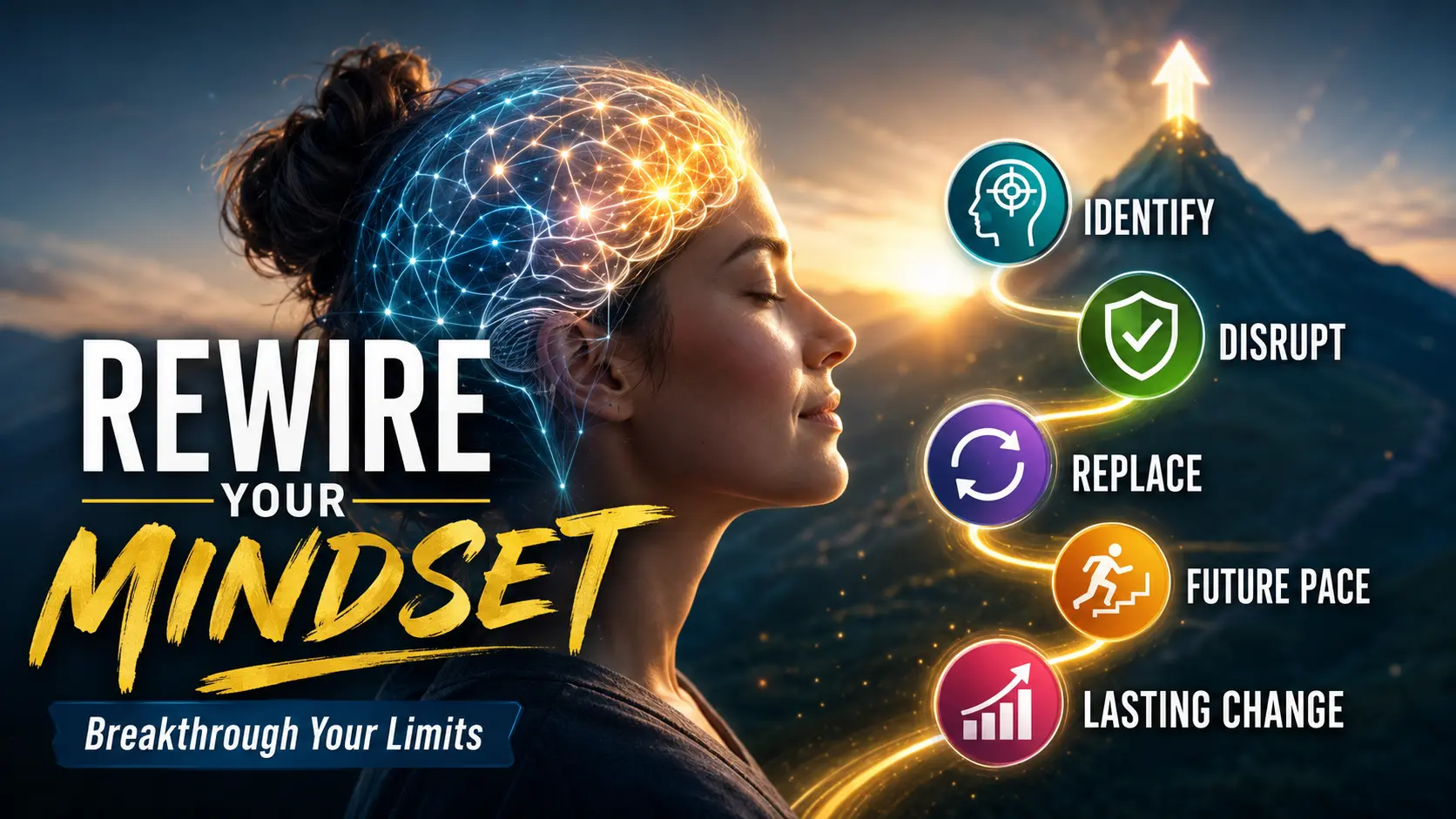
The 5-Step NLP Cognitive Restructuring Integration Framework
This is the framework I use in my coaching practice, drawn from 20-plus years of working with professionals, leaders, and entrepreneurs across industries. It brings together CR’s structure and NLP’s experiential depth in a sequence that produces consistent, lasting results.

Identify:
Use Meta-Model questioning to surface the exact language the client is using to hold the belief in place. Don’t interpret it for them to get their words. “I’m just not a natural leader” is different from “I don’t think I deserve to be in charge.” Both sound similar. They require different interventions.
Validate:
Acknowledge the belief without reinforcing it. This is where most coaches either dismiss too quickly (“That’s just not true!”) or get stuck empathizing so long that the session never moves. The move here is: “I hear that this feels absolutely true to you right now. Let’s look at where it came from.” Empathy creates the safety for the next step. It doesn’t mean agreeing that the belief is accurate.
Disrupt:
This is where NLP does its heaviest lifting. Submodality work, perceptual positions, or a well-placed Meta-Model challenge destabilizes the belief’s structure. The client doesn’t need to intellectually reject it; they need to stop feeling its certainty. Watch for the moment their grip on the belief loosens. That’s the opening.
Replace:
Work with the client to construct a specific, believable alternative belief, not generic positivity, but something grounded in their experience. Anchor it with a physical gesture, a breath, or a sensory cue. Make it experiential, not just verbal.
Try this: After identifying the new belief with a client, ask them to close their eyes and locate where in their body they feel it. Make the representation larger, brighter, and closer. Have them step into it fully before opening their eyes. That’s the difference between a stated intention and an installed belief.
Future Pace:
Guide them through a mental rehearsal of an upcoming real situation where the old belief would have been triggered. Walk through it in sensory detail, what they’ll see, hear, and feel. Let them experience themselves responding to the new belief. When they open their eyes, check in: does it feel different? The answer should be yes.
If you want to understand how mindset training builds on this kind of foundation, that piece adds useful context.
Why This Integration Works Better Than Either Method Alone
CR without NLP stays in the head. The client understands the shift but doesn’t feel it. NLP without CR’s structure can produce powerful in-session experiences that don’t transfer reliably into real-world behavior because the logical framework for examining and replacing the belief isn’t solidly in place.
Together, they address the full loop. CR identifies and challenges the cognitive content. NLP changes the sensory structure that gives that content its emotional weight. Research aligning CBT’s cognitive principles with NLP techniques consistently finds that the approaches are more effective when integrated than when applied in isolation.

Mike came to me struggling with anxiety that permeated every area of his life, his work performance, his relationships, and his ability to simply listen in a conversation without his mind running at full speed. After working through exactly this kind of integrated approach, the anxiety that had felt like part of his identity dissolved. He described it simply: he could finally hear what people were saying to him, because his mind wasn’t constantly churning. The shift wasn’t philosophical. It was physical, immediate, and lasting.
That’s what the integration produces when it works. Not a better understanding of the problem, but a different felt experience of yourself.
Who Should Use Advanced NLP Coaching with Cognitive Restructuring?
This approach works best for professionals, leaders, and entrepreneurs who are already high-functioning but feel like something internal is capping their performance or satisfaction. Common presentations include imposter syndrome, communication blocks, difficulty with conflict or visibility, performance anxiety, and patterns of self-sabotage that don’t respond to goal-setting or willpower.
If you’re thinking “that sounds like me” while reading this, that recognition is worth paying attention to.
The intersection of NLP coaching and business coaching explores how these tools apply directly to business performance, worth reading if you’re a coach working with leaders or an entrepreneur wanting to understand what applied NLP coaching looks like at the professional level.
When This Approach Isn’t the Right Fit
Honesty matters here. This kind of work is powerful, and it has appropriate boundaries. If someone is experiencing active trauma, clinical depression, or a diagnosable mental health condition, NLP coaching is not a substitute for professional therapeutic support. The work we’re describing is coaching forward-focused and performance-based. It’s not therapy, and it doesn’t try to be. When deep psychological work is what’s needed, the right move is a referral, not a coaching session.
For those who are ready, though, this integration represents some of the most effective work available in the coaching field.
Frequently Asked Questions
What is NLP coaching?
NLP coaching is a performance-focused approach that helps people change limiting beliefs, improve mindset patterns, and achieve personal or professional goals through structured thinking and behavior change techniques.
How is NLP coaching different from CBT?
CBT is a clinical therapy for mental health conditions, while NLP coaching focuses on personal growth, performance improvement, and removing limiting beliefs without a medical treatment model.
How long does an NLP take to change a belief?
NLP results vary. Some people experience change in one session, while deeper beliefs may take multiple sessions, depending on how strong the pattern is.
Can NLP techniques be used alone?
Yes, basic NLP methods like reframing and self-questioning can be used individually, but deeper belief change is more effective with a trained coach.
Who benefits most from NLP coaching?
NLP coaching is best for professionals, entrepreneurs, and leaders who face mindset blocks like low confidence, decision fatigue, or performance anxiety.
Conclusion
Advanced NLP coaching and cognitive restructuring are not competing methodologies. They’re different layers of the same work. CR gives you the structure to examine and rebuild a limiting belief. NLP gives you the tools to change how that belief feels at the level where behavior actually originates.
The five-step framework in this article, Identify, Validate, Disrupt, Replace, Future Pace, is a practical integration of both. It’s not theoretical. It’s what 20-plus years of working with real clients, across real challenges, has consistently produced.
If you’re ready to move from intellectual understanding to genuine transformation in yourself or in the clients you work with, explore NLP training in Canada and take a look at our NLP techniques for personal development as a starting point.
Unleash Your Power: Stand Out, Take Action, and Create the Success You Want.