

Picture this: You’re about to walk into the most important presentation of your career. Your palms are sweaty. Your mind is racing with worst-case scenarios. Then you touch your thumb to your forefinger, take a breath, and instantly, like flipping a switch, you feel the confidence surge through you. Not fake confidence. Real, grounded certainty.
Key Takeaway:
- NLP anchoring is a powerful psychological technique that lets you instantly trigger a desired emotional state (like confidence, calm, or focus) by associating it with a simple physical trigger (touching thumb & finger, a word, or gesture). [1]
- How it works: During a peak emotional moment (high confidence), you deliberately create a sensory “anchor” (e.g., press thumb & finger together). Later, firing that same anchor reactivates the emotional state almost instantly through classical conditioning (Pavlov-style association). [1]
- Steps: 1) Recall or create a strong positive state (e.g., peak confidence moment). 2) Intensify the feeling. 3) At the emotional peak, apply your chosen anchor (squeeze fingers, say a word, etc.). 4) Release & break state. 5) Test by firing the anchor later. Repeat 5–7 times to strengthen. [2]
- Best used before high-stakes moments (speeches, interviews, dates). Anchors can stack (multiple positive states on one trigger). Avoid anchoring negative states. Works on almost anyone with practice; effects can last months/years with reinforcement. [2]
Bottom Line: NLP anchoring gives you an instant, reliable way to access powerful states like confidence on demand. Create strong anchors during peak moments and fire them when you need them most—simple, fast, and surprisingly effective with just a few minutes of practice.
- Source: Unleash Your Power – NLP Anchoring & Instant Confidence
- Source: Article Summary / Key Points
Sounds like something out of a movie, right? But this isn’t fiction. It’s a technique called NLP anchoring, and thousands of professionals use it every day to access peak emotional states exactly when they need them most. Unlike generic “think positive” advice that leaves you trying to force feelings that won’t come, anchoring creates actual neural pathways in your brain. You’re not pretending to be confident. You’re triggering genuine confidence through proven neuroscience.
If you’ve ever felt at the mercy of your emotions, nervous when you need to be calm, hesitant when you need to be decisive, this technique gives you back control. Through advanced NLP training, professionals learn to anchor resourceful states like confidence, focus, and motivation so they can perform at their best regardless of external circumstances. The power isn’t in positive thinking. The power is in understanding how your brain actually works and using that knowledge to break through limiting beliefs that have held you back.
What Is NLP Anchoring? The Neuroscience Explained
At its core, NLP anchoring is about creating an association between a specific trigger and an emotional state. When you set up an anchor properly, firing that trigger brings back the state you need, whether that’s confidence, calm, motivation, or focused energy.
Here’s what makes this different from just “thinking positive thoughts.” When you create an anchor, you’re building actual neural pathways in your brain. This isn’t wishful thinking. This is how your nervous system naturally works.
The foundation goes back over a century. Russian physiologist Ivan Pavlov won a Nobel Prize for his work on conditioning. You probably remember the famous experiment where dogs learned to salivate at the sound of a bell. That wasn’t magic either. That was the brain forming associations between a stimulus and a response. Foundational conditioning research showed that when you pair a neutral stimulus with a powerful experience repeatedly, the brain links them together neurologically.
But here’s where NLP anchoring goes beyond simple conditioning. Unlike Pavlov’s dogs, you’re not a passive subject responding reflexively. You’re actively choosing which states to anchor and when to fire them. You have control. And modern neuroscience research shows that your brain prioritizes memories connected to peak emotional experiences, especially rewarding ones. When you anchor a moment of genuine confidence at its peak, you’re tapping into your brain’s reward system, making that memory more accessible whenever you need it.
The key insight? Your brain can’t fully distinguish between a vividly imagined experience and a real one. That’s why when you relive a confident moment with full sensory detail, your body responds as if you’re experiencing it again. And when you add a unique physical trigger at that peak moment, you create a neurological shortcut. From that point forward, the trigger can bring back the state.
This is one of many practical NLP techniques that put you in the driver’s seat of your own neurology. You’re not waiting to “feel confident.” You’re programming your brain to access confidence on command.
How Your Brain Creates Anchors (You’re Already Using Them)
Before we dive into how to create intentional anchors, let’s talk about something important: You already have dozens of anchors running in the background of your life right now. You just didn’t choose them consciously.
Think about the last time you heard a song that instantly transported you back to high school. Or maybe there’s a smell of fresh-baked cookies, a specific perfume that floods you with emotion before you even realize why. Those are anchors. Your brain naturally creates associations between sensory experiences and emotional states. It’s happening all the time, whether you’re aware of it or not.
Some of your anchors are positive. The sound of your favorite person’s laugh. The feeling of accomplishment when you check something off your list. Others? Not so much. Maybe there’s a colleague whose voice triggers instant frustration. Or a specific situation, like walking into a boardroom, that automatically makes you feel small.
Here’s the thing: If your brain is going to create anchors anyway, why not take control of the process? Why not intentionally anchor states that actually serve you?
The marketing industry figured this out decades ago. Think about the Intel sound you know, the one that has a five-note jingle. Hear it and you immediately think “computer technology.” That’s an auditory anchor worth millions. Or consider how McDonald’s golden arches can make you think of burgers even when you’re not hungry. These companies use anchoring to trigger specific responses in consumers, and it works because the brain is wired to make these connections.
I once felt invisible in meetings. Today, I command respect through tools you can use. The difference wasn’t becoming a different person. The difference was learning to anchor resourceful states and access them when they mattered most. And one of the most powerful applications is anchoring confidence so you can access it in those high-stakes moments when doubt used to take over.
The good news? Creating positive anchors for yourself is simpler than you think. You just need to understand the process.
The 5-Step Process to Create a Confidence Anchor
Let’s get practical. Here’s exactly how to create an anchor that gives you instant access to confidence whenever you need it. Follow these steps carefully; the details matter.
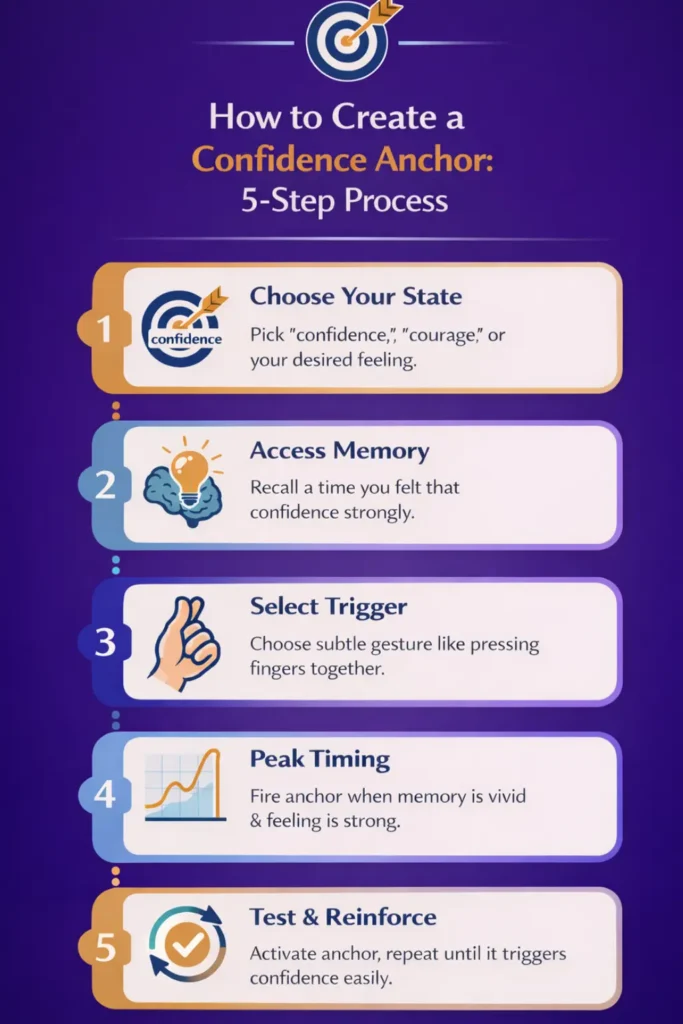
Step 1: Choose Your Desired State
Start by getting specific about what you actually want to feel. “I want to be more confident” is too vague. Your brain needs clarity.
Instead, ask yourself: What kind of confidence? Is it the calm confidence you need for a difficult conversation? The energized confidence for a presentation? The quiet certainty you need when making a major decision?
Be precise. The more specific you are, the more powerful your anchor will be. Common states professionals anchor include calm confidence, focused determination, charismatic presence, and decisive certainty. Pick one to start with.
Step 2: Access a Powerful Memory
Now you need to find a memory where you felt that exact state intensely. It is crucial that your anchor is only as strong as the state you’re anchoring.
Think back to a time when you felt genuinely, powerfully confident. It doesn’t matter what the situation was. Maybe it was nailing a presentation. Maybe it was standing up for yourself. Maybe it was a moment in sports or a personal accomplishment. The context doesn’t matter. The intensity does.
Once you’ve identified the memory, you need to fully step back into it. This is where most people make a mistake. Don’t watch the memory like it’s a movie playing in front of you. That’s called being “dissociated,” and it won’t work. You need to be “associated,” meaning you step back inside your younger self and experience it from within.
Close your eyes. See what you saw through your own eyes. Hear what you heard. Feel what you felt in your body. Make the images brighter. Make the sounds clearer. Amplify everything. The more vividly you relive this moment, the stronger your anchor will be. Research on anchoring techniques confirms that the intensity of your emotional state directly correlates to the effectiveness of your anchor.
Step 3: Select Your Unique Trigger
Your anchor needs to be unique, something you don’t do accidentally throughout your day. You also need to be able to replicate it precisely.
Most people use a kinesthetic anchor (physical touch) because it’s the most reliable. Common examples:
- Pressing your thumb and forefinger together on one hand
- Pressing a specific knuckle
- Making a subtle fist gesture
- Touching your earlobe
You can also use visual anchors (a specific mental image) or auditory anchors (a word or phrase you say to yourself). Some people use multiple anchors at once, a physical gesture plus a power phrase like “I’ve got this.”
Whatever you choose, make sure it’s unique, easy to replicate, and something you can do discreetly. You’ll want to use this in real-world situations without drawing attention to yourself.
Step 4: Set the Anchor at Peak Intensity
This is where timing becomes everything. You need to apply your trigger at the exact moment your emotional state hits its peak.
Go back into that confident memory again. Let the feeling build. As the confidence intensifies, watch for the moment when it reaches about two-thirds of the way to its peak; that’s your cue. Apply your trigger (press your thumb and forefinger together, or whatever you chose) and hold it as the feeling continues to climb to its maximum intensity.
Keep holding the anchor for about 20 to 30 seconds while you’re at that peak. Really feel the confidence flooding through you. Then release the trigger just before the feeling starts to fade.
This timing is critical. If you anchor too early or too late, you won’t capture the peak state. Established NLP methods emphasize what’s called the I-T-U-R-N principle:
- Intensity – Your emotional state must be strong
- Timing – Set the anchor at the peak
- Uniqueness – Your trigger must be distinctive
- Replication – You must be able to repeat it exactly
- Number – Repetition strengthens the anchor
Step 5: Test and Reinforce
Now you need to test if your anchor works. Break your state, think about something completely different. Your grocery list. Tomorrow’s weather. Anything mundane.
Then fire your anchor. Press your thumb and forefinger together (or whatever trigger you chose) exactly the way you did before. What happens? Do you feel the confidence returning? Even partially?
If yes, congratulations. You’ve created an anchor. If it’s not as strong as you’d like, don’t worry. You can stack additional confident memories onto the same anchor to intensify it. Just repeat the process with different memories of confidence, using the same trigger.
Practice firing your anchor in low-stakes situations first. Use it before a regular meeting. Use it when you’re about to make a phone call. The more you practice, the stronger the neural pathway becomes. You’re literally rewiring your brain to respond to your chosen trigger with confidence. That’s the power of managing stress effectively through NLP techniques that give you control over your state.
Why Doesn’t Confidence Anchoring Work for Everyone?
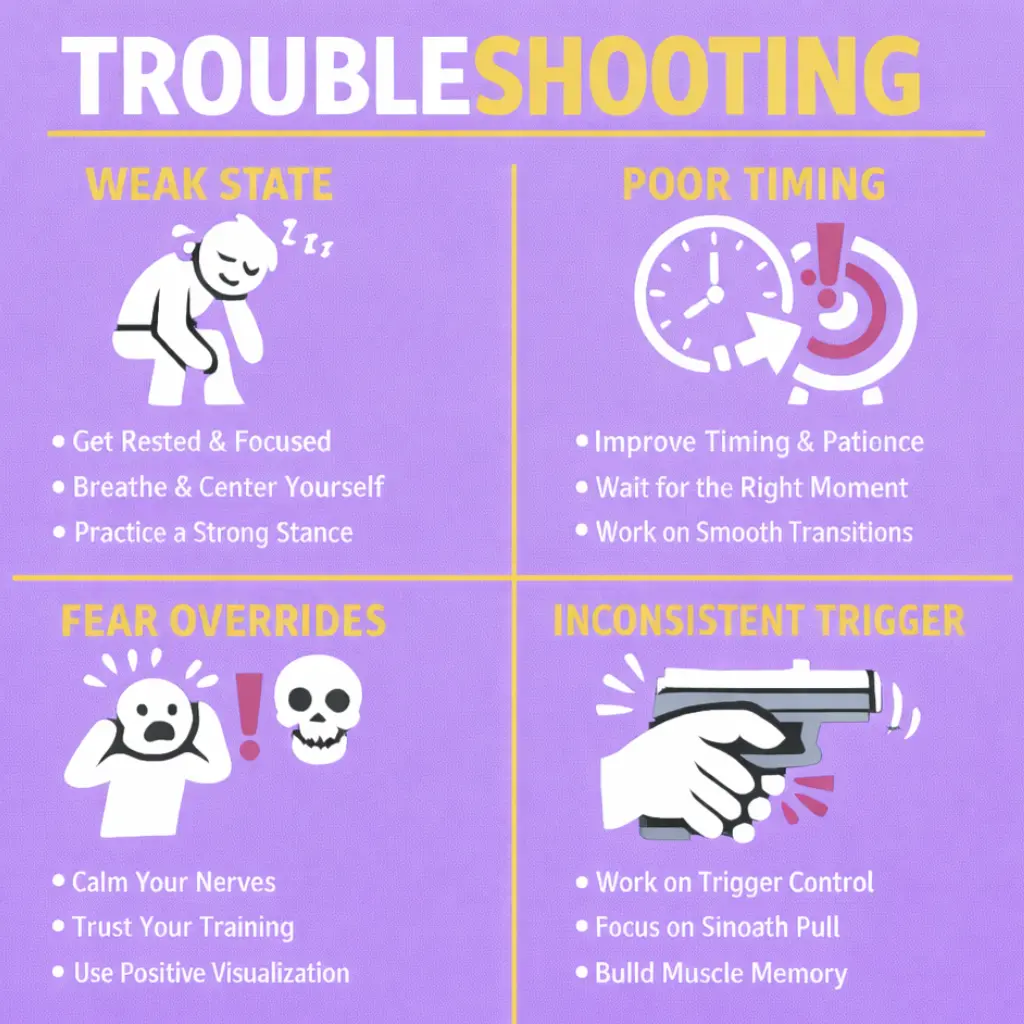
Let’s address the elephant in the room. If you’ve tried anchoring before and it didn’t work, you’re not alone. There are specific reasons why anchoring fails, and understanding them can help you troubleshoot.
Weak Initial State The most common problem? People try to anchor when they’re only mildly confident instead of powerfully confident. Remember, your anchor is only as strong as the state you capture. If you recall a memory where you felt “pretty good” instead of genuinely powerful, your anchor will be weak. Go back and find a stronger memory. Push yourself to really amplify the experience in your mind.
Poor Timing Anchoring during the decline of your emotional state is like trying to capture lightning after it’s already struck. You need to catch the peak. If you’re too late, if you apply your trigger as the feeling is already fading, you’re anchoring the fade, not the peak. Pay careful attention to when the intensity starts to drop off and release your anchor just before that happens.
Overwhelming Fear Overrides the Anchor. Here’s an honest limitation: Anchoring works best for accessing resourceful states in situations where you have some baseline capability. If you’re facing a phobia or extreme trauma-level fear, a confidence anchor alone probably won’t override that. This isn’t a failure of the technique. It’s a matter of using the right tool for the right job.
Think of anchoring like a garden hoe. It works great in soft soil with shallow weeds. But if you’re trying to remove a tree stump, you need different tools. Similarly, if intense fear or trauma is present, anchoring can be part of your toolkit, but you’ll likely need other NLP techniques or professional therapeutic support alongside it. That’s where overcoming presentation anxiety requires a more comprehensive approach.
Inconsistent Trigger: If you press your knuckle slightly differently each time, you’re not firing the same anchor. Your brain needs the stimulus to be identical to what you originally set. Be precise. Use the exact same pressure, the exact same location, the exact same gesture.
Studies on conditioning effectiveness show that consistency in the stimulus is just as important as the intensity of the initial state. Your nervous system recognizes patterns. Give it a clear, consistent pattern to recognize.
The bottom line? Anchoring isn’t magic. It’s neuroscience applied with precision. When it fails, there’s usually a specific reason and that reason is fixable.
Real-World Applications: When to Fire Your Anchor
So, when should you actually use your confidence anchor? The answer: any time you need to shift your state quickly in a professional context.
Before Important Presentations You’ve prepared. You know your material. But as you wait to go on stage, doubt creeps in. Fire your anchor. Give yourself that 20-30 second boost of confident certainty before you step into the spotlight.
During High-Stakes Negotiations When the conversation gets tense and you feel yourself starting to waver, fire your anchor subtly under the table. Regain your center. Come back to that powerful state where you know your worth and can advocate effectively.
Walking Into Interviews. Whether you’re interviewing for a job or interviewing a candidate, that first impression matters. Fire your anchor in the parking lot, in the elevator, right before you open the door. Walk in radiating the confidence you need.
Difficult Conversations with Stakeholders When you need to deliver tough feedback or push back on unrealistic demands, your confidence anchor can be the difference between backing down and standing firm with grace.
Moments of Self-Doubt Imposter syndrome hits all of us. When that voice in your head says “you’re not qualified” or “who do you think you are?” that’s your cue. Fire your anchor. Access the part of you that knows better.
One client came to me struggling with constant self-doubt in professional settings. Through anchoring and other NLP techniques, he transformed from second-guessing every decision to communicating with genuine confidence. The result? Career advancement and the disappearance of workplace anxiety. The technique gave him a tool to shift his state in real-time, rather than being at the mercy of whatever emotion showed up.
Professional tip: Don’t wait until the high-stakes moment to test your anchor. Mental rehearsal is powerful. Before an important event, sit quietly, visualize yourself in that situation, and practice firing your anchor as you imagine yourself succeeding. Athletes use anchoring this way all the time, rehearsing their performance while triggering their confident state. You can do the same.
The goal isn’t to become a different person. The goal is to access the resourceful version of yourself that already exists. Anchoring gives you the key. That’s what developing leadership presence is really about: having tools that allow you to show up as your best self consistently.
Can You Anchor Your Way Out of Deep Anxiety or Fear?
Let’s talk honestly about what anchoring can and cannot do. This is important because I’ve seen people disappointed when they try to use anchoring for situations where it’s simply not the right tool.
If you’re dealing with deep-seated anxiety, trauma, or a legitimate phobia, a confidence anchor alone isn’t going to resolve that. Anchoring is powerful for state management, shifting from nervous to confident, from distracted to focused, from hesitant to decisive. But it’s not a replacement for therapy or comprehensive treatment when you’re dealing with serious mental health challenges.
Think of it this way: Anchoring helps you access resourceful states you already have. If anxiety is so overwhelming that you can’t recall a time when you felt genuinely confident, or if the fear is so intense that it drowns out everything else, you need to address the underlying issue first.
That said, anchoring can be part of a broader strategy. Many professionals use anchoring alongside other techniques like collapsing anchors (where you simultaneously fire a resourceful anchor and an unresourceful anchor to neutralize negative associations) or swish patterns (a technique for changing unwanted behaviors). When combined strategically, these tools can help manage even significant emotional challenges.
The key is knowing your limits and being honest about what you need. Clinical applications research shows that NLP techniques work best when matched appropriately to the situation. For everyday confidence challenges, nervousness before a meeting, doubt during a tough conversation, hesitation when taking action, anchoring is incredibly effective. For trauma or severe anxiety, seek professional help and consider how anchoring might support your broader treatment plan.
If you’re wondering whether NLP approaches are right for your situation, understanding how NLP compares to traditional therapy can help you make an informed decision about which tools to use when.
The Science Behind Why This Actually Works
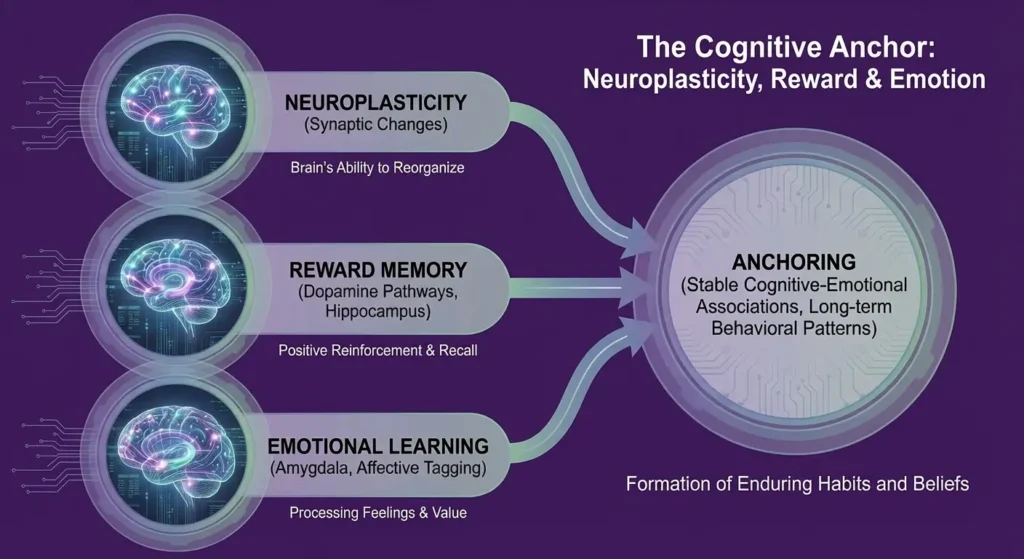
Let’s pull back the curtain completely and look at what’s happening in your brain when you create and fire an anchor.
Your nervous system is constantly forming associations. This is called neuroplasticity, your brain’s ability to form new neural connections and reorganize existing ones. Every time you experience something intensely, particularly if there’s a strong emotional component, your brain creates or strengthens pathways connecting that experience to whatever else was happening at the time.
When you anchor a confident state, you’re deliberately creating one of these connections. You’re linking a specific sensory trigger (your knuckle press, your thumb-finger touch) to a specific neural pattern (the way your brain fires when you’re in a confident state). Do this precisely, at the right moment, and your nervous system learns the connection. From then on, the trigger can reactivate that pattern.
Recent studies on memory formation show something fascinating: Your brain prioritizes memories connected to rewarding experiences. When researchers had participants search for rewards in a simulated environment, they found that after 24 hours, participants specifically remembered objects that were closest to the moment of reward. Everything else faded.
This is huge for anchoring. When you anchor at the peak of a confident memory that moment of triumph, success, or genuine certainty, you’re capturing a rewarding experience. Your brain naturally wants to hold onto that. The anchor becomes the key that unlocks access to that prioritized memory.
Classical conditioning (Pavlov’s work) showed us that associations can be automatic and reflexive. But NLP anchoring goes further because it involves conscious choice. You’re not passively conditioned like Pavlov’s dogs. You’re actively programming your neurology. You choose the state, choose the trigger, and choose when to fire it. That’s what makes this approach so powerful.
Repetition matters too. Each time you fire your anchor and re-access that confident state, you strengthen the neural pathway. It’s like walking a path through a forest. The first time is difficult, but with repeated use, the path becomes clear and easy to follow. Your brain works the same way. The more consistently you use your anchor, the more automatic the response becomes.
This is why anchoring isn’t “woo woo” or pseudoscience. It’s a practical application of how your nervous system naturally operates. You’re just taking deliberate control of a process that happens automatically anyway. And when you understand how NLP enhances communication skills through techniques like anchoring, you realize this is about giving yourself tools that match how humans actually function.
Frequently Asked Questions
What is NLP anchoring and how does it create instant confidence?
NLP anchoring is a psychological technique that creates a neural shortcut between a physical trigger and a resourceful emotional state. By applying a unique gesture like pressing your thumb and forefinger together at the peak of a vivid memory of success, you utilize classical conditioning to “program” your brain. This allows you to bypass the struggle of positive thinking and trigger genuine, grounded confidence in seconds during high-stakes professional moments.
Is there scientific evidence that NLP anchoring actually works?
The effectiveness of anchoring is rooted in neuroplasticity and associative learning, following over a century of research into Pavlovian conditioning. Modern neuroscience confirms that the brain prioritizes neural pathways linked to high-intensity emotional peaks and reward-based memory formation. When you fire an anchor, you are biologically reactivating the specific neural firing patterns of the original confident state, making the shift from anxiety to power a measurable physiological event.
Why do some people fail when trying to set a confidence anchor?
Most failures stem from weak emotional intensity during the setup or poor timing of the trigger. To be effective, you must fully relive a powerful memory, not just observe it and apply the trigger exactly as the emotion peaks, releasing it before the feeling fades. Additionally, using a gesture that is too common or failing to “stack” multiple memories can result in a weak neurological connection that lacks the strength to override real-world pressure.
Can NLP anchoring be used to overcome deep-seated fears or phobias?
While anchoring is an elite tool for situational state management, it is not a standalone cure for clinical anxiety or trauma. It works brilliantly to shift you from nervous to decisive in professional settings, but deep-seated phobias often require advanced techniques like Timeline Therapy to address root causes. Think of anchoring as a tactical “volume knob” for your confidence; it manages your current state, while deeper psychological work removes the underlying barriers.
How do I choose and maintain the best anchor for professional use?
The best triggers are discrete, kinesthetic gestures, such as touching a specific knuckle, that are unique enough to avoid accidental firing but easy to replicate under stress. To maintain potency, “recharge” the anchor periodically by stacking new memories of success onto the same gesture and avoid using it when you are in a negative state. Precision is vital: consistent pressure and location reinforce the neural pathway, ensuring the anchor remains a reliable default for high-performance scenarios.
Conclusion
Anchoring puts you in control of your emotional state. Not through forced positive thinking or pretending everything’s fine. Through practical neuroscience that respects how your brain actually works.
You already know what confidence feels like. You’ve experienced it before. Anchoring simply gives you a way to access that state on demand when you’re walking into a presentation, negotiating a deal, or facing a conversation you’ve been avoiding.
The technique is straightforward: Choose your state, access a powerful memory, select a unique trigger, set it at peak intensity, and test. Do this with precision and consistency, and you create a neural pathway you can fire whenever you need it.
Is it magic? No. It’s neuroscience backed by over a century of research, from Pavlov’s conditioning experiments to modern studies on reward-based memory. Is it effective? Absolutely. Thousands of professionals use anchoring daily to perform at their peak.
Start small. Choose one situation this week where you want to feel more confident. Set your anchor. Practice firing it. See what shifts for you.
The technique is powerful, but mastery comes through guided practice. That’s what our NLP Training programs are designed for: giving you hands-on experience with anchoring and dozens of other techniques that unleash your potential. You’ll learn not just how to create basic anchors, but how to stack them, collapse negative anchors, and integrate these tools into your daily leadership practice.