
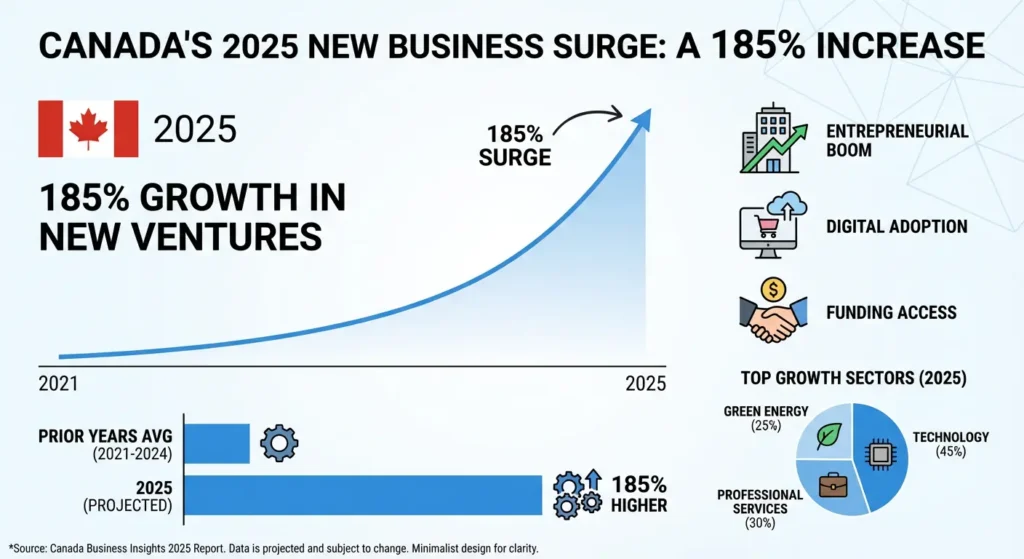
Here’s a number that might surprise you: 39,828 new businesses opened in Canada in January 2025 alone, a 185.7% jump compared to the same month last year. That’s not a typo. Thousands of Canadians are launching businesses right now, many with minimal upfront capital.
If you’ve dreamed of entrepreneurship but convinced yourself you need tens of thousands in startup funds, you’re not alone. That’s the story most people tell themselves. It’s also the exact limitation that keeps them stuck in jobs that drain them.
Key Takeaway:
- Low-cost businesses in Canada leverage digital tools and e-commerce growth ($8.1T globally by 2026) to launch under $5,000, focusing on service-based models with high margins and quick revenue potential up to $130,000+ annually. [1]
- Top ideas: Social media consulting ($500–$2,000 startup, $40K–$100K+ income), virtual assistant ($300–$1,500, $35K–$75K+), online tutoring ($200–$1,000, $50K–$100K+), cleaning services ($500–$3,000, $40K–$80K+), freelance writing ($100–$800, $40K–$90K+), bookkeeping ($500–$2,000, $50K–$130K+), pet care ($300–$2,000, $35K–$50K+). [1]
- Match skills to demand (list 5 strengths, target clients), start digitally with free audits or networking, use tools like QuickBooks, offer retainers for steady income, and launch imperfectly via evenings/weekends. [2]
- Caveats: Success demands action over perfection, avoiding underpricing or delays; revenue in 1–4 weeks possible, but build value and clients consistently ideal for side hustles without inventory risks. [2]
Bottom Line: Profitable low-cost ideas like consulting and freelancing offer high earnings with minimal startup focus on skills, digital tools, and client value for sustainable income in Canada’s online market.
In this post, you’ll discover seven proven low-cost business ideas thriving in Canada’s current market, what makes them genuinely profitable, and the mindset shift that separates those who launch from those who stay dreaming. No vague advice, just practical insights you can act on today.
Why Low-Cost Businesses Are Thriving in Canada Right Now
The entrepreneurial landscape has fundamentally changed. What required massive capital investment a decade ago now launches from a laptop and an internet connection.
The Canadian Market Advantage for Bootstrapped Entrepreneurs
Canada’s economy is creating unique opportunities for lean startups. With e-commerce projected to reach $8.1 trillion globally by 2026 and 75% of Canadians already shopping online, digital-first businesses have unprecedented market access. You’re not limited to your neighborhood anymore; your potential customers span provinces and countries.
The numbers tell the story: 70% of small businesses remain optimistic about the year ahead, even as they navigate inflation and rising costs. That optimism isn’t blind faith. It’s recognition that entrepreneurs are prioritizing lean business models that can adapt quickly without drowning in overhead.
Technology Has Eliminated Traditional Barriers to Entry
AI-powered tools, cloud-based platforms, and social media have democratized business launch. Tasks that once required hiring employees or expensive agencies website design, customer relationship management and marketing, now cost next to nothing. Digital transformation is accelerating entrepreneurial opportunities across every sector.
Solo entrepreneurs are achieving significant success operating businesses with minimal staff. More than half of Canadian small businesses operate with fewer than four employees, proving you don’t need a team to generate substantial income.
What Makes a Business Idea Actually “Low-Cost”
Let’s be clear about what we mean. Low cost doesn’t mean zero effort or instant profits. It means you can start for under $5,000, often much less and generate revenue within weeks, not years.
These businesses share common traits: minimal physical inventory, service-based models, high-margin offerings, and scalability without proportional cost increases. You’re selling your expertise, time, or facilitation rather than manufacturing products or leasing commercial space.
What Are The 7 Most Profitable Low-Cost Business Ideas in Canada?
Here are seven business models with proven track records in Canada’s current market, listed with realistic startup costs and income potential:
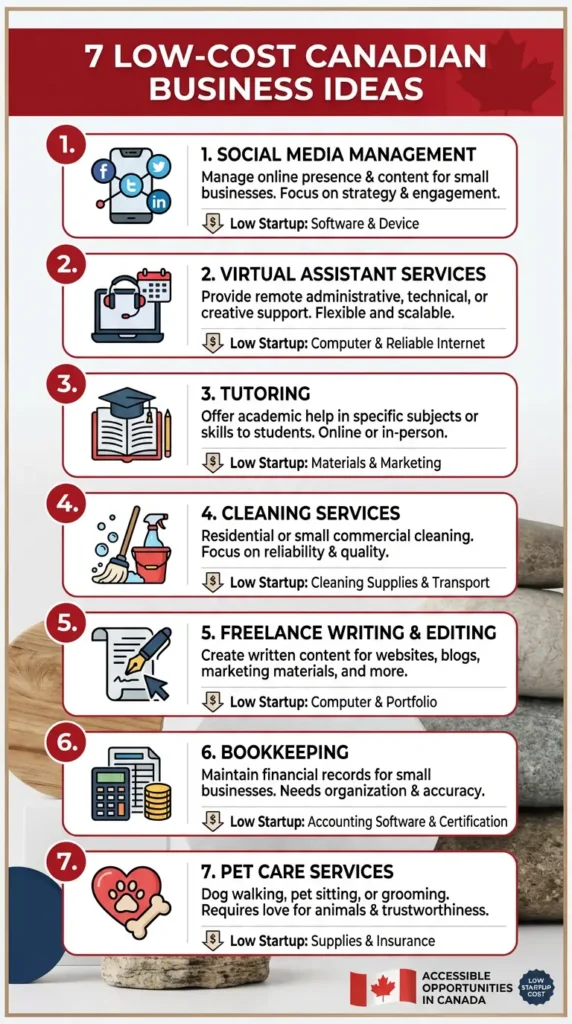
1. Social Media Consulting & Management – Startup: $500-$2,000 | Income Potential: $40,000-$100,000+/year. Businesses desperately need help navigating Instagram, TikTok, LinkedIn, and Facebook. Social media management roles are growing rapidly as companies recognize these platforms drive real revenue.
2. Virtual Assistant Services – Startup: $300-$1,500 | Income Potential: $35,000-$75,000+/year. Entrepreneurs and executives need administrative support without hiring full-time staff. You provide scheduling, email management, research, and project coordination remotely.
3. Online Tutoring & Course Creation – Startup: $200-$1,000 | Income Potential: $40-$65/hour or $50,000-$100,000+/year. The e-learning market continues to expand, with Canadian families prioritizing education. Whether you teach math, languages, music, or business skills, demand remains strong.
4. Cleaning Services (Residential & Commercial) – Startup: $500-$3,000 | Income Potential: $40,000-$80,000+/year. The cleaning services industry is experiencing steady growth, with the Canadian market predicted to expand at 3.8% annually through 2032. Low equipment costs and no physical location make this exceptionally accessible.
5. Freelance Writing & Content Creation – Startup: $100-$800 | Income Potential: $40,000-$90,000+/year. Every business needs content blogs, website copy, social media posts and email campaigns. Strong writing skills and SEO knowledge create consistent client demand.
6. Bookkeeping & Financial Services – Startup: $500-$2,000 | Income Potential: $50,000-$130,000+/year. The financial services sector is experiencing robust growth, with the bookkeeping industry expanding 9.9% to reach $26 billion. Small businesses need help managing finances but can’t afford full-time accountants.
7. Pet Care Services (Walking, Sitting, Grooming) – Startup: $300-$2,000 | Income Potential: $35,000-$50,000+/year. Canada’s pet market is growing 4.3% annually, and busy professionals need reliable pet care. Start with walking or sitting, then expand to grooming as you build clientele.
Digital Service Businesses: Your Lowest Barrier to Entry
If you’re looking to launch quickly with minimal capital, digital services offer the fastest path to revenue.
Social Media Consulting
Nearly every business knows it needs a social media presence. Few know how to do it effectively. You don’t need to be an influencer yourself; you need to understand platform algorithms, content strategy, and business goals.
Start by offering free audits to three businesses in your network. Document the results. You’ve just built your portfolio. By leveraging social platforms for zero-cost customer acquisition through organic content, your marketing budget can remain virtually nonexistent.
Virtual Assistant Services

This is one of the most versatile low-cost businesses. Your services can include calendar management, email filtering, travel booking, basic bookkeeping, customer service, or project coordination. The key is positioning yourself as a problem-solver who creates time for busy professionals.
Target entrepreneurs, consultants, real estate agents, or coaches who need support but aren’t ready for full-time hires. Start with two clients at 10-15 hours per week each. Scale from there.
Content Creation & Freelance Writing
If you can write clearly and research thoroughly, businesses will pay you. Blog posts, website copy, case studies, white papers and email sequences the demand never stops.
The mistake most people make is waiting to be “ready.” You’re ready when you can string coherent sentences together and meet deadlines. Your first clients won’t be Fortune 500 companies. They’ll be local businesses that need help yesterday.
How Do You Choose The Right Low-Cost Business For You?
Match your existing skills to market demand, then start with what you can launch this week, not next month.
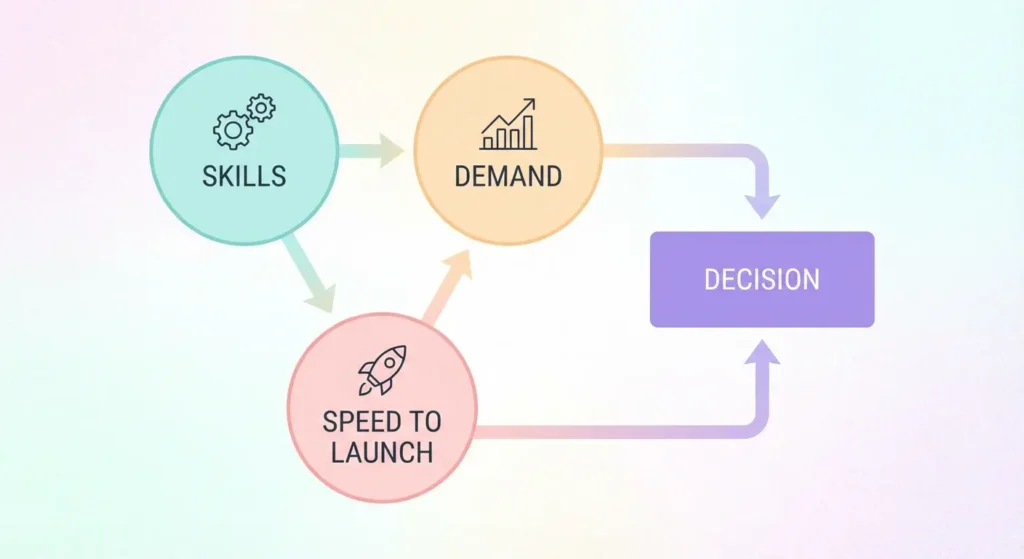
The best business idea sits at the intersection of three factors: what you’re already good at, what people will pay for right now, and what you can begin immediately without waiting for perfect conditions.
Stop asking “What’s the most profitable business?” and start asking “What can I offer that solves a real problem for people who have money to spend?” That’s where opportunity lives.
Here’s your decision framework: List five skills you possess. Identify which businesses or individuals pay for currently. Choose the one you can start marketing tomorrow. That’s your business. Everything else is procrastination disguised as planning.
Consider your time commitment realistically. If you’re transitioning from a full-time job, start with something you can do evenings and weekends. If you’re going all-in, choose something with faster revenue generation and client acquisition.
Assess scalability potential. Can you eventually productize your service (courses, templates, systems)? Can you hire others to deliver the work? These questions matter more at month six than day one, but keep them in mind.
The strategic goal-setting frameworks for business growth I teach clients focus on this: clarity first, then action. Most people reverse it; they take scattered action without clarity, then wonder why nothing sticks.
Service-Based Businesses With Proven Canadian Demand
Some opportunities thrive specifically because of Canada’s market conditions and demographics.
Cleaning Services
The cleaning services sector proves that “unglamorous” often means “profitable.” With the cleaning services industry experiencing steady growth at 3.8% annually through 2032, demand remains consistent regardless of economic shifts.
You need basic cleaning supplies, reliable transportation, and attention to detail. Start residential, then transition to commercial contracts for steady income. Word-of-mouth marketing and local online presence drive client acquisition.
Bookkeeping Services
If numbers don’t intimidate you, bookkeeping offers substantial income with minimal startup costs. The financial services sector is experiencing robust growth, reaching $26 billion as the industry expanded 9.9% in recent years.
Small businesses need someone to manage invoices, track expenses, reconcile accounts, and prepare for tax season. You don’t need a CPA designation to handle basic bookkeeping, just solid organizational skills and familiarity with software like QuickBooks or Xero.
Target service-based businesses, tradespeople, consultants, and small retailers. Monthly retainer clients create predictable income while you build your practice.
The Mindset That Separates Successful Entrepreneurs From Dreamers
Here’s what nobody talks about: the business ideas aren’t the problem. Your relationship with uncertainty and imperfect action is the problem.
I’ve worked with hundreds of professionals who “wanted to start a business someday.” The ones who actually launched had one thing in common: they stopped waiting for permission, perfect conditions, or absolute certainty.
Darren came to Unleash Your Power feeling stuck in his corporate job despite wanting to launch his own business. He had the skills, experience, and even savings. What he didn’t have was the ability to move past his goal blocks and limiting beliefs about what entrepreneurship required. Through identifying these blocks, he achieved radical shifts that unlocked the abundance he’d been seeking, transforming not just his career trajectory but his entire approach to possibility.
That’s the pattern I see repeatedly: it’s rarely capability blocking you. It’s the unconscious beliefs about what you need before you can begin.
You tell yourself you need more money, more time, more connections, more expertise. What you actually need is the willingness to start imperfectly and learn as you go. The development an entrepreneurial mindset through proven NLP techniques I teach helps you identify and eliminate these blocks systematically.
The “I need more” syndrome is your brain’s protection mechanism. It keeps you safe from failure, rejection, and discomfort. It also keeps you stuck exactly where you are. NLP strategies that accelerate entrepreneurial success work because they address the root cause of the unconscious patterns running your decision-making.
Understanding and avoiding the mistakes that derail most small businesses before you launch gives you a significant advantage. Most businesses fail not because the idea was wrong, but because the founder couldn’t navigate the inevitable challenges, setbacks, and uncomfortable growth phases.
Your first client won’t be perfect. Your pricing will need adjustment. Your service delivery will improve with practice. All of that is normal and expected. The entrepreneurs who succeed embrace that reality instead of waiting for conditions that never arrive.
Your Next Steps: From Idea to Launch
Canada’s entrepreneurial landscape has never been more accessible. With entrepreneurial activity surging across Canada and technology eliminating traditional barriers, the market opportunity exists. The low-cost business models are proven and profitable.
The only missing piece is your decision to start.
Choose one business idea from this list that matches your current skills and market demand. Take the first concrete action today, not next week, not after you “research more” today. Register your business name, create a simple one-page website, or contact your first potential client.
Your transformation from employee to entrepreneur, from dreamer to doer, begins with that first decisive action. The confidence, skills, and systems will develop as you move forward. Waiting for them before you start guarantees you’ll never begin.
If you need support navigating the mindset shifts and strategic decisions that accelerate your entrepreneurial journey, coaching support specifically designed for entrepreneurs can make the difference between stalling and succeeding.
Which business idea resonates most with your current skills? What’s the first action you’ll take today?
Frequently Asked Questions
What is the easiest low-cost business to start in Canada?
Virtual assistant services and freelance writing are the easiest to launch. You need only a computer, an internet connection, and existing skills. Start marketing to your network today and land your first client within days.
How much money do I actually need to start a small business in Canada?
Most service-based businesses launch with $500-$2,000 or less. This covers basic business registration, simple website setup, and initial marketing. Digital services like social media consulting can start for under $500.
Can you really make money with a low-cost business?
Yes. Many low-cost businesses generate $40,000-$100,000+ annually once established. Bookkeeping services, for example, operate in a $26 billion Canadian industry. The key is delivering real value and building a consistent client base.
What low-cost business is most profitable in Canada right now?
Bookkeeping and financial services offer the highest income potential ($50,000-$130,000+), followed closely by social media consulting and online tutoring. Service businesses with specialized expertise command premium rates.
How long does it take to make money with a low-cost business?
Service-based businesses can generate revenue within 1-4 weeks. Your timeline depends on your network, marketing efforts, and how quickly you take action. Waiting for perfect conditions delays income; imperfect action creates it.
Do I need a business license to start a low-cost business in Canada?
Requirements vary by province and business type. Most service-based businesses need basic registration with their provincial government. Consult your local small business center for specific requirements. It’s typically straightforward and inexpensive.
What’s the biggest mistake people make when starting low-cost businesses?
Waiting for perfect conditions instead of launching imperfectly and learning as they go. The second biggest mistake is underpricing services. You’re selling expertise and results, not just time; charge accordingly.