

You know the cycle. Monday morning, you wake up fired up with clarity and vision. By Wednesday afternoon, you’re drowning in decisions, second-guessing yourself, and wondering if this entrepreneurial path is worth it. The motivation that felt so certain three days ago? Gone.
Key Takeaway:
- Micro-habits are tiny, low-effort daily actions (1–5 minutes) that compound into massive entrepreneurial success—outperforming big resolutions by building consistency, reducing resistance, and rewiring identity without burnout. [1]
- Mechanisms: Small actions bypass willpower depletion (ego depletion theory), trigger dopamine loops for momentum, stack onto existing routines (habit stacking), and create identity shifts (“I’m someone who shows up daily”)—leading to 10× better long-term adherence than ambitious goals. [1]
- Top micro-habits for entrepreneurs: 2-min daily review (wins/obstacles), 5-min focused deep work block, 1 outreach message/day, 60-sec gratitude or visualization, 2-min movement (push-ups, stretch), read/listen 5 pages/podcast minutes, track one key metric—stack onto existing triggers (coffee, phone unlock, shower). [2]
- Caveats: Keep habits stupidly small to avoid resistance; track streaks visually (don’t break the chain); forgive misses without guilt—consistency over perfection; review/upgrade every 30 days; combine with accountability (partner, app) for 80%+ adherence. [2]
Bottom Line: Micro-habits are the most reliable way for entrepreneurs to build momentum, skills, and results without willpower battles—start ridiculously small, stack them, track visually, and let compounding do the heavy lifting for sustainable growth.
- Source: Unleash Your Power – Micro-Habits for Sustained Entrepreneurial Success
- Source: Article Details / FAQs
Here’s the reality: 79% of entrepreneurs say personal development and habits fuel their success, yet 46% struggle with high stress that disrupts their workweek. The problem isn’t you. The problem is trying to run a business on motivation alone, a resource that fluctuates as wildly as your revenue in the early days.
What if I told you there’s a different approach? One that doesn’t depend on feeling motivated, doesn’t require iron willpower, and works even when results are painfully slow. It starts with understanding how your brain actually forms habits and ends with micro-actions so small you’ll laugh but so powerful they’ll transform your entire entrepreneurial journey.
The entrepreneurs who thrive long-term aren’t the ones with the most motivation. They’re the ones who’ve built systems of tiny habits that keep them moving forward, whether they feel like it or not. Through building an entrepreneurial mindset through NLP and applying proven mindset training techniques, you can create the same momentum.
What Are Micro-Habits for Entrepreneurs?
Micro-habits are tiny, consistent actions taking less than 2 minutes that:
- Bypass willpower by being too small to resist
- Rewire neural pathways through repetition and neuroplasticity
- Compound into breakthrough results over time through the mathematics of small gains
- Work even when motivation and results are low; they don’t depend on feeling inspired
- Build entrepreneurial identity through daily votes of action that prove “I’m someone who follows through”
Unlike traditional habits requiring motivation and perfect conditions, micro-habits leverage neuroscience to create automatic behaviors that sustain business success regardless of external circumstances.
Why Motivation Fails Entrepreneurs (And Why Micro-Habits Work)
Let’s be honest about the entrepreneurial motivation trap. You start with passion and vision. Then reality hits: funding stress, decision fatigue, isolation, and the relentless pressure to perform. Research shows that 36% of entrepreneurs face mental health challenges that disrupt their workweek. When you’re managing cash flow uncertainty and economic volatility, “just stay motivated” isn’t a strategy; it’s a setup for failure.
Traditional motivation fails for one simple reason: willpower is a finite resource. Every decision you make depletes it. By the time you reach 3 PM and need to tackle that important strategic project, your willpower tank is empty. You’ve already decided what to eat, how to respond to that difficult client, which crisis to handle first, and whether to invest in new software. That’s why crash diets fail 70-90% of the time and New Year’s resolutions are abandoned by 92% of people before February.
But here’s where it gets interesting. Your brain has a different system, one that doesn’t rely on willpower at all. It’s called neuroplasticity, and it’s the foundation of how micro-habits transform entrepreneurs.
When you repeat a tiny action consistently, your brain creates and strengthens neural pathways through a principle neuroscientists call “neurons that fire together, wire together.” Research from MIT has identified the habit loop: cue, craving, response, reward. Micro-habits work because they’re so small they bypass your brain’s resistance entirely. There’s no internal argument about whether you can manage it. You just do it.
Researchers at the University of Sherbrooke asked 16 surgeons to take 20-second micro-breaks every 20 minutes during procedures. The remarkable results? Surgeons who took these tiny pauses were seven times more accurate in their postoperative work and experienced 50% less physical fatigue. Twenty seconds. Seven times more accurate. That’s the power of micro-habits applied in high-stakes environments, exactly what entrepreneurship demands.
Here’s what separates micro-habits from traditional approaches:
| Traditional Habits | Micro-Habits |
| Require high motivation | Require zero willpower |
| 30-60 minute commitment | Less than 2 minutes |
| Outcome-focused (“lose 20 lbs”) | Identity-focused (“I’m healthy”) |
| All-or-nothing mentality | Progress over perfection |
| 92% failure rate | Sustainable long-term |
| Depend on ideal conditions | Work on the worst days |
| Build guilt when skipped | Build momentum when completed |
The Identity Shift That Changes Everything
Traditional habit formation fails because it focuses on outcomes: “I want to build a million-dollar business” or “I want to feel motivated every day.” But lasting change happens when you shift from outcome-based goals to identity-based habits.
Stop asking: “What do I want to achieve?”
Start asking: “Who do I want to become?”
Every micro-habit you complete is a vote for your new entrepreneurial identity. You’re not trying to force motivation. You’re becoming someone who follows through regardless of how they feel. That shift from hoping to be consistent to being someone who is consistent changes everything.
I once struggled with the same challenges you’re facing now. Through NLP techniques and understanding how beliefs shape behavior, I discovered that transformation isn’t about grand gestures. It’s about proving to yourself, one small action at a time, that you’re the kind of person who does what they say they’ll do. When you need help overcoming mindset blocks that limit growth, this identity-based approach accelerates your progress.
7 Micro-Habits That Sustain Entrepreneurial Motivation
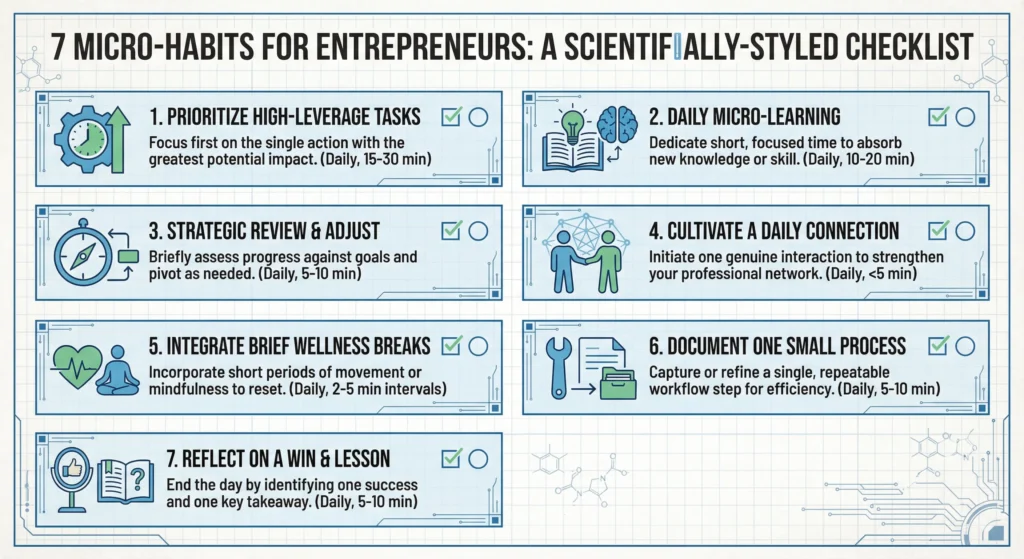
Let’s get practical. These seven micro-habits are specifically designed for the unique pressures entrepreneurs face. Each takes less than 2 minutes initially but compounds into breakthrough results.
1. The 5-Minute Morning Business Review
What it is: Before you touch email or Slack, spend five minutes reviewing yesterday’s single biggest win and setting three micro-goals for today.
Why it works: You’re creating clarity before chaos. Most entrepreneurs start their day in reactive mode, responding to whatever screams loudest. This habit anchors you to what actually matters. It’s a proven NLP technique starting each day with intentional focus rather than external demands.
The resistance: “I need to jump straight into email to handle fires.”
Try this: Stack it with your morning coffee. While the coffee brews, open your journal. By the time you take your first sip, you’ve already won the day.
One entrepreneur I worked with eliminated anxiety and second-guessing by establishing this exact routine. He went from constant mental noise to clear, confident decision-making, transforming his career trajectory in the process.
2. Delegate One Task Daily (Even If It’s Small)
What it is: Identify one recurring task, no matter how small and hand it off or automate it.
Why it works: The founder’s trap is believing “I’m the only one who can do this right.” But creating predictable business results requires building systems that work without you. If you delegate just one hour of low-impact tasks every working day for a month, you reclaim 2.5 working days each month going forward.
The resistance: “It’s faster if I just do it myself,” or “No one can do it as well as I.”
If you’ve explained a task twice, take 2 minutes to document and delegate it. Done beats perfect every single time.
Try this: Use the 2-minute rule. Start with the smallest recurring task: calendar scheduling, email sorting, social media posting. Don’t wait for the perfect system.
3. Take Strategic Micro-Breaks Every Hour
What it is: Every 60 minutes, take a 20-second pause to stand, breathe, or step away from your screen.
Why it works: Your brain isn’t designed for constant high-intensity focus, which proves that these tiny pauses improve accuracy, reduce fatigue, and enhance decision quality. But here’s what entrepreneurs miss: breaks aren’t a weakness. They’re leveraged.
The resistance (productivity guilt): “I don’t have time to stop. There’s too much to do.”
Address the resistance: You’re running a marathon at sprint pace. Micro-breaks let you maintain sprint-level intensity sustainably. Twenty seconds now prevents a two-hour burnout recovery later. This isn’t indulgence, it’s strategy.
Try this: Set a phone timer for 60-minute intervals. When it goes off, stand up, roll your shoulders, take three deep breaths. Stack it with your hourly calendar check. That University of Sherbrooke study proved it: surgeons who took 20-second breaks were seven times more accurate. You can’t afford NOT to take breaks.
4. Track One Daily Win (No Matter How Small)
What it is: At the end of each day, write down one thing you completed. Even if it’s “sent that difficult email” or “made one sales call.”
Why it works: This micro-habit restores the bridge between intention and action. When you’re an entrepreneur, it’s easy to focus on the massive gap between where you are and where you want to be. That gap breeds discouragement.
Tracking daily wins shifts your focus to progress. You’re building evidence that you follow through. Over time, this evidence rewrites your self-concept from “I struggle with consistency” to “I’m someone who gets things done.”
For entrepreneurs recovering from setbacks or slow results, this habit is transformational. You’re not measuring yourself against your competitors or your vision. You’re measuring yourself against yesterday’s version of you.
The resistance: “Only big wins count. This feels insignificant.”
Try this: Keep a simple note on your phone titled “Wins.” Before bed, add one line. Thirty seconds. That’s it. The strategies you’ll find for staying committed to your goals build on this foundation.
One business professional felt completely blocked in his career, stuck without promotions or raises despite strong performance. By tracking small wins and building relationship habits daily, he broke through that ceiling and achieved radical improvements in both career advancement and personal abundance.
5. Ask One Better Question Before Deciding
What it is: Before making any business decision, pause and ask yourself one strategic question: “Will this move me toward my 3-year vision?”
Why it works: Shiny object syndrome kills more businesses than bad products. Every day brings new opportunities, tactics, and distractions. Without a filtering question, you chase everything and master nothing.
This micro-habit takes 10 seconds but saves hours, days, even months of wasted effort. It’s a meta-model technique from NLP using powerful questions to access clarity that bypasses emotional reactivity.
The resistance: “But this opportunity seems so good right now! I can’t miss out.”
Reframe it: The best entrepreneurs aren’t the ones who never get distracted. They’re the ones who catch themselves faster and redirect toward what matters. This question is your redirect mechanism.
Try this: Post this question somewhere you’ll see it when making decisions on your monitor, in your wallet, as your phone wallpaper. Let it become your automatic filter. Combine this with strategic goal-setting frameworks for maximum impact.
6. Connect With One Person Outside Your Business Daily
What it is: Send one genuine message to a mentor, peer, potential collaborator, or even a friend. Not a pitch. Just a real human connection.
Why it works: Entrepreneurship is isolating. You make dozens of decisions daily that no one else understands. That isolation breeds doubt, anxiety, and eventually burnout.
But here’s the compounding magic of daily connection: relationships are like network effects. Each genuine connection creates exponential value over time shows that 61% of entrepreneurs find customers through word-of-mouth referrals. Your network isn’t separate from your business it IS your business infrastructure.
The resistance: “It feels unproductive compared to real work.”
Reframe it: That’s exactly why most entrepreneurs skip it and why the ones who do this consistently seem to have opportunities fall in their lap. Your network compounds over time.
Try this: Make it part of your morning routine, right after checking email. Before you respond to anyone, reach out to one person with no agenda. Ask how they’re doing. Share something helpful. Celebrate their win.
7. Practice 60 Seconds of Intentional Breathing
What it is: Box breathing (inhale 4 counts, hold 4, exhale 4, hold 4) or simply ten deep, intentional breaths.
Why it works: Your nervous system has two modes: fight-or-flight and rest-and-digest. Entrepreneurship keeps you in fight-or-flight mode constantly. Intentional breathing flips the switch, resetting your nervous system and interrupting stress spirals before they derail your day.
This isn’t about meditation or spirituality. It’s about physiology. Deep breathing activates your parasympathetic nervous system, lowering cortisol and improving decision-making. When you’re about to make a hiring decision, negotiate a contract, or handle a crisis, 60 seconds of breathing might be the highest-leverage action you can take. It’s an NLP anchoring technique creating a calm state you can access on command.
The resistance: “I don’t have time for meditation stuff.”
Address it directly: This isn’t meditation. It’s physiology. Before major calls, negotiations, or crisis management, these 60 seconds might be your highest-leverage action of the day.
Try this: Use it as your “power pose” before major calls or meetings. Stack it with putting on your headset or opening Zoom. The NLP stress management techniques you’ll learn create lasting anchors for calm confidence.
One client struggled with chronic health issues for four years that doctors couldn’t solve. Through consistent NLP breathing and mental practices, he eliminated the problem within minutes of sessions and achieved a pain-free life. That’s the power of small, repeated actions on your mind-body connection.
How to Actually Make Micro-Habits Stick (The 3E Filter)
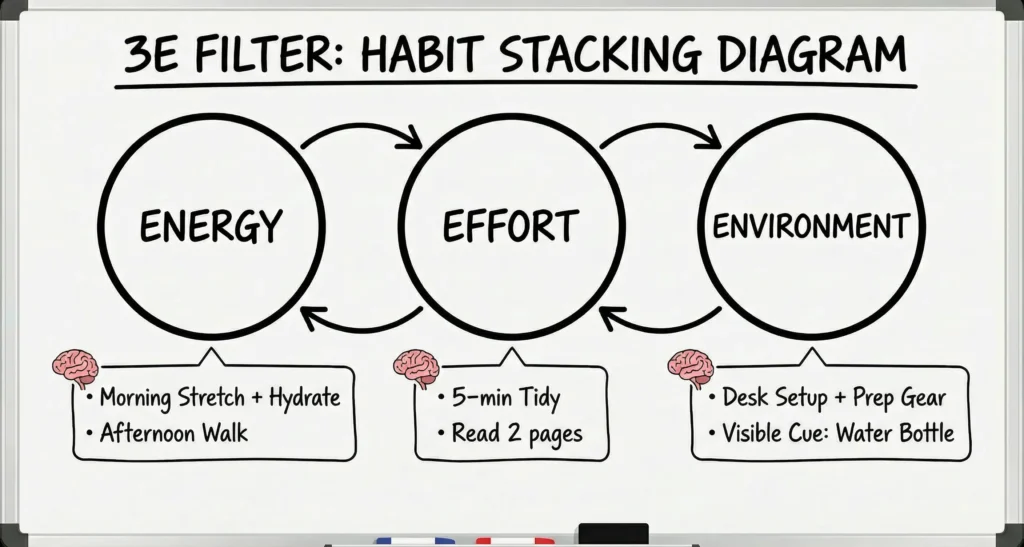
Knowing what to do isn’t enough. You need a system that works when you’re tired, stressed, or doubting yourself. That’s where the 3E Filter comes in: Energy, Effort, Environment.
This proprietary framework helps you troubleshoot why habits fail and design ones that actually stick.
Energy Check: Match Habits to Your State
The biggest mistake entrepreneurs make is choosing habits for their “ideal self” instead of their “actual self.” At 8 PM, exhausted from a 12-hour day, you’re not going to build an elaborate dashboard or write a detailed strategic plan.
Be honest about your current capacity. If you’re running on fumes, choose the micro version of your habit. One sentence in your journal beats a skipped 10-minute reflection. Reviewing three metrics beats abandoning your entire tracking system.
Example: A tired founder chooses “write one win from today” instead of “complete full weekly review.” Both count. One actually happens.
The key is removing the all-or-nothing mentality. Progress over perfection, every single time.
Effort Assessment: The 2-Minute Rule
If your micro-habit takes more than 2 minutes when you’re starting, break it into smaller parts. I mean it lower the bar until you laugh, then go one step lower.
Want to start running? Don’t commit to a 5K. Commit to putting on your running shoes and walking to the end of your driveway. Want to improve your finances? Don’t commit to building a complete financial model. Commit to opening your accounting software and looking at one number.
This feels ridiculous until you realize the truth: the hardest part of any habit is starting. Once you’ve put on the shoes, you’ll probably walk around the block. Once you’ve opened your accounting software, you’ll probably check a few more metrics.
You’re not lowering standards. You’re removing the psychological barrier between thinking about it and doing it. That’s the wisdom you’ll find when you optimize with smarter work instead of harder work.
Environment Design: Remove Friction
Habit stacking works better than time-based commitments. Instead of “I’ll review my finances at 9 AM,” try “When I pour my coffee, I’ll open my financial dashboard.” You’re attaching the new habit to an existing behavior that already happens automatically.
Habit Stacking Formula:
After [Current Habit], I will [New Micro-Habit]
Examples:
- After I pour coffee → I open the financial dashboard
- After I sit at the desk → I write yesterday’s win
- After I close my laptop → I write 3 goals for tomorrow
Make good habits obvious:
- Keep your success journal on your nightstand
- Set your financial tracker to open as your first browser tab
- Delete social media apps from your phone during work hours
The 66-day milestone: The statistics show it takes approximately 66 repetitions for a habit to become automatic, after about two months of daily practice. You’re not aiming for perfection. You’re aiming for consistency. Missing one day doesn’t break the chain. Missing two consecutive days does.
What Stops Most Entrepreneurs (And How to Overcome It)
“I Don’t Have Time for Habits Right Now”
Let me reframe this: You don’t have time NOT to build these habits.
The math: The seven micro-habits I’ve shared total 10-15 minutes combined. That’s less time than you’ll spend scrolling social media or in one unfocused meeting.
The real ROI: Research shows that 40-95% of what we do daily falls into the habit category. Once a behavior becomes automatic, you stop spending mental energy on it. You just do it.
Those 15 minutes of habit time save you hours of wasted effort, overthinking, and false starts. It’s not about adding to your workload. It’s about making everything else you do more effective.
“I’ve Tried Habit Systems Before and Failed”
Of course you have. Most habit systems fail because they’re too ambitious, require constant motivation, or depend on perfect conditions.
Micro-habits work because they require zero willpower. They’re too small to resist. You can do them on your worst day, when you’re sick, when results are slow, when nothing is going right.
Here’s my challenge: Don’t try to adopt all seven habits at once. Choose ONE. Just one. Commit to it for 30 days. Let it prove itself to you.
I’ve seen entrepreneurs eliminate years of chronic struggle through small, repeated practices. One client had mysterious health issues that doctors couldn’t solve for four years. Through consistent micro-practices using NLP techniques, he found relief within minutes and transformed his entire quality of life. That’s what happens when you trust the process of tiny, repeated actions.
“How Do I Know Which Habit to Start With?”
Choose the habit that addresses your biggest current pain point.
Quick selector:
- Scattered/overwhelmed? → 5-minute morning review
- Stressed/reactive? → Intentional breathing
- Isolated/stuck? → Daily connection
- Losing track of progress? → Track one daily win
- Decision paralysis? → Ask better questions
- Doing everything yourself? → Delegate one task
- Burning out? → Strategic micro-breaks
There’s no wrong choice. The only mistake is waiting for perfect clarity before you begin. Start anywhere. Momentum creates clarity, not the other way around.
If you want personalized support in building these habits and transforming your entrepreneurial mindset, explore life coaching for Toronto entrepreneurs or connect with experienced coaches who understand your journey.
FAQs
How can a 2-minute habit actually grow a business?
Micro-habits focus on the gateway action. While “filing taxes” is daunting, “opening the accounting software” is easy. Once you start, the psychological barrier is broken, making the actual work 80% easier to complete. By mastering the start, you naturally build the momentum required to finish high-leverage tasks.
How long until these habits become automatic?
On average, it takes 66 days. However, because micro-habits require so little effort, you experience “automaticity” much faster than with complex lifestyle changes. This shorter feedback loop provides the quick wins necessary to keep you engaged during the difficult early stages of habit formation.
What is the best micro-habit to start with?
Start with the Morning Review. Spending 60 seconds defining your #1 priority prevents “reactive mode,” which is the leading cause of entrepreneurial burnout. Setting this mental anchor early ensures that your limited energy is spent on growth-driven activities rather than minor fires.
Can I start multiple micro-habits at once?
It is best to start with one or two. Mastering the “art of showing up” for one habit builds the self-trust needed to stack more complex systems later. Overloading your schedule with too many new behaviors, even tiny ones, can trigger the very decision fatigue you are trying to avoid.
How do I handle days when I’m completely overwhelmed?
Scale back to the “Minimum Viable Habit.” If your habit is a 5-minute review, do a 30-second review. The goal is to keep the neural pathway active, no matter how small the action. Maintaining the “chain of consistency” is more important for your identity than the actual volume of work produced on a single day.
Conclusion
Sustained entrepreneurial motivation isn’t about feeling fired up every morning. It’s about building systems that keep you moving forward regardless of how you feel.
The seven micro-habits you’ve learned today morning reviews, daily delegation, strategic breaks, win tracking, better questions, genuine connection, and intentional breathing work because they leverage neuroscience, not willpower. They’re identity-based, not outcome-based. They compound over time through the mathematics of small, consistent improvement.
You’re not trying to become someone who’s always motivated. You’re becoming someone who follows through even when motivation is nowhere to be found. That’s the difference between entrepreneurs who burn out in year two and those who build sustainable, thriving businesses over decades.
Entrepreneurship demands consistency, but consistency doesn’t demand perfection. It demands showing up. One small action. One micro-habit. One day at a time.
Here’s your action step: Choose ONE micro-habit from this article. Not seven. One. Commit to it for the next 30 days. Let it prove to you that transformation doesn’t require massive overhauls or superhuman willpower. It just requires you showing up for yourself in the smallest possible way, consistently.
I spent years struggling with self-doubt before discovering these exact principles. Through NLP training and understanding how micro-actions reshape belief systems, I went from invisible to a confident international trainer. If these tools worked for me and thousands of entrepreneurs I’ve coached, they’ll work for you too.
Ready to unleash your entrepreneurial power through proven strategies? Explore our NLP training for business or reach out for personalized coaching that transforms how you show up every single day.
Your sustainable success starts with one tiny habit. What will yours be?