
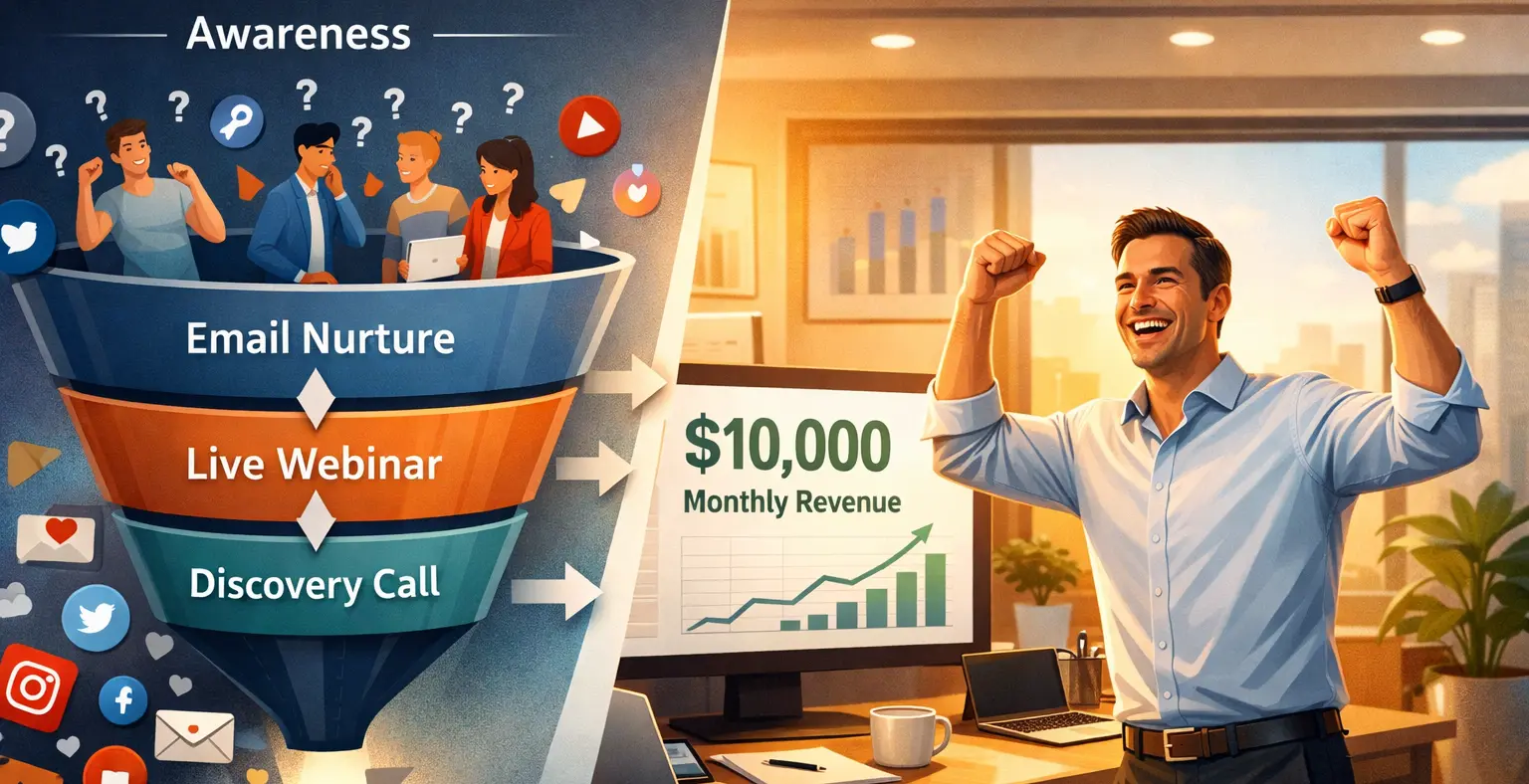
Most coaches build funnels backward. They obsess over fancy software and complex automation before they have a single proven client transformation. They buy expensive funnel builders, watch hours of tutorials, and create elaborate email sequences that nobody reads.
Key Takeaway:
- A well-designed marketing funnel is the fastest way for coaches to reach $10K+ months consistently. It systematically turns strangers into high-paying clients by building trust, providing value, and guiding them through a clear journey. [1]
- The most effective coaching funnel has 4 main stages: Attract (free content that solves problems), Nurture (email list + valuable follow-up sequences), Convert (webinar, challenge, or discovery call), and Deliver (high-ticket 1:1 or group coaching programs). [1]
- Focus on creating irresistible lead magnets (free training, checklist, or mini-course), building an engaged email list, and using automated sequences that educate and sell. High-ticket coaches who master this funnel often close 20-40% of discovery calls. [2]
- The biggest mistake most coaches make is trying to sell too early or having no system at all. A simple, consistent funnel focused on value first can replace chaotic marketing with predictable income. [2]
Bottom Line: To hit $10K+ months as a coach, stop relying on random social media posts. Build a simple, value-driven marketing funnel that attracts the right clients, nurtures them with trust, and converts them into high-ticket coaching packages. A strong funnel turns coaching into a predictable and scalable business.
Then they wonder why they’re still struggling to book discovery calls.
Here’s the truth: reaching consistent $10K months requires systematic marketing, but systems without strategy create expensive chaos. Whether you just completed your life coaching certification or you’re an established coach ready to scale, your funnel needs to match your stage.
We’ve covered foundational marketing, but now you need the exact funnel stages, email templates, and webinar strategies that separate coaches who hit $10K months from those who stay stuck at $3K.
In my 20+ years working with coaches, I’ve watched the same pattern repeat: the coaches who succeed don’t have the fanciest funnels. They have the clearest offers and the most systematic follow-up. That’s what we’re building today.
Why Most Coaching Funnels Fail (And What Actually Works)
Three fatal mistakes kill coaching funnels before they generate a single dollar.
First, coaches build funnels before validating their offer with real clients. You can’t automate something that doesn’t work manually. If you haven’t successfully enrolled at least five paying clients through direct conversation, you’re not ready for automation. Your funnel will just scale your confusion.
Second, lead magnets attract freebie-seekers instead of buyers. A checklist titled “10 Ways to Feel Better” brings people who want free tips. A mini-course called “The 5-Day Blueprint to Your First $5K Month” attracts people ready to invest in themselves. The difference in conversion rates is staggering.
Third, skipping the nurture sequence kills conversion. Going straight from opt-in to hard pitch feels pushy. People need to know you, trust your expertise, and believe you can deliver transformation before they hand over thousands of dollars.
Here’s the coaching industry reality that most gurus won’t tell you: only 55% of webinar registrants actually attend. That means half your effort promoting the webinar gets wasted if you don’t have a solid reminder sequence. The coaches hitting $10K months understand this math and build systems accordingly.
What separates success from struggle comes down to three elements: qualified traffic, compelling offer plus systematic follow-up. Miss any one of these, and your funnel leaks prospects faster than you can generate them.
Why do funnels work better than referrals alone? Scalability, predictability, and 24/7 lead generation. Referrals are fantastic. They convert at high rates because they come with built-in trust. But you can’t control when they arrive or how many you get each month. Funnels give you that control.
The 4-Stage Marketing Funnel Every Coach Needs
Stage 1 – Awareness: Your Lead Magnet Strategy
Your lead magnet exists for one purpose: attract the RIGHT people who can afford and need your coaching.
What works right now: free webinars generate the highest intent leads, followed by PDF guides that solve specific problems, assessments that create self-awareness, and mini-courses that deliver quick transformations. Each of these shows prospects your methodology before they pay you a dollar.
What doesn’t work: generic checklists and “10 tips” lead magnets everyone has seen before. These attract tire-kickers who collect free resources but never buy. For coaches teaching NLP techniques, your lead magnet should demonstrate NLP in action rather than just explain it theoretically.
Run your lead magnet through this checklist. Does it solve ONE specific problem? Does it deliver a quick win that creates momentum? Does it create desire for more by opening a loop you close in your paid offer? If you can’t answer yes to all three, redesign it.
Your landing page needs three elements: a clear headline that speaks to the desired outcome, benefits-focused copy that addresses what they’ll gain, and a single call to action. Multiple CTAs split attention and tank conversion rates.
Example of a strong lead magnet: “5-Day Email Course: Break Through Your First $5K Month Plateau.” Notice the specificity. It’s not for everyone. It’s for coaches stuck at a particular revenue level who want to reach the next milestone.
Stage 2 – Interest: The Email Nurture Sequence
Your email sequence builds trust, demonstrates expertise, and warms leads for your offer. Without this bridge, your conversion rates suffer.
The welcome sequence should run 3-5 emails over 7-10 days. Email one delivers the lead magnet and sets expectations for what comes next. Email two provides a quick win or shares a case study showing real transformation. Email three addresses, a common objection or create a belief shift necessary for change. Emails four and five introduce your methodology and include a soft invitation to your webinar or discovery call.
Follow this principle: 80% value, 20% promotion. Your emails shouldn’t feel like sales messages. They should feel like valuable teaching with occasional invitations to go deeper.
Personalization that actually works involves segmenting by lead magnet downloaded, quiz results that reveal their specific challenges, or engagement level with your content. Generic blast emails to your entire list get ignored.
Stage 3 – Decision: Webinar Funnels That Convert
Webinars beat video sales letters for coaching because live interaction builds trust faster. Prospects get to experience you in real-time, ask questions, and feel your energy. That’s something a recorded video can’t replicate.
The proven webinar structure breaks into three parts. Spend 40 minutes teaching real value, not fluff. Your content should deliver genuine breakthrough moments that leave attendees thinking, “This free training just shifted my entire perspective.” Then transition to 15 minutes pitching your offer with clear benefits, bonuses, and deadline-driven urgency. Close with 5 minutes of Q&A, handling the specific objections your niche struggles with.
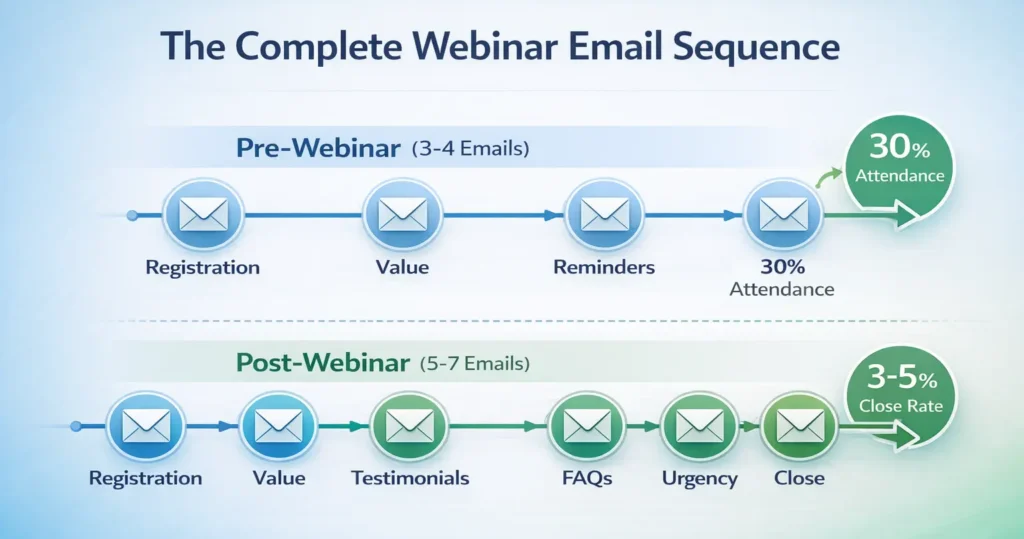
Your pre-webinar email sequence needs 3-4 emails. Send registration confirmation immediately with calendar links and what to expect. Two to three days before the webinar, send a value email previewing what they’ll learn and why it matters. Then deploy your reminder sequence: one day before, two hours before, and “going live now” as the webinar starts. This sequence alone can double your attendance rates.
The post-webinar close sequence runs 5-7 emails over 5-7 days. Start with replay access and testimonials from past clients. Follow with FAQs and case studies addressing common concerns. Build scarcity and urgency by communicating the deadline for bonuses or special pricing. End with a final call email emphasizing the cart closing and the cost of inaction.
Expect these conversion rates: 3-5% of attendees to high-ticket offers ($2,000+), and 10-15% to mid-ticket offers ($500-$1,500). If you’re converting significantly below these benchmarks, your offer needs work before you blame the funnel.
Stage 4 – Action: Discovery Calls & Conversion
Qualifying leads before calls saves everyone time. Use an application funnel that asks specific questions about their situation, budget, and commitment level. If you’re serving corporate clients, your qualifying questions should address decision-making authority and organizational buy-in.
Your discovery call framework follows three steps: diagnose their situation and identify the gap between current state and desired outcome, prescribe your solution as the bridge across that gap, and close by handling objections and asking for the sale.
The three most common objections you’ll face are price (“It’s too expensive”), timing (“Now isn’t the right time”), and skepticism (“How do I know this will work for me?”). Prepare specific responses for each that reframe the objection into an opportunity.
Your follow-up sequence for “not ready yet” prospects keeps you top of mind without being pushy. Continue providing value through email, invite them to future webinars, and check in quarterly. Some of my best clients initially said no, then reached out six months later when their situation changed.
Simple vs. Sophisticated: Which Funnel For Your Stage?
The 2-Step Funnel (For New Coaches: 0-10 Clients)
Step one creates valuable blog content or video addressing your niche’s specific pain points, then includes a call to action to book your calendar. Step two is the discovery call, where you diagnose, prescribe, and close.
Why this works: you prove your offer works before building complex systems. You learn what objections come up, what language resonates, and what transformation your clients actually experience. This intelligence becomes the foundation for your automated funnel later.
Timeline expectations matter. Expect 30-60 days to land your first clients using this approach, and 3-6 months to refine your messaging and offer based on real conversations. As you’re launching your practice, simplicity beats complexity every time.
Tools needed: completely free. Use Calendly for scheduling, leverage social media and LinkedIn for content distribution, and build a basic website with clear messaging about who you help and how.
The Webinar Funnel (For Growing Coaches: 10-25 Clients)
This funnel flows from lead magnet to email nurture to live webinar to discovery calls. You’re systematizing what worked manually and reaching more people simultaneously.
Why this works: You demonstrate transformation live while building community. Webinar attendees who raise their hand for discovery calls arrive pre-sold on your methodology. Your close rate on these calls should exceed 30%.
Timeline to consistently $10K months runs 6-12 months with this funnel. The first few months involve testing messaging, optimizing conversion rates at each stage, and building your email list to critical mass.
Tools needed include an email platform like ConvertKit or ActiveCampaign ($40-100 monthly) and webinar software like WebinarJam or Zoom Webinars ($50-100 monthly). Total investment runs $100-200 monthly.
Expected metrics to track: 30-40% email open rates, 25-30% webinar attendance rate from registrants, and 3-5% conversion from attendees to paying clients. If you’re hitting these numbers consistently, you’re on track for $10K months.
The Evergreen Automated Funnel (For Scaling Coaches: 25+ Clients, $10K+ Months)
Your automated webinar runs on repeat, segmented email sequences nurture leads based on behavior, applications filter serious prospects, and discovery calls close qualified leads.
Why this works: predictable lead flow and leveraged time. You record the webinar once, set up the automation, and it runs 24/7, generating clients while you deliver coaching or create new offers.
Tools needed at this level cost $200-500 monthly and include advanced automation platforms, CRM systems, and comprehensive funnel builders that integrate everything.
When should you build this? Only AFTER manually running successful live webinars 5-10 times. You need to know what works, what objections arise, and how to handle them before automating. Automating a mediocre webinar just scales mediocrity.
The Email Sequences That Drive $10K Months
High-converting sequences follow a specific anatomy. Your subject line combines curiosity with benefit to earn the open. Your body copy hooks with a compelling first sentence, tells a brief story that creates a connection, teaches something valuable, and ends with a clear call to action.
Subject line formulas that consistently perform well include “[Curiosity hook] + [Specific benefit]” and “How [Ideal client] achieves [Desired outcome].” Test variations to find what resonates with your specific audience.
Body copy structure flows naturally. Hook them in the first sentence with a bold statement or intriguing question. Share a brief story that illustrates the problem or solution. Teach one specific concept or strategy. Close with a clear next step.
Frequency matters more than you think. During launch sequences, daily emails keep momentum and urgency high. For ongoing nurture, 2-3 emails weekly maintain presence without overwhelming subscribers. Less frequent than that and people forget who you are.
Segmentation strategies separate engaged subscribers from cold ones. Send re-engagement campaigns to people who haven’t opened in 30 days. Offer them a way to stay on your list or unsubscribe. Cleaning your list improves deliverability and engagement rates.
A/B testing priorities start with subject lines since they determine open rates. Once you’ve optimized opens, test CTA placement, then email length, and then storytelling approaches. Test one element at a time so you know what actually moved the needle.
Here’s a real example sequence breakdown. Welcome email: “You’re in! Here’s what happens next…” sets expectations and builds anticipation. Value email: “The #1 mistake holding you back from $10K months” teaches something immediately useful. Social proof email: “How Sarah went from $3K to $12K in 90 days” shows that transformation is possible. Invitation email: “Join me for a free training this Thursday” makes the ask after delivering value. Reminder email: “Tomorrow at 2 pm – don’t miss this” drives attendance. Replay email: “Here’s what you missed plus special bonus” captures no-shows. Last chance email: “Doors close in 24 hours” creates urgency for fence-sitters.
Landing Pages That Convert Cold Traffic
The anatomy of a high-converting landing page starts with a compelling headline that follows this formula: [Desired outcome] without [major objection].
Example: “Hit Your First $10K Month Without Burning Out or Sleazy Sales Tactics.” Notice how this speaks directly to what coaches want while addressing their biggest fears about achieving it.
Essential elements include social proof above the fold showing testimonials or client results, a video, if possible since it builds trust and connection faster than text alone, and a single call to action repeated throughout the page rather than multiple competing options.
Mobile optimization isn’t optional anymore. Over 60% of traffic comes from mobile devices. If your landing page doesn’t load fast and look great on phones, you’re losing more than half your potential leads.
Load speed matters enormously. Pages that take longer than 3 seconds to load lose 40% of visitors before they even see your content. Compress images, minimize scripts, and use fast hosting. Using NLP language patterns in your copy helps create a deeper connection and motivation to take action.
A/B testing priorities for landing pages start with headline variations since that’s what people see first. Then test the CTA button color and text since small changes can significantly impact click rates. Finally, test form length if you’re collecting information, balancing data collection with conversion rate.
The Truth About Timeline to $10K Months
Realistic expectations depend on your starting point. New coaches with 0-5 clients should expect 12-18 months to reach consistent $10K monthly revenue. Growing coaches with 5-15 clients can hit $10K in 6-12 months with systematic funnel implementation. Established coaches with 15+ clients can optimize to $10K+ within 3-6 months.
Variables that accelerate results include niche clarity, since specific positioning beats general every time. Traffic quality matters more than traffic volume. Warm audiences from referrals or content marketing convert better than cold ads. Offer pricing determines how many clients you need. High-ticket coaching means you need fewer clients to hit $10K. Conversion skills improve with practice, so run more discovery calls to get better at closing.
Variables that slow results include starting with no existing audience; building from zero takes longer than most coaches expect. Unclear positioning makes every marketing effort harder. Technical overwhelm from trying to learn too many tools simultaneously creates paralysis. Inconsistent implementation kills momentum faster than anything else.
The compound effect follows a predictable pattern. Months 1-3 involve setup, learning tools, creating content, and building your email list. Months 4-6 shift to testing what messaging works, which lead magnets convert, and which offers resonate. Months 7-12 focus on optimization, doubling down on what works and eliminating what doesn’t. Month 12 and beyond become scaling, where you increase traffic to proven funnels and watch revenue multiply.
What’s the Best Funnel Software for Coaches?
Start with free tools for your first 10 clients, then invest in ClickFunnels or Kartra once you’re making $5K+ monthly consistently. The software doesn’t matter as much as your message and offer.
Your free starter stack includes Calendly for scheduling discovery calls, MailChimp or ConvertKit’s free tier for email up to 1,000 subscribers, Canva for creating simple graphics and lead magnets, and Zoom for video calls and small webinars.
The mid-tier stack costing $100-200 monthly includes ConvertKit or ActiveCampaign for advanced email automation and segmentation, WebinarJam for professional webinar delivery, and WordPress plus OptimizePress for landing pages and membership areas.
The advanced stack running $300-500 monthly includes ClickFunnels or Kartra, providing all-in-one funnel building, email, membership, and checkout, plus ActiveCampaign or Infusionsoft for sophisticated CRM and automation.
The real investment isn’t the monthly fee. It’s your time learning the platform and creating content that converts. Don’t platform-hop, chasing the newest shiny tool. Pick one, master it, and focus on messaging instead of technology.
How Many Emails Should Be in My Coaching Funnel Sequence?
Six to eight emails minimum for a complete webinar funnel: 3-4 pre-webinar emails covering registration confirmation, value delivery, and attendance reminders, plus 5-7 post-webinar emails including replay access, testimonials, FAQs, urgency building, and final close.
Pre-webinar emails maximize attendance rates. Registration confirmation goes out immediately. Value email arrives 2-3 days before the webinar, previewing what they’ll learn. Reminder emails hit the day before, two hours before, and as you go live. This sequence can double your show-up rate.
Post-webinar emails convert warm leads who attended but didn’t buy immediately. Most people need time to process big decisions, especially investments of several thousand dollars. Your email sequence continues the conversation, addresses objections, and creates urgency through limited-time bonuses or pricing.
Your welcome sequence runs 3-5 emails over 7-10 days for new subscribers who aren’t yet ready for your webinar. Your webinar sequence needs 3-4 emails before and 5-7 emails after. Your evergreen nurture continues at 2-3 emails weekly for long-term relationship building.
The biggest mistake coaches make: sending ONE email, then wondering why nobody bought. People need multiple touchpoints before making significant investments. Your email sequence provides those touchpoints systematically.
Best practice involves mapping your entire customer journey before building automation. Understand what questions arise at each stage, what objections surface, and what information helps people make confident decisions. Then create email content addressing those specific needs.
Can I Really Make $10K Months with a Funnel?
Yes, but it requires the right math: either 7 clients at $1,500 monthly, 14 clients at $700 monthly, or 20 clients at $500 monthly, plus a funnel that consistently delivers qualified leads.
Break down the math clearly. Starting with 100 leads generates 30 webinar attendees at a 30% conversion rate. Those 30 attendees produce 3 sales at a 10% close rate. If your offer is $3,000, that’s $9,000. Or consider 200 leads generating 60 attendees producing 6 sales at $1,500 each, again totaling $9,000.
Real talk: most coaches need 6-12 months of consistent funnel optimization to hit $10K. The first few months involve testing and learning. The middle months bring optimization based on data. The latter months scale what’s proven to work.
Success factors include a proven offer that solves a specific problem people will pay to fix, qualified traffic from people who can afford your coaching and need your expertise, and conversion skills that improve through practice and feedback.
It’s not magic. It’s systematic lead generation combined with strategic follow-up and practiced closing skills. The coaches who hit $10K months understand this and do the work consistently.
Industry benchmarks show coaching businesses averaging 30-70% profit margins, making it one of the most profitable business models when executed well. Your funnel is the system that brings consistent clients while you focus on delivering transformation.
FAQs
1. How long does it take for a coach to reach consistent $10K months using a marketing funnel?
Most coaches reach consistent $10K months within 6–12 months when using a properly structured marketing funnel. New coaches may take 12–18 months, while established coaches with validated offers can achieve results faster. Success depends less on funnel software and more on offer clarity, traffic quality, and consistent testing and optimization at each funnel stage.
2. What is the best marketing funnel for coaches?
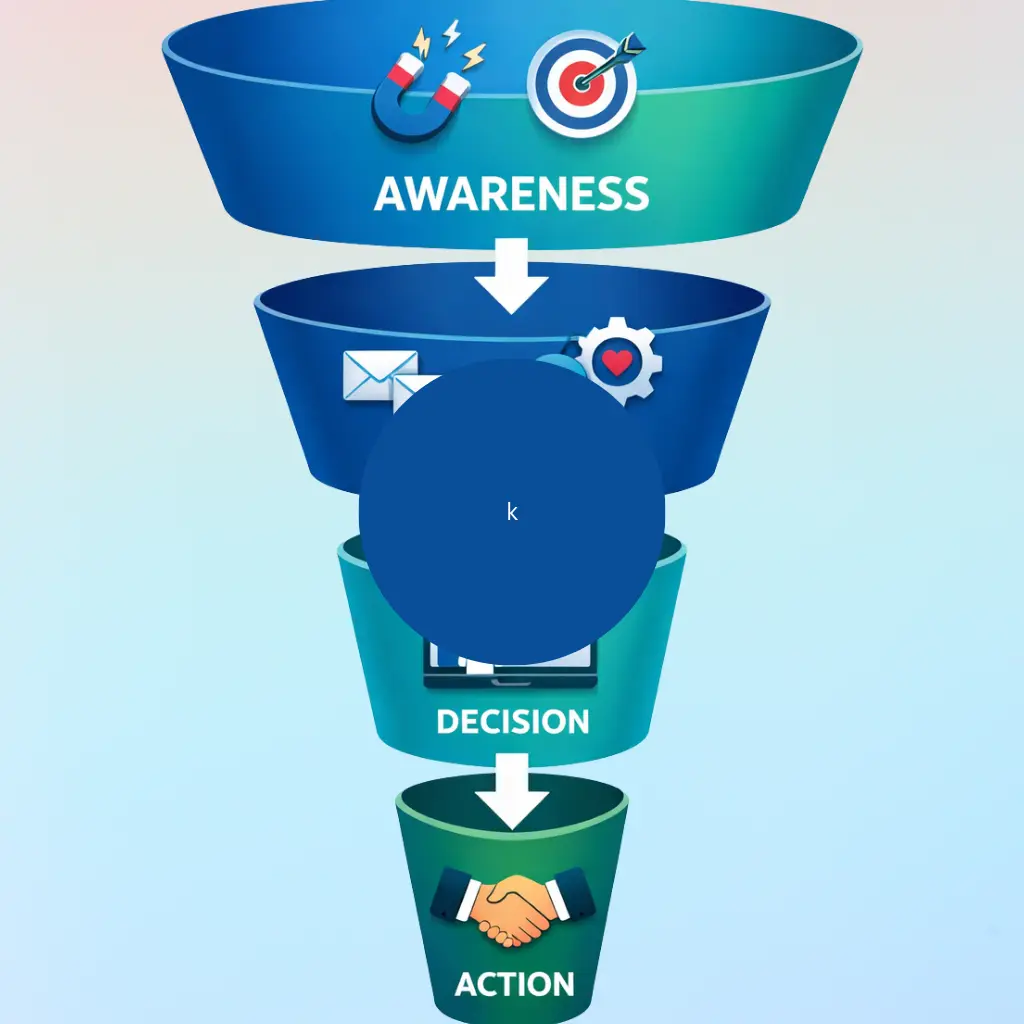
The best marketing funnel for coaches follows a four-stage structure: Awareness (lead magnet), Interest (email nurture), Decision (webinar or VSL), and Action (discovery call). This framework mirrors buyer psychology, builds trust gradually, and allows coaches to scale client acquisition predictably. Webinar-based funnels typically outperform simple lead magnet funnels for high-ticket coaching offers.
3. Do coaches really need webinars to make $10K months?
Coaches do not strictly need webinars to make $10K months, but webinars significantly increase conversion rates for premium coaching programs. Live webinars allow prospects to experience the coach’s expertise, energy, and communication style in real time, which builds trust faster than static content. As a result, webinar funnels often produce higher-quality leads and stronger discovery call close rates.
4. How many emails should be in a coaching funnel?
A high-converting coaching funnel typically includes 6–8 core emails, with 3–4 sent before a webinar and 5–7 sent after. Pre-webinar emails focus on confirmation, value, and attendance reminders, while post-webinar emails handle objections, provide social proof, and create urgency. Each email has a specific role in moving prospects toward a confident buying decision.
5. What is the biggest mistake coaches make with funnels?
The biggest mistake coaches make is building automated funnels before validating their offer with real clients. Funnels only amplify what already works, so automating an unproven message leads to poor conversions and wasted effort. Successful coaches first enroll clients manually, refine their messaging through real conversations, and then scale using automation.
Your Path Forward Starts Today
The funnel paradox resolves clearly now: complexity isn’t the answer, clarity is. You don’t need seventeen software tools and thirty-email sequences. You need crystal-clear positioning, a compelling offer, and systematic follow-up.
Your action plan depends on your current stage. If you’re a new coach with 0-10 clients, master the 2-step funnel first. Create valuable content that demonstrates your expertise, add clear calls to action, and book discovery calls. Prove your offer works before automating anything.
If you’re a growing coach with 10-25 clients, build your webinar funnel systematically. Create a lead magnet that attracts your ideal clients, nurture them through email, invite them to live webinars, and convert attendees through discovery calls. Test and optimize each stage.
If you’re a scaling coach with 25+ clients already generating $10K+ monthly, automate what’s proven. Record your best webinar, set up evergreen automation, and focus on increasing traffic to your proven funnel. Hire support to handle administrative tasks so you can focus on high-level strategy and delivery.
Most successful coaches follow this exact progression: start simple, test relentlessly, scale what works. They don’t skip steps. They don’t chase the newest tactic. They master fundamentals and build on that foundation.
The real differentiator between coaches who hit $10K months and those who struggle isn’t the funnel software they use or the number of emails they send. It’s the transformation they deliver. Your funnel is a vehicle for getting the right people to experience that transformation. The vehicle matters, but the destination matters more.
Take decisive action this week. Choose ONE funnel stage to build or optimize. If your lead magnet isn’t converting, redesign it. If your emails aren’t getting opened, test new subject lines. If your webinars aren’t closing sales, record yourself and identify where you lose people. Small improvements compound over time.
Ready to master the coaching skills that make your funnel convert? Explore our NLP Training Canada to develop the communication and transformation techniques that turn leads into lifelong clients. Your funnel brings people to the door. Your skills create the breakthrough that makes them stay.