

Picture this: You’re the CEO of a mid-sized Canadian tech company. You’ve just watched your third senior AI engineer walk out the door in six months. Your VP of Engineering is scrambling to cover the gaps. Your product roadmap is slipping. And you’re about to spend another $150,000 recruiting, interviewing, and onboarding replacements only to wonder if they’ll stay a year.
Key Takeaway:
- Employee retention in Canadian tech companies has become a major challenge, with turnover rates often exceeding 20–25% annually. The biggest drivers of attrition are lack of career growth, poor work-life balance, inadequate compensation, and weak leadership. [1]
- High retention is achievable when companies focus on clear career progression paths, competitive compensation (including equity and bonuses), strong leadership development, flexible/hybrid work models, and a genuine culture of recognition and psychological safety. [1]
- Practical strategies that work in Canada include regular career conversations, personalized development plans, transparent promotion criteria, mental health support, competitive benefits packages, and building inclusive team cultures that make employees feel valued and connected. [2]
- Companies that invest in retention see significantly lower hiring costs, higher productivity, stronger innovation, and better knowledge retention — creating a real competitive advantage in Canada’s tight tech talent market. [2]
Bottom Line: In Canadian tech, high employee turnover is expensive and avoidable. Companies that prioritize career growth, fair compensation, strong leadership, and a supportive culture dramatically increase retention, reduce costs, and build more innovative and resilient organizations.
The numbers are brutal. Canadian companies are bracing for 28-33% turnover in 2025. For tech firms, it’s even worse; the industry holds the unwanted crown for the highest turnover of any sector. Each departure costs an average of $29,234 in direct replacement expenses, not counting the invisible bleeding of lost institutional knowledge, delayed projects, and demoralized teams left behind.
You’ve tried the usual moves. Competitive salaries. Better benefits. Ping pong tables and free snacks. Nothing’s sticking. Here’s what most tech leaders miss: Your retention crisis isn’t a compensation problem. It’s a leadership problem. And there’s a proven solution that’s delivering 788% ROI for companies that get it right corporate leadership coaching that transforms your managers from taskmasters to talent magnets. When leaders learn NLP strategies for retention and genuine development skills, people stop leaving.
In my 20+ years working with tech leaders, I’ve seen this pattern repeat: The companies that invest in executive coaching don’t just reduce turnover. They create competitive advantages that money alone can’t buy.
Why Canadian Tech Firms Are Bleeding Talent in 2026
The Great Resignation may have cooled off, but for Canadian tech companies, the talent crisis is far from over. Recent Canadian employment survey data shows 28% of companies expect increased employee turnover this year, with replacement costs averaging $30,674 per person. For tech firms specifically, 2025 Canadian retention data reveals a brutal reality: while the national average sits at 10.2%, tech companies are hemorrhaging talent at rates that threaten their ability to compete.
The Canadian tech landscape faces unique pressures that make retention even harder. You’re not just competing with local firms; you’re battling US companies offering remote roles at Silicon Valley salaries. The brain drain is real. Meanwhile, Canadian technology employment data shows that while 300,000 tech jobs were created over the past six years, CEO surveys consistently rank “attracting and retaining top talent” as their number one operational priority.
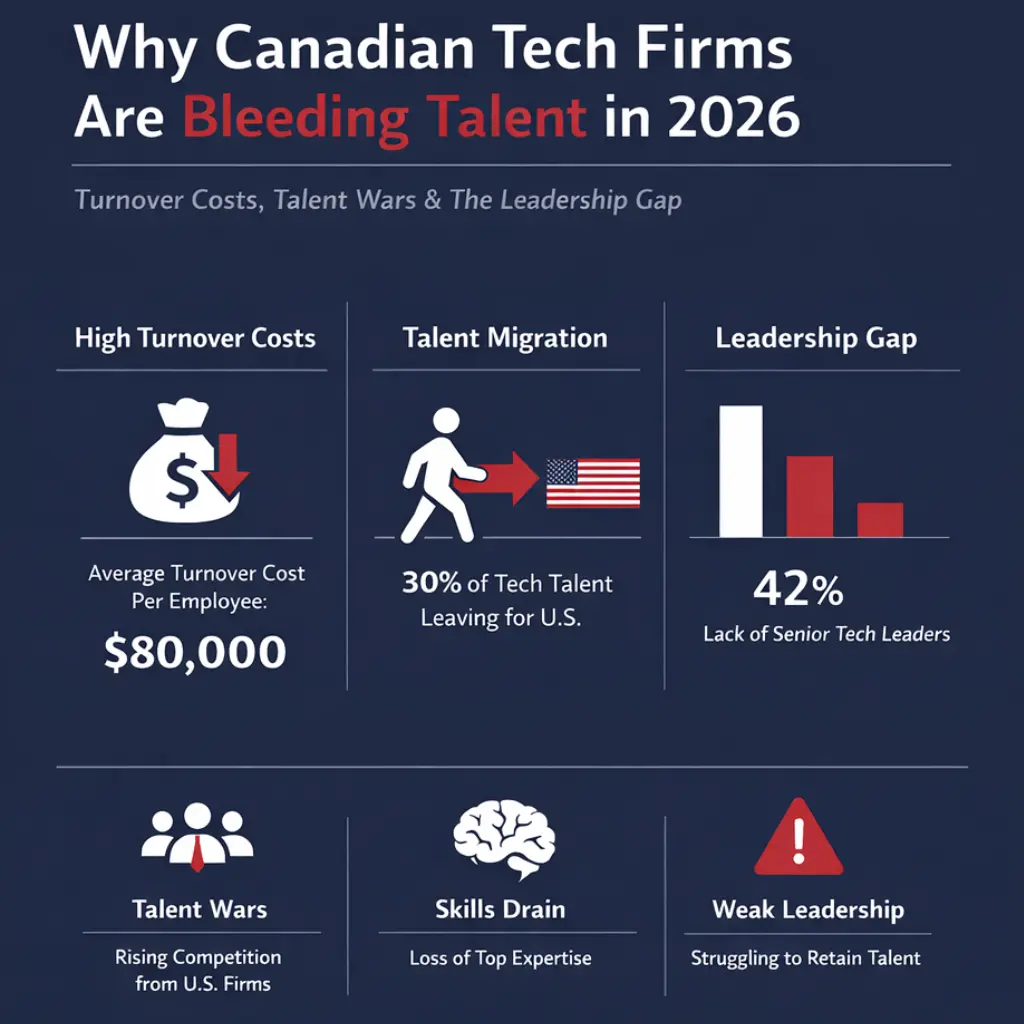
Then there’s the hybrid work battle. Rogers Communications, TD Bank, and BMO have all mandated four to five days in-office, triggering employee backlash in a market where two-thirds of Canadian workers now consider work flexibility a top factor in whether they stay or leave. When a third of remote workers say they’d start looking for another job if ordered back, and a quarter say they’d likely quit outright, return-to-office mandates become retention grenades.
Add to that the skills shortage in the exact areas driving tech growth. With just 3.3% unemployment among tech professionals and 88% of technology leaders struggling to find qualified candidates for AI, machine learning, cybersecurity, and cloud roles, every departure feels catastrophic. You’re not just losing an employee, you’re losing capabilities you can’t easily replace.
But here’s what the data really tells us: The reasons people leave haven’t changed. They’ve just intensified.
The Leadership Gap That’s Costing You Talent
A Gallup workplace research study uncovered something startling: 52% of voluntarily exiting employees believe their former employers “could have done more to prevent them from leaving.” Half of all the people quitting would have stayed if their company had done something. But done what, exactly?
The answer isn’t what most tech executives expect. It’s not bigger stock options or fancier titles. According to recent tech industry analysis, 64% of tech professionals who change jobs cite limited career advancement as the primary driver. But advancement isn’t just about promotions, it’s about growth, learning, mentorship, and feeling like you’re developing.
That’s where the leadership gap crushes retention. Your technical managers are brilliant engineers, brilliant architects, brilliant analysts. But can they conduct a meaningful career development conversation? Do they know how to mentor someone through a skill gap? Can they spot burnout before it leads to resignation? Most haven’t been trained to do any of it.
Tech leaders face brutal pressures, sprint deadlines, product pivots, distributed teams across time zones, the constant velocity of innovation. Under that stress, most default to directive management: assign tasks, check status, move to the next crisis. What disappears is the human connection, the development, the coaching that makes people feel invested in.
Your managers aren’t bad leaders. They just haven’t been given the tools to be the leaders your talent needs. That’s the gap executive coaching fills.
How Executive Coaching Transforms Retention Outcomes
Executive coaching doesn’t just polish communication skills or boost confidence. When done right, it fundamentally rewires how leaders think about their role from getting work done through people to developing people who get work done. That shift is what drives retention.
The numbers back this up with remarkable consistency. A comprehensive Fortune 500 study by MetrixGlobal found that executive coaching delivered a 788% return on investment, with significant gains attributed to improved productivity and employee retention. Even when you exclude retention benefits entirely, the ROI was still 529% . International Coaching Federation research confirms these findings across industries, reporting an average return of seven times the coaching investment.
But ROI numbers don’t tell you how it works. Let me break down the mechanics of why coached leaders retain talent better.
Three Ways Coaching Directly Addresses Turnover Drivers
1. Developing Career Development Capabilities
When leaders learn to have genuine career development conversations, not annual performance reviews, but real discussions about growth, aspirations, and path, everything changes. Employees don’t need a promotion every year. They need to see a path. They need to know you’re invested in their growth.
The data here is stark: Research shows that 94% of employees would stay at a company longer if it invested in their career development. Another study found that 82% of employees would quit because of no career progression opportunities.
Coaching teaches leaders how to identify development opportunities, create growth plans, provide stretch assignments, and connect employees’ work to their long-term goals. When your VP of Engineering learns to do this across their organization, you don’t just reduce turnover, you build a talent development machine that becomes a competitive advantage.
2. Building Emotional Intelligence for Retention
The single biggest predictor of whether an employee stays isn’t their salary or title. It’s their relationship with their direct manager. Employees don’t leave companies; they leave managers. Coaching develops the emotional intelligence that makes managers people want to work for.
This means learning empathy, active listening, psychological safety, conflict resolution, and how to provide feedback that strengthens rather than deflates. Studies indicate that employees led by managers with high emotional intelligence are 30% more likely to report high job satisfaction.
When Starbucks implemented leadership training emphasizing emotional intelligence, communication, and coaching skills, they created leaders who fostered supportive environments for their teams. According to company reports, this focus on leadership development contributed to a 70% employee retention rate significantly above the industry average.
Similarly, Google’s G2G (Googler-to-Googler) mentorship program pairs emerging leaders with mentors who provide coaching and support. This initiative has contributed to high engagement and notably low turnover rates within Google, as employees feel genuinely guided in their careers rather than managed.
3. Strengthening Communication & Feedback Culture
In tech environments moving at breakneck speed, communication often becomes transactional. Standup updates. Slack pings. Jira tickets. What gets lost is the meaningful dialogue that builds connection and surfaces problems before they become resignations.
Executive coaching develops leaders who establish regular check-ins, create transparency around decisions, recognize contributions, and most critically spot and address burnout before it leads to exits. The tech industry’s culture of “always-on” collaboration and aggressive deadlines creates burnout at epidemic levels. Leaders who can recognize the warning signs and intervene make all the difference.
Addressing workplace communication breakdowns isn’t about more meetings. It’s about more meaningful conversations. Coached leaders learn when to pivot from task-mode to person-mode, how to read what’s not being said, and how to create space for the conversations that keep talented people engaged.
The Ripple Effect: When Leaders Change, Culture Follows
Here’s what happens when you coach senior leadership: The impact multiplies downward. When your C-suite and VPs demonstrate growth mindsets, vulnerability, development focus, and coaching approaches, that behavior cascades through the organization.
Your senior leaders model that it’s safe to admit you don’t know something. They demonstrate that asking for help is a strength, not a weakness. They show that investing in someone’s growth is more important than squeezing out the last 5% of productivity this quarter. That creates a learning culture, and learning cultures have dramatically better retention.
Gallup workplace research confirms this: Organizations with formal coaching programs experience 22% higher retention rates. Why? Because employees feel they have strong guidance and growth opportunities within the organization. They don’t need to leave to level up.
I’ve walked this path with dozens of tech executives. The pattern is always the same. Six months into coaching, they’ll tell me their teams feel different. More engaged. More collaborative. More willing to speak up. A year in, their retention numbers start shifting, not dramatically at first, but consistently. Two years in, they’ve built something competitors can’t easily replicate: a culture where talented people choose to stay and grow.
The ROI Math Canadian Tech Leaders Need to See
Let’s talk numbers, because at the end of the day, executive coaching is a business investment that needs to justify itself financially. The math is surprisingly straightforward and compelling.
Start with your current reality. Let’s say you’re running a 500-employee tech company. The 2025 Canadian retention data shows the average Canadian company spends $29,234 per employee replacement when you factor in recruiting, interviewing, onboarding, and lost productivity. Some companies report turnover costs exceeding $100,000 annually 15% of Canadian employers are in that category.
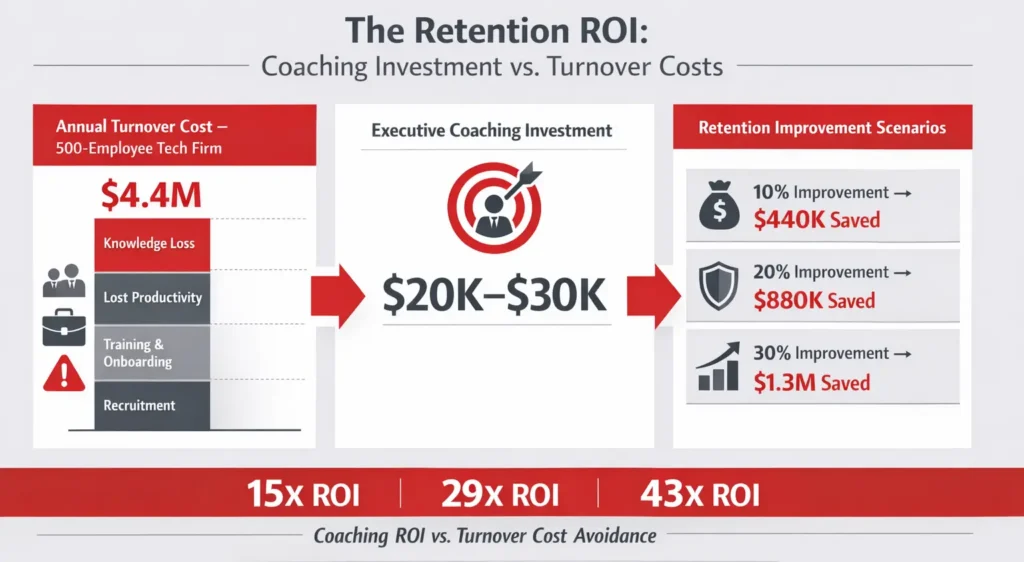
At the national average turnover rate of 10.2%, you’re losing roughly 50 employees per year. But tech companies run higher, so let’s be realistic and say you’re at 30% annual turnover. That’s 150 departures. At $29,234 each, you’re bleeding $4,385,100 annually just to stand still. And that’s the conservative estimate that doesn’t account for:
- Critical knowledge walking out the door
- Projects delayed or derailed
- Remaining employees are picking up the slack (leading to their burnout and eventual departure)
- Team morale is taking repeated hits
- Clients experiencing service disruptions
- Innovation is slowing because no one has an institutional context
Now consider the coaching investment. A comprehensive executive coaching program for your senior leadership team, let’s say your C-suite plus VPs, roughly 8-12 people, typically runs $20,000 to $30,000 annually when you factor in coach fees, assessment tools, and program design.
What happens when those coached leaders reduce turnover by 30%? You retain 45 employees who would have left. That’s a savings of $1,313,530. Your coaching investment paid for itself 44 times over. Even a conservative 10% improvement, retaining just 15 people, delivers $438,510 in savings. That’s still a 15x return.
But let’s look at what organizations that calculate coaching ROI actually report. According to International Coaching Federation data, 86% of companies that measure it made back their initial investment. Among those that saw positive returns, 19% reported a 50x ROI, and 28% saw returns between 10-49x. These aren’t outliers; they’re the norm when coaching is implemented strategically.
Quantifiable Coaching Outcomes
The beauty of executive coaching is that the benefits extend far beyond retention savings. Research from the International Coaching Federation documents these performance improvements:
- Individual performance increases by 70% on average in areas like goal attainment and clearer communication
- Team performance jumps by 50% through improved collaboration and alignment
- Organizational performance increases by 48%, including revenue growth and operational efficiency
- Employee engagement scores climb, with 72% of organizations reporting a strong correlation between coaching and increased employee engagement
Think about what a 50% improvement in team performance means when you’re competing for contracts, racing to market with new features, or trying to outmaneuver competitors. Think about what happens when your leadership team is 70% more effective at achieving strategic goals.
Beyond the hard costs, there’s the competitive advantage of continuity. When your senior architect has been with you for eight years instead of two, they understand your codebase intimately. They know why certain decisions were made. They can mentor new hires effectively. That institutional knowledge is worth far more than what shows up on any ROI calculation, but it’s what separates companies that execute consistently from those that constantly restart.
What Tech Exodus Looks Like? Why Top Talent Really Leaves
So what actually drives your best people out the door? The answer is more nuanced than “they got a better offer.”
Top tech talent leaves primarily due to three interconnected factors: limited growth opportunities, poor leadership, and misalignment with company vision. Let me unpack what that really means in the Canadian tech context.
First, career stagnation. Many tech companies, especially high-growth startups, have flat organizational structures designed to promote agility and innovation. But those same flat structures create a problem: limited opportunities for vertical career advancement. When there are only a handful of leadership positions and no clear path to get there, talented people plateau quickly.
Recent surveys of tech job-hoppers found that 64% believe frequent job moves enhance their career mobility and salary prospects. They’re not wrong. When internal growth feels blocked, the fastest way to level up is to leave. The primary motivations they cite? Limited career advancement, exposure to outdated technologies, and inflexible workplace policies.

Second, managers who can’t mentor. Technical brilliance doesn’t automatically translate into leadership capability. Your senior developers, your engineering leads, your product managers, they can build remarkable things. But can they develop people? Can they have career conversations that go beyond “keep doing what you’re doing”? Can they provide mentorship that helps someone grow from intermediate to senior to principal level?
When managers lack development skills, employees feel stuck. They don’t see a path forward. They don’t feel invested in. So they start looking elsewhere for the mentorship and growth they’re not getting.
Third, the misalignment problem. Smart people want to do work that matters. When they can’t connect their daily tasks to meaningful outcomes, when they don’t understand how their work fits into the bigger picture, when decisions feel arbitrary or opaque, engagement dies. And once engagement dies, it’s just a matter of time before they leave.
In tech’s pressure-cooker environment, this gets amplified. Aggressive deadlines without support create burnout. Constant firefighting without space for innovation leads to exhaustion. Always-on collaboration expectations erode work-life balance. When leaders don’t recognize these patterns and intervene early, talented people reach their breaking point and walk.
The coaching solution addresses all three. Leaders learn to create visible growth paths, even in flat structures. They develop the mentoring capabilities their teams desperately need. They master the communication skills that help people connect their work to purpose. And they build the emotional intelligence to spot burnout before it becomes resignation.
How Does Executive Coaching Actually Improve Retention Rates?
Here’s the mechanism: Executive coaching improves retention by equipping leaders with emotional intelligence, development skills, and communication capabilities that directly address why employees stay or leave. It’s not magic, it’s psychology applied systematically.
When leaders go through coaching, they learn to adopt what the International Coaching Federation calls a “coaching mindset.” This means becoming genuinely curious about people’s goals and challenges, asking powerful questions instead of defaulting to directive answers, and creating space for employees to discover their own solutions. That shift from “I manage people” to “I develop people” changes everything.
Practically, coached leaders start conducting career development conversations not once a year during reviews, but regularly. They ask questions like “Where do you want to be in three years?” and “What skills do you want to develop?” and then they actually help create paths to get there. They provide stretch assignments, connect people with mentors, advocate for training budgets, and recognize growth publicly.
They also build psychological safety. When your manager demonstrates vulnerability, admits mistakes, and responds to challenges with curiosity rather than blame, you feel safe bringing up problems early. You feel comfortable saying “I’m struggling with this,” or “I need help,” or “I’m thinking about my career path.” Those conversations, when they happen early, prevent the quiet disengagement that leads to resignations six months later.
Then there’s the feedback culture shift. Coached leaders learn to provide regular, specific, growth-oriented feedback, not the annual “here’s your rating” conversation, but ongoing dialogue about what’s working, what could improve, and how to get better. That consistent feedback loop keeps people engaged and progressing.
Organizations with formal coaching programs experience 22% higher retention rates, according to Gallup research. The mechanism is clear: employees feel they have strong guidance and genuine growth opportunities. They don’t need to job-hop to advance.
The transformation timeline matters too. You’ll see initial behavioral shifts within three to six months as leaders start applying new skills. Cultural change takes longer, typically 12 to 18 months but once it takes hold, it becomes self-reinforcing. Leaders who’ve been coached start coaching others. The growth mindset spreads. The development culture becomes “how we do things here.”
I’ve seen this play out repeatedly. A tech executive starts coaching, feeling overwhelmed by turnover. Six months in, they’re having different conversations with their team. A year in, their retention numbers are trending upward. Two years in, they’re known in the market as a place where people grow. That reputation becomes a retention tool by itself.
Is Executive Coaching Worth the Investment for Mid-Sized Tech Companies?
Yes, even for mid-sized firms operating on tighter budgets than enterprise giants, coaching delivers measurable ROI through retention savings that far exceed program costs.
The key is strategic implementation. You don’t need to coach everyone all at once. Start with senior leadership because that’s where you get the biggest ripple effect. When your C-suite and VP level demonstrate coaching behaviors, it cascades through the organization. Your directors and managers observe how their leaders operate and start modeling it.
For smaller budgets, consider group coaching for mid-level managers. Instead of one-on-one sessions for 30 managers, run cohort-based programs where 8-10 managers go through coaching together. This has multiple benefits: it’s more cost-effective, it builds peer support networks, and it creates shared language around leadership development.
What matters most is that you measure. Set clear retention KPIs before you start. Track turnover by department and manager. Run engagement surveys. Use 360-degree feedback to assess leadership development. Then measure quarterly. The data will tell you whether it’s working, and when you can demonstrate ROI with actual retention metrics, the business case for continuing investment becomes obvious.
For business coaches in Toronto and across Canada, this is familiar territory. We help mid-sized tech companies design coaching programs that fit their budget while delivering measurable impact. The approach scales you can start small, prove value, then expand.
One practical framework: invest heavily in coaching your top five leaders for 12 months. Track retention in their organizations. If you see even a 15% improvement in retention in those specific teams, you’ve made your case. Then expand the program with confidence, using your internal success story as proof.
You can also reference proven approaches for measuring ROI from business coaching to set up the right metrics from day one. Don’t wait until the end to figure out if it worked. Build measurement into the design.
The bottom line: Mid-sized tech companies can’t afford not to invest in leadership development. When losing even five key people costs you $150,000+ in hard replacement costs and potentially millions in lost productivity and knowledge, a $25,000 coaching investment is a bargain. The question isn’t whether you can afford coaching. It’s whether you can afford to keep losing talent.
Implementing Executive Coaching for Retention in Your Tech Firm
Let’s get practical. How do you actually implement a coaching program that moves your retention numbers? Here’s the framework that works.
Start with the Leadership Assessment
Before you bring in any coaches, get clear on where you are and what you need. This means identifying which departments or teams have the highest turnover; that’s where coaching will deliver the fastest ROI. Look at the exit interview data if you have it. What are people saying about their managers? About growth opportunities? About communication?
Next, assess your leaders’ capabilities. Where are the gaps? Are your managers struggling with career development conversations? Do they avoid difficult feedback? Are they burning out their teams with unrealistic demands? You can use 360-degree feedback tools, employee surveys, or even simple one-on-one conversations to surface these patterns.
Finally, set baseline retention KPIs. What’s your current turnover rate overall? By department? By tenure? By role? You need these numbers locked in before you start so you can measure improvement accurately. And don’t just track voluntary turnover, track regrettable vs. non-regrettable departures. Losing a low performer is different from losing your star architect.
Design Coaching Program with Retention Focus
With assessment complete, design your coaching program specifically around retention outcomes. Start with senior leadership because cultural change flows from the top. Your C-suite and VP-level leaders set the tone for the entire organization.
The coaching needs to integrate with your broader talent development strategy. This isn’t a standalone HR initiative; it’s a business strategy to protect your most valuable asset: your people. That means aligning coaching objectives with your retention challenges.
Focus coaching on specific, retention-relevant skills: conducting meaningful career development conversations, providing regular feedback, recognizing contributions, building psychological safety, spotting and preventing burnout, and communicating vision and purpose. These aren’t generic leadership topics; they’re the exact capabilities that prevent people from leaving.
Consider bringing in leadership training programs alongside individual coaching. Group workshops on topics like “Developing Your People,” “Feedback That Strengthens,” or “Career Conversations That Matter” give leaders shared frameworks and language. Individual coaching helps them apply those concepts to their specific situations.
Measure and Iterate
Here’s where most coaching programs fail: they don’t measure systematically. You need data flowing consistently to know if the investment is paying off.
Track retention rates by team and leader monthly. When you coach the VP of Engineering, you should be able to see whether turnover in Engineering improves. If it doesn’t change after six months, either the coaching isn’t working or there are systemic issues coaching alone can’t fix.
Run employee engagement surveys quarterly. Ask specific questions about manager effectiveness, growth opportunities, and whether people feel developed. Watch for trends. If engagement scores climb in areas where leaders are being coached, that’s a leading indicator that retention will improve.
Use 360-degree feedback for coached leaders every six months. Are their teams reporting better communication? More career development support? Improved feedback quality? This tells you whether leaders are actually changing their behavior, not just learning concepts.
Then iterate based on data. If you see certain coaching approaches working better than others, double down on those. If specific departments aren’t improving, dig into why. Maybe the leader needs a different coach. Maybe there are structural problems coaching can’t solve. Maybe you need to coach more people in that organization.
The key insight: Coaching is not a one-time program you “complete.” It’s an ongoing investment in leadership capability that adapts based on what the data tells you.
Choosing the Right Executive Coach for Tech Retention Goals
Not all executive coaches are created equal, and choosing the wrong one can waste money and time you don’t have. Here’s what to look for when your specific goal is improving retention in a tech environment.
First, experience matters but not just any experience. You need a coach who understands tech industry dynamics. Someone who gets the velocity, the technical complexity, the distributed teams, the pressure-cooker timelines. They should speak your language and understand the specific leadership challenges tech executives face.
Second, they need to understand Canadian market dynamics. The retention challenges in Toronto tech firms differ from Silicon Valley because of different immigration policies, salary expectations, cultural norms, and competitive landscape. A coach who’s only worked in US markets may miss important context.
Third, look for a track record with retention-focused outcomes. Ask potential coaches directly: “What results have you achieved with retention?” Request case studies or references from other tech companies. If they can’t point to specific examples of clients who improved retention after working with them, keep looking.
Fourth, expertise in NLP (Neuro-Linguistic Programming), emotional intelligence, and leadership development methodologies matters. These aren’t buzzwords; they’re the psychological frameworks that make coaching effective. NLP training for business provides tools for understanding communication patterns, shifting limiting beliefs, and creating lasting behavioral change, exactly what leaders need to become better developers of people.
FAQs
How do you measure the impact of coaching on employee retention?
We measure retention impact by tracking pre- and post-coaching metrics such as voluntary turnover rates, engagement scores, internal mobility, and exit interview patterns. These quantitative data points are paired with qualitative feedback from leaders and teams to assess behavioral change over time. Progress is reviewed at defined intervals to ensure coaching outcomes align with measurable business results. This approach connects leadership development directly to retention performance.
What leadership development frameworks do you use to build career-ready leaders?
Our approach uses evidence-based leadership frameworks focused on core competencies such as decision-making, communication, emotional intelligence, and strategic thinking. These frameworks are customized to the leader’s role, career stage, and organizational context. Skill development is reinforced through practical application, reflection, and feedback loops. This ensures leaders gain capabilities that translate into long-term career growth and team effectiveness.
What experience do you have coaching hybrid and remote tech teams?
We have extensive experience coaching leaders managing hybrid and fully remote tech teams across distributed environments. This includes addressing challenges related to communication clarity, trust, accountability, and maintaining engagement without physical proximity. Coaching focuses on building systems and habits that support flexibility while sustaining high performance. This is especially critical in today’s Canadian tech landscape, where distributed work is standard.
How do you ensure coaching leads to real behavior change, not just insights?
Coaching is designed around behavior change, not just awareness, by setting clear goals and defining observable actions from the start. Leaders are supported through accountability structures such as action plans, progress reviews, and real-world practice between sessions. Feedback from peers and stakeholders reinforces learning and course correction. This ensures insights are consistently translated into daily leadership behaviors.
Can you share an example of coaching that improved team retention?
One example involved coaching a senior tech leader whose team was experiencing high voluntary turnover and disengagement. Through focused work on communication, workload prioritization, and leadership presence, the team saw a measurable improvement in engagement scores and a reduction in attrition within six months. The leader also developed stronger feedback and support practices. These changes directly contributed to improved retention and team stability.
Finally, trust your gut. The coach-client relationship requires trust, vulnerability, and psychological safety. If the chemistry isn’t there in your initial conversation, it won’t magically appear later. Find someone who challenges you while making you feel supported, not judged.
In my two decades working with tech leaders across Canada, I’ve seen coaching transform companies that were hemorrhaging talent into magnets that attract and keep the best people. The difference wasn’t the technology or the compensation. It was leaders who learned to develop people, not just manage tasks.
Your Competitive Retention Advantage Starts Now
Here’s what we know: Retention isn’t a compensation problem that money alone can solve. It’s a leadership problem that coaching systematically addresses.
While your competitors are throwing salary increases at the symptom, you have the opportunity to fix the cause. When you invest in executive coaching that builds emotionally intelligent, development-focused leaders, you create an environment where talented people choose to stay and grow. That becomes your sustainable competitive advantage.
Think about that tech executive we started with, the one watching talent walk out the door every quarter. I worked with a client in exactly that situation. A Toronto-based fintech company has about 400 employees, losing 30% of its workforce annually. The CEO was frustrated. They’d raised salaries. Expanded benefits. Nothing moved the needle.
We implemented executive coaching for their senior leadership team. Started with the C-suite and VPs, 11 people total. Focused the coaching specifically on retention-relevant skills: career development conversations, emotional intelligence, feedback culture, and burnout prevention. We measured monthly.
Six months in, turnover in coached leaders’ organizations dropped from 30% to 24%. Not dramatic, but consistent. By month 12, it hit 18%. Two years later, they’re running at 12% turnover, better than the national average and they’re known in the Toronto tech scene as a place where people grow their careers. Recruiting got easier because their reputation preceded them.
The math told the story: They retained 72 employees they would have lost. At $29,000 each in replacement costs, that’s $2.1 million in hard savings. Their coaching investment? $35,000 annually. That’s a 60x return, not counting the competitive advantages of continuity, institutional knowledge, and team cohesion.
You have the power to create that same transformation in your organization. The tools exist. The frameworks work. The data proves it. What’s required is the decision to invest in your leaders as developers of people, not just managers of tasks.
Your transformation starts when you stop treating retention as an HR metric to manage and start seeing it as a leadership capability to develop. That mindset shift from reactive firefighting to proactive development is what separates companies that constantly rebuild from those that compound talent advantages over time.
The talent you need to win is already in your organization. The question is whether you’ll develop the leaders who can keep them there.
Discover how targeted coaching can slash your retention costs and keep your best innovators in-house. Book your no-obligation UYP executive coaching strategy session today and learn the specific frameworks Canadian tech leaders are using to transform turnover into competitive advantage.