
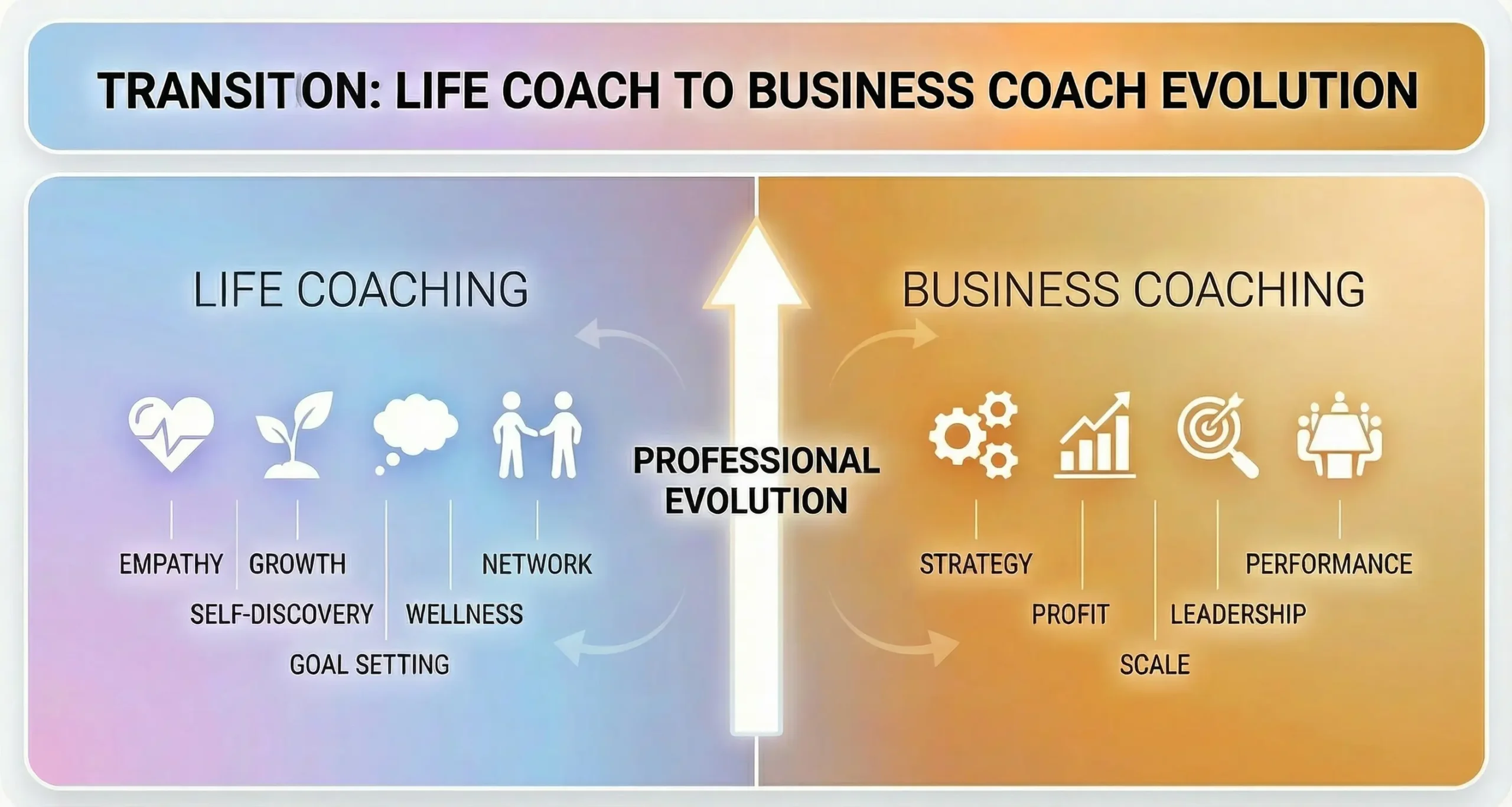
You became a life coach to make a difference. You’ve invested in life coaching certification programs, developed your skills, and genuinely help your clients transform their lives. But here’s the reality: life coaching is incredibly hard to monetize. Making the shift from life coach to business coach becomes a consideration for many talented coaches who plateau at inconsistent income levels, struggling to attract clients willing to pay premium rates for personal development work.
Key Takeaway:
- Life coaches can transition to business coaching by leveraging core skills like active listening, goal-setting, and emotional intelligence for business contexts, unlocking 2-3x higher earnings ($200-$500+ per session) and corporate clients with measurable ROI like revenue growth and leadership development. [1]
- Mechanisms include adding business acumen (revenue models, cash flow, sales funnels, metrics like conversion rates), developing strategic thinking for systems/bottlenecks, and tracking ROI (e.g., “30% revenue increase”) without needing an MBA reposition via case studies with quantified impacts. [1]
- Practical tips: Use NLP techniques for business reframing; start coaching immediately (certification optional via ICF/WABC for credibility); target niches (e.g., tech startups); offer pilot programs for case studies; network in chambers/startup meetups; update messaging to emphasize outcomes like “40% team engagement improvement.” [2]
- Caveats: Certification unregulated and not required prioritize results over formal education; learn business language quickly via podcasts/books; avoid broad targeting to command premiums; align shift with your niche to prevent mindset blocks like imposter syndrome. [2]
Bottom Line: Life coaches can seamlessly transition to business coaching by layering practical business knowledge onto their transformative skills, unlocking higher earnings and impactful results without starting over.
Business coaching offers a different path, one where your existing skills become even more valuable. Corporate clients, higher rates, strategic positioning, and measurable ROI. The best part? Your life coaching foundation isn’t something you leave behind. It’s the exact launchpad you need to make this transition successfully.
Why Life Coaches Are Uniquely Positioned for Business Coaching
Most people think business coaching and life coaching are completely different worlds. They’re wrong. The distinction isn’t about capability, it’s about context.
When Darren came to coaching, he had a well-paying job but felt completely stuck. No promotions, no raises, and unable to launch his own business despite having the skills. Through coaching that addressed his limiting beliefs and goal blocks, Darren experienced radical shifts that transformed both his career trajectory and his income potential. This is the power of combining personal development expertise with business strategy and it’s exactly what makes life coaches uniquely equipped for business coaching.
The Skills That Already Translate
Think about what you already do as a life coach. You build rapport instantly. You ask powerful questions that unlock hidden insights. You help clients set meaningful goals and hold them accountable. You recognize limiting beliefs and guide people through transformation. These aren’t just life coaching skills; they’re the foundation of exceptional business coaching.
Research confirms that personal and professional lives are interconnected. When professionals resolve internal blocks, their business performance transforms. You already know how to facilitate that shift. Business coaches who lack your personal development expertise often miss the deeper patterns holding their clients back: the fear of visibility, the perfectionism preventing launches, the imposter syndrome sabotaging negotiations.
What Makes Business Coaching Different (And Why That’s Good)
Here’s where context matters. While life coaching focuses on personal development, business coaching channels those same transformations toward specific business outcomes: revenue growth, team leadership, strategic decision-making, and operational excellence.
The shift isn’t about abandoning what you know; it’s about applying your expertise to help clients achieve measurable business results. That strategic focus is precisely what allows business coaches to command higher rates and attract corporate clients who understand the ROI of transformation.
What Skills Do You Already Have That Business Coaching Requires?
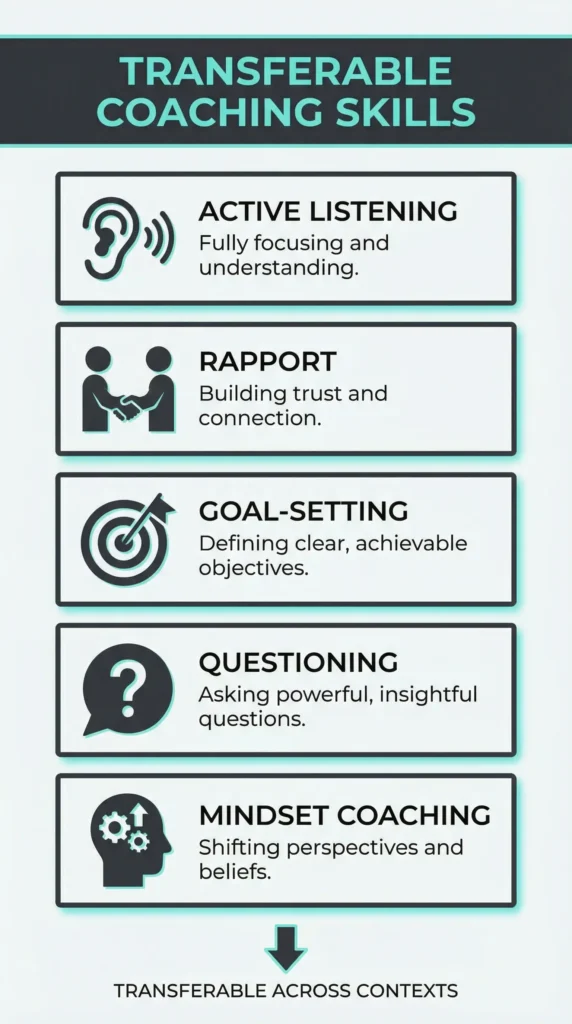
Let’s be direct: core coaching competencies remain the same whether you’re working with someone on their relationships or their business strategy. The difference is where you apply them, not whether you possess them.
Active listening. You already listen beyond words, picking up on vocal tone, energy shifts, and what’s left unsaid. In business coaching, you’ll apply this same skill to understand team dynamics, leadership challenges, and organizational culture.
Powerful questioning. You’re skilled at asking questions that challenge assumptions and reveal new perspectives. Business coaching uses the exact same technique; you’re just asking about business models, growth strategies, and market positioning instead of personal goals.
Goal-setting and accountability. You guide clients to set clear, achievable goals and hold them accountable to follow through. Business coaching requires identical skills, focused on quarterly targets, project milestones, and strategic objectives.
Rapport-building. Your ability to create psychological safety and trust transfers directly. Business clients need that same environment to be vulnerable about their fears, uncertainties, and leadership gaps.
Emotional intelligence and communication skills represent core competencies for any coach, according to leadership development research. You’ve already developed these. Business coaching simply applies them to workplace scenarios, team conflicts, difficult conversations, executive presence, and stakeholder management.
If you’ve integrated NLP techniques for business applications, you’re even further ahead. Reframing helps clients see market challenges as opportunities. Anchoring builds confidence before high-stakes presentations. Sensory acuity reveals unspoken team tensions. These tools work powerfully in business contexts because human psychology doesn’t change when someone puts on a suit.
The skills you already have aren’t just transferable, they’re exactly what business clients need most.
The 4 Skills You Need to Add to Your Toolkit
You’re equipped with the coaching foundation. Now let’s talk about the strategic layers that complete your business coaching expertise. These aren’t massive gaps; they’re focused additions that position you as a credible business advisor.
Business Acumen (Not an MBA, Just Practical Knowledge)
You don’t need a business degree. You need a basic understanding of business functions enough to understand your clients’ challenges and speak their language.
Learn the fundamentals of how businesses generate revenue, manage cash flow, and measure success. Understand the difference between B2B and B2C models. Know what sales funnels, customer acquisition costs, and profit margins mean. You’re not becoming a CFO, you’re building enough fluency to guide clients strategically.
Most of this knowledge comes from conversation, podcasts, books, and observation. If you’ve ever run a coaching business, you already understand more than you think.
Strategic Thinking and Systems Design
Life coaching often focuses on immediate challenges and personal growth. Business coaching requires you to think in systems about how different business areas connect, where bottlenecks create inefficiency, and how small changes cascade into bigger results.
This isn’t complicated. It’s about asking: “What happens next? What breaks if we scale this? Where’s the constraint?” You’re already skilled at seeing patterns in people’s lives. Apply that same pattern recognition to business processes.
Understanding Business Metrics and ROI
Business clients think in numbers. Revenue targets. Conversion rates. Team retention. Customer lifetime value. You don’t need to calculate complex formulas, but you need to help clients set measurable goals and track progress against them.
Analytical skills and risk evaluation become essential here. When a client wants to launch a new service line, you’ll help them evaluate the opportunity, identify risks, and create a decision framework, not just explore how they feel about it.
The beauty? This makes your coaching results tangible. Instead of “I feel more confident,” your clients say, “I increased revenue by 30% while working fewer hours.” That’s the ROI business coaching delivers.
Industry-Specific Knowledge (Optional but Powerful)
This is your competitive edge. If you niche into coaching tech founders, learn the startup ecosystem. If you work with healthcare professionals launching private practices, understand the industry’s regulations and challenges.
You don’t need to be an expert; your clients are the industry experts. You need enough context to ask intelligent questions and understand their unique constraints. This specialization allows you to charge premium rates and attract ideal clients faster.
Do You Need Business Coaching Certification to Make the Transition?
Here’s the truth: coaching remains an unregulated industry. You don’t legally need any certification to call yourself a business coach and start working with clients. So why does certification matter and when doesn’t it?
The case for certification: If you’re targeting corporate clients or executive coaching roles, corporate clients often require ICF credentials. Organizations want proof that you’ve completed rigorous training and adhere to professional standards. An ICF credential or WABC business coaching certification signals credibility before you even speak.
Certification also fills knowledge gaps systematically. If you don’t have real-world business experience, a structured program teaches frameworks, methodologies, and business coaching best practices that would otherwise take years to discover on your own.
The case against certification: If you have significant business experience, you’ve run companies, led teams, or built successful ventures and credibility often trumps credentials. Your results speak louder than any certificate.
Certification also costs time and money. If you’re ready to start coaching business clients today and have a way to demonstrate your value (case studies, testimonials, proven frameworks), jumping straight into client work might serve you better than spending months in another training program.
The strategic middle ground: Many successful business coaches build their practice first, then pursue certification strategically as they scale. You start with the clients you can serve now, deliver exceptional results, and add credentials later if corporate opportunities require them.
Your positioning matters more than your certification. A life coach who’s built a six-figure practice understands business better than many certified business coaches who’ve never generated consistent revenue. Lead with your strengths, and add credentials where they genuinely enhance your credibility.
How to Reposition Your Practice Without Starting Over
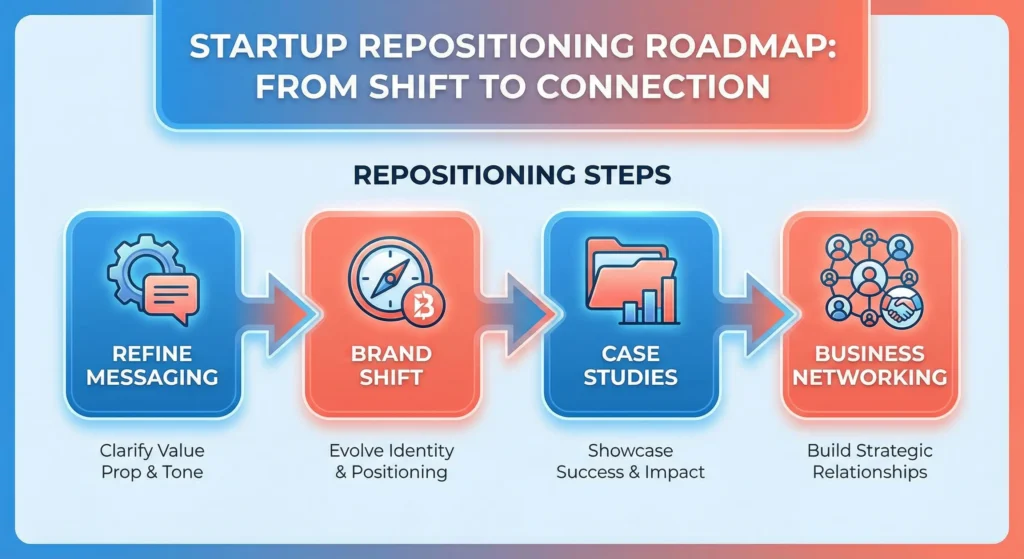
You’re not abandoning your life coaching practice, you’re evolving it. That means you don’t need to rebuild from scratch. You need to reposition strategically so business clients see you as the solution to their challenges.
Refining Your Messaging and Ideal Client
Your website probably talks about transformation, fulfillment, and living your best life. Business clients need a different language; they want results, ROI, and competitive advantage.
Update your messaging to address business outcomes. Instead of “I help professionals find clarity and purpose,” try “I help business leaders eliminate self-doubt so they make confident decisions that drive growth.” Same transformation, different framing.
Define your ideal business client specifically. “Entrepreneurs” is too broad. “Tech startup founders scaling from 10 to 50 employees” is precise. “Solo consultants who want to package their expertise and raise their rates” works. Narrow your focus, and your messaging becomes magnetic.
Case Studies That Show Business Impact
Business clients make decisions based on proof. They want to see what results you’ve delivered for people like them.
Review your existing client wins. Which ones achieved business-relevant outcomes? Maybe a client gained the confidence to negotiate a major contract. Maybe someone launched their side business successfully. Maybe a leader transformed their team’s culture and reduced turnover.
Frame these stories around business impact. Quantify results where possible: “Helped a VP overcome leadership anxiety, resulting in a 40% improvement in team engagement scores.” “Coached a consultant through pricing strategy and mindset blocks, leading to a 3x rate increase.”
If you’re just starting the transition and lack business-specific case studies, offer pilot programs at reduced rates in exchange for detailed testimonials and success metrics. Three powerful case studies are worth more than any certification.
Networking in Business Communities (Not Just Coaching Circles)

Life coaches network with other coaches. Business coaches network with business owners, executives, and industry leaders. That’s where your future clients are.
Join local business groups, chambers of commerce, and industry associations. Attend startup meetups, leadership conferences, and entrepreneurial events. Contribute value, speak at events, write articles for business publications, and offer insights in online forums where your ideal clients gather.
Your business coaching expertise grows through immersion. The more you engage with the business community, the more fluent you become in their challenges, language, and priorities. This isn’t just marketing, it’s professional development that makes you a better coach.
When you understand how NLP enhances business coaching, you bring a unique advantage. Most business coaches focus purely on strategy and tactics. You address the mindset and communication patterns that determine whether those strategies actually get implemented. That’s your differentiator.
Frequently Asked Questions
Can a life coach become a business coach?
Yes, life coaches can become business coaches. The core coaching competencies, active listening, powerful questioning, goal-setting, and accountability, are identical for both roles. The difference is context: life coaches focus on personal development while business coaches apply the same skills to business outcomes. Life coaches who add business acumen and understand metrics can transition successfully.
What is the difference between a life coach and a business coach?
Life coaches help clients achieve personal goals related to relationships, health, and life balance. Business coaches focus on professional objectives, including revenue growth, leadership development, and strategic planning. The coaching skills are nearly identical, but business coaches need additional knowledge of business operations, financial metrics, and ROI measurement to deliver strategic guidance.
How much do business coaches make compared to life coaches?
Business coaches typically earn significantly more than life coaches. While life coaches charge $75-$200 per session, business coaches command $200-$500+ per session or monthly retainers of $2,000-$10,000+. Corporate and executive coaching contracts can reach six figures annually due to measurable business impact and ROI.
Do I need a business degree to be a business coach?
No, you don’t need a business degree to become a business coach. What matters is understanding business fundamentals, revenue generation, operations, and success metrics, combined with strong coaching skills. Many successful business coaches built their credibility through running businesses, not academic credentials. ICF or WABC certifications can help if you lack hands-on business experience.
Is business coaching certification worth it for life coaches?
It depends on your goals. Certification is valuable if you’re targeting corporate clients who often require ICF credentials. It also helps if you lack business experience, providing frameworks and credibility. However, if you have real-world business experience, your proven results may matter more. Many coaches start working with clients first and pursue certification later as they scale.
Your Next Step: From Life Coach to Business Coach
The transition from life coach to business coach isn’t about learning an entirely new profession. It’s about recognizing that the skills you’ve already mastered, the ability to facilitate transformation, build trust, and guide people through change, are exactly what business clients desperately need.
You’ve invested in your coaching foundation. You understand human behavior, motivation, and transformation at a deep level. Now you’re adding strategic business context, metrics-focused thinking, and industry knowledge. That combination is powerful.
The path forward is clear: identify the business niche you’re drawn to, learn their specific challenges, position your expertise around business outcomes, and start serving clients who value the transformation you deliver. Your life coaching skills aren’t a limitation; they’re your competitive advantage in a business coaching market that often overlooks the human side of business success.
Transform your coaching practice by leveraging what you already know and adding what’s missing. The businesses that need your help are waiting; they just need to discover that you’re the coach who gets both the business strategy and the human transformation required to execute it.
What’s one business skill you’re most excited to develop as you make this transition? Share your thoughts, I’d love to hear where you’re headed next.