

Your resume got you the interview. Your technical skills landed you the job. Your intelligence opened doors that others couldn’t even see. But when it comes to EQ vs IQ, here’s what nobody told you: none of that predicts whether you’ll actually succeed as an executive.
Key Takeaway:
- In 2026 and beyond, Emotional Intelligence (EQ) will be far more important than IQ for executive success. While IQ gets you the job, EQ determines how far you’ll go and how effectively you’ll lead in an increasingly complex, hybrid, and AI-driven business world. [1]
- Top leaders with high EQ excel at self-awareness, empathy, emotional regulation, relationship management, and adaptability — skills that drive better team performance, innovation, retention, and crisis management. IQ-focused leaders often struggle with collaboration and people challenges. [1]
- Organizations are now actively measuring and developing EQ in leadership programs. Executives who invest in building their emotional intelligence will have a significant competitive advantage in promotions, influence, and long-term career success. [2]
- The future belongs to leaders who combine high IQ with even higher EQ — the ability to understand, manage, and influence emotions in themselves and others. [2]
Bottom Line: In 2026, EQ will outperform IQ as the #1 predictor of executive success. Leaders who deliberately develop self-awareness, empathy, and relationship skills will rise faster, lead better teams, and create more resilient organizations than those who rely solely on intelligence.
I’ve worked with dozens of brilliant leaders who couldn’t figure out why they kept hitting career ceilings. High IQ. Impressive credentials. Technical mastery in their field. Yet they watched colleagues with less intellectual firepower get promoted past them, close bigger deals, and build teams that would follow them anywhere. The difference wasn’t intelligence. It was emotional intelligence and the gap between the two determines everything about your trajectory once you reach leadership levels.
The data is clear and it’s surprising. Emotional intelligence is four times more powerful than IQ in predicting success once you enter executive roles. NLP techniques that develop emotional intelligence systematically offer a proven pathway to building these capabilities, and leadership development that integrates both cognitive and emotional intelligence creates executives who don’t just manage, they transform organizations. Let’s look at why this matters in 2026 and exactly how you can develop the emotional intelligence that separates good leaders from exceptional ones.
The IQ Myth: Why Intelligence Alone Doesn’t Predict Executive Success
For decades, organizations built their entire hiring and promotion systems around intelligence testing. High IQ meant high potential. The smartest person in the room should lead the room, right? That logic makes sense until you actually test it against real-world outcomes.
Daniel Goleman’s research revealed something that changed how we think about leadership capability. There’s a threshold effect with IQ. You need above-average intelligence, roughly 115 or one standard deviation above the norm, to master the technical knowledge required to be a doctor, lawyer, or business executive. But here’s the critical insight: once people enter the workforce at that level, IQ and technical skills become roughly equal among those rising through the ranks. Beyond that threshold, IQ stops correlating with success.
Think about your own organization. At the executive level, everyone’s smart. Everyone has solid credentials and technical competence. So what separates the top 10% from the middle 60%? It’s not who scores highest on cognitive ability tests. It’s who can read a room, regulate their emotional responses under pressure, build trust quickly, and navigate the complex interpersonal dynamics that define leadership work.
The 2026 reality makes this even more pronounced. Technical skills have become table stakes, not differentiators. Your competition isn’t less intelligent than you. They have access to the same information, the same tools, and often the same education. The executives who stand out are the ones who can do something AI and algorithms can’t replicate: understand human emotion, build genuine relationships, and inspire people to follow them through uncertainty.
The EQ Advantage: Data That Changes Everything
The 90/20 Rule
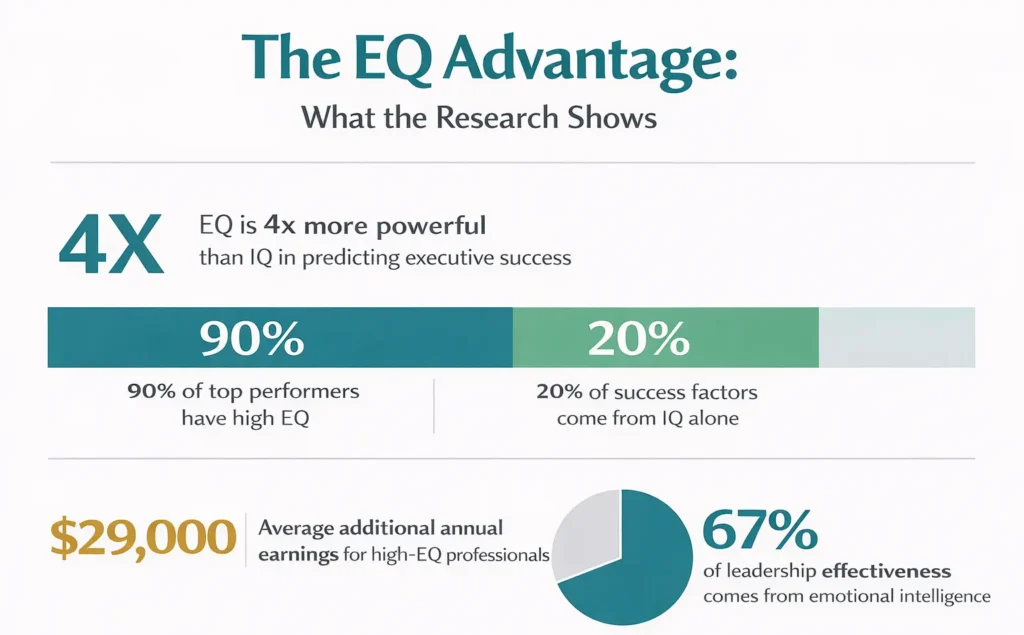
Harvard research demonstrates that emotional intelligence accounts for nearly 90% of what moves people up the ladder when IQ and technical skills are roughly similar. Let that sink in. Once you’re competing with equally intelligent people, 90% of your differentiation comes from emotional intelligence.
The numbers get more specific. Ninety percent of top performers score high on emotional intelligence. Compare that to high IQ, which accounts for only about 20% of the factors that distinguish high performers from average ones. Emotional intelligence influences 58% of job performance across all job types. Recent studies confirm that executives with high EQ outperform their peers by 35% in leadership effectiveness.
The $29,000 Question
Here’s where emotional intelligence stops being an abstract concept and becomes a concrete financial reality. Workplace intelligence research reveals that people with high emotional intelligence make an average of $29,000 more per year than those with lower EQ. Not 29 dollars. Not 2,900. Twenty-nine thousand.
Break it down further and the pattern holds. Every single point increase in emotional intelligence adds roughly $1,300 to your annual salary. Companies aren’t paying a premium for niceness or being easy to work with. They’re paying for measurable business outcomes. Leaders with high EQ close deals that others lose, retain talent that competitors can’t keep, and navigate conflicts that would derail less emotionally aware executives.
Organizations that focus on hiring and developing emotional intelligence see 22% higher revenue growth than those that don’t. That’s not correlation, that’s causation backed by longitudinal research tracking business outcomes over years.
Leadership Effectiveness Formula
When you measure what actually makes leaders effective, emotional intelligence dominates the equation. Sixty-seven percent of leadership effectiveness comes from EQ, not from cognitive ability or technical expertise. McKinsey research shows that emotionally intelligent leaders boost employee engagement by 20%. Teams led by high-EQ leaders experience 50% lower turnover rates.
Organizational culture research from 2025 reveals even more dramatic impacts. Employees working for leaders with high emotional intelligence are 18 times more likely to feel a strong sense of success, 13 times more likely to do great work, and 9 times more likely to have a sense of purpose. Those aren’t marginal improvements. Those are transformational differences in how people experience their work and how much they contribute.
What Exactly Is Emotional Intelligence? (And Why Most Definitions Miss the Point)
Emotional intelligence gets reduced to “people skills” or “being nice” in most conversations, but that misses what actually makes it powerful. Daniel Goleman identified four core components: self-awareness, self-management, social awareness, and relationship management. Each one matters, and most leaders are stronger in some than others.
Self-awareness means you can recognize your emotions as they’re happening. You know when you’re getting defensive, frustrated, anxious, or overly excited. That sounds simple until you’re in a high-stakes negotiation and realize you missed your own emotional shifts until after you’d already reacted poorly.
Self-management takes that awareness and uses it to direct your behavior productively. You feel frustrated, but you don’t let that frustration control how you respond. You’re anxious about a presentation, but you access a state of confidence instead of letting anxiety undermine your delivery.
Social awareness is about reading other people’s emotions accurately. Can you tell when someone’s disengaged in a meeting? Do you pick up on micro-expressions that reveal disagreement before it’s voiced? Can you sense when your team is burning out before they explicitly say so?
Relationship management brings it all together. You use your awareness of your emotions and others’ emotions to build trust, resolve conflicts, influence decisions, and inspire performance. This isn’t manipulation. It’s calibration. It’s understanding that different people need different communication approaches and having the flexibility to adapt.
From an NLP perspective, emotional intelligence is about sensory acuity and behavioral flexibility. Can you notice subtle shifts in tone, posture, and language patterns? Can you adjust your approach based on what you’re observing? That’s what separates technically competent managers from leaders people choose to follow.
The 2026 Context: Why EQ Matters More Than Ever
Emerging trends in emotional intelligence show that AI is fundamentally changing what organizations value in human leaders. As artificial intelligence handles more technical and analytical tasks, the skills that remain uniquely human become exponentially more valuable. Machines can process data, recognize patterns, and even simulate certain empathetic responses. They can’t build genuine trust, navigate complex interpersonal dynamics, or inspire people through authentic connection.
Hybrid work environments have amplified the need for emotional intelligence. Leading teams across digital and physical spaces requires heightened social awareness. You can’t rely on walking through the office and picking up on the ambient mood. You need to read subtle cues through video calls, written communication, and asynchronous interactions. The executives who thrive in hybrid contexts are those who can maintain connection and read emotional states across limited bandwidth.
Economic uncertainty demands resilience and adaptability, both grounded in emotional intelligence. When markets shift, strategies fail, or organizations restructure, people look to leaders who can acknowledge reality without catastrophizing, who can regulate their own stress responses while helping others do the same.
The trust crisis affecting institutions globally requires authentic leadership. People can spot performance from miles away. They’ve been burned by leaders who said the right things but didn’t mean them. The executives building loyalty in 2026 are those who demonstrate genuine emotional awareness and integrity.
The World Economic Forum projects that demand for emotional intelligence skills will grow six times over the next few years. Not incrementally. Exponentially. Organizations recognize that technical skills become obsolete quickly, but emotional intelligence remains relevant regardless of industry shifts or technological changes.
IQ vs. EQ: The Real Relationship (It’s Not Competition)
The question isn’t whether IQ or EQ matters more in some absolute sense. Both matter, but they matter at different stages and in different contexts. IQ opens doors. It gets you hired. It helps you master technical complexity and solve analytical problems. Emotional intelligence determines how far you go once you’re through those doors.
Think of it as a progression. Early career success correlates more strongly with cognitive ability and technical skills. You’re proving you can do the work. Mid-career differentiation starts shifting toward emotional intelligence. You’re now working through others, influencing without authority, navigating politics. By the time you reach executive levels, emotional intelligence becomes the primary predictor of effectiveness.
The danger zone is high IQ combined with low EQ. A landmark 40-year study tracking PhDs at UC Berkeley found that emotional intelligence was four times more powerful than IQ in predicting long-term success. The “brilliant jerk” phenomenon is real. Leaders who are intellectually impressive but emotionally tone-deaf create toxic cultures, lose top talent, and ultimately undermine their own potential.
Research shows a case that illustrates this perfectly. A technically brilliant CEO, someone who could analyze complex market dynamics and develop sophisticated strategies, struggled to retain leadership team members. His IQ was exceptional. His emotional awareness was minimal. He couldn’t read when he was overwhelming people, dismissing their concerns, or creating environments where no one felt safe disagreeing with him. The organization’s performance suffered not because of a bad strategy, but because execution depended on people who eventually left.
The most effective leaders integrate both. They use cognitive intelligence to understand complex problems and emotional intelligence to mobilize people around solutions. They think strategically and connect authentically. That combination is what creates sustainable executive success.
How Can Executives Develop Emotional Intelligence?
Here’s the good news that changes everything: unlike IQ, which remains relatively stable after adolescence, emotional intelligence can be developed throughout your career. Emotional intelligence research shows that with awareness and deliberate practice, people can significantly improve their emotional capabilities.
How NLP enhances the communication skills that emotional intelligence requires starts with building self-awareness. One powerful technique is anchoring, consciously linking resourceful emotional states to specific triggers you can access under pressure. When you need confidence before a high-stakes presentation, you can anchor that feeling to a gesture or phrase that reliably brings that state back. This isn’t positive thinking. It’s neurological programming based on how your brain creates associations.
Sensory acuity training develops your ability to read micro-expressions, shifts in tone, and subtle non-verbal cues. Most people miss 80% of the emotional information available in conversations because they’re focused on content rather than calibration. Learning to notice pupil dilation, breathing patterns, posture shifts, and micro-expressions gives you real-time feedback about how your message is landing and what others are actually feeling.
Reframing is the NLP technique for managing your emotional response under pressure. Something goes wrong. Your initial reaction might be frustration or anxiety. Reframing lets you consciously shift perspective. “This isn’t a disaster, it’s feedback. What can I learn from this? How can this make the outcome better?” That’s not denial. It’s choosing where to direct your attention and what meaning to assign to events.
Rapport-building skills let you establish trust quickly with diverse stakeholders. Matching and mirroring communication styles, pacing and leading conversations, and understanding predicates (whether someone processes information visually, auditorially, or kinesthetically) help you connect authentically rather than forcing your natural style on everyone you meet.
One executive came to me, earning well but feeling completely stuck, blocked from promotions despite obvious intelligence and technical skill. Through identifying his goal blocks and emotional patterns using NLP techniques, he unlocked radical shifts in both his career trajectory and his relationships. The breakthrough wasn’t learning new technical skills. It was developing awareness of the emotional patterns that were sabotaging his leadership potential and building new capabilities for managing those patterns differently.
What’s the Difference Between Self-Awareness and Self-Management?
These terms get used interchangeably, but the distinction matters. Self-awareness is recognizing your emotions as they happen. You notice, “I’m feeling defensive right now,” or “I’m getting anxious about this deadline,” or “I’m more excited about this idea than the data warrants.” That recognition is the foundation.
Self-management takes that awareness and directs your behavior productively despite what you’re feeling. You notice defensiveness and choose not to dismiss valid criticism. You recognize anxiety and implement techniques to access calm focus. You catch yourself getting carried away by excitement and deliberately evaluate the idea more critically.
Most leaders are stronger in one than the other. Some have excellent self-awareness but struggle with self-management. They know exactly what they’re feeling and why, but they still let those emotions control their responses. Others have strong self-management through sheer willpower but limited self-awareness. They control their outward behavior through discipline but don’t actually notice their emotional shifts until they’re already intense.
The NLP meta-model provides powerful questions for developing self-awareness. “What specifically am I feeling right now?” “What triggered this emotional response?” “How is this feeling showing up in my body?” Those questions create the observation point that awareness requires.
Anchoring techniques support self-management by giving you reliable access to resourceful states when you need them. You can’t always control what you feel initially, but you can learn to shift into states that serve your goals. That’s what self-management actually means in practice.
Can High IQ Compensate for Low EQ in Leadership Roles?
Short answer: No. And the data makes clear why attempting it creates more problems than it solves. Research consistently shows that high-IQ leaders with low EQ create toxic organizational cultures. They might achieve short-term results through force of intellect or technical brilliance, but they leave destruction in their wake.
The “brilliant jerk” problem is so common it has a name. These are leaders who excel at analysis, strategy, and technical problem-solving but fail catastrophically at the interpersonal dimensions of leadership. They dismiss emotions as irrelevant, treat people as interchangeable resources, and create environments where fear replaces trust.
Specific NLP frameworks for leadership effectiveness emphasize that emotional regulation matters more as the stakes increase. When pressure is low, you can sometimes compensate for emotional blind spots through intellect alone. When pressure intensifies during a crisis, rapid change, or high-stakes negotiations, your emotional intelligence determines whether you elevate or crater.
Fifty-nine percent of employers say they wouldn’t hire someone with low emotional intelligence regardless of how high their IQ scores are. That’s not because organizations undervalue intelligence. It’s because they’ve learned through painful experience that brilliant people without emotional awareness create unsustainable costs: turnover, conflict, damaged relationships with clients and partners, and cultures that repel rather than attract top talent.
How Do You Measure Emotional Intelligence in the Workplace?
Unlike IQ, which can be assessed through standardized cognitive tests, emotional intelligence reveals itself through behavior in real contexts. The most reliable measurement comes from 360-degree feedback, where colleagues, direct reports, and supervisors evaluate specific behaviors related to self-awareness, self-management, social awareness, and relationship management.
Watch how people handle conflict. Do they escalate or de-escalate tension? Can they disagree without making it personal? Do they seek to understand before seeking to be understood? Those behaviors reveal emotional intelligence in action.
Observe feedback delivery. Leaders with high EQ give feedback that’s direct but respectful, specific rather than vague, and focused on growth rather than blame. They can deliver difficult messages in ways that strengthen rather than damage relationships.
Notice team collaboration patterns. High-EQ leaders build psychological safety where people share ideas, admit mistakes, and challenge assumptions. Low-EQ leaders create environments where people hide problems, agree publicly but disagree privately, and cover themselves rather than taking intelligent risks.
From an NLP perspective, assessment includes calibration accuracy. Can the person read emotional states correctly in others? When they think someone is engaged, are they actually engaged? When they perceive resistance, is resistance actually present? Misreading emotional states leads to interventions that don’t match the situation.
Tools like the EQ-i 2.0 (used by Google, Microsoft, Amazon, and Stanford University) provide structured assessment frameworks, but real emotional intelligence shows up in how people navigate actual workplace challenges, not just in how they describe their capabilities on assessments.
Why Does Emotional Intelligence Predict Career Success Better Than IQ?
The answer becomes obvious when you look at what executive work actually requires. Success at leadership levels depends far more on influencing people than analyzing data. You need to build coalitions, resolve conflicts, inspire commitment, and navigate organizational politics. None of those challenges yield to pure intellectual horsepower.
Collaboration beats solo genius in modern organizations. The problems companies face are too complex for any individual, regardless of IQ, to solve alone. Executive coaching that develops emotional intelligence alongside business acumen recognizes that getting results through teams requires understanding motivation, building trust, and managing group dynamics, all emotional intelligence capabilities.
Stress management determines performance under pressure. Executives face constant high-stakes decisions with incomplete information, competing priorities, and significant consequences. Your cognitive abilities don’t help if stress hijacks your prefrontal cortex and you revert to reactive, emotional responses. Emotional intelligence includes the capacity to regulate stress responses and maintain executive function when it matters most.
Relationship quality drives opportunities and support throughout your career. The executives who advance aren’t necessarily the smartest. They’re the ones people want to work with, who build networks of advocates, who create goodwill that translates into opportunities others never see. Those relationships are built on emotional intelligence, not intellectual performance.
Seventy-one percent of hiring managers value emotional intelligence over technical skills when evaluating candidates. That’s not sentimentality. That’s recognition that technical skills can be taught but emotional capabilities determine whether someone will actually succeed in the role.
FAQs
1. Which is a better predictor of executive success: IQ or EQ?
While IQ is essential for entering high-level roles, Emotional Intelligence (EQ) is 4x more powerful than IQ in predicting executive success. Research indicates that once a leader meets the cognitive threshold (roughly an IQ of 115), intellectual ability stops correlating with career advancement. In leadership roles, 67% of effectiveness is driven by EQ, as executives must navigate complex interpersonal dynamics and team leadership rather than just technical tasks.
2. Why does emotional intelligence (EQ) matter more in the 2026 workplace?
In 2026, EQ has become the primary differentiator for human leaders because AI and algorithms now handle most technical and analytical tasks. As automation manages data processing, uniquely human skills such as building genuine trust, reading subtle emotional cues in hybrid work environments, and inspiring teams through economic uncertainty have grown 6x in demand according to the World Economic Forum.
3. Can emotional intelligence be learned, or is it an innate trait?
Unlike IQ, which remains relatively stable after adolescence, emotional intelligence can be systematically developed at any career stage. Proven methods for increasing EQ include NLP (Neuro-Linguistic Programming) techniques such as:
Anchoring: Accessing confident emotional states under pressure.
Reframing: Shifting perspectives to manage stress responses.
Sensory Acuity: Training the brain to recognize micro-expressions and non-verbal cues to improve social awareness.
4. What is the financial impact of high emotional intelligence for leaders?
High EQ correlates directly with higher earnings and organizational growth. Statistics show that individuals with high emotional intelligence earn an average of $29,000 more annually than those with low EQ. On a corporate level, organizations that prioritize emotional intelligence in leadership development see 22% higher revenue growth and 50% lower employee turnover rates.
5. What are the 4 core components of emotional intelligence in leadership?
According to Daniel Goleman’s framework, there are four pillars of EQ essential for executives:
Self-Awareness: Recognizing your emotions and triggers in real-time.
Self-Management: Controlling your behavioral responses despite emotional shifts.
Social Awareness: Accurately reading the emotions and concerns of others (empathy).
Relationship Management: Using emotional insights to resolve conflict, influence others, and build high-performing teams.
Conclusion
IQ gets you hired. Emotional intelligence gets you promoted. That’s the pattern that holds across industries, organizations, and career levels. The technical skills and cognitive ability that built your early career become baseline expectations as you move into leadership. From there, your trajectory depends on capabilities that many smart people never develop: the ability to recognize and manage your own emotions, read and respond to others’ emotional states, build trust across diverse relationships, and navigate complex interpersonal dynamics with skill.
The 2026 imperative is clear. As AI handles more technical and analytical work, the skills that remain uniquely human become your primary source of value. Organizations will pay a premium for leaders who can do what machines can’t: inspire teams through authentic connection, build cultures of trust and innovation, and navigate the messy, complicated, emotionally charged realities of human collaboration.
Here’s what separates executives who plateau from those who keep advancing. Start with self-awareness. Practice noticing your emotional states in real time. Build self-management skills through techniques like anchoring and reframing that give you access to resourceful states under pressure. Develop social awareness by paying attention to the subtle cues most people miss. Strengthen relationship management by using NLP applications for executive performance that enhance your ability to connect, influence, and lead.
Emotional intelligence isn’t a personality trait; you’re born with it’s a skillset you develop through deliberate practice. The executives who thrive in 2026 won’t be the smartest people in the room. They’ll be the ones who can read the room, regulate their responses, and build trust across diverse teams navigating unprecedented uncertainty. Your intelligence opened doors. Your emotional intelligence determines what you build once you walk through them.