
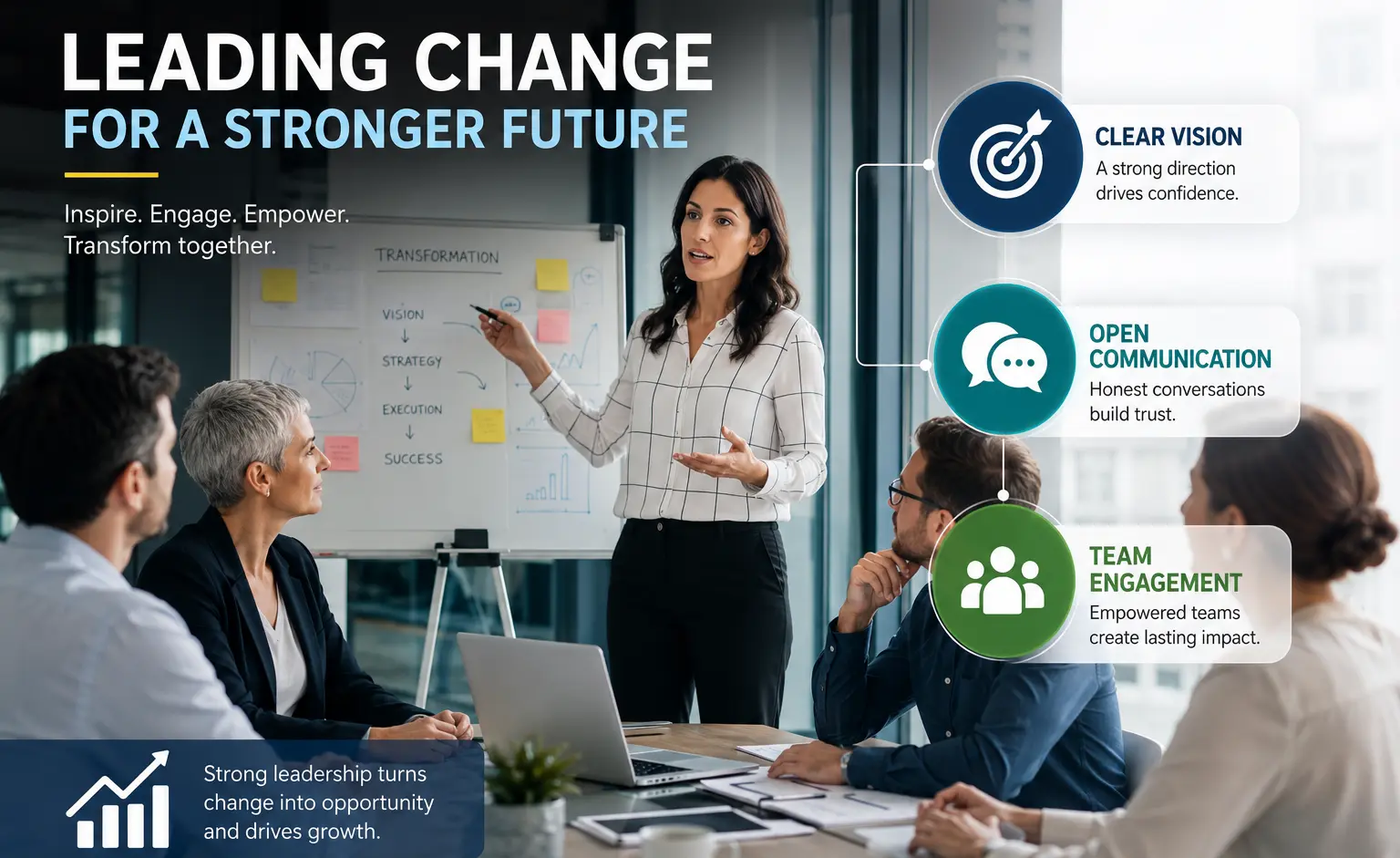
Effective leadership during change requires clear communication, empathy, adaptability, employee involvement, ongoing training, and a compelling vision. Leaders who provide clarity and support during transitions help reduce resistance, improve engagement, and increase the likelihood of successful organizational transformation.
Change is inevitable in every organization, whether it’s adopting new technology, entering fresh markets, or restructuring teams. For employees, change often brings uncertainty, fear, and resistance. This is where leadership makes the difference between chaos and growth.
Key Takeaway:
- Successful change leadership starts with a clear vision and purpose. Employees are more likely to embrace change when they understand why it is happening, how it supports organizational goals, and what success looks like. [1]
- Transparent communication and employee involvement reduce uncertainty and resistance. Leaders who encourage feedback, share updates regularly, and create opportunities for participation build trust and commitment during transitions. [1]
- Empathy, adaptability, and ongoing support help teams navigate disruption more effectively. Providing training, resources, and guidance enables employees to develop confidence and new skills throughout the change process. [1]
- Breaking large transformations into smaller milestones and celebrating progress keeps teams engaged, motivated, and resilient while reinforcing positive momentum toward long-term goals. [2]
Bottom Line: Effective change leadership combines vision, communication, empathy, and adaptability to guide teams through uncertainty. Leaders who involve employees, provide support, and celebrate progress can transform resistance into engagement and turn organizational change into an opportunity for growth.
A leader’s role is not just to manage processes but to inspire confidence, create clarity, and guide teams with resilience. Effective leadership during change transforms potential disruption into a springboard for innovation, engagement, and long-term success.
In this article, we’ll break down seven core strategies for leading through change, explore the benefits of strong leadership, highlight common challenges leaders face, and share practical tips to keep teams motivated and adaptable.
What Is Change Leadership?
Change leadership is the process of guiding individuals, teams, and organizations through transitions while maintaining engagement, productivity, and alignment with business goals. Unlike change management, which focuses on processes and systems, change leadership focuses on people, communication, trust, and organizational culture
Strong change leaders help employees understand why change is necessary, reduce uncertainty, and build confidence throughout the transition process.
| Change Leadership | Change Management |
|---|---|
| Focuses on people | Focuses on processes |
| Creates vision and inspiration | Implements plans |
| Builds trust | Tracks execution |
| Encourages adaptability | Ensures compliance |
| Long-term cultural impact | Short-term operational focus |
Why Effective Leadership Matters During Change

Organizational change often creates uncertainty among employees. Without strong leadership, productivity can decline, morale may suffer, and resistance can spread throughout teams.
Effective leaders provide clarity, maintain trust, and help employees navigate transitions with confidence. By communicating openly and supporting their teams, leaders can turn disruptive periods into opportunities for innovation and growth.
Core Strategies for Effective Leadership During Change
- Establish a clear vision and purpose.
- Communicate transparently and consistently.
- Foster an inclusive environment.</li>
- Lead with empathy and adaptability.</li>
- Empower teams with resources and training.
- Set short-term goals and celebrate wins.
- Demonstrate resilience and positivity.
These strategies help leaders reduce uncertainty, improve employee engagement, and increase the success rate of organizational change initiatives.
How Effective Change Leadership Works
Successful change leadership follows a structured approach that keeps employees informed, engaged, and prepared throughout the transition process.
- Create a Clear Vision: Explain why the change is necessary and what success looks like.
- Communicate Frequently: Provide regular updates and address concerns before uncertainty grows.
- Involve Employees: Seek feedback and encourage participation in decision-making.
- Provide Resources: Offer training, tools, and support to help employees adapt.
- Monitor Progress: Track milestones and adjust strategies when necessary.
- Celebrate Wins: Recognize achievements to sustain momentum and motivation.
Benefits of Effective Change Leadership

Effective leadership during change goes beyond managing transitions; it shapes how employees feel, adapt, and perform. When leaders provide clarity, empathy, and support, teams grow stronger instead of resisting. These benefits not only ease the current shift but also set the stage for long-term organizational success.
Enhanced Employee Engagement
When leaders communicate openly and include employees, engagement rises. Teams feel valued and committed to organizational goals.
Strengthened Organizational Culture
Inclusive leadership fosters trust and collaboration. Over time, this strengthens a culture that embraces change instead of fearing it.
Improved Change Resilience
Equipped with adaptability, employees become more capable of facing future transitions confidently.
Greater Innovation
Encouraging diverse ideas during change creates opportunities for fresh solutions and creative problem-solving.
Long-Term Sustainability
Strong leadership during change lays the foundation for healthier, more collaborative organizations that thrive in the long run.
Data and Findings on Leadership During Change
Research consistently shows that leadership quality is one of the strongest predictors of successful organizational change. Organizations that prioritize communication, employee involvement, and leadership development are significantly more likely to achieve successful transformation outcomes.
- Research from McKinsey suggests that a large percentage of transformation initiatives fail to achieve their intended goals, often due to employee resistance and insufficient leadership support.
- Gallup research shows that managers and leaders have a major influence on employee engagement, trust, and workplace performance.
- Studies consistently find that employees are more likely to embrace change when leaders communicate a clear vision and explain the reasons behind organizational decisions.
- Organizations that invest in employee training and development during transitions typically experience higher adoption rates and improved long-term outcomes.
| Success Factor | Impact |
|---|---|
| Clear communication | Reduces resistance |
| Leadership trust | Improves engagement |
| Employee involvement | Increases adoption |
| Skills training | Accelerates transition |
| Recognition programs | Maintains motivation |
Challenges Leaders May Face During Change

Change is rarely a smooth process, and even the most skilled leaders encounter obstacles when guiding their teams through transitions. From resistance fueled by fear of the unknown to communication gaps and limited resources, these challenges can quickly derail progress if not handled effectively.
Understanding these common hurdles and knowing how to address them with empathy, strategy, and resilience helps leaders turn potential roadblocks into opportunities for growth and stronger team alignment.
Resistance to Change
Resistance is one of the most common hurdles leaders encounter. Employees may worry about losing their jobs, adapting to new systems, or failing to meet new expectations. This fear of the unknown can create pushback, rumors, and negativity that slow down progress.
Solution: Leaders can ease resistance by practicing empathy and maintaining open communication. Listening to concerns, addressing fears honestly, and clearly explaining the benefits of the change helps employees feel included rather than forced into transition.
Resource Constraints
Organizational change often requires additional resources, whether financial, technological, or human. Limited budgets, tight deadlines, or staff shortages can create stress and make teams feel overwhelmed. Without proper support, even well-planned initiatives may stall.
Solution: Leaders should prioritize high-impact actions, focusing on areas that bring the greatest return. Phased rollouts, cross-training staff, and reallocating resources strategically can help manage limitations while still achieving meaningful progress.
Communication Breakdowns
When updates are inconsistent or unclear, confusion spreads quickly. Misunderstandings, misinformation, or mixed messages can lead to frustration, mistakes, and disengagement across the team.
Solution: Establishing centralized communication channels, such as weekly updates, dedicated project dashboards, or town hall meetings, ensures everyone receives accurate and consistent information. Routine check-ins provide opportunities to clarify details and answer questions.
Decline in Engagement
Change fatigue can set in when employees feel overloaded by constant shifts or unclear expectations. This often results in declining motivation, productivity, and morale.
Solution: Leaders can sustain engagement by recognizing employee contributions, celebrating small wins, and maintaining ongoing dialogue. Creating opportunities for feedback and highlighting progress helps teams feel their efforts are valued and impactful.
Common Mistakes Leaders Make During Organizational Change

Even well-intentioned leaders can unintentionally create obstacles during organizational change. Understanding these common mistakes can help leaders maintain trust, reduce resistance, and improve the likelihood of a successful transition.
Failing to Explain the “Why” Behind the Change
One of the biggest mistakes leaders make is announcing a change without clearly explaining the reason behind it. Employees are far more likely to support change when they understand the business goals, challenges, or opportunities driving the decision.
Without context, team members may assume the worst, leading to fear, skepticism, and resistance.
Best Practice: Clearly communicate why the change is happening, how it aligns with organizational goals, and what benefits it is expected to deliver.
Communicating Too Little or Too Late
During periods of uncertainty, employees actively seek information. When leaders fail to communicate regularly, rumors and misinformation often fill the gap.
Infrequent updates can create confusion, lower morale, and weaken trust in leadership.
Best Practice: Establish a consistent communication schedule through meetings, emails, team updates, and one-on-one conversations.
Ignoring Employee Feedback and Concerns
Employees are often the first to identify practical challenges associated with organizational change. Leaders who dismiss concerns risk creating frustration and disengagement.
Resistance is frequently not opposition to change itself but a response to feeling unheard or excluded from the process.
Best Practice: Create opportunities for employees to ask questions, share feedback, and participate in discussions about the transition.
Assuming Employees Will Automatically Adapt
Many leaders underestimate the learning curve associated with new technologies, processes, or organizational structures. Employees may struggle to adapt without proper support.
This can result in lower productivity, increased errors, and reduced confidence.
Best Practice: Provide training programs, coaching, documentation, and ongoing support throughout the transition period.
Focusing Only on Operational Changes
Successful change is not just about systems and processes. Organizational change also affects employee emotions, workplace relationships, and team dynamics.
Leaders who focus exclusively on operational objectives may overlook the human side of change.
Best Practice: Balance business goals with empathy, emotional support, and active listening.
Trying to Implement Too Many Changes at Once
Introducing multiple major initiatives simultaneously can overwhelm employees and create change fatigue. Teams may struggle to prioritize tasks and maintain performance levels.
Excessive change often leads to burnout, reduced engagement, and slower adoption.
Best Practice: Prioritize initiatives and introduce changes in manageable phases whenever possible.
Neglecting to Measure Progress
Without measurable goals and performance indicators, leaders may struggle to determine whether change efforts are succeeding.
A lack of monitoring can cause problems to go unnoticed until they become significant obstacles.
Best Practice: Track key metrics such as employee engagement, adoption rates, productivity, training completion, and project milestones.
Failing to Recognize and Celebrate Progress
Large-scale organizational change can take months or even years to complete. If leaders focus only on the final outcome, employees may lose motivation along the way.
Celebrating milestones reinforces positive behaviors and helps maintain momentum.
Best Practice: Recognize both team and individual achievements throughout the change journey.
| Leadership Mistake | Potential Impact | Recommended Solution |
|---|---|---|
| Poor communication | Confusion and rumors | Frequent updates |
| Lack of vision | Resistance and uncertainty | Explain the purpose |
| Ignoring feedback | Employee disengagement | Encourage participation |
| Insufficient training | Slow adoption | Provide resources |
| Change overload | Burnout and fatigue | Implement in phases |
| Lack of measurement | Poor decision-making | Track KPIs |
| Ignoring emotions | Lower trust | Lead with empathy |
| No recognition | Reduced motivation | Celebrate milestones |
Best Practices for Leading Through Change
- Communicate consistently and transparently.
- Explain the purpose behind organizational changes.
- Encourage employee participation.
- Invest in ongoing training and development.
- Recognize achievements regularly.
- Monitor team morale and engagement.
- Remain flexible when challenges arise.
- Lead by example.
Real-World Example of Effective Change Leadership

During the global shift to remote and hybrid work environments, organizations that communicated frequently, provided digital collaboration tools, and prioritized employee well-being adapted more successfully than those that relied solely on traditional management approaches.
Leaders who maintained transparency, encouraged feedback, and invested in employee support programs were better positioned to sustain productivity and engagement throughout the transition.
Conclusion: Leading Change as a Catalyst for Growth
Organizational change can feel disruptive, but with the right leadership, it becomes an opportunity for transformation. Leaders who communicate with clarity, lead with empathy, and empower their teams create workplaces where resilience and innovation thrive.
By applying these strategies, challenges turn into stepping stones and employees see change as growth, not fear. Ultimately, leadership is not just about navigating uncertainty; it’s about shaping a future where both the organization and its people flourish.
Frequently Asked Questions About Effective Leadership During Change
Below are answers to some of the most common questions leaders ask when managing organizational change, employee resistance, and workplace transformation.
What is effective leadership during change?
Effective leadership during change is the ability to guide employees and teams through organizational transitions while maintaining trust, productivity, and engagement. It involves clear communication, empathy, adaptability, and a strong vision that helps employees understand the purpose behind the change and their role in its success.
Why do employees resist organizational change?
Employees often resist change because of uncertainty, fear of failure, loss of control, or concerns about how new processes may affect their jobs. Resistance is a natural response to disruption. Leaders can reduce resistance by communicating openly, addressing concerns early, involving employees in decision-making, and providing adequate training and support throughout the transition.
What are the most important leadership skills during times of change?
The most important leadership skills during change include communication, emotional intelligence, adaptability, strategic thinking, decision-making, and resilience. Leaders who combine these skills are better equipped to manage uncertainty, build trust, and help employees navigate transitions successfully.
How can leaders keep employees engaged during organizational change?
Leaders can maintain engagement by providing regular updates, recognizing employee contributions, encouraging feedback, and involving team members in the change process. Employees are more likely to stay motivated when they understand the purpose of the change and feel that their opinions and efforts are valued.
What are the biggest reasons change initiatives fail?
Many change initiatives fail due to poor communication, lack of leadership support, employee resistance, insufficient training, and unclear objectives. Organizations that invest in leadership development, transparent communication, and employee involvement are generally more successful in implementing long-term change.
How do successful leaders build resilience during change?
Successful leaders build resilience by remaining adaptable, focusing on solutions rather than obstacles, and maintaining a positive outlook during challenges. They also encourage continuous learning, support employee well-being, and celebrate progress, helping teams stay motivated and confident during periods of uncertainty.