
Virtual boardroom trust is the credibility a senior audience extends to you before they evaluate your argument. Most advice treats it as a production problem: lighting, framing, posture, camera height. Much of that advice rests on a misreading of 1960s research that was never about general conversation.
Research on social judgment shows people assess warmth and intent before they assess competence. Video changes the conditions under which those judgments are made while adding its own cognitive demands.
Technique can improve how a presentation looks. It cannot manufacture trust, judgment, or presence that isn’t available underneath it. A consultant arriving at their ninth call of a sixty-hour week has less capacity for the qualities executives actually read as credibility: unhurried thinking, tolerance for silence, and the willingness to say “I don’t know.”
Key Takeaway:
- Virtual boardroom trust is the credibility senior decision-makers extend before evaluating your argument. On video calls, people often assess intent and trustworthiness before competence, making presence more than a matter of expertise or camera technique.
- The widely cited 7-38-55 communication rule is frequently misapplied. The original research addressed how people interpret conflicting signals, not how communication generally works, so better lighting, posture, or body language cannot create trust on their own.
- Over-preparation can undermine executive presence by creating hesitation, rigidity, and a need to control the conversation. Instead, use a shorter deck, pause before answering, give a clear “I don’t know” when appropriate, and make one accountable recommendation rather than presenting multiple safe options.
- Capacity matters as much as presentation. Excessive meetings, cognitive switching, and long workweeks can reduce the mental space needed to think clearly, listen fully, tolerate silence, and remain composed during high-stakes conversations.
- Fix production problems once, then focus on capacity and business structure. Better audio, lighting, and framing remove distractions, while fewer unnecessary meetings, less over-preparation, clearer thinking, and stronger positioning improve what you actually bring into the virtual boardroom.
Bottom Line: Virtual executive presence is not primarily about looking impressive on camera. Build trust through calm thinking, honest answers, concise recommendations, and enough capacity to be fully present when the conversation matters.
- Source: Unleash Your Power – The Human API: Building Virtual Boardroom Trust on Video
- Source: Unleash Your Power – Leadership & Business Coaching
What Is Virtual Boardroom Trust?
Virtual boardroom trust is the willingness of senior decision-makers to believe you, on screen, before you’ve proven anything.
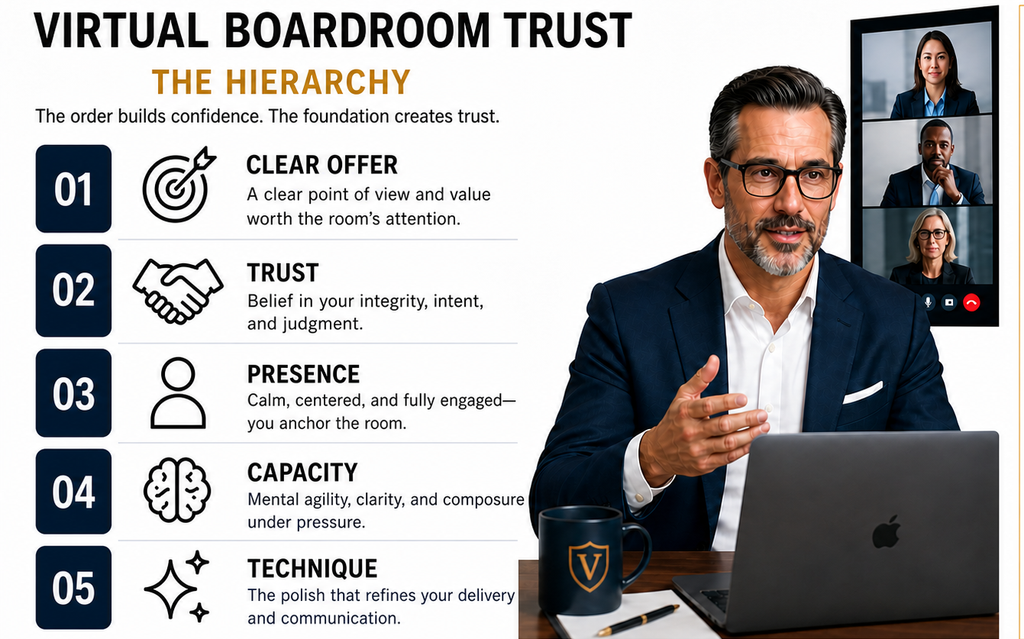
It sits above technique and below your offer. A useful hierarchy: your offer has to be credible, then you have to be trusted as a person, then you can be experienced as having presence, which requires capacity, which technique can only polish. Skip a layer and the ones above it stop working.
It is not the same as likability, and it is not the same as expertise. You can be extremely good at what you do and still watch a room decide, in the first two minutes, to keep you at arm’s length. MIT Sloan Executive Education describes executive presence as a leadership capability that can be developed deliberately rather than something certain people simply possess, which is good news, and also means it’s a skill with a mechanism you can look at.
The environment is not making this easier. The 2026 Edelman Trust Barometer found that people are retreating into smaller, more familiar circles of trust as economic and technological pressures intensify. If you’re the outside expert on the screen, you are, by definition, the person from outside the circle. The same dynamic that governs trust and confidence inside a team is running in that virtual room; you just don’t have the hallway conversations that usually do the work, which is part of why leading in a hybrid workplace demands more deliberate signalling than leading in person ever did.
Why Executives Decide About You Before You Present
People judge intent before they judge ability.
Decades of research on social perception from Susan Fiske, Amy Cuddy and Peter Glick established two dimensions that account for most of how we characterise other people: warmth and competence. Their work found that warmth is judged before competence, and warmth judgments carry more weight in how people actually react. Warmth here doesn’t mean friendliness in the small-talk sense. Fiske frames it as a read on trustworthiness and intent, essentially: are you here to cooperate or to compete?
Now think about what a consultant prepares before a boardroom call. Slides. Data. Objection handling. Credentials. All competence, all the time.
The dimension being assessed first is the one nobody rehearses. And on a video call, where the executive is looking at a face in a rectangle with no room to read, that assessment happens fast and with less to go on.
Is Executive Presence on Video Really About Lighting and Body Language?
Partly. Much less than you’ve been told.
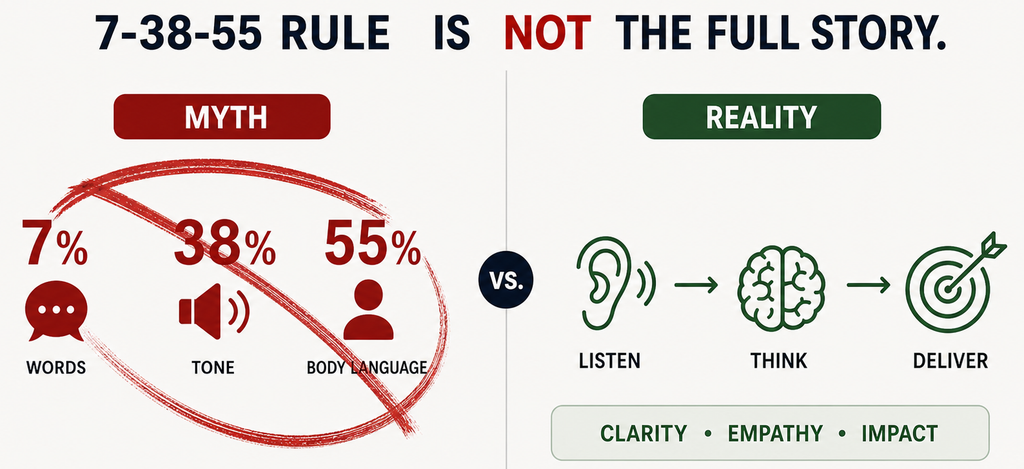
Nearly every article on this subject cites the same statistic: 7% of communication is words, 38% tone, 55% body language. It’s traceable to two small studies published by Albert Mehrabian in 1967, and it does not mean what it’s used to mean. As one review of the research notes, Mehrabian’s work has been widely misinterpreted, and broad conclusions about the nature of communication simply cannot be drawn from it; the original studies involved no actual conversations at all.
A published critique of the ratio goes further, describing the merging of two separate experiments into a single formula as an unsupported analysis that has functioned as an urban legend. Mehrabian himself has spent years trying to correct the record.
Here’s the honest version: the 7-38-55 rule does not tell you that body language matters more than words in every conversation. It describes how people resolve ambiguity when someone’s words and their delivery disagree.
That’s still worth knowing. If you say “happy to take that on” while looking like you’d rather be anywhere else, the mismatch is what gets read. But it is not a licence to believe a ring light and better posture will carry a boardroom.
Why Over-Preparing for a Boardroom Call Costs You the Room
Because over-preparation is a competence display aimed at a warmth question.
See if this looks familiar. The call is Thursday. By Tuesday night you have forty slides. By Wednesday you’ve rehearsed the opening four times and built pre-emptive answers to three objections nobody raised. You go in carrying a deck built to prove you deserve to be there.
I know that pattern because it was mine. Fifth business, eighty-hour weeks, on anxiety medication and calling the whole thing success. I built a prison with a nice view. And the calls that mattered most were the ones I over-built for because underneath the preparation was a quiet belief that being impressive was the price of being taken seriously.
What over-preparation signals that you don’t intend
Over-preparation can leak into the interaction as hesitation, rigidity, or a need to control the conversation. You stay on the script when the room wants a detour. You answer the question you rehearsed rather than the one you were asked. You fill silence because silence feels like losing.
None of that reads as expertise. It reads as effort and effort; in a room of senior people, reads as someone who isn’t yet operating at their level.
This is the same unconscious programming that shows up everywhere else in your business. It’s why you over-deliver on scope, and it’s why you undercharge. One of our clients, Jennifer (name changed), had an extraordinary background, real expertise, and prices that didn’t reflect either. She knew she should raise them and couldn’t make herself do it. The work that changed it wasn’t affirmations it was deep reconditioning. Within sixty days, she’d doubled her prices and more than doubled her revenue.
Doubled her prices in 60 days. The strategy was never her problem. Her programming was.
Same programming, different room. If you want to see it plainly, start by seeing the patterns you keep repeating.
You Can’t Technique Your Way Out of a 60-Hour Week
Let me separate what the research shows from what I’ve concluded from coaching people through it.
What the research establishes. Stanford’s Jeremy Bailenson published the first peer-reviewed analysis of why videoconferencing is uniquely tiring, identifying four mechanisms: excessive close-up eye gaze, cognitive load, increased self-evaluation from staring at video of yourself, and constraints on physical mobility. Stanford’s summary of the work notes that both the amount of eye contact on video and the size of faces on screen are unnatural compared with an ordinary meeting. Video meetings can impose additional cognitive and attentional demands. That’s the finding.
What I’ve concluded from the work. If you’re already depleted, those additional demands leave less capacity for the qualities that make presence convincing. That’s an interpretation, not a study but it’s consistent, and I’ve watched it play out for years.
The maths isn’t complicated. Presence requires spare capacity: room to think, room to listen, room to be unhurried. A sixty-hour week doesn’t leave spare capacity. It leaves you arriving at the call that matters with whatever’s left after the eight calls that didn’t.
So you’re not stuck despite the hours. You’re stuck because of them. Which makes how you spend the hours before the call a strategic decision, not an admin one, and makes regulating stress in high-pressure environments a business skill rather than a wellness one.
I take a thirty-six-minute nap before a call that matters. Not as self-care theatre. I’ve tested what I bring into a room with it and without it, and the difference is not subtle.
What Actually Signals Trust to an Executive Audience
Four things, and none of them are on camera-technique lists.
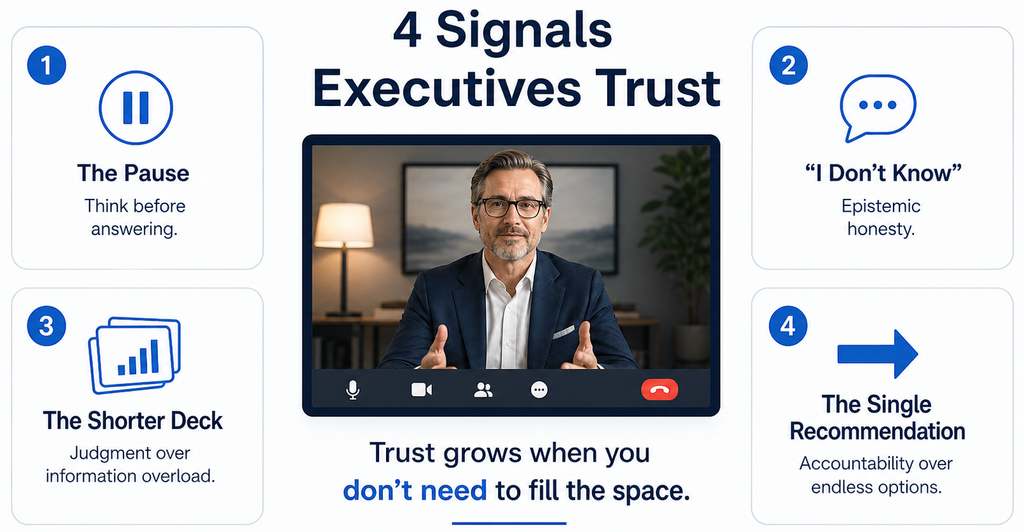
The pause
When you take two seconds before answering, you demonstrate that you’re thinking rather than performing. Executives are surrounded by people who answer instantly to appear sharp. The pause is rarer, and it reads as someone who isn’t scrambling. It also requires enough internal calm to tolerate the silence, which is exactly why it’s hard on your ninth call of the day.
“I don’t know”
Said cleanly, with no hedging and no scramble to recover, this is the single strongest credibility move available to you. It demonstrates epistemic honesty: you’ll tell them when you’re outside your knowledge, which means they can believe you when you say you’re inside it. Nobody trusts the expert who has an answer for everything.
The shorter deck
Twelve slides instead of forty demonstrates judgment. You’ve already done the work of deciding what matters, which is the work they’re considering hiring you for. A long deck outsources that filtering back to them.
The single recommendation
Not three options with pros and cons. One recommendation, the reasoning behind it, and your willingness to be accountable for it. Options are safe. Options are also what a supplier offers. A recommendation is what an advisor offers.
Notice what these have in common: they all require you to be resourced enough to hold your ground without filling space. The Forbes Coaches Council recently identified confusing visibility with presence as the common mistake in distributed environments, arguing that gravitas now comes down to dedicated attention being fully there, focused on one thing at a time. You cannot fake dedicated attention. You can only have it or not have it.
Tom (name changed) had twenty years of hard-won experience and was effectively invisible in his market. The fix wasn’t better delivery. He rebuilt his positioning around his own story and his own methodology, specific enough that the right clients recognised immediately that he was for them and moved from long, underpriced programmes to premium rates for focused engagements.
Twenty years of expertise, invisible. Then positioned properly, and the right clients came to him.
Production Fixes vs. Capacity Fixes
Both matter. They solve different problems, and almost everyone is working exclusively on the first column.
| Production Fix | Capacity Fix |
|---|---|
| Better lighting | Fewer unnecessary meetings |
| Better framing | More recovery before high-stakes calls |
| Better camera | Less cognitive switching |
| Better background | Less over-preparation |
| Stronger posture | Greater tolerance for silence |
| Better scripting | Clearer thinking |
| Polished delivery | The ability to say “I don’t know” |
Production fixes remove distractions. Capacity fixes change what you are capable of bringing into the room.
Do the production work once. It’s cheap and finite. Then put your attention where the returns are.
The Mechanism: Three Pillars Applied to the Virtual Room
Virtual boardroom trust isn’t a communication skill you bolt on. It’s an output of how your business is built. That’s what The 5 Shifts to Freedom addresses through The 3 Pillars: psychology first, then strategy, then structure. Because you can’t delegate what your unconscious won’t release.
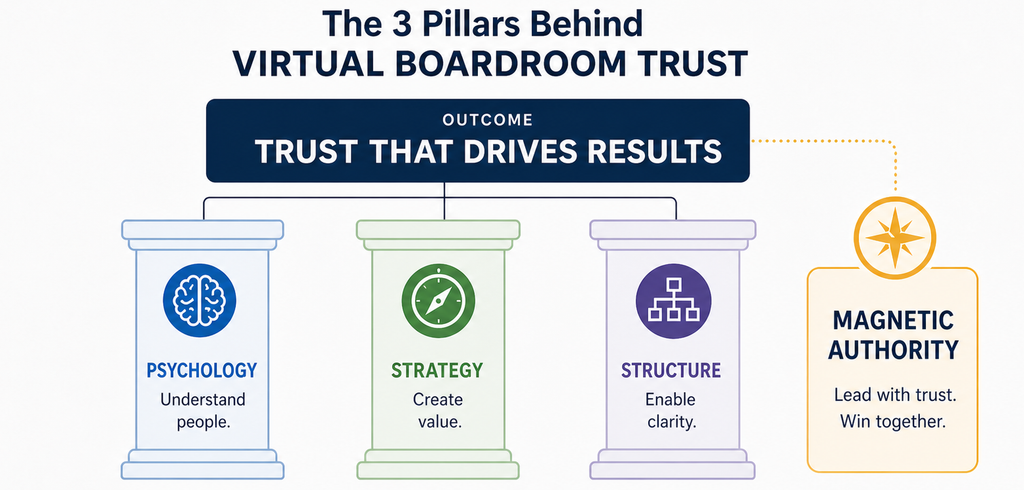
Performance Psychology
This is where the over-preparation gets dismantled: the programming that says impressive equals safe, that disappointing someone is unbearable, that busy equals valuable. Shift 4, Mindset Unlock, does this work directly. Technique layered on top of unexamined programming produces a more polished version of the same anxiety.
Freedom-First Business Strategy
Ruthless elimination. Cutting the eighty percent of activity that consumes your week so the calls that determine your year get a version of you that has something left. This is Shift 2, and it’s why capacity is a strategy question rather than a scheduling one.
Freedom-First Business Structure
Redesigning operations so you’re not the bottleneck, so nine client calls a day isn’t the shape of your Tuesday in the first place.
Then Shift 5, Magnetic Authority, does the positioning work: becoming specific enough that the right senior buyer recognises you rather than evaluates you.
Strategy without psychology is another unfinished course. Psychology without strategy is feel-good fluff that doesn’t pay the bills. Structure without both is a prettier prison. You need all three.
When Virtual Boardroom Trust Is Actually the Problem
Be honest about which problem you have. Capacity cannot compensate for a weak offer.
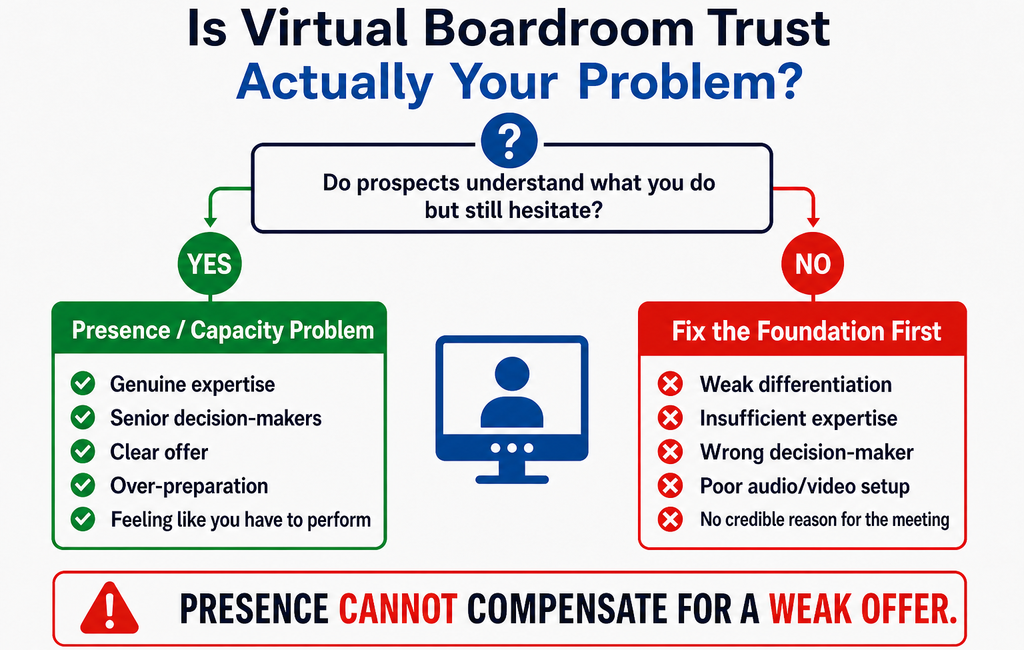
This is your problem if:
- You already have genuine, relevant expertise
- You’re regularly in conversations with senior decision-makers
- Prospects clearly understand what you do and still hesitate
- You over-prepare for the calls that matter most
- You routinely finish those calls feeling like you had to perform
This isn’t your first problem if:
- Your offer isn’t clearly differentiated from three other people they’re speaking to
- You don’t yet have the relevant expertise for the room you’re in
- You’re talking to the wrong decision-maker
- Your setup genuinely makes you hard to see or hear; fix that first, it’s an afternoon
- You haven’t given the executive a credible reason to take the meeting at all
If you’re in the second list, no amount of presence work will rescue the call. Go fix the thing that’s actually broken.
Frequently Asked Questions
How long does it take to build executive presence on video calls?
The production layer lighting, framing, audio, background takes an afternoon and is finished. The capacity layer takes as long as it takes to change how your week is built, because presence draws on reserves you either have or don’t. Most people see the shift within weeks of cutting the calls that shouldn’t have been on the calendar, not from practising delivery.
Should I keep my camera on for every client call?
No. Camera-on for every internal check-in is one of the fastest ways to arrive at the call that matters with nothing left. Reserve full video presence for conversations where trust is being formed or a decision is being made, and let routine updates happen by audio or asynchronously.
Does a virtual background hurt credibility with senior decision-makers?
A clean, stable background helps; an artificial one that glitches around your shoulders is a distraction that costs you attention you need elsewhere. Real is better than simulated when you can manage it. This is a production question, so solve it once and stop thinking about it.
Is it risky to say “I don’t know” in a boardroom presentation?
Said cleanly, it’s one of the strongest credibility moves available. It tells the room you’ll flag the edge of your knowledge, which is what makes your confident answers believable. The risk isn’t the admission it’s the scramble that usually follows it, which is a capacity problem, not a script problem.
How many slides should a consultant bring to an executive video call?
Fewer than feels comfortable. A short deck demonstrates that you’ve already done the filtering, which is precisely the judgment they’re considering hiring. A long deck hands that work back to them and reads as effort rather than expertise.
Can communication or presentation training fix virtual presence on its own?
It can improve how a presentation is delivered. It cannot manufacture trust, judgment, or presence that isn’t available underneath it. Training layered on top of a sixty-hour week produces a more polished version of the same depletion, which is why the psychology and the structure have to move together.
The Bottom Line
Virtual executive presence isn’t primarily about looking impressive on camera. It’s about having enough internal capacity to think clearly, tolerate silence, tell the truth, and make a recommendation without performing for approval.
Fix the lighting. It takes an afternoon. Then go look at the week that’s leaving you with nothing to bring into the room that decides your year.
Most consultants are stuck because they’re working sixty hours, not despite it. The overwhelm is the plateau. And the room can tell.
Book a Freedom Blueprint 30 Minutes Call. We’ll find the one thing that’s actually keeping you stuck. No pitch unless you ask for one.