
Broken communication usually isn’t caused by a lack of love. It’s driven by repeated patterns like criticism, defensiveness, assumptions, and emotional flooding that hijack a conversation before real understanding can happen. NLP communication techniques such as state management,
Meta Model questioning, reframing, and active listening give couples a way to interrupt these patterns in the moment. Applied consistently, they help partners move from reacting to actually hearing each other, which is where most conflict resolution starts.
Key Takeaway:
- Broken communication is often driven by recurring patterns such as criticism, defensiveness, assumptions, emotional flooding, and stonewalling not necessarily a lack of love. Recognizing these patterns early creates an opportunity to interrupt them before conversations escalate. [1]
- Core NLP techniques such as state control, Meta Model questioning, reframing, communication-preference awareness, and positive anchoring can provide practical tools for creating calmer, clearer conversations and reducing reactive communication patterns. [1]
- The SHIFT Framework makes these techniques easier to apply: Stop and Settle your emotional state, Hear Clearly through better questions, Identify communication preferences, Frame the situation constructively, and Take One Next Step together. Consistent practice is more important than trying to have perfect conversations. [2]
- NLP is a communication toolkit, not a replacement for professional therapy. Abuse, fear, unresolved trauma, addiction, persistent emotional withdrawal, or serious relationship problems may require support from a licensed therapist or other qualified professional. [3]
Bottom Line: Fixing broken communication starts with changing the patterns that make conversations spiral. Using state control, clearer questions, reframing, and the SHIFT Framework can help couples communicate with greater clarity and empathy, while deeper relationship issues should be addressed with appropriate professional support.
- Source: Unleash Your Power – Fix Broken Communication in Relationships Using Core NLP
- Source: SHIFT Framework for Better Conversations
- Source: When to Seek Professional Help
Most couples I work with don’t have a love problem. They have a communication problem that gets mistaken for one. The same argument keeps resurfacing, one partner shuts down while the other pushes harder, and small comments get read as attacks. It’s exhausting, and it makes people wonder if they’re simply incompatible.
I’ve seen the opposite play out enough times to know that’s rarely true. When you understand why these patterns show up and you have practical tools to interrupt them, connection comes back faster than most people expect. This article walks through what’s actually breaking down, what core NLP techniques can do about it, and a simple five-step framework called SHIFT you can use in your next hard conversation.
Signs Your Relationship Has a Communication Problem
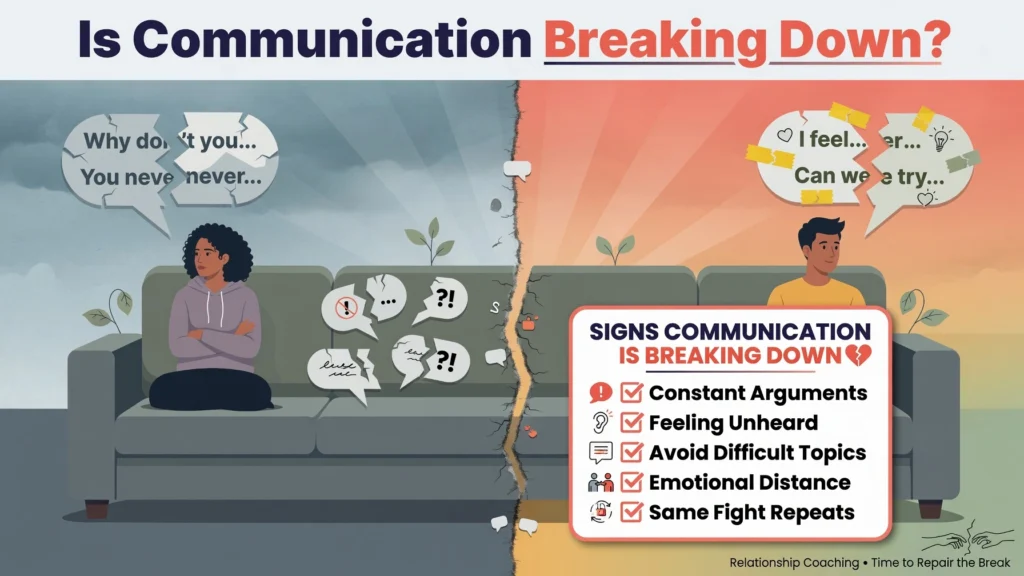
Communication breakdown rarely announces itself. It builds gradually, and most couples adjust to it without realizing how much distance it’s created.
Common signs include:
- Nearly every conversation turns into an argument
- One or both of you regularly feel unheard
- Small misunderstandings keep repeating
- You choose your words carefully to avoid setting the other person off
- Hard topics get avoided instead of discussed
- Silence replaces conflict instead of resolving it
- You have the same fight, almost word for word, over and over
- One partner has quietly started pulling away emotionally
Does this sound familiar?
If you recognized three or more of these, the good news is that these are learned patterns, and learned patterns can be changed.
Why Communication Breaks Down Between Partners
Underneath most recurring arguments are a handful of predictable causes: emotional flooding, assumptions about what your partner meant, mind reading instead of asking, expectations that were never actually spoken out loud, and two people who simply process conversations differently.
Dr. John Gottman’s decades of relationship research gave these patterns names. His team identified four specific behaviors, known as the Four Horsemen, that predict relationship breakdown with striking accuracy:
- Criticism: attacking character instead of addressing a specific issue
- Contempt: sarcasm, mockery, or eye-rolling that signals moral superiority
- Defensiveness: deflecting responsibility instead of hearing the complaint
- Stonewalling: shutting down and withdrawing from the conversation entirely
Recognizing these patterns as they happen, rather than after the fact, is what gives you the chance to intervene before the conversation spirals.
How to Fix Broken Communication in Relationships in Toronto and Across Ontario
Communication challenges affect couples everywhere, whether you’re navigating the fast pace of Toronto, balancing family life in Ottawa, or managing work and relationships anywhere across Ontario. Learning how to fix broken communication starts with recognizing that most conflicts are driven by habits rather than a lack of love. By using practical NLP communication techniques such as state management, better questioning, reframing, and active listening, couples can interrupt destructive patterns before they escalate. With consistent practice, these skills create calmer conversations, stronger emotional connection, and healthier relationships, regardless of where you live.
Can NLP Really Help Improve Relationship Communication?
NLP is a set of practical tools for managing your internal state and the language you use under pressure. It’s not a diagnosis, a therapy modality, or a guaranteed fix. Research on NLP as a complete system is mixed, but many of its individual techniques overlap closely with practices used in evidence-based communication coaching, including documented case studies on NLP in conflict management.
Used consistently, NLP complements professional couples therapy rather than replacing it. If your relationship has deeper wounds to address, NLP gives you tools for the day-to-day conversations while therapy addresses what’s underneath them.
Core NLP Techniques That Improve Communication
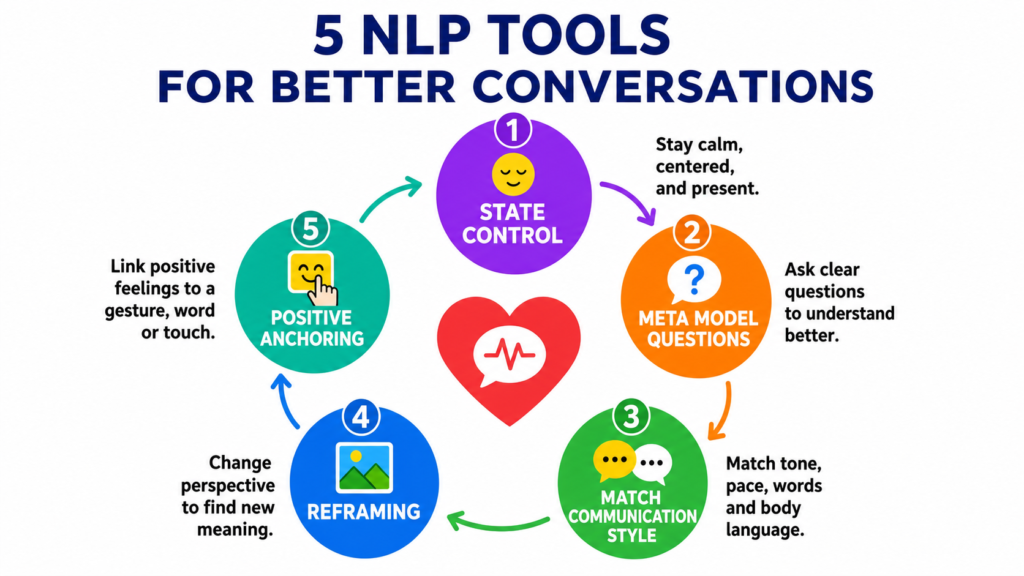
State Control Before You Speak
When emotions spike, the brain’s capacity for calm, rational conversation drops sharply. This is the flooding response Gottman’s team documented, and it’s often what turns a disagreement into a blowup. Before responding, pause. Take a slower breath. Give your nervous system a few seconds to settle before you say anything. This single habit prevents more damage than almost any other technique on this list.
Use Meta Model Questions
Instead of reacting to “you never listen,” ask a clarifying question like “can you tell me about a recent time you felt unheard?” Meta Model questioning works by turning vague, emotionally loaded statements into something specific enough to actually address. Vague complaints breed more conflict. Specific ones create a path to resolution.
Match Communication Preferences
People tend to describe experiences differently. Someone might say “I don’t see your point,” another might say “that doesn’t sound right,” and a third might say “I don’t feel supported.” None of these are wrong. Rather than labeling your partner, pay attention to the language they naturally reach for and experiment with meeting them there. This is one piece of the broader NLP relationship-building toolkit that builds trust over time.
Reframing
Reframing means choosing a more useful interpretation of what just happened. Instead of “they’re criticizing me,” try “they’re expressing an unmet need.” This isn’t about pretending the comment didn’t sting. It’s about not letting one interpretation dictate your entire response. Reframing is closely tied to identifying the limiting beliefs that often drive our first, most defensive reaction.
Positive Anchoring
An anchor is a small, repeatable action tied to a calmer emotional state. That might be holding hands before a hard conversation, taking a breath together, or using a private phrase that signals “we’re safe, let’s talk this through.” Over time, the anchor itself starts triggering the calm state faster.
Try This: Before your next difficult conversation, agree on one small physical or verbal anchor with your partner and use it deliberately before you start talking.
The SHIFT Framework for Better Conversations
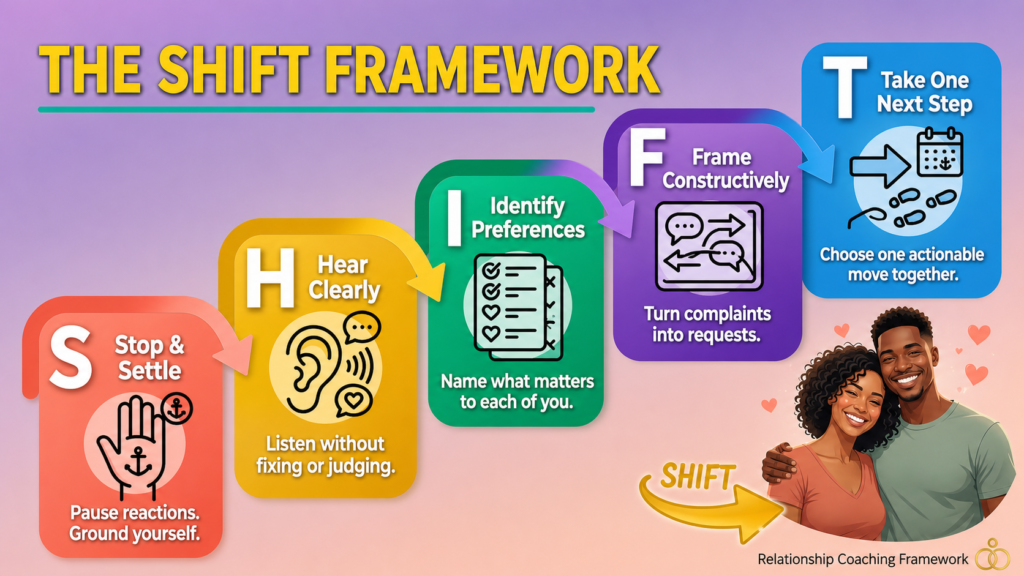
- Stop and Settle: Interrupt emotional flooding before you respond. Pause, breathe, let your body settle.
- Hear Clearly: Use Meta Model questions to clarify what your partner actually means instead of assuming.
- Identify Communication Preferences: Notice the language your partner is using and meet them there.
- Frame Constructively: Replace blame with curiosity. Reframe the moment before you respond to it.
- Take One Next Step: End the conversation with one concrete, agreed-upon action, not a vague resolution to “do better.”
Stop and settle your state. Hear clearly with better questions. Identify how your partner communicates. Frame the moment constructively. Take one next step together.
Mike L. came to me struggling with anxiety and constant second-guessing that bled into his relationships. Working through NLP techniques quieted the mental noise that used to hijack his conversations, and for the first time he was actually hearing what people said instead of reacting from anxiety. That shift alone changed how he connected with the people closest to him.
Gottman’s Four Horsemen vs NLP Responses
| Gottman’s Pattern | What It Looks Like | Helpful NLP Technique | Better Response |
| Criticism | Blaming, character attacks | Meta Model | Clarify instead of accuse |
| Defensiveness | Excuses, counter-complaints | Reframing | Accept part of the responsibility |
| Contempt | Sarcasm, eye-rolling | Perceptual shift and empathy | Express appreciation |
| Stonewalling | Withdrawal, shutting down | State Control | Pause and return calmly |
What NLP Can’t Do
NLP is a communication toolkit, not a cure-all. It cannot fix emotional abuse, restore trust after a betrayal on its own, replace professional therapy, make an unwilling partner participate, or resolve every relationship issue. Used honestly, within its actual scope, it’s genuinely effective. Used as a substitute for real professional support when one is needed, it isn’t.
Who Should Use This?
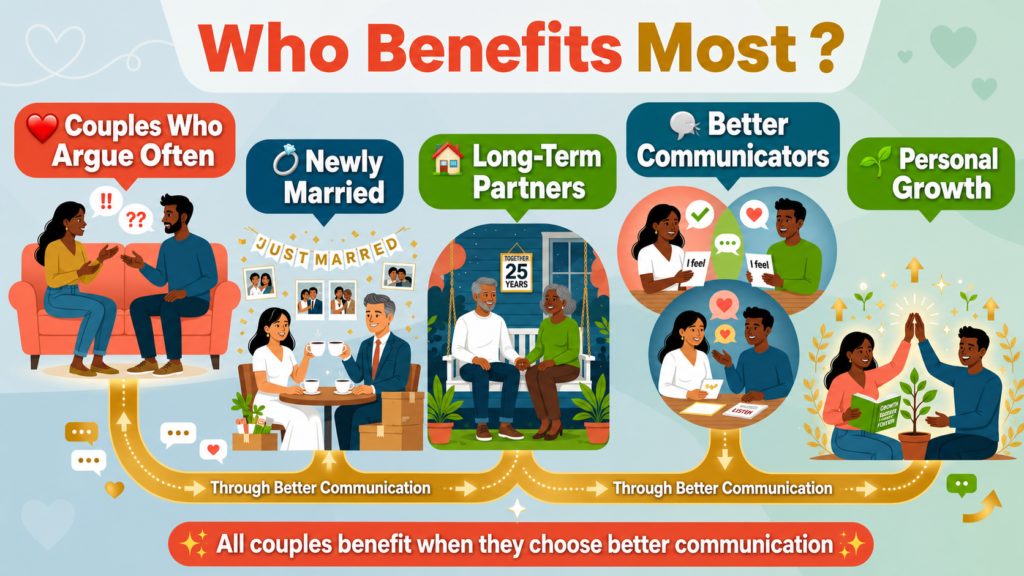
This approach works well for couples who argue frequently but still want to work things out, newly married partners building their communication habits early, long-term couples who’ve fallen into repetitive fights, anyone wanting sharper conflict resolution skills, and individuals looking to strengthen their own communication regardless of where their partner is at.
When to Seek Professional Help
Reach out to a licensed therapist if abuse is present in any form, if fear is part of the dynamic, if infidelity has happened more than once, if addiction is involved, if unresolved trauma keeps surfacing, or if emotional withdrawal persists despite genuine, repeated effort. NLP is a valuable set of tools, but it was never meant to carry that weight alone.
NLP vs Couples Therapy
| NLP | Couples Therapy |
| Practical communication tools | Addresses deeper relationship dynamics |
| Self-practice | Guided by a licensed professional |
| Everyday conversations | Complex emotional or relational issues |
| Skill development | Healing and long-term change |
Both have a place. If you’re navigating everyday friction and want tools you can use immediately, NLP is a strong starting point. If there’s deeper hurt, unresolved trauma, or patterns that haven’t shifted despite real effort, it may be worth exploring the difference between NLP and traditional therapy with a licensed therapist alongside your own practice.
Frequently Asked Questions
Can NLP really improve communication in relationships?
Yes, when practiced consistently. Techniques like state control and Meta Model questioning directly target the patterns that cause most conversations to break down.
Is NLP manipulation?
No. NLP done ethically is about understanding and clarity, not control. The goal is mutual understanding, not getting your partner to agree with you.
How long does it take to improve communication?
Most couples notice a shift within a few weeks of consistent practice, though deeper patterns can take a few months to fully change.
Can one partner use NLP alone?
Yes. Changing how you listen and respond shifts the entire dynamic, even if your partner isn’t actively practicing these techniques yet.
What’s the difference between NLP and couples therapy?
NLP offers practical, self-guided communication tools. Couples therapy is professionally guided and better suited for deeper relational or emotional issues.
Which NLP technique is best for arguments?
State control. Most arguments escalate because someone responds while flooded. Settling your state first changes everything that follows
Can NLP save a relationship?
It can meaningfully improve how two people communicate, but “saving” a relationship also depends on both partners’ willingness to engage and, where needed, professional support.
Do communication problems always lead to divorce?
No. They’re one of the most cited factors in divorce, but they’re also one of the most changeable when addressed early and consistently.
Conclusion
Better communication is a skill, and like any skill, it’s built through practice rather than a single breakthrough conversation. Start small. Pick one upcoming conversation and try the SHIFT framework instead of trying to transform every interaction at once.
Shirly Z. described it well after her own work with these techniques. She found she could finally express her emotions honestly and stay present in the moment, without holding onto old hurt. That’s the shift available to you too, one conversation at a time.
If you’re ready to build these skills further, explore more NLP techniques for stronger relationships or take the next step with empathetic listening skills that pair directly with everything covered here. Unleash Your Power: Stand Out, Take Action, and Create the Success You Want.