

51% of employees are actively job-hunting right now. That’s not a forecast, that’s reality. Half your team could walk out the door tomorrow, and the traditional retention playbook isn’t stopping them.
Key Takeaway:
- Retaining employees in today’s market requires more than salary—top strategies focus on coaching, career growth, recognition, autonomy, and strong culture to reduce turnover (which costs 1.5–2× salary per employee) and boost productivity by 20–30%. [1]
- Core drivers: Regular 1-on-1 coaching builds trust and clarity; personalized development plans increase engagement; meaningful recognition (public praise, bonuses, growth opportunities) fulfills intrinsic motivation; flexible work/autonomy reduces burnout; strong team culture and clear values create belonging. [1]
- Practical moves: Implement weekly/monthly coaching conversations (focus on goals, feedback, obstacles); create individual development plans with training budget; recognize wins publicly (Slack shoutouts, awards); offer flexible schedules/remote options; run quarterly pulse surveys; foster belonging through team events and transparent communication. [2]
- Caveats: Retention fails without consistent leadership buy-in; generic programs feel inauthentic; ignoring burnout or poor culture leads to quiet quitting; measure success via engagement scores, turnover rate, and eNPS—aim for <15% annual voluntary turnover in small/medium businesses. [2]
Bottom Line: The most effective way to retain employees is through consistent coaching, personalized growth, genuine recognition, and a supportive culture—invest in people development and leadership habits to cut turnover costs and build a loyal, high-performing team.
- Source: Unleash Your Power – Strategies for Retaining Employees Through Coaching
- Source: Article Details / FAQs
More money? They’ll take it and leave anyway. Better titles? Nice, but not enough. Fancy perks? They want substance, not ping-pong tables. The truth is that 68% of people who quit do so because of engagement and culture issues, not compensation. They leave because they don’t feel valued. After all, they can’t see their future, because their manager treats them like a task list instead of a human being.
This is where coaching changes everything. NLP-based coaching approaches address the psychological and developmental needs that actually drive retention. When you help someone break through limiting beliefs, gain confidence, and see a clear path forward, they don’t need to look elsewhere. Leadership development programs that integrate coaching methodologies aren’t nice-to-haves anymore, they’re competitive necessities.
Here’s what you’ll learn: five NLP coaching strategies that reduced turnover by 22% at a major pharmaceutical company, plus the frameworks you can implement starting this week.
Why Traditional Retention Strategies Fall Short
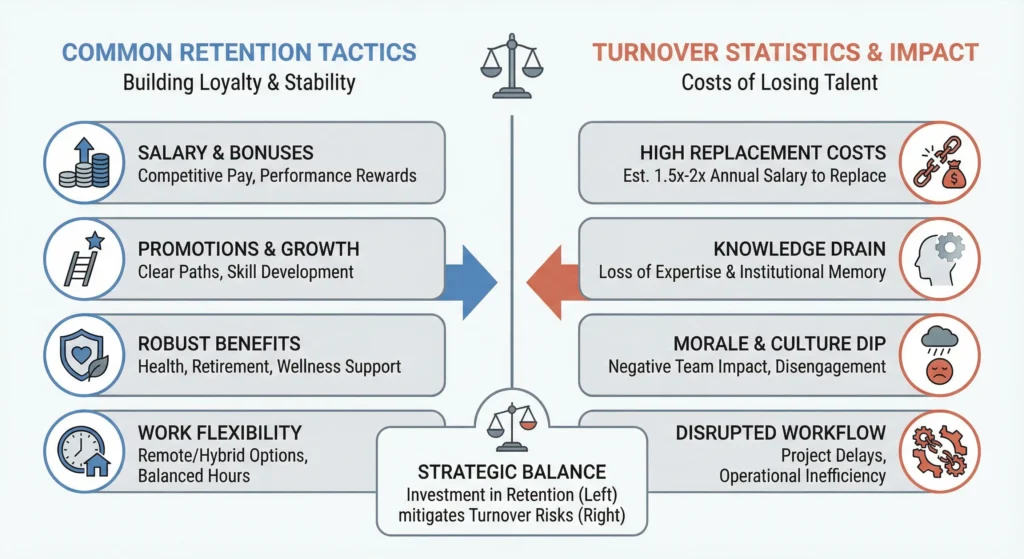
You’ve probably tried the usual fixes. Salary bumps. Promotions. Benefits packages. Maybe even flexible work arrangements. And yet, people still leave.
Here’s why: 42% of turnover is preventable, but most leaders are solving the wrong problem. They assume it’s about money when only 28% of people primarily leave for better compensation. The real reasons run deeper.
According to workforce retention analysis, 70% leave because they see no career development path. 56% point to poor workplace culture. 40% cite ineffective managers who can’t coach them forward. The pain points aren’t on the surface; they’re psychological.
The hidden cost is staggering. Replacing one employee costs between 30% and 200% of their annual salary. U.S. businesses collectively spent $900 billion in 2023 on unnecessary turnover. That’s money thrown at symptoms instead of root causes.
Coaching works differently. It addresses the self-imposed performance constraints and limiting beliefs that keep high performers stuck. Executive coaching programs target the psychological patterns beneath the surface complaints. Instead of asking “what will make you stay?” coaching asks “what’s holding you back from thriving here?”
That shift changes everything.
How Coaching Directly Impacts Employee Retention
Let’s look at what happens when coaching becomes strategic, not accidental.
Johnson & Johnson faced a retention problem despite their strong market position. High turnover. Employee feedback shows unclear career paths. They needed something beyond the standard HR playbook.
Their solution? Train internal coaches, managers, HR professionals and external experts to work with employees on development, not just performance. After 18 months, the results were clear: 22% reduction in turnover, significantly improved engagement scores, and a strengthened leadership pipeline ready to drive strategic initiatives.
What did coaching unlock? Three retention mechanisms that traditional management misses:
Psychological Safety and Feeling Valued
When employees feel valued, they’re 63% less likely to job-hunt. Coaching creates space for vulnerability without judgment. It’s not top-down directives, it’s two-way dialogue. You’re not telling people what to do; you’re helping them discover what they’re capable of.
Clear Career Trajectory and Growth Opportunities
People are 93% more likely to stay when you invest in their development. Coaching reveals the path from “where I am” to “where I want to be.” It addresses goal blocks those unconscious barriers that keep someone stuck, even when they have the talent to advance.
Enhanced Confidence and Capability
This one’s subtle but powerful. Anxiety drives people to seek “safer” opportunities elsewhere. Coaching builds confidence, which builds capability, which reduces the need to escape. You’re creating an internal locus of control, people who are self-motivated instead of externally dependent.
Here’s a real example. One professional was struggling with self-doubt and anxiety that affected his work and relationships. Through coaching that addressed his limiting beliefs using NLP coaching methodologies, his anxiety vanished. Confidence surged. He started communicating assertively at work. His career trajectory completely shifted, not because of a promotion, but because of the internal transformation that made him promotable.
That’s the retention power of coaching. It doesn’t just keep people, it transforms them into the employees you never want to lose.
The Remote/Hybrid Coaching Challenge
If you’re managing remote or hybrid teams, you already know: this is where retention gets harder.
Turnover is highest in remote settings where rapport is hardest to build. The irony? 68% of remote employees say flexibility is why they stay, but isolation is often why they leave. You need both and that requires a different coaching approach.
When you’re coaching via screen, NLP techniques become even more critical. Without full body language, tonality carries 80% of the emotional information. You have to listen differently. Pay attention to visual, auditory, and kinesthetic language preferences. “I see what you mean,” versus “I hear you,” versus “That feels right.” These aren’t just phrases. They’re clues to how someone processes information.
Structure matters too. Weekly 15-minute coaching conversations prevent the “out of sight, out of mind” spiral that kills engagement. Here’s a framework that works:
- In-person (quarterly): Deep-dive career development sessions where you map the bigger picture
- Virtual (bi-weekly): Progress coaching and accountability quick check-ins that keep momentum
- Async (between sessions): Written reflection prompts that keep the development conversation alive
Companies with strong remote work policies that include coaching report 25% lower turnover. The key? Start your next virtual one-on-one by matching the employee’s communication style and energy level. If they’re high-energy and fast-paced, match it. If they’re reflective and measured, slow down. That small adjustment builds the rapport that everything else depends on.
What Makes Employees Feel Valued Through Coaching?
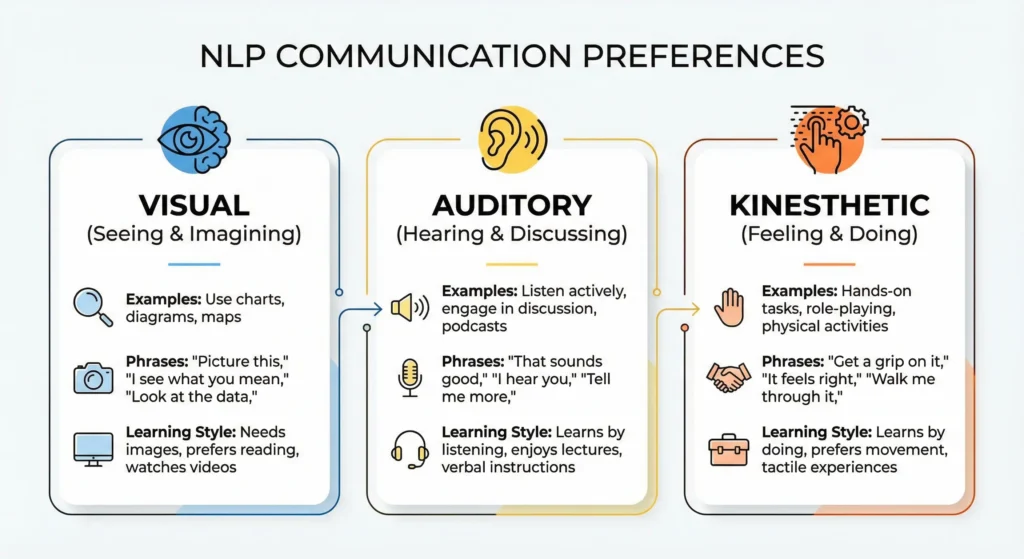
Recognition. Autonomy. Personalized development. Genuine two-way communication. That’s the short answer.
The longer answer reveals why most managers get this wrong.
Generic praise doesn’t cut it anymore. “You’re crushing it, keep it up” feels hollow because it is. Coaching asks different questions: “I noticed how you handled that conflict. What did you learn about yourself?” That’s recognition that goes beneath the surface.
People are motivated by different things. Some thrive on public acknowledgment. Others prefer quiet one-on-one appreciation. Some want challenging projects that stretch them. Others seek work-life integration that respects their boundaries. Coaching uncovers these individual drivers instead of treating everyone the same.
The research backs this up. The ideal feedback ratio is 5.6 positive interactions to every one corrective comment. And here’s why it matters: 21.5% of employees who feel unrecognized have already interviewed elsewhere in the last three months. They’re halfway out the door before you even notice.
The strengths-based approach delivers 10X improvement compared to marginal gains from fixing weaknesses. You’re not trying to turn weaknesses into mediocrity, you’re turning strengths into excellence.
Try this in your next coaching conversation:
- Ask: “What energizes you most in your role?”
- Listen for themes: problem-solving, collaboration, autonomy, impact
- Map their next project to those themes
- Check back in two weeks on progress
That’s how you make someone feel valued. Not through generic praise, but through attention to what makes them come alive.
Five NLP-Based Coaching Strategies to Reduce Employee Turnover
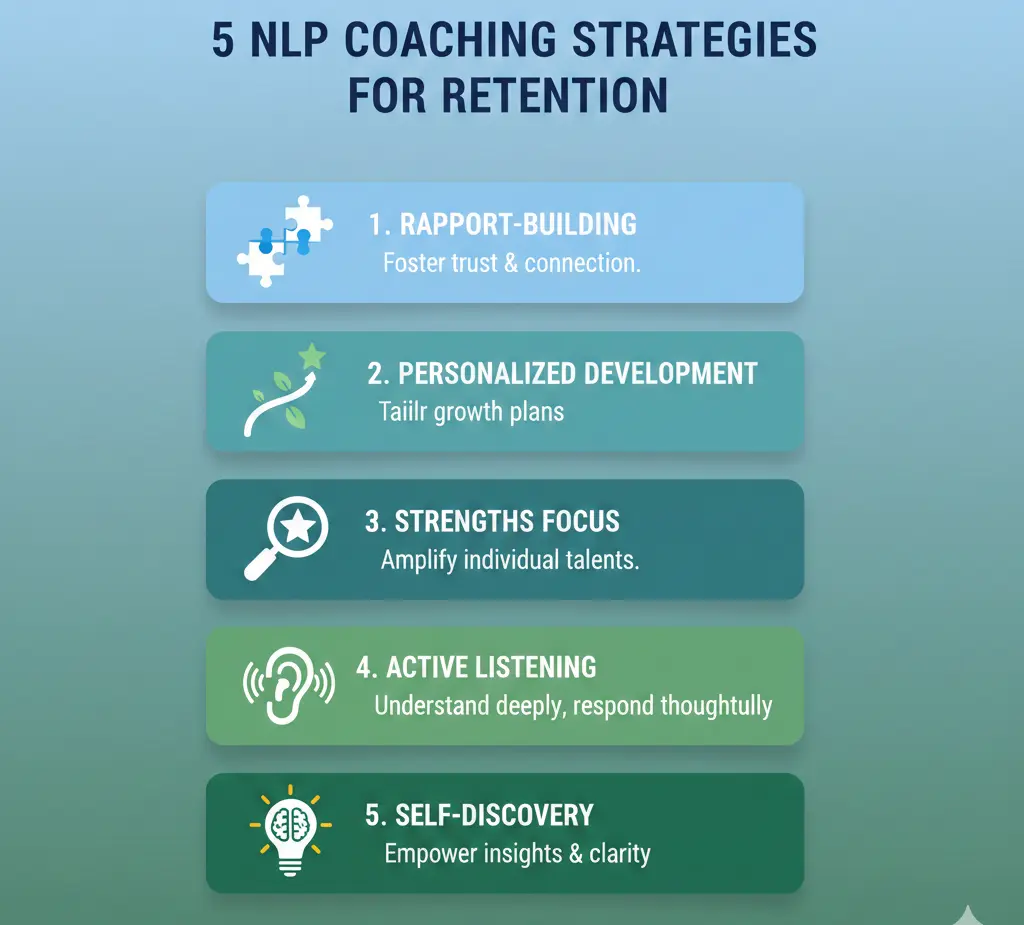
These aren’t theoretical. They’re practical tools you can use this week.
Strategy 1: Build Genuine Rapport Before Attempting Change
Trust comes first. Always. Employees who trust their managers show 75% higher engagement, and engagement predicts retention better than almost any other factor.
The NLP technique here is mirroring and matching what I call manager-employee trust calibration. You’re subtly aligning your communication style with theirs. Match their pace of speech. Reflect body language naturally. Use similar language patterns, whether they speak in visual, auditory, or kinesthetic terms.
Start every coaching conversation by matching their energy. If they walk in speaking quickly with high energy, match it. If they’re reflective and measured, slow down. In virtual settings, match tone and respect video presence preferences. Some people think clearly with the camera on; others need it off. Don’t force it.
This isn’t manipulation, it’s meeting people where they are.
Strategy 2: Create Personalized Development Plans That Address Goal Blocks
Here’s the stat that matters: 94% would stay if their employer invested in their long-term learning. But investment doesn’t mean generic training programs. It means addressing the specific psychological barriers keeping someone stuck.
Goal blocks are self-imposed performance constraints. They’re the unconscious beliefs that whisper “you’re not ready,” or “people like you don’t get promoted,” or “if you try and fail, everyone will see you’re a fraud.”
I worked with a mid-career professional who felt stuck despite strong performance and good pay. On paper, he should have been thriving. But coaching revealed the goal blocks keeping him from advancement, unconscious beliefs about whether he deserved success. Once we identified and addressed those patterns, everything shifted. His thinking changed. His behaviors followed. He secured the promotion he’d been chasing for years.
In your development planning conversations, try this:
- Ask: “What would you attempt if you knew you couldn’t fail?”
- Listen for “yes, but…” patterns; these reveal limiting beliefs
- Challenge those beliefs: “What evidence contradicts that assumption?”
- Map specific skills development aligned with their vision
Team development through NLP creates cohesive advancement pathways that keep your best people engaged and growing.
Strategy 3: Coach to Strengths, Not Just Weaknesses
Focusing on strengths creates 10X improvement. Focusing on weaknesses? You get maybe 10% gains. The math is clear.
The NLP technique is sensory acuity learning to detect what genuinely energizes each person. Watch for posture shifts. Listen for voice animation and faster speech when they discuss certain topics. These physiological signals reveal authentic passion, not just polite interest.
Conduct quarterly “talent insight” conversations. Ask: “When do you feel most alive at work?” Then design 80% of their role around those areas. Delegate or automate the energy-draining 20%.
Top performers leave when you force them into roles that drain them. They stay when you help them do more of what lights them up.
Strategy 4: Practice Active Listening That Addresses the Unspoken
21.5% of employees actively seek new roles when they feel unrecognized. But most feel unheard before they feel unvalued. The breakdown happens in the listening.
Reading non-verbal cues and linguistic patterns matters. “I’m fine” paired with downcast eyes and slow speech? That person is not fine. You’re looking for incongruence between words and physiology and then you’re asking the question that addresses what they’re not saying.
The meta-model provides structured, insight-driven questioning:
- “What specifically concerns you about that project?”
- “What would need to happen for you to feel confident?”
- “How do you know when you’ve done excellent work?”
Spend 80% of coaching time listening, 20% talking. Let silence create space for deeper truth. Don’t fill the gaps with advice; let them fill the gaps with honesty.
Strategy 5: Facilitate Self-Discovery Rather Than Prescribing Solutions
Self-motivated teams have an internal locus of control. They don’t wait for direction; they take initiative. Coaching builds this.
When an employee brings you a problem, resist the urge to solve it. Instead:
- Ask: “If you had to solve this yourself, what would you try first?”
- Let them work through possibilities
- Support their chosen approach
- Debrief the learning afterward
Managing says, “Here’s what you need to do.” Coaching asks, “How do you see this situation? What options come to mind?”
People stay where they feel capable and trusted. When you facilitate self-discovery, you’re sending a message: I believe you can figure this out. That belief builds loyalty faster than any retention bonus.
Stay Interviews vs. Coaching Sessions: What’s the Difference?
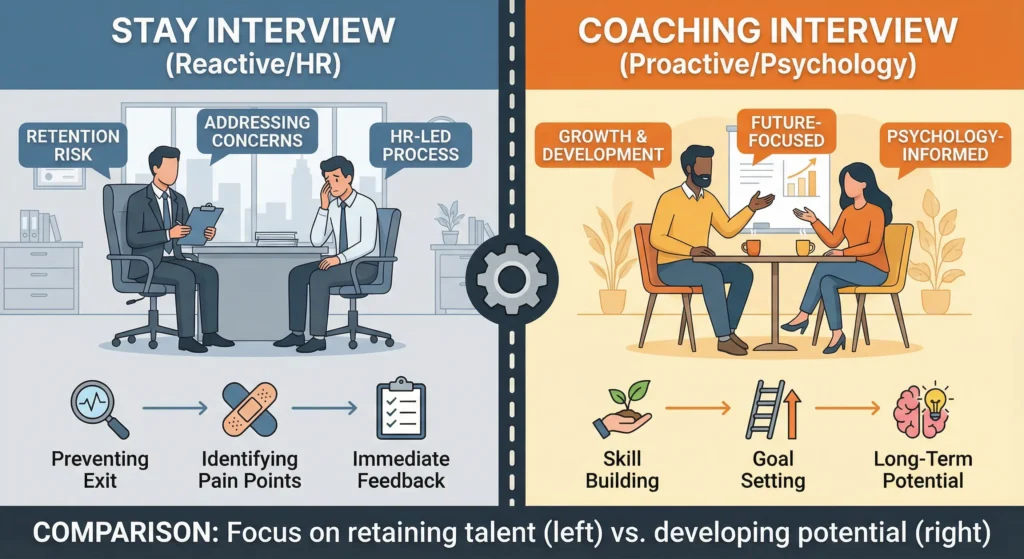
Most HR-led stay interviews feel like exit interview prevention. Surface questions. Expected answers. Minimal insight.
“What keeps you here?” gets you “the people, the mission, growth opportunities.” That’s nice, but it doesn’t tell you what’s really happening.
Coaching-led stay interviews go deeper. They explore psychology, not just satisfaction. “What would make you consider leaving?” opens the door to truth. “When do you feel most stuck? Most energized?” reveals patterns. “What’s changed since you felt really engaged?” uncovers the inflection point you missed.
Here’s the comparison:
Traditional Stay Interview: Focuses on current satisfaction. HR-driven checklist. Reactive when flight risk is detected. Surface-level responses. Company-centric: “What can we do?”
Coaching-Led Stay Interview: Focuses on future possibilities. Manager-led dialogue. Proactive with a quarterly rhythm. Psychological insight. Employee-centric: “What do you need?”
Convert your quarterly one-on-ones into coaching-led stay interviews. Schedule 45 minutes, not 15. Ask future-focused questions. Document themes, not just tasks. Follow up with specific actions within two weeks.
Employees who have meaningful career conversations with their managers quarterly are three times less likely to be job-searching.
How Do You Measure Coaching Success in Retention?
Track voluntary turnover rates, engagement scores, internal promotions, time-to-productivity, and stay interview insights. Those are the basics.
But you want leading indicators, the signals that predict turnover before it happens. Stay interview feedback quality. Career development plan completion rates. Manager-employee relationship scores from pulse surveys. Coaching conversation frequency minimum of monthly for high performers.
Lagging indicators confirm impact. Voluntary turnover rate by department lets you compare coached versus non-coached teams. Time-to-productivity for new hires shows whether your culture of coaching accelerates onboarding. Internal promotion rates reveal retention plus advancement. Exit interview themes tell you if coaching issues are declining.
Real-world metrics matter. Johnson & Johnson saw 22% turnover reduction, significantly improved engagement scores, and a strengthened leadership pipeline. The average ROI on coaching is 7:1.
Here’s how to calculate your own:
Annual Cost of Turnover = (Number of Departures) × (Average Salary × 1.5)
Example: 10 employees × ($75,000 × 1.5) = $1,125,000
If coaching reduces turnover by 22%: Savings = $1,125,000 × 0.22 = $247,500
Coaching program cost for 50 leaders: approximately $35,000
ROI: $247,500 ÷ $35,000 = 7:1
Create a quarterly retention dashboard correlating coaching participation with turnover by team. The patterns will show you where coaching works and where it doesn’t.
Coaching vs. Managing for Retention: The Critical Distinction
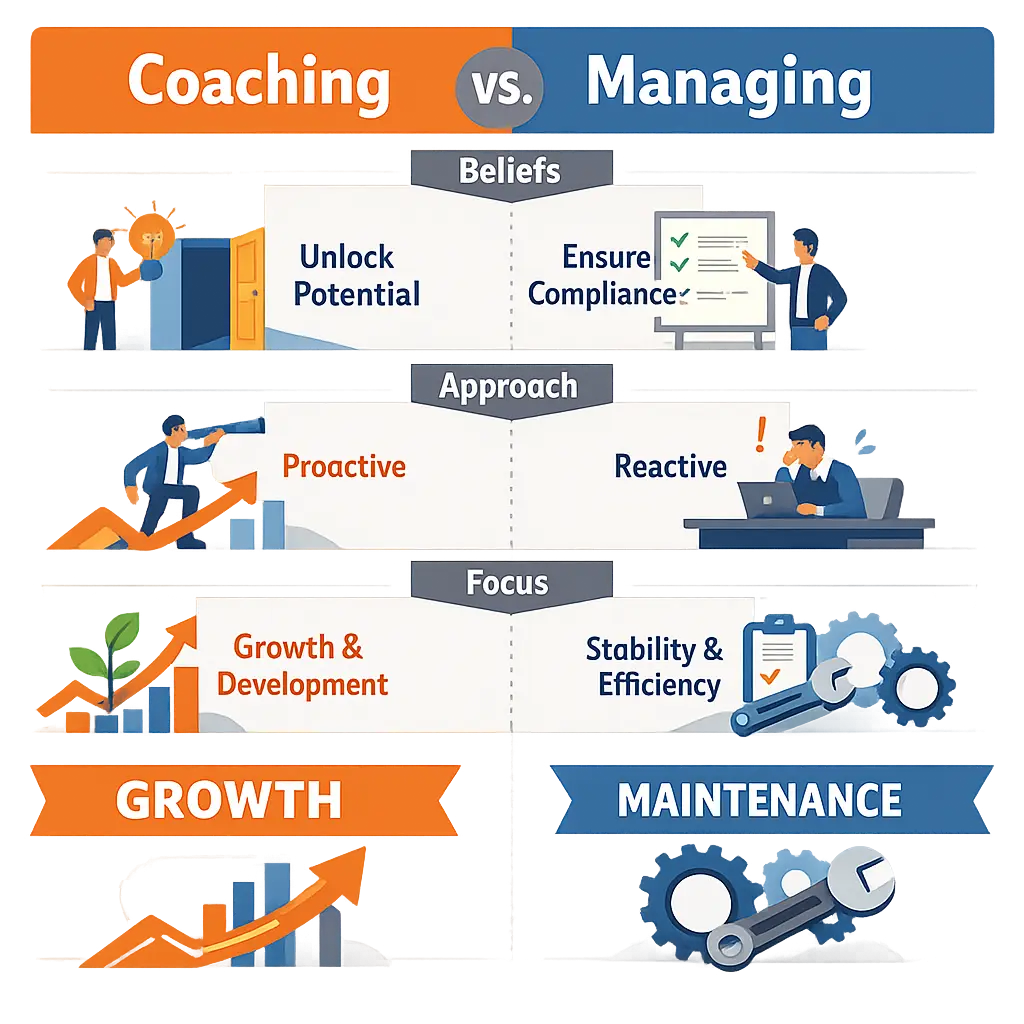
Management directs tasks and maintains performance. Coaching develops people toward self-sufficiency and unlocks potential. That difference determines whether people stay or leave.
40% cite poor manager performance as their primary reason for leaving. They’re not leaving jobs; they’re leaving managers who can’t coach.
Managers focus on deadlines, solve problems, direct what to do, maintain current capacity, run task-oriented check-ins, say “here’s what went wrong,” and react to issues.
Coaches focus on beliefs, ask powerful questions, explore how people think, develop future capability, lead development-focused conversations, ask “what did you learn?” and stay proactive about growth.
Managers who only manage create 25% higher turnover than managers who coach. The ideal blend creates environments where people feel challenged without being overwhelmed, supported without being coddled, trusted without being micromanaged, and seen without being invisible.
Audit your last five conversations with team members. Were they 80% task-focused, or closer to 50/50 task-and-development? That ratio reveals whether you’re managing or coaching.
Implementing a Coaching Culture That Retains Talent
Start with leadership. Train managers in coaching fundamentals, rapport-building techniques, powerful questioning frameworks, feedback delivery using that 5.6:1 ratio, and active listening without an agenda.
Create structured frameworks that make coaching predictable:
- Weekly: 15-minute progress coaching
- Monthly: 30-minute development check-ins
- Quarterly: 60-minute career vision conversations
- Annual: Comprehensive growth planning
Normalize vulnerability. Safe spaces for discussing challenges, fears, and career doubts build the psychological safety that keeps people engaged. Leaders model this by sharing their own growth edges. Make psychological safety scores a KPI.
Measure and recognize the managers who get it right. Celebrate those whose teams have the lowest turnover rates, highest internal promotion rates, and best engagement scores. Make coaching effectiveness part of leadership performance reviews.
Scale gradually. Pilot with five to ten high-performing managers. Gather feedback and iterate. Expand to mid-level leadership. Eventually cascade to all people leaders.
When complexity exceeds internal capacity, executive-level coaching needs, training internal coaches, building systematic coaching frameworks, bring in external support. NLP training for organizational leaders provides the advanced tools that turn managers into transformation agents.
FAQs
1. How can coaching improve employee retention?
Coaching improves employee retention by addressing engagement and culture issues, which account for 68% of departures. It helps employees overcome limiting beliefs and see a clear growth path, reducing turnover by an average of 22%.
2. What is the ROI of employee coaching programs?
Employee coaching programs offer a high return on investment, typically yielding a 7:1 ROI. Organizations that invest in development through coaching see significantly lower turnover and have teams that feel more valued and engaged.
3. What are the key NLP coaching strategies for managers?
The five core NLP coaching strategies for retention include:
Rapport-Building: Establishing trust before initiating change.
Personalized Development: Addressing individual goal blocks.
Strengths Focus: Coaching to an employee’s talents rather than weaknesses.
Active Listening: Paying attention to unspoken cues.
Self-Discovery: Facilitating insights instead of giving prescriptions.
4. Why do employees leave despite competitive pay and perks?
While compensation is important, 68% of employees quit due to engagement and culture issues. Many leave because they do not feel valued as human beings or cannot envision a future at the company, problems that traditional management often ignores.
5. How do NLP coaching tools transform leadership?
NLP-based coaching tools transform managers into “transformation agents” by equipping them to handle the psychological needs of their team. These tools focus on building deep connections and helping high performers unleash their full potential through meaningful dialogue.
Your Team Doesn’t Need Perks, They Need Leaders Who See Their Potential
51% of your workforce is actively looking elsewhere right now. U.S. companies waste $900 billion annually on preventable turnover when 42% could have been retained with better leadership.
The coaching solution addresses the real problem: 68% of departures stem from engagement and culture issues that traditional management ignores. Build rapport before pushing change. Address goal blocks through personalized plans. Coach to strengths, not weaknesses. Listen to what’s unspoken. Facilitate self-discovery over prescription.
The transformation is measurable. 22% lower turnover. 93% more likely to stay with development investment. 7:1 ROI on coaching programs. Teams that feel genuinely seen and valued.
Here’s your action step this week: Schedule one 30-minute coaching conversation with a high performer. Ask them three questions:
- “What would you attempt if you knew you couldn’t fail?”
- “When do you feel most alive in your work?”
- “What would make this the best year of your career?”
Then listen. Really listen.
Your team doesn’t need perks and ping-pong tables. They need leaders who see their potential and help them unleash it.
Ready to transform retention through coaching? Explore our leadership training programs that equip your managers with NLP-based coaching tools or reach out to discuss a custom coaching solution for your organization.