
You’re standing at a threshold. You’ve heard about NLP certification, maybe from a colleague who transformed their coaching practice, or through your own research into personal development. Now you’re wondering: which certification level matches where you are and where you want to go?
Key Takeaway:
- NLP certification levels typically progress from Practitioner → Master Practitioner → Trainer (or Coach/Advanced), each building deeper skills in communication, mindset change, modeling excellence, and application—choose based on your goals (personal growth, coaching, therapy, business leadership, or teaching NLP). [1]
- Practitioner (entry): 120–150 hours, core techniques (rapport, anchoring, reframing, submodalities, meta-model, Milton model); Master Practitioner: advanced modeling, strategies, belief change, advanced language patterns; Trainer: certification to teach NLP, group facilitation, design training, and certify others—requires real-world mastery. [1]
- Choose reputable providers (ABNLP, INLP Center, SNLP, or ICF-aligned) with live/in-person components; expect 7–21 days per level (or modular online); cost ranges $1,500–$5,000 per level; focus on trainer credibility, post-cert support, and practical application over just “fast” online courses. [2]
- Caveats: Certification alone doesn’t guarantee skill—practice and real-world application matter most; not all certifications are equal (check accreditation); NLP is unregulated in many countries—vet trainers for experience and testimonials; higher levels require significant time investment and personal growth. [2]
Bottom Line: NLP certification levels offer a clear progression from foundational skills to mastery and teaching—choose accredited training with live practice, focus on reputable providers, and prioritize real-world application over quick certificates for genuine transformation and credibility.
This isn’t just about adding letters after your name. When you explore NLP training options in Canada, you’re choosing the depth of change you want to create in yourself first, then in others. Many aspiring coaches combine their NLP journey with life coach certification programs to build the strongest foundation possible.
The question isn’t “which certification looks best on paper?” The real question is: what level of transformation are you ready for?
The Foundation: NLP Practitioner Certification
The Practitioner level is where your NLP journey begins. This isn’t a surface-level introduction; it’s a genuine shift from curious observer to confident practitioner.
What You’ll Learn at Practitioner Level
At Practitioner certification, you’ll build the core toolkit that makes NLP so powerful. You’ll learn rapport-building techniques that create instant connection. You’ll master anchoring, linking specific triggers to desired emotional states. Reframing becomes second nature, helping you (and others) see challenges from empowering perspectives.
You’ll understand representational systems how people process information through visual, auditory, or kinesthetic channels. This alone transforms your communication. You’ll develop emotion management skills and learn to control your own state, which is essential before you can guide others through change.
The training covers language patterns that influence thinking at the subconscious level. You’ll explore how the conscious and unconscious minds work together, and how to work with both effectively.
Time and Prerequisites
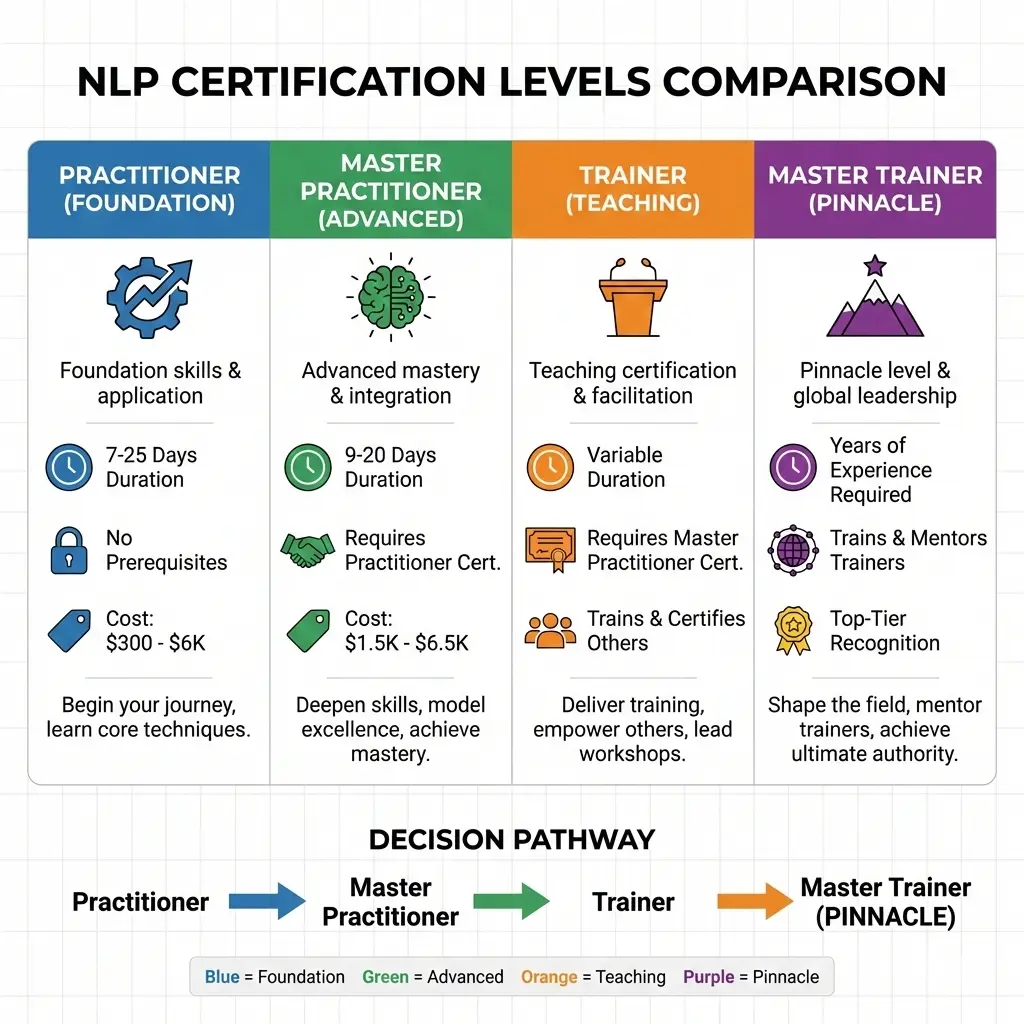
Most accredited NLP Practitioner programs require 7-25 days of training, typically totaling around 120 hours minimum. Some programs offer intensive week-long immersions. Others spread the learning over several weeks or months to allow for practice and integration.
Here’s what makes Practitioner certification accessible: you don’t need any prerequisites. Whether you’re a professional looking to enhance your communication skills, someone committed to personal growth, or an aspiring coach taking your first steps, this level welcomes you exactly where you are.
The format usually combines self-paced pre-work, live training sessions, practice exercises with peers, and assessments to demonstrate competency.
Who This Level Serves Best
Practitioner certification serves several paths beautifully. If you’re starting your coaching career, this gives you the foundational skills clients expect. For professionals in leadership, sales, teaching, or management, these techniques immediately improve how you connect and influence.
Many people pursue Practitioner purely for personal development and that’s completely valid. The insights about your own patterns and the tools to shift them create lasting change. Some discover their passion for coaching only after experiencing their own transformation at this level.
Business leaders use Practitioner skills to understand team dynamics better, improve workplace communication, and navigate conflicts with greater emotional intelligence.
Real-World Application
One of the most powerful aspects of Practitioner training is the immediate applicability. You’ll use these techniques in conversations the very next day. Building rapport becomes natural rather than forced. You’ll notice patterns in yourself and others that were invisible before.
You’ll practice in safe environments first coaching sessions during training before applying skills with real clients or in professional settings. You’ll develop what’s called “sensory acuity,” the ability to notice subtle shifts in someone’s physiology, tone, and energy that signal internal changes.
The Transformation You’ll Experience
The shift from curious beginner to confident practitioner happens gradually, then suddenly. You’ll move from surface-level awareness (“people communicate differently”) to profound curiosity about human behavior (“I can see the exact moment someone accesses a limiting belief”).
Your communication becomes intentional rather than reactive. You’ll catch yourself running old patterns and have tools to shift them in real-time. You’ll build a solid toolkit for creating change in yourself, your relationships, and eventually with clients.
“Mastery begins with a strong foundation. The Practitioner level gives you the tools. What you do with them determines your impact.”
Ready to take the first step? Practitioner certification opens doors you didn’t know existed. The investment typically ranges from $300-$6,000, depending on format and provider, a range that reflects everything from introductory online programs to comprehensive in-person immersions with lifetime support.
The Deepening: NLP Master Practitioner Certification
If Practitioner certification builds your foundation, Master Practitioner takes you into the architecture of transformation itself. This is where you move from applying techniques to embodying the art of change.
What Makes a Master Practitioner Different
Master Practitioner isn’t just “more techniques.” It’s a quantum leap in how you understand and work with human change. You’ll learn advanced modeling, the ability to deconstruct excellence in any field and replicate it systematically.
The training goes deep into belief and values transformation work. While a practitioner teaches you to work with behaviors and emotions, a Master Practitioner teaches you to work at the level of identity. You’ll learn to identify core values, shift limiting beliefs at their roots, and help people align their actions with their deepest motivations.
Meta-programming and advanced language patterns let you work conversationally rather than formally. You’ll deliver powerful techniques that feel like natural conversation rather than structured interventions. Timeline therapy and advanced change techniques handle complex scenarios, trauma, deep-seated fears, and identity-level shifts.
You’ll explore how NLP integrates with professional coaching at the highest levels, combining behavioral change with strategic goal achievement.
Prerequisites and Investment
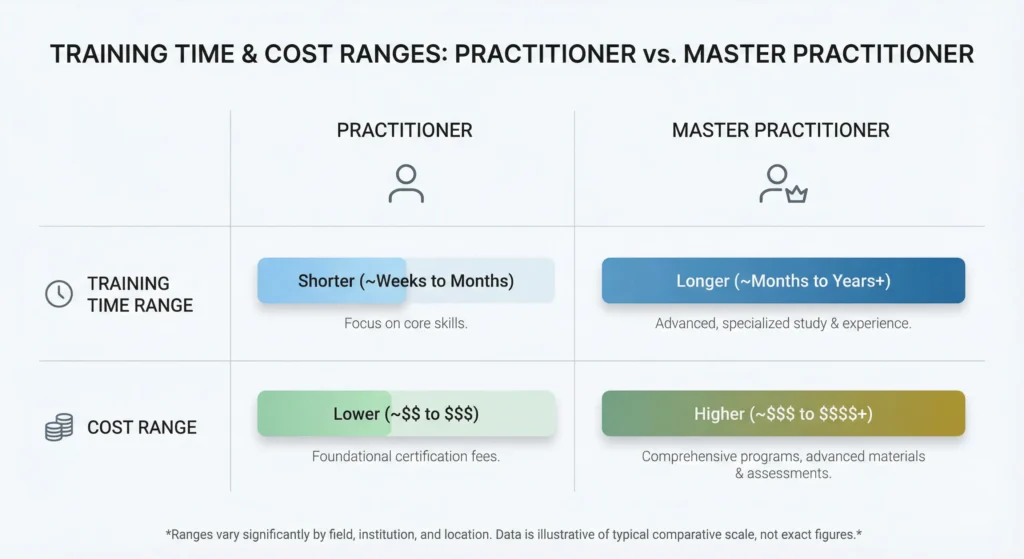
Master Practitioner requires completion of Practitioner certification first. This ensures you have the foundational skills to handle advanced work safely and effectively. You can’t work at the level of identity without mastering behavior-level change first.
The additional training typically requires 9-20 days (40-90 hours minimum). Many programs offer combined packages, Practitioner and Master Practitioner together, which often provide better value and create a cohesive learning journey.
The financial investment ranges from $1,500-$6,500 or more, depending on the trainer’s credentials, program depth, and delivery format. This reflects the advanced nature of the work and typically includes extensive post-training support.
The Quantum Leap in Capability
At Master Practitioner, you’ll develop capabilities that seem almost intuitive to others. You’ll identify limiting beliefs just by listening to someone’s language patterns. A single sentence reveals volumes about their internal world.
You’ll work at the level of identity, not just behavior. Instead of helping someone “act more confident,” you help them become confident at the core. Instead of managing anxiety symptoms, you help eliminate the patterns that generate anxiety.
The ability to deliver techniques conversationally means your work becomes elegant rather than mechanical. You’ll know dozens of ways to accomplish the same goal and intuitively choose the approach that fits your client’s unique wiring.
For a deeper exploration of specific techniques, the blog post on advanced NLP techniques offers practical applications.
Who Pursues Master Practitioner
Most people who complete the Master Practitioner level fall in love with NLP at the Practitioner level and want to complete their journey. It feels incomplete to stop halfway, like learning to read music but never performing.
Professional coaches building a practice find the Master Practitioner essential. Your clients bring complex scenarios that require advanced skills. Leaders handling organizational change need the depth that a Master Practitioner provides.
This level attracts people committed to mastery, not just competence. You’re willing to invest the time, money, and energy because the transformation in you creates transformation in everyone you touch.
The Transformation at This Level
Sarah Merron, an experienced NLP trainer, describes a Master Practitioner as developing “a quantum leap of awareness, knowledge, capacity to deliver techniques conversationally, and the awareness that our reality is completely fluid.”
You begin to understand consciousness itself. The idea that we’re so much more than our behaviors, emotions, or physical reality becomes increasingly clear. You question long-held beliefs while building the resilience to handle that destabilization.
Your confidence shifts from “I know these techniques” to “I embody this work.” Master Practitioners become the mirror or light most appropriate to leading their clients into transformation. That’s not something you learn, it’s something you become.
NLP Certification Levels: Quick Comparison
| Level | Duration | Prerequisites | Investment Range | Who It’s For |
| Practitioner | 7-25 days (120+ hours) | None | $300-$6,000 | Beginners, aspiring coaches, professionals enhancing skills |
| Master Practitioner | 9-20 days (40-90 hours) | Practitioner certification | $1,500-$6,500 | Coaches building practice, leaders handling complexity, those committed to mastery |
| Trainer | Varies (typically weeks) | Master Practitioner | Significant investment | Those wanting to teach NLP and certify others |
| Master Trainer | Years of experience | Trainer certification + 3-5+ years practice | Advanced investment | Field leaders training other trainers |
The Leadership Path: Trainer and Master Trainer Levels
For some practitioners, the journey doesn’t end with personal mastery. They feel called to teach, to raise standards in the field, and to contribute to NLP’s evolution.
NLP Trainer Certification
Trainer certification qualifies you to teach NLP Practitioner and Master Practitioner courses and certify new practitioners. This level requires Master Practitioner certification as a foundation; you must embody the work before teaching it.
The training focuses on teaching methodology, demonstration skills, and program design. You’ll learn how to structure effective learning experiences, manage group dynamics, and assess student competency fairly. You’ll practice demonstrating techniques clearly and creating environments where transformation happens.
Many Trainers also develop motivational speaker training skills as complementary capabilities, since teaching NLP often involves inspiring and engaging audiences.
Master Trainer: The Pinnacle
Master Trainer represents the highest recognized level in NLP. These are the practitioners who train other trainers, the teachers of teachers. Very few reach this level globally because the standards are rigorous.
Master Trainer requires years of practical experience, typically 3-5+ years of actively training practitioners. You must demonstrate not just competence but excellence in teaching, mentorship, and upholding field standards.
Organizations like ANLP maintain strict criteria for Master Trainer recognition because these individuals shape the future of NLP. They design sophisticated training programs, foster new generations of competent trainers, and contribute meaningfully to how NLP evolves.
Beyond Certification: Meta Master Trainer
Some organizations recognize a Meta Master Trainer level as more of an honorific title than a formal certification. It’s rarely given and reserved for individuals who truly live and embody NLP presuppositions in their daily and professional lives.
This recognizes lifetime contribution to the field and demonstrates that NLP isn’t something you do, it’s something you are.
What’s the Difference Between a Practitioner and a Coach?
This question comes up frequently, and it’s an important distinction. An NLP Practitioner is certified in NLP techniques and principles. An NLP Coach has typically completed additional training that combines NLP with coaching models and business practices.
Many programs now offer dual certification, NLP Practitioner AND Life Coach Certification in one comprehensive training. This combination prepares you for professional coaching practice with the business-building components you’ll need.
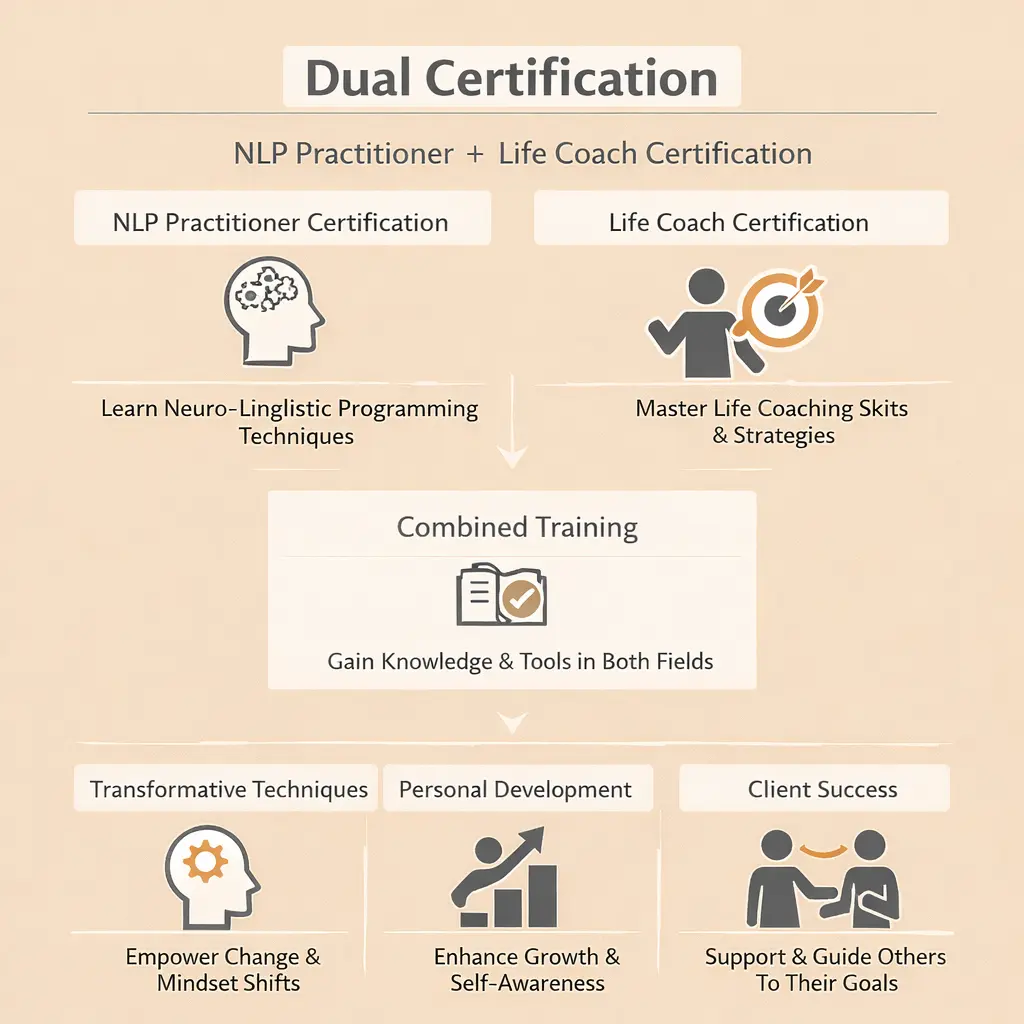
NLP provides the techniques for creating change. Coaching provides the structure for guiding clients toward their goals. Together, they create a powerful toolkit for transformation.
If you’re considering coaching as a career, setting realistic expectations for your coaching practice helps you build sustainable success from the start.
How Do I Choose the Right Certification Level for Me?
This decision matters. Not because one level is “better” than another, but because choosing the right starting point sets you up for success.
Consider Your Current Reality
Start with an honest assessment of where you are right now. What’s your current professional situation? Do you have a career you’re enhancing, or are you building something new? Have you explored personal development work before, or is this your first deep dive?
Consider your available resources, both time and financial. Can you invest 1-2 weeks intensively, or do you need a program spread over several months? What investment feels challenging but doable rather than impossible?
Think about your learning style. Do you thrive in immersive environments where you dive deep quickly? Or do you need time between sessions to practice and integrate before moving forward?
Clarify Your Desired Outcome
Get crystal clear on what you want certification to achieve. Is this purely for personal transformation? Are you enhancing your current career with better communication skills? Or are you building a new coaching practice from the ground up?
Consider your timeline. When do you want to start seeing results? Practitioner certification provides immediate tools you’ll use right away. Master Practitioner deepens capabilities over time with practice.
Be honest about your commitment level. Are you sampling NLP to see if it fits? Or are you all-in on mastering this work regardless of how long it takes?
Quick Self-Assessment
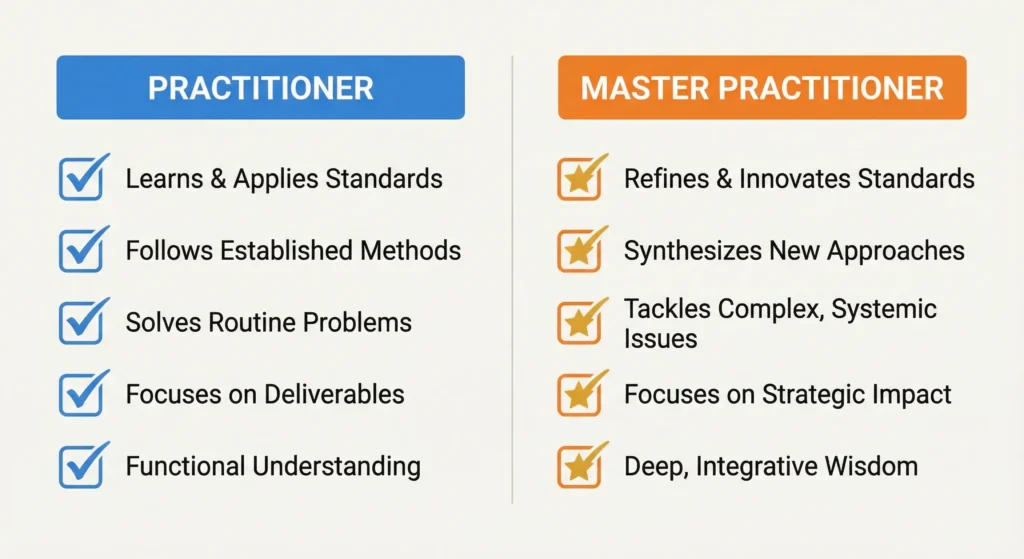
Ask yourself these questions:
Consider starting with Practitioner if you answer yes to 3 or more:
- I’m new to NLP and want to experience it before a deeper investment
- I want tools I can apply immediately in my life or work
- I’m exploring whether coaching is the right career path for me
- I need to see results before committing to advanced training
- I prefer starting with foundations and building from there
Consider Master Practitioner if you answer yes to 3 or more:
- I’ve completed Practitioner and want to go deeper
- I’m building or already running a coaching practice
- I work with clients facing complex, deep-rooted challenges
- I’m committed to mastery, not just competence
- I understand this is a long-term investment in my development
The Path Most Take
Most people start with the Practitioner certification. They experience the training, practice the techniques, and see results in their own life. Many then realize they want to complete the journey and pursue Master Practitioner within 1-2 years.
Some discover their passion for coaching only after personal transformation at the practitioner level. Others know from day one they’re building a coaching career and pursue both levels as quickly as possible.
There’s no wrong path, only the path that’s right for you right now.
Can I Do NLP Certification Online as Effectively as In-Person?
This question matters more than ever. The short answer: yes, with the right provider, online certification can be as powerful, sometimes more so, than in-person training.
What the Research Shows
A 2023 study published in the MDPI journal found that online continuing professional development resolves common barriers like location and time while matching in-person outcomes in knowledge gains when interactive elements are included. Harvard Extension research highlights online learning’s “unmatched” benefits for busy professionals who need flexibility without sacrificing quality.
Online learning can actually increase retention rates by 25-60% because you can rewatch complex sections, practice at your own pace, and review materials indefinitely.
The Key Factors for Effective Online Training
Not all online programs deliver equal results. The difference comes down to design and interaction. Look for programs that include:
Live interactive sessions (not just pre-recorded videos), you need real-time interaction with trainers and peers. The questions you ask andthe answers you receive in the moment create breakthrough understanding.
Structured practice with peers, you can’t learn NLP by watching videos. You need to practice techniques, receive feedback, and experience being both coach and client in real sessions.
Trainer demonstration and feedback, seeing techniques demonstrated live and getting personalized feedback on your practice are essential for developing competency.
Breakout coaching exercises and small group work during live sessions create the container for real learning and connection.
Post-training support and community,y the learning doesn’t stop when training ends. Ongoing access to trainers, peer practice opportunities, and continued resources matter enormously.
When In-Person Makes Sense
In-person training excels at creating immersive experiences. When you step away from daily life for a week, with full attention on learning, transformation can happen rapidly. The networking and relationships built during intensive in-person training often last for years.
Some people simply learn better in person. If you’re someone who gets distracted easily at home, or if you thrive on face-to-face energy, the additional investment in travel and time might be worth it.
The Bottom Line
Quality matters more than format. A well-designed online program with experienced trainers, live interaction, and structured practice will outperform a poorly designed in-person workshop every time.
What Happens After Certification? The Real Journey Begins
Here’s a truth many training programs don’t emphasize enough: certification is not the end, it’s the beginning. The real transformation happens in the months and years after you complete your training.
The Integration Phase
You’ll leave certification with new skills, fresh insights, and probably a lot of excitement. Then you’ll return to regular life and face the integration challenge: how do I actually use this?
The most successful practitioners approach integration systematically. They start by using techniques on themselves daily. Managing your own state, reframing your own challenges, and anchoring your own resourceful states becomes practice.
Then they begin applying skills conversationally with friends, family, and colleagues, not in formal sessions, just natural use of rapport, language patterns, and reframing in everyday interactions.
Only then do they begin working with actual clients. Starting small, maybe pro bono sessions with willing friends, builds confidence and competence before launching a full practice.
Real Transformation: Mike’s Story
One of our clients, Mike, struggled with self-doubt and anxiety that held back his career for years. The mental noise was constant second-guessing everything, anxiety spiking before important meetings, and confidence eroding over time.
Through NLP training and coaching, Mike learned to manage his internal state, reframe limiting beliefs, and anchor resourceful states. Within months, the anxiety vanished. He now speaks with genuine confidence in professional settings, listens clearly without mental chatter, and his career trajectory has completely transformed.
That’s the kind of transformation certification equips you to create not just for yourself, but for every client you serve.
Building Your Practice
If you’re planning to coach professionally, launching your coaching practice requires more than just certification. You’ll need to clarify your niche, develop your business model, create your marketing strategy, and build systems for client acquisition and retention.
Start practicing immediately, don’t wait for “perfect” readiness that never comes. Find supervision or mentorship from experienced practitioners who can guide you through challenging client scenarios. Join professional communities where you can learn from peers, ask questions, and stay connected to the field.
Commit to continuous professional development. Attend workshops, read current research, and explore adjacent modalities that complement your NLP skills. The best practitioners never stop learning.
The Long Game
Certification gives you tools and credentials. Application develops mastery. One client described it perfectly: “The training taught me what to do. Practice taught me how to be.”
That distinction matters. When you embody the principles of NLP rather than just applying techniques, your work becomes elegant, intuitive, and deeply transformational.
Investment Considerations: Time, Money, & Transformation
Let’s talk practically about what NLP certification costs and what it returns.
Financial Investment Ranges
The investment varies significantly based on certification level, training format, and provider credentials:
NLP Practitioner: $300-$6,000
- Lower range: Online introductory programs, self-paced study
- Mid-range: Quality online programs with live sessions and support
- Upper range: In-person immersive training with experienced trainers
NLP Master Practitioner: $1,500-$6,500
- Reflects the advanced nature of work and the depth of training
- Often includes extensive post-training support and mentorship
- In-person intensives are typically at the higher end
Combined Programs: Many providers offer Practitioner + Master Practitioner packages at better overall value, often in the $4,000-$8,000 range for comprehensive dual certification.
Trainer and Master Trainer: Significant investment reflecting the advanced level and smaller cohort sizes, typically $5,000-$15,000+.
Return on Investment
Current data from Indeed and ZipRecruiter shows NLP coaches earning $47-$59 per hour on average, with ranges from $40-$100+ depending on experience, specialization, and market. Annual earnings for full-time NLP coaches typically range from $60,000-$120,000+, with Master Practitioners and Trainers commanding higher rates for specialized work.
A certification costing $1,500-$6,000 can pay for itself within 6-18 months through client sessions at $100-$300 per hour. Many coaches recoup their investment even faster by combining NLP with other services or by focusing on higher-ticket corporate training.
Beyond direct financial ROI, consider the lifetime value of enhanced communication skills, deeper relationships, personal transformation, and the ability to create meaningful change in others’ lives.
Time Commitment Reality
Factor in more than just training days. You’ll invest time in:
- Pre-work and preparation materials (typically 10-20 hours)
- Live training sessions (120+ hours for Practitioner, 40-90 additional for Master)
- Practice sessions with peers (ongoing)
- Integration and application (continues indefinitely)
- Business building if pursuing coaching professionally (varies widely)
Online programs offer more flexibility; you can spread learning over several months while managing work and family. Intensive in-person programs require concentrated time away but create rapid immersion.
The Real Investment: Your Commitment
Here’s what certification can’t teach: commitment to your own growth. You can complete every hour of training, pass every assessment, and receive your certificate but without consistent practice and application, the transformation stays surface-level.
The practitioners who see the greatest results are those who commit to:
- Daily practice of state management and self-coaching
- Regular application with willing friends and family
- Continuous learning through books, workshops, and peer discussions
- Honest self-reflection about their own patterns and growth edges
- Patience with the journey from competence to mastery
That commitment matters more than which program you choose or how much you invest.
Accreditation: Why It Matters and What to Look For
NLP exists in a unique position: it’s a powerful methodology with global reach, but it’s not regulated by any single governing body. That creates both opportunity and risk.
The Unregulated Nature of NLP
Unlike licensed professions with strict oversight, NLP has no single authority controlling who can call themselves a practitioner, trainer, or master trainer. Technically, anyone can claim these titles without any training whatsoever.
This decentralization has led to wide variations in training quality. Some programs offer rigorous, comprehensive certification that truly develops competency. Others provide a certificate after minimal training that doesn’t prepare practitioners for real-world application.
That’s why choosing a reputable, accredited program matters so much. Certification standards vary widely, which makes selecting an experienced training provider more important than the certificate itself.
Reputable Accrediting Bodies
Several organizations maintain standards and provide independent verification of training quality:
ICF (International Coaching Federation) focuses on coaching ethics and competencies. Many NLP programs seek dual accreditation here for broader recognition and to meet coaching industry standards.
ABNLP (American Board of NLP) provides certification standards for US-based programs and emphasizes ethical practice and professional conduct.
INLPTA (International NLP Trainers Association) defines global guidelines for NLP certifications, requiring minimum training hours (120 for Practitioner, for example) and competency assessments.
ANLP (Association for Neuro Linguistic Programming) is UK-based and offers independent accreditation along with a member directory for verified trainers. They’ve worked to establish clear Master Trainer criteria across multiple UK certification bodies.
SNLP (Society of NLP) is the original certifying body, founded by NLP co-creators Richard Bandler and John Grinder, and focuses on maintaining integrity in the field.
When evaluating programs, verify trainer credentials with these bodies. Reputable trainers will display their certifications prominently and encourage you to confirm their standing.
Red Flags to Avoid
Watch for warning signs that suggest substandard training:
Impossibly short training times. “Become a certified NLP Practitioner in a weekend!” Real competency requires 120+ hours of training, practice, and assessment.
Trainers without proper credentials themselves. Your trainer should hold certification at least one level above what they’re teaching. Practitioner trainers should be certified Trainers. Master Practitioner trainers should be certified Trainers with Master Practitioner credentials.
Promises of instant mastery. Legitimate programs acknowledge that certification provides tools and foundational knowledge, but mastery develops through practice over time.
No practice or evaluation requirements. If you can get certified by just showing up and paying, the certification means nothing. Quality programs require demonstrated competency through practice sessions, peer coaching, and assessments.
Vague or nonexistent accreditation claims. Be skeptical of programs claiming accreditation from unknown bodies or refusing to provide verifiable credentials.
When in doubt, trust your instincts. If a program feels more like a sales pitch than genuine education, it probably is.
FAQs
What is the difference between the NLP Practitioner and Master Practitioner certifications?
NLP Practitioner builds foundational skills like rapport, anchoring, state management, and basic behavioral change. Master Practitioner advances to deeper work on beliefs, values, identity-level shifts, advanced modeling, and intuitive application of complex techniques. Practitioner is the entry-level toolkit; Master builds mastery for sophisticated transformations. Master requires completing the Practitioner first.
How much does NLP certification cost and what is the ROI?
Practitioner programs typically cost $300–$3,000 (online often lower; in-person higher). Master Practitioner ranges $1,500–$5,000+. Certified NLP coaches commonly earn $47–$100+ per hour. Many recoup costs in 6–18 months via client sessions, plus gain lifelong enhanced communication skills for personal/professional growth.
Is online NLP certification as valid as in-person training?
Yes, online certifications are equally valid and effective when they include live interactive sessions, breakout practice, real-time feedback, and supervised coaching, not just pre-recorded videos. Quality programs with peer practice and accreditation match in-person skill retention and competency.
Do I need any prerequisites to start NLP training?
No prerequisites for NLP Practitioner, open to beginners with zero prior knowledge. Master Practitioner requires completing a certified Practitioner level first, as advanced work builds directly on foundational skills.
How do I verify if an NLP certification program is legitimate?
NLP is unregulated, so check accreditation from reputable bodies like ABNLP, ANLP, INLPTA, or ICF (for coaching-integrated programs). Look for enforced standards on curriculum, practice hours, and ethics. Avoid “weekend fast-track” programs lacking depth. Accredited providers offer globally recognized certifications with proven quality. Check the organization’s approved trainer/institute lists.
Conclusion
Each NLP certification level represents not just new skills, but a deeper understanding of yourself and others. The levels aren’t a ladder to climb for status; they’re a path of genuine transformation.
Practitioner certification builds your foundation, giving you tools that create immediate change in your communication, your relationships, and your ability to help others shift limiting patterns. Master Practitioner deepens that foundation into artistry, teaching you to work at the level of identity and values, creating profound transformation rather than surface-level change. Trainer and Master Trainer levels call to those who want to raise standards in the field and contribute to NLP’s evolution.
Your decision isn’t about which certificate looks best on your wall or which title sounds most impressive. It’s about the depth of change you want to create in yourself first, then in others.
The transformation begins the moment you commit. Not when you complete certification, not when you land your first client, but when you decide that understanding human change matters enough to invest your time, energy, and resources into mastering it.
Whether you start with Practitioner certification to build your foundation or pursue Master Practitioner to deepen your expertise, the key is taking that first step. Your transformation and your ability to transform lives begin with committed action today.
Unleash your potential through NLP certification, and discover what becomes possible when you master the tools of lasting change. Explore how NLP training for business applications can amplify your impact in corporate environments, or take the first step into personal and professional mastery right now.