

The most scalable low-capital startups in Canada share three traits: they run on your expertise instead of inventory, they grow through systems rather than more hours, and they can be launched for under $1,000. The top options for Canadians this year include online coaching and consulting, digital products like templates and mini-courses, content creation with monetization, and freelance services in writing, SEO, or design.
Unlike traditional small business models, these scale without a matching increase in cost or effort. The real obstacle for most people stuck in a 9-to-5 is not finding the right idea. It is the fear, analysis paralysis, and limiting beliefs that make the leap feel impossibly risky. Pairing the right business model with a mindset built for independent action is what separates people who research forever from people who actually launch.
Key Takeaways
- The 3S Rule filters any startup worth pursuing: Skills over stock, Systems over time, Scale without hiring.
- The five highest-potential low-capital startups for Canadians are online coaching, digital products, freelance content services, online courses, and niche e-commerce.
- Most Canadians do not fail to launch because of bad ideas. They fail because of three internal blocks: analysis paralysis, perfectionism loop, and fear of judgment.
- The 4-Step Clarity Framework moves you from overwhelmed to committed: audit assets, match to market, set a 90-day proof-of-concept goal, and build the identity before the business.
- Realistic first-90-day income ranges from $1,500 to $5,000 per month, depending on model. The goal is proof of concept, not salary replacement.
- Canada offers structural advantages, including low-cost sole proprietor registration, the $30,000 HST threshold for new businesses, and USD earning potential for those selling internationally.
- The fastest path forward is committing to one model, one audience, and one offer for 90 days. Not three. One.
What Makes a Startup ‘Scalable’ in Canada Right Now
Most low-capital business lists miss the most important filter: scalability. A business is not scalable just because it costs little to start. It is scalable when your revenue can grow without a matching increase in your time, effort, or overhead. That distinction changes everything about which ideas deserve your energy.
The 3S Rule is the simplest filter for identifying genuinely scalable startups in Canada right now. It has three parts.
- Skills over stock means your value comes from what you know, not what you hold or ship.
- Systems, over time, mean the business runs on repeatable processes, not constant manual effort.
- Scale without hiring means one person can serve many clients or customers through automation, digital delivery, or group formats.
Run any startup idea through the 3S Rule before you commit. A residential cleaning business fails on ‘systems over time.’ A print-on-demand shop passes on ‘skills over stock.’ An online coaching practice passes all three. This filter alone will save you from spending six months in a business that traps you inside a second job.
Canada also offers a structural advantage that most global articles skip entirely. When you sell services or digital products to American or international clients, you earn in USD while living on CAD. At current exchange rates, that gap meaningfully increases your real purchasing power without raising your prices. On the legal side, registering as a sole proprietor is straightforward and inexpensive. You are also not required to collect HST or GST until your annual revenue crosses $30,000, which gives you a clean runway to validate your business before any tax complexity enters the picture. For a full breakdown of how to structure your banking from day one, see our guide on bank accounts for Canadian startups.
The 5 Highest-Potential Low-Capital Startup Ideas for Canadians
These five ideas pass the 3S Rule. Each one has proven demand in the Canadian market, a low barrier to entry, and a clear path from solo launch to scalable income. A Scalability Scorecard follows each idea so you can compare them at a glance.
Online Coaching or Consulting
You already have skills someone else is paying to learn. Coaching and consulting convert that knowledge into a business with almost no overhead. If you are wondering how to start a coaching business from scratch, the short answer is this: a clear outcome, a specific audience, and a booking link are all you need to land your first client. A coach working with professionals in leadership, career transitions, health, or business can generate meaningful income from a handful of well-positioned clients.
The key shift is positioning. You are not selling your time. You are selling a specific outcome for a specific type of person. The more specific your offer, the faster you land clients and the less you compete on price.
Once you have validated your offer and built a client base, the path to scaling your coaching business opens up through group programs, digital products, and online courses. But that growth starts with one client, and that first client starts with a single conversation.
| Factor | Rating |
| Startup Cost | Under $500 |
| Time to First Dollar | Fast (2 to 4 weeks) |
| Scalability | Very High |
| Skill Barrier | Low to Medium |
Digital Products (Templates, Toolkits, Mini-Courses)
Digital products are the closest thing to sustainable passive income that actually works. You create a product once and sell it repeatedly, with no inventory, no shipping, and no delivery cost. Platforms like Gumroad, Payhip, or Shopify handle fulfillment automatically. Once a product is established, digital products can run at up to 94% profit margins, meaning a single strong product can outperform months of service revenue.
The challenge is distribution, not creation. Build an audience on LinkedIn, a newsletter, or a niche community before you launch. A hundred engaged followers will generate your first sales faster than a polished product with no audience behind it.
| Factor | Rating |
| Startup Cost | $0 to $200 |
| Time to First Dollar | Medium (4 to 8 weeks) |
| Scalability | Extremely High |
| Skill Barrier | Low |
Freelance Content Services (Writing, SEO, Design)
Freelancing is the fastest path to revenue on this list. If you can write, design, edit, build websites, or manage social media, you can find a paying client within days. The Canadian market has strong demand from small businesses, startups, and professional service firms that need content expertise but cannot justify a full-time hire.
The productization step is what separates a freelancer from a business owner. Instead of custom quotes for every project, you offer a fixed-scope monthly package. That one shift makes your income predictable and your business far easier to manage and grow.
| Factor | Rating |
| Startup Cost | Near zero |
| Time to First Dollar | Very Fast (1 to 2 weeks) |
| Scalability | Medium to High |
| Skill Barrier | Low |
Online Course Creation
The e-learning industry has reached $203 billion globally and is projected toward $400 billion by 2026. Canadians are building courses on platforms like Teachable, Thinkific, and Kajabi covering everything from tax strategy to Excel for project managers. The ‘create once, sell infinitely’ model means your income ceiling is not tied to your calendar.
The biggest mistake course creators make is building before validating. Sell a live cohort first. Run it with a small group, collect feedback, and then record the polished version. You will learn more from 10 paying students than from 10 months of solo preparation.
| Factor | Rating |
| Startup Cost | $200 to $600 |
| Time to First Dollar | Medium (6 to 12 weeks) |
| Scalability | Very High |
| Skill Barrier | Low to Medium |
Niche E-Commerce or Print on Demand
Print-on-demand services like Printful let you sell custom apparel, accessories, and home goods without holding a single unit of inventory. Each order is produced after the sale, which means no upfront stock cost and no risk of unsold products sitting in a spare room.
The brands that succeed with this model are hyper-specific. A generic ‘motivational quotes’ store competes with thousands of others. A store built around Canadian outdoor culture, a specific profession, or a tight hobby community has a clearly defined audience and far less competition.
| Factor | Rating |
| Startup Cost | $100 to $400 |
| Time to First Dollar | Medium (4 to 8 weeks) |
| Scalability | High |
| Skill Barrier | Low |
Quick Decision Matrix
Not sure which model fits you? Use this to shortcut the decision.
| If you want… | Best model | Why |
| Revenue fast | Freelance Services | Lowest time to first dollar |
| Long-term scale | Digital Products | Create once, sell infinitely |
| Authority building | Online Coaching | Positions you as the expert |
| Passive income (phase 2) | Online Courses | Build audience first, monetize second |
| No audience needed yet | Print on Demand | Product validates the market for you |
What’s Actually Stopping You (It’s Not the Idea)

You have probably read at least three ‘top business ideas’ articles before this one. You bookmarked them, maybe started a spreadsheet, told yourself you would start ‘next month.’ And yet here you are.
This is not a motivation problem. It is a belief architecture problem.
The ideas above are not secret. Anyone with a phone and an internet connection can find them. The gap between the people who launch and the people who stay employed forever is rarely information. It is the internal wiring that decides, below the level of conscious thought, whether the risk is worth taking.
In my 20-plus years working with entrepreneurs and professionals, I have watched three specific patterns derail almost every person who never makes the leap. Understanding how your entrepreneurial mindset shapes every business decision is the starting point for changing it. Here are the three patterns.
Pattern 1: Analysis Paralysis
You open 12 tabs, compare 6 platforms, and research for another week before making a decision. You frame this as due diligence. What it actually is: fear dressed in productivity clothing. The cure is not more research. It is a 90-day proof-of-concept commitment that gives you a real answer faster than any article ever will.
Pattern 2: The Perfectionism Loop
You need a better website. A more refined offer. A cleaner brand name. You tell yourself you will start ‘when it’s ready.’ But the version of ‘ready’ in your head keeps moving further away.
Darren G. came to me unable to land a promotion, unable to start his own business, and unable to break through what he described as an invisible wall of resistance. What we discovered together was not a strategy problem. It was a set of goal blocks and limiting beliefs that had been quietly making every decision for years. Once we identified and dismantled them, his career trajectory, his relationships, and his daily momentum changed radically. The wall was always internal, and it always is.
Pattern 3: Fear of Judgment
What if people think you are not credible? What if it fails publicly? What if your colleagues find out you tried and it did not work? This pattern is the quietest and the most destructive. The truth is that the people you are afraid of judging you are far too occupied managing their own fears to track yours.
Which Block Are You Facing Right Now?
Check the one that resonates most.
- ‘I need more clarity before I can decide’ is analysis paralysis. Shrink the decision to its smallest viable form and commit to 90 days.
- ‘I’ll start when my offer is more polished’ is the perfectionism loop. Put a rough offer in front of one real person this week and adjust from what you learn.
- ‘What if I try and it doesn’t work out?’ is fear conditioning. Learning to identify your limiting beliefs is the first step toward dismantling them. An offer that doesn’t land is data about the market, not a verdict on your worth as a person.
Try this: Write down the single thought that comes up every time you consider launching your business. Sit with it for 60 seconds and ask yourself: ‘When did I first decide this was true? That question alone, applied honestly, is the beginning of the identity shift that makes entrepreneurship possible.
Startup Advice That Will Keep You Stuck
Before you build anything, it helps to know what not to do. Most advice about starting a business is well-intentioned and deeply counterproductive.
‘Follow your passion’ is the most recycled piece of startup advice in existence, and it has derailed more businesses than almost any external factor. Passion does not predict market demand. Start with skills the market already pays for, and let passion develop as your results build momentum and confidence.
‘Build a professional website first’ costs you weeks of focus before you have validated a single thing. A LinkedIn profile and a booking link have launched coaching businesses with five-figure monthly revenue. The website comes after proof of concept, not before.
‘Wait until you’re ready’ is not a strategy. It is fear with a calendar attached. There will never be a moment when you feel fully prepared to do something you have never done before. Readiness is built by doing, not by planning to do.
‘Expect passive income on day one’ is a story sold by people who have already spent years building an audience. Digital products and courses can absolutely generate passive income over time. But in your first 90 days, expect active work. The passive element develops as your systems and audience mature.
The 4-Step Clarity Framework: Find Your Right Idea
The question is not ‘which business idea is best?’ The question is ‘which idea fits where I am right now?’ These four steps move you from overwhelmed and stuck to a committed path with a clear starting point.
Step 1: Audit Your Assets:
Before you look at market trends, look at what you already have. List your professional skills, your lived experience, the problems you have already solved, and the communities you belong to. The fastest path to your first dollar is almost always built on something you can already do, not something you need to learn first.
Step 2: Match to Market Demand:
Take your top two or three asset areas and spend one hour searching for evidence of people paying for solutions in that space. Search freelance platforms, course marketplaces, coaching directories, and LinkedIn. If paying clients exist, the market is real. If you cannot find anyone charging for it, that is data too.
Step 3: Set a 90-Day Proof-of-Concept Goal:
Choose one model, one audience, and one offer. Not three. Not a portfolio of experiments. One. Define what success looks like in 90 days: your first paying client, your first product sale, your first retainer. A specific target creates momentum that ‘I’ll work on my business someday’ never will.
Step 4: Build the Identity Before the Business:
This is the step most frameworks skip entirely, and it is the one that determines whether you follow through. Before you launch your offer, you need to decide, at the identity level, that you are an entrepreneur. Not ‘trying to become one.’ Not ‘exploring the idea.’ The shift from employee to founder is first a decision about who you are, and then a set of actions that follow from it. NLP techniques for entrepreneurs are specifically designed to install that internal wiring at the subconscious level, so your daily actions align with the identity you are building.
Heather Chetwynd came to an NLP training already familiar with the concepts but unclear on how to put them into practice. What she left with was not just a toolbox of techniques. It was a level of clarity about her business direction and future that she had not expected to find in a skills training. The framework and the identity work came together in a way that made both more useful.
What You Can Realistically Earn in Your First 90 to 180 Days
Honest income expectations are rarer than startup ideas, so here is what the data and real-world patterns actually suggest.
For coaching and consulting, most people land their first one or two clients within 30 to 60 days of focused outreach. At $500 to $2,000 per client per month, reaching $2,000 to $5,000 in monthly revenue within 90 days is realistic if your offer is specific and your outreach is consistent.
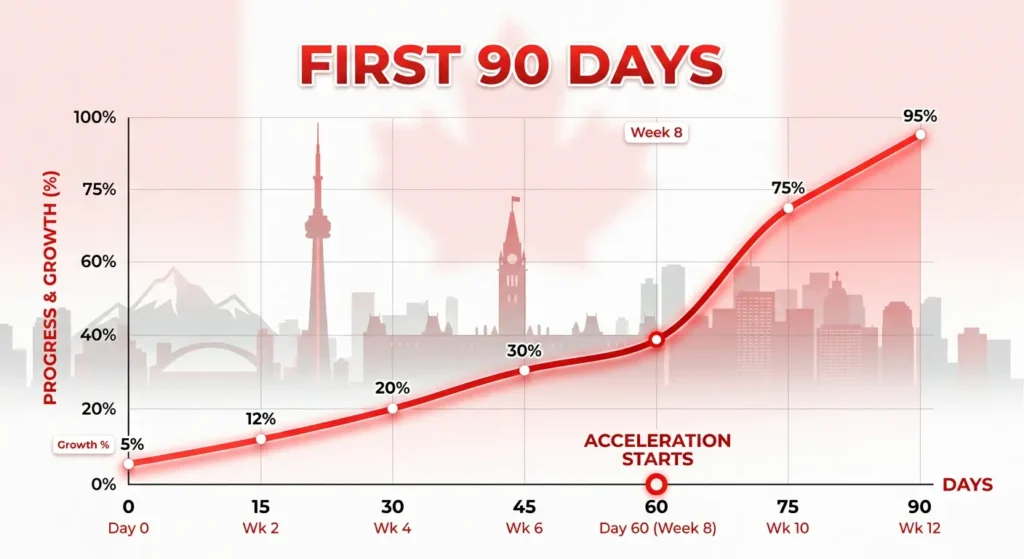
For freelance content services, the ramp is faster. Writers, designers, and SEO specialists often land their first paid project within one to two weeks of active outreach. Monthly income of $1,500 to $4,000 in the first 90 days is achievable with a clear service package and steady client conversations.
For digital products and online courses, the first 90 days are typically slower. Expect to invest in audience-building and product validation before revenue becomes consistent. The payoff tends to arrive between months three and six, when a well-positioned product starts generating sales without proportional effort.
What this means for you: none of these numbers replaces a full salary in 30 days. But they are real enough to validate your model and build momentum while you are still employed. The goal of the first 90 days is not financial replacement. It is a proof of concept.
Your First 48 Hours
The research phase is over. Here is what the next 48 hours look like if you are serious about moving.
Day 1: Use the Clarity Framework to pick your model and your audience. Do not move until you have written it down in one sentence: ‘I help [specific person] achieve [specific result] through [specific service or product].’ Then spend 30 minutes searching for three to five real examples of someone already charging for this. Confirmation from the market permits you to move that no article can.
Day 2: Create your simplest possible offer and put it in front of one person. Send a message to someone in your network who fits your target audience. Tell them what you are offering, what it does for them, and what it costs. Do not wait for a website. Do not wait for branding. This one action closes more psychological loops than any amount of additional planning ever will.
The point is not perfection. It is momentum. Every day you stay in research mode is another day the version of you that actually runs a business stays theoretical.
Data and Findings
Canada’s self-employment landscape is larger than most people realise. Statistics Canada data shows 2.7 million Canadians were self-employed in 2023, representing 13.2% of the employed population. Separately, research tracking global side hustle trends found that 30% of Canadian workers ran a side hustle in 2024, with the majority citing financial motivation. Here are the numbers, with context.
| Stat | Number | What This Means for You |
| Self-employed Canadians (2023) | 2.7 million / 13.2% | The infrastructure for independent work in Canada is established and real |
| Canadians with a side hustle (2024) | 30% of workers | You are entering a competitive space. Niche clarity wins, not just effort |
| Digital product profit margins | Up to 94% | One strong product can outperform months of service-based revenue |
| Global e-learning market (2026 Approx.) | $400 billion | Demand for packaged knowledge is accelerating. Canadians can sell globally |
| AI productivity boost for solopreneurs | Up to 40% | One person in 2026 can manage what once required a small team |
This Path Is for You If…
- You have skills you have been paid for inside a job that other people would value outside of one.
- You are willing to tolerate 90 days of uncertainty in exchange for a fundamentally different kind of working life.
- You understand that building something requires active effort before it generates passive returns.
- You are ready to be a student of your market rather than waiting until you feel like the leading expert.
- You are open to addressing the internal blocks alongside the external strategy, because you understand that mindset is not soft stuff. It is infrastructure.
This Will Not Work for You If…
- You need a guaranteed income to replace your salary before you will take any action.
- You want a business that involves no discomfort, no rejection, and no learning curve.
- You are expecting passive income within the first few weeks with minimal effort.
- You are not willing to spend 90 days testing an idea before deciding whether it works.
- Understanding why most small businesses fail to grow makes it easier to avoid the patterns before they take hold. The most common cause is not a lack of capital. It is launching without clarity on who they serve and what problem they are solving.
The Difference Between Knowing and Acting
You now have more clarity about scalable low-capital startup ideas than the vast majority of people who read about them. You know the 3S Rule. You know the five models. You know which internal blocks are most likely to stop you and what to do about each one.
But knowing is not the same as doing. Every person who has stayed in a 9-to-5 longer than they wanted to already knew, on some level, that options existed. What they lacked was the internal alignment between what they knew and what they were willing to do.
You do not need another idea. You need a different way of thinking about what is possible for you, and a framework that turns that clarity into consistent action.
That is exactly the work we do together. If you are ready to address both the strategy and the internal architecture that actually drives results, book a conversation at unleashyourpower.com. And once you are generating your first revenue, our guide on smart reinvestment strategies for small businesses will help you turn early profit into long-term momentum.
Unleash Your Power: Stand Out, Take Action, and Create the Success You Want.
Frequently Asked Questions
What is the cheapest business to start in Canada?
Online coaching, freelance writing, and digital product creation are among the lowest-cost businesses to launch in Canada, with startup costs under $500 in most cases. These models require no physical inventory, no commercial space, and scale through expertise and systems rather than capital investment.
Can I run a low-capital startup while working full-time in Canada?
Yes, and it is often the smartest approach. Starting a coaching practice, freelance service, or digital product business alongside employment lets you validate the model and build initial income before making a financial leap. Most successful solo founders spent 3 to 12 months building their business part-time before going full-time.
Do I need to register a business in Canada to get started?
Not immediately. You can begin validating an idea and landing early clients without a formal registration. Once your income becomes consistent, registering as a sole proprietor through your province is inexpensive and straightforward. You are not required to register for HST or GST until your revenue exceeds $30,000 annually.
How do I know if my business idea is scalable?
Apply the 3S Rule. Skills over stock means you generate value from expertise, not inventory. Systems, over time, mean the business can run on repeatable processes. Scale without hiring means one person can serve a growing number of clients or customers through automation, digital delivery, or group formats. If your idea passes all three, it has genuine scalability.
What is the biggest mistake people make when starting a low-capital business?
Spending weeks on branding, websites, and business infrastructure before validating that anyone will pay for their offer. The fastest path to a real business is putting a simple, specific offer in front of a real person as quickly as possible and adjusting based on what you learn.