

You’re sitting across from a potential client in a Toronto coffee shop. They say they’re “very interested” in your services, but something feels… off. Their arms are crossed. They avoid eye contact. Their voices are flat. Should you believe their words or trust your gut?
Key Takeaway:
- Non-verbal communication accounts for 55–93% of message impact (Mehrabian’s 7-38-55 rule)—NLP enhances mastery through reading/calibrating body language, mirroring/leading, micro-expressions, posture, eye accessing cues, and gesture congruence to build instant rapport and influence. [1]
- Key NLP techniques: Calibrate baseline (normal posture/tone), mirror subtly to create unconscious rapport, lead to guide state change, read eye accessing cues (visual/auditory/kinesthetic recall/construction), match breathing rhythm, use open/grounded posture, and align gestures with words for congruence and credibility. [1]
- Practical applications: In sales/negotiation, mirror to build trust fast; in coaching/therapy, read incongruence for deeper insights; in leadership, use expansive posture for authority; practice daily: observe people in public, note eye cues during conversations, consciously match breathing/posture in meetings. [2]
- Caveats: Avoid over-mirroring (feels manipulative); cultural differences affect gestures/eye contact norms; congruence is key—fake non-verbals backfire; combine with verbal skills for full impact; ethical use builds genuine connection, not manipulation. [2]
Bottom Line: NLP gives you precise tools to read, match, and influence through non-verbal channels—mastering body language, mirroring, and congruence dramatically improves rapport, persuasion, and connection in any interaction.
This disconnect between verbal and non-verbal communication happens dozens of times every day in sales calls, coaching sessions, job interviews, and even casual conversations. Most people rely on vague “gut feelings” to navigate these moments. But what if you could systematically decode non-verbal cues with the same precision you use to parse words?
That’s exactly what Neuro-Linguistic Programming (NLP) calibration techniques teach: a structured methodology for reading body language, spotting micro-expressions, and building authentic rapport. Not through guesswork or pseudoscience, but through systematic observation and behavioral psychology principles.
In this guide, you’ll learn:
- The OBSERVE Framework – a 6-step calibration protocol competitors don’t teach
- How to spot micro-expressions in 0.5 seconds (based on Paul Ekman’s research)
- Ethical mirroring techniques that build trust without manipulation
- Toronto-specific applications for coaches, sales professionals, and executives
But first, let’s get something critical out of the way.
Full Transparency: What NLP Is (And Isn’t)
Full disclosure: NLP has limited scientific backing as a therapy modality. A 2012 systematic review by the NIH found “little evidence that NLP interventions improve health-related outcomes,” and the quality of NLP research remains limited.
However and this is important, the observation techniques NLP teaches (calibration, sensory acuity, baseline reading) are grounded in broader behavioral psychology. This guide focuses on what works, debunks what doesn’t, and shows you exactly how to apply these skills ethically in real-world settings.
You won’t become a mind reader. You won’t detect lies through eye movements (that’s a myth we’ll debunk below). But you will develop sharper observational skills that enhance communication in coaching, sales, leadership, and everyday life.
Ready? Let’s start by understanding what makes NLP calibration different from generic body language tips.
What Makes NLP Non-Verbal Communication Different?
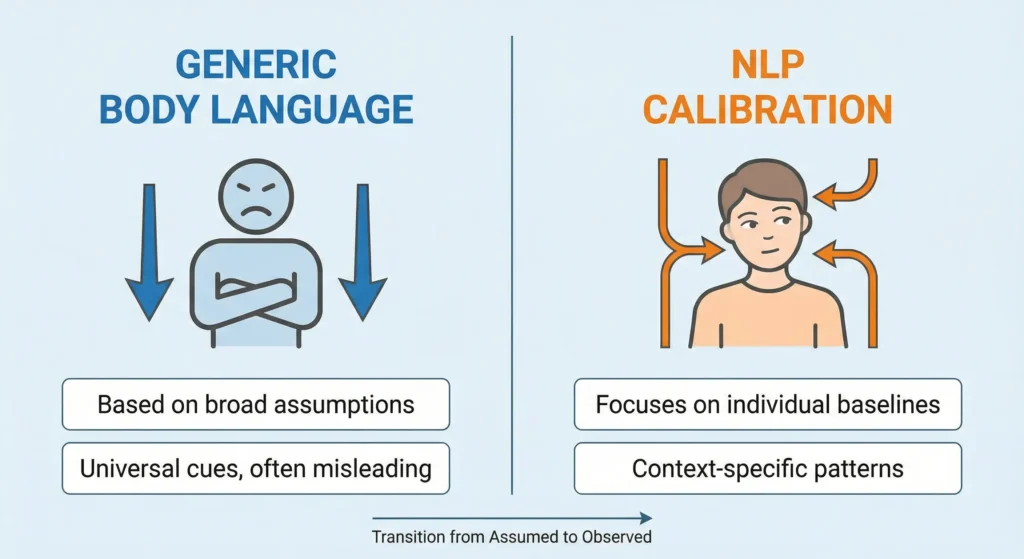
Walk into any bookstore and you’ll find dozens of body language guides. Most repeat the same generic interpretations: “Crossed arms mean defensive,” “Touching your face means lying,” “Leaning in shows interest.”
NLP calibration takes a fundamentally different approach.
NLP Calibration vs. Traditional Body Language Reading
| Traditional Body Language | NLP Calibration |
| Generic interpretations (“crossed arms = defensive”) | Individual baseline + deviation detection |
| Isolated gesture reading | Cluster reading (multiple cues together) |
| Static universal rules | Context-dependent interpretation |
| Guesswork and intuition | Systematic observation protocol |
| One-size-fits-all meanings | Calibrated to each person individually |
The key difference: NLP doesn’t just observe, it calibrates.
Here’s what that means in practice:
Traditional approach: “Client crossed their arms. They’re being defensive.”
NLP calibration approach:
- Observe baseline: “Client usually sits with arms crossed when comfortable. That’s their default.”
- Notice deviation: “When I mentioned pricing, they uncrossed their arms and leaned forward. That’s the signal.”
- Interpret in context: “The shift indicates interest or concern, which needs more data to determine which.”
See the difference? You’re not applying cookie-cutter rules. You’re detecting changes from each individual’s unique baseline.
The Three Pillars of NLP Non-Verbal Mastery
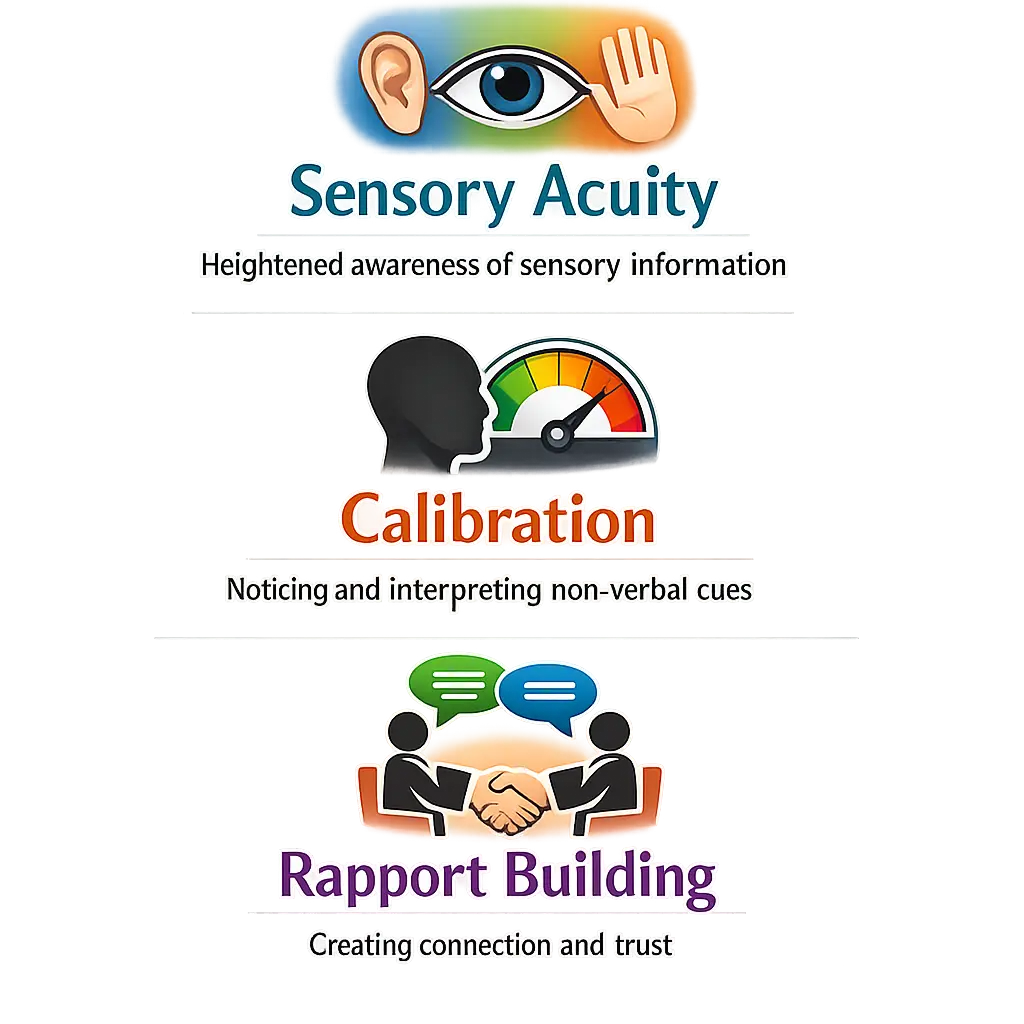
Sensory Acuity
Sharpening your ability to notice subtle non-verbal signals, micro-facial movements, breathing patterns, vocal tone shifts, and posture adjustments. Most people are operating at maybe 20% of their potential observational capacity. NLP trains you to notice what others miss.
Calibration
Establishing an individual’s “normal” behavior (baseline) so you can identify deviations that signal emotional or cognitive shifts. This is where the science lives. Behavioral psychology has long established that detecting deviations from a baseline is far more accurate than interpreting absolute behaviors.
Rapport Building
Using ethical mirroring and matching techniques to createa subconscious connection and trust. This is rooted in the well-established “chameleon effect” (Chartrand & Bargh, social psychology research), showing that subtle behavioral mimicry increases liking and affiliation.
Now, before we dive into the practical techniques, we need to clear up the two biggest myths in non-verbal communication because building authority requires honesty, not hype.
Myth-Busting: The Science vs. The Sales Pitch
MYTH #1: “93% of Communication is Non-Verbal”
You’ve heard this stat everywhere. It’s in TED talks, business books, and every body language course on the internet.
It’s also completely misunderstood.
The Real Story (Albert Mehrabian, 1967)
Psychologist Albert Mehrabian conducted studies in the late 1960s exploring how people communicate feelings and attitudes. He found that when verbal and non-verbal messages conflict (like saying “I’m fine” with a distressed tone and expression), people rely more on:
- 7% – Words
- 38% – Tone of voice
- 55% – Facial expressions/body language
The Critical Context Everyone Ignores:
- Only applies when discussing feelings/attitudes – Not facts, not information, not business models
- Only when verbal and non-verbal cues conflict – When congruent, words matter much more
- Artificial lab setup – Participants judged feelings from single words like “maybe” spoken in different tones
- Limited sample – One study had only 62 female subjects
- Didn’t include full body language – One study used only facial expressions, not gestures or posture
What Mehrabian Himself Says:
On his own website, Mehrabian clarifies: “This equation is only applicable when a communicator is discussing their feelings or attitudes.“
When the 93% Rule Actually Applies:
YES: Client says they’re “excited to start,” but voice is flat, shoulders slumped, avoiding eye contact → Trust the non-verbal cues (they’re ambivalent)
NO: Explaining your 5-step coaching framework → Words carry the vast majority of the meaning
Bottom line: Non-verbal communication matters enormously in specific contexts. But claiming “93% of all communication is non-verbal” is simply wrong.
MYTH #2: “Eye Movements Detect Lies”
This might be NLP’s most persistent and most damaging myth.
The Claim:
“If someone looks up and to the right, they’re lying. Up and left means they’re remembering.”
The Reality:
NLP founders Richard Bandler and John Grinder never claimed eye movements detect lies. This urban legend emerged from a misunderstanding of what “eye accessing cues” actually measure.
What Eye Accessing Cues Really Show:
Eye movements indicate which representational system a person is accessing (how they’re thinking), not what they’re thinking or whether it’s truthful:
- Up-left: Visual memory (recalling images)
- Up-right: Visual construction (imagining new images)
- Left: Auditory memory (recalling sounds/words)
- Right: Auditory construction (creating sounds/dialogue)
- Down-left: Internal dialogue (self-talk)
- Down-right: Kinesthetic (accessing feelings/sensations)
So what’s wrong with the lie detection claim?
- Eye cues show process, not content – Someone imagining a new scenario isn’t necessarily lying; they could be problem-solving
- Individual variability is massive – Left-handed people often have reversed patterns
- No scientific evidence – Studies attempting to link eye movements to deception found no correlation (Carlei & Kerzel, 2020, Laterality journal)
- Context matters enormously – A complex question may trigger multiple representational systems
The Honest Application:
Eye accessing cues can give you clues about how someone processes information:
- Highly visual thinker? Use visual language and imagery
- Auditory processor? Focus on tone, stories, and verbal explanations
- Kinesthetic person? Emphasize feelings, experiences, and hands-on examples
But using them as a lie detector? That’s pseudoscience, and it damages NLP’s credibility.
The OBSERVE Framework: Your 6-Step Calibration Protocol
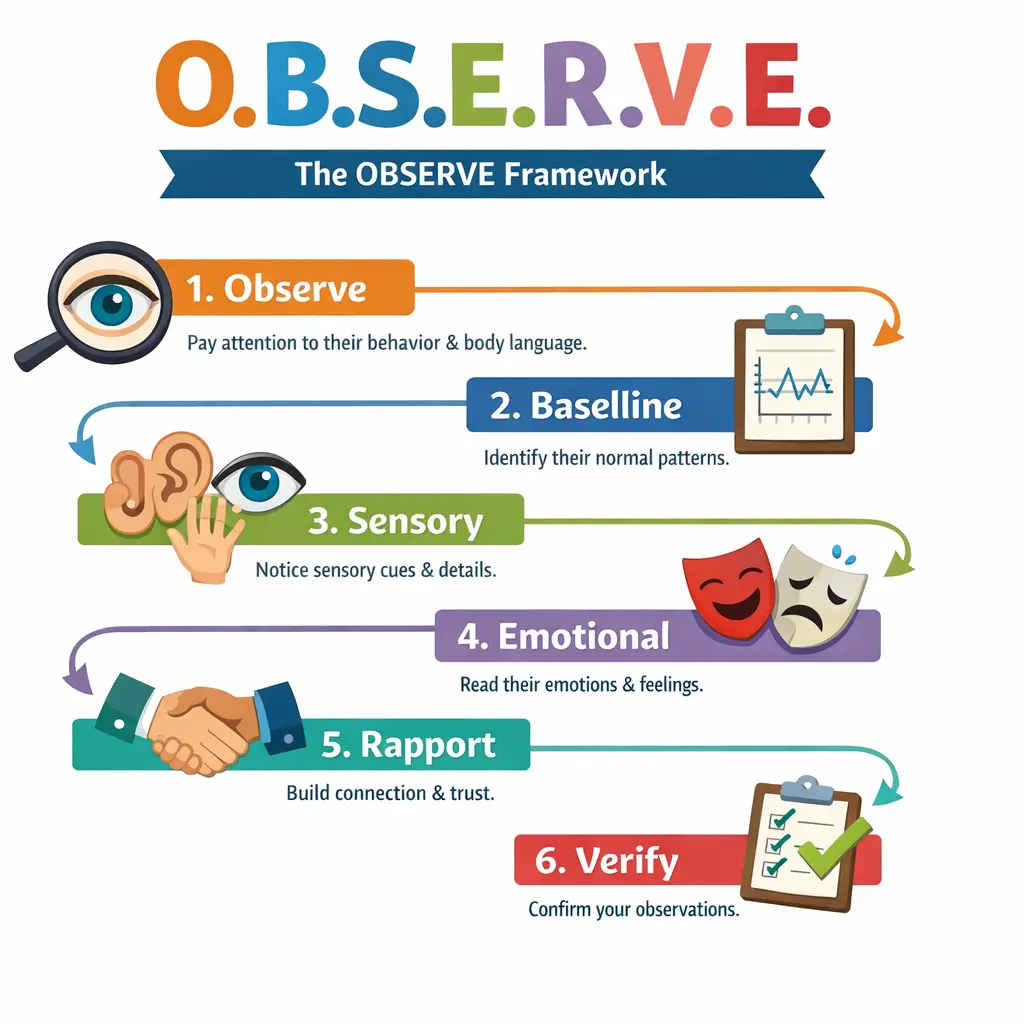
This is the practical methodology competitors don’t teach. Use this framework to calibrate anyone from clients to executives to networking contacts at Toronto business events.
O – Observe Baseline Behavior (Step 1)
Goal: Establish each person’s “normal” state before discussing important topics.
What to Watch:
- Facial expressions – What does their neutral/relaxed face look like?
- Posture – Where do they naturally place their hands, arms, legs?
- Breathing – What’s their resting breathing rate and depth?
- Vocal tone – What’s their comfortable speaking pace, pitch, and volume?
- Gesture frequency – How animated are they normally?
How: Spend 5-10 minutes in casual, neutral conversation. Ask about their weekend, commute, interests, and anything low-stakes.
Toronto Example:
At a networking event at MaRS Discovery District, spend your first few minutes asking about their work, how they heard about the event, and what brought them to Toronto. Notice their baseline before pitching your services or asking for a meeting.
Pro Tip: Take mental (or physical) notes. You’re building a reference point for comparison.
B – Baseline Deviations (Step 2)
Goal: Introduce a meaningful topic and watch for changes from baseline.
Trigger Topics:
- Pricing/money discussions
- Commitment questions (“Are you ready to start?”)
- Sensitive subjects
- Decision points
What Changes to Notice:
- Micro-expressions – Fleeting flashes of emotion (0.04-0.5 seconds)
- Posture shifts – Forward lean, pull back, crossed/uncrossed arms
- Breathing changes – Faster, shallower, held breath
- Voice variations – Pitch increase, speed change, volume drop
- Gesture disruption – Sudden increase or decrease in hand movements
Example (Toronto Sales Context):
Baseline: Tech startup founder is leaning back, arms relaxed on armrests, steady breathing, speaking at a moderate pace.
After pricing mention: Slight forward lean (0.5 seconds), jaw tension (micro-expression), breathing rate increases, “Hmm” in a lower pitch.
Calibration: This signals concern or surprise, not necessarily rejection. It’s an invitation to address their hesitation: “I noticed a shift. What questions do you have about the investment?”
S – Sensory Channels (Step 3)
Goal: Identify how someone prefers to process information.
Eye Accessing Cues (Use with Caution)
Remember: These show how someone thinks, not what they’re thinking.
Visual Quadrant (Up):
- Up-left → Recalling images
- Up-right → Constructing/imagining images
Auditory Quadrant (Level):
- Center-left → Recalling sounds, words, conversations
- Center-right → Constructing sounds, internal dialogue
Kinesthetic Quadrant (Down):
- Down-left → Internal dialogue, self-talk
- Down-right → Accessing feelings, emotions, bodily sensations
Critical Caveats:
- Must calibrate to each individual (patterns vary)
- Left-handed people often reverse the pattern
- Not universal cultural differences exist
- Complex questions trigger multiple accessing cues
Practical Application:
If a client consistently looks up when processing your questions, they’re likely visual. Adapt your language:
- “How does that feel?”
- “Can you see yourself implementing this?”
If they look down-right frequently, they’re kinesthetic:
- “Do you envision success?”
- “How does that sit with you?”
E – Emotional Clusters (Step 4)
Goal: Identify emotions through multiple converging signals.
The 7 Universal Emotions (Paul Ekman Research)
Cross-cultural studies by psychologist Paul Ekman identified seven emotions recognized universally through facial expressions:
- Happiness – Crow’s feet around eyes, raised cheeks, smile
- Sadness – Inner eyebrows raised, lip corners down, eyes drooping
- Anger – Lowered brows, tight lips, flared nostrils
- Fear – Raised eyebrows, wide eyes, open mouth
- Disgust – Wrinkled nose, raised upper lip
- Surprise – Raised eyebrows, wide eyes, dropped jaw
- Contempt – One-sided mouth raise (asymmetrical expression)
Cluster Reading: The Golden Rule
Never interpret a single cue in isolation.
Look for 3+ signals pointing to the same emotion:
Example – Detecting Genuine Interest:
| Single Cue (Unreliable) | Cluster (Reliable) |
| “They leaned forward.” | Leaned forward + maintained eye contact + nodding + uncrossed arms + asking questions |
Example – Spotting Hidden Resistance:
| Single Cue | Cluster |
| “Arms crossed” | Arms crossed + pulled-back posture + minimal eye contact + monosyllabic answers + jaw tension |
Toronto Cultural Note:
Toronto is one of the world’s most diverse cities. Body language norms vary significantly across cultures. Direct eye contact is valued in Canadian business culture but may be considered aggressive or disrespectful in others. Always calibrate individually. Never stereotype culturally.
R – Rapport Mirroring (Step 5)
Goal: Build subconscious connection through ethical matching.
The Science of Mirroring
The “chameleon effect” (Chartrand & Bargh, social psychology) shows that people who subtly mimic others are perceived as more likable, trustworthy, and persuasive. This isn’t manipulation; it’s how human connection naturally works.
How to Mirror Ethically:
1. Match Energy Level
If they’re high-energy and animated, they bring more enthusiasm. If they’re calm and measured, slow down.
2. Mirror Posture (Delayed)
If they lean forward, wait 10-15 seconds, then lean forward too. The delay prevents obvious mimicry.
3. Align Vocal Pace and Tone
Fast talker? Speed up slightly. Soft-spoken? Lower your volume a notch.
4. Breathe at a similar rhythm
This is subtle but powerful. Match their breathing pace during key moments.
Ethics Alert
Rapport Building ≠ Manipulation
- Ethical: Matching energy to make someone comfortable, build a genuine connection
- Unethical: Mirroring to deceive, pressure, or coerce someone into decisions against their interest
If you’re using mirroring to exploit rather than connect, you’re not influencing, you’re manipulating. Influence serves both parties. Manipulation serves only one.
When NOT to Mirror:
- Negative emotional states (anger, anxiety don’t amplify)
- Destructive behaviors
- When it feels disingenuous to you
V – Verify Through Calibration (Step 6)
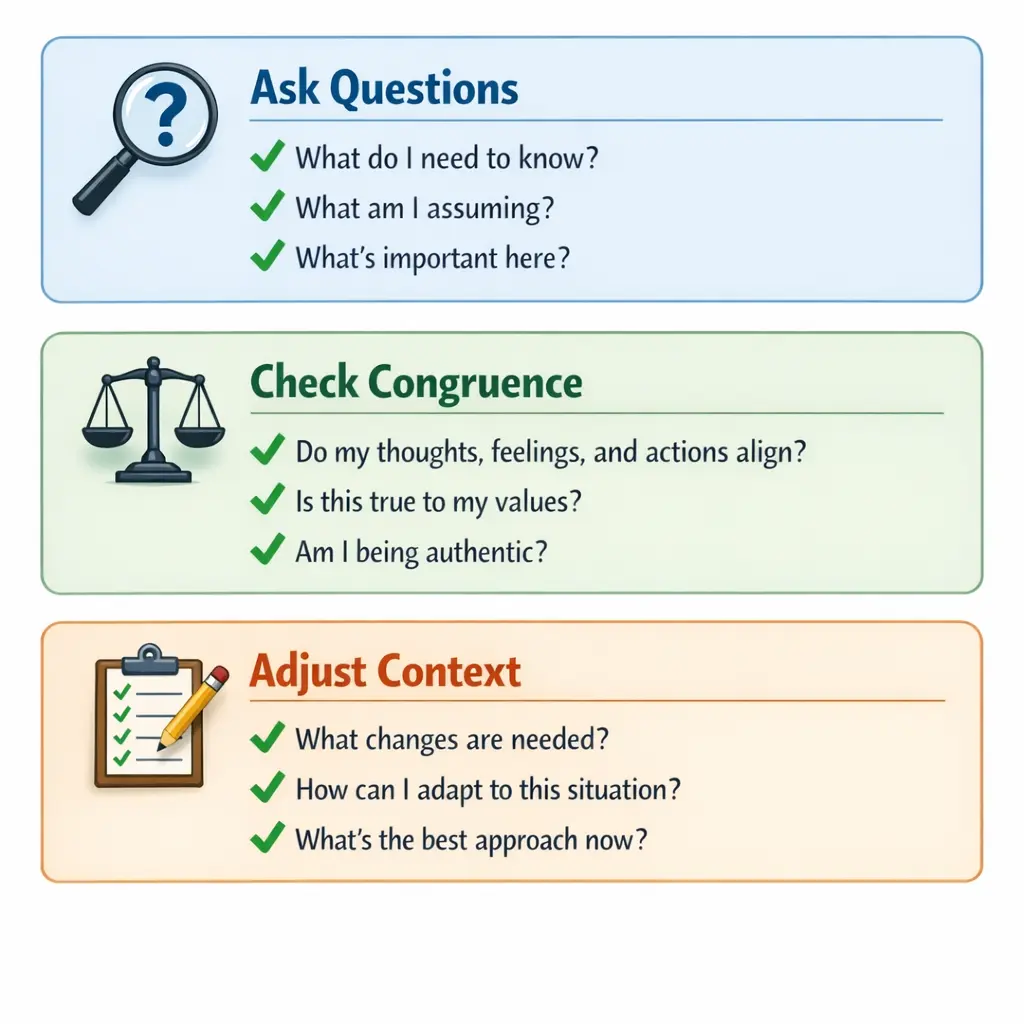
Goal: Test your observations and adjust interpretations.
Verification Techniques:
Ask Open-Ended Questions
“I noticed you paused there. What’s on your mind?”
“You seem thoughtful about this. What questions do you have?”
Check for Congruence
Do their words match their body language? If yes, you’re likely on track. If no, which signal is stronger?
Adjust Based on Context
- Crossed arms in a cold coffee shop ≠ , Defensiveness
- Avoiding eye contact in some cultures ≠ Dishonesty
- Fidgeting in someone with ADHD ≠ Anxiety
Calibrate Over Time
Your first impressions won’t be perfect. Refine your baseline as you interact more.
Toronto Executive Example:
You’re presenting to a VP at a Yonge Street office tower. You think you see a micro-expression of concern when discussing timelines. Before concluding, they’re hesitant, ask: “How does this timeline align with your Q2 goals?” Their verbal response either confirms your calibration or corrects it.
Practical Applications: Toronto Context
For Coaches: Reading Client State
Scenario: Your client says they’re “ready to make the change,” but you notice:
- Avoiding eye contact
- Arms tightly crossed
- Voice hesitant, lots of “um” and “maybe.”
NLP Calibration Interpretation:
They’re ambivalent, not committed. Their non-verbal cues reveal inner conflict.
What To Do:
Don’t push forward. Address the resistance:
“Part of you seems excited, and part of you seems hesitant. What’s the concern your gut is trying to tell you?”
This builds trust (“My coach actually sees me”) and uncovers real blockers.
For Sales Professionals: Buying Signals
Toronto B2B Sales Example:
Baseline (First 10 minutes):
Director of Operations at a Markham manufacturing company sits back, arms loosely folded, asking clarifying questions.
After Product Demo:
Leans significantly forward, uncrosses arms, eyebrows raised, “Hmm, interesting” in a higher pitch, asks about implementation.
Translation:
Interest activated. The shift from baseline signals engagement. This is your window for a trial close:
“It sounds like this could solve the bottleneck you mentioned. Want to walk through what implementation would look like for your team?”
For Executives: Boardroom Calibration
Reading the Room During a Proposal:
- Multiple micro-expressions of surprise → Your proposal is unexpected (could be good or bad, probe further)
- Nodding + leaning in + note-taking → Strong buy-in
- Crossed arms + looking at phones + minimal eye contact → Resistance, boredom, or skepticism
- Sideways glances between executives → Nonverbal conferring they’re aligned but not telling you yet
Adjust on the fly: If you see resistance, pause and ask, “Before I continue, what questions or concerns are coming up?”
For Networking: Cultural Sensitivity in Toronto
Toronto is one of the most multicultural cities globally. Body language is not universal.
Examples of Cultural Variation:
- Eye contact: Direct and sustained in Canadian/Western norms; potentially aggressive or disrespectful in some East Asian, Middle Eastern, or African cultures
- Personal space: North Americans prefer ~2-4 feet; Latin American and Mediterranean cultures often prefer closer; some Asian cultures prefer more distance
- Hand gestures: Thumbs-up is positive in Canada; offensive in parts of the Middle East
- Head nodding: Means “yes” in Canada; means “I’m listening” (not agreement) in some cultures
The NLP Solution:
Never apply generic rules. Always calibrate individually.
At a Toronto tech meetup, don’t assume someone’s lack of eye contact means dishonesty. It may be cultural, introverted, or neurodivergent. Focus on their baseline and deviations from their norm, not a universal checklist.
Micro-Expression Training: The 0.5-Second Window
What Are Micro-Expressions?
Definition: Fleeting, involuntary facial movements lasting 0.04 to 0.5 seconds that reveal genuine emotion before conscious control suppresses them.
Why They Matter:
You can smile and say “That’s fine” while a 0.2-second flash of anger crosses your face. Trained observers catch that flash. Untrained people miss it.
The Research (Paul Ekman, UCSF)
Psychologist Paul Ekman spent decades studying facial expressions across cultures. His research established:
- 7 universal emotions (listed earlier)
- Micro-expressions occur cross-culturally (same facial muscle movements for anger in Tokyo, Toronto, and Timbuktu)
- Training improves recognition – His Micro Expression Training Tool (METT) shows immediate accuracy gains
How to Train Yourself to Spot Them
Slow-Motion Video Practice
- Find YouTube videos of speeches, interviews, and debates
- Watch at 0.25x speed
- Pause on facial flashes, what emotion was that?
- Gradually increase speed as you improve
Partner Drills
- Ask a partner to vividly recall an emotional memory (don’t tell them which)
- Watch their face closely
- Guess the emotion based on micro-expressions
- Get feedback
Frame-by-Frame Awareness
- When someone says something incongruent (“I’m fine,” but it seems off), replay the last 3 seconds in your mind
- Did you catch a facial flash you initially ignored?
- Over time, your real-time awareness sharpens
Important Reality Check
Micro-expressions are hard.
Despite what TV shows like Lie to Me portray, real-time micro-expression detection requires significant training. Paul Ekman himself notes that even trained law enforcement officers have limited accuracy without ongoing practice.
Don’t overestimate your ability. Use micro-expression awareness as one data point in your calibration, never as definitive proof of anything.
What NLP Can and Cannot Do: The Honest Truth
What NLP Communication Techniques ARE Good For:
Let’s close with radical transparency, because real authority comes from honesty, not hype.
- Systematic observation of non-verbal behavior – Developing sharper sensory acuity
- Building rapport through ethical mirroring – Creating subconscious connection
- Baseline calibration methodology – Detecting meaningful deviations
- Understanding representational systems – Adapting communication to how people think
- Improving emotional intelligence – Becoming more aware of others’ states
What NLP Is NOT:
- A scientifically validated therapy – 2012 NIH systematic review found “limited evidence” for health outcomes
- A lie detector – Eye cues don’t predict deception; micro-expressions are hard to spot in real-time
- Mind reading – You’re observing behavior and making educated inferences, not accessing thoughts
- Universal – Massive individual and cultural variation; one-size-fits-all rules don’t work
- A substitute for expertise – If you’re a coach, your coaching skills matter most. NLP enhances, doesn’t replace
The Bottom Line:
NLP as a psychotherapy modality lacks robust scientific support (source: NIH, 2012). Many of its theoretical claims are based on outdated neuroscience metaphors and haven’t been validated through rigorous research.
However
The observation and communication skills taught in NLP (calibration, sensory acuity, rapport building) are grounded in broader behavioral psychology and social science. They work because humans respond to:
- Attention and presence (rapport)
- Congruence detection (noticing mismatches)
- Subtle behavioral synchrony (mirroring)
- Pattern recognition (baseline deviations)
Use NLP techniques as communication tools, not therapeutic interventions.
Be honest about what they can and cannot do.
Focus on ethical application connection, not coercion.
That’s how you build genuine authority.
Your 4-Week Practice Routine (15 Minutes Daily)
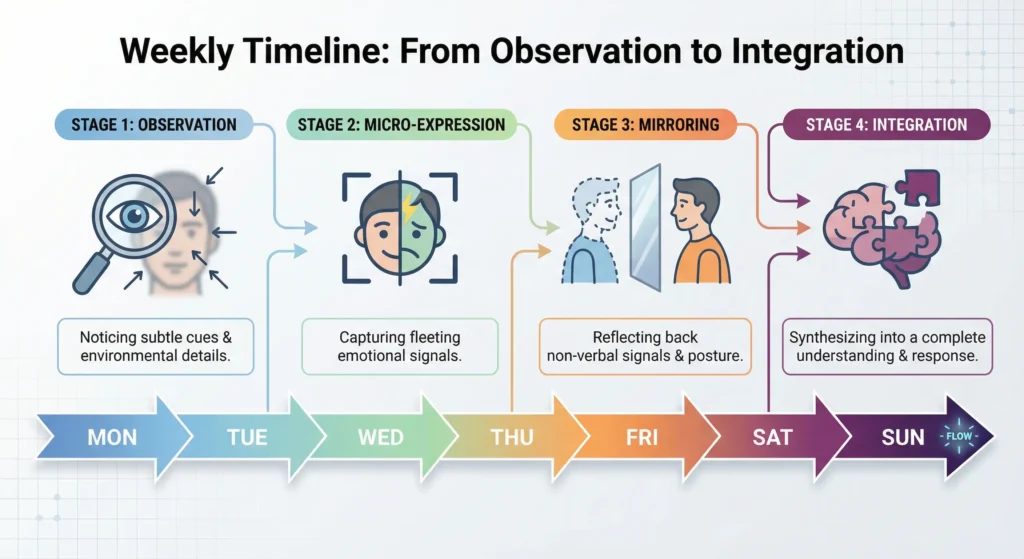
Want to actually get good at this? Here’s your structured training plan:
Week 1: Baseline Observation
- Days 1-3: Observe friends/family in neutral settings. Note their default posture, facial expressions, breathing, and vocal tone
- Days 4-7: Introduce various topics. Watch for deviations from baseline
- Goal: Build a mental library of “normal” for people you know
Week 2: Micro-Expression Training
- Daily: 15 minutes of slow-motion video analysis (YouTube political debates, interview clips)
- Goal: Spot 1-2 micro-expressions per video
- Bonus: Try to name the emotion (happiness, fear, disgust, etc.)
Week 3: Ethical Mirroring Practice
- Daily: Practice subtle matching in low-stakes conversations (barista, Uber driver, colleague)
- Test: Ask afterward, “Did you notice I was matching your energy?” (Most won’t consciously notice)
- Goal: Make mirroring feel natural, not forced
Week 4: Full OBSERVE Framework
- Daily: Apply the complete 6-step protocol on 1 person
- Journal: What baseline did you establish? What deviations did you notice? Were your interpretations accurate?
- Goal: Integrate all skills into seamless observation
After 4 weeks:
You’ll have dramatically sharper observational skills. You won’t be perfect (no one is), but you’ll notice 3-5x more non-verbal cues than you do now.
Conclusion: Influence Through Awareness, Not Manipulation
Mastering non-verbal communication with NLP isn’t about gaining some secret superpower to control people. It’s about:
Paying better attention.
Noticing what’s unspoken.
Adapting your communication to meet people where they are.
Building authentic connection through presence and rapport.
The OBSERVE Framework gives you a systematic approach. The science that grounds your practice in reality. The ethical boundaries ensure you use these skills to serve others, not exploit them.
Whether you’re a coach helping clients break through resistance, a sales professional reading buying signals, an executive navigating boardroom dynamics, or someone who simply wants to communicate more effectively in Toronto’s diverse, multicultural environment, these skills will serve you.
But they require practice. Intentional, consistent practice.
Ready to take your NLP skills to the next level?
Want Hands-On Training in Toronto?
Unleash Your Power offers NLP Practitioner certification in Toronto, combining these calibration techniques with live practice in real-world coaching and communication scenarios. You’ll master the OBSERVE Framework, practice micro-expression detection, and learn ethical influence strategies from experienced trainers.
Based in Toronto – Training in one of the world’s most diverse cities gives you real-world cultural calibration experience
Internationally Recognized Certification – Become a certified NLP Practitioner
Small Group Learning – Personalized feedback and hands-on practice
Frequently Asked Questions
How long does it take to get good at reading non-verbal communication with NLP?
Basic competency: 4-8 weeks of daily 15-minute practice. Real proficiency: 6-12 months. Mastery: Years. Like any skill, it gets better with deliberate practice.
Can NLP techniques work over video calls?
Yes, but with limitations. You can still observe facial expressions, eye movements, and upper body posture. You lose full postural shifts and breathing patterns. Focus on micro-facial cues and vocal tone.
Is it manipulative to mirror someone without telling them?
Mirroring is a natural human behavior; we do it unconsciously all the time with people we like. Consciously mirroring to build rapport is ethical when your intent is a genuine connection. It becomes manipulative when you use it to deceive or coerce someone’s interest.