
Picture this: You step onto the stage, the room goes silent, and every eye locks onto you. Your heart’s steady. Your mind’s clear. You own that space before you even speak your first word, using proven NLP techniques to regulate confidence, focus your state, and command presence effortlessly.
Key Takeaway:
- NLP (Neuro-Linguistic Programming) offers powerful, practical techniques that help public speakers overcome anxiety, boost confidence, connect deeply with audiences, and deliver more impactful presentations. [1]
- Key techniques include anchoring (creating instant confidence triggers), reframing (turning nervousness into excitement), visualization (mentally rehearsing success), mirroring & matching (building instant rapport with the audience), and powerful language patterns that influence and inspire listeners. [1]
- Top speakers use these tools to manage stage fright, stay calm under pressure, read audience energy in real-time, and deliver presentations that are not only informative but emotionally memorable and persuasive. [2]
- Mastering a few core NLP techniques can dramatically improve your speaking performance, audience engagement, and overall confidence — whether you’re a beginner or an experienced professional speaker. [2]
Bottom Line: NLP gives public speakers a significant edge by transforming fear into confidence, improving audience connection, and making presentations more persuasive and memorable. Learning and applying these techniques can take your speaking skills to a professional level faster than traditional practice alone.
That’s not magic. That’s NLP in action.
Here’s the reality: about 75% of people fear public speaking more than death. If you’ve felt that knot in your stomach before a presentation, you’re not alone. Most speakers obsess over their slides, rehearse their content word-for-word, and hope confidence shows up on game day. But here’s what they miss: commanding a room has almost nothing to do with what you say. It’s about how you program your mind, body, and presence to radiate authority the moment you enter that space.
Through NLP training programs, thousands of professionals have transformed speaking anxiety into magnetic stage presence. The tools you’re about to learn work whether you’re delivering corporate keynote presentations, leading a team meeting, or pitching to investors. These aren’t theories. They’re practical techniques you can apply today.
Understanding NLP for Public Speaking
Neuro-Linguistic Programming studies how your thoughts shape your behavior and communication. Break it down: Neuro (your brain), Linguistic (language patterns), Programming (the mental patterns you can change). For speakers, this matters because research shows 55% of communication is non-verbal, 38% is vocal tone, and only 7% is the actual words you say.
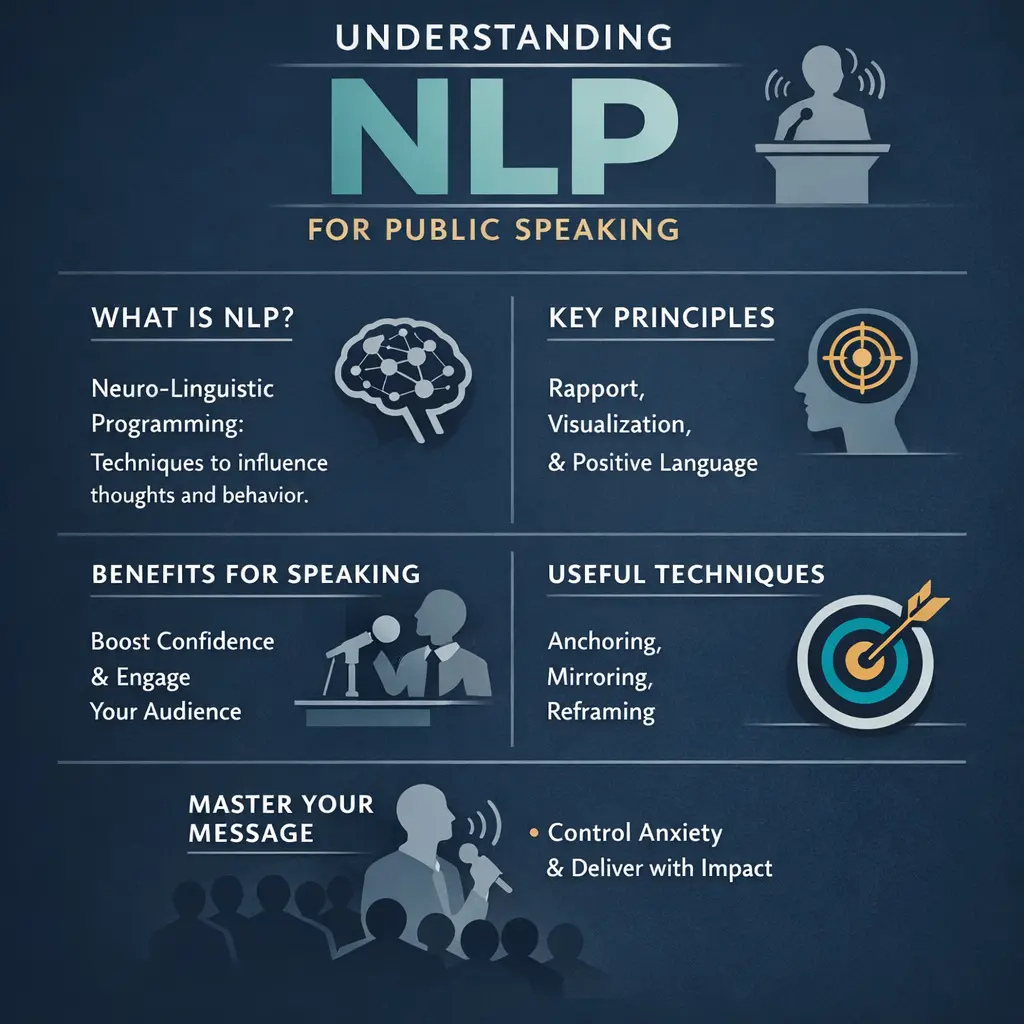
That statistic should wake you up. You could have the most brilliant content in the world, but if your body language screams nervous and your tone wavers, your message dies before it reaches anyone.
The NLP advantage is simple: you can reprogram your anxiety responses, build instant rapport with strangers, and control your emotional state on command. Think of it as upgrading your operating system. Most speakers run on default settings; whatever mood shows up that day, they’re stuck with. NLP gives you the control panel.
The Science Behind NLP and Stage Presence
Studies on NLP and public speaking consistently show that speakers who apply these techniques are perceived as more credible, confident, and persuasive. One comprehensive study found that incorporating NLP methods led to measurably improved communication skills and increased confidence in speaking scenarios. When audiences watch someone who’s mastered their state, they instinctively trust that person more.
Here’s why: your audience’s mirror neurons fire when they watch you. If you’re anxious, they feel anxious. If you’re grounded and confident, they relax and open up. You’re not just presenting information, you’re creating an emotional experience. NLP gives you the tools to engineer that experience deliberately.
Technique #1: Anchoring for Instant Confidence
Anchoring is where transformation happens fast. Here’s how it works: you associate a specific physical gesture with a powerful emotional state. When you need that state, say, unshakeable confidence, before walking on stage, you trigger the gesture, and the feeling floods back.
Your brain already does this naturally. A certain song brings back a memory. A smell transports you to childhood. Anchoring harnesses this process intentionally.
Here’s how to create your confidence anchor:
- Recall a moment when you felt absolutely confident. Not “kind of confident,” truly unstoppable. Relive it fully. What did you see? What sounds were around you? What did confidence feel like in your body?
- As the feeling peaks, create a unique physical trigger. Touch your thumb and middle finger together, or press a specific spot on your wrist. Hold it for 5-10 seconds while the confident feeling intensifies.
- Release. Break your state, think about something completely different.
- Repeat this process 3-5 times, always at the peak of the confident feeling.
- Test it. Fire your anchor (do the gesture) without thinking about confidence. If you’ve built it correctly, the feeling returns automatically.
One of my clients, Mike, struggled with self-doubt and anxiety that derailed his professional presentations. Through anchoring and other NLP techniques, Mike eliminated his anxiety entirely and now speaks with confidence at work, completely transforming his career trajectory.
The Pre-Stage Confidence Routine
Before you speak, use the Circle of Excellence technique. Imagine a circle on the floor in front of you. Step into it mentally, and as you do, stack every resource you need: confidence, clarity, charisma, calm. See the circle glowing with these qualities. Step in and out several times, feeling the difference. When it’s time to present, mentally step into that circle as you take the stage.
Pair this with the Breath of Life pattern: inhale through your nose for four counts, hold for four, exhale through your mouth for four, hold for four. This breathing rhythm creates a baseline state of calm alertness. Do this for 60 seconds before speaking, and you’ll notice your nervous system shifting from fight-or-flight to focused readiness.
Technique #2: Match and Mirror for Instant Rapport
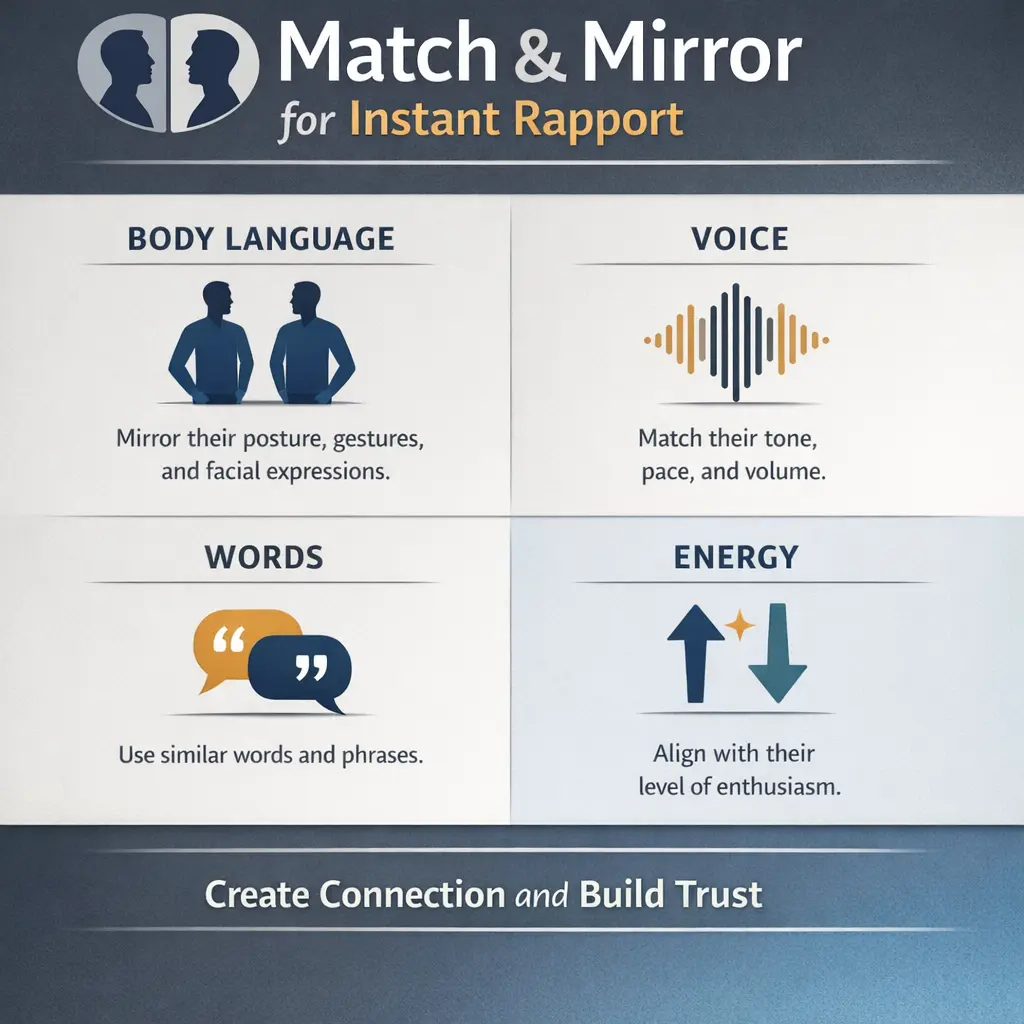
Walk into any room and you’ll see it happening naturally: friends sitting in similar positions, couples unconsciously matching each other’s gestures, teams that sync their energy. This is rapport at the subconscious level, and it’s one of the most powerful tools for commanding attention.
Matching and mirroring means subtly reflecting your audience’s body language, tone, and energy level. Not mimicking that’s obvious and awkward. Subtle alignment. If your audience is seated and attentive, you mirror their composure with grounded, purposeful movement. If they’re high-energy, you bring that energy up without going manic.
The key is sensory acuity. Before you speak, scan the room. What’s their energy? Are they leaning forward (engaged) or back (skeptical)? Are they making eye contact or checking phones? Notice facial expressions, posture shifts, and even breathing patterns if you’re close enough.
Here’s where NLP communication strategies become essential for leaders. You’re not manipulating, you’re meeting people where they are. Once you’ve matched their state, you can lead them somewhere new.
Reading Your Audience’s Non-Verbal Cues
Develop your sensory acuity by practicing this in low-stakes conversations. Notice when someone’s face shifts a micro-expression of doubt or excitement slightly. Watch for congruence: does their verbal “yes” match their body’s tension? The more you notice, the better you adapt in real time.
During presentations, track three audience members in different sections of the room. Check in with them periodically. If one looks confused, slow down or clarify. If all three are nodding, you’ve hit the mark. This real-time feedback loop keeps you connected instead of stuck in your script.
Technique #3: Sensory-Rich Language That Captivates
Your audience doesn’t want data. They want to experience something. Sensory-rich language makes that happen.
There are three primary representational systems in NLP: visual, auditory, and kinesthetic. Most people have a preference, but everyone responds when you engage all three.
Visual predicates: see, look, imagine, picture, clear, bright, focused, vision. “Picture this: you’re standing on that stage, and you see the audience leaning forward, eyes locked on you.”
Auditory predicates: hear, sounds, resonates, rings, harmony, loud, quiet. “Listen to how the room goes silent when you deliver that opening line.”
Kinesthetic predicates: feel, grasp, touch, solid, rough, smooth, warm, handle. “Feel the confidence settling into your chest as you take that first step forward.”
When you mix these, you create an immersive story. Compare these two versions:
Flat: “Public speaking is important for your career.”
Sensory-rich: “Picture yourself standing in front of the executive team. You hear the silence as they wait for your opening. You feel that surge of confidence in your body, solid and grounded. They see a leader.”
Which one lands? The second one, because it pulls your audience into the experience instead of telling them about it.
Creating Immersive Stories That Stick
In NLP, we distinguish between association and dissociation. Associated means experiencing something from inside your own perspective, seeing through your own eyes, feeling it in your body. Dissociation means watching yourself from the outside, like viewing a movie.
When you tell stories in presentations, associate your audience with the narrative. Use “you” language and the present tense. “You’re walking into that negotiation,” not “I walked into the negotiation.” Let them experience it, not just observe you experiencing it.
Research shows that presentations using storytelling are 22 times more memorable than facts alone. But only if the story engages their senses. A bland story might as well be bullet points. A sensory-rich story becomes unforgettable.
Technique #4: Strategic Silence and Power Pauses
Silence terrifies most speakers. They rush to fill every gap, convinced that silence equals failure. They’re wrong.
Strategic silence demonstrates authority. It says, “I’m comfortable here. I control the pace. You’ll wait for my next words because they matter.”
Here’s the 6-second rule: after you make a powerful point, pause for at least six seconds. Count it in your head. Let the weight of what you said settle into the room. Watch what happens, people lean in. They process. They respect the moment you just created.
When you eliminate filler words like “um,” “uh,” and “like,” you sound dramatically more confident and credible. The fix? Replace fillers with silence. When you need to think, just pause. Breathe. Then speak.
Using Pauses to Reclaim Attention
If you sense the audience drifting and you will at some point deploy silence strategically. Stop mid-sentence. Let the quiet stretch for three seconds. Eyes will snap back to you. Then continue as if nothing happened. You’ve just reclaimed the room without saying a word.
Pauses also build anticipation. Want your next point to hit hard? Set it up, then pause. “And the single most important factor in leadership success is…” (pause for 3 seconds) “…your ability to regulate your own state.”
That pause makes them hunger for the answer. Without it, the sentence blends into everything else.
Technique #5: Spatial Anchoring and Stage Movement
Your position on stage carries meaning. Most speakers don’t realize they’re sending mixed signals by moving randomly. NLP spatial anchoring gives you a framework.
Stage left (audience’s right): Use this position when discussing the past. “Three years ago, when this company faced that challenge…” Move left.
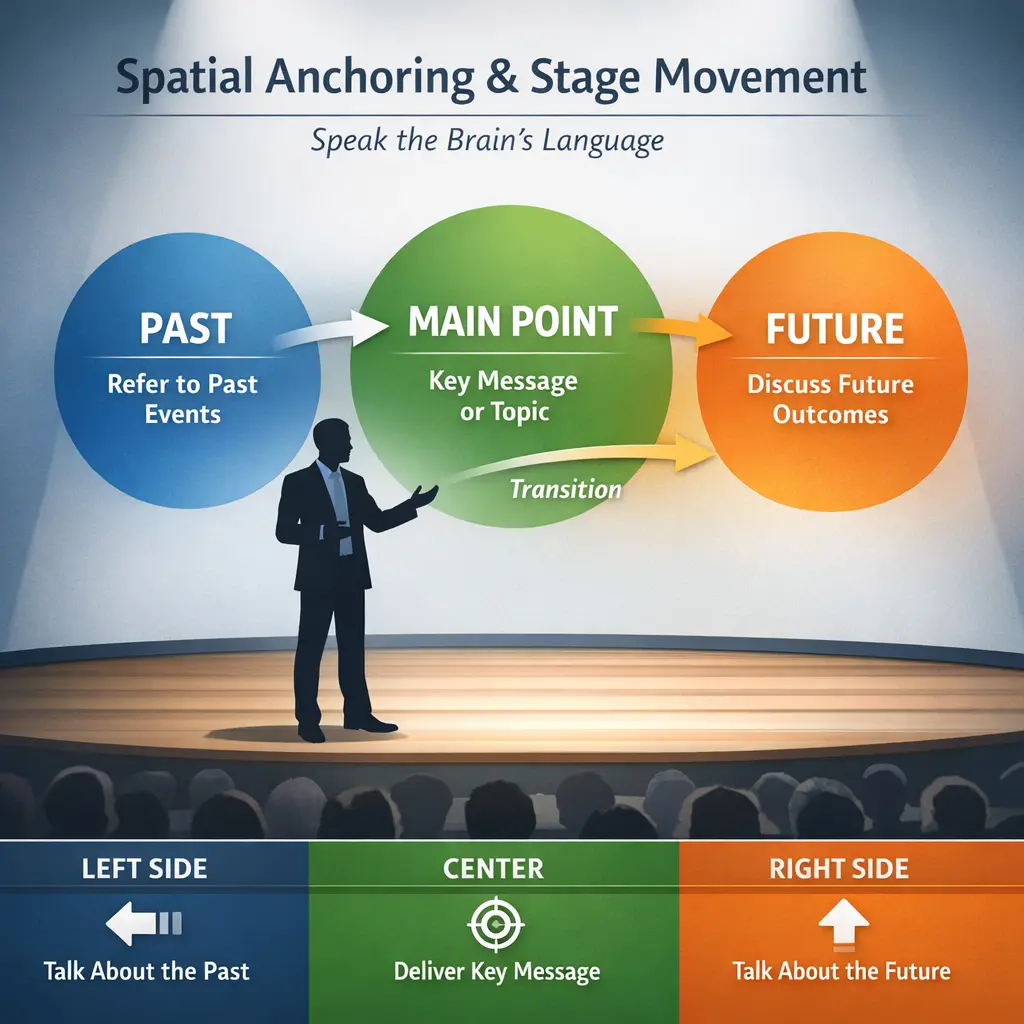
Center stage: This is the present. Your power position. “Right now, we have an opportunity…” Claim center.
Stage right (audience’s left): This is the future. “Imagine where we’ll be six months from now…” Move right.
Why does this work? NLP eye movement theory shows that people naturally look in different directions when accessing past, present, or future thinking. When you move in alignment with their internal processing, you’re literally speaking their brain’s language.
The Power of Physical Expression
Don’t just deliver information, embody it. If you’re talking about growth, gesture upward. If you’re describing a barrier, use your hand to show a wall. If you’re explaining a connection, bring your hands together.
Your gestures should be larger than normal conversation but not theatrical. Think about how you’d explain something to a friend you really want to convince. That’s your baseline. On stage, expand it by about 20%.
Purposeful movement matters. Don’t pace nervously. Don’t stay glued to one spot. Move when it reinforces your point. Then stop and plant yourself for emphasis. This contrast between movement and stillness keeps the audience’s visual attention locked on you.
Invest in proper speaker training to master these physical elements. The difference between amateur speakers and professionals often comes down to how they use their bodies and space.
Technique #6: Reframing Nervousness as Excitement
Here’s a secret: anxiety and excitement are physiologically almost identical. Increased heart rate, heightened alertness, adrenaline surge. The only difference is the story you tell yourself about those sensations.
Most speakers label the feeling as “I’m nervous, this is bad.” That’s one interpretation. Here’s another: “I’m excited, this is energy I can use.”
Reframing is an NLP technique that changes the meaning you assign to an experience. Your pre-stage jitters aren’t a problem; they’re rocket fuel. That elevated state means you’re primed for peak performance.
Try this before your next presentation: when you feel those butterflies, say out loud, “I’m excited to share this.” Not “I’m nervous.” The simple act of relabeling shifts your neurochemistry.
The Swish Pattern for Pre-Stage Anxiety
If negative visualizations haunt you, imagining yourself freezing, forgetting lines, seeing disapproving faces, use the Swish Pattern to interrupt them.
- Picture the negative image clearly. See yourself failing on stage.
- In the corner of that mental image, create a small, bright picture of yourself succeeding, confident, articulate, commanding attention.
- Rapidly “swish” the images. The small positive image explodes to fill your entire mental screen while the negative image shrinks to a dot and disappears.
- Clear your mind completely.
- Repeat 5-7 times, faster each time.
This pattern interrupt rewires your automatic response. Instead of anxiety being your default, confidence becomes it. For more depth on overcoming public speaking anxiety, explore targeted NLP methods designed specifically for speakers.
Technique #7: State Control and Energy Management
State control is the meta-skill underlying everything else. Your “state” is the combination of your thoughts, emotions, and physiology at any moment. Most people let their state happen to them. NLP teaches you to choose it deliberately.
Before you speak, ask yourself: what state do I want to be in? Confident? Energized? Calm but authoritative? Then build that state using physiology (posture, breathing, movement), focus (what you’re thinking about), and language (what you say to yourself).
Breathing rhythms are your fastest lever. High-energy state? Quick, shallow breaths through your mouth. Calm, grounded state? Slow, deep breaths through your nose. Your nervous system follows your breath, so control your breath and you control your state.
During your presentation, monitor your state. Feel yourself getting flat? Shift your physiology, take a step forward, raise your energy, and use bigger gestures. Feel yourself getting too amped? Ground yourself, slow your pace, lower your voice slightly.
The best speakers adjust their state in real time based on audience response. If the room’s energy drops, they don’t just push through their script. They change their state first, then change the room.
FAQs
How quickly can NLP techniques reduce public speaking anxiety?
Most people experience significant anxiety reduction within 2-3 weeks of consistent practice. Some techniques, like anchoring, show immediate results in your first session. The key is repetition. Just like building muscle, building new neural pathways takes consistent practice.
Don’t expect one anchor-building session to eliminate years of speaking fear. But don’t underestimate how fast your brain can rewire when you give it clear patterns. Within a month of daily practice, most speakers report feeling noticeably more confident and in control.
Do I need NLP certification to use these techniques for speaking?
No formal certification is required to apply these tools. However, working with an NLP-trained coach or taking certification training accelerates your mastery significantly. You’ll learn the techniques correctly, practice with feedback, and avoid common mistakes that reduce effectiveness.
Self-study can get you started. Certification gives you the depth and precision that transforms good results into exceptional ones. If public speaking is central to your career, the investment in proper training pays dividends quickly through better presentations, more opportunities, and increased credibility.
What’s the most important NLP technique for commanding a room instantly?
Anchoring, for instant confidence combined with purposeful silence creates the fastest shift in audience perception. Here’s why: your confidence anchor eliminates internal anxiety before you even speak, allowing you to project calm authority. When you then use strategic pauses in your opening, you establish control of the room’s rhythm within the first 30 seconds.
Start here. Build a solid confidence anchor this week. Practice the 6-second pause after powerful statements. Those two skills alone will dramatically shift how audiences perceive you.
Can NLP techniques help with virtual presentations and video calls?
Absolutely. Every technique in this article works in virtual formats, though some adapt slightly. Sensory language is just as powerful through a screen. Strategic pauses command attention, whether you’re in person or on Zoom. State control matters even more in virtual settings where technical issues and distractions are constant.
Spatial anchoring adapts for seated presentations; you can still shift your position slightly to indicate past, present, and future, or use hand position zones. Eye contact becomes camera contact. Matching and mirroring happen through screen positioning and vocal pacing rather than large body movements.
The principles remain identical. The execution adjusts to your medium.
Conclusion
Commanding a room isn’t about being the loudest voice or the slickest performer. It’s about mastering your internal state so completely that confidence becomes your default, not your exception.
The seven NLP techniques you’ve learned today, anchoring, matching and mirroring, sensory language, strategic silence, spatial anchoring, reframing, and state control, give you the tools to transform speaking anxiety into magnetic presence. Start with one. Build your confidence anchor this week. Notice what shifts.
These aren’t tricks or manipulations. They’re technologies for authentic connection. When you command your own state, you naturally command the room. The audience feels it before you speak a word.
Your transformation happens one practice session at a time. Take decisive action. Master this skill. And when you’re ready to go deeper, explore how to integrate NLP into daily practice so these tools become second nature.
The stage is waiting. Command it.