

Most small businesses should reinvest 20–30% of their monthly profits to maintain healthy growth. Startups aiming for rapid expansion may reinvest 50–70%, while mature, stable businesses can sustain with 9–20%. The key is to reinvest consistently, track ROI, and balance growth with personal income and stability.
You don’t have a revenue problem, you have a profit allocation problem.
Most small business owners either reinvest too little (and stay stuck)… or reinvest too much (and burn out financially).
The real question isn’t “how much profit you make”, it’s how strategically you reinvest it.
Every successful business grows because its owners make one smart decision repeatedly reinvesting profits strategically. Reinvestment isn’t just about spending money; it’s about fueling sustainable growth, improving systems, and securing long-term stability. But how much should you actually reinvest each month?
This guide breaks down everything you need to know, from benchmarks and influencing factors to practical calculations and reinvestment ideas to help you make informed, data-driven choices for your business.
Key Takeaway:
- Most small businesses should reinvest 20%–50% of their profits, depending on their stage. Startups often reinvest 50%–70% to drive rapid growth, while established businesses typically reinvest 10%–30% to maintain stability and optimize performance. [1]
- Why it matters: Profit reinvestment directly impacts growth speed, scalability, and long-term sustainability. Under-investing leads to stagnation, while over-investing can create cash flow pressure and financial risk. [1]
- How to decide: The right percentage depends on your profit margins, cash flow stability, growth goals, and business model. Scalable businesses (like SaaS or digital services) can reinvest more aggressively than local or service-based businesses. [2]
- Where to reinvest: Focus on high-ROI areas such as marketing, systems/automation, team development, and product improvement — these drive the fastest and most sustainable growth. [2]
Bottom Line: There’s no universal reinvestment percentage — but most businesses grow best by reinvesting strategically within the 20%–50% range, balancing growth with financial stability.
- Source: Unleash Your Power – How Much Profit Should a Small Business Reinvest
- Source: Unleash Your Power – Business Growth Insights
How Much Profit Should a Small Business Reinvest? (Simple Rule)
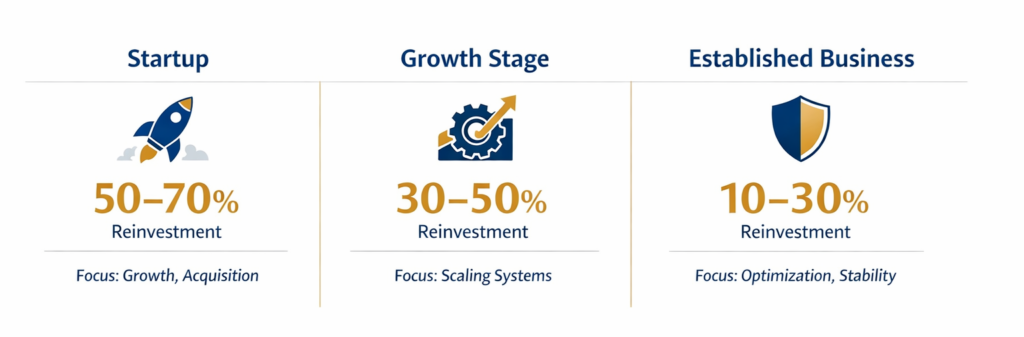
- Startups: Reinvest 50%–70% of profits to accelerate growth and customer acquisition.
- Growth-stage businesses: Reinvest 30%–50% to scale systems, marketing, and operations.
- Established businesses: Reinvest 10%–30% to maintain stability and optimize profitability.
Bottom line: The right reinvestment percentage depends on your stage, cash flow stability, and growth goals — not a fixed universal number.
Small Business Profit Reinvestment Benchmarks
| Business Stage | Reinvestment % | Primary Focus |
|---|---|---|
| Startup | 50%–70% | Customer acquisition, product validation, growth |
| Growth Stage | 30%–50% | Scaling systems, marketing, team expansion |
| Established | 10%–30% | Optimization, efficiency, long-term stability |
The 3-Layer Profit Allocation Framework™
Instead of guessing how much to reinvest, smart business owners use a structured allocation model:
1. Survival Layer (Foundation)
- Operating expenses
- Emergency cash reserves
- Debt obligations
2. Growth Layer (Reinvestment)
- Marketing and customer acquisition
- Systems and automation
- Team and skill development
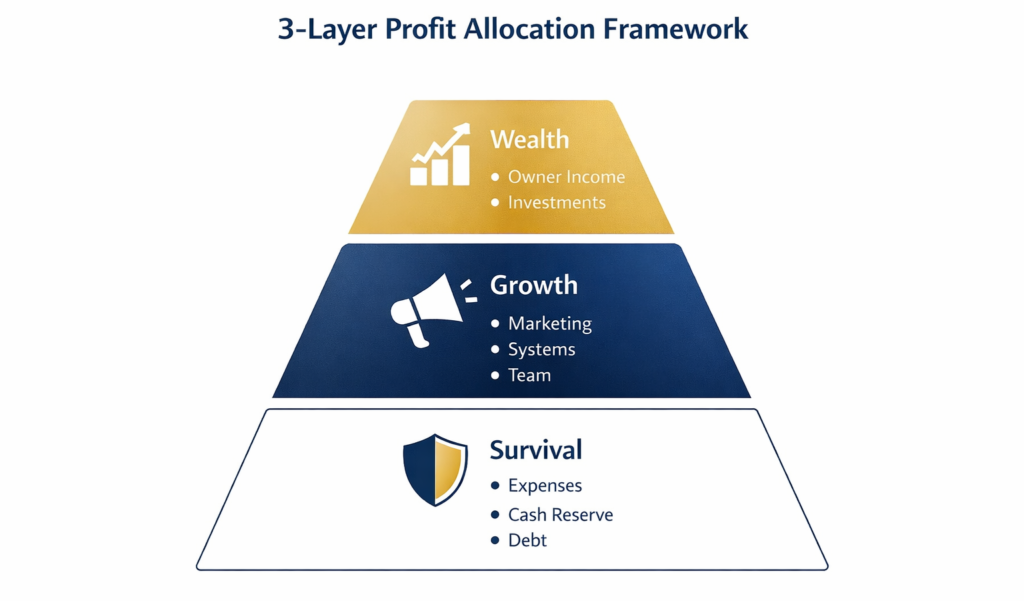
3. Wealth Layer (Owner Benefit)
- Owner salary or dividends
- Personal investments
- Long-term wealth building
Key insight: Most businesses fail because they over-prioritize one layer and ignore the others.
How to Decide Your Exact Profit Reinvestment Percentage
Use this simple decision checklist to determine what percentage is right for your business:
- Profit Margin: Higher margins allow more reinvestment without risk.
- Cash Flow Stability: Unstable cash flow requires lower reinvestment and higher reserves.
- Growth Goal: Aggressive growth = higher reinvestment percentage.
- Business Model: Scalable businesses (SaaS, digital) benefit from higher reinvestment.
- Risk Tolerance: Conservative owners should reinvest less and protect capital.
Simple rule: If reinvestment is creating consistent growth without cash stress, you’re in the right range.
Key Factors Influencing How Much to Reinvest

Determining how much profit to reinvest depends on your business’s stage, goals, and financial stability. Here are the main factors that guide smart reinvestment decisions:
Business Stage: Startup vs. Mature Business
Your reinvestment rate should align with your business phase.
Startups often reinvest 50–70% of profits to fund growth, marketing, and product development.
Mature businesses usually reinvest 10–30%, focusing on maintenance, efficiency, and modest expansion.
Profit Margins and Industry Norms
Different industries operate with different profit capacities.
High-margin sectors (like software or consulting) can comfortably reinvest more.
Low-margin sectors (like retail or food services) should be more conservative to preserve cash.
Knowing your industry averages, such as those shared by Knocked-Up Money+1, helps you stay realistic and competitive.
Cash Flow Stability and Reserves
Strong cash flow allows for confident reinvestment.
Ensure you have 3–6 months of expenses in reserve before allocating profits.
If your cash flow is steady, reinvest more.
If it’s tight or irregular, build stability first.
As AmazingAccountants notes, sustainable reinvestment depends on consistent liquidity.
Growth Goals vs. Personal Income Needs
Balance your growth ambitions with your personal financial needs.
Aim higher (40–70%) if you want rapid expansion.
Choose a moderate rate if your focus is on steady income and work-life balance.
Your reinvestment plan should match your long-term goals and comfort level with risk.
Reinvestment Benchmark Ranges and Rules of Thumb
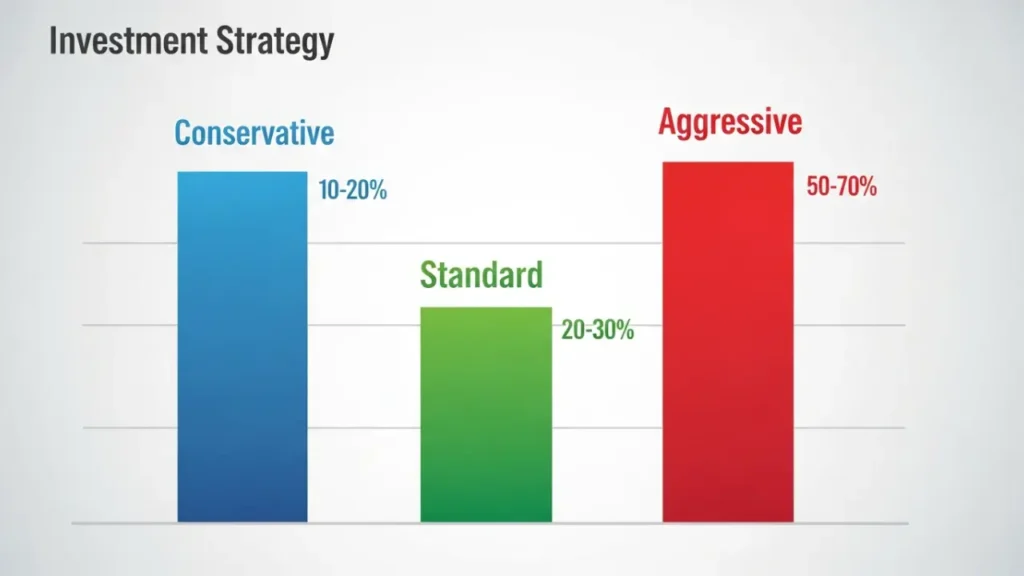
There’s no single formula for how much profit a small business should reinvest each month but several proven benchmarks can guide your decisions. The right percentage depends on your business goals, cash flow stability, and growth stage.
Common Guidance (20–30% of Profits)
For most small and mid-sized businesses, reinvesting 20–30% of monthly profits strikes a healthy balance. It allows for steady growth while keeping enough cash for operations, taxes, and the owner’s income. This range supports sustainable business expansion without overextending your resources.
Aggressive Growth Stage (50–70% of Profits)
If your business is in a rapid growth phase like expanding locations, launching new products, or scaling marketing, reinvesting up to 70% of profits can accelerate progress dramatically. This high reinvestment level works best when your personal expenses are covered elsewhere or when you have strong financial buffers in place.
Conservative or Steady Stage (10–20% of Profits)
Established businesses that prioritize stability over fast growth can comfortably reinvest 10–20% of profits. This approach focuses on maintenance, small upgrades, and efficiency improvements while preserving cash reserves for emergencies or predictable payouts.
Simple Allocation Models: The 30/50/20 Rule
Many experts recommend following the 30/50/20 allocation model:
30% for reinvestment (marketing, equipment, staff)
50% for operating expenses and the owner’s salary
20% for savings, taxes, and reserves
This model ensures that every dollar earned has a clear purpose helping your business grow while keeping your finances balanced and stress-free.
How to Calculate Your Monthly Reinvestment Amount
Turning the theoretical into a concrete dollar figure is a straightforward, three-step process. Performing this calculation monthly ensures your reinvestment is data-driven and intentional.
Step 1: Determine Net Profit for the Month
This is your foundational number. It is not your total revenue, but what remains after all expenses are paid. Crucially, you must include a fair market-rate salary for yourself as an expense. The formula is simple:
Net Profit = Total Revenue – Total Operating Expenses (Including Your Salary)
If you pay yourself a draw from profit instead of a salary, calculate your net profit first, then decide on the draw from the remainder.
Step 2: Review Essential Reserves and Debts
Before you decide to reinvest, you must ensure the business’s financial health is stable. Ask yourself:
Do I have a sufficient cash buffer? Most experts recommend 3-6 months of operating expenses set aside for emergencies. If you are below this threshold, prioritizing your reserve fund is a form of strategic reinvestment in stability.
Are there high-interest debts? It often makes more financial sense to pay down a loan with a 10% interest rate than to reinvest in a marketing campaign that might only yield a 7% return. Conduct a cost-benefit analysis.
Step 3: Choose a Reinvestment Percentage Aligned with Your Goals
Now, refer to the benchmarks in Section 3. Given your business stage (aggressive growth vs. stable), your financial stability (from Step 2), and your growth objectives, select a percentage.
Example Calculation: Putting It All Together
Let’s assume your business had the following month:
Monthly Revenue: $30,000
Monthly Expenses (including your $4,500 salary): $22,000
Net Profit: $30,000 – $22,000 = $8,000
Chosen Reinvestment Rate (You’re in growth mode): 30%
Monthly Reinvestment Amount: $8,000 x 0.30 = $2,400
This $2,400 is now your dedicated “Strategic Growth Fund” for the upcoming month.
Examples: How Different Businesses Reinvest Profit
- Freelancer / Consultant: Reinvest 20%–30% into tools, personal branding, and lead generation.
- SaaS Startup: Reinvest 60%–70% into product development and aggressive marketing.
- Local Service Business: Reinvest 20%–40% into marketing, staff, and operational improvements.
- E-commerce Brand: Reinvest 30%–50% into ads, inventory, and conversion optimization.
Insight: The more scalable your business model, the higher your optimal reinvestment percentage.
What to Reinvest In: Effective Use of Reinvestment Funds
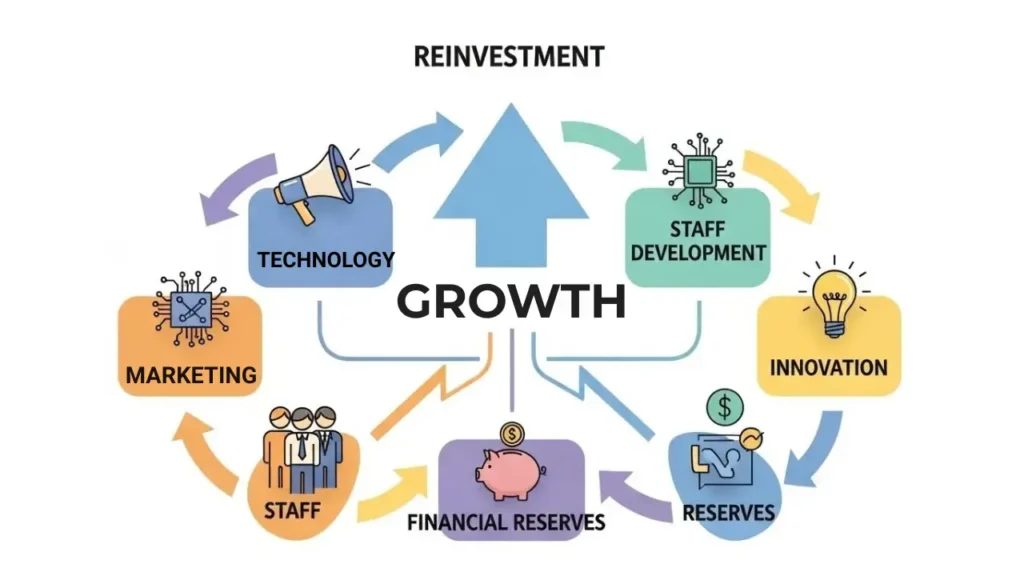
Once you’ve determined how much profit to reinvest, the next step is deciding where to allocate it for maximum impact. Smart reinvestment isn’t about spending more, it’s about spending wisely in areas that fuel long-term growth and stability.
Marketing & Customer Acquisition
Investing in marketing directly drives revenue growth. This includes:
Running social media or Google Ads campaigns to attract new customers.
Improving your website for better SEO and user experience.
Hiring a freelance marketing expert or agency for strategic planning.
Developing lead magnets like e-books or free trials to grow your audience
Strong marketing ensures steady customer inflow the lifeline of every business.
Equipment, Technology, and Process Improvements
Efficiency boosts profit margins. Use funds to:
Upgrade outdated equipment or software that slows operations.
Adopt automation tools for accounting, CRM, or project management.
Streamline workflows to reduce errors and save time.
These investments often pay for themselves through improved productivity and cost savings.
Talent and Training
Your team is your greatest asset. Reinvest in people through:
Hiring key roles that drive growth (e.g., marketing manager, operations head)
Providing skill-based training to improve performance.
Offering employee benefits or bonuses to boost motivation and retention.
Well-trained, motivated employees deliver higher-quality work and foster innovation.
New Product Development or Market Expansion
Innovation keeps your business relevant. Consider reinvesting in:
Research and development (R&D) for new products or services.
Testing new markets or customer segments.
Creating minimum viable products (MVPs) to validate new ideas.
These forward-looking investments open doors to fresh revenue streams and growth opportunities.
Reserve Fund Growth for Emergencies
A healthy reserve fund ensures financial stability. Set aside part of your reinvestment for building or replenishing your cash buffer. Aim for 3–6 months of expenses in savings. This protects your business during slow periods or emergencies, helping you stay resilient.
Where Should You Reinvest Profit for Maximum Growth?
- Marketing & Customer Acquisition: The fastest way to scale revenue.
- Automation & Systems: Improves efficiency and reduces long-term costs.
- Talent & Team: Hiring the right people accelerates growth.
- Product or Service Improvement: Increases customer retention and lifetime value.
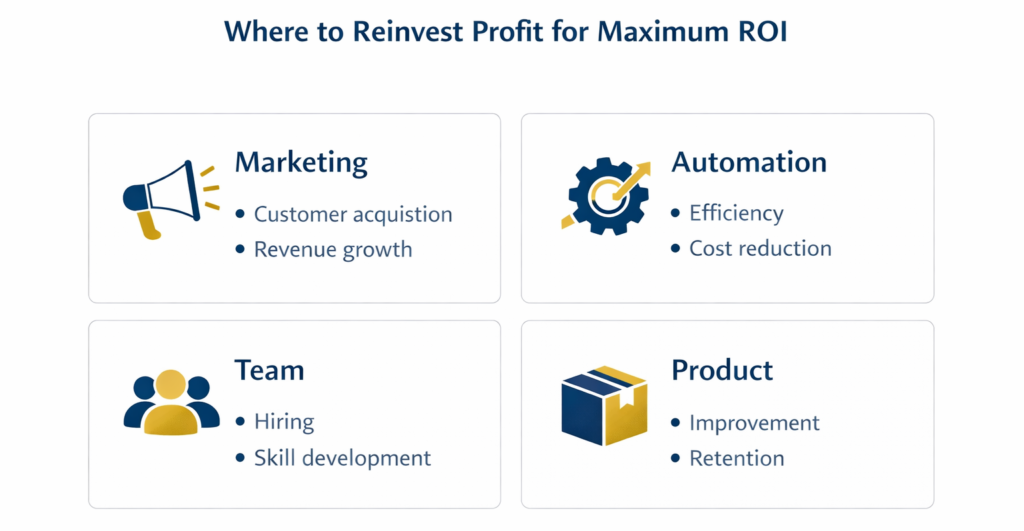
Pro insight: The highest ROI usually comes from marketing and systems, not random spending.
Common Profit Reinvestment Mistakes to Avoid
- Over-reinvesting: Leads to cash flow problems and financial stress.
- Under-reinvesting: Causes slow growth and missed opportunities.
- Random reinvestment: Spending without clear ROI reduces profitability.
- Ignoring cash reserves: Leaves the business vulnerable during downturns.
Bottom line: Reinvestment should be strategic, not emotional.
FAQs
What is a healthy profit margin for a small business?
A healthy small business profit margin typically ranges from 10% to 20%, depending on the industry, with service-based businesses often achieving higher margins.
Should I reinvest all my profits in my business?
No. While startups may reinvest heavily, most businesses should balance reinvestment with personal income and financial reserves to avoid cash flow risk.
How do I know if I’m reinvesting too much?
If your business struggles to cover operating expenses, maintain cash reserves, or pay yourself consistently, you may be over-reinvesting.
Is reinvesting better than taking a salary?
Both are important. Strategic reinvestment drives growth, but consistent salary ensures sustainability and prevents burnout.
What is the fastest way to grow profit using reinvestment?
Reinvesting in high-ROI areas like marketing, automation, and customer acquisition typically generates the fastest profit growth.
Ready to Turn Your Profit Into Real Growth?
Knowing how much to reinvest is only the first step. The real advantage comes from allocating your profit strategically, so every dollar works to grow your business faster and smarter.
If you want a clear, personalized plan based on your business stage, cash flow, and growth goals, it’s time to take the next step.
👉 Book a free strategy session and discover exactly how to allocate your profits for maximum growth, stability, and long-term success.