

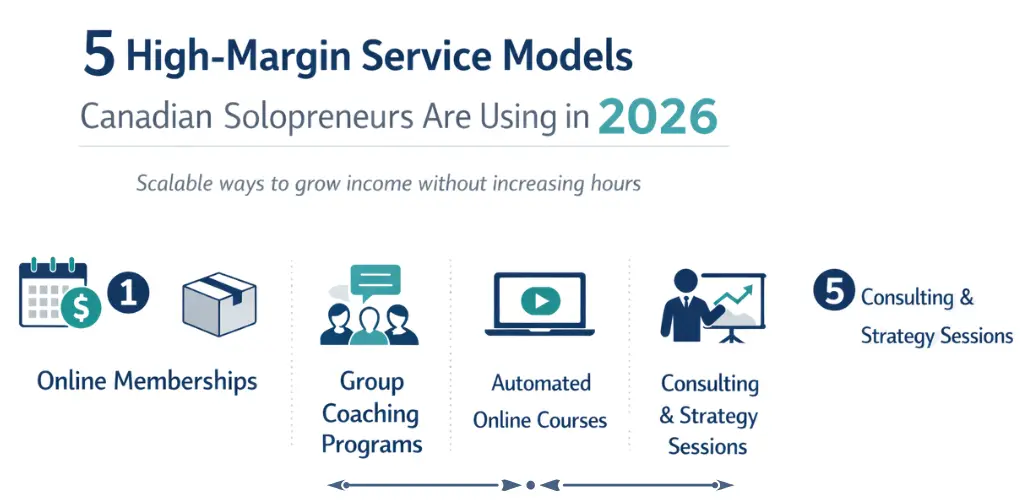
High-margin service models allow Canadian solopreneurs to generate significantly more income without adding more hours. The five most effective models in 2026 are strategic retainers, productized services, group coaching programs, digital products and online courses, and fractional advisory roles. These structures typically achieve profit margins between 65% and 95% because they package expertise into repeatable systems rather than selling hours. In Canada, Statistics Canada reports over 2.7 million self-employed workers as of early 2025. Solopreneurs who adopt structured service models regularly reach six-figure revenue with fewer than ten active clients. The shift from hourly billing to packaged, value-based services is the single most powerful income lever available to an established solopreneur in 2026. The right model depends on your expertise, existing proof of results, and income targets.
Key Takeaway:
- High-margin service models allow Canadian entrepreneurs to earn significantly more profit with less time and overhead by focusing on premium, high-value services instead of low-margin, high-volume offerings. [1]
- The most profitable models include done-for-you services, premium coaching/consulting, group programs, retainers, and hybrid digital + service packages — many achieving 70–90% gross margins. [1]
- To build one: Identify your highest-value skills, package them into clear high-ticket offers, set premium pricing based on results and transformation (not hours), systemize delivery, and create simple recurring or leveraged revenue streams. [2]
- These models give you more freedom, higher income, better work-life balance, and scalability while remaining fully compliant with Canadian tax and business regulations. [2]
Bottom Line: Shifting to a high-margin service model is one of the smartest moves a Canadian entrepreneur can make — it allows you to work less, earn more, and build a scalable, fulfilling business without burning out.
What Makes a Service Model High-Margin?
A service model is high-margin when the value it delivers to a client dramatically exceeds the time it costs you to produce. Most solopreneurs undercharge because they price based on hours, not outcomes. That’s the root of the income ceiling.
High-margin models share three characteristics: they deliver a specific, measurable result rather than general availability; they’re structured so delivery becomes repeatable (your second client takes less time than your first); and they command prices tied to transformation, not time.

The math is straightforward. A consultant running five strategic retainers at $3,000 per month generates $15,000 monthly in predictable cash flow. That same consultant at $150 per hour would need 100 billable hours just to match it, plus another 30 hours of admin, proposals, and invoice follow-up. The model you choose has a bigger impact on your income than working harder ever will.
Why Hourly Billing Keeps Solopreneurs Stuck
Hourly billing feels safe. It’s familiar, transparent, and easy to quote. But it’s one of the most reliable ways to permanently cap your income.
Here’s what hourly billing actually costs you:
- Your income is hard-capped by the number of billable hours in a week
- Every new client requires the same selling effort as the last
- Revenue drops immediately when you take time off or slow down delivery
- Clients focus on hours spent rather than outcomes received
- There’s no mechanism to reward you for getting faster and better over time
Shifting to packaged or value-based pricing removes those constraints structurally. The goal isn’t to work more, it’s to earn more from the expertise you’ve already built. That shift starts with choosing the right model.
What Is the Most Profitable Service Model for Solopreneurs?
The most profitable service models for solopreneurs are strategic retainers and group coaching programs. Retainers deliver consistent monthly revenue at 70–85% margins with relatively low complexity. Group coaching multiplies delivery leverage, serving ten or twenty clients in the same hours you’d otherwise spend with one, at margins above 80%.
Digital products and online courses offer the highest theoretical margins (up to 95%) because they involve zero additional delivery time after creation. The trade-off is a longer runway to first revenue and a higher upfront investment. The five models and their full benchmarks are mapped in the comparison table below.
The 5 High-Margin Service Models Canadian Solopreneurs Are Running in 2026
Model 1: The Strategic Retainer
A strategic retainer is a recurring monthly agreement where a client pays a fixed fee for ongoing access to your expertise, advice, or deliverables. It’s the fastest high-margin model to implement for an established solopreneur with an existing client base.
Typical Canadian pricing ranges from $2,000 to $10,000 per month, depending on scope and seniority. Margins sit between 70–85% because delivery is structured, repeatable, and scoped in advance. The key is positioning retainers around ongoing value, not hours.
One compliance consultant made the shift from project work to retainers and described the result as “a paycheck every month from 20 different clients.” That predictability changes how you plan, invest in your business, and show up for clients. When your revenue is no longer a question, your energy can go to delivery.
Try this: Look at your three best current clients. Write down the ongoing result that each one relies on you to produce. That’s the basis of a retainer conversation.
Model 2: Productized Services
A productized service is a fixed-scope, fixed-price offer that delivers a defined outcome. Instead of custom proposals, you present a clear package: here’s what’s included, here’s the deliverable, here’s the price.
This model removes the proposal grind that drains solopreneurs who live project-to-project. Margins typically reach 65–80% once the delivery process is dialled in. And the sales cycle shortens dramatically because clients aren’t evaluating open-ended quotes; they’re choosing a clear offer.
One analytics consultant who productized their services reported generating $4,500 in new monthly recurring revenue within 60 days simply by shifting from hourly consulting to a packaged offering with a defined scope and a fixed price.
Model 3: Group Coaching Programs
Group coaching is where delivery leverage becomes dramatic. Instead of coaching one client per session, you coach ten or twenty. Your revenue multiplies while your delivery time stays constant.
One practitioner who made this shift went from 40 client hours per week with eight clients to just eight hours per week with the same client load, and then used the freed capacity to scale their business fivefold within 90 days. That’s not a marketing claim; it’s the straightforward arithmetic of group delivery.
For established coaches and trainers, this is often the highest-ROI structural change available. The challenge is building the right container: a program with clear outcomes, strong community engagement, and pricing that reflects the collective value delivered. Done well, margins easily reach 80–90%.
Model 4: Digital Products and Signature Online Courses
Digital products, online courses, frameworks, toolkits, and templates are created once and sold repeatedly with no additional delivery time. Some solopreneurs report that digital products make up 75% or more of their total income once the right content and distribution system is in place.
The global e-learning market is tracking toward over $842 billion by 2030, and demand for expert-led, outcome-specific courses continues to accelerate. The margin ceiling here is the highest of all five models, often 85–95%, because your cost after creation is essentially zero.
The trade-off is time: realistically expect 90–180 days from creation to meaningful revenue. But the compounding effect of a well-built course that sells for years makes it one of the most strategically powerful assets a solopreneur can own.
Model 5: Fractional Advisory / Pay-for-Access
The fractional advisory model offers senior-level expertise on a part-time basis. Clients pay a monthly retainer for strategic access, not deliverables, at a fraction of the cost of a full-time hire.
This model works especially well for experienced solopreneurs with deep functional expertise in finance, HR, marketing strategy, or operations. Margins are strong at 75–90%, complexity is medium, and time-to-first-revenue is fast, often 30–60 days for someone with an established professional network.
Unlike hourly consulting, fractional advisory is positioned around ongoing strategic impact rather than task completion. That positioning shift alone often justifies a 2–4x increase in effective hourly rate.
Model Comparison: The 5 High-Margin Service Models at a Glance
| Model | Avg Monthly Revenue | Margin | Complexity | Time to Revenue | Best For |
| Strategic Retainer | $3K–$15K/mo | 70–85% | Low | 30–60 days | Consultants, coaches |
| Productized Service | $2K–$10K/mo | 65–80% | Medium | 30–90 days | Designers, marketers |
| Group Coaching | $5K–$25K/mo | 80–90% | High | 60–120 days | Coaches, trainers |
| Digital Products | $1K–$20K+/mo | 85–95% | High | 90–180 days | Educators, experts |
| Fractional Advisory | $2K–$8K/client | 75–90% | Medium | 30–60 days | Senior specialists |
All revenue ranges are benchmarks based on established solopreneurs with proven client results. New practitioners should expect the lower end of each range initially.
The Hidden Reason Most Canadian Solopreneurs Stay Underpriced
You can understand all five models above and still not move on to any of them. That’s not a strategy problem. It’s a mindset one. Most solopreneurs carry a deeply-seated belief that charging premium rates means losing clients, coming across as arrogant, or not being “good enough” to ask for that much. That belief runs quietly in the background, often more powerful than any business plan. I’ve watched this pattern repeat across 20+ years of working with professionals and entrepreneurs in Canada and internationally.
This is what NLP does for solopreneurs who are structurally ready but internally stuck. It’s not mindset cheerleading; it’s precise work on the exact patterns generating the block. And it’s why business strategy and inner work need to develop together, not sequentially.
Try this: The next time you’re about to quote a rate, notice the first thought that arises after you say the number. Write it down. That thought is data; it’s showing you exactly where the internal work needs to happen.
If you recognise this pattern in yourself, explore how NLP for entrepreneurs and NLP coaching for business can help you build the internal foundation that makes every model above actually executable.
The 5-Stage Profit Architecture Framework
Once the internal work is underway, this is the execution framework. It moves you from “I know I should package my services” to generating revenue from a structured model.
Audit:
Identify which of your current services delivers the highest value relative to your time. These are your packaging candidates.
Package:
Define a specific scope, outcome, and delivery structure for your strongest offer. Remove ambiguity; the cleaner the scope, the easier the sale.
Price:
Anchor your fee to the value delivered, not the hours worked. Research comparable market rates, then price at the upper-middle range, not the bottom.
Protect:
Build recurring revenue into the structure. A retainer, subscription, or ongoing program creates a financial floor that project work cannot.
Expand:
Once your primary model generates consistent monthly revenue, layer in a second stream, typically a digital product or group offer, that multiplies income without multiplying hours.
Once the internal work is underway, this is the execution framework. It moves you from “I know I should package my services” to generating revenue from a structured model. Work through these stages in order. Jumping to Expand before Protect means you’re building revenue on an unstable floor. Jumping to Price before Package means you’re negotiating without clarity. The sequence is the strategy.
Data & Findings
The following benchmarks are drawn from Statistics Canada labour data, global solopreneur research, and Unleash Your Power’s 2026 observations from working with Canadian entrepreneurs, coaches, and professionals.
| Metric | Finding |
| Canadian Self-Employed Workers | ~2.7 million as of February 2025 (Statistics Canada / CEIC) |
| Average Solopreneur Income | ~$39,000/year across all solopreneurs; top performers reach $100K+ with structured models |
| Service Business Margins | 50–90% gross margins when pricing is packaged or value-based vs. 30–50% for hourly billing |
| Productized/Retainer Margins | 70%+ profit margins routinely achieved with repeatable delivery and minimal overhead |
| Digital Product Income | Up to 75% of total solopreneur income once a content and distribution system is established |
| Group Coaching Leverage | One practitioner reduced delivery hours from 40 to 8/week with an identical client load after switching from 1:1 to a group format |
| E-Learning Market | Projected to exceed $842 billion by 2030 |
Who Should Use These Models?
These five models are designed for established solopreneurs who are ready to scale income without scaling hours. You’re a strong candidate if you:
- Are already generating income from services but have hit an income ceiling.
- Have proof of results, client testimonials, case studies, or a demonstrable track record.
- Want to grow revenue without hiring staff or dramatically increasing hours.
- Are you ready to have direct, confident pricing conversations with prospects?
- Can commit to a defined delivery model rather than responding to every custom request.
If you’re building a coaching practice in Canada and want the methodology to price at the level your expertise deserves, the Life Coach Training Certification at Unleash Your Power gives you the structure and credibility to make that shift.
Who Should Avoid These Models (For Now)?
Not every solopreneur is ready for high-margin packaged models, and that’s fine. These are starting conditions, not permanent ceilings. Consider waiting if you:
- Are brand-new to solopreneurship with no client results to draw on yet
- Are still unclear on your niche, your ideal client, or the specific outcome you deliver
- Haven’t had direct pricing conversations and don’t yet have confidence in them
- Currently depend on a single client for the majority of your revenue (resolve the dependency first)
Every item on this list is solvable. They’re starting conditions, not permanent disqualifiers. Building clarity, gaining your first real client wins, and developing pricing confidence unlock every model above. That work starts internally, and that’s exactly where NLP-based business coaching accelerates the journey.
Ready to Build a Business That Works on Your Terms?
The model you choose matters less than the decision to choose one deliberately.
Most Canadian solopreneurs don’t fail because they lack expertise. They stay stuck because they’ve never made the conscious shift from selling time to packaging value. The five models in this article are what established solopreneurs are actively using right now to generate six figures without adding headcount or burning out.
If you’re ready to build the internal infrastructure behind your business model, the pricing confidence, the communication clarity, and the internal permission to charge what your expertise is actually worth, explore the NLP Training for Business at Unleash Your Power. It’s the methodology that makes every model above executable, not just understandable.
“Unleash Your Power: Stand Out, Take Action, and Create the Success You Want.”
Frequently Asked Questions
What is the highest-margin service model for a solopreneur?
Digital products and online courses carry the highest theoretical margins, often 85–95%, because they generate revenue with no additional delivery time after creation. For faster time-to-revenue, strategic retainers and fractional advisory roles offer 70–90% margins with a launch runway of just 30–60 days.
How do Canadian solopreneurs break through income ceilings?
Most income ceilings are structural (hourly billing) or internal (mindset blocks around pricing). The structural fix is transitioning to a retainer, group coaching, or productized service model. The internal fix typically requires working directly on the limiting beliefs and pricing confidence patterns, areas where NLP-based coaching delivers measurable, lasting results.
How long does it take to generate revenue from a new service model?
It depends on the model. Strategic retainers and fractional advisory roles typically produce first revenue within 30–60 days for solopreneurs with an existing network. Productized services take 30–90 days. Group coaching programs typically require 60–120 days to fill. Digital products and courses have the longest runway, 90–180 days from creation to meaningful sales.
Do I need new credentials to switch to a higher-priced model?
In most cases, no. The shift to high-margin models requires packaging and positioning your existing expertise more intentionally, not acquiring new qualifications. Credentials can strengthen credibility in specific niches, but the more common barrier is pricing confidence, not credential gaps.
What is the 5-Stage Profit Architecture for solopreneurs?
The 5-Stage Profit Architecture is a framework for transitioning from hourly service delivery to a structured, high-margin model. The stages are: Audit (identify your highest-value services), Package (define scope and outcomes), Price (anchor to value, not hours), Protect (build recurring revenue), and Expand (layer in a second income stream without multiplying hours).