

You’re working 60-hour weeks. You’re handling client work, admin tasks, marketing campaigns, and daily operations. You know you should delegate, but every time you try, it feels harder than just doing it yourself. Sound familiar?
Key Takeaway:
- Effective delegation frees leaders from overload, empowers teams, boosts productivity, and drives growth by focusing on high-impact tasks while developing team skills and ownership. [1]
- Common barriers include fear of losing control, perfectionism, lack of trust, unclear expectations, and poor communication overcome by shifting mindset to “teaching vs. doing” and viewing delegation as investment in team capability. [1]
- Strategies: Choose the right person (match skills/interest), clearly define outcome/expectations/deadlines/authority, provide resources/support without micromanaging, use RACI framework, follow up progressively, and give feedback/recognition for motivation. [2]
- Start small with low-risk tasks, build trust gradually, document processes for repeatability, and celebrate successes avoid reverse delegation by coaching self-sufficiency; consistent practice turns delegation into a leadership strength. [2]
Bottom Line: Master delegation by selecting the right tasks/people, communicating clearly, providing support without control, and building trust over time it multiplies your impact, develops your team, and creates sustainable business growth.
Here’s the truth most business owners don’t want to hear: “Nobody can do it as I can” isn’t confidence, it’s a growth ceiling. When you’re the bottleneck in every decision, every task, and every process, your business can’t scale beyond your personal capacity. You become the limiting factor in your own success.
This framework walks you through exactly what to delegate, how to let go without losing control, and why delegation isn’t just about freeing up time; it’s about multiplying your impact and accelerating growth. You’ll learn a proven four-step process that transforms you from overwhelmed operator to strategic owner, along with the mindset shifts that make delegation actually work.
Why Delegation Is Your Growth Bottleneck
The data tells a compelling story. Research from Gallup shows that CEOs who delegate effectively generate 33% more revenue than their counterparts who struggle with delegation $8 million versus $6 million annually. Even more striking, business leaders who excel at delegation demonstrated a 1,751% growth rate over low delegators, a difference of 112 percentage points.
These aren’t minor improvements. They’re business-transforming differences that separate businesses stuck at the same revenue plateau from those experiencing exponential growth.
When you don’t delegate, you’re trapped in operator mode. You’re executing tasks instead of building a strategy. You’re managing details instead of developing leaders. You’re working in your business instead of working on your business. This is often why small businesses fail to scale: the owner becomes the constraint.
Delegation isn’t about offloading work you don’t want to do. It’s strategic leadership. It’s recognizing that your highest value isn’t in executing tasks, it’s in vision, strategy, relationships, and growth. Every hour you spend on $10-per-hour tasks is an hour stolen from $1,000-per-hour strategic work that actually moves your business forward.
The question isn’t whether you can afford to delegate. The question is whether you can afford not to.
The Four-Step Delegation Framework
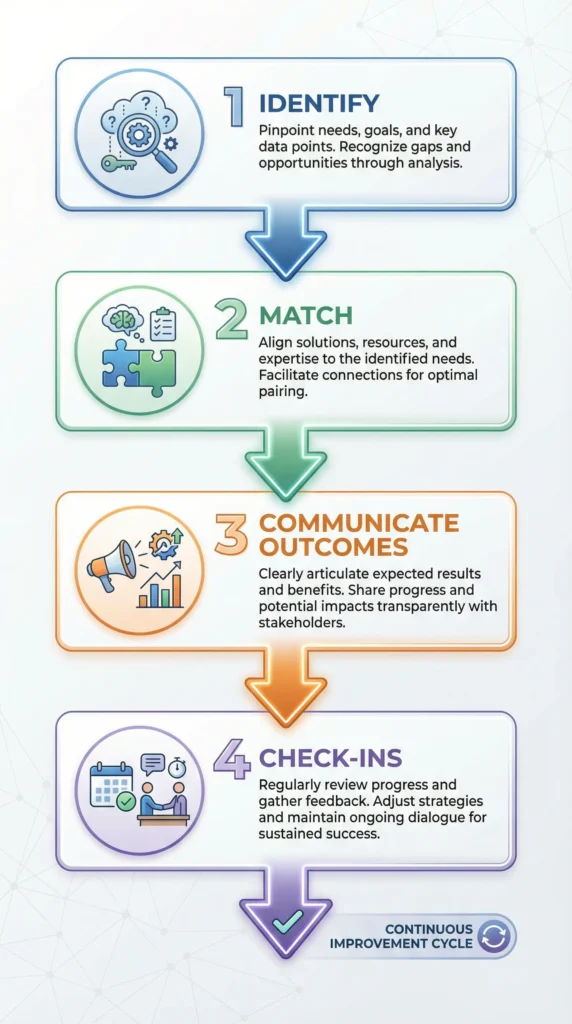
Effective delegation follows a systematic process. Skip steps, and you’ll end up either micromanaging or dealing with poor results that confirm your fears. Follow this framework, and you’ll build a team that operates with clarity, confidence, and competence.
Step 1 – Identify What to Delegate (Eisenhower Matrix)
Start by categorizing every task on your plate using the Eisenhower Matrix, which divides work into four quadrants based on urgency and importance.
Quadrant 1 contains urgent and important tasks, crisis management, critical deadlines, and pressing problems. These require your immediate attention and often can’t be delegated initially. Quadrant 2 holds important but not urgent work like strategic planning, relationship building, and business development. This is where you should spend most of your time as a business owner.
Here’s what matters for delegation: Quadrant 3 tasks are urgent but not important interruptions, some meetings, many emails, and administrative tasks. These are prime delegation candidates. They demand attention but don’t require your specific expertise. Quadrant 4 contains neither urgent nor important tasks, time wasters, busy work, and activities that don’t drive results. Eliminate these entirely or delegate them at minimal cost.
Map your typical week into these quadrants honestly. Most overwhelmed business owners discover they’re spending 60-70% of their time in Quadrants 3 and 4, leaving minimal capacity for the strategic work that actually grows their business.
Step 2 – Match Tasks to Team Strengths
Delegation isn’t just offloading tasks randomly. It’s strategic task distribution that matches work to the right people based on their skills, interests, and development goals.
Consider what energizes each team member. Someone might excel at detail-oriented administrative work that drains you but fulfills them. Another might thrive on client communication that you find time-consuming. Build your delegation strategy around these natural strengths rather than forcing square pegs into round holes.
Start small if you’re new to delegation. Research shows that starting with smaller tasks builds confidence for both you and your team. Choose repetitive tasks with clear processes first; these are easier to hand off and less risky if mistakes happen. As confidence grows, expand to more complex responsibilities.
Step 3 – Communicate Outcomes, Not Just Tasks
This is where most delegation breaks down. You tell someone what to do instead of what you need accomplished. The difference is critical.
Task-focused delegation sounds like: “Update the client spreadsheet by the end of the day.” Outcome-focused delegation sounds like: “I need accurate visibility into our top 20 clients’ project status and upcoming renewals so I can prioritize outreach. The format should make it easy to spot clients at risk or ready for upsells.”
When you focus on delegating outcomes rather than tasks, you empower team members to think critically, solve problems creatively, and potentially find better approaches than your predetermined method. You’re developing leaders, not just task-completers.
Define what success looks like. What’s the deadline? What quality standard must be met? What constraints exist? What resources are available? Clear expectations up front prevent confusion, rework, and frustration later.
Step 4 – Establish Check-Ins Without Micromanaging
The key to avoiding micromanagement is structured accountability without hovering. Schedule specific check-in points based on task complexity and team member experience.
For complex or unfamiliar tasks, schedule early check-ins, perhaps at 25% completion. This allows course correction before significant time is invested in the wrong direction. For routine tasks with experienced team members, a simple completion notification might suffice.
Ask questions instead of giving answers: “What challenges are you encountering?” “What resources would help?” “How are you thinking about approaching this?” This develops problem-solving capabilities while keeping you informed without controlling every detail.
Trust the process. Mistakes aren’t failures; they’re feedback. When you create a culture where team members can learn from errors without punishment, they develop competence faster and you build a resilient, capable team.
What Tasks Should Small Business Owners Delegate?
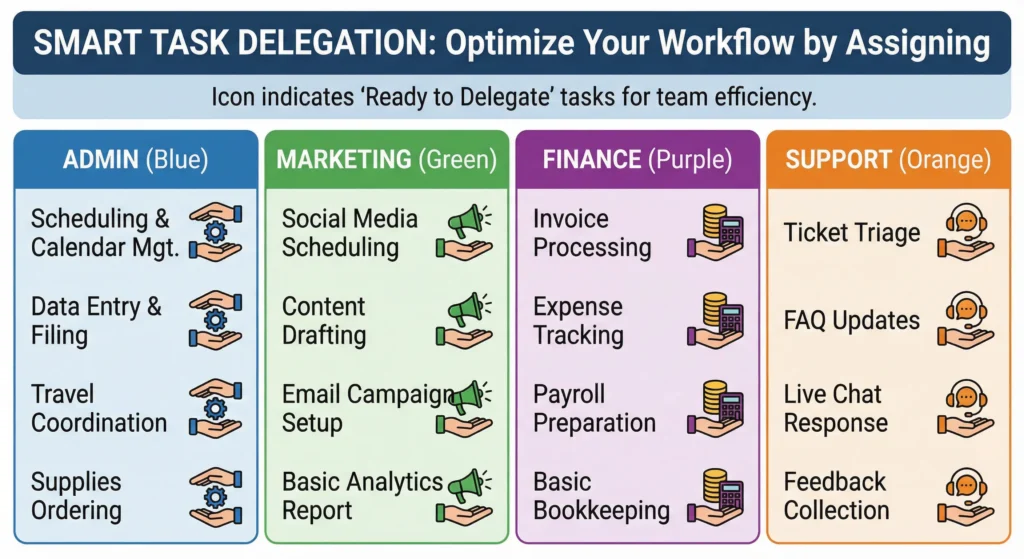
The short answer: Delegate repetitive tasks, specialized tasks outside your expertise, and anything in Eisenhower’s “urgent but not important” quadrant. Here’s how to think strategically about what leaves your plate.
Administrative work tops the delegation list. Scheduling appointments, managing your calendar, data entry, email sorting, expense tracking, and invoice processing consume hours but require minimal strategic thinking. These tasks have clear processes and immediate time savings.
Repetitive processes with established procedures are perfect delegation candidates. If you’ve done something the same way three times, document the process and hand it off. Content posting, report generation, routine customer service responses, and order processing fall into this category.
Specialized tasks requiring expertise you lack make financial sense to delegate. Unless you’re an accountant, delegate bookkeeping. Unless you’re a designer, delegate graphics. Unless you’re a copywriter, delegate content creation. Your hourly value applied to learning these skills versus hiring expertise rarely makes business sense.
Social media management, basic marketing tasks, research projects, and initial customer inquiries can move to team members while you focus on strategy, major client relationships, and revenue-generating activities.
Here’s what you should never delegate in the early stages: overall business strategy, hiring decisions for key positions, core client relationships, company culture development, and financial oversight. These require your vision, judgment, and leadership. As your business matures and you develop senior leaders, even some of these responsibilities can be shared but initially, they’re yours to own.
Overcome the Mental Blocks Holding You Back
The mechanics of delegation are straightforward. The psychology? That’s where business owners get stuck. Let’s address the three limiting beliefs that keep you trapped in do-it-all mode.
“Nobody Can Do It Like I Can” (Perfectionism trap)
You’re right nobody will do it exactly like you. They’ll do it differently. Sometimes worse. Often better. Always with their unique perspective and approach.
The perfectionism trap assumes your way is the only right way. In reality, “done well by someone else” beats “done perfectly by you” when it frees you for higher-value work. Your business doesn’t need perfection in every task it needs excellent execution in the areas that truly differentiate you and good-enough completion of everything else.
One of our clients, Darren, came to us feeling blocked from building the business he envisioned because he couldn’t let go of control. Through identifying and eliminating his limiting beliefs about delegation, he unlocked radical shifts that transformed not just his workload, but his entire leadership approach and business growth.
“It’s Faster to Do It Myself” (Short-term thinking)
This is true in the moment and false over time. Yes, explaining a task takes longer than completing it once. But that one-time investment in training creates ongoing leverage. The delegation mistakes small business owners make often stem from confusing activity for results and valuing speed over scalability.
Calculate the real cost. If a task takes you 30 minutes weekly and takes 2 hours to train someone else, you break even after 4 weeks. Then you reclaim 26 hours annually forever. That’s 26 hours for strategy, sales, or simply reclaiming your life outside work.
“What If They Make a Mistake?” (Fear of failure)
They will make mistakes. You make mistakes. Mistakes are how competence develops. The question isn’t whether errors will happen; it’s whether you create a system to catch and learn from them before they become critical.
This is why Step 4 of the framework includes structured check-ins. You’re not abandoning responsibility, you’re distributing it with appropriate oversight. Start with low-risk tasks where mistakes are learning opportunities, not business threats. As competence grows, the complexity and oversight.
Fear of mistakes is often the fear of losing control. But control isn’t the same as results. Sometimes, releasing control is exactly what creates better outcomes because you’ve empowered people who are closer to the work to make better, faster decisions.
How Do You Delegate Without Losing Control?
You maintain strategic oversight while releasing operational control. Here’s how that works in practice.
Set clear expectations upfront. Define the desired outcome, success metrics, deadlines, and boundaries. When expectations are crystal clear, team members have autonomy within defined parameters. They know when to make decisions independently and when to seek guidance.
Create feedback loops, not micromanagement. Scheduled check-ins at predetermined milestones provide visibility without hovering. Weekly reports on key metrics give you data without requiring constant status updates. Exception reporting, where team members only escalate issues, not routine progress, keeps you informed while trusting their execution.
Build systems and standard operating procedures before delegating. Document your process, create checklists, and record video walkthroughs. These systems ensure consistency and quality while reducing training time. They’re the infrastructure that makes scaling your business possible without recreating the wheel for every new task or team member.
Empower decision-making within boundaries. Instead of requiring approval for every choice, establish decision frameworks. “You can spend up to $500 without approval.” “You handle any customer complaint you can resolve in under 10 minutes.” “For anything affecting more than three clients, loop me in.” This creates autonomy with safety nets.
Trust the process, not perfection. Your role shifts from doer to coach. You’re developing capabilities, not just completing tasks. This long-term thinking is what transforms a business dependent on you into a business that scales beyond you.
FAQs:
1. How do I know which tasks I should delegate first?
Start with repetitive, process-driven tasks (like invoicing or scheduling) and specialized tasks that are outside your expertise (like graphic design or bookkeeping). Use the Eisenhower Matrix to identify “urgent but not important” tasks to offload.
2. Isn’t it faster if I just do it myself?
In the short term, yes. However, investing two hours to train someone on a 30-minute weekly task saves you 26 hours per year. Delegation is a long-term strategy for scalability, not a quick fix for today’s to-do list.
3. How can I ensure quality without micromanaging?
Delegate the outcome, not the method. Define what success looks like and set clear quality standards. Establish “check-in” milestones (e.g., at 25% completion) to provide feedback without hovering over every step.
4. What should I never delegate as a business owner?
In the early stages, keep control of your high-level business strategy, core company culture, hiring for key leadership positions, and high-level financial oversight. These require your specific vision and judgment.
5. What if my team member makes a mistake?
View mistakes as a “training tax.” Use them as coaching opportunities to refine your Standard Operating Procedures (SOPs). Building a resilient team requires allowing them the space to learn and course-correct.
Your Transformation Starts Today
Effective delegation isn’t about working less it’s about working on what matters most. You now have a proven framework: identify what to delegate using the Eisenhower Matrix, match tasks to team strengths, communicate outcomes instead of micromanaging processes, and establish structured check-ins that build competence without hovering.
You understand the data: leaders who delegate effectively generate 33% more revenue and experience dramatically higher growth rates than those who don’t. You’ve examined the mental blocks of perfectionism, short-term thinking, and fear of mistakes that keep capable business owners trapped in operator mode instead of stepping into true leadership.
Here’s what I’ve learned in over 20 years of helping business leaders transform their approach: delegation is a learnable skill, not an innate talent. It requires practice, patience with imperfection, and commitment to developing others. But the payoff isn’t just more time; it’s a business that can grow beyond your personal capacity and a team that operates with confidence and competence.
The question isn’t whether you’re ready to delegate. The question is whether you’re ready to stop being the bottleneck in your own success.
Take decisive action today. Map your tasks into the Eisenhower Matrix this week. Choose one Quadrant 3 task and delegate it completely. Document the process and hand it off with clear outcome expectations. Schedule your first check-in. Then watch what happens when you free yourself to focus on the strategic work only you can do.
Your business doesn’t need you to do everything. It needs you to lead effectively, think strategically, and empower others to execute with excellence.
Ready to master delegation and other critical leadership skills? Explore our business coaching programs and leadership training to transform how you lead, delegate, and scale your business. Your transformation starts today take the first step.