

You’re ready to become a coach. You’ve got the training, the drive, and a deep desire to transform someone’s life. But the moment you sit down to define your coaching niche, two voices start battling inside your head. One whispers, “Follow your passion, the money will come.” The other fires back, “Pick what pays or you’ll be coaching for free.”
You’re not alone. The coaching industry has exploded to over $5.34 billion in global revenue, with the number of active coaches growing 15% since 2023. That growth is exciting but it also means competition is fierce. Choosing the right niche isn’t just a branding exercise. It’s the foundation of a coaching business that actually sustains you.
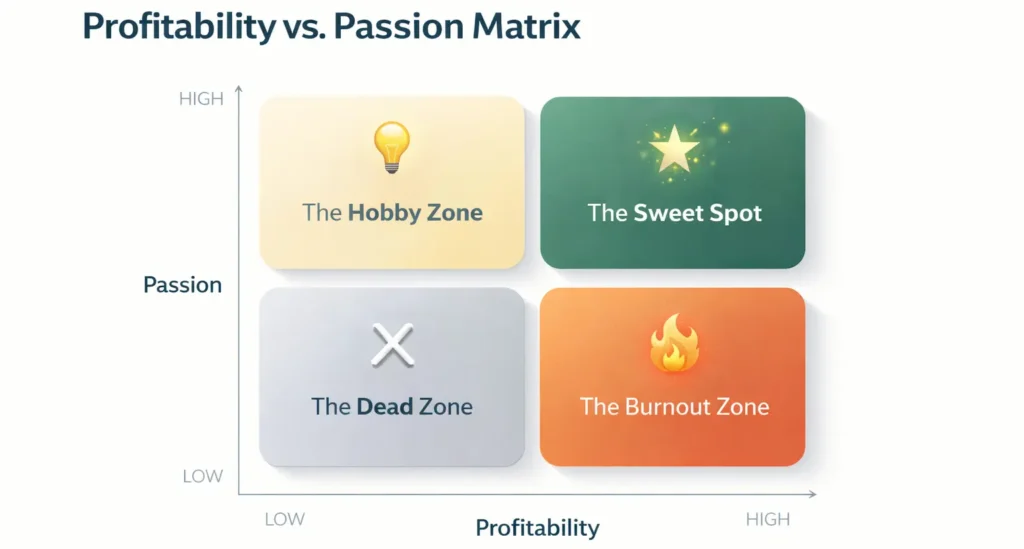
Here’s the truth I’ve learned in over 20 years of coaching, training, and mentoring aspiring coaches: passion and profitability aren’t opposites. They’re partners. And with the right framework, you can stop guessing and start choosing with clarity. That’s exactly what the Profitability vs. Passion Matrix gives you.
Key Takeaway:
- Choosing the right coaching niche is one of the most important decisions for building a profitable and sustainable coaching business. A well-chosen niche allows you to attract ideal clients, charge premium rates, and stand out in a crowded market. [1]
- The most profitable niches combine three key factors: high demand, clients who have money to invest, and your genuine passion or expertise. Niches like executive leadership, career transition, health & wellness, relationships, and business growth tend to perform best financially. [1]
- Avoid choosing a niche based only on what’s popular or what you think will make money. Instead, evaluate profitability by researching client willingness to pay, competition level, and how deeply you can solve their specific pain points. [2]
- A focused niche gives you authority, easier marketing, higher conversion rates, and the ability to charge premium fees — ultimately leading to faster business growth and more fulfillment. [2]
Bottom Line: Don’t try to coach everyone. Choosing a specific, profitable niche where you can deliver deep value is the fastest path to building a successful, high-income coaching business while avoiding burnout and generic competition.
Why Your Coaching Niche Is the Foundation of Everything
What Is a Coaching Niche (And What It Isn’t)?
A coaching niche is the specific intersection of who you serve, what problem you solve, and how you help them solve it. It’s not a cage. It’s a compass. Think of it this way: “I help mid-career professionals overcome imposter syndrome so they can lead with confidence.” That’s clear. That’s compelling. And it’s a coaching niche that positions you as someone worth hiring.
What a niche is not: a permanent tattoo. Your niche can evolve as you grow. But starting without one is like driving cross-country with no GPS; you’ll burn fuel, waste time, and end up frustrated.
What Happens When You Skip This Step?
The global coaching market is projected to reach roughly $7.3 billion in 2025, with the number of practicing coaches on track to more than double from 2019 levels. In a market this crowded, “I help everyone with everything” is invisible. Without a defined niche, your marketing is vague, your messaging doesn’t land, and potential clients scroll right past you. Becoming a life coach is an incredible decision but choosing who you serve is what turns that decision into a business.
The Passion Trap: Why “Do What You Love” Isn’t Enough
When Passion Doesn’t Pay the Bills
Let’s be direct. Passion is essential but passion alone doesn’t create a sustainable coaching business. You might be deeply passionate about helping people journal through grief or coaching artists to find creative flow. Those are meaningful pursuits. But if the people you want to serve aren’t actively looking for (or willing to invest in) that kind of support, you’ll struggle to fill your calendar.
The “passion-first” approach fails when it ignores a basic business reality: there needs to be a market of people who have the problem you solve and the means to pay for the solution. According to the ICF’s 2025 Global Coaching Study, leadership and executive coaching remain the dominant specializations, with 54% of coaches working in those areas largely because organizations see clear ROI and allocate real budgets for coaching.
How Do You Know If Your Passion Has Market Demand?
Here’s a quick gut-check. Search your potential niche topic in Google, LinkedIn, or podcast directories. Are people actively talking about this problem? Are other coaches (even a few) already serving this audience? That’s a good sign; it means demand exists. If you find zero conversations, zero competitors, and zero communities around the topic, your passion may be too narrow or too early for the market.
The Profitability Trap: Why Chasing Money Leads to Burnout
The Hidden Cost of Coaching Without Purpose
On the other end of the spectrum sits the coach who picks a niche purely for the payday. Executive coaching sounds lucrative. Business coaching looks scalable. So you jump in even though you have no genuine interest in corporate strategy or leadership dynamics. Six months later, you dread your sessions. Your energy drops. Your clients feel it.
I’ve seen this pattern many times in my 20+ years as a Board Designated NLP Trainer. Coaches who chase profitability without connecting to purpose burn out and burnout doesn’t just stall your business; it erodes your confidence. Darren G. came to me feeling exactly this way: stuck, purposeless, and blocked despite having a well-paying job. Through our work together, we uncovered the goal blocks and limiting beliefs keeping him trapped in a direction that didn’t align with who he truly was. Once we cleared those, his thinking, his actions, and even his relationships shifted radically.
What Makes a Coaching Niche Truly Profitable?
Profitability isn’t just about the hourly rate. A truly profitable coaching niche has three elements: clients who can afford coaching, a problem that costs them significantly if left unresolved, and a clear pathway from their pain to your solution. According to research on the fastest-growing coaching segments, niches tied to career advancement, leadership development, and financial confidence consistently command higher fees because the cost of inaction for those clients is measurable and real.
The Profitability vs. Passion Matrix: A Framework for Choosing Your Coaching Niche
This is where passion and profitability stop competing and start collaborating. Picture a simple 2×2 grid. The vertical axis measures your passion (genuine energy, interest, lived experience). The horizontal axis measures profitability (market demand, client willingness to pay, scalability). Every potential coaching niche falls into one of four quadrants.
Quadrant 1 High Passion + High Profitability (The Sweet Spot)
This is where transformation happens for your clients and for your bank account. You’re energized by the work, your audience is actively seeking solutions, and they’re willing to invest. Examples include confidence coaching for corporate leaders, career transition coaching for mid-level professionals, or NLP-based coaching for entrepreneurs. If your niche idea lands here, you’ve found your launchpad.
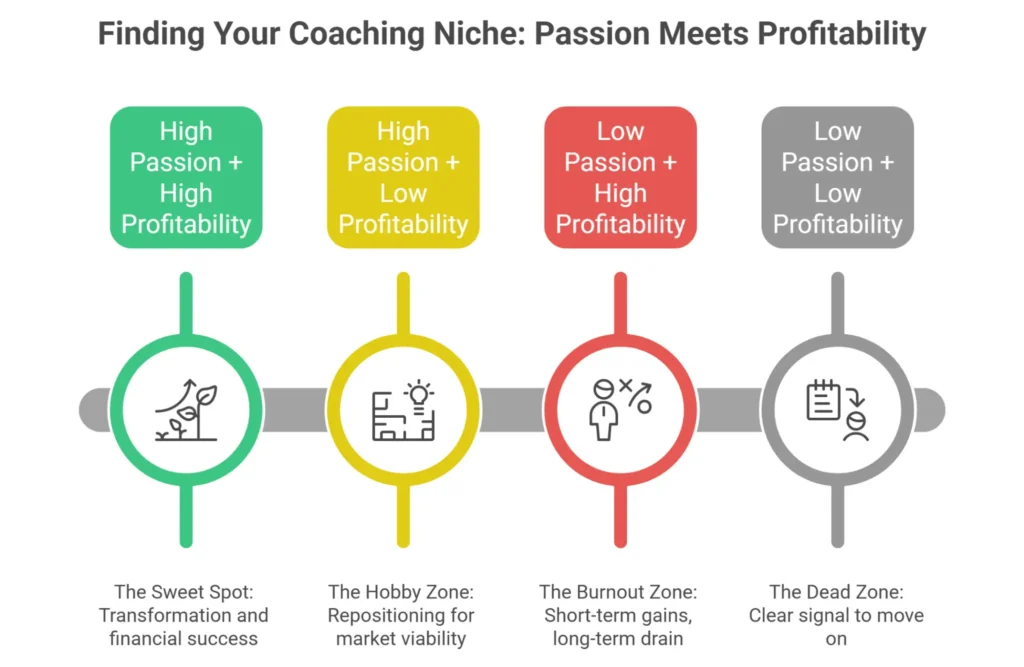
Quadrant 2 High Passion + Low Profitability (The Hobby Zone)
You love this topic. You could coach on it for hours. But the market isn’t ready to pay premium rates for it yet. This doesn’t mean you abandon the idea entirely. It means you might need to reposition it. Can you serve a higher-budget audience within this space? Can you bundle your passion with a more commercially viable offer? Creativity turns Quadrant 2 into Quadrant 1.
Quadrant 3 Low Passion + High Profitability (The Burnout Zone)
The money is there, but your heart isn’t. This niche will drain you. You’ll deliver competent sessions, but never exceptional ones. Over time, your clients will sense the disconnect, referrals will slow, and the income advantage disappears. Profitability without passion is a short-term play at best.
Quadrant 4 Low Passion + Low Profitability (The Dead Zone)
No energy. No demand. If an idea falls here, it’s a clear signal to move on. Don’t force what isn’t working. Direct that energy toward a niche that lights you up and serves a real market need.
Try This: Rate Your Top 3 Niche Ideas on the Matrix
Grab a piece of paper and draw the grid. For each of your top 3 coaching niche ideas, rate your passion from 1–10 and the profitability potential from 1–10. Plot them. Where do they land? Any ideas in Quadrant 1 deserve your full attention. Ideas in Quadrant 2 might need creative repositioning. If everything clusters in 3 or 4, it’s time to brainstorm fresh options.
How to Use NLP to Get Crystal Clear on Your Coaching Niche
Here’s what I’ve found after two decades of working with NLP: the biggest obstacle to choosing a coaching niche isn’t information. It’s clarity. You have too many ideas, too many voices in your head, and a subconscious pattern of second-guessing yourself. NLP offers powerful tools to cut through that noise.
The Values Elicitation Exercise
Your values are the compass behind every decision you make. In NLP, a values elicitation helps you uncover what truly drives you, not what you think you should value, but what you actually prioritize at a subconscious level. When your coaching niche aligns with your core values, showing up becomes effortless. When it doesn’t, everything feels like a push.
Heather Chetwynd experienced this firsthand when she enrolled in James’s NLP Practitioner course. She’d already trained in NLP with someone else, but walked away confused about how to integrate the techniques into her work. Through the training, she didn’t just learn tools; she gained unexpected clarity about her business direction and future. The right framework doesn’t just teach you skills. It reveals the path those skills were meant to serve.
Try This: Future Pace Your Niche Decision
Close your eyes and imagine it’s 18 months from now. You’ve been coaching full-time in the niche you’re considering. Walk through a typical day: Who are your clients? What problems are you helping them solve? How do you feel at the end of a session? NLP future pacing allows you to “try on” a niche before committing to it. If the vision energizes you, you’re on the right track. If it feels heavy or hollow, pay attention to that signal.
Reframing “What If I Choose Wrong?”
This is the fear that paralyzes more aspiring coaches than any other. Here’s the reframe: your niche isn’t a life sentence, it’s a launching pad. The most successful coaches in the world started with one focused area and evolved over time. Choosing a niche doesn’t close doors. It opens a specific one and once you walk through it with credibility and momentum, many more doors appear.
From Matrix to Action: Your Next Steps to Launch
Test Before You Commit
Before you invest in a logo, a website, and a full coaching package, test your niche with real people. Offer three to five complimentary sessions in your target area. Pay attention: Are these clients energized by the work? Are you? Does the conversation flow, or does it feel forced? Real-world feedback beats hypothetical planning every time. As you refine your focus, having a clear plan for how to start your life coaching business makes the transition from idea to action far smoother.
How Do You Know When You’ve Found the Right Coaching Niche?
You know because three things align: you feel genuine energy when you talk about the topic, there’s a clear audience willing to invest in solutions, and your own experience or training gives you credible authority to guide others. That alignment, passion, market demand, and expertise are the engine behind every thriving coaching practice. According to recent industry data, life coaching is the second fastest-growing industry in the US, which means the demand is real. Your job is to meet it with a focused, compelling offer.
Your Niche Is Waiting Go Claim It
Choosing your coaching niche doesn’t require perfection. It requires honesty. Be honest about what genuinely excites you. Be honest about what the market will pay for. And be honest about where those two forces overlap. The Profitability vs. Passion Matrix gives you a simple, visual way to make that decision with confidence instead of confusion.
Remember: the coaches who thrive aren’t the ones who try to help everyone. They’re the ones who have the courage to focus. Your coaching niche isn’t a limitation; it’s the very thing that will set you apart, attract the right clients, and build a business that sustains you for years to come.
If you’re ready to take decisive action and build a coaching practice rooted in both purpose and profitability, explore the training and coaching programs at unleashyourpower.com. Your transformation starts today. Take the first step.
Unleash Your Power: Stand Out, Take Action, and Create the Success You Want.
Frequently Asked Questions
How long does it take to choose a coaching niche?
For most aspiring coaches, the initial decision takes two to four weeks of focused reflection and research. But don’t confuse choosing with finalizing. Start with your best hypothesis, test it with real clients, and refine from there. Action creates clarity faster than overthinking ever will.
Can I change my coaching niche later?
Absolutely. Your coaching niche will naturally evolve as you gain experience, refine your skills, and learn more about the clients you serve best. Many successful coaches started in one area and pivoted based on what they discovered in practice. The key is to start focused and expand intentionally.
What are the most profitable coaching niches right now?
Executive coaching, leadership development, career transition coaching, and business coaching consistently rank among the highest-earning specializations. Health and wellness coaching is also experiencing significant growth. The common thread: these niches solve urgent, high-stakes problems that clients and organizations are actively willing to invest in.
Do I need a certification before choosing a niche?
While certification isn’t legally required in most regions, it significantly boosts your credibility. Industry research suggests roughly three-quarters of coaching clients expect their coach to hold a certification or credential. Training programs like NLP Practitioner and life coach certification give you both the skills and the professional standing to attract serious clients.
How specific should my coaching niche be?
Specific enough to be memorable and credible, but broad enough to sustain a full client roster. “Life coaching” is too vague. “Confidence coaching for left-handed accountants in one city” is too narrow. A strong coaching niche clearly defines your ideal client, the transformation you deliver, and what sets your approach apart.