

Have you ever gone out of your way to help someone only to realize they were quietly working against you the entire time?
It’s a painful experience. Not just because of the betrayal, but because it often catches you off guard. You were kind. You were supportive. You thought you were building trust. But somewhere beneath the surface, they were pulling strings that chipped away at your credibility, confidence, or peace of mind.
This isn’t just about toxic people. It’s about the dangerous habit of pouring your time, energy, and goodwill into those who don’t respect it and worse, use it to their advantage.
In this guide, we’re going to unpack what it really looks like when someone undermines you while still accepting your help. You’ll learn how to recognize the signs early, understand why we often ignore the red flags, and most importantly, how to protect yourself without turning cold or cynical.
Helping others is a strength but only when it’s directed toward those who value your presence, not those who secretly resent it.
What Does It Mean to Be Undermined by Someone You Help?
Being undermined isn’t always loud or obvious. It can show up in subtle actions that slowly erode your sense of self, all while the other person continues to accept your support as if nothing’s wrong.
You step in to help someone because it feels right. Maybe they’re struggling. Maybe they asked nicely. Maybe you just wanted to be kind. But then things start to feel… off.

Here’s what it can actually look like when someone accepts your help while quietly working against you:
- They take your ideas but erase your name. Suddenly, your suggestions become their brilliant solutions.
- They praise you in private but plant seeds of doubt in public. It sounds like support until you realize the tone is condescending.
- They constantly need you, but never show up when it’s your turn. You’re their safety net, not their equal.
- They act grateful, but you’re always walking on eggshells. One wrong move, and somehow you’re the bad guy.
These patterns don’t usually scream “toxic.” They whisper. And that’s what makes them dangerous. That discomfort you feel? That’s not overthinking, it’s your gut trying to get your attention.
Helping someone who quietly undercuts you is more than just a bad dynamic; it chips away at your self-respect and mental clarity. And if you don’t recognize it early, it becomes a cycle that’s hard to break.
Why We Help People Who Undermine Us
It’s easy to look back and think, “How did I not see it sooner?” But the truth is, this kind of dynamic plays on your strengths, your empathy, loyalty, and sense of responsibility.
Here’s why we often find ourselves helping the very people who work against us:
You’re Wired to Keep the Peace
For many of us, conflict feels worse than being taken advantage of.
- You tell yourself, “It’s not worth the drama.”
- You’d rather be overworked than be seen as “difficult.”
- You bite your tongue, hoping things will smooth over on their own.
But peacekeeping isn’t the same as self-respect. And when you keep the peace with people who cross your boundaries, you’re the one left paying the emotional bill.
You’re Hoping They’ll Change
You keep giving chances. Hoping they’ll grow. That they’ll eventually see how much you’ve helped and show some loyalty back. But here’s what usually happens:
- They take your support for granted.
- Your silence becomes permission.
- The longer you wait for change, the deeper the damage gets.
Hope feels kind. But when it keeps you stuck, it becomes a trap.
You’ve Been Conditioned to Overgive
This is especially common if you were raised to:
- Always “be the bigger person”
- Put others first, no matter what
- Keep the family, team, or friendship circle together at all costs
While those values sound noble, they become dangerous when:
- You ignore patterns because confronting them feels “mean”
- You confuse being used with being useful
- You think saying “no” makes you selfish
There’s a difference between helping and sacrificing your well-being.
They Make You Feel Responsible for Their Emotions
Underminers are often skilled manipulators. They know how to flip the script and make you feel like:
- You’re overreacting
- You’re being cold or unfair
- You owe them for the times they showed up (even if it came with strings attached)
This keeps you stuck in a loop: over-giving, emotional fatigue, guilt-tripped, and back to over-giving. That’s not generosity, it’s emotional control.
The Hidden Costs of Helping Those Who Undermine You
At first, it might seem harmless. You tell yourself you’re just being supportive. That you’re strong enough to handle it. But over time, this dynamic starts eroding things that matter, things you can’t always get back.
Helping someone who continually disrespects you doesn’t just hurt in the moment. It leaves long-term scars on your mental clarity, confidence, and personal growth.
Let’s break down what’s really at stake:
It Erodes Your Self-Trust
When you keep showing up for someone who subtly tears you down, you start to lose faith in your own judgment. The voice that once warned you gets quieter each time you ignore it.
It Quietly Wears You Down
Even when you think you’re managing it, this dynamic drains you:
- Constant second-guessing
- Less time and energy for your own goals
- Unresolved emotional tension that lingers for days
Meanwhile, the person taking from you continues on, unaffected and unaccountable.
It Can Undermine How Others See You
In professional settings, helping someone who subtly undermines you can:
- Chip away at your credibility
- Link your name with their poor behavior
- Get you passed over for leadership roles
Being nice shouldn’t cost you respect.
It Keeps You Emotionally Trapped
You crave clarity but stay confused. You want space but feel guilty. This back-and-forth turns into a cycle of emotional paralysis that seeps into every area of your life.
The damage doesn’t happen all at once. It builds quietly. And it always starts with the signs we choose to overlook.
Red Flags That Someone You’re Helping May Be Undermining You
If you’re always feeling uneasy around someone you’re trying to help, pay attention. Your discomfort is data. Here are the signs that shouldn’t be brushed off:
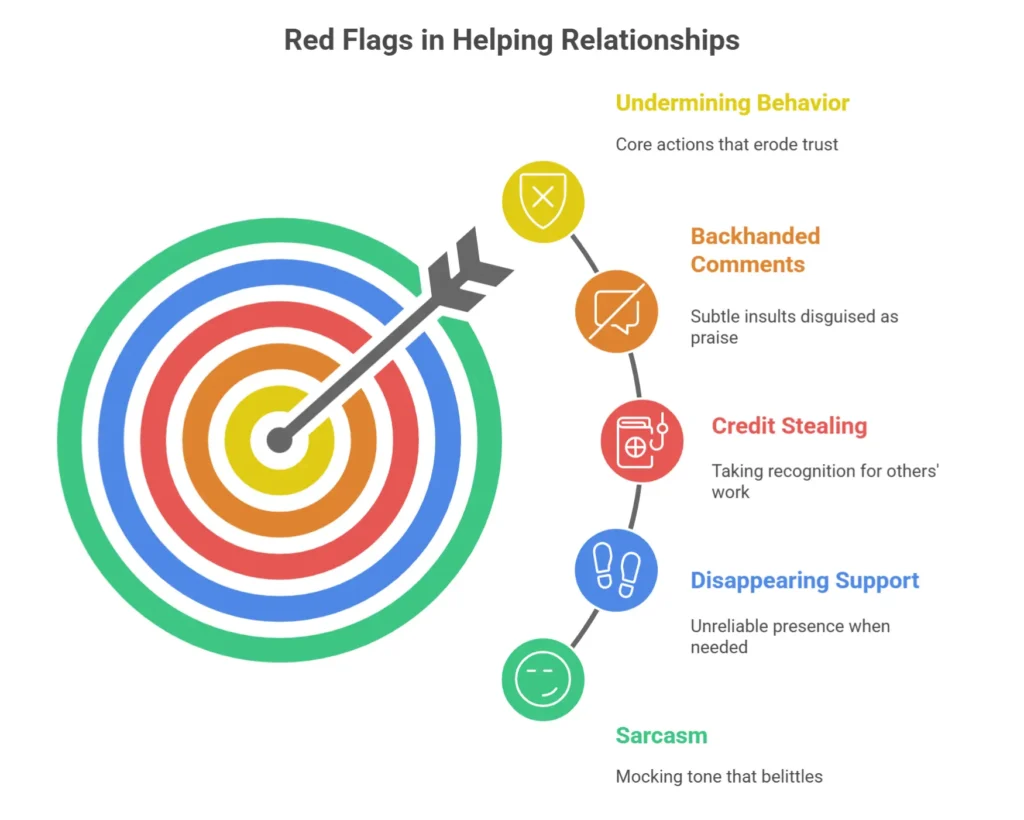
They Only Show Up When They Need Something
- They vanish when you need support, but expect you to always be available
- Every conversation has a hidden agenda
- You’re always the one doing the emotional heavy lifting
They Undermine You in Subtle Public Ways
- They joke at your expense to make themselves look better
- They interrupt, correct, or one-up you in meetings
- They respond to your success with jealousy disguised as sarcasm
It’s not harmless if you always leave feeling smaller.
They Deflect Blame and Demand Loyalty
- You’re always the fallback when things go wrong
- They expect your full support, even when they’ve created the mess
- Saying “no” triggers guilt trips and silent treatment
They Speak About You Differently Behind Your Back
- You hear things that don’t match how they act in front of you
- They downplay your role or dismiss your contributions to others
- They go quiet when others criticize you, even if you’re close
You Leave Every Interaction Feeling Off
You may not be able to name it, but it’s there:
- You feel tense before, foggy during, and depleted afterward
- You begin to second-guess your own emotions
- Your self-confidence quietly shrinks over time
How to Protect Yourself Without Becoming Bitter or Cold
Protecting yourself doesn’t mean you stop caring. It means you care smarter. Here’s how to create distance with grace and strength:
Set Boundaries That Are Clear, Not Cruel
- “I’m not available for that right now.”
- “I can’t commit to this, but I hope it works out for you.”
- “I need space from this dynamic; it’s been weighing on me.”
Boundaries aren’t rejection. They’re self-respect.
Stop Rescuing People Who Aren’t Growing
Some people don’t want solutions; they want a pattern. Let go of the urge to fix what someone refuses to face.
Step Back Quietly
You don’t need to make an announcement. Just:
- Stop initiating
- Pause your emotional investment
- Let the silence reveal what’s real
Shift From Emotion to Observation
Emotion clouds judgment. Observation reveals patterns.
- “How do I feel after every interaction?”
- “Is their behavior something I’d accept from anyone else?”
- “If a friend were in my place, would I tell them to stay?”
Distance brings perspective. Perspective brings peace.
Guard Your Energy Like It’s Gold
Your emotional bandwidth is not endless. Save it for:
- People who value you
- Work that fulfills you
- A version of yourself that feels whole, not depleted
When Cutting Ties Is the Healthiest Option

Sometimes, boundaries aren’t enough. When the patterns persist, despite all efforts, the healthiest option may be to let go completely.
The Pattern Never Changes
- They apologize, but the behavior repeats
- Your concerns are dismissed or flipped back on you
- You’ve done the work alone
You Don’t Feel Safe
- You’re walking on eggshells
- You shrink to avoid conflict
- You’re never emotionally steady around them
You’re Losing More Than You’re Gaining
Ask yourself:
- What am I actually getting from this?
- Is it rooted in respect or just routine?
You’re Shrinking to Keep the Peace
- Your standards are lower
- You don’t trust your voice anymore
- You’re tolerating what once would’ve been a dealbreaker
Loyalty is not worth your dignity.
You’ve Outgrown the Dynamic
Not every relationship is meant to last. And that’s okay. Growth doesn’t always come in pairs.
How to Exit with Clarity and Self-Respect
Leaving doesn’t have to be dramatic. It just has to be clear. Here’s how to do it:
- Stay calm. You don’t need to explain your entire decision, just state the boundary.
- Keep it short. Overexplaining opens the door for debate or guilt-tripping.
- Be honest, not harsh. “This dynamic hasn’t been healthy for me, and I need space to move forward.”
- Stick to it. Don’t be lured back in by temporary remorse or promises that never lead to action.
Conclusion: You Don’t Owe Anyone Access to Your Energy
Not everyone you help is on your side, and that’s a hard truth to accept. But continuing to give your time, trust, or energy to someone who quietly works against you does more than just wear you down; it trains you to ignore your own instincts.
You don’t have to turn cold to protect yourself. You just have to be honest about who’s actually adding value to your life and who’s quietly subtracting from it. Letting go isn’t cruel, it’s clarity. You don’t.
FAQs
How do you know if someone is quietly undermining you, even when you help them?
A person undermines you when they seek your support but subtly damage your confidence, reputation, or boundaries. Signs include backhanded comments, taking credit for your work, emotional manipulation, and disappearing when you need support. These patterns drain your energy and weaken self-trust over time.
Why do I keep helping people who don’t respect me or secretly work against me?
People often overgive out of empathy, conflict avoidance, hope for change, or conditioning to “be the bigger person.” Underminers exploit these traits. Understanding these patterns helps you break cycles of overhelping and protect your emotional well-being without feeling guilty.
What are the psychological risks of helping someone who undermines you?
Repeatedly helping someone who devalues you leads to self-doubt, emotional fatigue, lowered confidence, guilt-driven decisions, and diminished boundaries. Long-term exposure can also affect your professional reputation and create chronic stress that impacts your mental clarity and self-worth.
How do you set boundaries with someone who manipulates or undermines you?
Use clear, calm statements like “I’m not available for that” or “I need space from this dynamic.” Avoid overexplaining, detach emotionally, stop rescuing, and observe their response. Effective boundaries are direct, consistent, and rooted in self-respect, not conflict.
When is it time to cut ties with someone who repeatedly undermines your efforts?
It’s time to walk away when patterns persist despite boundaries, you feel unsafe or anxious around them, you lose confidence, or the relationship drains more than it gives. Leaving protects your emotional energy and helps rebuild clarity, confidence, and peace.