

Vague corporate language breeds internal chaos because unclear instructions force every person on your team to privately invent their own definition of the task and those definitions only collide at the deadline, when the work comes back wrong.
Phrases like “own the client experience,” “make it feel more premium,” or “take the lead on this” feel like direction. They aren’t. They’re containers the receiver has to fill in themselves, using guesses about what you meant.
Six decades of workplace research point to the same conclusion: unclear expectations, not heavy workload, are the most damaging stressor people face at work. In a small coaching or consulting business, the damage compounds faster, because there’s no process layer to catch the miss.
Key Takeaway:
- Vague corporate language creates internal chaos because phrases like “take the lead,” “tighten this up,” or “make it more premium” do not define a finishable outcome. Team members must guess what “good” means, often producing work that misses the leader’s unstated expectations.
- Mechanism: Unclear expectations transfer decision-making to people who lack the original context. Jargon can make this worse by discouraging clarification, allowing confusion to remain hidden until poor work, rework, or missed deadlines expose it.
- Use the “I’ll know this is done when I see…” test. Define one observable, measurable outcome for every important handoff, then clarify whether the decision is “Yours” to make, “Ours” to recommend together, or “Mine” to approve.
- Avoid confusing precision with micromanagement. Good instructions specify the desired outcome and boundaries while leaving the method to the person doing the work. Micromanagement controls the method, whereas clarity creates autonomy.
- Start small: rewrite the three tasks currently delegated to others using clear “definition of done” statements and ask each person to restate the assignment in their own words. This 30-second playback can expose misunderstandings before they become expensive rework.
Bottom Line: Vague language is often more than a communication problem; it can become a structural bottleneck that keeps leaders trapped in rework and decisions. Define what “done” means, clarify decision rights, and let your team own the method.
- Source: Unleash Your Power – How Vague Corporate Language Breeds Internal Chaos
- Supporting Research: Journal of Vocational Behavior – Meta-analysis of role stressors and workplace outcomes
Why Does Vague Language Create Chaos on a Small Team?
Vague language creates chaos because it silently transfers your decisions to people who don’t have the information to make them.
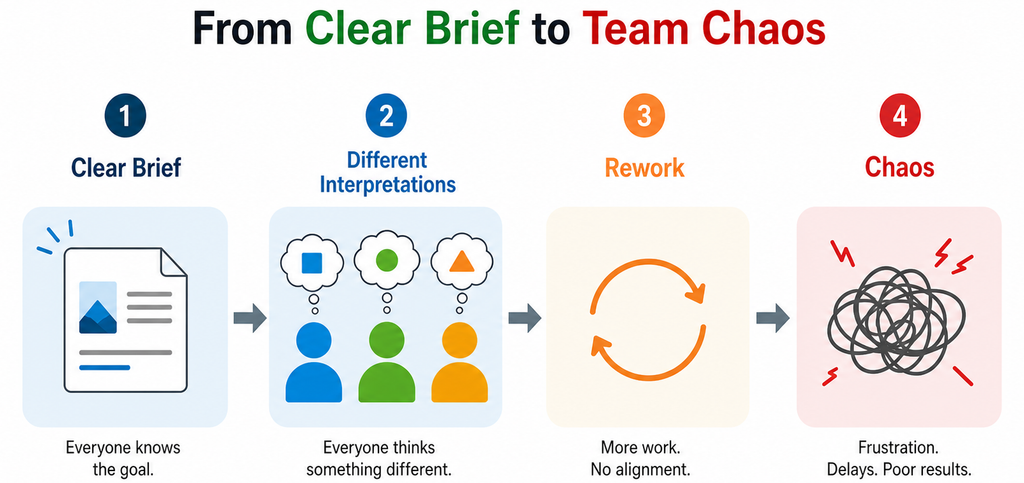
When you say “clean up the onboarding sequence,” you have a picture in your head. A specific email. A specific tone. A problem you noticed on Tuesday. Your contractor has none of that, so she builds her own picture: reasonable, professional, completely different from yours. Nobody finds the gap until she delivers.
Multiply that by four people and a week and you get the thing you keep calling a team problem. Writing in Harvard Business Review, consultant Andrea Belk Olson notes that terms like “customer-first” give departments no common anchor, so everyone proceeds in parallel, each convinced they’re doing the right thing.
Here’s what makes small businesses worse, not better. A large company has documentation, review cycles, and a project manager whose entire job is catching this. You have a Slack thread and hope. The miss goes all the way to the client or all the way to you, at 11 pm, fixing it yourself.
This is one of the communication breakdowns most owners misdiagnose. You conclude the person wasn’t a good fit. The instruction was never fit to begin with.
What Vague Corporate Language Actually Sounds Like in a Coaching Business
Most coaches and consultants didn’t invent this vocabulary. They imported it.
If you spent time in a corporate role before building your own thing, you absorbed a dialect built for a different purpose. In a large organisation, ambiguity is often useful it lets a message survive six stakeholders without anyone disagreeing out loud. James spent 14 years at IBM, Lenovo and Novell learning to speak that way fluently, then carried it into his own business, where it did real damage.
The tell is language that describes a direction instead of a deliverable:
- “Own the client experience”
- “Let’s make the offer feel more premium”
- “Take the lead on the launch”
- “Tighten this up”
- “Circle back on the proposal”
- “Just make it pop”
None of those can be finished. There’s no observable moment where the person can look at their screen and know they’re done. So they either overwork it, under-work it, or stall and stalling looks like laziness from the outside when it’s actually paralysis.
The Three-Word Test
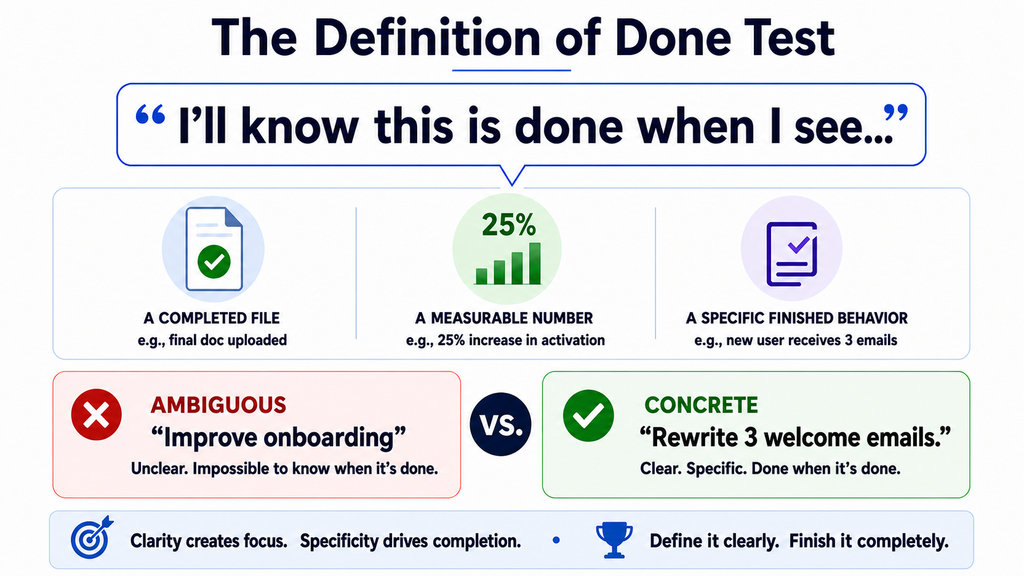
Take any instruction you gave this week and finish this sentence: “I’ll know this is done when I see.”
If you can’t complete it concretely a file, a number, a specific behaviour, a thing you could point at your team can’t either. It takes four seconds and it will make you uncomfortable the first ten times you run it.
Watch nominalizations especially: verbs that got turned into nouns. “Improve our onboarding” has no actor and no action. “Rewrite the three welcome emails so a new client knows what happens in week one” has both. Precision in how leaders phrase things isn’t a style preference. It’s the difference between work happening and work orbiting.
What the Research Says About Unclear Expectations
The data on this is stronger than most owners realise, and it points somewhere unexpected.
Unclear expectations beat workload as a stressor. A 2026 meta-analysis in the Journal of Vocational Behavior consolidated 515 studies and 588 samples covering roughly 788,000 workers across six decades. Researchers compared the three classic role stressors: role overload (too much to do), role conflict (competing demands), and role ambiguity (not knowing what’s expected). Role ambiguity was the most damaging across nearly every outcome measured. In coverage of the study, lead author Gargi Sawhney noted that overload is the stressor everyone assumes is worst, and the data didn’t support that assumption.
The performance effect is not marginal. Reporting on the same analysis attributes the large majority of the decline in task performance, and roughly seven-tenths of the drop in work engagement, to ambiguity rather than the other two stressors. Earlier work agrees: a meta-analysis in the Journal of Management found a consistent negative relationship between role ambiguity and job performance.
Jargon makes people stop asking. This is the finding that should worry you most. A 2025 University of Florida study in the International Journal of Business Communication surveyed close to 2,000 people about a jargon-heavy work email. The jargon made messages harder to process, left people less confident, and made them less likely to ask for clarification or share information. Younger workers were the least likely to ask. So the vagueness never surfaces as a question. It surfaces as a wrong deliverable later.
Canada treats this as a health and safety matter, not a soft skill. Under the National Standard of Canada for Psychological Health and Safety in the Workplace (CSA Z1003), Clear Leadership and Expectations is one of the thirteen psychosocial factors employers are expected to assess a work environment where people know what they need to do and how their work contributes. It sits alongside physical safety.
The time cost is measurable. Research from Grammarly with The Harris Poll estimated poor communication costs the average worker close to seven and a half hours every week most of a working day- spent rebuilding context and redoing work.
Why You Stay Vague Even Though You Know Better
You stay vague for two reasons. One is a cognitive limitation. The other is protection and it’s the one that actually runs your business.
The cognitive limitation is the curse of knowledge:
In a 1990 Stanford study, participants tapped the rhythm of well-known songs on a table while listeners guessed the title. Tappers predicted listeners would identify about half. Listeners got three out of 120, under three percent. The tappers could hear the melody in their heads and genuinely couldn’t imagine that nobody else could.
That’s you, briefing your VA. The full picture is playing at volume in your head. What lands on her end is tapping.
The Part Nobody Says Out Loud
The curse of knowledge explains the honest mistakes. It doesn’t explain why you keep doing it after being burned six times.
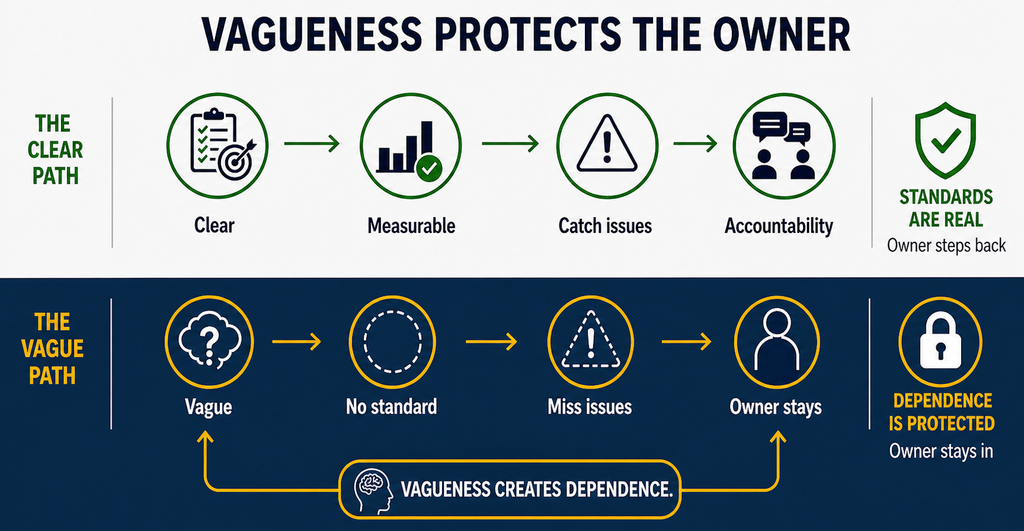
Here’s the harder version. A specific instruction is a commitment. Once you’ve written “the three welcome emails, rewritten, so a new client knows what happens in week one, by Thursday,” you’ve made something falsifiable. It can come back wrong. It can come back late. And then you’ll have to have the conversation.
Vagueness protects you from that conversation. It keeps you the only person who knows what “good” means, so nobody can fully take the work off you, so you stay necessary. That feels like standards. It functions like a cage.
This is unconscious programming doing exactly what it was built to do: protect you from disappointment by making sure you never fully hand anything over. You can’t delegate what your unconscious won’t release, and the very first thing it refuses to release is the definition of done.
The Delegation Loop
Watch the sequence, because it’s the same one every time:
- You give a vague brief, because a specific one takes twenty minutes and feels like over-explaining
- The work comes back at sixty percent
- You fix it yourself rather than have the conversation
- You conclude, quietly, that it’s faster to do it yourself
- You take the task back
- You are the bottleneck again and now you’re also convinced the market is short on good people
Nobody in that loop is lazy. The instruction was the failure point, and it was vague for reasons that had nothing to do with time. Most of the warning signs your systems are failing start here, one unclear brief at a time.
James spent years at step three. Fifth business, 80-hour weeks, on anxiety medication, rewriting other people’s work near midnight and calling it commitment to quality. It wasn’t quality. It was an unwillingness to say out loud what he actually wanted, in case someone failed to deliver it.
Vague vs. Shorthand vs. Micromanaging
Not all short instructions are vague, and not all specific instructions are micromanaging. The test is whether the receiver can independently tell when they’re finished.
Shorthand is compressed detail between people who share context; efficient and fine. Vagueness is absent detail dressed up as trust. Micromanaging is detail about method rather than outcome.
| Particular | Vague | Shorthand | Micromanaging |
|---|---|---|---|
| Sounds like | “Own the client experience” | “Standard onboarding, Tier 2 client” | “Open the doc, change the header font, then send at 9:04 am” |
| What the receiver does | Guesses, then hedges | Executes from shared context | Follows steps without judgement |
| Definition of done | Absent | Already established between you | Yours, not theirs |
| What it costs | Rework, stalling, silent resentment | Nothing it’s the goal state | Their initiative, and your time |
| Appropriate when | Never | Context is genuinely shared and proven | Safety, compliance, or a legal process |
The goal isn’t longer instructions. It’s shorthand earned by defining the terms once, properly, before you compress them.
How to Make Instructions Specific Without Micromanaging
Specify the outcome and the boundaries. Never specify the keystrokes.
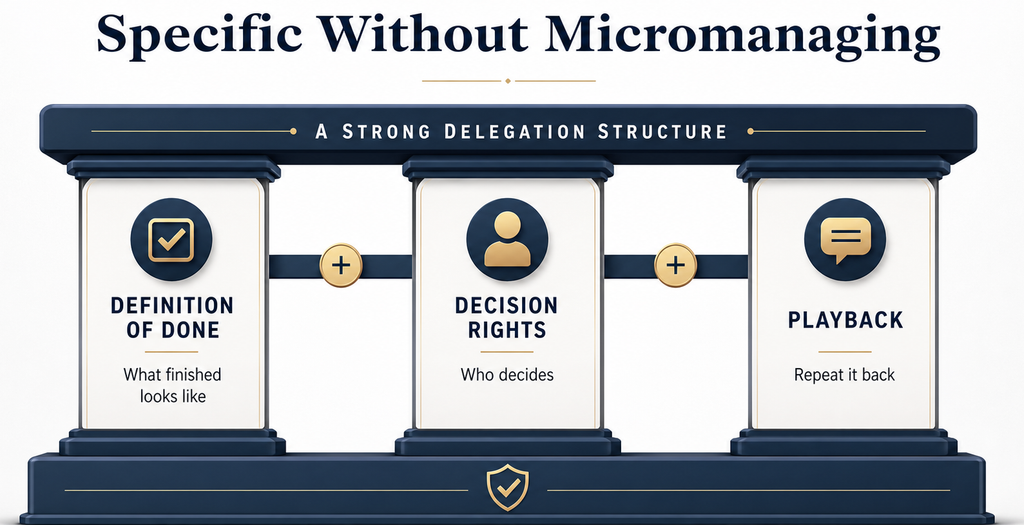
Definition of Done
One sentence, observable, falsifiable. Not “improve the proposal template” but “the proposal template has a pricing section a client can understand without a call, and it fits on two pages.”
If a reasonable stranger couldn’t judge whether it was met, rewrite it. Ninety seconds per task, and it removes most rework.
Try this today: take the three things currently sitting with other people and write a done-sentence for each. Send them. You’ll feel like you’re being obvious. You are not.
Decision Rights
Chaos is often less about what than who decides. Attach one of three labels to every handoff:
- Yours: decide it, tell me after
- Ours: bring me an option and a recommendation
- Mine: don’t move until I’ve said yes
Most owners never name these, then get frustrated when someone either overstepped or waited. They were guessing. Structure is what stops you from being the last stop on every decision.
The Playback
Before anyone starts, they say the task back in their own words. Not “got it” an actual restatement.
Thirty seconds, and it catches the mismatch while it’s still free. It also rebuilds what jargon erodes, because trust is built on knowing what “done” means rather than on being told to ask questions and never feeling safe enough to.
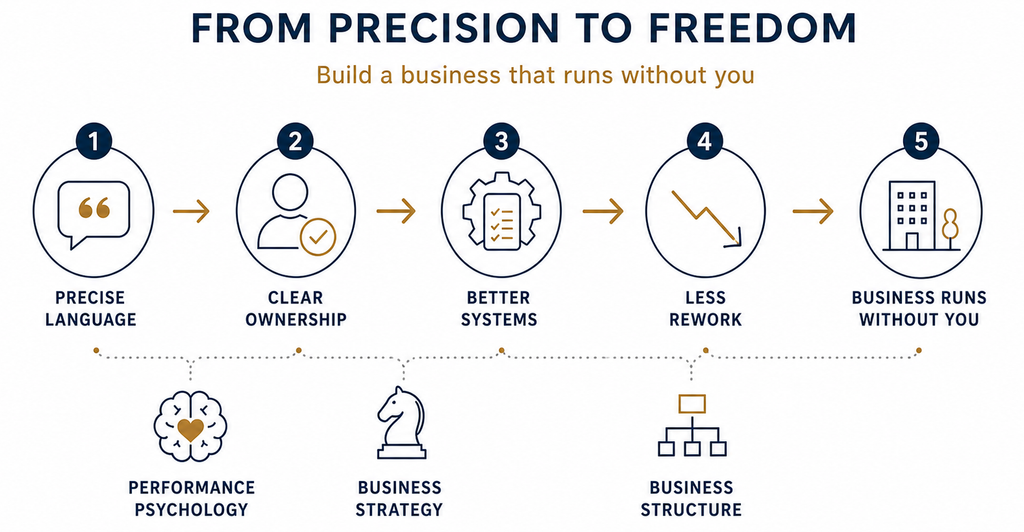
Where Language Precision Fits in the 5 Shifts to Freedom
The 5 Shifts to Freedom is the journey; the 3 Pillars are the mechanism underneath it. Language sits inside the mechanism, which is why vocabulary swaps alone never hold.
Performance Psychology:
Why you won’t define it: over-delivering because disappointing someone feels unbearable, staying necessary because being replaceable feels unsafe. Strategy without this is another unfinished course.
Freedom-First Business Strategy:
Which instructions shouldn’t exist at all. A meaningful share of the tasks you’re briefing badly should be eliminated, not clarified.
Freedom-First Business Structure:
Decision rights, documented standards, and ownership that doesn’t route through you. The plumbing, not the pep talk.
Systems without the psychology just produce beautifully documented processes nobody follows, because you’re still quietly rewriting everything at 11 pm. You need all three together.
David (name changed) was brilliant at the work and completely trapped by it. Everything ran through him, and he was certain that was a standards problem rather than a structural one. He spent thirty days getting his expertise out of his head and into documented process. His assistant took over most of his inbox. He took his first real two-week holiday in five years, and revenue went up while he was gone.
First two-week holiday in five years, and the business grew while he was gone. That’s what happens when your expertise stops living in your head.
James’s own version of this is smaller and more ordinary. He’s home for dinner, phone in another room, on days when the work still got finished without him because the brief was specific enough that nobody needed to reach him at 6pm. That’s the whole payoff. Not a bigger operation. A quieter evening.
Who Should Fix Their Language First and Who Shouldn’t Bother
Fix this first if:
- At least one other person delivers work in your business: an employee, contractor, VA, or fractional
- You’ve hired for a role, been disappointed, and quietly absorbed it back
- Your team asks fewer questions than they used to
- You’re doing final-pass edits on other people’s work most weeks
This isn’t your bottleneck if:
- You’re genuinely solo with no contractors; your issue is capacity, not clarity
- You’re pre-revenue and still defining the offer; you can’t specify what you haven’t decided
- Your team is clear and delivering well and you’re simply working too many hours; that’s a volume and elimination problem, a different conversation
- You’ve already documented standards and decision rights and the work still misses; that’s a hiring fit question, not a language one.
Frequently Asked Questions
Is vague language really the problem, or am I just hiring the wrong people?
It’s worth testing before concluding it’s the people. Write a done-sentence for one task, hand it over, and see what comes back. If the quality jumps immediately, the brief was the issue. If you’ve already documented standards and decision rights and the work still misses, then it’s genuinely a fit question but most owners haven’t run that test before deciding.
Doesn’t being this specific make me a micromanager?
No, those are opposite failures. Micromanaging specifies the method: which font, which order, what time to hit send. Precision specifies the outcome and the boundary, then leaves the method entirely to them. Specific outcomes actually create more autonomy, because the person can make their own choices without wondering whether they’ve guessed wrong.
How long does a proper brief take to write?
Roughly ninety seconds once you’re used to it. That feels expensive compared to firing off “tighten this up,” which takes four. It isn’t. The vague version costs you a rewrite, a difficult conversation, or a task quietly absorbed back onto your plate, routinely an hour or more.
My team never asks clarifying questions, so surely I’m being clear?
Silence is the least reliable signal you have. Research on workplace jargon found that confusion makes people less likely to ask for clarification, particularly younger workers, because asking feels like exposure. Fewer questions can mean people have stopped believing it’s safe to ask. Use the playback instead; have them restate the task in their own words, so clarity is demonstrated rather than assumed.
Where do I start if my whole business runs on vague briefs?
Don’t rewrite everything. Take the three tasks currently sitting with other people, write a done-sentence for each, and attach a decision: yours, ours, or mine. Run that for two weeks before touching anything else. Trying to document the entire operation at once is how this project dies in week one.
Does this apply if it’s just me and one part-time VA?
More than it applies to a large company, actually. Big organisations have review cycles and project managers who catch unclear instructions before they reach a client. You have neither. With a team of one, a single vague brief goes straight through to the customer or straight back onto your own evening.
Conclusion
Your team isn’t confused because they’re junior. They’re confused because the instruction was never finishable and it was never finishable because part of you doesn’t want to hand over the definition of done.
That’s fixable, and faster to fix than hiring someone new. Precision in language is a structural change disguised as a vocabulary change. Get it right and the rework stops, the questions come back, and you stop being the last stop on every decision.
You’re stuck because you’re working sixty hours and a chunk of those hours is you redoing work you never properly described.
The Freedom Blueprint Call: 30 minutes. We’ll find the one thing that’s actually keeping you stuck. No pitch unless you ask for one.