

The mirror neuron close is the sales industry’s name for a simple idea: subtly match a prospect’s posture, pace and language, activate their mirror neurons, and rapport follows. The technique has some real support. The explanation does not. Mirror neurons were identified in macaques, and the claim that a comparable system drives human empathy remains contested.
What the research does support is narrower and more useful. Nonconscious mimicry is a normal feature of human interaction. Subtle mimicry can raise trust, and in one negotiation study, trust was the specific mechanism that turned mimicry into deals. It also carries a hard failure condition: when mimicry is strong enough to be noticed, liking and trust drop.
That failure condition is the entire point. Buyers respond to more than the movements you copy. If your words say confidence while your behaviour communicates urgency, no technique reliably hides the mismatch. Frictionless high-ticket sales calls come from congruence, not choreography.
Key Takeaway:
- The “mirror neuron close” is built around a real phenomenon, but the popular neuroscience explanation is overstated. Mirror neurons were identified in macaques, while evidence that they directly explain human empathy or sales rapport remains weak. [1]
- Subtle mirroring can increase trust in certain negotiations, particularly when success depends on uncovering the buyer’s underlying needs. Research found no meaningful benefit in purely price-based negotiations, showing that mirroring is not a universal closing technique. [1]
- The key risk is overdoing it. Strong or noticeable mimicry can reduce liking and trust, so focus on naturally matching pace, language, and communication style rather than deliberately copying gestures or posture. [1]
- High-ticket sales improve when your behaviour is congruent with your message. Watch for anxiety-driven patterns such as justifying your price, adding unrequested deliverables, discounting before objections, or accepting poor-fit clients. [1]
- Build genuine sales confidence by creating more capacity in the business. A healthier calendar, stronger positioning, and freedom to walk away from bad-fit prospects reduce the urgency that can undermine trust during sales conversations. [1]
Bottom Line: Effective high-ticket sales are less about manipulating mirror neurons and more about building trust through subtle communication, genuine listening, and behavioural congruence. Stop performing rapport and create the confidence, capacity, and positioning that make the sales conversation feel natural.
What Is the “Mirror Neuron Close”?
The mirror neuron close is a rapport technique: you mirror a prospect’s body language, speech rate and vocabulary, and their brain supposedly reads you as safe and similar. Search the term and you’ll find it packaged as the closing move for premium offers.
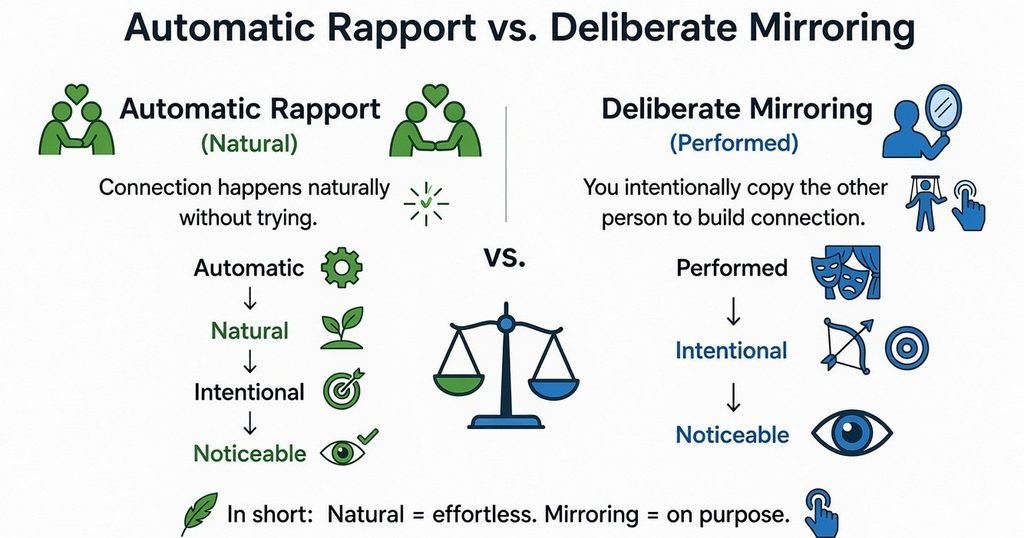
The underlying behaviour is real and well documented. Chartrand and Bargh named it the chameleon effect in 1999: people adopt each other’s postures and mannerisms automatically, with no intent to imitate and usually no awareness that it’s happening.
Notice the word doing the work there: automatically. The phenomenon that made mirroring famous happens on its own. The sales version asks you to do it on purpose, on a call where you want something, and that’s a different activity wearing the same name.
This matters because coaches and consultants are being sold the technique as the fix for calls that don’t convert. It isn’t. If you want the broader picture of how NLP techniques apply to selling, start there but start with the mechanism first.
Do Mirror Neurons Actually Explain Sales Rapport?
Probably not, and the sales industry has been repeating a claim the neuroscience never settled. Mirror neurons were found by recording single cells in macaque monkeys. Those recordings have not been replicated in humans, and the case for a human mirror system rests on indirect evidence from brain imaging and lesion studies rather than direct measurement.
The empathy claim has fared worse. A systematic review and meta-analysis found only weak evidence that mirror neuron activity underlies human empathy at all. Quanta Magazine’s account of the field describes how the idea outran the data: cells with mirroring properties exist, but the sweeping explanations built on top of them collapsed.
So the neurons are not the reason mirroring sometimes helps. Which means every sales course teaching you to “activate their mirror neurons” is teaching a real technique with a fictional mechanism attached.
That should bother you more than it bothers most people. When you don’t know why something works, you can’t tell when it’s about to stop working.
Does Mirroring Actually Increase Your Chances of a Deal?
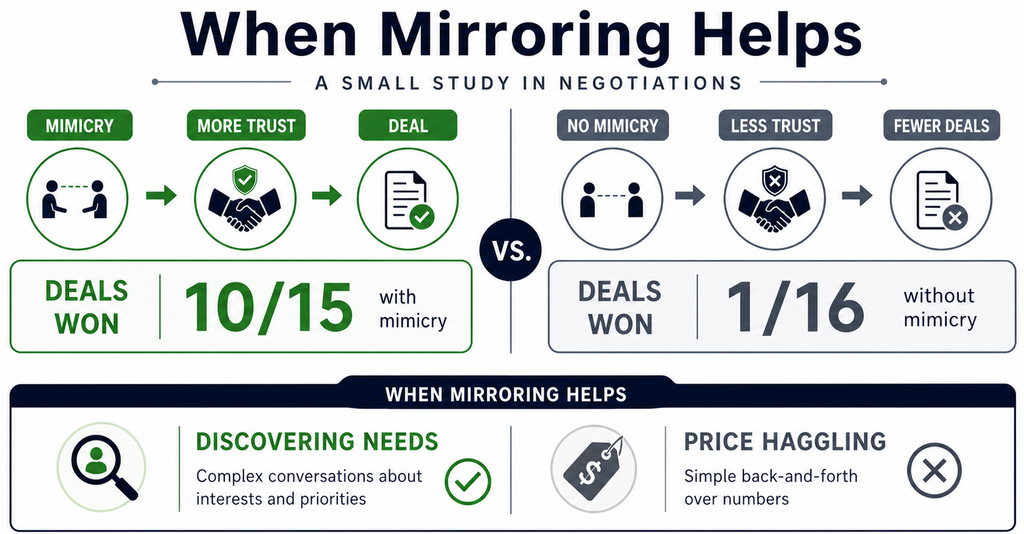
Yes, under specific conditions, and the strongest evidence comes from Maddux, Mullen and Galinsky’s negotiation experiments published in the Journal of Experimental Social Psychology. In their second study, MBA students negotiated a business sale that looked impossible on price alone: the seller’s minimum sat above the buyer’s maximum, so the only route to a deal was uncovering what each side actually needed.
Buyers who were told to mimic reached a workable deal in 10 of 15 pairs. Buyers who weren’t reached reached one in 2 of 16. Trust was the mediating variable: mimicking buyers earned more trust from sellers, and that trust, not the mimicry itself, predicted whether a deal happened.
Two caveats the sales blogs skip. The sample was 31 pairs, which is small. And the same authors ran a single-issue, purely price-based negotiation with a larger group and found no effect at all.
Read that carefully. Mimicry helped when the deal depended on someone revealing what they really wanted. It did nothing when the conversation was just haggling. That’s the difference between negotiation without pressure tactics and a transaction and it tells you exactly what mirroring is for.
Why Does Mirroring Backfire the Moment It’s Noticed?
Because detection reverses the effect. A 2023 set of experiments on the too-much-mimicry effect tested no mimicry, subtle mimicry, and strong mimicry across three studies. Subtly mimicked participants liked their partner more. Strongly mimicked participants liked and trusted them less. And once participants became aware they were being mimicked, liking and trust dropped regardless of which condition they were in.
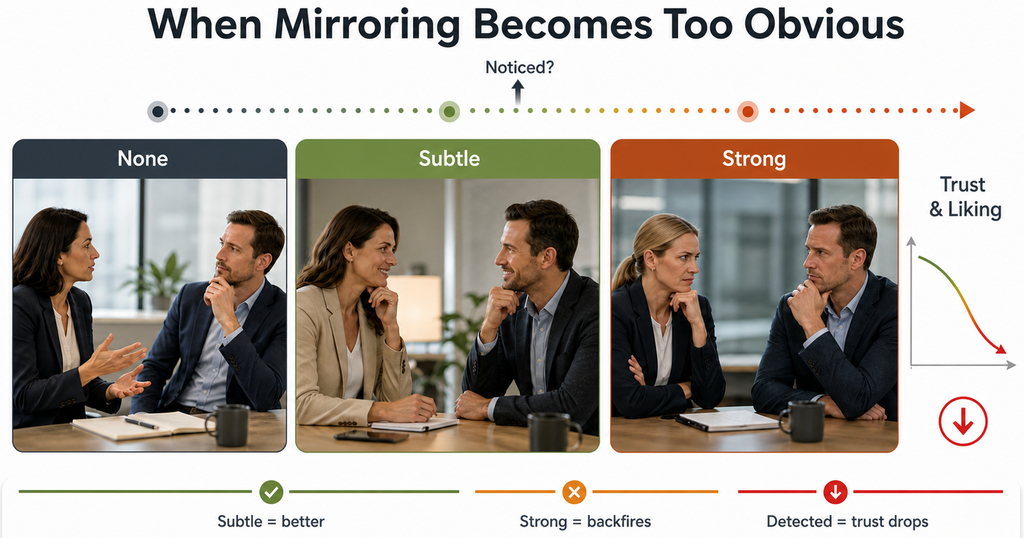
The Maddux instructions said the same thing years earlier. Participants were explicitly warned to keep it subtle enough to go unnoticed, or the technique would fail outright. Across both of their studies, nobody who was mimicked noticed it.
So the technique has a built-in ceiling: it only works while the other person cannot tell you’re doing it. Which makes it a strange thing to build a sales process on. You’re one perceptive prospect away from the whole thing inverting.
And here’s the part that should land. Coaches and consultants sell to people who are unusually good at reading other people. Your buyers are often in the business of noticing. If you’re both leaning forward and copying each other’s arm positions, you haven’t built rapport; you’ve started a staring contest. The alternative isn’t a better technique. It’s what changes when you stop performing and start listening.
What Are Buyers Actually Responding To?
More than the movements you copy. Research on emotional contagion describes a broader process: people spontaneously mimic each other’s facial expressions and vocal patterns, emotional states converge, and heart-rate synchrony between interacting partners can accompany that convergence. A review in Frontiers in Psychology describes emotional contagion producing behavioural, attentional and emotional synchrony across an interaction.
This doesn’t prove that a buyer’s nervous system tracks a seller’s internal state, or that internal state is what decides the sale. Be careful with anyone who tells you it does. What it does establish is that the emotional and physiological dynamics of a conversation are shared property, not something one party controls unilaterally.
That’s enough to explain why performed rapport is fragile. If your words say confidence while your behaviour communicates urgency, the technique cannot reliably hide the mismatch. You are not the only signal in the room, and you are not editing the feed.
Which raises the question nobody in sales training wants to answer: what’s producing the urgency in the first place? It isn’t the script. Understanding how rapport is built through communication patterns helps but only once you’ve dealt with what you’re bringing into the call.
Why Your Calendar Decides Your Close Rate
You’re not closing badly because your technique is weak. You’re closing badly because you’re working sixty hours and you need this one to say yes.

That’s the mechanism. A full week of low-fit clients means no slack, no reserve, and no genuine ability to walk away from a bad match. The prospect doesn’t have to detect a mirrored gesture to sense that something in the conversation is being pushed. Need has a texture, and everyone can feel it.
James spent his fifth business at eighty-hour weeks, calling it success while it hollowed him out. On sales calls, he was not a bad communicator; he was a man with no room. Every call had to convert, so every call carried weight it shouldn’t have. He rebuilt the business in ninety days, down to twenty-five hours, and the calls got easier before the script changed a word.
Working less isn’t the reward you get after you learn to sell better. It’s the thing that makes selling feel different. Now he’s home for dinner with the phone in another room, and he’ll take a thirty-six-minute nap before an afternoon call without a flicker of guilt. A well-rested man asking a direct question is a completely different instrument than a depleted one.
Which Unconscious Patterns Leak on a Sales Call?
Specific, observable ones, not vague self-doubt. Watch for these four in your own recordings.
You quote the price and immediately justify it. The number leaves your mouth and you keep talking. Nobody asked. You filled the silence because the silence felt like rejection.
You add deliverables that weren’t in the offer. Mid-call, you throw in extra sessions or a bonus audit. This is over-delivering as an anxiety response, and it teaches the buyer your scope is negotiable.
You discount before anyone objects. You pre-empt a price objection that hasn’t arrived, which announces that you don’t believe the number either.
You take the client you already know is wrong for you. Because the calendar demands it and the pipeline is thin.
Jennifer (name changed) came in with an extraordinary background and real expertise, badly undercharging. She knew she should raise her prices. She could not make herself do it not once, not for a single new client. The work that changed it was deep reconditioning, not affirmations. Within sixty days she had doubled her prices and more than doubled her revenue.
Doubled her prices in 60 days. The strategy was never her problem. Her programming was.
How Do You Build Congruence Instead of Technique?
By fixing the three things that produce your state on a call, in order. This is the mechanism behind The 5 Shifts to Freedom, the method that rewires the unconscious programming keeping you overworked, then rebuilds your strategy and your business around your life. It runs on three pillars, and they only work together.
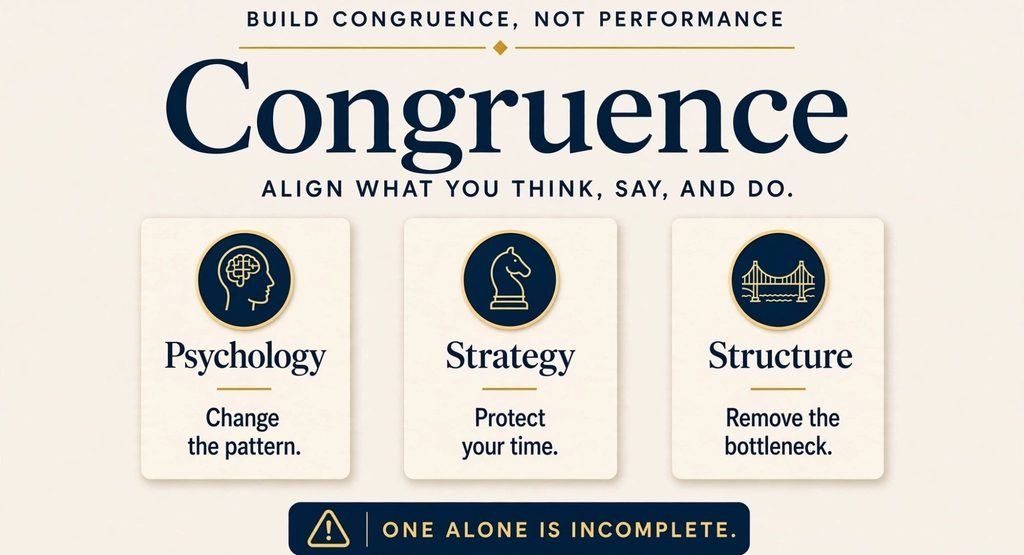
Performance Psychology:
Dismantle the programming that makes you justify prices and over-deliver. This is Shift 4, Mindset Unlock. You cannot perform your way past a belief that your work isn’t worth the number; the belief shows up in your timing, your pace, and what you do with silence.
Freedom-First Business Strategy:
Cut the eighty percent of activity stealing your time so the twenty percent can produce. Fewer, better-fit conversations. A calendar with slack in it is the only place where “this might not be a fit” is a sentence you can actually say.
Freedom-First Business Structure:
Redesign operations so you aren’t the bottleneck. When the business doesn’t collapse without you in every seat, no single call carries the week.
Strategy without psychology is another unfinished course. Psychology without strategy is feel-good fluff that doesn’t pay the bills. Structure without both is a prettier prison.
Then comes Shift 5, Magnetic Authority. Tom (name changed) had twenty years of hard-won experience and was effectively invisible in his market. He rebuilt his positioning around his own story and methodology, specific enough that the right clients recognised themselves immediately and moved from undercharging for long programmes to premium rates for focused engagements.
Twenty years of expertise, invisible. Then positioned properly, and the right clients came to him.
That’s influence that doesn’t require a persona.
Who Should Use This Approach?
Coaches, consultants and wellness practitioners who are already good at the work and already getting calls, but whose calls feel effortful. If you finish a sales conversation tired, or you’ve caught yourself discounting unprompted, the friction is diagnostic.
It also fits established practitioners with teams and families, people whose capacity problem is structural, not motivational.
Who Should Avoid This?
Anyone whose actual problem is lead volume. If you’re having two conversations a month, congruence won’t fix arithmetic. Get the pipeline working first.
Also skip it if you want a script. This approach removes the script rather than improving it, and some people genuinely prefer the choreography. And if you’re at the very start no clients, no proof, no track record you need reps before you need reconditioning.
Technique-Led Mirroring vs. Congruence-Led Selling
Both can produce a sale. They fail in different ways, and only one of them scales past the day you get tired.
| Particulars | Technique-Led Mirroring | Congruence-Led Selling |
|---|---|---|
| What you manage | Posture, pace, vocabulary | Capacity, positioning, programming |
| Evidence base | Subtle mimicry raises trust in specific negotiation conditions | Broader; rests on what you bring rather than what you perform |
| Failure mode | Detection reverses liking and trust | Slow to build; requires structural change |
| What the buyer feels | Smoothness, until they notice | Nothing in particular that’s the point |
| Effort during the call | Continuous monitoring | Minimal |
| Ideal user | Reps in high-volume, transactional cycles | Practitioners selling premium engagements |
Data & Findings
Deal rates under mimicry. In Maddux, Mullen and Galinsky’s integrative negotiation with no price-based solution, 10 of 15 pairs reached a deal when the buyer mimicked, versus 2 of 16 when the buyer did not. Interpersonal trust mediated the effect. Sample: 31 pairs of MBA students.
No effect in purely distributive negotiations. The same paper reports a separate single-issue negotiation with 56 pairs in which mimicry produced no significant impact on outcomes.
Detection threshold. Across both published studies in that paper, no mimicked participant noticed the mimicry.
The too-much-mimicry effect. Across three 2023 experiments, subtle mimicry increased liking relative to none, while strong mimicry reduced both liking and trust relative to subtle. Awareness of being mimicked damaged liking and trust in every condition.
Canadian negotiators mimic more frequently and it only paid off unnoticed. Researchers from the University of Waterloo and McGill coded videotaped Canadian and Chinese negotiations and found Canadian negotiators displayed postural mimicry more frequently, while Chinese negotiators held mirrored postures for longer. Mimicry raised joint gains only where pairs weren’t attending to the indirect meaning of the mimicked behaviour.
Nonverbal norms aren’t universal. Semnani-Azad and Adair at the University of Waterloo found male Canadian negotiators adopted more relaxed postures and displayed more negative emotion than their Chinese counterparts, who occupied more table space. Use of space and negative emotion partly mediated the relationship between culture and both joint gains and satisfaction with the process, a reminder that a mirrored posture doesn’t carry fixed meaning.
Mimicry tested outside the lab. Field experiments in a chain hotel and a chain grocery shop examined whether mimicry’s benefits extend beyond the immediate pair to the business itself, moving the question out of the university and into real customer interactions.
Mirror neuron evidence in humans. Single-cell recordings exist in macaques, not humans. A systematic review found weak support for mirror neuron activity underlying human empathy.
Canadian negotiators and postural mimicry. A study presented at the 2019 Hawaii International Conference on System Sciences coded videotaped negotiations and reported that Canadian negotiators mirrored posture more frequently than their Chinese counterparts, who instead held mirrored postures for longer. The finding that matters most here is the condition attached to the benefit: mimicry produced higher joint gains only where the pairs weren’t reading meaning into the mirrored behaviour itself. This was a conference paper rather than a peer-reviewed journal article, so weight it accordingly.
Frequently Asked Questions
Does mirroring work on video calls?
Partly, and with less to work with. Video strips out most of the postural signal, leaving pace, vocabulary and tone. Emotional contagion does still occur in video conversations; a preregistered study found emotional states transferring between people in dyadic online video calls across anger, happiness and sadness. What travels over video is closer to mood than to posture.
Is mirroring manipulative?
It depends on whether you’re matching something true. Slowing down for someone who speaks slowly is ordinary courtesy. Deliberately copying gestures to extract a yes you wouldn’t otherwise get is a technique with a documented failure condition, and coaching and consulting buyers are unusually good at spotting it. Congruence sidesteps the question entirely, because there’s nothing there to detect.
What’s the difference between mirroring and matching?
Mirroring reflects a behaviour as though across a mirror: they lean right, you lean left. Matching reproduces it directly, or shifts a different channel into alignment, like adopting their tempo or their vocabulary. For premium engagements, matching pace and language tends to be both subtler and more useful than copying posture, because it’s harder to notice and it forces you to actually listen.
How do I know if I’m mirroring too much?
If you’re thinking about it during the call, it’s too much. The research is consistent here: strong mimicry lowers liking and trust relative to subtle mimicry, and a buyer’s awareness of it damages both regardless. A practical test: review a recording and ask whether you could describe what the other person’s hands were doing. If you can, your attention was in the wrong place.
Can I fix my sales calls without changing my schedule?
Up to a point. You can stop justifying the price after you say it, and stop discounting before anyone objects; those are catchable on a recording this week. But if every call has to convert because the calendar has no slack, the pressure keeps regenerating faster than you can manage it. That’s the part technique doesn’t reach.
The Call That Doesn’t Feel Like Selling
The most frictionless high-ticket sales conversation you’ll ever have is one where you’re not managing anything not your posture, not their posture, not the silence after the number.
That state isn’t a skill you perform. It’s a by-product of a business with enough room in it that a single “no” is genuinely fine.
Book a Freedom Blueprint Call. We’ll find the one thing that’s actually keeping you stuck. No pitch unless you ask for one.