
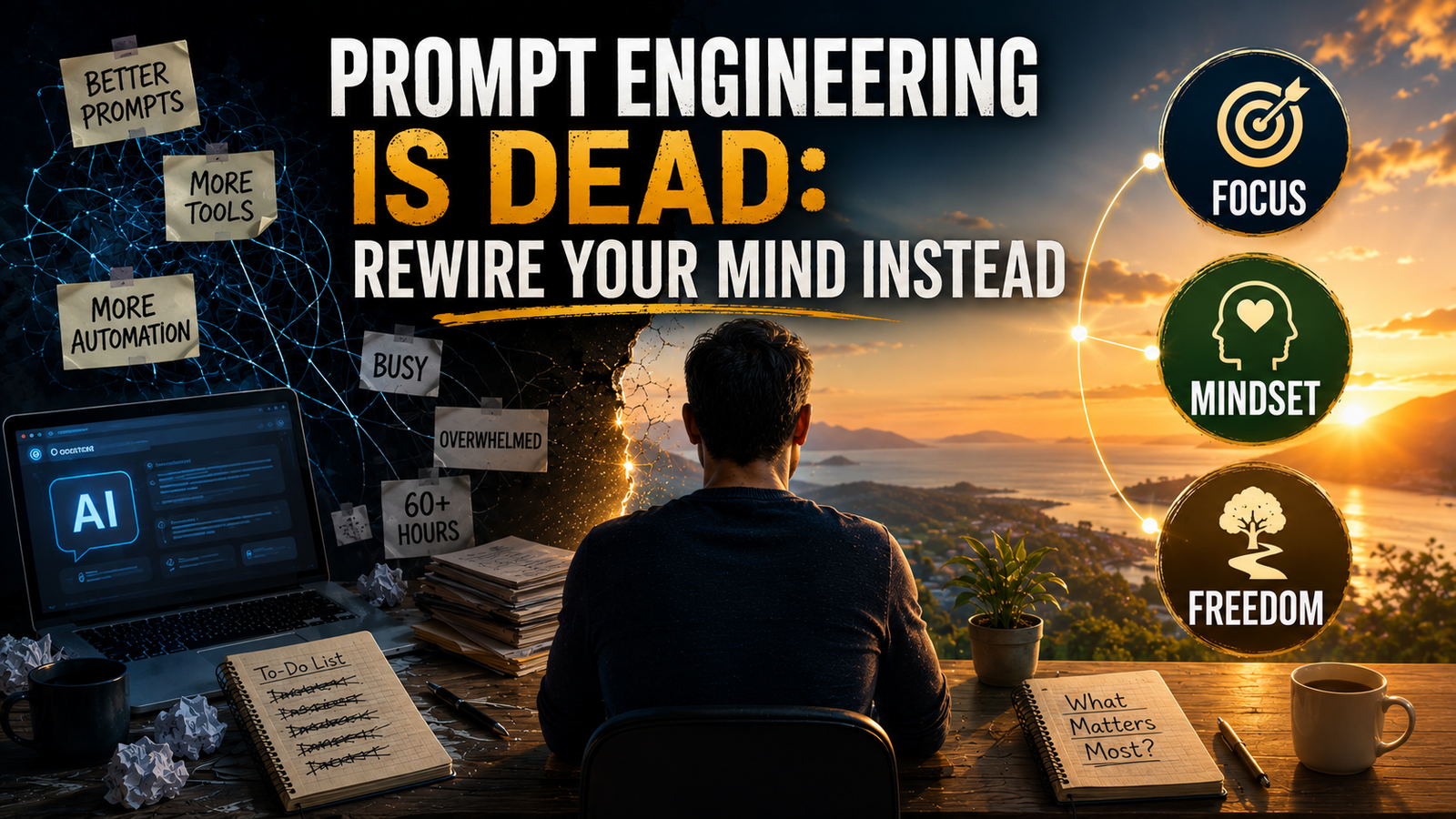
You learned prompting. You bought the tools. You automated the obvious work. And somehow you’re still working sixty hours.
Prompt engineering is no longer the advantage it was in 2023. Models now read plain language well enough that clever phrasing produces diminishing returns, and the skill has been absorbed into broader disciplines: context engineering, workflow design, AI orchestration. That’s the technical story, and it’s accurate.
It also isn’t your problem. The research on AI at work is consistent: it genuinely saves time, and most of that time gets reinvested into more work rather than less. Throughput rises. Hours don’t fall. That happens because the constraint was never the tooling. It’s the pattern underneath it the one that can’t hand off a task without checking the work twice, that undercharges, that over-delivers because disappointing someone feels unbearable, that stays busy to avoid the one move that would actually change things.
AI amplifies the operator before it fixes the operation. Change the pattern first. Then cut the work that shouldn’t exist. Then build the structure. Tools amplify. They don’t decide.
Key Takeaway:
- Prompt engineering is not literally dead, but it is no longer the main competitive advantage. As AI models improve, prompting is increasingly absorbed into broader disciplines such as context engineering, workflow design, and AI orchestration. [1]
- Why AI does not automatically create more free time: AI can genuinely save hours, but that capacity is often redirected into rework, broader responsibilities, or more tasks. The article argues that the real constraint is often the behaviour surrounding the technology, not the technology itself. [1]
- The real bottleneck can be learned behaviour: repeatedly checking delegated work, undercharging, over-delivering, avoiding difficult decisions, or believing that being needed is the same as being valuable. These patterns can survive automation and may simply become faster with AI. [1]
- What to do: Recondition the pattern before adding more tools. Identify the behaviour in real time, reduce the discomfort associated with changing it, and repeatedly practise the new response until delegation, prioritisation, and decision-making become more natural. [1]
- Use the right sequence: clarify your vision, eliminate work that should not exist, document knowledge and build scalable systems, then use AI to accelerate what remains. Efficiency makes existing work faster; freedom comes from deciding which work no longer deserves your time. [1]
Bottom Line: The next AI advantage is not simply writing better prompts; it is knowing what work deserves to exist, what should be delegated, and what should be eliminated. Rewire the behaviour first, then use AI to make the right work faster and build a business that gives you time back.
Is Prompt Engineering Actually Dead?
Not literally but it has stopped being a moat.
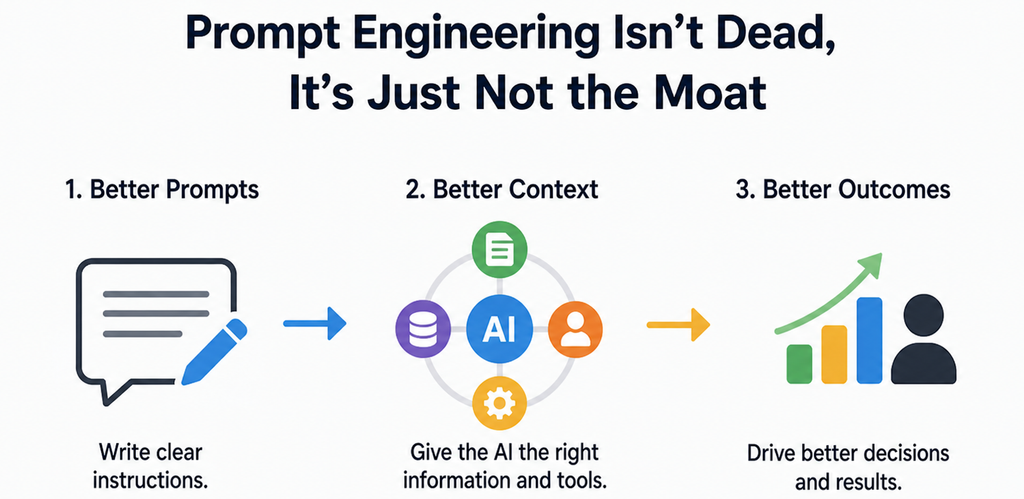
The shift is well documented. Gartner advised AI leaders as far back as mid-2025 to prioritise context-aware architecture over polishing static prompts, and the standalone job title has thinned from its peak. What replaced it is broader: designing the whole information environment a model works inside.
The counter-argument deserves a hearing. Writing in Forbes in June 2026, Dan Fitzpatrick argued the obituaries are premature the underlying skill was always clear thinking and precise expression, and those don’t expire. He’s right. What died wasn’t communication. It was the belief that a magic phrase could substitute for knowing what you actually want.
Which is where this gets interesting, because you’re not building agents for an enterprise. You’re a coach, a consultant, a practitioner. You learned prompting for one reason: you wanted your evenings back.
So let’s ask the question the technical articles skip. Did it work?
Why Better Prompts Didn’t Give You Your Time Back
Because the time came back and then quietly disappeared into more work.
Workday’s January 2026 study of 3,200 business leaders found 85% of employees saving one to seven hours a week with AI. Real gains. But close to 40% of that saving is eaten immediately by rework, fixing, rewriting, and double-checking generic output. And when organisations decided what to do with what survived, the most common answer was to add more work.
Harvard Business Review was blunter in February 2026, in AI Doesn’t Reduce Work It Intensifies It. People worked faster, took on wider scope, and stretched work into more hours of the day. Often without anyone asking them to.
Read that last part again. Without anyone asking them to.
The most rigorous version of this finding comes from Statistics Canada. Linking firm-level survey waves to administrative business data, Li and Liu found AI adopters showing 16.8% higher labour productivity than non-adopters. Controlling for how productive those firms already were before adopting, the premium falls to 10.2%. Control for the capabilities surrounding the tool data practices, training, digital groundwork and it drops to 5.1% and stops being statistically significant. Their conclusion is unusually direct for a government agency: adoption on its own is unlikely to deliver transformative gains.
The tool wasn’t doing the work. What surrounded the tool was.
Nobody instructed you to fill the two hours AI gave back. You did that. And if you’re self-employed, there’s no employer to blame, no manager piling on, no quota rising to meet your new speed. Just you, at 9:40 pm, using a beautifully efficient workflow to do more of the thing you said you wanted less of.
That’s not a tooling failure. That’s a pattern.
The Real Bottleneck Isn’t Your Prompt: It’s Your Programming
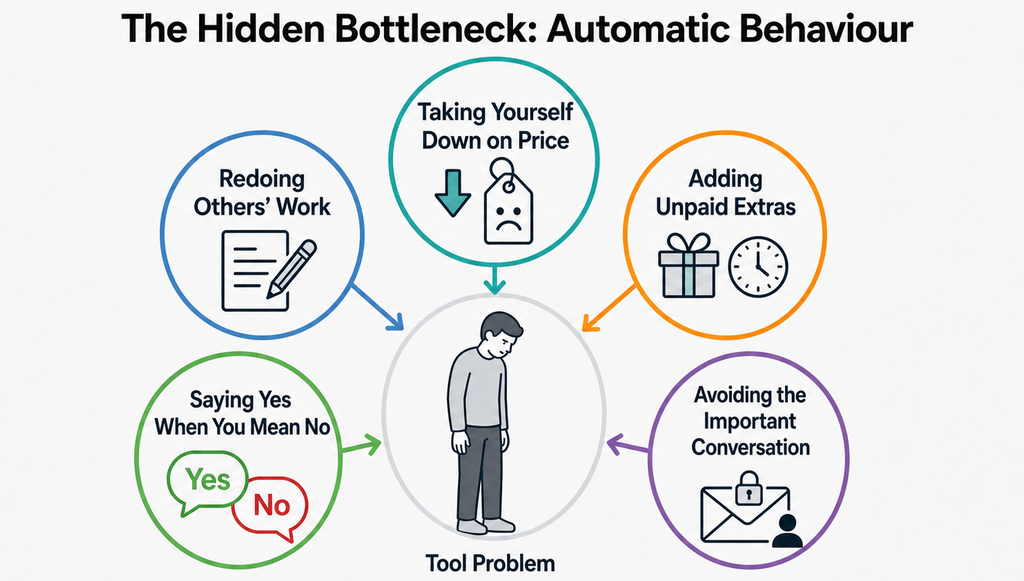
The bottleneck is the belief that being the only one who can do it properly is evidence of your value.
This is the least comfortable section here, so let’s be specific rather than vague. “Unconscious programming” doesn’t mean mystical blockages. It means the automatic decisions you make so fast you don’t experience them as decisions:
- You rewrite the assistant’s work instead of correcting it once and letting the standard rise
- You quote a number, then talk yourself down before the client responds
- You add three unpaid extras because delivering exactly what was agreed feels stingy
- You reorganise your CRM on the afternoon you’d blocked for the sales conversation you’re avoiding
- You say yes while your body is already saying no
None of those are AI problems. All of them survive automation intact.
There’s real evidence for this. A study in Applied Psychology, built on interviews with 30 founders and 14 of the managers they’d hired, found that successful delegation depended on founders recalibrating their psychological ownership of the venture. The researchers tied it explicitly to identity work. Not process. Not systems. Identity.
Which is exactly why the delegation advice you’ve already read didn’t take. You didn’t need a better handoff template. You needed to stop believing that being needed and being valuable are the same thing.
Take David (name changed). Brilliant at the work and completely trapped by it, everything ran through him, because everything always had. He spent thirty days getting his expertise out of his head and onto paper. His assistant took over most of his inbox. He took his first real two-week holiday in five years, and revenue went up while he was gone.
First two-week holiday in five years, and the business grew while he was gone. That’s what happens when your expertise stops living in your head.
Notice what AI could not have done for him. You can’t prompt a model to extract knowledge you’ve never articulated. The documentation wasn’t a technical task. It was David deciding that being replaceable in the delivery isn’t the same as being unnecessary in the business.
I’d like to say I saw this early. I didn’t. By my fifth business, I was working eighty-hour weeks on anxiety medication and calling it success and if today’s tools had existed then, I’d have bought every one of them. Not because I needed them. Because installing something new felt like progress, and the move I was actually avoiding never did. The self-programming that keeps people stuck is rarely dramatic. It just looks like being extremely busy with the wrong things.
Then my niece asked why I don’t visit anymore. That one I couldn’t automate my way past.
What “Rewire Your Mind” Actually Means (It Isn’t Affirmations)
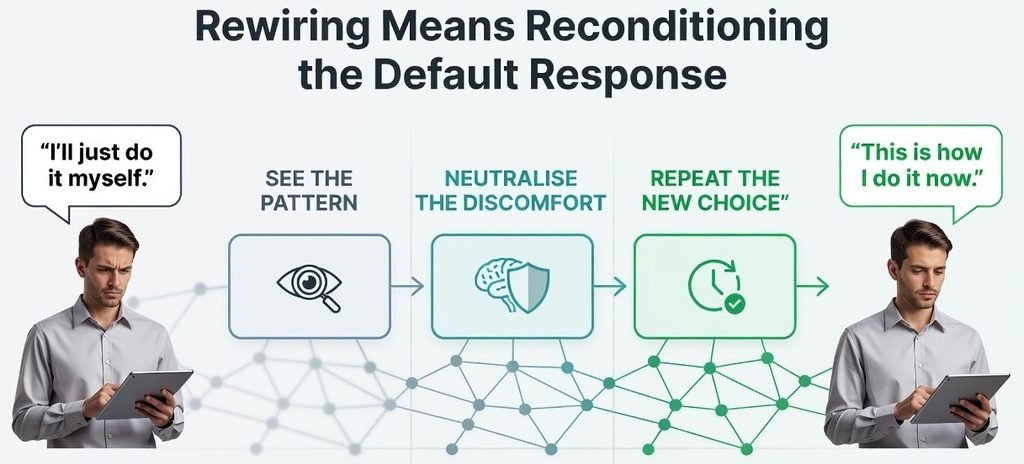
It means changing learned behavioural patterns until the better choice becomes the automatic one.
Let’s be precise, because this phrase gets abused. Nobody rewires their brain in a weekend, and anyone promising that is selling you something. What actually happens is more modest and more useful: you recondition automatic responses, the default that fires before you’ve consciously chosen anything.
Right now your default when a task feels important is I’ll just do it myself. That was learned, and it was probably adaptive once early on; you genuinely were the only one who could. It’s now the most expensive habit in your business, and it runs faster than your conscious reasoning does.
Changing it takes three things, in order:
- See the pattern in real time, not in hindsight, but in the moment your hand moves to redo someone’s work. Most people can’t identify the beliefs running underneath their behaviour because it feels like a preference, not a program.
- Neutralise the discomfort attached to the alternative. Handing something off doesn’t feel risky because it is risky. It feels risky because your nervous system flagged it that way years ago. That’s technique, not positive thinking.
- Repeat the new choice until it stops costing effort. This is the part people skip and it’s why real change takes longer than a weekend workshop, and why the workshop high always faded by Wednesday.
No mysticism. Recondition the automatic response, then let repetition make it your new normal.
Why AI Makes an Overworked Business Worse, Not Better
Because it removes the friction that used to stop you.
The honest version isn’t anti-AI: AI isn’t the enemy of freedom. Using AI without changing the behaviour that created the workload is. The tools are extraordinary, which is precisely the problem when the pattern underneath them is unexamined.
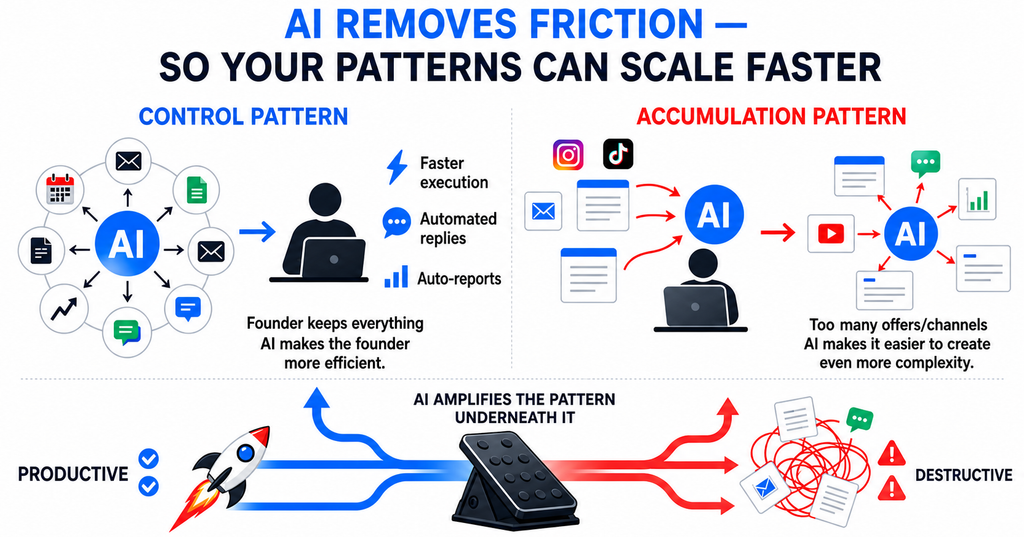
Consider what friction used to do for you. Launching a second offer took weeks, so you thought about it first. Building a full email sequence was painful, so you only did it for things that mattered. Now it takes an afternoon. If your pattern is accumulation more offers, more channels, more streams- all in the name of stability, AI just removed the last thing keeping that impulse in check.
Take Nik (name changed). She’d built seven income streams chasing security and was exhausted and barely moving. She eliminated five of them. Within 90 days, revenue had nearly tripled, with fewer hours, fewer clients, and more impact.
Seven revenue streams down to two, and revenue nearly tripled. Less complexity, more money. Exactly how this is supposed to work.
David’s problem was control. Nik’s was accumulation. Same root, opposite symptoms, and AI removes neither. It makes both more sophisticated. David gets a more efficient way to stay the bottleneck. Nik gets to run eleven streams instead of seven.
There’s a quality cost too. Harvard Business Review’s research on “workslop” polished-looking output with nothing underneath it found that roughly 40% of surveyed desk workers had received some in a single month, each instance costing nearly two hours to sort out. Volume went up. Value didn’t.
Efficiency is doing the same work faster. Freedom is deciding that some of the work doesn’t need to be done at all.
Only one of those gives you a Tuesday afternoon back.
And that’s the real test: not whether your outputs got faster, but whether your life changed shape. I take a 36-minute nap most days now, without negotiating with myself about it. I’m home for dinner with my phone in another room. Martial arts twice a week, in the diary like a client call, because it is one. None of that came from a tool. It came from deciding what deserved my attention, then building the structure and systems that protected the decision.
The 5 Shifts to Freedom: Rewiring Before Tooling
Here’s the sequence I use to address this problem, and the order is the whole point.
The 5 Shifts to Freedom is the journey. It works because of the mechanism underneath the 3 Pillars. Performance Psychology deals with the programming driving the behaviour. Freedom-First Business Strategy cuts the 80% of activity stealing your time so the 20% can produce. Freedom-First Business Structure redesigns operations, so you stop being the bottleneck.
You need all three. Strategy without psychology is another unfinished course. Psychology without strategy is a nice feeling that doesn’t pay anyone. Structure without both is a prettier prison. Most AI adoption is structure alone, bolted onto a pattern nobody looked at.
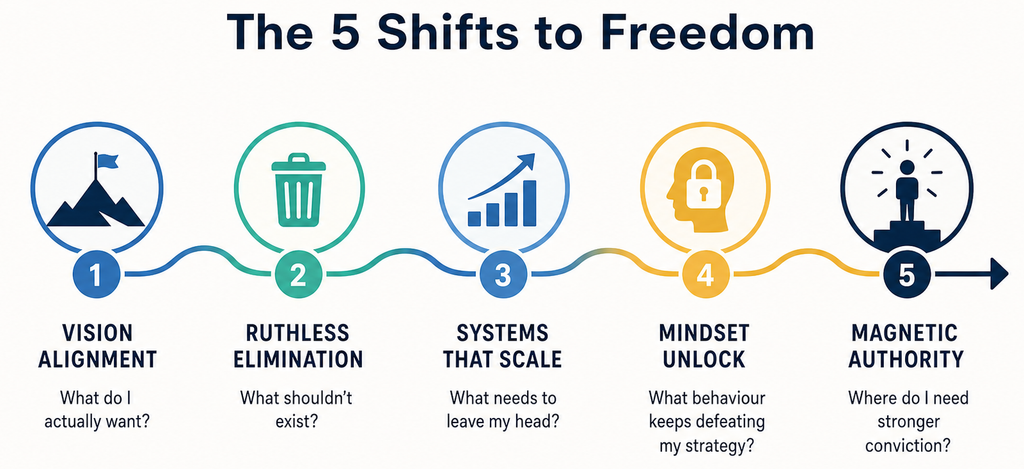
Vision Alignment:
What do you actually want this business to give you? Not what you should want. What you’d choose if nobody were watching.
Ruthless Elimination:
What shouldn’t exist at all, before you automate a single thing? Automating work that should have been deleted is the most expensive mistake in this whole category.
Systems That Scale:
What knowledge needs to leave your head? This is where AI earns its place, and where technology’s actual role in growth becomes obvious an accelerant on a decision you’ve already made, never the decision itself.
Mindset Unlock:
What behaviour keeps defeating the strategy you know is right? Name it concretely. “I redo my contractor’s work” is workable. “I have limiting beliefs” is not.
Magnetic Authority:
Where do you need stronger conviction in your positioning and pricing? Charging properly is a psychology problem wearing a strategy costume.
Notice AI appears once, at Step 3. That’s not snobbery; it’s sequencing.
Prompt Engineering vs. Context Engineering vs. Rewiring the Operator
These three solve genuinely different problems, and confusing them is why capable people stay stuck. Prompt engineering improves an answer. Context engineering improves a system’s performance. Neither can tell you that the task shouldn’t be on your list.
| Particular | Prompt Engineering | Context Engineering | Rewiring the Operator |
|---|---|---|---|
| Optimises | Instructions | Information + workflow | Behaviour + decisions |
| Main question | How do I ask better? | What context does the model need? | Why am I still doing this? |
| Fixes | Output quality | AI performance | Human bottlenecks |
| Cannot fix | Business priorities | Founder behaviour | Technical implementation |
| Best use | Specific AI tasks | Complex AI workflows | Sustainable freedom |
You’ll likely want all three. Just not in that order.
Who Should Use This Approach?
This is for you if:
- You’re a coach, consultant, or wellness practitioner with proven results and a business that has quietly taken over your life
- You’re working 50–60+ hours and the number hasn’t moved despite better tools
- You already own the AI stack and have done the prompting. Efficiency is not your missing ingredient
- You’ve hired help and found yourself checking, redoing, or hovering
- You suspect the thing in the way is you, and you’d rather know than keep guessing.
Who Should Avoid It?
Be honest with yourself here:
- You’re pre-revenue and genuinely need volume. Early on, doing everything yourself is correct. Elimination comes after you have something to eliminate.
- You want a technical AI career. Context engineering and orchestration are exactly where your attention belongs. This article isn’t for you.
- You want a tactic that doesn’t touch the pattern. This will frustrate you. If the answer you want is a better tool, plenty of people are selling one.
- You’re not willing to be uncomfortable for a few weeks. Reconditioning an automatic response isn’t difficult, but it is unfamiliar and unfamiliar feels bad before it feels normal.
Data & Findings
What the 2026 research actually shows about AI and workload:
| Finding | Source |
|---|---|
| AI adopters showed 16.8% higher labour productivity; 10.2% after controlling for pre-adoption productivity; 5.1% and statistically insignificant once complementary capabilities were controlled | Statistics Canada, April 2026; Li & Liu, linked firm-level data |
| 85% save 1–7 hours a week with AI; ~40% of that gain is lost to rework, and 32% of organisations respond by increasing workload | Workday, January 2026: 3,200 leaders |
| Employees with AI tools worked faster, widened their scope, and extended work into more hours, often unprompted | Harvard Business Review, February 2026 |
| Time saved is routinely reinvested into more work rather than less | Fortune, April 2026 |
| ~40% of desk workers received low-substance AI output in one month, at nearly two hours per incident to resolve | HBR with BetterUp Labs and Stanford: 1,150+ workers |
| Delegation succeeded only when founders recalibrated psychological ownership identity work, not process | Applied Psychology, Zhu et al. 30 founders, 14 managers |
| 84% of owners sacrificed health, sleep, or relationships; only 22.5% described their mental health as thriving | Patriot Software, 2026 1,000 owners |
One widely quoted figure needs a caveat. MIT’s NANDA initiative reported that roughly 95% of enterprise AI pilots showed no measurable profit-and-loss impact, a number that went viral and has since been challenged on methodology, including its narrow six-month definition of success. Preliminary, not peer-reviewed: worth knowing, not worth building a worldview on.
The Canadian data is the more useful anchor, and it says the same thing more carefully. Focus and groundwork beat firepower.
Frequently Asked Questions
Is prompt engineering still worth learning in 2026?
Yes, at a basic level but treat it as literacy, not leverage. A few hours gets you most of the available benefit. The standalone role has thinned as models improved and the skill folded into context engineering and workflow design. Learn enough to work efficiently, then stop optimising there. The returns flatten fast.
What replaced prompt engineering?
Context engineering and AI orchestration. Instead of perfecting a single instruction, the work is now designing the whole information environment a model operates inside: what data it can reach, what tools it can call, how the workflow is sequenced. It’s a systems discipline rather than a phrasing one.
Why isn’t AI saving me any time?
Because the time is being saved and then reabsorbed, research across 2026 consistently shows hours genuinely returned, then spent on rework, wider scope, or more clients. Unless you decide in advance what the reclaimed hours are for and protect them, existing behaviour fills the gap automatically.
Can AI fix a delegation problem?
No. AI can reduce the volume of work, but delegation fails for reasons that sit upstream of workload. Peer-reviewed research on founders found successful handover depended on changing how they held ownership of the business. If you redo your assistant’s work now, you’ll redo the model’s output too.
How long does it take to change these patterns?
Weeks for the first shift, months for it to become automatic. Seeing a pattern in real time can happen in a single conversation. Making the new response the default requires repetition under mild discomfort. Anyone promising permanent change in a weekend is describing a feeling, not a result.
Should I stop using AI in my business?
No. The argument here isn’t anti-AI; it’s about sequence. Decide what your business is for, delete what shouldn’t exist, then automate what remains. Used in that order, AI is genuinely powerful. Used before it, it makes the existing pattern faster and harder to see.
The Real Question
Prompt engineering isn’t really the thing that died. The fantasy that a better tool will automatically produce a better business that’s what needs to go.
You have more capability at your desk right now than a ten-person agency had five years ago. If capability were the constraint, you’d be finished by two. You’re not and that’s information, not failure. It means the work in front of you isn’t technical.
The next real advantage isn’t knowing how to talk to AI. It’s knowing when not to, which tasks deserve your attention at all, which ones are genuinely yours, and which ones you keep because letting go still feels like losing something.
Ready to Find What’s Actually in the Way?
Book a Freedom Blueprint Call. We’ll find the one thing that’s actually keeping you stuck. No pitch unless you ask for one.
You didn’t build this to spend your evenings writing better prompts. Let’s fix what’s actually broken.