The science behind NLP begins with your brain’s ability to change throughout life, thanks to neuroplasticity, its ability to build and strengthen new neural pathways. Some emotional and behavioral shifts can happen surprisingly quickly through a process called memory reconsolidation, where an activated emotional memory becomes briefly open to revision. Neuro-Linguistic Programming (NLP) includes techniques that many practitioners believe can engage these natural learning processes.
Here’s the honest part: while the neuroscience of brain change is well established, research on NLP as a complete therapeutic method remains mixed compared with approaches like Cognitive Behavioral Therapy. The takeaway is simple. Rapid insight is possible, but lasting transformation still asks for repetition, practice, and reinforcement. Once you understand how your brain actually changes, you can use tools like NLP far more effectively, with realistic expectations and none of the hype.
Key Takeaway:
- Neuro-Linguistic Programming (NLP) draws on concepts related to communication, learning, and behavior change. While some NLP techniques overlap with established psychological principles such as visualization, goal setting, and cognitive reframing, many of NLP’s original theoretical claims have limited or mixed scientific support. [1]
- Research on neuroplasticity the brain’s ability to form and strengthen new neural pathways supports the idea that repeated thoughts, behaviors, and learning experiences can contribute to lasting change. Many coaches use NLP techniques as practical tools for developing new habits, improving communication, and reinforcing positive behavioral patterns. [1]
- The effectiveness of NLP often depends on the specific technique, the practitioner’s skill, and the individual’s goals. It is best viewed as a coaching and personal development methodology rather than an evidence-based clinical treatment for mental health disorders. [2]
- If you’re considering NLP training or coaching, choose a reputable practitioner with recognized credentials and realistic claims. NLP can complement personal growth and performance development but should not replace licensed medical or psychological care when clinical treatment is appropriate. [2]
Bottom Line: The science behind NLP is nuanced. Although many of its core theoretical claims remain debated, several techniques align with well-established psychological concepts used in coaching and behavior change. When practiced ethically by qualified professionals, NLP can serve as a practical framework for improving communication, mindset, and personal performance, but it should not be presented as a scientifically proven therapy for mental health conditions.
Why People Think NLP Works
NLP became popular for a good reason. People wanted a faster, more practical path to change than years of talk therapy, and NLP promised exactly that: a toolkit for “rewiring the brain” to shift confidence, communication, and old habits.
That promise is also where the controversy starts. The phrase “rewire your brain” gets used so loosely that it now sounds like marketing rather than mechanism. Some fans treat NLP as proven neuroscience. Some critics dismiss the whole thing as pseudoscience. Both are missing the real picture.
The biggest misconception is treating NLP and brain science as the same thing. They aren’t. NLP is a collection of communication and change techniques. The science lives in how your brain actually learns and updates itself. Separate those two ideas and everything gets clearer.
Key takeaway: NLP isn’t the science. It’s a set of techniques. The science is in how your brain learns.
How Your Brain Actually Rewires Itself
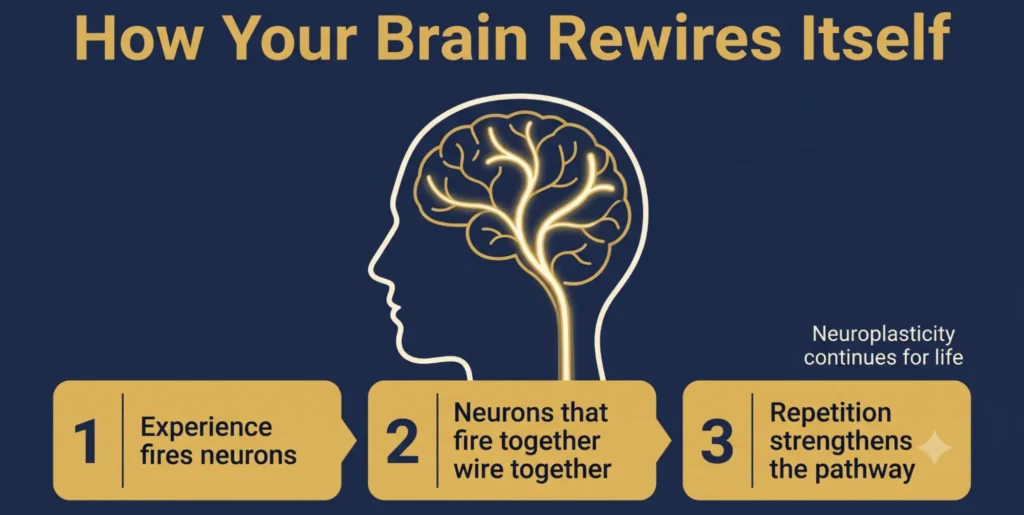
For a long time, scientists assumed the adult brain was fixed. That view is gone. Research now shows that plasticity continues across the whole lifespan, supporting learning, memory, and recovery well into adulthood. Your brain is not a finished machine. It’s a living system that reshapes itself with experience.
The core idea is neuroplasticity: every thought, action, and repeated experience subtly adjusts your neural wiring. When neurons fire together often, the connection between them strengthens, a principle usually summarized as cells that fire together wire together. This is why repetition matters so much. The pathway you use most becomes the pathway your brain reaches for first.
That’s also why a limiting belief feels so automatic. You’ve run it thousands of times, so it fires without asking permission. The good news is that the same rule works in your favor. Deliberate, repeated practice of a new response builds a competing pathway, and over time the new one wins. If you want the practical side of this, our guide to NLP techniques for personal development walks through daily reps that reinforce healthier patterns.
In short: Neuroplasticity is real and lifelong. New pathways grow through repetition. That’s the foundation everything else stands on.
Why Change Can Sometimes Happen Surprisingly Fast
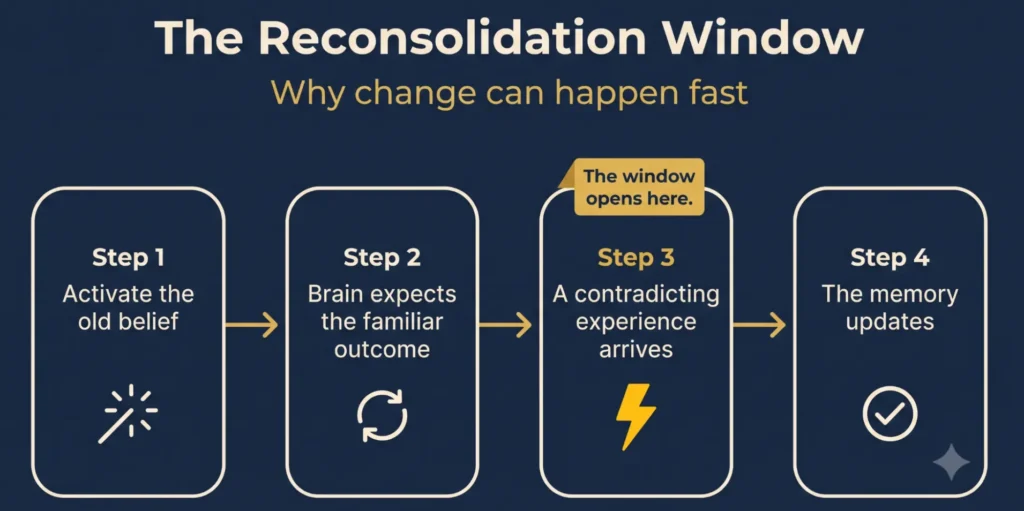
If rewiring depends on repetition, why do people sometimes report a shift in a single session? The answer is a documented process called memory reconsolidation.
Here’s how it works, step by step:
- An old belief or emotional memory becomes active. You feel it, not just think about it.
- Your brain expects the familiar outcome that memory always predicts.
- A new, contradicting experience arrives instead, something that clearly violates that expectation.
- During a brief window, the memory becomes editable and updates around the new experience.
Researchers describe this as the mechanism behind change across many different therapies: activate the old learning, introduce an experience that genuinely contradicts it, then let the memory restabilize in its new form. It’s the same three-part sequence whether the label is CBT, exposure work, or coaching. A growing body of brain science supports the idea that emotional memories update when new emotional experiences are folded into them.
Neuroscience is also uncovering faster forms of learning. A newly described mechanism called behavioral timescale synaptic plasticity suggests the brain can encode a lesson from a single meaningful experience, not only through slow repetition. Treat this as emerging science about how brains learn, not as proof of any one method. It helps explain why a single powerful experience can leave a lasting mark.
What Does the Science Behind NLP Actually Say?
This is where honesty earns trust, so let’s be precise about what’s settled and what isn’t.
What Scientists Agree On
- Neuroplasticity is real and continues in adulthood.
- Memory reconsolidation is a genuine mechanism for updating emotional memories.
- Beliefs shape behavior, attention, and performance.
- Mental rehearsal and visualization can improve real-world results.
What Scientists Still Debate
- The quality and size of NLP research studies.
- How effective NLP is as a standalone clinical treatment.
- How it compares head to head with established therapies.
- Whether larger, better-designed trials would confirm the claims.
The record is genuinely mixed. A systematic review in the British Journal of General Practice found little evidence that NLP improves health outcomes, while noting that this reflects the limited quantity and quality of the research rather than proof that nothing works. Summaries for general readers similarly point out that NLP hasn’t been held to the same rigor as CBT. On the other side, a meta-analysis of NLP psychotherapy reported a moderate positive effect for people with social and psychological concerns, while calling for more study.
So here’s the balanced verdict. The brain mechanisms are scientifically established. NLP may help some people access those mechanisms in a practical, structured way. The current evidence does not show NLP reliably outperforming established psychological therapies. If you want a fuller side-by-side, our breakdown of NLP compared with traditional therapy goes deeper.
NLP vs CBT vs ACT vs Coaching vs Habit Training
Different tools do different jobs. Here’s how the main approaches to changing your patterns compare.
| Approach | Evidence Strength | Best For | Time to Initial Shift | Long-Term Success | Limitations |
| NLP | Mixed, developing | Confidence, communication, limiting beliefs | Fast, often 1 to 3 sessions | Depends on reinforcement | Uneven research base |
| CBT | Strong, well-studied | Anxiety, depression, thought patterns | Moderate, a few weeks | High with practice | Requires structure and effort |
| ACT | Strong and growing | Acceptance, values, chronic stress | Moderate | Good with continued use | Less focused on symptom removal |
| Coaching | Practical, varies by coach | Goals, performance, accountability | Fast for clarity | Strong with follow-through | Not clinical treatment |
| Habit Training | Solid behavioral science | Daily routines and automaticity | Slow, builds over weeks | Very durable once formed | Slower payoff, needs consistency |
The honest read: for clinical conditions, evidence-based therapy leads. For confidence, communication, and stuck beliefs in an otherwise healthy life, practical tools like NLP and coaching can move quickly, especially when paired with real repetition afterward.
How Fast Can You Really Rewire Your Brain?
The word “fast” causes most of the confusion, so let’s split it into two speeds.
Speed One Is Insight
A belief can loosen in minutes or hours when a contradicting experience opens that reconsolidation window. This is the breakthrough people talk about, and it’s real.
Speed Two Is Automatic Behavior
Turning a new response into second nature takes longer, because your brain needs repetition to strengthen the pathway. Research on habit formation found it took an average of about 66 days for a new behavior to feel automatic, with a wide range from roughly 18 to 254 days depending on the person and the behavior. There’s no single fixed timeline for rewiring, which is exactly why expectation setting matters.
Hold both truths at once and you’ll stay motivated instead of discouraged. The shift can start fast. The staying power is built. If you want the deeper reasoning here, we cover why lasting change takes time in its own guide.
The RECODE Framework
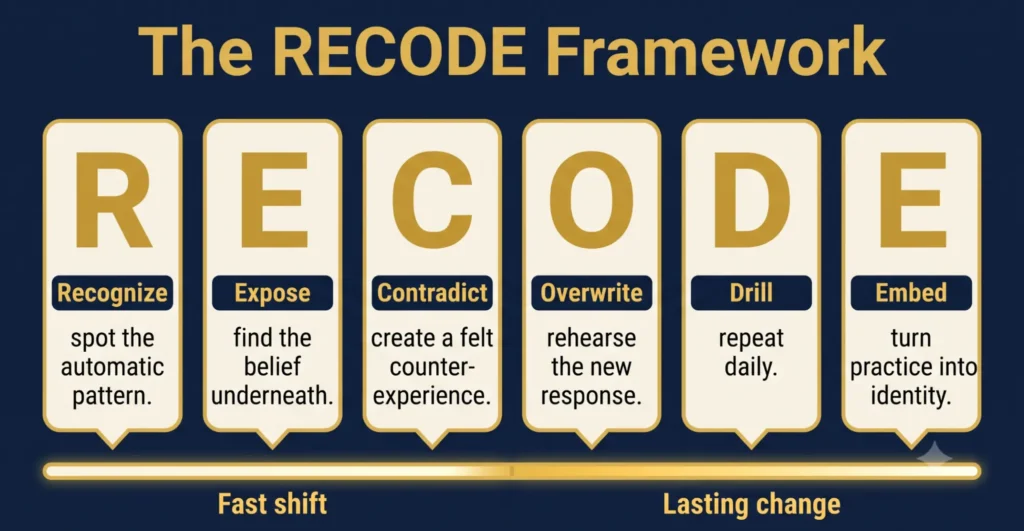
After more than 20 years of NLP training and coaching, James R. Elliot developed RECODE to map the practical steps onto what the brain science actually shows. It’s a structured way to break through limiting beliefs and make the new pattern stick.
Recognize
Notice the automatic pattern as it runs. Awareness is the entry point, because you can’t change a response you can’t see.
Expose
Find the belief underneath the reaction. Ask what this pattern assumes to be true about you or the situation.
Contradict
Create a vivid, felt experience that clearly violates the old prediction. This is the mismatch that opens the reconsolidation window, so make it real, not just a nice idea.
Overwrite
Rehearse the new response while your brain is receptive. Repetition in this moment is where the update takes hold.
Drill
Practice consistently in daily life. This is where neuroplasticity does its quiet work, strengthening the pathway with each rep.
Embed
Keep going until the new response stops feeling like effort and starts feeling like you. That’s the point where behavior becomes identity.
The first three steps often move quickly. The last three are the patient part, and they’re what separate a temporary high from durable change. For more tools that support this process, see our guide to overcoming limiting beliefs with NLP.
Data & Findings
The honest picture combines what independent research shows with what we track in our own coaching work. Here are the key findings, each tied to its source.
| Finding | What the data shows | Source |
| Neuroplasticity is lifelong | The adult brain keeps forming and reorganizing neural connections across the whole lifespan, not only in childhood | ScienceDirect, 2025 |
| New behaviors take time to automate | Across 96 participants, a new behavior took an average of about 66 days to feel automatic, with a range of 18 to 254 days | University of Surrey |
| Emotional memories can update | Memory reconsolidation lets a reactivated emotional memory become briefly editable, the documented mechanism behind quick shifts | Clinical Social Work Journal |
| NLP therapy shows a moderate effect | A meta-analysis of 12 studies reported an overall standardized effect near 0.54 (confidence interval 0.20 to 0.88) for social and psychological concerns | Evidence-based NLP Psychotherapy meta-analysis |
| NLP health evidence is limited | A systematic review of 10 experimental studies, 5 of them randomized trials, found little evidence that NLP improves health outcomes, reflecting a small research base | British Journal of General Practice |
Read together, the data supports the article’s core claim: the brain’s capacity to change is well established, some emotional shifts can happen fast, durable change is built over weeks, and NLP as a method carries a modest and mixed evidence base rather than settled proof.
Alongside the published research, the Unleash Your Power 2026 Client Performance Report tracks outcomes across coaching clients working on confidence, communication, and limiting beliefs. Within that group, most reported a first noticeable shift inside the first one to three sessions, while the new responses tended to feel automatic over roughly two to three months of consistent practice. Those ranges line up with the two-speed pattern the science predicts, not with overnight miracles.
Mike L. came to James weighed down by self-doubt and near-constant mental noise, second-guessing himself in ways that drained his confidence at work. Through NLP work that quieted the overthinking, the Contradict and Overwrite steps in action, his anxiety eased and he started speaking to people with genuine confidence. His experience tracks the two-speed pattern: the mental noise dropped noticeably early, and the steadier confidence built as he kept practicing.
Darren G. felt stuck and blocked despite a well-paying job, unable to reach the promotions and momentum he wanted. James helped him surface the goal blocks and limiting beliefs quietly running the show, and once those were challenged and reinforced with new behavior, his thinking and his results began to shift. His case shows the framework’s back half at work, where repeated reinforcement turned a fresh insight into a lasting change in how he showed up.
Who Can Benefit Most from This Approach

This work fits best when you’re fundamentally well and want to grow. It tends to help:
- Professionals ready to communicate with more confidence.
- Entrepreneurs and leaders working through self-doubt or goal blocks.
- Anyone focused on performance, presence, and momentum.
- People wanting to break through limiting beliefs and take decisive action.
If that sounds like you, structured training accelerates the process. Our NLP training in Canada gives you the tools and the reps in one place.
When NLP Isn’t the Right Tool
Clear boundaries matter, so here’s the honest line. NLP and coaching are not a substitute for medical or psychological treatment. If you’re dealing with severe trauma, major depression, PTSD, or psychosis, licensed professional care comes first.
Think of it this way. NLP and coaching can complement healthcare for growth, confidence, and performance. They do not replace it. A good coach will tell you when something belongs in the hands of a licensed clinician, and will support the work rather than compete with it.
Common Myths About Brain Rewiring
| Myth | Reality |
| NLP instantly rewires your brain | Change can begin quickly, but lasting change needs repetition |
| Neuroplasticity stops after childhood | Adults stay highly capable of change throughout life |
| One breakthrough changes everything | New pathways strengthen through continued practice |
| NLP is fully scientifically proven | The evidence for NLP as a method remains mixed |
Frequently Asked Questions
Is NLP scientifically proven?
Not in the way established therapies are. The brain mechanisms it aims to use are well supported, but NLP as a complete method has a mixed research base and less rigorous evidence than CBT.
Can adults rewire their brains?
Yes. Neuroplasticity continues throughout life, so adults can form and strengthen new neural pathways with focused, repeated practice.
How long does brain rewiring take?
It depends on the change. An insight can shift in minutes, while a new behavior often takes weeks to feel automatic, averaging around two months with a wide individual range.
Can limiting beliefs really change?
Yes. Beliefs are learned patterns, and memory reconsolidation shows how an activated belief can update when it meets a strong contradicting experience.
Is memory reconsolidation real?
Yes. It’s a recognized process in neuroscience where a reactivated emotional memory becomes briefly editable before it restabilizes.
Can NLP replace therapy?
No. For clinical conditions, licensed treatment comes first. NLP and coaching can complement that care for growth and performance, not replace it.
Why do some people experience fast breakthroughs?
Because the reconsolidation window lets an old belief update quickly when a vivid, contradicting experience shows up at the right moment.
What is the difference between neuroplasticity and NLP?
Neuroplasticity is the brain’s natural ability to change. NLP is a set of techniques that aims to engage that ability. One is the mechanism, the other is a method.
Conclusion
Science supports your brain’s remarkable ability to change. Not magic, but measurable learning processes you can work with on purpose. Once you understand what neuroscience confirms and where NLP fits inside that bigger picture, you can pursue growth with both optimism and realistic expectations. The goal was never an overnight transformation. It’s building new patterns that become second nature over time, and that’s a goal you can reach with the right tools and steady practice.
Unleash Your Power: Stand Out, Take Action, and Create the Success You Want.