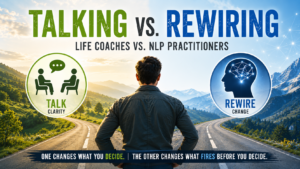
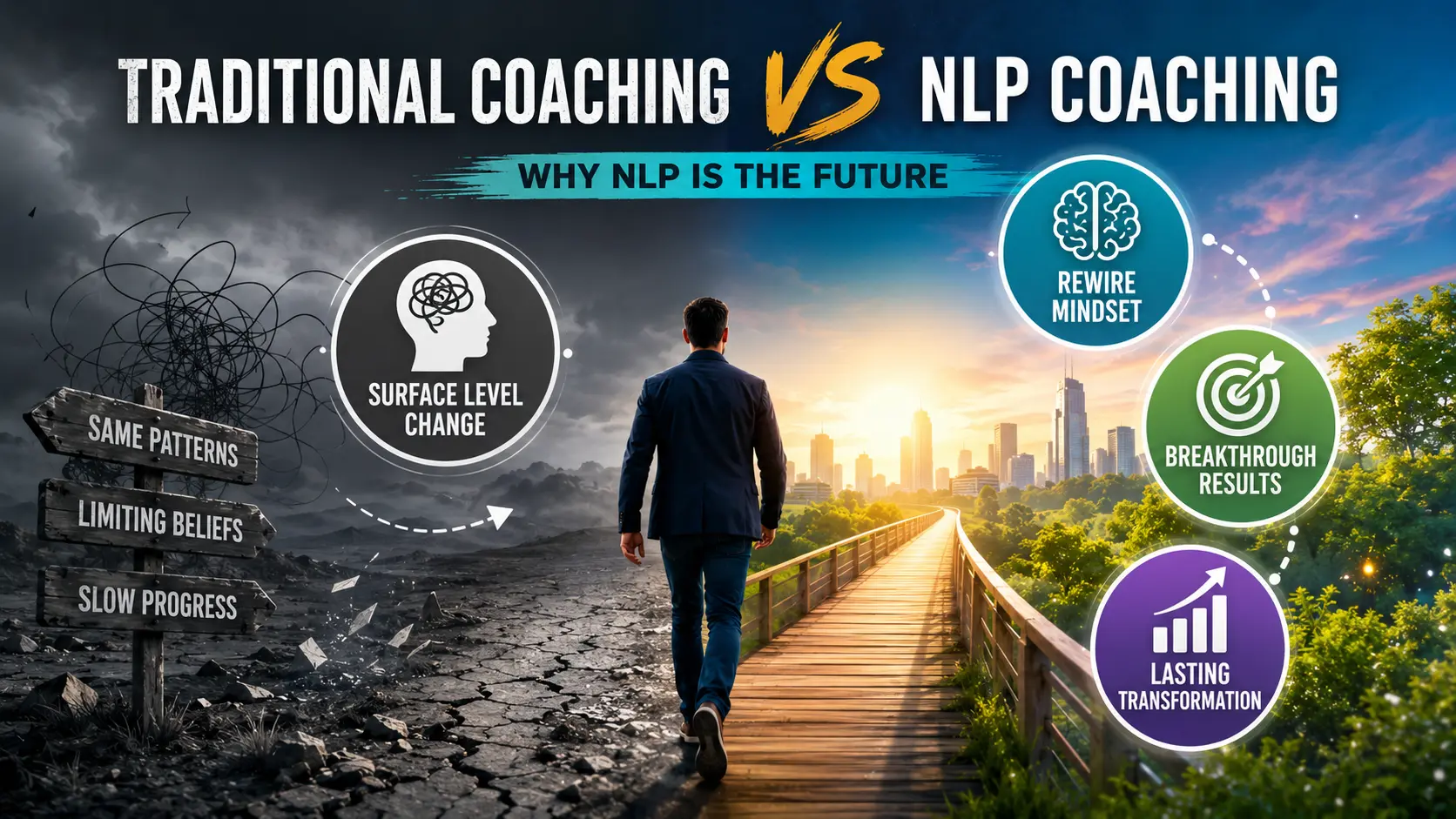
You’ve invested in coaching. You’ve attended the sessions, set the goals, and followed the action plans. And yet, somewhere between the strategy and the actual result, something keeps getting in the way.
Sound familiar? You’re not alone, and more importantly, you’re not the problem.
The reality is that traditional coaching can be genuinely powerful. But for many people, insight and accountability on their own don’t create the kind of lasting change they’re looking for. The gap isn’t a motivation issue. It isn’t a willpower issue. It’s that most of the patterns driving your behavior aren’t conscious decisions at all.
They’re subconscious.
That’s exactly where Neuro-Linguistic Programming, better known as NLP, changes the game. NLP isn’t a replacement for coaching. It’s the next evolution of it, an approach that works with the deeper mental and emotional patterns shaping your thoughts, your communication, and your results.
In this article, you’ll discover why traditional coaching is struggling to keep pace with what people actually need, what NLP does differently, and whether it might be the missing piece in your own development journey.
Key Takeaway:
- Traditional coaching primarily focuses on conscious goals, accountability, strategy, and action plans, while NLP coaching works with subconscious beliefs, language patterns, emotional responses, and behaviors that influence long-term results. Both approaches can create meaningful change but use different methods. [1]
- NLP coaching uses techniques such as reframing, anchoring, visualization, and language pattern recognition to help clients overcome limiting beliefs, improve confidence, strengthen communication, and accelerate personal or professional growth. [1]
- The right coaching approach depends on your goals. Traditional coaching is often best for performance improvement, goal achievement, and accountability, whereas NLP coaching may be more suitable when mindset, self-sabotage, emotional blocks, or communication challenges are limiting progress. [2]
- Many coaches combine traditional coaching with NLP techniques to address both external actions and internal thought patterns. This integrated approach can help clients create sustainable behavioral change while achieving measurable personal and professional outcomes. [2]
Bottom Line: Traditional coaching helps you define goals and stay accountable, while NLP coaching focuses on transforming the subconscious patterns that influence behavior. Choosing the right approach—or combining both—can help you achieve deeper, longer-lasting personal and professional growth.
Traditional Coaching vs. NLP Coaching
| Factor | Traditional Coaching | NLP Coaching |
|---|---|---|
| Focus | Goals, strategy, and accountability | Beliefs, mindset, and behavior patterns |
| Level of Change | Conscious actions and decisions | Conscious and subconscious transformation |
| Techniques | Goal setting, planning, and feedback | Anchoring, reframing, modeling |
| Problem Solving | Addresses symptoms and challenges | Targets underlying root causes |
| Speed of Results | Often gradual and incremental | Can produce faster breakthroughs |
| Emotional Change | Secondary focus | Core part of the process |
| Long-Term Impact | Relies on ongoing accountability | Emphasizes lasting internal change |
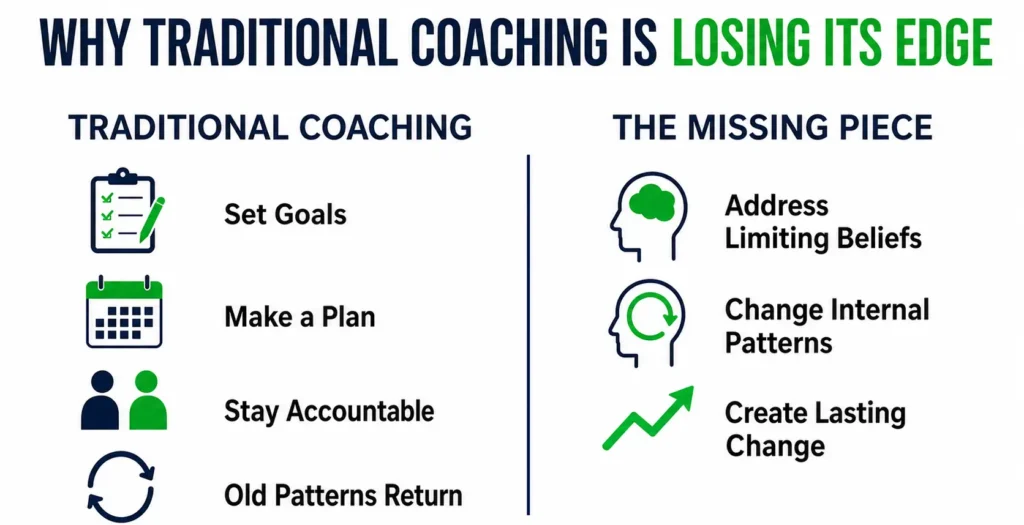
Why Traditional Coaching Is Losing Its Edge
The Surface-Level Problem with Goal-Setting Frameworks
Goals matter. Nobody disputes that. But here’s what the coaching industry has been slow to acknowledge: setting a goal is the easy part. The hard part is everything happening in your mind between the goal and the action.
Most traditional coaching frameworks, SMART goals, accountability check-ins, and action plans are built around conscious decision-making. They assume that if you know what to do and have someone holding you accountable, you’ll do it. And sometimes that works. But for many people, it doesn’t.
They leave sessions energized, clear on their next steps, and ready to take action. Then, within days, the same patterns resurface. The procrastination returns. The self-doubt comes back. The confidence that felt within reach disappears again.
That’s not a failure of the coaching model. It’s a signal that something deeper needs attention.
What Most Coaches Miss About How the Mind Influences Behavior
Research consistently shows that the vast majority of human behavior is driven by subconscious patterns, not conscious choices. Limiting beliefs formed years ago, emotional associations tied to past experiences, and habitual thinking patterns that run quietly in the background are the real drivers behind why people get stuck.
Traditional coaching, at its core, is a conscious-level intervention. It’s brilliant at helping you clarify what you want and map out how to get there. What it often can’t do is reach the subconscious layer where the resistance actually lives.
As one executive coaching specialist has noted, most traditional coaches accept their clients’ self-diagnoses at face value, missing the deeper subconscious blocks that are actually preventing progress. The result is that clients end up working on the symptom while the root cause keeps driving the same behaviors.
The Coaching Industry Is Evolving
The coaching market has grown significantly. The global industry was valued at $5.34 billion in 2025, with projections showing the online segment alone reaching $11.7 billion by 2032. That kind of growth tells you demand is real and accelerating.
But growth doesn’t automatically mean outcomes are improving. Clients are getting more sophisticated. They want measurable results. They want methods grounded in how the brain actually works. And they’re increasingly unwilling to spend six to twelve months on frameworks that leave the deeper stuff untouched.
That shift in client expectations is exactly what’s pushing the industry toward neuroscience-informed development approaches, and toward NLP.
What Is NLP Coaching and Why Is It Different?
Understanding Neuro-Linguistic Programming
NLP was developed in the 1970s by Richard Bandler and John Grinder. They began by studying the most effective communicators and therapists of their time, people who created remarkable results with clients consistently, and asked a simple question: What are they doing that others aren’t?
What they found was a set of patterns. Patterns in language, in behavior, in how people used their minds. NLP was built from those patterns, creating a practical toolkit for understanding and changing how people think, communicate, and perform.
The three elements of the name reflect the core framework. Neuro refers to how your nervous system and brain process experience. Linguistics captures the role of language in shaping your thoughts and reality. Programming describes the habitual patterns, often installed unconsciously, that drive your behavior.
Put simply, NLP works at the intersection of mind, language, and behavior to help you change patterns that aren’t serving you and replace them with ones that do.
The Principles Behind NLP
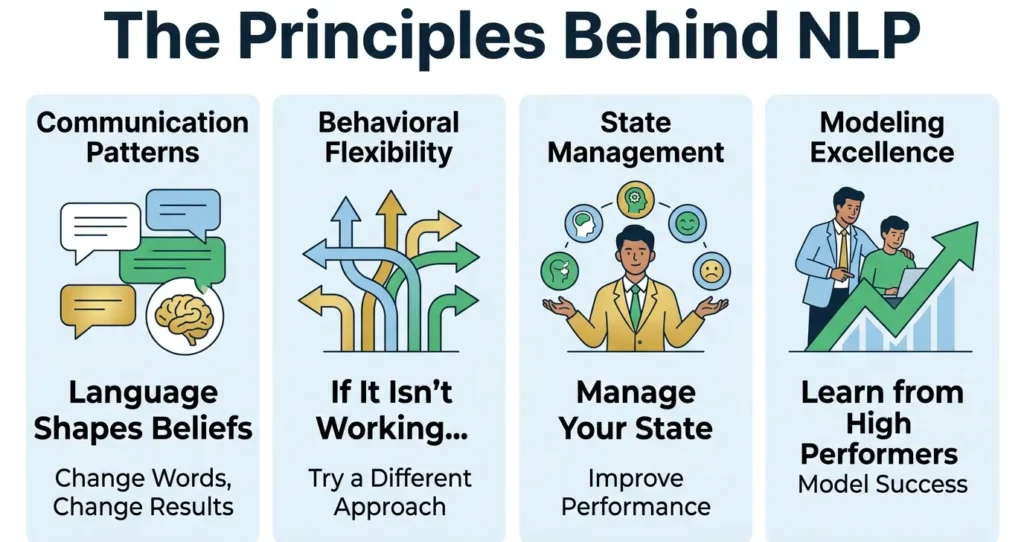
NLP is built on a few foundational ideas that distinguish it from more traditional approaches.
- Communication patterns are central. NLP recognizes that the way you talk to yourself and others shapes what you believe is possible. Small shifts in language can produce meaningful shifts in behavior.
- Behavioral flexibility is another cornerstone. NLP holds that if what you’re doing isn’t working, the most powerful thing you can do is try something different. The more flexible your responses, the more likely you are to find what works.
- State management is where many people first experience NLP’s practical power. Your emotional state influences everything: your thinking, your decisions, and your performance. NLP gives you tools to shift your state deliberately, not just reactively.
- Modeling excellence ties it all together. Rather than reinventing the wheel, NLP teaches you to identify how high performers think and behave and then replicate those strategies in your own context.
NLP Coaching vs. Traditional Coaching: A Clear Comparison
| Factor | Traditional Coaching | NLP Coaching |
| Primary focus | Goals and accountability | Goals plus subconscious patterns |
| Core method | Questioning and reflection | Questioning plus active change techniques |
| Level of change | Conscious awareness | Conscious and unconscious influences |
| Root cause work | Addresses symptoms | Explores and resolves root causes |
| Speed of results | Often requires extended engagement | Often designed for accelerated, targeted change |
| Mindset tools | Strategy and planning | Anchoring, reframing, modeling, state management |
| Best suited for | Clarity, structure, accountability | Belief shifts, pattern change, deep transformation |
Understanding the distinction helps you make a more informed choice about your development journey. For a deeper look at how these two approaches combine in practice, NLP coaching and business coaching explore how the integration works in a professional context.
How Does NLP Produce Faster, Deeper Results?
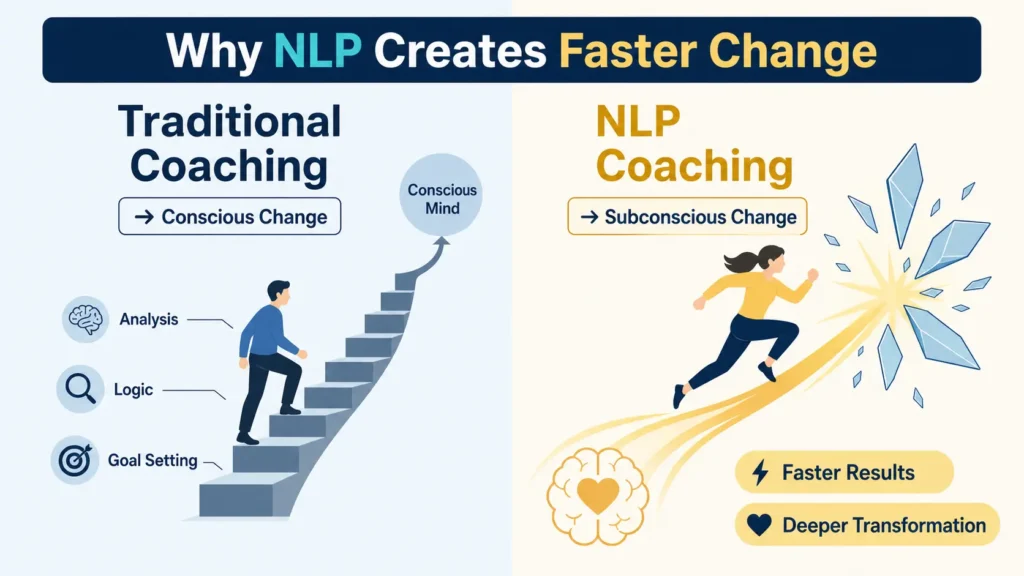
The speed difference between NLP coaching and traditional coaching often surprises people. What might take months of conscious-level work can sometimes shift in a handful of focused sessions when you’re working at the level of the subconscious pattern itself.
Here are three of the core techniques that make that possible.
Anchoring: Accessing Resourceful States on Demand
Think about a time when you felt completely confident. Fully present, clear, and capable. Now imagine being able to access that exact emotional state anytime you needed it, before a high-stakes presentation, a difficult conversation, or a challenging decision.
That’s what anchoring makes possible.
Anchoring is an NLP technique that links a specific physical cue, a gesture, a breath, or a particular posture to a powerful emotional state. When a peak experience is identified and a cue is attached to it, the brain begins to associate the two. Over time, using that cue signals the nervous system to recreate the state on demand.
It’s not magic. It’s neuroplasticity in action, the brain’s well-documented ability to form and reinforce new pathways through repetition and association. And in a coaching context, it gives clients a practical tool they can use independently, long after the session is over.
Reframing: Changing the Meaning, Changing the Outcome
Your brain doesn’t respond to events; it responds to the meaning you assign to them. Two people can experience the same situation and walk away with completely different emotional responses, based entirely on how they’ve interpreted what happened.
Reframing is the NLP process of deliberately shifting that interpretation. When a challenge is seen only as a threat, reframing opens up the possibility that it’s also an opportunity. When a setback is viewed as failure, reframing reveals it as information.
Research on reframing shows that this kind of perspective shift activates different neural pathways, giving people access to more resourceful emotional states and a broader range of behavioral options. That’s not simply a mindset trick. It’s a neurological change with real behavioral consequences.
Try This:
The 60-Second Reframe Exercise
Take a challenge you’re currently facing. Write it down in one sentence, describing it exactly as you currently see it.
Now ask yourself: “What else could this mean? If I knew there was a hidden opportunity inside this situation, what would it be?”
Write that down too. Notice how your emotional response shifts between the first sentence and the second. That shift is the reframe in action. With practice, you can do this in real time, in the middle of difficult situations, without needing to stop and write anything down.
Modeling: Learning from Excellence
One of NLP’s most practical applications is also one of its most overlooked. Rather than struggling to build skills from scratch, NLP teaches you to identify people who already do what you want to do, and study precisely how they do it.
Not just what they do, but how they think about it. What beliefs do they hold? How they talk to themselves in the moments that matter. What emotional states do they access under pressure?
This process, called modeling, gives you a practical shortcut to excellence. Instead of discovering what works through years of trial and error, you borrow the blueprint from someone who has already figured it out and adapt it to your own context.
For leaders, this is particularly powerful. You can model calm under pressure from one mentor, precision communication from another, and decisive thinking from a third. NLP gives you the tools to identify and replicate those patterns intentionally. NLP techniques for personal development go deeper into how these tools apply across different areas of growth.
What Results Can You Expect from NLP Coaching?
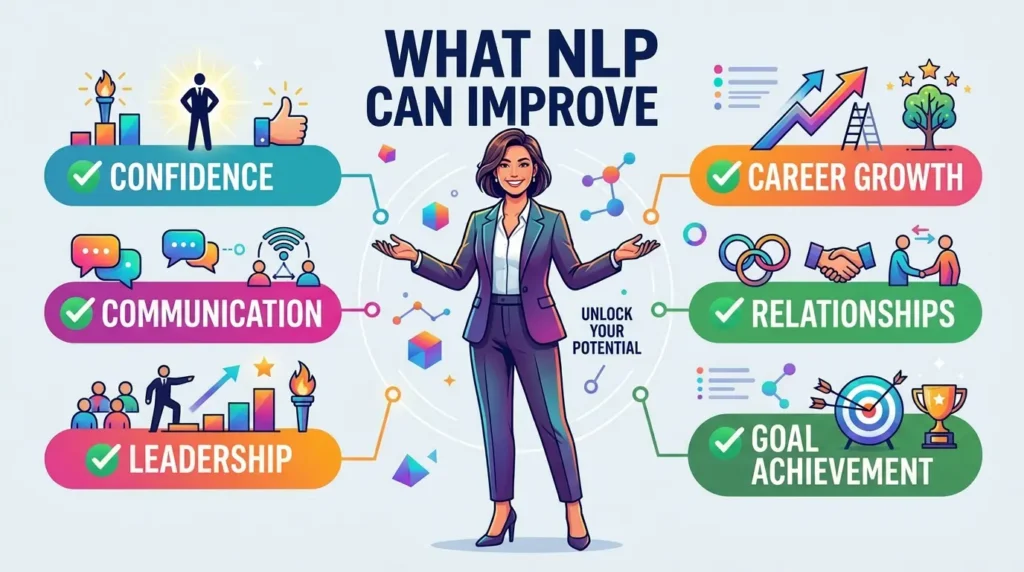
Confidence, Communication and Career Growth
NLP is most commonly applied in areas where subconscious patterns have the biggest impact. Confidence, because most confidence problems aren’t skill gaps; they’re belief gaps. Communication, because how you speak to yourself and others determines the quality of every relationship and interaction you have. Leadership presence, because commanding a room has as much to do with internal state as external technique.
Professionally, NLP is used across leadership development, sales performance, executive coaching, public speaking, team communication, and career transitions. Personally, it’s applied to self-doubt, anxiety, relationship dynamics, goal achievement, and identity shifts.
The common thread in all of these is that the change happens at the level of the pattern, not just the behavior.
Client Story: Mike L.’s Transformation
Mike came to James struggling with anxiety, self-doubt, and constant mental noise that affected every area of his life, his career, his relationships, and his confidence in everyday situations. He was second-guessing himself constantly, and no amount of willpower or awareness was breaking the cycle.
Working with James through NLP techniques, Mike addressed the underlying patterns driving his anxiety. He learned to quiet the mental chatter, clear the limiting beliefs that had accumulated over the years, and build genuine confidence from the inside out. The transformation was thorough: anxiety lifted, communication sharpened, and his career trajectory shifted in ways he hadn’t imagined. As Mike described it, he finally felt like he could enjoy his life again.
Why NLP Often Succeeds Where Traditional Coaching Stalls
The reason NLP frequently produces results where traditional coaching hasn’t comes down to one key difference: where the work is being done.
Traditional coaching works with what’s conscious. It assumes that if you understand a pattern and commit to changing it, change will follow. For some patterns, that’s true. But for deeply embedded subconscious beliefs, the kind that formed before you had the language or framework to question them, conscious-level work often isn’t enough on its own.
NLP goes to the source. It identifies the internal representation that the pattern is built on, the image, the sound, the feeling, the internal narrative, and works with that directly. The result is that change can happen at the level of the root, not just the surface.
Client Story: Darren G.’s Breakthrough
Darren had a good job, a solid income, and every external marker of success. But something was blocking him, from promotions, from building his own business, from the sense of abundance he knew was possible but couldn’t seem to reach. He felt hopeless, purposeless, stuck.
Working with James, Darren discovered the goal blocks and limiting beliefs that had been quietly running his behavior. The NLP process exposed them and dismantled them. The shifts that followed were significant: his thinking changed, his behaviors changed, and his relationships improved as a natural side effect. What had felt like a ceiling turned out to be a belief, and beliefs can change.
Is NLP Coaching Right for You?
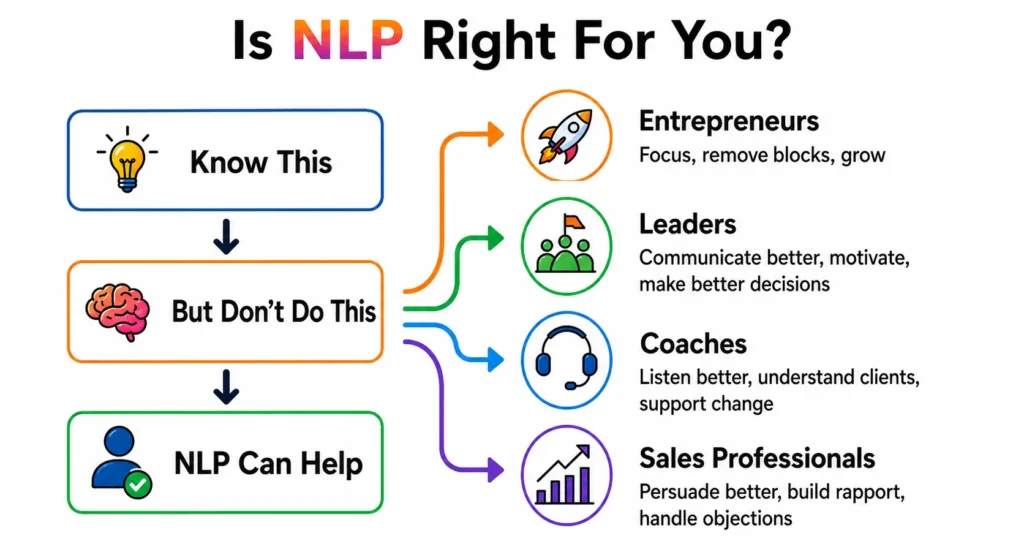
Signs Traditional Coaching Hasn’t Delivered What You Need
This is worth honest reflection. Traditional coaching has helped a lot of people, and it may have helped you, too. But if any of the following resonate, it’s worth considering whether a subconscious-level approach might be what’s actually missing.
You know what to do but don’t consistently do it. You’ve had the insight, written the plan, and set the intentions, and you still find yourself reverting. You repeat the same patterns despite full awareness of them. Awareness hasn’t been enough to break the cycle. You struggle with confidence, procrastination, or self-sabotage in ways that feel beyond your conscious control. Accountability helps in the short term, but the change doesn’t stick. You’re back to the same place within weeks.
If any of those hit close to home, you’re not broken. You’re working at the wrong level.
Who Benefits Most from NLP Training?
Entrepreneurs who want to break through mental blocks that limit business growth and decision-making. Leaders and managers who want to communicate with more impact, build stronger teams, and lead with presence. Sales professionals who want to sharpen their influence, rapport-building, and resilience. Coaches and consultants who want to serve their clients at a deeper level with more powerful tools. Individuals committed to personal growth who are ready to work at the level of the mind, not just behavior.
Why NLP Improves Leadership Skills is a strong read if leadership is your primary focus.
Who May Not Need NLP Right Now?
NLP isn’t for everyone at every stage. If you’re primarily looking for business strategy, market analysis, or operational frameworks, a business consultant may be a better fit. If you prefer long-term, reflective conversations over focused intervention techniques, a more traditional coaching approach might suit your style. And if accountability is genuinely all you need to execute on a clear plan you already believe in, that’s a legitimate and valid option too.
The goal isn’t to sell you on NLP. It’s to help you find the right tool for where you actually are.
Try This: The Subconscious Success Audit
Take five minutes with these questions. Answer them honestly, not with the answer you think you should give.
Where in your life do you know exactly what to do but don’t do it? What belief would have to be true for that pattern to make sense? If you had to guess at a deeper reason for the pattern beyond “I need to try harder,” what might it be?
Your answers will tell you whether the work is primarily strategic or whether something deeper is worth exploring.
Is NLP Backed by Science?
Understanding the Debate Around NLP
This is a question worth addressing directly, because honest credibility matters more than easy reassurance.
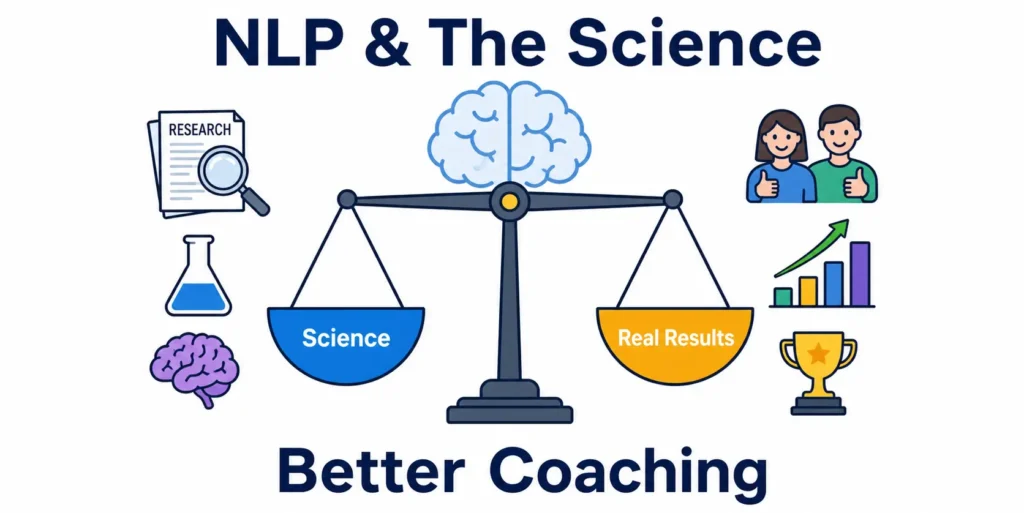
The research on NLP as a complete system is mixed. Some studies have found positive outcomes. Others have found limited evidence or have criticized NLP for its lack of rigorous scientific validation. That debate is real, and it’s fair to acknowledge it.
What that doesn’t mean is that NLP has no value. It means the scientific picture is more nuanced than either enthusiastic advocates or skeptical critics tend to present.
Where NLP Aligns with Modern Psychology
Several of NLP’s core techniques overlap meaningfully with concepts that have solid research support. Cognitive reframing is well-established in cognitive behavioral therapy and has been studied extensively. Behavioral conditioning and pattern interruption have robust support in behavioral psychology. Modeling and observational learning connect directly to established learning theory. And neuroplasticity, the brain’s ability to form new neural pathways, provides a compelling biological framework for why techniques like anchoring and repetitive reframing work in practice, even if the NLP-specific mechanisms haven’t been fully isolated in controlled studies.
In over 20 years working with clients as a Board Designated NLP Trainer, what I’ve observed is this: the techniques produce real results for real people in real situations. The science of why they work is still catching up, but the evidence of the outcomes isn’t hard to find; you can see it in clients who couldn’t speak publicly without anxiety and now train others, in leaders who once froze under pressure and now make decisions with clarity and confidence.
Why Practical Results Matter
Science is important. It keeps us honest. But outcomes are the ultimate test of any development approach. The question worth asking isn’t only “has this been studied?” It’s also “Does this work for the people who try it?”
For that question, the most relevant data is in the lived experience of practitioners and clients, not just in academic journals. Working with a qualified, experienced NLP practitioner is the most reliable way to assess the value of the approach for your specific situation.
Data and Findings
The coaching industry’s rapid expansion is backed by data, and that data tells a clear story: the profession is growing fast, client expectations are rising, and demand is shifting toward methods that deliver measurable, lasting outcomes.
Coaching market size and growth
The global coaching market reached approximately $14.1 billion in 2024 when executive coaching and leadership development are included, according to IBISWorld’s business coaching industry analysis. The life and personal coaching segment was valued at $5.34 billion in 2025, and the online coaching segment is projected to reach $11.7 billion by 2032, reflecting a compound annual growth rate of around 8.5%, according to Luisa Zhou’s coaching industry analysis.
Practitioner growth signals surging demand
The number of active coaches worldwide nearly doubled between 2019 and 2023, rising from approximately 71,000 to 126,000 globally, with projections estimating 145,500 practitioners by 2024. This data, cited in a 2025 peer-reviewed coaching scholarship editorial, reflects how seriously organizations and individuals are taking professional coaching.
Confidence declining despite market growth
Despite the positive revenue figures, the coach’s confidence in future earnings has declined. According to The Coaching Tools Company’s 2025 industry analysis, many coaches report a lived experience that doesn’t match the headline numbers. Economic pressure is building, and generic methods are failing to differentiate practitioners in an increasingly saturated market.
Specialization is now economically essential
The same industry analysis highlights that specialization has shifted from a strategic advantage to an economic requirement for coaches who want to command premium fees. Clients no longer accept one-size-fits-all frameworks. They want practitioners with proven, targeted methodologies, which is precisely where NLP’s focused approach to subconscious change stands apart.
NLP’s reach is expanding across industries
As of 2026, NLP training and techniques are being actively integrated across coaching, leadership development, education, sales, corporate wellness, and organizational development programs worldwide, according to Indian Counselling Services’ 2026 NLP training trends report. The shift reflects growing recognition that communication, emotional intelligence, and mindset work are not soft skills; they’re competitive advantages.
The subconscious gap in traditional coaching
Research published in the Forum for Education Studies (2024) found that NLP allows for both micro and macro analysis of results across diverse fields and is notable for teaching practitioners “how to do” rather than just “what to do,” a distinction that separates technique-based approaches like NLP from purely reflective coaching models.
These numbers don’t just describe an industry. They describe a shift in what people are looking for from coaching and why approaches that work at the level of the subconscious are gaining ground.
The Future of Coaching: Where NLP Fits In
Coaching Is Evolving, Not Disappearing
There’s a headline in the title of this article that’s worth softening, because the full picture is more interesting than a simple death narrative. Traditional coaching isn’t dying in the sense that it has no value. It’s evolving, and the most effective coaching is moving toward something richer, deeper, and more tailored.
What is fading is the assumption that a goal-setting framework and weekly check-ins are sufficient for everyone and every challenge. Clients are demanding more. They want approaches grounded in how the brain actually works, methods that produce results they can measure, and practitioners who understand both the conscious and subconscious dimensions of change.
NLP is one of the most powerful answers to that demand.
Why Professionals, Leaders and Entrepreneurs Are Making the Switch
The coaching industry now represents a $14 billion global market when executive coaching and leadership development are included. That number reflects not just growth in demand but a shift in how organizations view coaching, from a perk to a strategic investment in human performance.
Alongside that shift, there’s a growing recognition that generic coaching methods yield generic results. Professionals in high-stakes roles need approaches that go beyond accountability. They need tools that address the mental and emotional complexity of leadership, not just the behavioral surface.
NLP is increasingly being applied across corporate leadership programs, executive coaching, team communication training, sales performance development, and personal transformation. It’s no longer a niche methodology. It’s becoming a standard part of the serious coach’s toolkit. What future work skills does NLP need to explore this shift in more depth?
The Emerging Role of NLP in Personal and Professional Development
As the demand for more sophisticated coaching tools grows, NLP’s applications continue to expand. In corporate environments, it’s being used to develop leadership presence, improve team communication, and build emotional resilience. In executive coaching, it addresses the mindset patterns that either accelerate or limit a leader’s impact. In personal development, it gives individuals the tools to finally shift patterns they’ve been struggling with for years.
The evolution of coaching isn’t about choosing one approach over another. It’s about integrating the right tools for the right person at the right time. And for a growing number of professionals, NLP is the piece that makes everything else start to work.
Frequently Asked Questions
What is the difference between NLP coaching and traditional coaching?
Traditional coaching primarily focuses on goals, accountability, and conscious decision-making. NLP coaching additionally works with thought patterns, language, beliefs, and emotional associations that influence behavior at a subconscious level. The result is that NLP addresses not just what you want to achieve, but what’s getting in the way of achieving it.
How many NLP coaching sessions does it take to see results?
Many people notice meaningful shifts within a handful of sessions, particularly when working on specific patterns like confidence, communication, or a clearly defined limiting belief. That said, results vary depending on the individual, the challenge, and the depth of the work. Complex, long-standing patterns may require more time.
Can NLP help with confidence and communication at work?
Yes. NLP techniques are among the most effective tools available for building genuine confidence, improving communication clarity and impact, and developing the kind of leadership presence that earns respect without effort.
Does NLP really work?
Many individuals and organizations report significant positive outcomes from NLP-based coaching. As with any development approach, results depend on the quality of the practitioner, the commitment of the client, and the fit between the method and the specific challenge. The most reliable way to assess it is to work with a qualified, experienced practitioner and evaluate your own results.
Is NLP backed by science?
Research findings on NLP as a complete system are mixed. However, several of its core techniques align with well-established concepts in cognitive behavioral therapy, behavioral psychology, and neuroplasticity research. The debate around scientific validation is worth knowing about, and it doesn’t invalidate the real-world outcomes many practitioners and clients consistently report.
How do I get started with NLP coaching?
Start by working with a qualified NLP practitioner who has verifiable training and a track record of results, or enroll in a structured NLP training program that teaches you practical tools you can use yourself. James’s NLP Training Canada programs are a strong starting point for anyone serious about transformation.
Conclusion
The gap between knowing what to do and actually doing it isn’t a discipline problem. It isn’t a strategy problem. Most of the time, it’s a pattern problem, and patterns live at the subconscious level, not the conscious one.
Traditional coaching builds the map. NLP helps you clear the roadblocks that keep you from following it.
The coaching industry is evolving because clients are evolving. They want approaches that go deeper, produce results faster, and create change that actually holds. NLP is at the center of that evolution, not as a replacement for everything that came before, but as a powerful step forward.
If you’ve been working hard on your development and still hitting the same walls, it may be time to work at a different level.
Ready to experience the difference for yourself? Explore James’s NLP Training Canada programs and discover how NLP can help you create faster, deeper, and more lasting transformation. Not sure where to start? Why Choose NLP is a good first read.
Unleash Your Power: Stand Out, Take Action, and Create the Success You Want.