
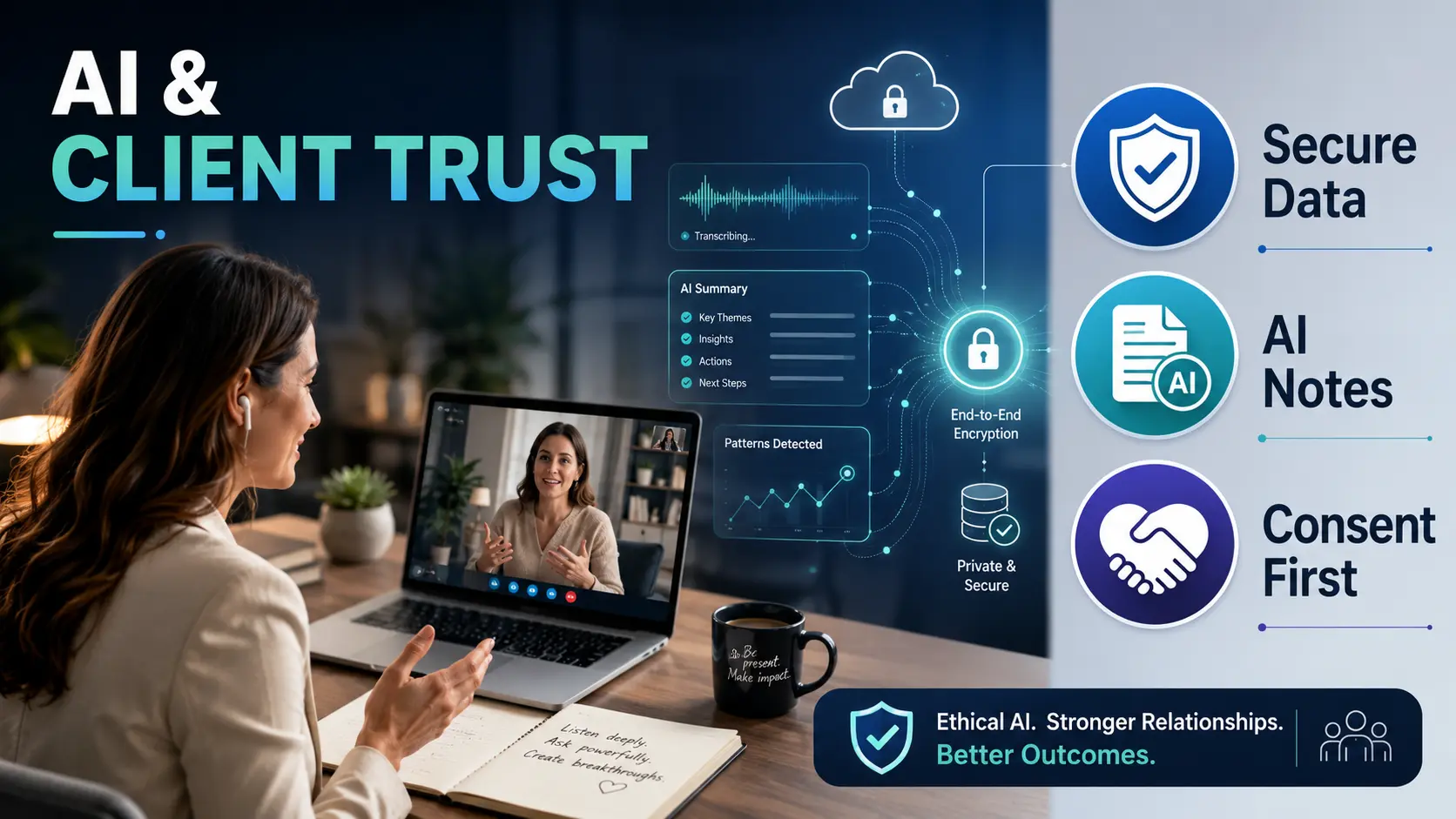
Your client finally opens up. Something they have never said out loud. Something they have carried for years. And somewhere on your screen, an AI tool is quietly transcribing every word.
Did they know? Did you tell them? Do you even know where that transcript goes once the session ends?
This is the situation thousands of coaches are in right now. AI note-taking for coaches has grown at a pace the profession was not ready for. The tools are impressive: they transcribe in real time, generate session summaries, flag recurring patterns, and free you to be genuinely present. But most coaches are adopting them faster than they are thinking through what ethical adoption actually looks like.
Key Takeaway:
- AI note-taking tools help coaches stay fully present during sessions by automatically recording conversations, generating transcripts, summarizing key insights, identifying action items, and reducing hours of manual administrative work. [1]
- Key benefits include improved client engagement, more accurate documentation, faster follow-up emails, consistent progress tracking, searchable coaching records, and better business scalability without sacrificing coaching quality. [1]
- Choose an AI note-taking solution with strong transcription accuracy, secure data handling, CRM and calendar integrations, customizable coaching templates, multilingual support, and automated summaries that fit your coaching workflow. [2]
- Always obtain client consent before recording sessions, verify AI-generated notes for accuracy, protect confidential information, and remember that AI should support not replace the coach’s judgment, empathy, and personalized guidance. [2]
Bottom Line: AI note-taking enables coaches to spend less time on documentation and more time coaching. When used responsibly with client consent, privacy safeguards, and human oversight, these tools improve efficiency, strengthen client relationships, and support long-term coaching success.
That gap became professionally consequential in 2026. The International Coaching Federation updated its Code of Ethics and, for the first time, added explicit requirements around AI disclosure, consent, and data handling. If you are using any AI tool in your coaching sessions, you are now professionally accountable for how you use it.
This article is your practical guide. By the end, you will know exactly which questions to ask before choosing any tool, what to say to clients, when to turn the AI off entirely, and how to build a note-taking practice that strengthens trust rather than quietly putting it at risk.
What AI Note-Taking Tools Actually Do in Coaching Sessions
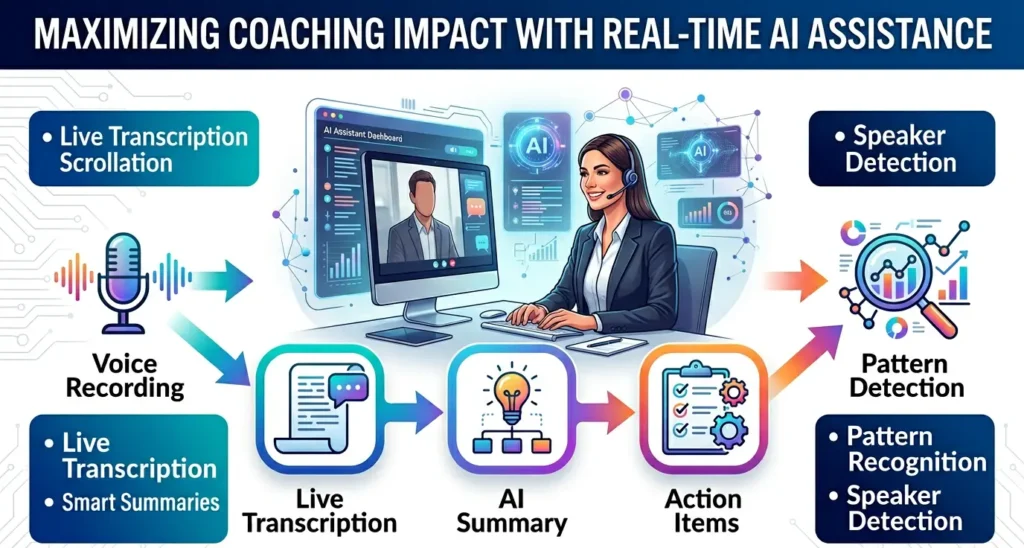
A lot of coaches underestimate what these tools are actually doing under the hood.
AI note-takers go well beyond capturing what you say. They use machine learning and natural language processing to transcribe spoken language in real time, generate summaries, identify action items, and distinguish between speakers. Some platforms are built to detect recurring themes across multiple sessions, flagging patterns in a client’s language and thinking over time.
That is genuinely powerful. It is also exactly why the stakes are higher than most coaches realize. You are not just automating a task. You are feeding your client’s most private disclosures into a software system, often hosted on servers in a country you have never thought about, governed by terms you have never read.
These tools process sensitive client data. Once you internalize that, the ethical questions become obvious.
Quick Ethics Checklist for AI Note-Taking in Coaching
Before going deeper, run through this list. If you are already using an AI note-taker, answer honestly.
- Have you disclosed AI use to your client in writing and verbally?
- Do you know how the tool stores session data and for how long?
- Is client consent explicit and documented in your coaching agreement?
- Can clients opt out without pressure or awkwardness?
- Does the tool comply with GDPR, HIPAA, or Canada’s PIPEDA?
- Do you pause or disable AI during highly sensitive conversations?
If you hesitated on more than two of those, keep reading. This is not about fear. It is about building a practice you are proud of.
Why Coaches Are Turning to AI Note-Taking (And Why It Is a Double-Edged Sword)

The Time-Saving Appeal Is Real
The numbers explain the momentum. Around 38% of ICF member coaches now incorporate AI tools into their practice, and adoption is accelerating. When you are managing multiple clients, tracking progress across sessions, and trying to stay present while writing quality notes, something has to give.
AI note-takers solve a genuine problem. They let you stop splitting your attention between listening and documenting. You stay in the conversation. You catch the pause before an answer. You ask the follow-up that changes everything. That is a real benefit.
The Hidden Risk: What Happens to What Your Client Says?
Here is what does not make it into the marketing materials. Cloud-stored transcripts are vulnerable to data breaches if they are not properly encrypted, and even strong security cannot fully protect against data exposure caused by technical errors or misconfigured settings. Some AI note-taking platforms also use session data to train their underlying models. Your client’s exact words could end up shaping a product they never agreed to contribute to.
Research from The Conference Board puts it directly: the more AI knows about your clients, the more effective it becomes, but the greater the risk if that data is ever mishandled. That is not a reason to avoid these tools. It is a reason to choose and use them deliberately.
Key data points coaches need to know:
- 38% of coaching association members now use AI tools in their practice
- Only 13% use AI specifically for client session documentation
- AI coaching market is growing at 156% year over year
- 2025 ICF Standard 2.5 now requires disclosure, consent, and equivalent data protection
- Legal recording consent requirements apply to AI transcription in many jurisdictions
AI Note-Taking Tool Comparison: What to Look For
Not all AI note-takers are built the same. Here is how the key features stack up across the dimensions that matter most for professional coaching.
| Feature | What to Look For | Red Flag |
| Data training policy | Explicitly states it does NOT train on user data | Vague ToS or silence on model training |
| Encryption standard | AES encryption in transit and at rest | No encryption standard listed |
| Audio retention | Deletes audio files after processing | Stores audio indefinitely |
| Meeting bot | Option to record without a bot joining the call | Bot-only, no device-level recording option |
| Data jurisdiction | Servers in your client’s legal region | Data stored offshore with no jurisdiction clarity |
| Compliance certifications | SOC 2 Type II, GDPR, HIPAA, PIPEDA | No third-party security certifications |
| Client opt-out | Easy, documented, no-consequence opt-out | No opt-out mechanism or unclear process |
| Transcript access | You control access and deletion | Vendor retains control of transcripts |
Try This: Before your next session using any AI tool, open the vendor’s Terms of Service and search for the word “training.” If you find language permitting the use of your data to improve AI models, contact their support team and ask directly: Does this apply to session transcripts? Get the answer in writing.
What the 2026 ICF Code of Ethics Actually Requires from You
The ICF’s 2026 update introduced Standard 2.5, which requires coaches to fulfill their ethical and legal obligations through any technology they use, including AI, and to ensure confidentiality, security, and privacy.
In practice, this means three things. You need to vet tools for data security and privacy practices before adopting them. If you use AI for session notes, data analysis, or any coaching function, you must disclose this to clients. And data handled by AI tools must meet the same confidentiality standards as information you process yourself.
This was absent from the 2020 code. The profession has caught up to technology. Your practice needs to as well.
What Most Coaches Misunderstand About Consent
Disclosure is not the same as informed consent. Telling a client “I use an AI tool” checks a box. It does not guarantee they understand what that means. A client might nod while having no idea their transcript is stored on servers in another country, accessible to vendor staff, or potentially feeding a model improvement pipeline.
Informed consent means the client understands what they are agreeing to. That requires you to understand it first.
Genuine consent happens in three stages: before sessions begin in your written coaching agreement, verbally at the start of each recorded session, and as an ongoing conversation whenever your tools or processes change.
Data and Findings
The growth in AI adoption across the coaching profession is not a trend. It is a structural shift. Here is what the data shows.
The global AI coaching market is projected to reach $2.4 billion by 2028, with corporate adoption increasing 156% year over year. At the same time, only 13% of clinicians and coaches are currently using AI specifically for client documentation, according to a 2024 SimplePractice survey. That gap represents both an opportunity and a risk: coaches are adopting AI broadly, but most have not yet built the ethical infrastructure to support it in the client relationship.
On the regulatory side, the stakes are rising. The 2026 ICF Code of Ethics now formally requires AI disclosure, informed consent, and data protection standards equivalent to human-handled information. Violations go through the ICF Ethical Conduct Review process, with consequences ranging from mandatory training to credential revocation.
Legal analysts note that recording laws in many jurisdictions, including all-party consent states and GDPR-regulated countries, may already classify AI transcription as a recordable event requiring explicit consent. Coaches operating across borders need to understand which legal standard applies to each client relationship.
The productivity case for AI note-taking is strong. Research consistently shows that coaches and professionals recapture significant time previously lost to manual documentation. AI tools have been shown to reduce time spent on information management by meaningful margins, with some studies pointing to productivity improvements of over 60% for professionals using AI-assisted documentation. That time, returned to direct client work, is worth something. So is the trust you protect by handling it responsibly.
The 5 Questions to Ask Before Using Any AI Note-Taking Tool
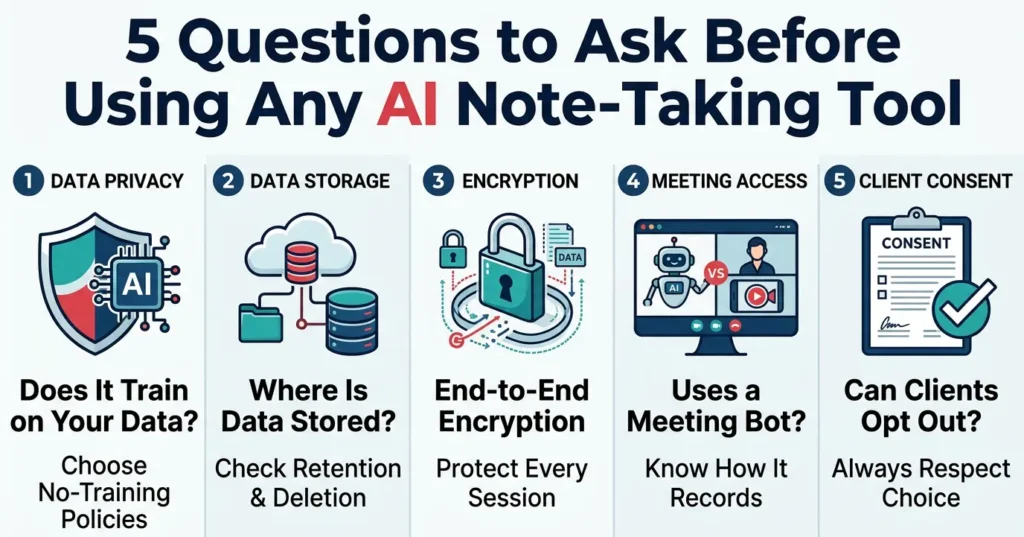
This is the most important section in this article. Before any AI tool enters your coaching practice, you need clear answers to these five questions.
Does It Train on Your Data?
Some platforms use session transcripts to improve their AI models. That means your client’s private disclosures could influence a product used by thousands of people they have never met. Read the Terms of Service specifically for language around model training and data improvement. A trustworthy tool states explicitly that it does not train on customer data. Vagueness is a red flag.
Where Is the Data Stored, and for How Long?
Cloud storage is standard, but not all cloud environments are equal. Ask where servers are physically located, which legal jurisdictions govern the data, and what the retention policy is. The gold standard is a tool that deletes audio after processing and gives you full control over how long transcripts are kept. Indefinite storage with no deletion option is a meaningful risk.
Is It End-to-End Encrypted?
“Secure” is a marketing word. End-to-end encryption is a technical standard. Look for tools that use AES encryption both in transit and at rest, meaning data is protected while moving between systems and while sitting on servers. If a vendor cannot tell you their encryption standard, keep looking.
Does It Use a Meeting Bot?
Some AI note-takers join your video call as a visible participant. This shows up on your client’s screen as a third party entering a private conversation. Beyond the discomfort factor, it raises immediate consent questions. Other tools record directly from your device with no meeting bot, which tends to feel less intrusive. Know which approach your tool uses before switching it on.
Can Your Clients Opt Out?
Every client has the right to say no. Not awkwardly, not with consequences, not after you explain why you think AI is fine, just no. Your disclosure process should make opting out easy and normal. If you find yourself reluctant to offer a genuine opt-out, that is worth examining. Safety requires real choice.
When Not to Use AI Note-Taking
There are moments in coaching when the ethical move is to put the technology down entirely.
High-sensitivity conversations involving trauma, legal situations, health concerns, or serious mental health disclosures warrant extra caution. Legal experts consistently advise pausing or disabling AI note-takers during confidential discussions, and professional coaching ethics align with that.
Client discomfort is also a signal worth honoring. If a client hesitates when you mention AI transcription, do not push through. In over 20 years of working with clients, the pattern I have seen is consistent: the moment a client feels like a subject rather than a partner, the coaching conversation closes. No tool is worth that.
Ethics over efficiency. Every time.
How to Disclose AI Note-Taking Without Breaking Rapport
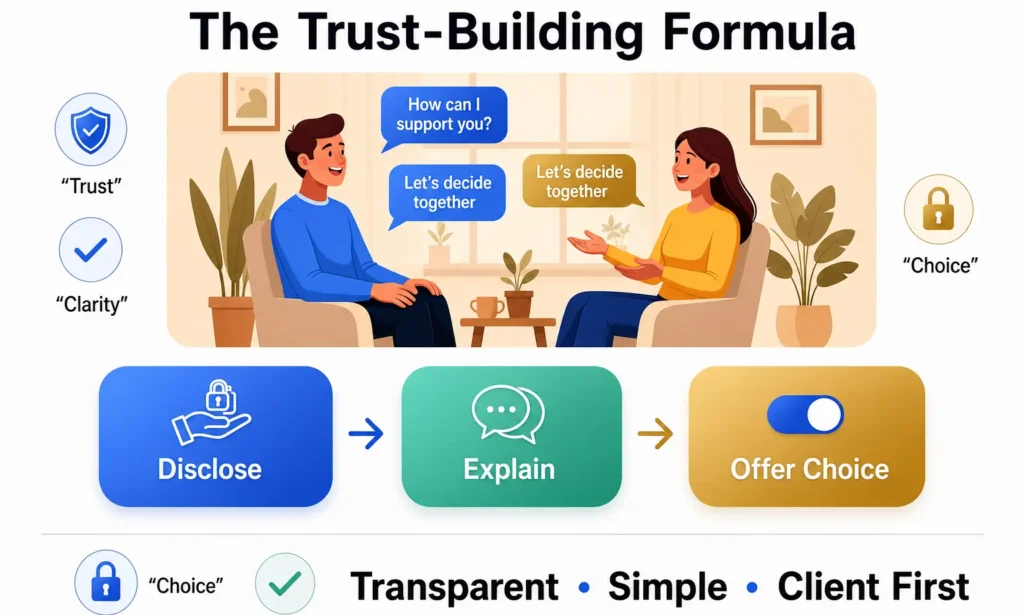
Disclosure does not have to feel heavy. Done right, it is one of the fastest trust-builders in your practice.
Before the First Session
Update your coaching agreement to include a dedicated section on technology use. Specify which AI tools you use, what they do with session data, how long data is retained, and how the client can opt out at any time. This is the foundation. It means the conversation has already happened in writing before you open the first session.
If you are just starting your life coaching business, build these habits into your practice from day one rather than retrofitting them later.
During the Session
You do not need to make this a moment. Keep it brief, calm, and framed around the client’s benefit:
“Before we dive in, I want to mention that I use an AI note-taking tool during our sessions. It helps me write accurate session summaries so I can track your progress precisely and stay fully present with you. Your transcript stays private and is [stored securely / deleted after X days]. You can opt out at any time and it will not change anything about how we work together. Any questions before I switch it on?”
That is it. Transparent. A real choice is offered. Framed in terms of what it does for them. An NLP-informed approach to confident communication here: normalize choice and center safety rather than seeking permission.
Sample Disclosure Language for Your Coaching Agreement
“[Your Practice Name] uses AI-assisted note-taking software to support accurate session documentation. This tool [describe function]. Session data is [stored/deleted] according to the following policy: [specifics]. You may opt out of AI note-taking at any time by notifying your coach before or during a session. Opting out will not affect the quality or nature of coaching services provided.”
Adapt the specifics to your actual tool and policy. The structure holds regardless.
Safe vs. Risky: AI Note-Taking Practices at a Glance
| Practice | Safe Approach | Risky Approach |
| Disclosure | Implied by the client joining the call | Assumed or never mentioned |
| Consent | Documented, opt-out explicitly offered | AI is left running throughout |
| Tool vetting | ToS reviewed, encryption confirmed, training policy verified | Chosen based on popularity or price |
| Sensitive conversations | AI disabled manually | Clear policy, the client can request deletion |
| Data retention | Clear policy, client can request deletion | Unknown or indefinite |
| Legal compliance | GDPR / HIPAA / PIPEDA verified for client’s jurisdiction | Assumed compliant with no verification |
| Transcript access | Coach controls access and deletion | Vendor retains control |
3 Ways AI Note-Taking Can Actually Strengthen Client Trust

Approached ethically, safe AI note-taking for coaches does not undermine the relationship. It deepens it.
Sharper Session Recaps That Prove You Were Listening
One of the most powerful things you can do after a session is send a precise, well-organized summary of what the client shared, what shifted, and what they committed to. When that summary reflects the specific language a client used, it sends a clear signal: you were fully there. That kind of attention is rare, and clients feel it immediately.
Heather, an NLP practitioner who trained with James, came into the program feeling like her coaching tools were not clicking together. What changed was not the tools themselves. It had a clear framework for how to integrate them. AI note-taking, approached intentionally, works the same way. The tool is not the point. The clarity it creates for your client is.
Spotting Patterns Across Sessions
A client might mention fatigue in session two, perfectionism in session five, and difficulty delegating in session eight. In isolation, these feel like separate topics. Across a body of notes, they form a picture. AI tools that surface language patterns across sessions help you see that picture faster, which means you bring more insight to the conversation, not less.
Try This: After your next three sessions, use your AI-generated summaries to identify one recurring word or theme across all three. Bring that observation to your next session: “I have noticed you use the word [X] a lot when we talk about [topic]. What does that word mean to you?” The insight comes from the tool. The question comes from you. That is the right division of labor.
More Presence When It Matters Most
The whole reason active listening sits at the center of NLP coaching is that what clients do not say is often as important as what they do. When you are not managing documentation, you can hear the hesitation before an answer. You can notice the energy shift when a topic lands differently. You can ask the follow-up that changes the session.
That is not AI replacing the coach. That is AI handling administration, so the coach can do what only a human can do.
Quick Setup Checklist
Before your first AI-assisted session:
- Disclosure added to your coaching agreement in writing
- Client consent is documented before the tool is switched on
- Tool vetted for training policy, encryption standard, and data retention
- Opt-out option communicated clearly and offered without pressure
- Protocol confirmed for disabling AI during sensitive conversations
If you are building toward life coach certification, this ethical infrastructure is not a formality. It is the foundation of a practice that earns lasting trust.
Frequently Asked Questions
Do I legally have to tell clients I am using an AI note-taker?
In many jurisdictions, yes. All-party consent laws in states like California and countries under GDPR may classify AI transcription as a recordable event requiring explicit consent. Beyond legality, the 2026 ICF Code of Ethics now makes disclosure a formal professional requirement for ICF-credentialed coaches. Even where it is not legally mandated, failing to disclose puts the client relationship at serious risk. The ethical and practical answer is the same: always tell clients.
What is the safest type of AI note-taking tool for coaches to use?
Look for tools that explicitly state they do not train on user data, use AES end-to-end encryption, delete audio files after processing, store data in compliant jurisdictions, and give you full control over retention and deletion. Tools that do not use a meeting bot tend to feel less intrusive to clients. Requesting a vendor’s SOC 2 Type II compliance report is a reliable signal of security maturity.
Can I use AI note-taking tools with trauma-informed or therapy-adjacent coaching clients?
With extra care, yes. Conversations involving trauma, mental health, legal situations, or medical information warrant heightened caution. Many coaches choose to disable AI entirely for these sessions and take manual notes instead. The guiding principle: client safety always outweighs administrative convenience.
What should I do if a client asks me to delete their AI-generated transcripts?
Honor the request immediately and confirm in writing that it is done. Your coaching agreement should specify that clients can request deletion at any time. If your chosen tool does not give you a clear way to delete individual client transcripts, that is a significant gap and a signal to reassess the tool.
How do I handle AI note-taking when I am becoming a life coach and do not have many clients yet?
This is actually the best time to build these habits. Set up your coaching agreement with AI disclosure language before your first paying client. Develop your verbal disclosure script and practice it. Vet your tools before you rely on them. Starting small does not mean starting carelessly. It means you build the right infrastructure from the ground up.
Conclusion
AI note-taking for coaches is not a risk. Hidden AI is.
The coaches building high-trust, lasting practices with these tools are the ones making them visible. They tell clients what they are using and why. They have read the Terms of Service. They know when to turn the bot off. They have built consent into onboarding as a demonstration of the values that define how they work, not as a legal formality.
The 2026 ICF Code of Ethics did not create these standards. It formalized what integrity-led coaches were already doing.
You have the framework. Now take decisive action.
If this approach to rigorous, ethical, transformation-focused coaching resonates with how you want to practice, explore James’s Life Coach Training Certification. It is built for coaches who understand that trust is not a soft skill. It is the whole job.
Unleash Your Power: Stand Out, Take Action, and Create the Success You Want.