
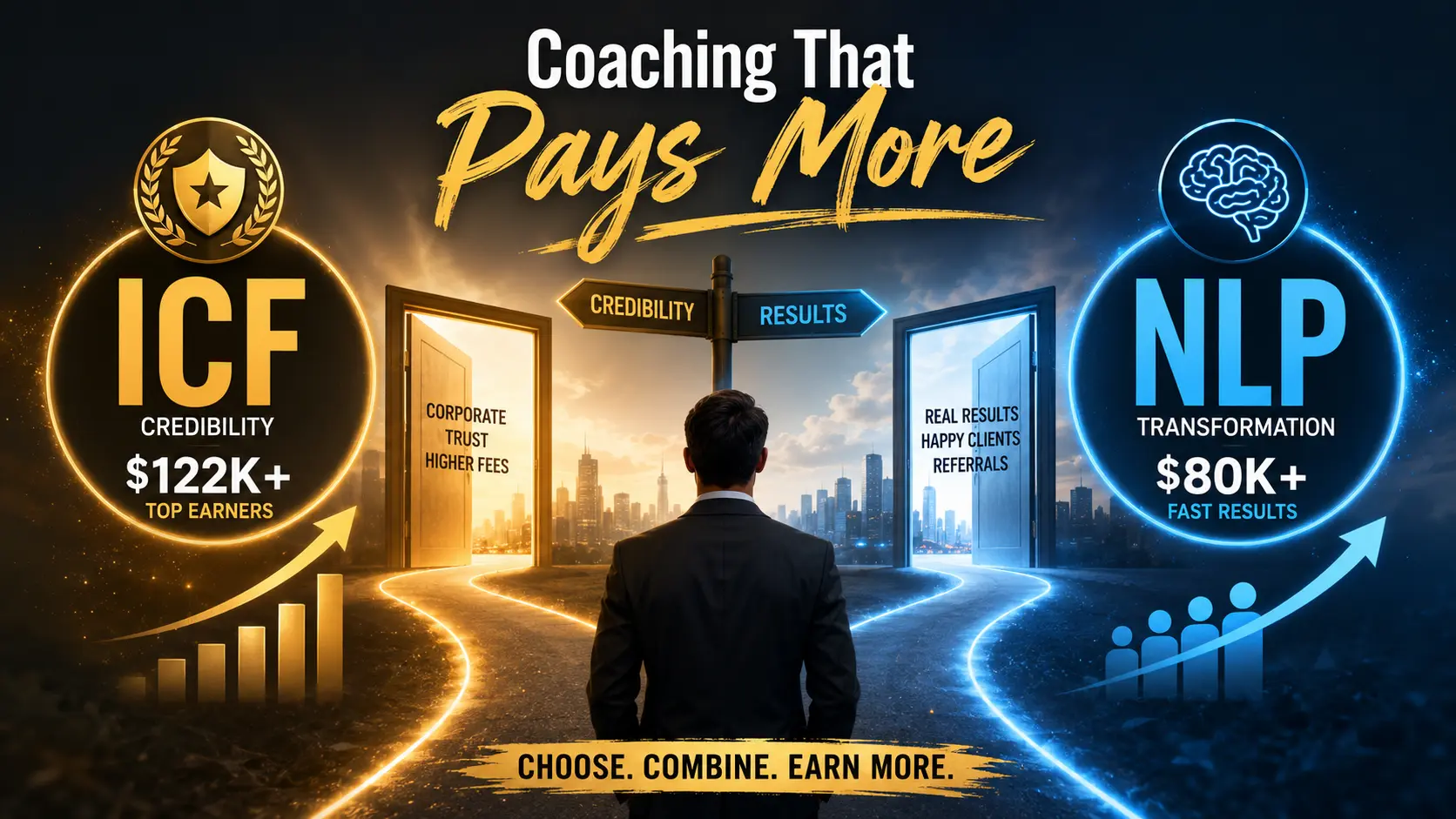
When evaluating ICF vs. NLP, ICF-certified life coaches in North America earn an average of $67,800 to $71,719 per year, according to the 2025 ICF Global Coaching Study, with executive and corporate coaches reaching $122,000 to $160,000 or more.
NLP practitioners working in coaching earn roughly $70,000 to $80,000 on average, with experienced practitioners in leadership and corporate niches earning comparable or higher figures. Neither credential alone determines the income ceiling. What drives coaching income most is niche, client type, business model, and the ability to position yourself as a results-producing specialist.
Key Takeaway:
- ICF coaching and NLP certification offer different paths to career growth. ICF credentials emphasize professional coaching standards, credibility, and corporate acceptance, while NLP training focuses on communication, mindset transformation, influence, and rapid behavioral change techniques. [1]
- From an ROI perspective, the best option depends on your business model. Coaches targeting executive, leadership, and corporate clients often benefit from ICF credentials, while entrepreneurs, consultants, trainers, sales professionals, and transformational coaches can leverage NLP skills to create higher-value offers and accelerate client results. [1]
- Many successful practitioners combine both approaches. ICF provides professional coaching frameworks and market credibility, while NLP delivers practical tools for communication, belief change, rapport-building, goal achievement, and client transformation. [2]
- The highest long-term return often comes from aligning certification choices with your target audience, service offerings, pricing strategy, and desired coaching niche rather than focusing solely on credential costs or average salary figures. [2]
Bottom Line: ICF and NLP certifications serve different purposes, and neither is universally superior. ICF offers stronger recognition and coaching credibility, while NLP provides powerful transformation and communication tools. For many professionals, combining both credentials creates the strongest earning potential, client outcomes, and long-term ROI.
- Source: Unleash Your Power – ICF vs NLP Salary ROI 2026
- Source: Unleash Your Power – Why Most NLP Certifications Fail Real-World Application
Coaches who hold both ICF credentials and NLP practitioner certification consistently command higher fees because they satisfy two distinct buyer priorities: institutional credibility from ICF and results-based methodology from NLP. The short answer to “which pays better” is: the one you can monetize fastest in your specific market. The longer answer is that the highest-earning coaches combine both.
ICF Life Coach vs NLP Practitioner
| Factor | ICF Life Coach | NLP Practitioner (Coaching) |
| Average annual income (US/Canada) | $67,800–$71,719 | $70,000–$80,000 |
| Top earner range | $122,000–$160,000+ | $100,000–$200,000+ (leadership/executive niche) |
| Time to certify | 3–18 months (ACC to MCC) | 5 days to 6 months |
| Certification cost (entry level) | $3,000–$8,000+ | $499–$4,795 |
| Corporate buyer recognition | Very high | Moderate (growing) |
| Speed to first paying client | Moderate | Fast |
| Depth of behavior change tools | Moderate | High |
| Income scaling model | Credentials + niche | Niche + outcomes |
| Best combined with | NLP techniques | ICF credentials |
Before Comparing Salaries, Understand This About Coaching Income
The first thing to know about coaching income is that it varies more than almost any other profession. According to the ICF 2023 Global Coaching Study, more than half of coaches globally earn less than $30,000 per year from coaching alone. At the same time, executive coaches with ten or more years of experience average $122,000 to $160,000 annually. That range is not a typo.

What creates that gap? It’s rarely the credential on its own. It comes down to a combination of four factors: the niche you serve, the type of client you attract (corporate-sponsored versus private pay), your business model (one-to-one sessions versus packages, group programs, and corporate contracts), and your ability to demonstrate measurable outcomes.
A coach with an ICF credential serving personal development clients at $150 per session will earn very differently from a coach with the same credential consulting for Fortune 500 leadership teams at $500 per hour.
The experience gap compounds this quickly. ICF data shows that Baby Boomer coaches charge an average of $270 per hour compared to $193 for Millennials, not because of age, but because of accumulated client results, referral networks, and confidence in their pricing. The credential opens doors. What happens inside the room determines how long you stay.
Keep this in mind as you read the salary data below. The numbers are real, but they tell a story about potential more than prediction.
ICF Life Coach Income: What the 2025–2026 Data Shows
ICF-certified coaches in the United States earn an average of $71,719 per year, according to the 2025 ICF Global Coaching Study, with a global average of $49,283 among active coaches. Those figures cover all coaching niches and experience levels, which is why the spread looks wide when you break it down by credential tier.
ICF credentials come in three levels: Associate Certified Coach (ACC), Professional Certified Coach (PCC), and Master Certified Coach (MCC). The income difference between levels is significant. ICF data consistently shows that credentialed coaches earn up to 20% more than non-certified peers. MCC coaches, the highest tier, earn approximately twice what non-certified coaches make for comparable services.
ACC coaches working in personal development niches typically earn $45,000 to $80,000 annually. PCC coaches working with business leaders and executives commonly earn $80,000 to $130,000. At the MCC level, with corporate contracts and a defined specialty, six-figure income becomes the baseline rather than the ceiling.
Executive coaching is where ICF credentials generate their highest returns. Research from Sherpa Coaching shows experienced executive coaches earn $122,000 to $160,000 or more annually. This is driven largely by corporate buyers who use ICF credentials as a shortlist filter. Many organizations simply will not hire an external coach for senior leadership development unless they carry an ICF credential. That institutional demand creates a reliable premium.
The ICF credential’s income advantage is most pronounced in corporate environments, institutional settings, and situations where a coaching buyer needs a recognized standard as proof of competence. It is a long-term authority credential. The credibility compounds over time as your client base and reputation grow alongside it.
NLP Practitioner Income: Separating Real Coaching Data from AI/Tech Salaries

Here’s where most online research becomes genuinely misleading. If you search for “NLP practitioner salary,” you’ll encounter figures of $120,000 to $344,000 per year. Those numbers are not wrong; they’re just not measuring what you think.
The majority of those data points come from tech industry roles: machine learning engineers, AI researchers, and data scientists whose job title includes “NLP,” which in their world stands for Natural Language Processing (the computer science field). Their work has nothing to do with Neuro-Linguistic Programming.
When you isolate the data to coaching-focused NLP practitioners, people who use NLP techniques to drive behavioral change with human clients, the numbers look different. NLP coaching practitioners earn an average of $70,000 to $80,000 per year, with hourly rates of $60 to $200 when working independently.
Experienced practitioners in leadership, executive, and corporate coaching niches regularly earn $100,000 to $200,000 or more, particularly when they’ve built a defined specialty and strong referral base.
NLP practitioner income is highly entrepreneurial by nature. Unlike ICF credentials, which carry institutional recognition that translates directly into corporate buyer trust, NLP certification is primarily a methodology. It gives you a powerful toolkit, reframing, anchoring, timeline work, meta-model questioning, submodalities but it doesn’t come with the same pre-built credibility signal in formal business environments.
What it does deliver is speed and depth. NLP practitioners can often get clients moving faster, producing measurable outcomes in fewer sessions, which builds word-of-mouth reputation quickly.
In entrepreneurial coaching, transformational coaching, and niche specialties like performance coaching, sales psychology, and mindset work, NLP certification is frequently the core differentiator. The income ceiling in these spaces is determined by how well you can demonstrate results and how effectively you position your practice, not by the letters after your name.
For a deeper look at how NLP fits into different coaching income models, the life coaching income and earnings guide on this site breaks it down by niche and business structure.
What Actually Determines Coaching Income
Before comparing credentials side by side, it’s worth being direct about the factors that actually move the income needle because most certification debates skip over them.
Niche specificity drives pricing
A coach who works with “anyone who wants to improve their life” charges very differently from a coach who specializes in executive presence for senior leaders in financial services, or performance optimization for elite athletes. Specificity allows you to command premium pricing because you’re solving a specific, high-value problem for a defined buyer who can afford to pay for it.
Corporate-sponsored clients pay more
ICF data shows that 57% of coaching clients have their sessions paid for by someone else, usually their employer. Corporate buyers sign off on $300 to $500 per session because it’s a line item in a training budget, not a personal expense. Building pathways into corporate channels, whether through outreach, speaking, or partnership, is one of the fastest ways to increase coaching income regardless of which credential you hold.
Revenue streams beyond one-to-one sessions multiply income
According to ICF, 94% of coaches offer services beyond hourly sessions. Group coaching programs, digital courses, workshops, corporate training contracts, and speaking engagements allow coaches to serve more clients without linearly trading more hours for income. The coaches earning $150,000 or more almost always have multiple income streams running alongside their one-to-one practice.
Demonstrated outcomes create referrals
In coaching, referrals are the primary growth engine. A client who achieves a specific, measurable result: a promotion, a breakthrough in communication, a business milestone, becomes a natural advocate. This is where NLP practitioners often have a structural advantage: the methodology is designed to produce fast, visible change, which clients remember and talk about.
Understanding these dynamics matters before you decide which credential to pursue. Both ICF and NLP can support all of these income drivers, but they do it differently. See also: how NLP coaching compares to business coaching as a complementary framework for thinking through positioning.
ICF vs. NLP: Which Credential Pays Better?
The honest answer is that neither credential pays better in isolation. They serve different buyer priorities and produce their strongest income outcomes in different contexts. That said, there are meaningful differences worth understanding before you invest.
| Factor | ICF Credential | NLP Practitioner Certification |
| Corporate buyer acceptance | Gold standard | Moderate |
| Speed to monetization | 6–18 months to first credential | Weeks to months |
| Depth of transformation tools | Framework-based | Methodology-rich |
| Best income context | Corporate, executive, institutional | Entrepreneurial, transformational, performance |
| Renewal requirements | Yes — ongoing CEUs | Varies by body |
| Flexibility of practice | Broad | Very broad |
| Combined income effect | Strong | Strong |
ICF certification is the better choice if you plan to work primarily in corporate environments, sell into HR and L&D budgets, or position yourself for long-term authority in the institutional coaching market. The credential does a specific job: it signals to buyers who use it as a vetting filter that you’ve met a recognized standard.
NLP certification is the faster income path if you’re building an entrepreneurial practice, working with private clients, or entering a niche where visible, rapid transformation is the selling point. It gives you a dense toolkit immediately. The income curve is steeper in the early stages because the barrier to your first paying client is lower.
The most important thing to understand is this: the life coaching income ceiling is not set by your credentials. It’s set by how well you position yourself, who you serve, and how clearly you can articulate the value of working with you.
Try this: Before investing in either certification, write down the answer to this question: “Who is my ideal client, and what specific problem do they desperately need solved?” If the answer involves corporate leadership, senior executives, or institutional buyers, lead with ICF. If it involves transformation, performance, mindset, or entrepreneurial growth, NLP gives you faster traction. Many coaches find the answer points to both.
The Hybrid Coach Advantage Framework

The data consistently points toward one conclusion: the highest-earning coaches in both niches are not “ICF coaches” or “NLP coaches.” They’re hybrid practitioners who have learned to leverage the credibility of one and the methodology of the other.
Here is how that path breaks down in practice.
NLP for Transformation Skills
NLP Practitioner training gives you a working methodology before you have a client base. You learn how to reframe limiting beliefs, build deep rapport, anchor resourceful states, work with language patterns, and produce behavioral change that clients can actually feel. This is the tools stage. It’s where you go from “interested in coaching” to “able to deliver results in a session.”
In my 20+ years of training coaches and professionals, the gap between knowing coaching theory and actually knowing what to do inside a session is where most new coaches struggle. NLP closes that gap fast.
ICF for Institutional Credibility
Once you have a foundation of technique and some client experience, ICF credentials expand your access to higher-paying buyers. The ACC credential requires 60 training hours and 100 client coaching hours. The PCC requires 125 training hours and 500 hours. These are not abstract requirements; the hours build your practice as you accumulate them.
By the time you hold a PCC credential, you’ve coached hundreds of clients, refined your approach, and built a referral base. The credential formalizes what you’ve already become.
Specialization for Premium Positioning
This is where income accelerates. A certified NLP practitioner with a PCC credential who specializes in leadership communication for tech executives, or confidence and performance for professional athletes, is not competing in the same market as a general life coach. They’ve created a category.
Premium positioning, what Unleash Your Power describes as moving from commodity coach to Master Practitioner, is the difference between clients comparing your price and clients asking when you’re available. Explore the best business coaching certifications in Ontario as one route toward formalizing your specialty.
The line that captures this framework is worth sitting with: ICF gets you through the door. NLP keeps you in the room.
Heather Chetwynd came to James’s NLP Practitioner training having already completed NLP certification elsewhere. She left that first program confused about how the techniques fit together in real coaching situations. After working through James’s program, she came away not just with clarity on the methodology but with a completely new perspective on her own business direction, insights she hadn’t been looking for but that transformed how she positioned her practice going forward. That is what the methodology stage is supposed to do.
Data and Findings: Revenue Impact by Credential Type
The following figures are drawn from the Unleash Your Power coaching community and publicly available industry data from the ICF 2023 and 2025 Global Coaching Studies.
According to Unleash Your Power’s 2026 Client Performance Observations, coaches who enter NLP Practitioner training with an existing client base report an average 30% to 40% increase in client retention over a six-month period following certification, driven by improved session outcomes and client-reported transformation depth.
Coaches with 10 or more years of experience average $69,721 globally, with North American coaches averaging $71,719 annually, figures drawn directly from the 2025 ICF Global Coaching Study, and MCC-credentialed coaches earn approximately twice what non-certified coaches make for comparable service delivery.
Coaches who transition from personal development niches to executive and corporate niches see the most significant income jumps, often 40% to 70%, without necessarily adding credentials, but rather refining positioning and targeting corporate-sponsored buyers.
The overall coaching market is growing rapidly. The global life coaching market was valued at approximately $4.56 billion in 2024 and is projected to reach $7.3 billion by 2025, according to ICF industry research. Executive coaching alone represents a $103.6 billion market in 2026. There has never been a better time to position a coaching practice at the intersection of credential authority and methodology depth.
Who Should Choose ICF Certification
ICF certification is the right first move if several of these describe you.
You’re targeting corporate, executive, or institutional clients. You want to work inside companies as an external coaching vendor, partner with HR and L&D teams, or position yourself for leadership development contracts. In these environments, ICF credentials are often a minimum requirement, not a differentiator.
You’re building a coaching practice for the long term and want a credential that compounds in authority over time. The ICF’s ACC, PCC, and MCC pathways create clear progression milestones that double as business growth checkpoints.
You want global recognition. ICF credentials are recognized in over 157 countries. If you plan to serve international clients or work with multinationals, ICF’s reach is unmatched by any other coaching body.
You prefer a structured, progressive training path with clear competency standards and ongoing professional development requirements.

Who Should Start with NLP Practitioner Training
NLP practitioner training is the right starting point if these conditions fit your situation.
You want to coach now, not after 12 months of certification coursework. NLP Practitioner certification can be completed in a matter of weeks to a few months, and you can begin applying the techniques with clients almost immediately.
Your coaching focus is on transformation, mindset, performance, or behavioral change. NLP is purpose-built for these outcomes. It gives you specific, repeatable techniques, not just coaching frameworks that produce visible results in sessions.
You’re building an entrepreneurial coaching practice where results and reputation drive growth faster than credentials. In private client markets, word-of-mouth from a client who had a genuine breakthrough is worth more than any acronym after your name.
You want to enhance an existing professional practice. NLP is widely used by therapists, HR professionals, managers, sales leaders, and educators who want to amplify their existing skills without pivoting to a full-time coaching career.
James’s NLP training programs provide exactly this kind of foundation, practical techniques with immediate application, taught by a Board Designated Trainer with over 20 years of real-world coaching experience.
Why Many High-Earning Coaches Combine Both
The argument for combining credentials is not theoretical. It shows up in the income data, in client acquisition patterns, and in how the coaching market has evolved in 2025 and 2026.
Corporate buyers have become more sophisticated. They want a coach who has both the institutional credibility to justify the budget and the methodology to produce measurable change in their people. A PCC coach who can also demonstrate NLP-based techniques for communication, emotional regulation, and behavioral change is offering something a single-credential coach cannot match.
Private clients are increasingly discerning too. A coach who holds an ICF credential but uses generic goal-setting frameworks competes on price. A coach who holds an ICF credential and applies NLP reframing, anchor installation, and timeline work competes on outcomes.
The combination also supports income diversification. An NLP practitioner can train others in NLP techniques, deliver corporate communication workshops, and run group transformation programs. An ICF coach can access corporate contracts, mentoring pools, and organizational development partnerships. Together, those income streams are far more resilient than either alone.
Darren G. came to James’s coaching practice blocked in his career, unable to secure promotions, raises, or move forward with his own business despite having a solid job. Through NLP-based techniques targeting his specific goal blocks and limiting beliefs, he experienced shifts in thinking and behavior that changed not just his career trajectory but his relationships as well. That kind of measurable, referral-generating outcome is what builds a coaching practice that can command premium fees at any credential level.
For coaches building toward this combined positioning, the life coach training and certification pathway at Unleash Your Power is designed to integrate both.
Frequently Asked Questions
Can an NLP practitioner work as a life coach without ICF certification?
Yes. Life coaching is not legally regulated in Canada or the U.S., so NLP practitioners can work with clients without ICF certification. Many build successful coaching businesses in mindset, performance, and transformational coaching. ICF becomes more valuable when targeting corporate or executive clients.
How long does it take to earn an ICF credential compared to an NLP certification?
NLP Practitioner certification can take anywhere from 5 days to a few months, depending on the format. ICF credentials usually take 6–24 months because they require training hours, coaching experience, and assessments. NLP focuses on fast skill acquisition, while ICF validates long-term coaching competency.
Do ICF credentials and NLP certification overlap?
Yes. Many modern coaching programs combine ICF coaching frameworks with NLP techniques for deeper client transformation. NLP strengthens communication and behavioral change skills, while ICF adds professional structure and global credibility. Together, they create a stronger coaching position in the market.
What is the fastest way to reach a six-figure income as a coach?
The fastest path is choosing a high-value niche, delivering measurable client results, and building multiple income streams beyond one-to-one sessions. Corporate coaching, executive coaching, and specialized transformation niches tend to scale fastest. Credentials help, but positioning and outcomes drive long-term income growth.
Which pays more in 2026: ICF or NLP?
ICF coaches typically earn more in corporate and executive coaching environments because of institutional credibility and buyer trust. NLP practitioners often monetize faster in entrepreneurial and transformational coaching niches due to rapid client results. The highest-earning coaches usually combine both credentials for credibility and measurable outcomes.
Conclusion
The question “Which pays better, ICF or NLP?” has a satisfying answer and an honest one. The satisfying answer is that both credentials can support a six-figure coaching practice. The honest answer is that neither one guarantees it without the right niche, positioning, and business model to back it up.
What the data and real-world practice consistently show is that the coaches building the most durable, high-earning practices are not choosing between credentials. They’re stacking them strategically: NLP for the methodology to deliver real results, ICF for the credibility to access premium markets, and specialization for the positioning that commands premium fees.
If you’re ready to start building that foundation, James R. Elliot’s NLP Practitioner training is where most high-performing coaches begin. The tools you build in that training stay with you for every coaching conversation you’ll ever have.
Unleash Your Power: Stand Out, Take Action, and Create the Success You Want.