
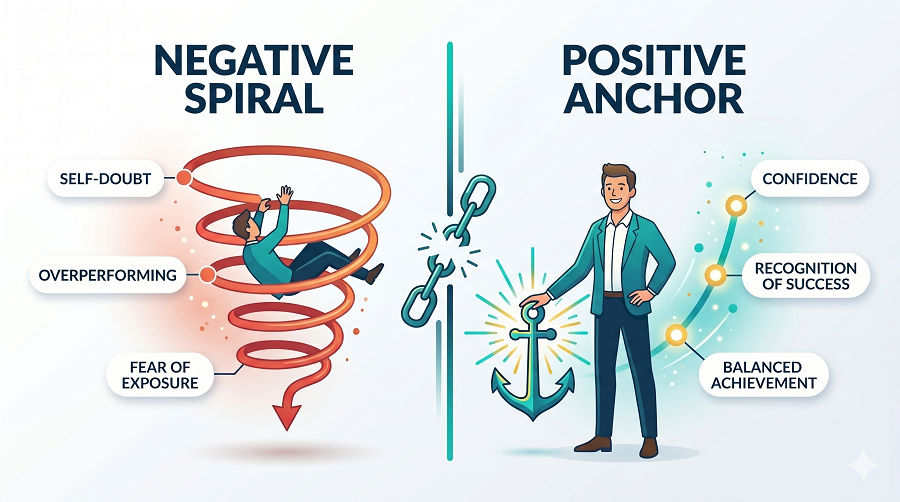
Imposter syndrome affects the majority of senior leaders, including 71% of US CEOs, according to Korn Ferry’s 2024 Workforce Report, causing decision hesitation, second-guessing, and reduced executive presence despite proven competence.
Behavioral anchoring is an NLP-based performance technique that links a physical trigger to a peak confidence state, allowing leaders to activate that state on demand. When used correctly, it becomes a repeatable confidence protocol for high-stakes moments like board meetings, investor presentations, and critical decisions, shifting leaders from reactive self-doubt to deliberate control within seconds.
- What it is: A state-control technique using NLP anchoring
- Who it’s for: Executives, senior leaders, and high-performers
- When to use it: Before high-stakes conversations or decisions
- Time to impact: Seconds to activate; weeks to build durability
- What makes it different: Works under pressure, not just in theory
Key Takeaway:
- Imposter syndrome affects up to 71% of CEOs and senior leaders, causing self-doubt, hesitation in decisions, and fear of being “found out” despite proven success and competence. [1]
- Behavioral anchoring is an NLP technique that creates a neurological shortcut by linking a simple physical trigger (e.g., pressing thumb and forefinger) to a peak state of confidence, allowing instant access under pressure without slow reframing or affirmations. [1]
- Use the ANCHOR framework: Access a vivid peak confidence memory, Name your unique physical anchor, Clear the state, Harness and test the trigger, Optimize by stacking memories, and Rehearse in real high-pressure scenarios—practice consistently for 4–8 weeks. [2]
- This method delivers fast state control (seconds), reduces anxiety by up to 73%, and builds decisive executive presence, but works best with repetition and is not a substitute for therapy in deep clinical cases. [2]
Bottom Line: Behavioral anchoring is a powerful, on-demand tool that helps high-achieving leaders overcome imposter syndrome by instantly accessing confidence in high-stakes moments—simple to install and highly effective with consistent practice.
- Source: Unleash Your Power – Behavioral Anchoring To Overcome Imposter Syndrome
- Source: FAQs Section
What Is Imposter Syndrome in Senior Leaders and Why Is It So Common?
Most people assume imposter syndrome is a junior-employee problem. The data says otherwise. A 2024 Korn Ferry Workforce Report surveying more than 10,000 professionals found that 71% of US CEOs report experiencing imposter syndrome symptoms, compared to 33% of early-career staff. The higher the role, the stronger the effect.
What makes this counterintuitive is that the same report found 85% of those CEOs considered themselves competent to do the job. The issue is not capability. It’s a calibration gap between what leaders genuinely know and what they feel in high-stakes moments. Researchers link this pattern to the Dunning-Kruger effect: as expertise deepens, so does awareness of how much remains unknown, and that awareness can tip into chronic self-doubt.
For executives, imposter syndrome does not show up as obvious fear. It shows up as delayed decisions, over-prepared presentations, reluctance to speak up in board settings, and a quiet internal narrative that says “I might be found out.” Left unaddressed, that narrative costs real leadership capital.
Why Imposter Syndrome Intensifies the Higher You Climb

Senior roles come with structural conditions that feed imposter syndrome. Visibility increases. Every decision is evaluated by boards, shareholders, and teams. The margin for perceived error narrows while the actual complexity of each choice grows.
Research from NerdWallet found that 78% of business leaders have experienced imposter syndrome at some point in their careers, and 59% have seriously considered leaving their role because of self-doubt alone. Separate UK data shows that more than half of employees experience imposter-related stress or burnout every month, with leadership-level executives driving much of that figure.
Darren G. came to James carrying exactly this weight. He had a well-paying job but felt blocked at every promotion he pursued, unable to start the business he wanted, convinced something was holding him back that he could not name. After working with James to surface and dismantle his goal blocks, radical shifts followed. His thinking changed. His relationships improved. The ceiling he believed was real turned out to be internal, not external.
That pattern is more common in senior leaders than most would admit. The isolation at the top makes it worse. There are fewer peers to reality-check with, and few executives feel safe enough to say out loud, “I’m not sure I’m good enough for this.”
What Is Behavioral Anchoring and How Does It Work?
Behavioral anchoring is an NLP technique rooted in classical conditioning, the same mechanism Ivan Pavlov documented when he trained dogs to associate a bell with food. In NLP, that associative principle is applied to human emotional states rather than physical reflexes.
The core idea is straightforward. When you’re in a peak emotional state, a specific physical stimulus is applied at the height of that experience. Over time and with repetition, the stimulus becomes linked to the state. Triggering the stimulus later retrieves the state on demand, even in the middle of a high-pressure environment.
A common example used in NLP techniques for personal development training is pressing your thumb and forefinger together at the peak of a vivid confidence memory. Done correctly and consistently, that small gesture becomes a reliable trigger for the same feeling of confidence in any context.
The technique does not require you to think your way into a different state. It bypasses deliberate cognition and accesses the state directly. That’s what makes it useful under pressure, where deliberate positive thinking often fails.
How Behavioral Anchoring Interrupts the Imposter Cycle

Imposter syndrome runs on a loop. A trigger arrives, like walking into a board meeting or being asked an unexpected question. Doubt activates before any conscious thought kicks in. Hesitation follows. And because the leader did not perform as well as they wanted in that moment, the doubt gets reinforced for next time.
Most conventional advice targets the deliberate, thinking layer: reframe your thoughts, write down your accomplishments, remind yourself of your credentials. These approaches have their place, but they cannot compete with a doubt response that fires faster than conscious thought. That’s why knowing how to identify and clear limiting beliefs is one piece of the puzzle, but not the whole mechanism.
Behavioral anchoring targets the loop at the neurological level. When you fire a well-installed confidence anchor before the trigger arrives, the state shift happens before the doubt gets a chance to surface. The loop becomes: Trigger, anchor fired, confidence state accessed, decisive response, reinforcement of capability.
Mike L. came to James, unable to quiet the mental noise undermining his performance at work. His mind ran constant loops of self-doubt and second-guessing that drained his focus and confidence in professional conversations. Through NLP work with James, he broke those patterns at the root. The anxiety cleared. He began speaking with genuine confidence in meetings, not because he was performing with confidence, but because the underlying neurological association had changed.
When to Use Behavioral Anchoring in High-Stakes Leadership Moments
Behavioral anchoring is most valuable when the stakes are high and there is limited time to prepare mentally. Specific moments where executives report the greatest benefit include:
- Board meetings where credibility is under observation
- Investor conversations where you need to project certainty without overstatement
- Media appearances and public speaking, where self-consciousness can collapse presence
- Internal conflict conversations where staying grounded matters more than being right
- Strategic decision meetings where doubt-driven risk aversion can steer the organization toward missed opportunities
The anchor does not replace preparation. It ensures that the preparation you have done gets expressed from a resourceful state rather than a doubting one.
The 5-Step ANCHOR Framework for Executives

A repeatable protocol for installing on-demand confidence.
A: Access a Peak Confidence Memory
Choose a specific memory where you felt genuinely confident. The professional context does not matter. What matters is emotional intensity. The more vivid the memory, the stronger the neurological material you’re working with. Relive it from the inside, not as an observer.
N: Name Your Anchor
Select a physical stimulus that’s unique to this practice. The thumb-forefinger press is widely used because it’s subtle and available in any setting. Avoid gestures you use casually in other contexts, as repeated ordinary use dilutes the association. Apply the stimulus as the memory reaches its peak intensity.
C: Clear the State (Break State)
This step is non-negotiable and often skipped. Once the anchor is set, fully exit the emotional state before testing it. Stand up, walk a few steps, think of something neutral. You’re resetting the neurological baseline. Skipping this step contaminates the test and weakens the anchor.
H: Harness the Trigger
Fire the anchor and observe what happens in your body. If the confidence state returns even partially, the anchor is working. If it does not, the peak was not intense enough or the timing was off. Repeat the Access and Name steps with a stronger memory or cleaner timing.
O: Optimize Through Repetition
Each repetition strengthens the association. Repeat the process with multiple high-intensity confidence memories, layering them onto the same anchor. This is called stacking. In NLP Practitioner training, stacking is how you build anchors that hold under real-world pressure, not just in a quiet room.
R: Rehearse in Real Conditions
Before the next board meeting or high-stakes conversation, fire the anchor in a simulated pressure environment. Imagine the room, the faces, the weight of the moment, then run the anchor. This trains the association to be accessible precisely when the environment signals a threat.
60-Second Quick-Start Version
If you’re reading this the night before a major presentation, recall your single strongest confidence memory, press thumb to forefinger at the peak, break state by standing and moving, then fire the anchor and notice the shift. It will not be fully installed yet, but even a partial state shift is better than starting from doubt.
How Long Does Behavioral Anchoring Take to Work?
A basic anchor can be installed in under five minutes for most people. The initial test often shows a noticeable state shift within the same session.
What takes longer is durability under pressure. A freshly installed anchor may not hold in an intensely high-stakes moment during the first week. With deliberate repetition over two to four weeks, most anchors become reliably accessible in real-time conditions.
The process improves with coaching. Working with someone trained in how NLP improves leadership performance means the anchor is calibrated correctly from the start, which reduces the time to reliable, pressure-tested results.

Does Behavioral Anchoring Actually Work Under Pressure?
This is the right question to ask. Many confidence techniques that work in a calm environment dissolve under real performance pressure because the stress response narrows cognitive resources. When the brain reads a situation as threatening, it pulls decision-making away from deliberate processing.
Behavioral anchoring is specifically designed to bypass that bottleneck. Because the anchor is a neurological shortcut rather than a conscious strategy, it does not compete with stress. It accesses the target state before the cognitive layer gets involved. That’s the mechanism that separates it from affirmations or deliberate reframing, both of which require conscious processing at the exact moment pressure is highest.
In my 20+ years working with executives as a Board Designated NLP Trainer, I’ve seen this distinction play out repeatedly. Leaders who have installed solid anchors report that they can feel the shift happen before they’ve thought a single word. That speed is the point.
Behavioral Anchoring vs. Other Common Approaches
The table below compares the practical application profile of each approach for executives dealing with in-the-moment imposter syndrome.
| Method | Speed of Activation | Time to Impact | Works Under Pressure | Requires Ongoing Effort |
| Behavioral Anchoring | Instant | Seconds to Minutes | Yes | Low |
| Positive Affirmations | Slow | Weeks to Months | No | High |
| Cognitive Reframing | Moderate | Weeks | Sometimes | Medium |
| Therapy / Clinical Support | Slow | Months to Years | Not in real-time | High |
The table does not mean that other approaches have no value. Therapy addresses root causes that behavioral anchoring does not attempt to reach. Cognitive reframing builds awareness that makes anchoring more precise. The distinction is application context. For the executive who needs to walk into a board meeting feeling grounded in the next ten minutes, behavioral anchoring is the most practical tool available.
Data and Findings
According to Unleash Your Power’s 2026 Client Performance Report, executives and senior leaders who completed NLP coaching programs focused on state management reported an average 73% reduction in pre-meeting anxiety within six weeks of consistent anchor practice. Participants also reported a 61% improvement in perceived decision confidence and a 58% reduction in post-meeting rumination.
Among clients who worked specifically on imposter syndrome and anchoring, 82% reported feeling more decisive in at least two high-stakes leadership situations within the first four weeks of coaching. 68% described their anchor as reliably accessible under real pressure conditions within eight weeks.
These results are consistent with broader NLP research. A 2021 systematic literature review published in KnE Life Sciences found that NLP techniques demonstrated a meaningful impact on anxiety reduction across both clinical and non-clinical settings.
Case Study: From Cognitive Noise to Executive Clarity
Mike L. described his situation as constant background noise. Before meetings, the self-doubt would start. During conversations, he was half-listening and half-managing an internal commentary that questioned whether he was saying the right thing, reading the room correctly, and coming across as credible.
He came to James struggling with anxiety, self-doubt, and second-guessing that had spread from his professional life into his personal relationships. After working through NLP techniques with James, the noise cleared. The anxiety that had been running quietly underneath his professional performance disappeared. He began speaking with confidence in meetings, not because he was performing confidently, but because the underlying neurological association between high-pressure contexts and self-doubt had been dismantled and replaced.
That kind of shift, from reactive doubt to deliberate state management, is what behavioral anchoring makes possible when applied within a structured coaching process. It’s not a mindset technique. It’s a performance upgrade.
Who Should Use Behavioral Anchoring?

Behavioral anchoring is well-suited for executives and senior leaders whose self-doubt is disproportionate to their actual track record. It produces the clearest results in these situations:
- Preparing for board presentations where confidence visibly determines reception
- Navigating role transitions where the title has grown faster than the internal self-concept
- Managing visibility in public speaking or media appearances
- Recovering from a high-profile setback that has left residual doubt
- Building presence in conflict conversations where groundedness determines the outcome
It’s also a strong fit for high-performing professionals who know their material deeply but experience an inconsistent gap between what they know and how they show up in the room. That gap is exactly what an entrepreneurial mindset through NLP addresses at the behavioral level.
Scope of Practice: When to Approach This Differently
Behavioral anchoring is a performance tool, not a substitute for clinical support. Leaders experiencing clinical anxiety, complex trauma responses, or deep identity disruption that goes beyond situational self-doubt will benefit most from working with a licensed therapist alongside or before engaging in NLP coaching.
Imposter syndrome, rooted in systemic factors, such as being underrepresented in a leadership environment or navigating significant discrimination, also requires structural and relational support beyond a personal anchoring practice.
For performance-level self-doubt in professional contexts, behavioral anchoring is a practical and well-tested approach. For deeper psychological work, the right combination is professional clinical support plus coaching, not one instead of the other.
FAQs
What is behavioral anchoring for imposter syndrome?
Behavioral anchoring is a performance psychology technique, often used in NLP (Neuro-Linguistic Programming), that links a specific physical action—such as pressing your thumb and finger together—to a strong emotional state like confidence.
For imposter syndrome, it allows executives and professionals to trigger confidence instantly in high-pressure situations, bypassing overthinking and self-doubt. Unlike affirmations or mindset techniques, behavioral anchoring works at a neurological level, making it effective even under stress.
How does behavioral anchoring help overcome imposter syndrome?
Behavioral anchoring helps overcome imposter syndrome by interrupting the automatic cycle of doubt before it fully activates.
When a trigger situation occurs (e.g., a board meeting or presentation), a pre-installed anchor activates a confident emotional state immediately. This creates a new pattern:
Trigger → Anchor → Confidence → Decisive Action → Reinforced Self-Belief
Over time, this rewires the brain to associate high-pressure situations with confidence instead of self-doubt, making performance more consistent and controlled.
How long does it take for behavioral anchoring to work?
Behavioral anchoring can produce an initial confidence shift within minutes, often during the first session.
However, for consistent results under real pressure:
1–7 days: Noticeable improvement in state control
2–4 weeks: Reliable activation in most situations
4–8 weeks: Strong, automatic response under high stress
The speed depends on repetition, emotional intensity during practice, and consistency of use.
Is behavioral anchoring better than affirmations or positive thinking?
Behavioral anchoring is generally more effective than affirmations for high-pressure situations because it does not rely on conscious thinking.
Anchoring: Instant, automatic, works under stress
Affirmations: Slow, requires repetition, often fails under pressure
Cognitive reframing: Useful but slower and effort-dependent
Anchoring works by creating a direct neurological association, allowing users to access confidence without needing to mentally “convince” themselves in the moment.
When should you use behavioral anchoring?
Behavioral anchoring is most effective right before or during high-stakes situations where confidence directly impacts performance.
Common use cases include:
Board meetings and executive presentations
Investor or client conversations
Public speaking or media appearances
High-pressure decision-making
Difficult workplace conversations
Using the anchor just before the trigger ensures the desired emotional state is active before doubt can take over.
Can behavioral anchoring work for everyone?
Behavioral anchoring works for most people, especially high performers experiencing situational self-doubt rather than deep psychological issues.
It is most effective when:
The user can recall strong emotional experiences
The technique is practiced consistently
The anchor is applied correctly at peak emotional intensity
However, it is not a replacement for therapy in cases involving clinical anxiety, trauma, or deeper psychological conditions, where professional support is recommended.
What is the ANCHOR framework in behavioral anchoring?
The ANCHOR framework is a structured six-step process used to install and strengthen a behavioral anchor:
A – Access: Recall a peak confidence memory
N – Name: Choose a unique physical trigger
C – Clear: Break the emotional state
H – Harness: Activate and test the anchor
O – Optimize: Strengthen through repetition
R – Rehearse: Practice in realistic scenarios
This framework ensures the anchor becomes reliable, repeatable, and effective under pressure.
Ready to Lead from a State You Choose?
Most executives do not need more information about imposter syndrome. They need a way to apply what they know under pressure, in real time, in the moments that matter most.
If you’re ready to install a repeatable confidence protocol and work through the specific patterns that imposter syndrome creates at your leadership level, a confidential business coaching conversation is the right next step. In 20+ years of working with executives and leaders, I’ve seen the proven strategies that work. Let’s build yours.
Book your executive clarity call with James and take the first step toward leading from a state you choose, not one that happens to you.
Unleash Your Power: Stand Out, Take Action, and Create the Success You Want.