
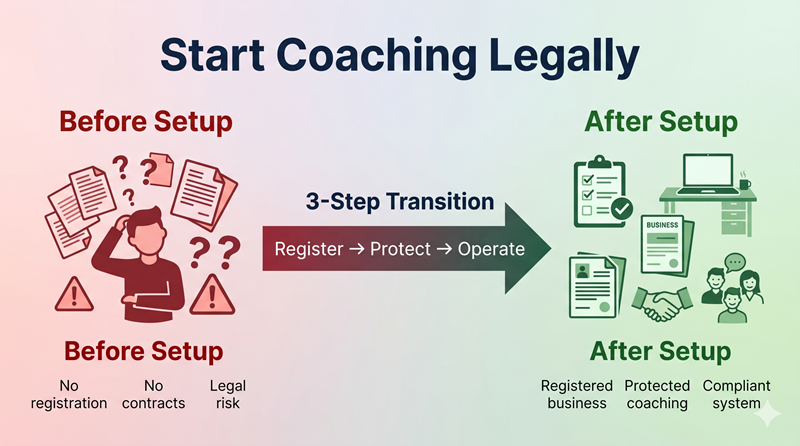
Here is a fact that surprises most people stepping into coaching: when it comes to legal requirements, you could legally call yourself a life coach in Canada today, sign your first client tomorrow, and no government body would stop you. No license exam. No regulatory board. No waiting period.
Key Takeaway:
- In Canada, life coaching is not a regulated profession. This means you do not need a government license, specific degree, or formal certification to legally call yourself a life coach or start a coaching business. [1]
- However, you must follow general business laws: register your business (sole proprietorship, corporation, or partnership), obtain any required municipal or provincial business licenses, collect and remit GST/HST if your revenue exceeds $30,000 per year, and comply with privacy laws (PIPEDA). [1]
- Using titles like “therapist,” “counsellor,” or “psychologist” is illegal without proper licensing. Always clearly position yourself as a coach, not a mental health professional, to avoid legal issues. [2]
- While certification is not legally required, having reputable training (ICF, PCC, or equivalent) significantly builds credibility, trust, and your ability to charge premium rates. [2]
Bottom Line: You can legally start coaching in Canada without a license or formal certification, but you must register your business, follow tax and privacy laws, and clearly distinguish yourself from regulated mental health professionals. Investing in quality training is highly recommended for credibility and business success.
That sounds like freedom, and in many ways it is. But if you have spent any time in the coaching or NLP space, you know that “unregulated” and “consequence-free” are two very different things. I have watched aspiring coaches build remarkable practices from scratch, and I have also watched them run into real, preventable problems. Not because they lacked skill or heart, but because they did not understand the legal and business landscape they were stepping into.
In my 20 plus years of working with coaches and professionals across Canada, I have seen this pattern repeatedly. People who are extraordinary at the work of coaching get tangled up in the business of it. This article is here to clear that up. You will get a practical, province-by-province breakdown of what is actually required to coach legally in Canada, from business registration to taxes to certification, so you can take decisive action and build something that lasts.

Is Life Coaching a Regulated Profession in Canada?
The Short Answer: No, and That Is Both Good and Tricky.
Life coaching is an unregulated field across all Canadian provinces and territories, as Zensurance’s guide for Canadian coaches confirms. There is no federal or provincial licensing body that governs who can practice. No mandatory certification. No government-issued credential required. If you want to call yourself a life coach, business coach, or NLP coach, you are free to do so.
That is the good news. The opportunity is real. The 2025 ICF Global Coaching Study puts the global coaching industry at $5.34 billion USD, with North America leading in both coach density and earning potential. Canada is a significant and growing slice of that market.
But here is where the complexity enters.
Where Coaching Ends and Regulated Professions Begin
Even though coaching is unregulated, several adjacent professional activities are governed by provincial law. The moment your language or practice starts to look like mental health counseling, registered dietetics, or psychotherapy, you are moving into territory that requires specific credentials, and the consequences of crossing that line range from professional complaints to legal action.
Research on mental health regulation across Canada makes the boundary clear: titles like “psychotherapist,” “counselling therapist,” and “social worker” are legally protected in specific provinces. Ontario, Quebec, and New Brunswick have formal legal frameworks protecting these titles, and anyone using them without proper registration is breaking the law regardless of intent.
As a coach, you have tremendous freedom. You can work on mindset, limiting beliefs, confident communication, goal clarity, peak performance, and personal transformation. What you cannot do without regulated credentials is diagnose, treat, or claim to address clinical mental health conditions. Know where coaching’s power lives, operate fully within it, and you will never need to worry about this boundary.
Do You Need a Business License to Coach in Canada? A Provincial Breakdown
Most aspiring coaches are genuinely surprised to learn that business registration is not a federal matter in Canada. It is provincial. And the rules vary meaningfully from one region to the next.

Ontario: Quick, Online, and Affordable
If you are coaching in Ontario under a business name other than your own legal name, you are required to register that name with the province. Registration runs $60 and is valid for five years, and it can be completed entirely online through the Ontario Business Registry, with your Master Business Licence issued almost immediately. If you are coaching under your full legal name only, no registration is technically required. That said, registering gives your practice official structure, opens the door to a business bank account, and signals professionalism from the very first client conversation. For coaches exploring the best business coaching certifications available in Ontario, that structure becomes even more valuable as your reputation grows.
British Columbia: A Two-Step Process
BC separates name approval from business registration. First, you reserve and approve your business name through BC Registry Services for a $30 fee. Once approved, you register the business itself for $40. Both steps can be completed online, in person at a Service BC location, or by mail. If you are coaching exclusively under your own name, neither step is required.
Alberta: The Simplest Path for Sole Proprietors
Alberta combines trade name registration and sole proprietorship registration into a single Declaration of Trade Name form, costing approximately $50. One form, one step. Note that Alberta does not currently support online filing for sole proprietorships, so you will submit through a licensed Corporate Registry agent.
Quebec: Language Law Is Not Optional
Quebec adds meaningful complexity. If your business name does not include your exact first and last name, you are required to register within the first 60 days of operating. Unlike most other provinces that operate on three to five-year renewal cycles, Quebec requires annual re-registration. And critically, even if your coaching practice has an English name, provincial law requires you to provide an officially approved French version, and that French name becomes the primary name under the Charter of the French Language. This is not a technicality to handle later. It is foundational.
Other Provinces: Nova Scotia, Manitoba, Saskatchewan, PEI and Beyond
The remaining provinces follow the same core principle: if you are operating under a name other than your legal name, register with the appropriate provincial authority. Fees and timelines vary. PEI charges $90 with a roughly five-business-day review. Nova Scotia and Manitoba both offer accessible online registries. Saskatchewan handles registration through the Information Services Corporation. New Brunswick operates similarly. One standout exception worth knowing: Newfoundland and Labrador has no mandatory registration requirement for sole proprietors at all, making it the easiest province in Canada from a registration standpoint.
What Every Canadian Coach Needs Legally, Regardless of Province
Three legal requirements apply to virtually every coach in Canada, no matter where you live or how you structure your practice. These are the ones that catch people off guard.
The GST/HST Threshold That Surprises New Coaches
You are not required to register for GST/HST until your coaching revenue exceeds $30,000 CAD over four consecutive calendar quarters. This is the Canada Revenue Agency’s small supplier threshold. Once you cross it, registration becomes mandatory and you will collect and remit GST/HST on all taxable services. What many new coaches do not realize is that early voluntary registration lets you claim input tax credits on your business expenses, potentially saving money before you even hit the threshold. If you are growing quickly, talk to an accountant about the timing.
Your Privacy Policy Is a Legal Requirement, Not a Courtesy
If your coaching website collects any personal information, including a contact form, an email opt-in, or a booking system, you are legally required to publish a privacy policy under Canada’s Personal Information Protection and Electronic Documents Act (PIPEDA) and applicable provincial equivalents. Your policy needs to clearly state what data you collect, how it is used, and when it is shared with third parties, including your email platform, scheduling software, or payment processor. If you work with clients in the European Union, GDPR compliance is also required. This is not bureaucratic overhead. It is the foundation of client trust, and in coaching, trust is everything.
Coaching Contracts: Non-Negotiable Before Client One
A coaching agreement is not legally mandated, but it is professionally and financially essential. A solid contract establishes what is included in your sessions, your payment, cancellation, and refund terms, how coaching will be delivered, and a clear scope-of-practice disclaimer confirming that your work is not a substitute for medical, psychological, or legal advice. This protects you legally and sets transparent expectations from day one. Never begin a paid coaching engagement without one.

Try This: Before writing your coaching contract, do a quick NLP values audit on your practice. Ask yourself: “What are the non-negotiables in how I show up for clients?” Write down five answers without filtering. Then ask: “What would I never want a client to misunderstand about what I offer?” Those two lists will tell you exactly what belongs in your contract and what your scope-of-practice disclaimer should clearly address.
Do You Need a Certification to Coach in Canada?
Legally? No. Strategically? Absolutely.
The 2025 ICF Global Coaching Study reveals that 73% of clients now expect their coach to hold a recognized certification or credential, and that number continues to climb. Corporate organizations, which represent some of the most lucrative coaching opportunities, actively filter for credentialed coaches when evaluating who to hire or recommend. The market is self-regulating, even as governments have not stepped in to do it.
This is the single most important truth about the Canadian coaching landscape right now: the market is professionalizing, and the coaches who thrive over the next decade will be the ones who treated certification as a foundation, not an afterthought.
What ICF Credentials Actually Signal to Clients
The International Coaching Federation offers three credential levels: Associate Certified Coach (ACC), Professional Certified Coach (PCC), and Master Certified Coach (MCC). Each requires progressively more accredited training hours, supervised client coaching hours, and demonstrated competency assessments. These credentials do not just add letters after your name. They represent a verified standard of practice that clients, corporations, and referral partners have learned to trust, and they command measurably higher fees.
How NLP Certification Transforms Your Practice and Your Results
This is where things get genuinely powerful. NLP gives coaches a deep, research-grounded toolkit for facilitating transformation that reaches far beyond goal setting. As a Board Designated NLP Trainer, I have seen firsthand how coaches who bring NLP methodology into their practice do not just help clients articulate goals. They help clients dismantle the subconscious patterns that were quietly blocking those goals all along.

Heather Chetwynd came to an NLP Practitioner training, having completed NLP elsewhere but left that first experience confused about how to actually integrate the techniques into her client work. After completing the program, she walked away with more than technical clarity. She gained unexpected business insight, genuine excitement about her coaching direction, and a structured methodology she could apply with confidence. That shift from knowing the theory to knowing how to use it is what rigorous, credentialed training actually delivers.
Explore NLP training in Canada and life coach training certification programs to see what a serious, professionally recognized path looks like and what it makes possible.
What Legal Risks Do Canadian Coaches Need to Actively Avoid?
The Mental Health Boundary Is a Hard Line
The most significant legal exposure for Canadian coaches is not a licensing violation. It is drifting into territory that resembles mental health practice without the corresponding regulated credentials. Canadian legal guidance for coaches is consistent on this: if your coaching starts to resemble therapy, if you are treating trauma responses, diagnosing psychological patterns, or claiming to address clinical mental health conditions, you are exposed to serious legal and professional liability. In Ontario specifically, the Regulated Health Professions Act creates clear statutory boundaries around psychotherapy.
The answer is not to be less powerful in your coaching. It is to be fully grounded in what coaching genuinely is: transformation through goal clarity, mindset work, behavioral change, and forward momentum. That is an extraordinary space to work in. Stay in it.
Misleading Advertising Is a Federal Issue
Canada’s Competition Act prohibits misleading advertising and deceptive marketing practices. If your website, program descriptions, or social media claim results you cannot substantiate, such as guaranteed transformation or results in unrealistic timeframes, you are exposed to complaints and potential enforcement. Use language that is both legally sound and genuinely truthful. Coaching builds confidence, clarifies purpose, shifts mindset, and creates momentum. That is real, that is enough, and it is more than enough.
Professional Insurance Is Your Safety Net
Professional liability insurance, also called errors and omissions insurance, protects you if a client alleges that your coaching caused harm or failed to deliver promised results. General liability covers physical incidents in in-person settings. These are the baseline for operating responsibly, and many professional coaching associations offer group rates that make coverage genuinely accessible for solo practitioners.
Try This: Before you sign your first paid coaching client, run this five-point self-audit. Do you have a coaching contract with a clear scope-of-practice disclaimer? A published privacy policy on your website? Is your business registered appropriately for your province? A plan for GST/HST once you approach the $30,000 threshold? Professional liability insurance in place? If you can check all five, you are not just legally protected. You are operating with the kind of credibility that clients feel before they have read a single testimonial.
How Do You Build a Coaching Business in Canada the Right Way?
Getting this right is not complicated. It is sequential.
Start with your legal structure. Most new coaches begin as sole proprietors. It is the simplest and least expensive structure. As your client base grows, incorporation offers meaningful liability protection and tax planning advantages worth discussing with an accountant.
Register in your province using the breakdown above. If your business name differs from your legal name, register it before any public-facing marketing. Note your province’s renewal schedule and add it to your calendar.
Invest in a recognized certification. Not because a law requires it, but because the market does, and because working from a credible methodology transforms both the quality of your client results and the confidence you bring to every session.
Darren came to James carrying real professional frustration: a well-paying job, genuine ambition, and an inexplicable inability to move forward on promotions, on income, and on the business he had been planning for years. After working through the goal blocks and limiting beliefs operating below the surface, the shifts were not incremental. They were radical. His thinking changed, his behavior changed, and his relationships improved as a direct result. That kind of transformation does not happen by accident. It happens through proven strategies applied by a coach who knows what they are doing.
Draft your coaching contract, get your privacy policy live, secure your professional liability insurance, and then start coaching. Keep refining. Keep growing.
For a deeper guide to starting a life coaching business in Canada, explore what the full journey looks like from first client to sustainable, thriving practice. And when you are ready to understand the life coaching certification landscape in Canada in depth, that resource has everything you need to choose your path with clarity.
Frequently Asked Questions
Do I need a license to be a life coach in Canada?
No. Life coaching is an unregulated profession across all Canadian provinces and territories. There is no government-issued license or mandatory certification required to call yourself a coach or charge for coaching services. That said, 73% of coaching clients now expect their coach to hold a recognized credential, making certification your most practical competitive advantage even without a legal mandate.
What province has the easiest business registration for coaches?
Newfoundland and Labrador requires no sole proprietorship registration at all. Alberta is the simplest province that requires registration, combining the process into a single form for approximately $50. Ontario is also straightforward, with online registration available for $60 and near-instant processing through the Ontario Business Registry.
When do I need to start collecting GST/HST as a coach?
Once your coaching revenue exceeds $30,000 CAD over any four consecutive calendar quarters, GST/HST registration becomes mandatory under Canada Revenue Agency rules. Below that threshold, you are classified as a small supplier and are not required to charge it. Voluntarily registering earlier allows you to claim input tax credits on business expenses, which can be advantageous if you are investing significantly in tools, training, and marketing.
Is NLP coaching a regulated profession in Canada?
No. NLP coaching, like life coaching generally, is not a regulated profession anywhere in Canada. However, the quality and credibility of your NLP training matter enormously for both client outcomes and professional reputation. Certification through a program delivered by a Board Designated NLP Trainer establishes the standard that corporate clients and serious coaching buyers look for.
What is the difference between a life coach and a therapist in Canada?
The distinction is both practical and legal. Therapists, including psychotherapists, counselling therapists, and psychologists, are regulated health professionals registered with provincial colleges, with legally mandated training standards and oversight. Life coaches are not regulated. Coaches work on goal achievement, mindset, performance, and forward momentum. Therapists address mental health treatment, trauma, and clinical psychological conditions. Coaches who blur this line, particularly by claiming to treat mental health conditions, face serious legal exposure under provincial health professions legislation.
Conclusion
The legal requirements for coaching in Canada are genuinely manageable. Coaching is unregulated. Business registration is straightforward and mostly inexpensive. The GST/HST threshold gives new coaches a meaningful runway before tax obligations kick in. Contracts, privacy policies, and insurance are achievable foundations, not obstacles.
Here is the deeper truth worth sitting with: knowing the rules gets you started. But the coaches who build practices that genuinely last, the ones who transform clients’ careers, relationships, and self-belief year after year, are not just compliant. They show up with world-class training, a credible methodology, and the inner clarity that comes from having done their own work first.
That is what this is really about. Not bureaucracy. Breakthrough.
Ready to build something that stands out? Explore life coach training certification in Canada or connect to learn about NLP-based coaching programs designed to give you the tools, credentials, and confidence to create a practice and a career that lasts.
Unleash Your Power: Stand Out, Take Action, and Create the Success You Want.
Disclaimer: This article is for informational purposes only and does not constitute legal or financial advice. Consult a qualified Canadian lawyer and accountant for guidance specific to your province and business structure.