
The deal is worth six figures. Maybe seven. The other party just pushed back on your proposal, and you can feel the tension in the room shift. Your next words matter more than any presentation slide or financial projection ever could. This is the moment where deals get made or lost.
Key Takeaway:
- NLP offers powerful techniques that give you a significant edge in high-stakes negotiations. It helps you stay calm under pressure, read people accurately, build instant rapport, and influence outcomes without manipulation. [1]
- Key NLP tools for negotiations include: anchoring positive emotional states, using powerful language patterns (embedded commands & pacing-and-leading), mirroring and matching to build subconscious trust, reframing objections, and calibrating non-verbal cues to detect hidden intentions. [1]
- Mastering these techniques allows you to control your own emotional state, uncover the other party’s true needs and motivations, overcome resistance gracefully, and guide negotiations toward win-win outcomes — even in tense, high-pressure situations. [2]
- Top negotiators, executives, and high-ticket closers use NLP not just to win deals, but to build long-term relationships and maintain integrity while achieving superior results. [2]
Bottom Line: NLP is a game-changer for high-stakes negotiations. By mastering emotional control, rapport-building, language patterns, and objection reframing, you can negotiate with greater confidence, clarity, and influence — leading to better deals, stronger relationships, and higher success rates.
Here’s what most people don’t know: 68% of negotiations end without any formal agreement. And 75% of managers will tell you that poor negotiation skills directly damage their company’s bottom line. The difference between walking away empty-handed and closing the deal often comes down to skills most negotiators never develop.
I’ve spent 20+ years working with professionals who face these high-stakes moments. What I’ve learned is this: the best negotiators aren’t necessarily the smoothest talkers or the most aggressive dealmakers. They’re the ones who understand the psychology behind every conversation. They know how to read what’s really happening beneath the surface, build genuine connections under pressure, and access their best performance exactly when it matters most. That’s where NLP training for business becomes your competitive advantage.
The three techniques you’re about to learn aren’t theories pulled from a textbook. They’re battle-tested tools from real negotiations where millions were on the line. And they work whether you’re closing a major contract, negotiating with investors, or handling a critical supplier relationship. Professional NLP training teaches you to apply these systematically, but you can start using them immediately.
Why Most High-Stakes Negotiations Fail (And How NLP Changes the Game)
Let’s be direct: most negotiations fail because people focus on what they’re saying instead of how they’re communicating. They prepare arguments, rehearse counterpoints, and walk in ready to win a debate. But negotiations aren’t debates. They’re psychological chess matches where rapport, timing, and emotional intelligence determine outcomes.
The Hidden Cost of Poor Negotiation Skills
People who negotiate frequently earn 25% more over their lifetime than those who rarely negotiate. That’s not a small difference. That’s the cost of a house, your children’s education, or your retirement security. In business, the stakes multiply. A poorly handled supplier negotiation costs you thousands per month for years. A botched partnership discussion closes doors that never reopen.
Research on extreme negotiations from Harvard Business Review shows something revealing: CEOs and senior executives report feeling constantly in negotiation mode, managing deals worth hundreds of millions in the shortest possible timeframes. The pressure is extreme. The margin for error is zero.
What Makes a Negotiation “High-Stakes”
A negotiation becomes high-stakes when it carries significant financial, strategic, or reputational risk. It’s not just about the dollar amount on the table. It’s about what happens if you walk away without a deal, or worse, with a bad deal you’ll regret for years.
High-stakes negotiations typically involve:
- Multiple stakeholders with competing agendas
- Long-term implications where one misstep cascades into future challenges
- Power dynamics that shift throughout the conversation
- Compressed timeframes demanding quick, confident decision-making
While the average negotiation lasts 13 minutes, high-stakes negotiations often extend over several days. Those are days of maintaining composure, reading subtle signals, and staying strategically focused when exhaustion and pressure are working against you.
How NLP Provides the Edge You Need
Neuro-Linguistic Programming studies the relationship between how we think (neuro), how we communicate (linguistic), and the patterns we run (programming). In negotiations, this means understanding the invisible forces that actually drive decisions.
Most negotiators operate at the surface level. They hear “your price is too high” and immediately defend their pricing. Someone trained in NLP hears the same objection and recognizes it as a surface-level statement masking deeper concerns. They know how to ask the questions that reveal what’s really going on. They can build rapport in minutes that would normally take hours. They can shift their own emotional state from anxious to confident in seconds.
That’s not manipulation. It’s mastery.
Technique #1: Mirroring and Matching Build Instant Rapport Under Pressure
Walk into any successful negotiation and you’ll notice something interesting: the people who reach agreements start to look and sound alike. Their posture aligns. Their speech patterns converge. They’re unconsciously mirroring each other, and that mirror is building trust at a level words alone can’t reach.
The Science Behind Mirroring in High-Pressure Situations
Negotiation research shows that negotiators who build rapport early on are 40% more likely to close deals successfully. That’s not a small advantage. That’s the difference between winning and losing nearly half the time.
When you mirror someone’s body language, voice tone, or language patterns, you’re sending a powerful unconscious signal: “I’m like you. We’re on the same wavelength.” The human brain is wired to trust people who are similar to us. It’s a survival mechanism that goes back thousands of years, and it still operates in every boardroom negotiation today.
The key is subtlety. Obvious mirroring feels creepy and manipulative. Skillful mirroring feels like a natural connection.
How to Mirror Without Being Obvious
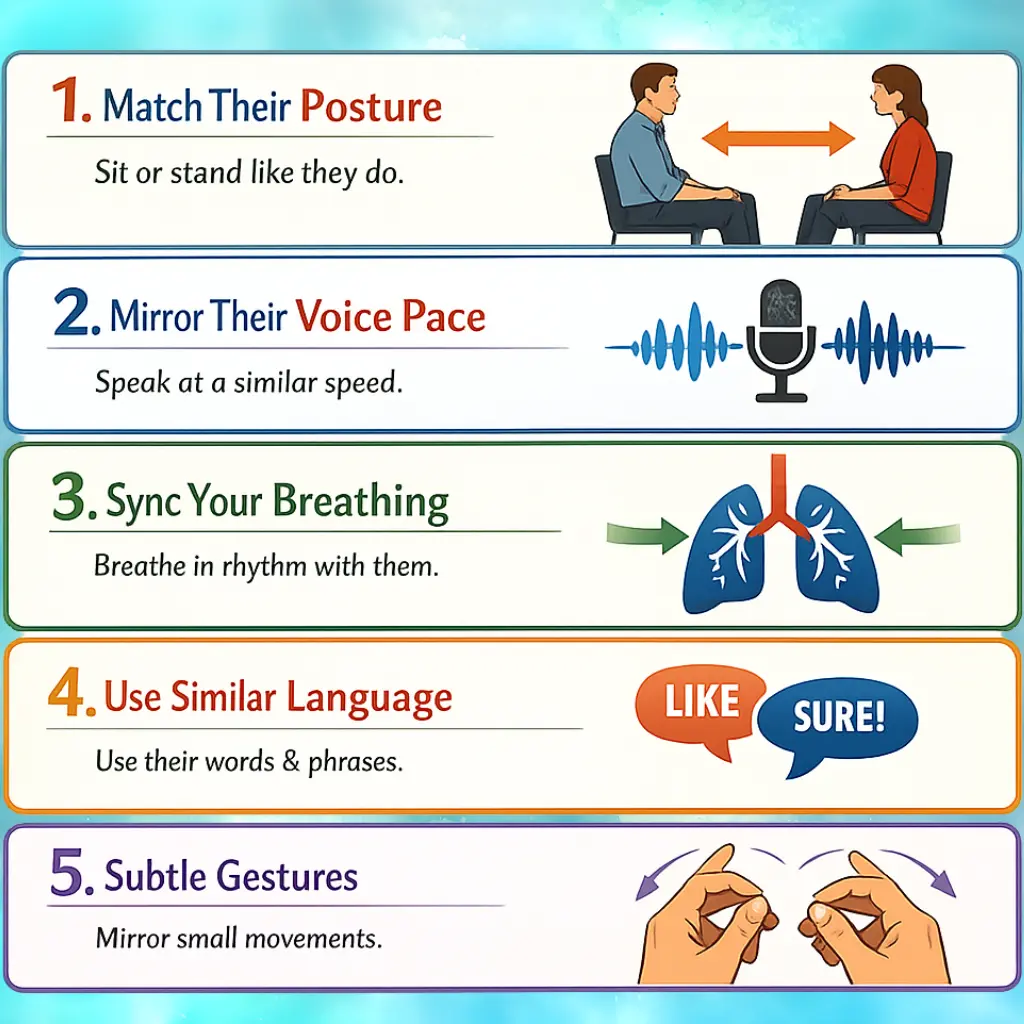
Start with posture. If they’re leaning forward, engaged, you lean forward slightly. If they’re sitting back, more relaxed, you match that energy. Don’t copy them exactly, that’s obvious and weird. Instead, find the general energy level and match it.
Voice is next. Listen to their pace. Are they speaking quickly, with urgency? Or slowly, deliberately? Match their rhythm within a reasonable range. If they’re speaking at 120 words per minute and you’re at 180, slow down. You want to be in the same ballpark.
Breathing is the subtle move that master negotiators use. Watch their shoulders, their chest. Match their breathing rhythm loosely. This creates unconscious synchronization that deepens rapport without any conscious awareness from either party.
Matching Language Patterns for Deeper Connection
People process information differently. Some people are visual (“I see what you mean”). Others are auditory (“That sounds right to me”). Still others are kinesthetic (“I get a sense that this will work”).
Listen for these patterns in how they speak, then mirror them back. If someone says, “I need to see the numbers,” respond with, “Let me show you the breakdown.” If they say, “This doesn’t feel right,” respond with “I understand that feeling. Let’s get to the heart of your concerns.”
You’ll find additional NLP negotiation strategies in practice, but mirroring is your foundation. Everything else builds on this rapport.
Real Application: Opening a Tense Negotiation
You walk into the room. The other party is sitting back, arms loosely crossed, speaking in measured tones. They’re not hostile, but they’re guarded. What do you do?
You don’t burst in with high energy trying to “pump them up.” That creates friction. Instead, you match their energy. You sit with a similar posture, open, but not overly eager. You speak at their pace, maybe slightly slower to bring calm to the room. Within three minutes, you’re starting to mirror their breathing.
Five minutes in, they lean forward. You lean forward. They start speaking faster, more animated. You match that shift. What you’ve done is create an unconscious rapport that makes every word you say land with more trust and receptivity.
This isn’t theory. This is how deals actually get made.
Technique #2: Meta Model Questions Uncover What They’re Really Saying
“I can’t do this.” “Your price is too high.” “We need more time.” “This won’t work for us.”
Every negotiator hears objections. Most respond by defending their position or offering immediate solutions. But here’s the problem: the objection you hear is almost never the real issue. It’s a surface-level statement that masks the actual concern.
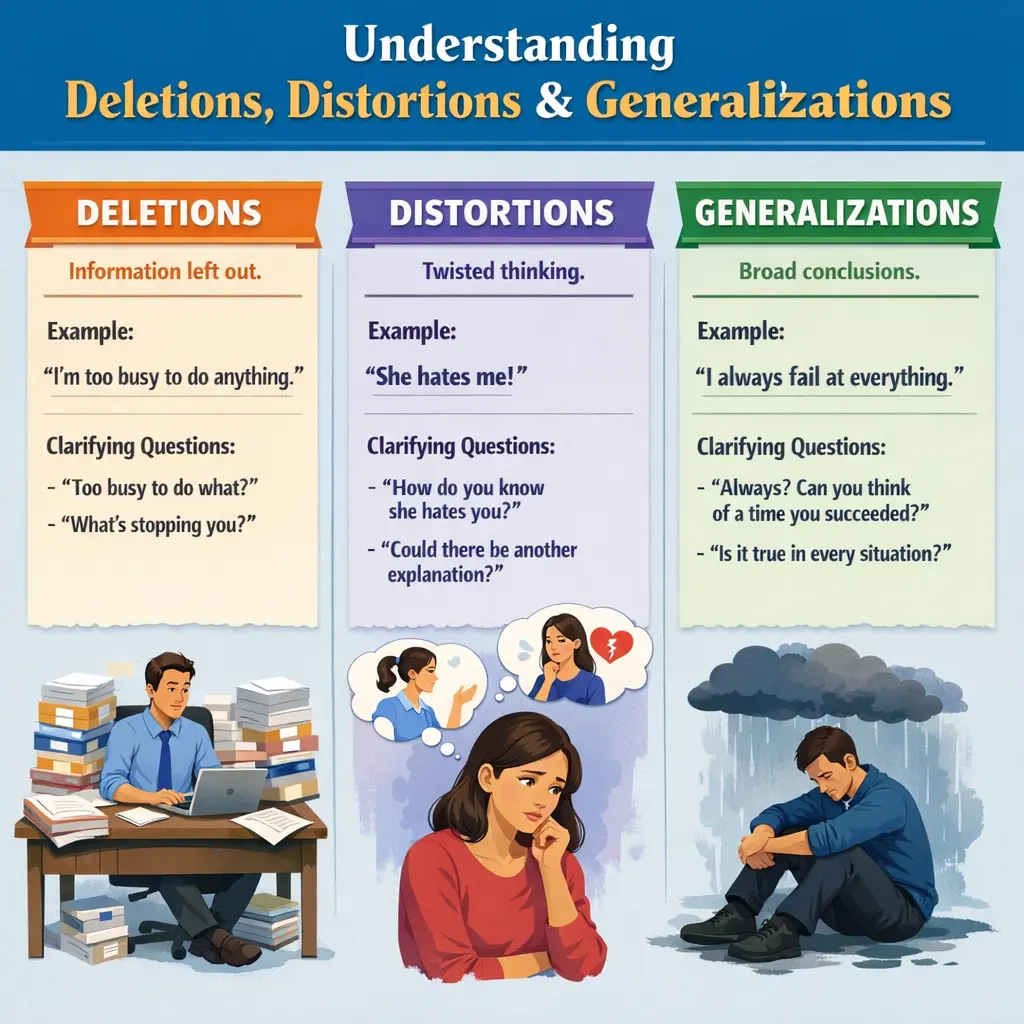
The Meta Model, developed by NLP founders Richard Bandler and John Grinder, gives you a systematic way to uncover what people are really saying. NLP practitioners have found that by challenging deletions, distortions, and generalizations in language, you can expand possibilities and discover solutions that weren’t visible before.
Why “I Can’t Do This” Isn’t the Real Objection
When someone says “I can’t do this,” they’re deleting crucial information. Can’t do what specifically? Under what circumstances? According to whom? What would need to change for them to be able to do it?
These aren’t hostile questions. They’re curious, respectful inquiries that help both parties get clear on what’s actually happening. Negotiation psychology research shows that when you explore someone’s objections with genuine curiosity rather than defensiveness, they become more receptive to finding solutions.
The real objection might be: “I can’t get approval from my CFO without stronger ROI projections.” Now you have something concrete to work with. You weren’t solving the right problem before because you didn’t know what the problem actually was.
The Three Types of Language Distortions in Negotiations
Deletions: Important information is missing. “This is expensive.” (Compared to what? Expensive for whom? Over what timeframe?)
Distortions: Two different things are treated as equivalent, or assumptions are presented as facts. “If we go with your proposal, we’ll lose flexibility.” (How specifically would you lose flexibility? What makes flexibility and this proposal mutually exclusive?)
Generalizations: Absolute statements that ignore exceptions. “We never do deals structured this way.” (Never? Has there been any situation where you’ve made an exception? What would make this situation different?)
How NLP enhances communication skills is precisely through this ability to recognize and skillfully address these language patterns.
Powerful Questions That Reveal True Intent
The questions you ask determine the information you uncover. Here are the Meta Model questions that work in high-stakes negotiations:
Challenging Deletions:
- “What specifically concerns you about the timeline?”
- “Compared to what other options?”
- “For whom exactly is this a problem?”
Challenging Distortions:
- “How does approving this proposal prevent you from making changes later?”
- “What evidence do you have that this approach won’t work?”
- “What assumptions are you making about our capabilities?”
Challenging Generalizations:
- “Have there been any exceptions to that rule?”
- “What would need to be different for this to work?”
- “Who specifically is saying this won’t work?”
The tone matters as much as the words. Ask with genuine curiosity, not interrogation. You’re helping both parties get clearer, not trying to trap anyone.
Real Application: Handling the “Your Price Is Too High” Objection
They say: “Your price is too high.”
Most people respond with: “Actually, when you consider the value…” and launch into a defense.
Instead, you ask: “Too high compared to what specifically?”
They might say: “Compared to your competitor, who quoted us 20% less.”
Now you ask: “What specifically are they including in their proposal? How does their scope compare to ours?”
Through three or four well-placed questions, you discover that the competitor’s lower price excludes implementation support, ongoing maintenance, and training, all of which are included in your proposal. The price isn’t actually higher. The value proposition was just unclear.
Or you discover that their real concern is cash flow this quarter, not total cost. Now you can discuss payment terms instead of defending your pricing.
NLP language techniques like the Hierarchy of Ideas help you move up to higher levels of abstraction where agreement becomes possible. When two parties seem stuck on opposing positions, moving to the bigger “why” behind each position often reveals shared goals.
Technique #3: Anchoring Access Confidence When Stakes Are Highest
I’ve worked with professionals who felt paralyzed before important negotiations. Mike came to me struggling with self-doubt and anxiety, exactly the internal state that kills deals. Through anchoring techniques, he learned to access confidence on demand. Now he enters high-stakes conversations with the certainty that used to elude him. His words: “I am now seeing myself speak to people with confidence… the anxiety has disappeared.” That’s the power of strategic anchoring.
Here’s what this means for you: you already have moments when you feel confident, resourceful, and fully capable. The problem is that those states show up randomly, not on command. Anchoring changes that.
What Anchoring Really Means in Negotiation Contexts
Research on neurolinguistic programming shows that anchoring is the process of linking a specific stimulus to a desired emotional state. You create this link deliberately, then trigger it when needed.
Think about how certain songs instantly transport you to a specific memory with all its associated feelings. That’s an anchor. Or how the smell of your grandmother’s cooking brings back childhood emotions. Also an anchor. Your brain is already creating these associations constantly. Anchoring just makes the process intentional and strategic.
In negotiations, anchoring lets you trigger confidence, calm, resourcefulness, or creative problem-solving exactly when pressure is trying to trigger anxiety, defensiveness, or mental fog instead.
How to Create Your Confidence Anchor Before the Deal
Find a quiet space where you won’t be interrupted. Close your eyes and remember a time when you felt completely confident. Not generic confidence, a specific moment when you knew you could handle whatever came your way. Maybe it was closing a previous deal, nailing a presentation, or handling a difficult conversation successfully.
Relive that moment vividly. See what you saw. Hear the sounds around you. Feel the confidence in your body. Notice where in your body you feel it: chest, shoulders, core. Let that feeling intensify.
When the feeling reaches its peak, create your anchor. This could be pressing your thumb and forefinger together, touching a specific spot on your wrist, or making a subtle gesture no one else would notice. Hold that physical trigger for five seconds while the confident feeling is at its strongest.
Repeat this process 3-5 times over several days. You’re training your nervous system to associate that physical trigger with that confident state.
Triggering Resourceful States in Critical Moments
You’re in the negotiation. They just challenged your key assumption, and you feel your confidence wavering. Your chest tightens. Your mind starts racing through worst-case scenarios.
This is when you fire your anchor. Press your thumb and forefinger together (or whatever trigger you created). Take a deep breath. Your nervous system recognizes the signal and begins shifting back into the confident state you’ve anchored.
It won’t feel as strong as when you were practicing in a relaxed environment, but it will shift your state enough to regain clarity. That’s often all you need.
NLP negotiation experts emphasize that emotional regulation through techniques like anchoring is what separates professionals who thrive under pressure from those who crumble. NLP for executive performance relies heavily on these state management tools.
Real Application: Maintaining Composure During Pushback
You’ve presented your proposal. You’re feeling good. Then they say, “I’m not sure this is what we’re looking for. We might need to explore other options.”
Your immediate internal response: panic. “Are they walking away? Did I miss something? Should I lower the price?”
Instead of reacting from that panicked state, you fire your anchor. Three seconds later, your nervous system starts to settle. You can think clearly again.
From this centered state, you respond: “I appreciate you being direct. What specifically about the proposal doesn’t align with what you’re looking for?”
You’ve just used Meta Model questions (Technique #2) from an anchored confident state (Technique #3). The techniques are compound.
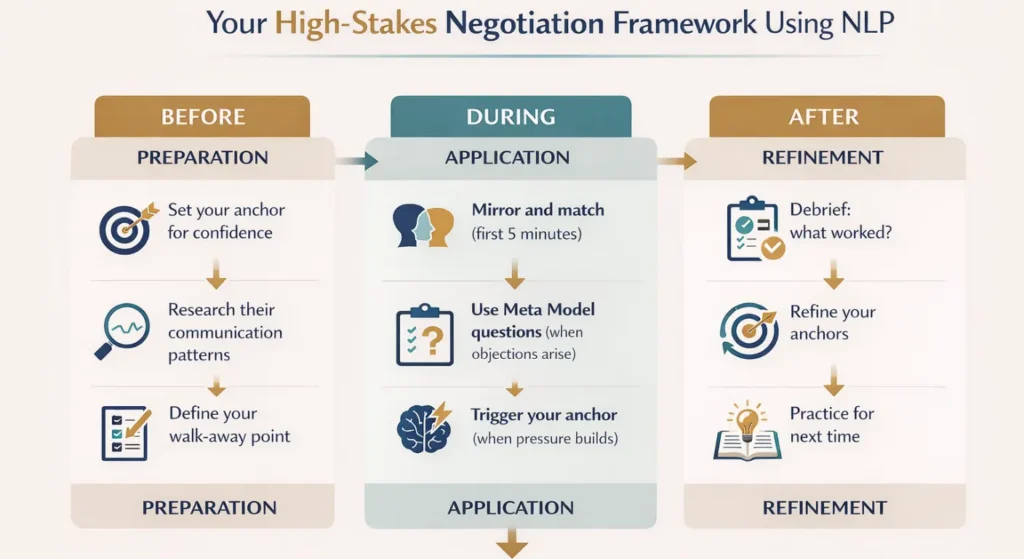
Putting It All Together: Your High-Stakes Negotiation Framework
The power of these three techniques multiplies when you use them together. Here’s your framework.
Pre-Negotiation Preparation Ritual
One week before:
- Research their communication patterns from previous interactions
- Create or reinforce your confidence anchor
- Identify likely objections and prepare Meta Model questions
One hour before:
- Fire your anchor three times to prime your nervous system
- Review your walk-away point and BATNA
- Set clear intention: what outcome do you want?
Five minutes before:
- Breathe deeply, centering yourself
- Fire your anchor one final time
- Remember: you’re entering as an equal, regardless of deal size
During the Negotiation: When to Use Each Technique
Minutes 1-10: Establish rapport through mirroring
Your only job in the opening is building unconscious connections. Match their energy, posture, and language patterns. Don’t rush into business. Let rapport develop naturally.
Successful negotiators allocate 70% of their effort to listening and understanding versus speaking. That’s not a weakness. That’s strategic intelligence gathering.
When objections arise: Deploy Meta Model questions
The moment you hear vague objections or generalizations, ask clarifying questions. “What specifically concerns you?” “Compared to what?” “Under what circumstances would this work?”
Your goal isn’t to trap them. It’s to help both parties get clear on what’s actually being discussed.
When pressure builds: Trigger your anchor
Anytime you feel yourself getting defensive, anxious, or emotionally reactive, fire your anchor. Three seconds of that physical trigger can shift your state enough to respond strategically instead of emotionally.
High-stakes negotiation research emphasizes that maintaining your emotional center while staying flexible on tactics is the key to long-term success.
Post-Negotiation: Learning and Refining
After every negotiation, whether you closed the deal or not, debrief yourself:
- What worked? When did you feel most confident and effective?
- What would you do differently? Where did you get reactive?
- How well did your anchor work? Do you need to strengthen it?
- What patterns did you notice in their language and behavior?
This reflection turns every negotiation into a learning opportunity. Over time, these techniques become unconscious competence. You won’t be thinking “now I should mirror them” or “time to ask a Meta Model question.” You’ll just do it naturally because you’ve trained the skill.
How long does it take to learn these NLP negotiation techniques?
You can start applying these techniques immediately after reading this article. Basic competence comes quickly within 2-3 negotiations; you’ll notice improved rapport and better questions leading to clearer conversations.
Real mastery takes practice. Plan on 3-6 months of consistent application before these techniques become automatic. The good news is that every negotiation you handle during that period becomes practice, so you’re learning while doing real deals.
The fastest path to mastery is formal training. When you learn NLP systematically, you’re not just getting techniques. You’re understanding the underlying structure of human communication and psychology. That deeper understanding lets you adapt these tools to any situation, not just negotiations.
Most professionals report noticeable improvements within their first month of intentional practice. By month three, colleagues start asking what changed. By month six, you’re operating at a completely different level.
Can I use these techniques in virtual negotiations?
Absolutely. In fact, virtual negotiations demand even more skill because you’re working with less information. You can’t see full body language, and technical issues can break rapport.
Here’s how to adapt each technique:
Mirroring on video calls: Focus on facial expressions, head movements, and voice tone. If they lean toward the camera, you lean in. If they’re animated, match that energy. Voice matching becomes more important when body language is limited.
Meta Model questions work identically: The questions don’t change whether you’re in person or on Zoom. In fact, virtual settings sometimes make people more comfortable being direct, which can work in your favor.
Anchoring is purely internal: Your anchor works the same whether you’re at a conference table or behind a computer screen. Physical triggers like pressing your fingers together are invisible to the camera.
One tip: mute yourself when you’re not speaking. This gives you moments to fire your anchor, take deep breaths, and reset your state without the other party seeing you pause.
What if the other party is also trained in NLP?
This is a sophisticated question that gets at the heart of ethical NLP use. Here’s the truth: when two skilled NLP practitioners negotiate, the outcome tends to be better for both parties, not worse.
Why? Both people are focused on understanding the other’s actual needs, building genuine rapport, and finding creative solutions. The techniques don’t become a competition; they become a collaboration.
I’ve negotiated with other NLP-trained professionals many times. It’s actually more pleasant. There’s a mutual understanding that we’re both reading subtle signals, asking clarifying questions, and managing our states. It creates respect and often leads to faster, more satisfying agreements.
The key is intention. If you’re using these techniques to manipulate people into bad deals, that’s unethical whether or not they know NLP. If you’re using them to facilitate clearer communication and mutually beneficial outcomes, everyone wins.
Master negotiators understand that the best deals are ones where both parties feel satisfied. That’s not a weakness. That’s how you build relationships that lead to future opportunities.
How do I practice these techniques before a real high-stakes negotiation?
Practice is essential. Here’s your training plan:
For mirroring: Practice with low-stakes conversations first. Mirror your barista, your colleague at lunch, a friend. Notice how the quality of the connection changes. Get comfortable with the mechanics before the pressure is on.
For Meta Model questions: Listen to interviews, podcasts, or news programs. Identify deletions, distortions, and generalizations in how people speak. Practice mentally formulating the questions you’d ask to clarify. Then start using these questions in everyday work conversations where the stakes are low.
For anchoring: Create your anchor in a relaxed setting, then test it in progressively more stressful situations. Start with something mildly stressful (making a phone call you’ve been avoiding). Then move to moderately stressful (having a difficult conversation with a team member). Build up to high-stakes negotiations once you know your anchor reliably shifts your state.
Role-play high-stakes scenarios: Find a colleague or hire a coach to role-play negotiations. Practice using all three techniques together. Have them throw objections at you. Practice staying calm, asking clarifying questions, and building rapport even when they’re being difficult.
Record yourself: Video record practice negotiations. Watch them back. Notice your body language, your voice, and your questions. You’ll spot patterns you can’t see in the moment.
The difference between good negotiators and great ones isn’t talent. It’s deliberate practice of specific skills.
FAQs
What is NLP in high-stakes negotiations?
NLP (Neuro-Linguistic Programming) in high-stakes negotiations focuses on understanding how language, behavior, and emotional states influence decision-making. It helps negotiators build rapport quickly, uncover hidden concerns behind objections, and regulate their own emotional responses under pressure. Rather than manipulating outcomes, NLP techniques improve clarity, trust, and communication so both parties can reach informed, mutually beneficial agreements, especially when financial, strategic, or reputational stakes are high.
How does mirroring improve negotiation outcomes?
Mirroring improves negotiation outcomes by creating unconscious rapport between parties. Subtly matching another person’s posture, tone, speaking pace, or language patterns signals familiarity and psychological safety. Research shows that negotiations with a strong early rapport are significantly more likely to reach an agreement. Effective mirroring is subtle and respectful; it aligns energy and communication style without imitation, making conversations feel smoother, more cooperative, and less adversarial.
What are Meta Model questions in negotiation?
Meta Model questions are NLP-based clarification questions designed to uncover hidden assumptions, vague language, or missing information in objections. When a negotiator hears statements like “your price is too high” or “this won’t work,” Meta Model questions explore what specifically is meant. By challenging deletions, distortions, and generalizations in language, negotiators move conversations from emotion and ambiguity to clarity and solvable problems.
How does anchoring help negotiators perform under pressure?
Anchoring helps negotiators access confident, calm, and resourceful emotional states during high-pressure moments. By deliberately associating a physical trigger (such as a subtle gesture) with a past experience of confidence, negotiators can activate that state on demand. This allows them to stay composed during objections, pushback, or silence, responding strategically instead of reacting emotionally when the stakes are highest.
Can NLP negotiation techniques be used ethically?
Yes, NLP negotiation techniques are ethical when used to improve communication, understanding, and decision-making, not manipulation. Ethical NLP focuses on building genuine rapport, asking clarifying questions, and managing one’s own emotional state. When applied responsibly, these techniques help both parties articulate real needs, reduce misunderstandings, and reach agreements that feel fair and sustainable. The outcome is better conversations, not coercion.
Conclusion
You now have three techniques that fundamentally change how you approach high-stakes negotiations. Mirroring builds unconscious rapport in minutes. Meta Model questions reveal the real issues beneath surface objections. Anchoring gives you access to your best state exactly when you need it most.
These aren’t separate tools. They’re an integrated system. You mirror to build a connection. You ask clarifying questions from a centered, confident state. You maintain that state under pressure through strategic anchoring. The techniques multiply each other’s effectiveness.
The negotiators who consistently close important deals aren’t necessarily the most charismatic or the most aggressive. They’re the ones who understand the psychology beneath every conversation. They know how to read what’s really happening, build genuine trust quickly, and stay resourceful when others get reactive.
That’s what separates a six-figure negotiator from a seven-figure negotiator. That’s what determines whether you walk away from the table with the deal you wanted or the deal you settled for.
You already have the intelligence and capability to negotiate successfully. These tools amplify what’s already there. They give structure to instincts you might have felt but couldn’t consistently access. They turn good outcomes into great ones.
Master this skill. It will pay dividends for the rest of your career. Whether you’re negotiating your next contract, closing a partnership deal, or handling supplier relationships, these techniques work. They’ve worked for thousands of professionals over 20+ years. They’ll work for you.
Ready to take this further? Business coaching provides personalized application of these techniques to your specific negotiation challenges. But you can start today, right now, with the next conversation you have. Build rapport. Ask better questions. Manage your state.
Your transformation starts with that next negotiation. Make it count.