
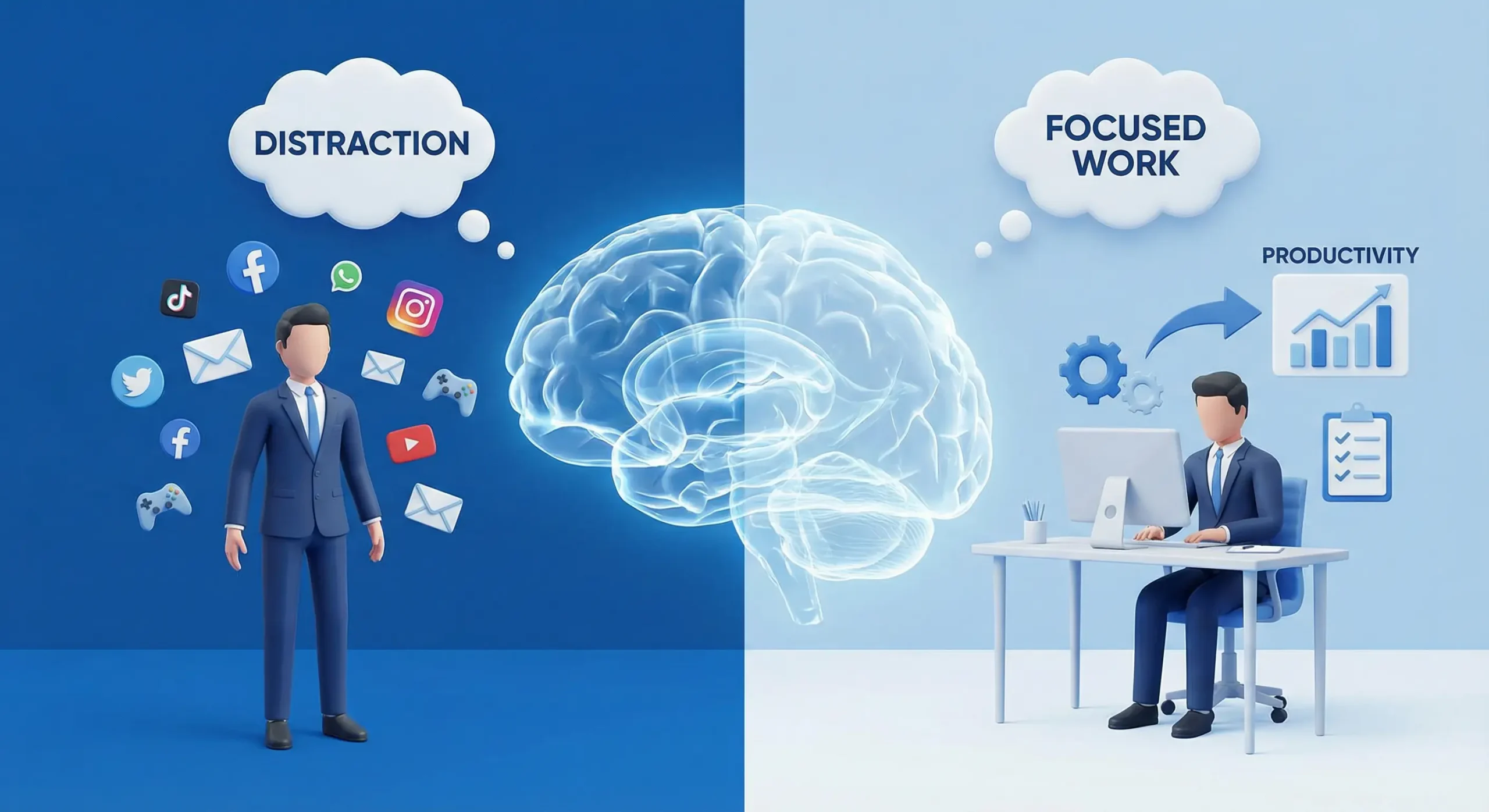
It’s 2 PM on a Tuesday, and that high-stakes presentation deck is still sitting untouched on your desktop. You know exactly what needs to happen, the data’s ready, the deadline’s looming, and your career trajectory might just hinge on nailing this one. But here you are, reorganizing your inbox for the third time today, scrolling through industry news you don’t really need, and suddenly developing an urgent interest in cleaning your workspace.
Key Takeaway:
-
Procrastination stems from the limbic system’s avoidance response overriding the prefrontal cortex NLP techniques rewire subconscious patterns to bypass willpower and create automatic motivation for lasting productivity. [1]
-
Core techniques: Swish Pattern replaces avoidance images with action ones; Anchoring links a gesture to peak motivation states; Reframing shifts “have to” to “get to” for opportunity mindset; Future Pacing visualizes completion and reverse-engineers steps; Submodalities Shift alters task representations (size, brightness) to feel easier. [1]
-
Practice: Repeat techniques 5–7 times daily (e.g., visualize swish rapidly, anchor with multiple memories); start with one matching your pattern (Anchoring for starting resistance, Swish for triggers); combine for deeper rewiring expect shifts in days with consistency. [2]
-
Caveats: Results vary by practice depth; not instant but build neuroplasticity; safe and self-applied no side effects beyond initial mental effort; consult a coach for complex patterns or underlying issues. [2]
Bottom Line: These 5 NLP techniques Swish, Anchoring, Reframing, Future Pacing, and Submodalities reprogram procrastination triggers at the subconscious level for effortless action and sustained productivity boost.
Sound familiar? You’re not alone, and you’re definitely not lazy. The truth is far more interesting and solvable. Your brain is simply following outdated programming that once kept our ancestors safe but now keeps you stuck. The good news? Neuro-Linguistic Programming offers five powerful techniques you can implement in the next hour to rewire those patterns permanently.
Let’s dive into the neuroscience behind procrastination and the practical tools that transform chronic delayers into unstoppable achievers.
What Is Procrastination Really Costing You?
Before we get to the solution, let’s acknowledge the real impact. According to research showing that professionals waste over 2 hours daily procrastinating, the average worker procrastinates for 2 hours and 11 minutes every single day. That’s not a few minutes here and there; it’s nearly 28% of an eight-hour workday vanishing into avoidance behaviors.

The numbers get even more sobering when you zoom out. Studies reveal that nearly half of all employees report regular procrastination, costing businesses billions annually in lost productivity. For a professional earning $40,000 annually, procrastinating just three hours daily translates to $15,000 in lost value per year. That’s not just your employer’s problem; it’s your raise, your promotion, your professional growth evaporating while you reorganize digital folders.
But the real cost isn’t measured in dollars. It’s the quiet erosion of your confidence every time you miss a deadline. It’s the stress that follows you home when important projects sit incomplete. It’s watching colleagues advance while you’re stuck explaining why you “just need a few more days.”Workplace productivity challenges extend beyond individual time management; they create ripple effects in team dynamics, career advancement, and your sense of professional identity.
Many professionals dealing with procrastination also experience related challenges with stress management through NLP, as the two issues often reinforce each other in a destructive cycle.
The Neuroscience Behind Procrastination: Your Brain’s Battle
Here’s where it gets fascinating. Procrastination isn’t a character flaw; it’s the result of a literal battle happening inside your skull. Neuroscience reveals a constant battle between your prefrontal cortex and limbic system, two brain regions locked in an evolutionary tug-of-war every time you face a challenging task.
The Prefrontal Cortex vs. The Limbic System
Your prefrontal cortex is the rational, strategic part of your brain. It’s the CEO who plans, prioritizes, and understands that completing that report today prevents chaos tomorrow. It values long-term rewards, manages impulses, and keeps your eyes on the prize.

Your limbic system, however, is ancient, powerful, and built for survival. This is your emotional brain, the part that screams “danger!” when tasks feel uncomfortable and offers immediate relief through distraction. When you’re staring at a blank document, your limbic system interprets the discomfort as a threat and pushes you toward anything that feels better right now. Scrolling social media? That’s immediate dopamine. Checking email? Instant sense of productivity without the real work.
The problem? Your limbic system is significantly stronger than your prefrontal cortex. It’s been refined over millions of years of evolution, while your planning brain is a relatively recent development. When these two clash, the limbic system wins most battles through sheer neurological firepower.
Why Your Brain Craves Immediate Gratification
This brings us to a concept called temporal discounting. Recent research published in Nature Communications shows that our brains systematically devalue rewards that are far in the future. The satisfaction of completing a project three weeks from now simply doesn’t activate your reward centers the way watching a funny video does right now.
Your brain literally calculates that the effort required today feels heavier than the distant consequences of not doing the work. The dorsomedial prefrontal cortex the region responsible for effort-cost calculations, signals “too hard, not worth it” when temporal distance makes future rewards feel abstract and unimportant.
The “Future You” Problem
There’s another fascinating twist: your brain treats your future self almost like a stranger. When you think “I’ll do it tomorrow,” you’re essentially delegating the task to someone else. Tomorrow, you will be more motivated, more energized, more ready to tackle hard things. Except tomorrow never comes, because tomorrow-you faces the same neurological battle, with the same outcome.
Every time you procrastinate and then eventually complete the task under pressure, you’re actually strengthening these neural pathways. Neuroplasticity allows you to create new neural pathways, but it cuts both ways. Repeated procrastination makes avoidance easier each time, literally rewiring your brain to default to delay.
What Makes NLP Different from Traditional Productivity Hacks?
So if procrastination is this deeply wired into our neurology, how do you break the pattern? This is where most productivity advice falls short. Time management apps don’t address the limbic system’s grip on your behavior. Willpower techniques exhaust your prefrontal cortex even further. Motivational posters on your wall can’t compete with millions of years of evolutionary programming.
NLP takes a completely different approach, one that works with your brain’s actual operating system rather than fighting against it.
Reprogramming at the Subconscious Level
Traditional productivity methods try to strengthen your conscious control, more discipline, better schedules and stronger willpower. But here’s the thing: most of our behavior happens below conscious awareness. Your limbic system doesn’t respond to logical arguments about why you should start that project now.
NLP techniques access and reprogram the subconscious patterns driving procrastination. Instead of relying on conscious effort (which depletes quickly), you install new automatic responses. The powerful NLP techniques, including reframing and anchoring, work at the same level as the problem itself, the automatic, emotional, pattern-based level where procrastination lives.
Addressing Root Causes, Not Just Symptoms
When you procrastinate, the surface behavior of avoiding the task is just a symptom. The root causes might include fear of judgment, perfectionism, unclear goals, or past experiences of failure. NLP techniques for personal development identify and transform these underlying patterns rather than just managing their surface expressions.
One professional, Mike, struggled with constant second-guessing that led to chronic procrastination. Through NLP coaching, he eliminated the mental noise and now speaks confidently in meetings, transforming his entire career trajectory. His procrastination wasn’t a time management issue; it was rooted in anxiety and self-doubt that NLP techniques addressed directly.
Creating Lasting Neural Pathways
Perhaps most importantly, NLP creates permanent change through neuroplasticity. When you use these techniques consistently, you’re literally building new neural pathways that make productive action the default response. The brain’s ability to rewire itself means you’re not fighting your neurology, you’re updating it.
This is fundamentally different from willpower-based approaches that require constant conscious effort. With NLP, the change happens at the pattern level. After the initial reprogramming, productive behavior becomes as automatic as the procrastination once was.
How Can You Use NLP to Stop Procrastinating Right Now?

Here’s where theory meets practice. These five NLP techniques can be implemented immediately, with no special equipment, no lengthy training, just practical tools you can use the next time you feel procrastination pulling you away from important work.
Technique 1: The Swish Pattern: Interrupt the Procrastination Loop
The Swish Pattern interrupts procrastination triggers by replacing the mental image that leads to avoidance with one that drives action.
Here’s how: Close your eyes and visualize the cue that typically triggers procrastination, maybe it’s seeing that blank document or thinking about a difficult conversation. Notice every detail of this image. Now, in the bottom corner of that mental picture, create a small, bright image of yourself taking confident, immediate action on that task. See yourself fully engaged, capable, and productive.
Now comes the “swish”: rapidly shrink the procrastination image while simultaneously expanding the action image until it fills your entire mental screen. Make the productive image bright, colorful, and compelling. Repeat this pattern seven times, getting faster each time.
What you’re doing is rewiring the neural connection between the trigger and your response. Instead of “difficult task = avoid,” your brain starts automatically connecting “difficult task = capable action.”
Technique 2: Anchoring Motivation: Access Productive States on Demand
Anchoring allows you to instantly access peak performance states whenever you need them. Think of it as creating an on-demand switch for motivation.
Recall a time when you felt completely motivated, energized, and productive. Immerse yourself in that memory, see what you saw, hear what you heard, feel what you felt. As these feelings intensify, create a unique physical gesture (like pressing your thumb and forefinger together or making a fist). Hold the gesture while the feelings peak, then release.
Repeat this process 3-5 times with different high-performance memories, using the same gesture each time. You’re conditioning your nervous system to associate that gesture with the productive state. Now, when you face a task and feel procrastination creeping in, use your anchor. The physical gesture triggers the neurological state, bypassing the conscious battle between your prefrontal cortex and limbic system.
Technique 3: Reframing: Transform How You Perceive Challenging Tasks
Your brain’s response to a task depends entirely on how you represent it mentally. Reframing changes the meaning you assign to challenging work, which changes your emotional and behavioral response.
Instead of “I have to write this report” (obligation, pressure, potential failure), try “I get to demonstrate my expertise to decision-makers” (opportunity, value, growth). The task hasn’t changed, but your brain’s interpretation and therefore its emotional response have shifted completely.
Ask yourself: What else could this task mean? What opportunity does it represent? What capability will I develop? Who benefits from my completing this well? Each reframe weakens the limbic system’s threat response and strengthens the prefrontal cortex’s engagement with meaningful outcomes. This technique addresses overcoming the mindset blocks that fuel procrastination at their source.
Technique 4: Future Pacing: Visualize Completion for Instant Momentum
Your brain can’t always distinguish between vividly imagined experiences and real ones. Future pacing leverages this by having you mentally experience task completion before you start, which eliminates much of the limbic system’s resistance.
Close your eyes and imagine it’s already done. See the completed project, feel the satisfaction, notice how others respond positively. Make this visualization rich with sensory detail. What do you see, hear and feel? Let yourself experience the relief, pride, and accomplishment.
Now, mentally work backward from completion to where you are now. What was the step right before finishing? And before that? Your brain now has a clear pathway from current state to desired outcome, dramatically reducing the overwhelm that triggers procrastination.
Technique 5: Submodalities Shift: Change the Mental Representation of Tasks
Submodalities are the specific qualities of your mental representations, such as size, brightness, distance, color, sound, and more. Tasks you procrastinate on typically have certain mental characteristics: they might appear large, dark, close, heavy, or accompanied by negative internal dialogue.
Think about a task you easily complete without procrastination. How does it appear in your mind? Now compare that to something you regularly avoid. Notice the differences in how you represent them mentally.
Now, take the procrastination task and deliberately change its submodalities to match the easy task. If easy tasks appear as small, bright images at a comfortable distance, while procrastination tasks loom large and dark, shrink and brighten the difficult task in your mental imagery. If you speak to yourself harshly about avoided tasks but encouragingly about completed ones, change your internal dialogue.
This might sound strange, but these mental representations directly influence your emotional and behavioral responses. By changing how tasks appear in your mind, you change how you feel about them and, consequently, whether you take action or avoid.
Which NLP Technique Should You Start With?

The honest answer: it depends on your specific procrastination pattern.
If you struggle primarily with getting started, that initial hump of beginning a task anchoring is your best bet. Create a powerful motivation anchor you can trigger whenever you need to overcome initial resistance. This gives you on-demand access to the mental state that makes action feel natural rather than forced.
If you find yourself mid-procrastination, already avoiding a task you know you should do, the Swish Pattern works brilliantly. It interrupts the pattern in real-time and redirects your neurology toward action.
If the issue is how you think about tasks, “this is going to be terrible” or “I’m not good enough for this,” start with reframing. Your internal dialogue creates your emotional reality, and transforming that narrative changes everything.
For ongoing productivity beyond just breaking procrastination, consider integrating NLP techniques into your daily routine systematically. Many professionals find that combining multiple techniques creates a comprehensive system that addresses procrastination from every angle.
The real power comes from experimentation. Try each technique this week and notice which creates the strongest shift for you. Your brain is unique, and the technique that works best will depend on your specific neurology and patterns.
Real Transformations: How Professionals Overcame Procrastination with NLP
Theory matters, but results matter more. Let’s look at how real professionals have used these exact techniques to eliminate procrastination and transform their careers.
Darren felt paralyzed when it came to advancing his career, despite having a well-paying job. He described feeling hopeless and worthless, watching opportunities for promotions and raises pass by while he remained stuck. The issue wasn’t capability; it was goal blocks and limiting beliefs that created chronic procrastination around career advancement.
Working with NLP coaching, Darren uncovered the unconscious patterns keeping him stuck. Through techniques like reframing and anchoring, he experienced what he called “radical shifts in thinking and behaviors.” The procrastination that once defined his professional life dissolved as the underlying blocks were identified and eliminated. His relationships improved as a side effect when you stop procrastinating on your own growth; everything else started moving forward, too.
These aren’t isolated cases. When you address procrastination at the neurological level rather than just the behavioral level, transformation happens quickly and permanently. The techniques you’ve learned in this article are the same ones that have helped thousands of professionals break free from patterns they thought they’d carry forever.
FAQs
Why does my brain choose procrastination over important tasks?
Your brain favors immediate relief over distant rewards, a concept called temporal discounting. Your ancient Limbic System interprets discomfort from hard tasks as a threat, driving you toward quick, pleasurable distractions over the long-term payoff managed by the Prefrontal Cortex.
How is Neuro-Linguistic Programming (NLP) different from standard time management tips?
Standard tips rely on willpower and conscious scheduling, which easily fail. NLP techniques bypass conscious control and reprogram the subconscious neural patterns that drive procrastination, creating automatic, lasting change through neuroplasticity.
Which NLP technique should I use if I struggle to even start a difficult task?
The Anchoring Motivation technique is highly effective for getting started. You condition a physical gesture to instantly access a past state of high motivation, bypassing initial resistance and making action feel natural.
What is the NLP “Swish Pattern” and how does it stop procrastination?
The Swish Pattern is a rapid visualization technique that intentionally interrupts the avoidance loop. It replaces the mental image that triggers procrastination with a compelling, vibrant image of you taking productive action, effectively rewiring your brain’s trigger-response pathway.
Your Brain Isn’t Broken, It Just Needs New Programming
You’ve learned something crucial today: procrastination isn’t a character flaw, and you’re not lazy. You’re a human being with a limbic system, doing exactly what evolution designed it to do: seek immediate relief from discomfort. The problem isn’t you; it’s that your brain’s default programming was designed for a world that no longer exists.
But here’s the empowering truth: neuroplasticity means you’re not stuck with these patterns. You now have five neuroscience-backed NLP techniques that work with your brain’s actual operating system. The Swish Pattern interrupts the trigger-response loop. Anchoring gives you on-demand access to motivation. Reframing transforms how you perceive challenging work. Future pacing eliminates overwhelm by pre-experiencing completion. Submodalities shifts change the mental weight of tasks.
Each technique rewires a different aspect of the procrastination pattern. Together, they create a comprehensive system for transforming chronic avoidance into unstoppable productivity.
Your transformation starts with a single decision. These techniques work but only if you use them. For professionals ready to go deeper and master the full spectrum of NLP applications, comprehensive NLP training programs provide the structured learning and practice that creates permanent change.
The question isn’t whether you can overcome procrastination. The neuroscience proves you can. The question is: what will you accomplish when nothing holds you back? When every important task feels as natural as the easy ones? When your brain automatically moves toward your goals instead of away from discomfort?
Book a discovery call today to explore how NLP training can eliminate procrastination and unleash your full potential in your career, your business, and your life. The professionals you just read about weren’t special. They were simply willing to try something different. Your breakthrough is one conversation away.
What will you tackle first?